Table of Contents
- An August Morning in Carthage: The Council Convenes
- Africa under Empire: The World that Birthed the Council
- From Persecutions to Power: The African Church before 397
- Bishops, Emperors, and Heretics: Why the Council Was Called
- Entering the Basilica: How the Council of Carthage 397 Unfolded
- Voices in the Hall: Debates over Scripture, Liturgy, and Authority
- Fixing the Scriptures: How the Biblical Canon Was Shaped
- Defining Orthodoxy: Battling Donatists, Manicheans, and Other Rivals
- Discipline and Daily Life: Clergy, Morality, and Church Governance
- The Human Faces of the Council: Bishops, Scribes, and the Unseen Crowd
- From Carthage to Rome: The Long Journey of the Council’s Decisions
- Waves across Centuries: The Council’s Impact on Western Christianity
- Memory, Myth, and Manuscripts: How We Know What Happened
- The African Roots of the Christian Bible
- Carthage after 397: Triumphs, Invasions, and Silence
- Reconsidering the Council of Carthage 397 in Modern Debates
- Conclusion
- FAQs
- External Resource
- Internal Link
Article Summary: On 28 August 397, bishops from across Roman North Africa gathered in the bustling port city of Carthage to debate Scripture, discipline, and the future of the Church in what is now known as the council of carthage 397. Meeting under the shadow of imperial power and the long memory of persecution, they attempted to bring unity to a fractured Christian world. This article reconstructs the sights, sounds, and tensions of that council, situating it within the complex political, social, and religious landscape of late Roman Africa. It explores how the bishops shaped the emerging biblical canon, addressed heresies, and negotiated their uneasy partnership with imperial authority. Tracing the council’s canons through later councils and manuscripts, it shows how the decisions taken in Carthage echoed through medieval and modern Christianity. Along the way, we encounter the human actors—famous bishops and anonymous scribes—whose choices helped define Christian orthodoxy. By revisiting the council of carthage 397 through narrative and analysis, we uncover an African chapter at the heart of Christian history. And we see how debates begun in that sunlit basilica still resonate in contemporary conversations over Scripture, authority, and tradition.
An August Morning in Carthage: The Council Convenes
The August sun had barely cleared the rooftops of Carthage when the bishops began to arrive. The harbor, a horseshoe of shimmering water ringed by warehouses and shipyards, already hummed with the cries of merchants and sailors. But the men walking with deliberate steps toward the basilica that morning in 397 carried no cargo and shouted no prices. Wrapped in plain cloaks, their tunics dusty from the road, they were bearers of something less visible but far more contested: authority over the souls and Scriptures of North Africa.
The meeting we now call the council of carthage 397 was not announced by trumpets or carved into marble. To many citizens of Carthage, it was just another gathering of bishops in a city where church councils had become almost as regular as market days. Yet for those who climbed the shallow steps into the basilica, this council felt different. Behind them lay decades of bitter schism and violent dispute; before them loomed a future in which the Christian faith seemed destined to become the organizing principle of the Roman world.
As they assembled, the scent of salt and tar from the port mingled with the faint sweetness of incense lingering from an earlier liturgy. Scribes unrolled bundles of papyrus and parchment, ready to catch every word. Couriers, bearing the dust of distant towns—Hippo Regius, Cirta, Utica—waited at the door, prepared to carry the council’s decisions back across miles of road and coastline. Somewhere near the front, older bishops compared memories of persecution under Diocletian and the heady days after Constantine’s conversion. Younger men, who had never known an un-Christian empire, whispered to one another about heresy, imperial edicts, and the alarming spread of rival doctrines.
Outside, the city lived its own life. In the forums, officials read out new tax demands. In the amphitheater, workers repaired a crumbling arch. In the narrow streets, pagans, Jews, and Christians crossed one another’s paths with wary familiarity. But inside the basilica, beneath its long nave and wooden roof, the bishops prepared to ask questions that would reach far beyond the city walls: Which books of Scripture should be read in the churches? How should errant clergy be disciplined? Who held the final word in disputes of faith—local bishops, regional councils, or the distant bishop of Rome?
The presiding bishop tapped his staff lightly, calling the room to order. A hush settled over the assembly, broken only by the scratching of quills and the soft murmur of prayers. The council of carthage 397 was about to begin. No one present could have guessed that centuries later, believers would still look back to this gathering as one of the moments when the Christian Bible and the structure of Latin Christianity were quietly, patiently, and sometimes painfully hammered into shape.
Africa under Empire: The World that Birthed the Council
To understand what happened in that Carthaginian basilica, we have to step back into the wider world of Roman North Africa at the end of the fourth century. This was a land of sharp contrasts. Along the coast, prosperous cities rose in terraces of stone and brick, adorned with baths, theaters, and forums; inland, the land opened out into miles of fields where grain and olives grew under the relentless sun. North Africa was one of the empire’s breadbaskets. Its harvests fed the masses of Rome and other great cities. Ships left Carthage and neighboring ports loaded with sacks of grain, amphorae of oil, and barrels of salted fish.
Carthage itself, once the proud rival of Rome, had long since been remade as a Roman city, but it kept its own spirit. Latin was the language of administration and law, but the echoes of Punic, the old Carthaginian tongue, still murmured in the alleys and markets. Statues of emperors watched over public squares, yet memories of Hannibal and the ancient wars survived in whispered tales. In the late fourth century, Carthage glittered with the wealth of centuries, but it also carried scars—physical, from the destruction wrought by Rome generations earlier; and spiritual, from recent controversies that had torn its Christian communities apart.
The empire itself stood at a crossroads. Christianity, once a persecuted religion, had become first tolerated, then favored, and finally—in the wake of Theodosius I—effectively the official faith of the Roman state. Temples that had echoed with pagan hymns were now, in some cases, silent or repurposed. Bishops were no longer furtive leaders of house congregations; they were prominent figures who moved in and out of imperial circles, carrying the weight of both local communities and theological traditions.
Yet this new Christian empire was anything but unified. In the West, imperial authority was fragile, threatened by military usurpers and barbarian incursions. Provincial governors struggled to maintain order and extract taxes. In the East, a different court, a different set of political intrigues, and a sometimes different theological emphasis shaped the church’s development. Across this vast space, local churches tried to navigate between two loyalties: to the universal faith they professed, and to the regional identities, rivalries, and memories that made them who they were.
North Africa’s Christian communities were among the most vibrant and contentious in the empire. They boasted a proud intellectual tradition rooted in figures such as Tertullian and Cyprian, who had written fiercely about discipline, martyrdom, and the nature of the Church. At the same time, they were divided by bitter schisms that had erupted during the persecutions under Diocletian in the early fourth century. Those wounds had not healed by 397; in some places, they had deepened.
It was in this environment—a wealthy but unstable province, a powerful but contested Church, an empire at once Christian and fragile—that the council of carthage 397 took shape. The men who gathered there were not abstract theologians detached from their world; they were local leaders, deeply entangled in the hopes and fears of their flocks. They navigated peasant revolts, estate politics, and civic obligations even as they debated questions of canon and creed. The walls of the basilica did not keep the world out; they simply framed it in stone and echo.
From Persecutions to Power: The African Church before 397
To the bishops filing into their places that August morning, memories of the past were never far away. Some of the oldest among them might have been children—or even young adults—when the great persecutions swept through the empire under Diocletian around 303. In North Africa, those years had left particularly deep scars. Roman officials demanded that Christian leaders hand over their sacred books to be burned and perform sacrifices to the gods of the empire. Some complied, out of fear or calculation; others refused and paid with prison, torture, or death.
The aftermath of that crisis set the stage for everything that followed. In Carthage and across the African provinces, believers began to ask: Could bishops who had surrendered Scriptures or collaborated with the authorities be restored to office? Were sacraments administered by such “traditores”—those who had “handed over” the books—valid at all? A purist movement, later called Donatism after one of its leaders, argued that the Church must be a community of the pure, and that clergy who had betrayed the faith could not be legitimate ministers of grace.
The result was not just a theological disagreement but a parallel church. Donatist bishops claimed the true succession; Catholic bishops—those loyal to the broader imperial Church—claimed the same. In towns and even villages, two rival bishops might preside over two congregations, each convinced that the other was an impostor. Clashes were sometimes violent. There are reports of Donatist militants, derided as “Circumcellions” by their enemies, who attacked estates and clashed with imperial troops. The Africa that produced the council of carthage 397 was not only devout but fiercely divided.
In the middle of this turmoil, African Christianity developed its own personality. The writings of Cyprian of Carthage, martyred a century earlier, continued to shape the imagination of local bishops. Cyprian had insisted on the unity of the bishop with his local church and was suspicious of distant interference. Tertullian, another Carthaginian figure, had once thundered against the laxity he perceived in Rome, declaring, “What has Athens to do with Jerusalem?” His rhetorical question expressed a broader African tendency to distrust outside influence, even when it came wrapped in the language of universal orthodoxy.
As imperial favor shifted decisively toward Nicene Christianity in the late fourth century, Catholic bishops in Africa gained new leverage. They could appeal to emperors and governors to suppress Donatists or seize their basilicas. Yet this newfound power was double-edged. The more the Church leaned on imperial authority, the more it risked being seen as just another arm of the state. Some bishops welcomed this alliance; others, mindful of the earlier persecutions, felt an unease they could not quite shake.
By the 390s, a new generation of bishops was rising, some of whom had been shaped by classical education and Christian rhetoric in equal measure. Men like Augustine of Hippo—who would attend future councils in Carthage and leave an indelible mark on Western theology—were beginning to articulate a vision of the Church as a mixed body, holy yet made of flawed humans, relying not on the purity of its ministers but on the grace of God. It was in this tense and evolving context that regional councils multiplied. They became tools for negotiating doctrine, discipline, and identity in a church that was still very much under construction.
Bishops, Emperors, and Heretics: Why the Council Was Called
So why gather again in Carthage in the late summer of 397? Council after council had already been held there and in other African cities; decisions had been made, appeals sent to emperors and to Rome. Yet the sense of unfinished business lingered. At least three large concerns drove the bishops to convene once more.
The first was the persistent question of unity. The Donatist schism still divided communities, and other doctrinal currents flowed through North Africa as well. Manicheans, followers of a dualistic religion that claimed to offer a rational and universal explanation of reality, had attracted some of the brightest minds of the age—including, for a time, Augustine himself. Their presence forced Christian leaders to sharpen their teaching on the goodness of creation, the problem of evil, and the authority of the biblical texts. In some coastal cities, Arianism—the belief that the Son was not co-eternal with the Father—still echoed faintly from earlier decades, kept alive by traders and travelers. A council could not make these movements disappear, but it could reaffirm boundaries and clarify the language of orthodoxy.
The second concern was Scripture. Across the Christian world, bishops and theologians read from a largely shared set of texts—Gospels, letters of Paul, historical books, prophets—but the exact limits of the canon were not yet settled everywhere. Which books were to be read as authoritative in the liturgy and used to ground doctrine? Which texts were beloved but “ecclesiastical,” suitable for private reading but not for establishing dogma? African bishops knew that divergent lists circulated in different regions. A man traveling from Rome to Carthage, or from Alexandria to Milan, might find that certain texts—like the Letter to the Hebrews, the Apocalypse of John, or the Wisdom of Sirach—enjoyed varying levels of acceptance.
This was not merely a librarian’s problem. In a world where theological disputes often turned on the interpretation of particular Scriptures, the question of which books counted as Scripture took on urgent pastoral significance. If Donatists or Manicheans appealed to texts that others rejected, unity in teaching would be almost impossible. The council of carthage 397 thus aimed, among other things, to bring greater clarity to the list of books to be read in African churches, aligning them as closely as possible with what they believed to be the consensus of the wider Church.
The third concern was discipline and governance. The rapid growth of Christianity, particularly after imperial favor, had created a vast clerical class and an expanding network of sees—urban bishoprics and rural parishes. Questions proliferated: How should bishops be chosen and consecrated? What standards of conduct should be required of clergy? How were disputes between bishops to be resolved? Could local decisions be appealed to Rome, and under what conditions? The tension between local autonomy and broader oversight was keenly felt in Africa, where bishops prized their regional councils yet could not ignore the rising prestige of the Roman see.
Underneath all of this lay a quiet anxiety. The world was changing. Barbarians pressed against the frontiers. Fiscal pressures mounted. Old civic institutions frayed. If the Church was to be the soul of this transforming empire, it needed clearer structures and a more coherent sense of itself. A council might not solve every problem, but it offered something precious in a time of uncertainty: the possibility of speaking with one voice, however tentative and negotiated that voice might be.
Entering the Basilica: How the Council of Carthage 397 Unfolded
We do not possess a minute-by-minute chronicle of the council of carthage 397. What we have instead are its canons—formal decisions, often written in terse legal language—and later references that allow us to imagine the proceedings with cautious creativity. Yet the outline is familiar, echoing other late antique councils whose rhythms are better documented.
The day likely began with prayer. Before any debates, the bishops gathered for the Eucharist, the ritual at the heart of their shared identity. Standing in a semicircle near the altar, they would have recited the Creed, invoked the Trinity, and exchanged the kiss of peace. Whatever disputes lay ahead, the liturgy reminded them that they were, at least in principle, one body. The bread broken on the altar and the cup raised high were more than symbols; they were, in the language they used, the body and blood of Christ—a mystery that bound them together even as theology and politics drove them apart.
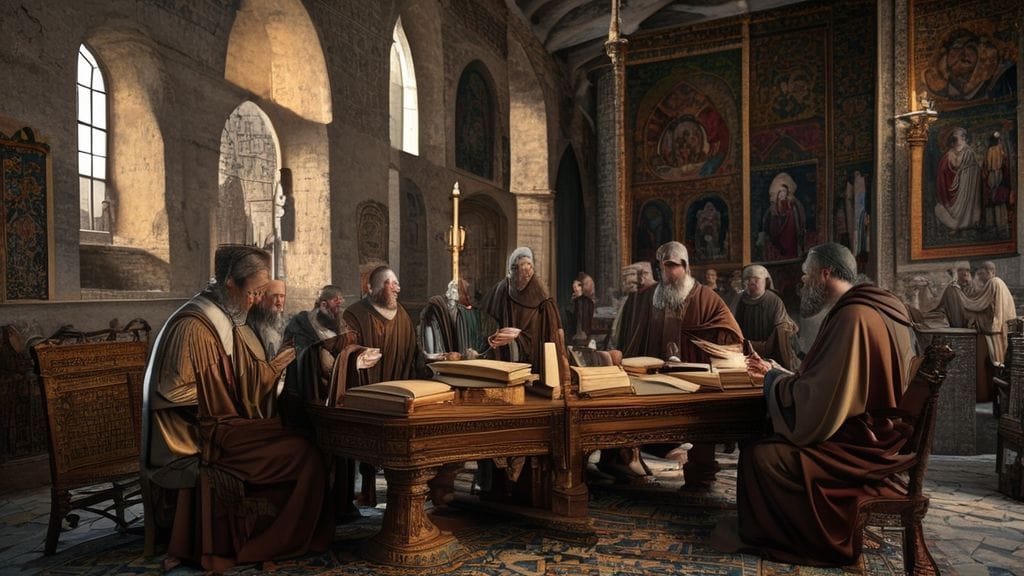
After the liturgy, they moved to the main hall. The basilica itself, rectangular and high-roofed, was a type of building originally used for markets and civic assemblies. In Carthage, as elsewhere, Christians had repurposed such spaces for their own gatherings. At the front, on a raised platform, sat the presiding bishop—likely the bishop of Carthage, who held a primacy of honor among the African churches. Alongside him were other senior bishops, some of whom had attended earlier councils and possessed a seasoned understanding of both imperial politics and ecclesiastical procedure.
Down the hall, rows of benches or simple chairs accommodated the rest of the assembly. Scribes positioned themselves at the sides, inkpots and pens at hand, ready to record motions, votes, and final formulations. The air was thick and warm. Open doors let in shafts of light and occasional street noise—the distant rumble of carts, the cries of traders. Within, voices rose and fell as issues were introduced, discussed, and sometimes hotly disputed.
The order of business would not have been improvised. Before the council, letters had circulated, outlining topics to be addressed. Some bishops probably came with written proposals from local synods; others brought petitions from clergy or laypeople in their dioceses. Questions of precedence were observed rigidly: bishops from older or more prestigious sees spoke earlier; younger or recently appointed bishops waited their turn. Yet within this hierarchy, personalities mattered. A gifted orator could sway the room; a respected elder could tip the balance with a few measured words.
Early in the proceedings, the council reaffirmed prior decisions from earlier African synods. This gesture was more than pious habit. It announced that the bishops saw themselves not as a new authority altogether but as the latest chapter in an ongoing story. Continuity mattered. Citing the decisions of previous councils—sometimes nearly word for word—they signaled both loyalty to tradition and a desire to refine and clarify, not to reinvent.
As the hours passed, the work of the council moved between lofty questions and prosaic details. One moment, a bishop might be defending the inclusion of a contested book in the canon; the next, they might be debating whether clergy should be allowed to engage in business or to move from one diocese to another without permission. Each decision, however small, carried ripples of consequence. To forbid certain practices was to reshape the daily life of communities; to define the Scriptures was to draw a boundary around the narratives and laws that would form Christian imaginations for generations.
At midday, the council likely paused. Bishops retired to nearby houses or side rooms to rest and eat. Informal conversations—over bread, olives, and diluted wine—could be as decisive as formal speeches. Alliances were renewed; doubts were aired; compromises were floated. By late afternoon, they reconvened, the hall filling again with the low roar of voices. Day after day, this pattern repeated, until the main items on the agenda had been addressed and the scribes had collated the canons for formal approval.
Voices in the Hall: Debates over Scripture, Liturgy, and Authority
We can almost hear the voices in that hall when we read the canons, brief as they are. Take, for instance, the questions surrounding appeals to distant bishops. African councils had long been wary of allowing clergy or laypeople to bypass local authority and take their cases directly to Rome. Yet the prestige of the Roman see, linked to the memory of Peter and Paul, exerted a spiritual and political pull that was hard to ignore.
As the matter came under discussion, one can imagine a bishop from a small inland town standing to speak. He insists that if priests or deacons can run to Rome whenever they are disciplined, local bishops will lose all authority. “Our people know us,” he might say. “They see our lives, hear our preaching. How can a distant bishop, who has never walked our streets, judge our controversies?” Murmurs of approval ripple through the hall.
Yet another bishop, perhaps from a larger city, raises his hand. He warns that without some avenue of appeal, injustice might go unchecked. What if a bishop abuses his power, silencing legitimate grievances? In such cases, he argues, Rome—or another distant, respected see—could act as a court of last resort. His words remind the assembly that power does not always reside in safe hands, even within the Church.
The debate turns not only on practicalities but on theology. Is the Church fundamentally local, manifest in each diocese with its bishop at the center? Or is it fundamentally universal, with regional and even global structures of oversight? The council of carthage 397 leaned toward reinforcing the authority of regional synods and limiting appeals to Rome. Yet its very need to address the issue shows how interconnected the Christian world had become. Africa could not pretend to exist in isolation, even if it sometimes bristled at outside intervention.
Liturgy, too, came under scrutiny, though often in indirect ways. Canons concerning the proper times and manner of performing baptisms, or the disciplines surrounding the Eucharist, shaped how ordinary believers experienced Christianity week after week. Should those who had lapsed under persecution be re-baptized? How soon after catechesis should a convert approach the font? To modern readers, these issues might seem arcane, but to the bishops of Carthage, they cut to the core of what it meant to enter and remain within the Christian community.
Behind every canon lay debates that rarely made it into the final text. A short line prohibiting clergy from engaging in certain types of trade might conceal a passionate argument about greed, scandal, and the dignity of the priestly office. A regulation about the transfer of bishops from one city to another might be the end point of a bitter struggle over influence and prestige between neighboring sees. The council’s official voice is calm, almost cold; but the process that produced it was hot with human emotion, ambition, and sincere conviction.
Fixing the Scriptures: How the Biblical Canon Was Shaped
Among the most far-reaching acts of the council of carthage 397 was its formal listing of the books to be read as divine Scripture in the churches. When we examine the canonical list transmitted under the name of this and related African councils, we find a lineup that looks remarkably familiar to later generations: the books of the Old Testament, including those later called “deuterocanonical” or “Apocrypha,” and the twenty-seven books of the New Testament that now appear in most Christian Bibles.
The canonical list did not descend on Carthage as a revelation. It was the product of centuries of usage, debate, and local consensus across the Christian world. Gospels such as Matthew, Mark, Luke, and John had long been central. Paul’s letters were read and copied widely. Yet in the margins of this core, uncertainty remained. Some communities cherished texts such as the Shepherd of Hermas or the Didache, while others viewed them as edifying but not authoritative. Questions lingered over books like the Letter to the Hebrews, whose authorship was unclear, or the Revelation of John, whose vivid apocalyptic imagery provoked both fascination and suspicion.
In Carthage, bishops did not simply consult their own preferences. By 397, they were acutely aware of developments in other parts of the Christian world. Athanasius of Alexandria, in his famous Easter Letter of 367, had already circulated a list of New Testament books that matched the one later confirmed in Carthage. Eastern councils and theologians had made their own contributions. The African bishops saw themselves as part of this wider consensus-building process, not as solitary innovators.
Nevertheless, their decision carried particular weight for the Latin West. By formally listing the canonical books and affirming that they should be read in the churches as divine Scripture, the council of carthage 397 helped to solidify a pattern of reading and teaching that would shape Western Christianity for over a millennium. Their canons indicate that this list was to be communicated “to the Church across the sea”—a phrase often understood as a reference to Rome. In other words, the African bishops did not merely receive a canon; they offered one, confident that their discernment deserved to be heard beyond their shores.
Imagine the discussions behind that list. A bishop stands to speak in favor of including the Book of Wisdom and Sirach among the sacred writings. These texts, rich in moral teaching and philosophical reflection, had long been used in African churches. They echoed in the sermons of local pastors and in the prayers of the faithful. To exclude them now, he argues, would be to mutilate the spiritual memory of his community. Another bishop, more cautious, wonders whether texts without a clear Hebrew original should be placed on the same level as the Law and the Prophets. The room weighs their words, balancing local devotion against the desire for broader uniformity.
The final list did not end all debate, but it established a powerful norm. Generations later, when medieval scribes copied Latin Bibles in European monasteries, they were, often unknowingly, living out the legacy of a decision taken in North Africa. The pages they illuminated with gold and bright pigments carried the imprint of voices from Carthage, voices that had once echoed off the basilica’s stone walls as bishops argued late into the afternoon.
“The councils of Hippo and Carthage, held at the end of the fourth century, set forth the complete list of books which are now in the Catholic Bible,” notes one modern historian, summing up this process. It is astonishing, isn’t it, to think that the book millions would later open for comfort, guidance, or controversy owes part of its shape to a gathering in an African port city on a hot August day?
Defining Orthodoxy: Battling Donatists, Manicheans, and Other Rivals
Scripture was only one front in the broader struggle to define orthodoxy. Across North Africa, the name “Christian” did not belong exclusively to the bishops meeting in Carthage. Donatists claimed it fiercely, building their own basilicas and holding their own councils. Manicheans, though ultimately condemned as heretics, appealed to some who sought a more philosophically “satisfying” explanation of good and evil than they believed the Catholics offered.
The canons of the council of carthage 397 speak indirectly to these conflicts. Rules about accepting those returning from heretical or schismatic groups, about re-baptism, and about who could serve in the clergy after such a return, all imply a society where religious boundaries were porous and contested. In some villages, families might be split, with one branch attending Catholic liturgy and another gathering with Donatist clergy. Festivals, funerals, and marriages drew these groups into uneasy proximity.
A council canon that declared the unacceptability of rebaptizing those already baptized in the Catholic Church was not just an abstract declaration; it was a direct challenge to Donatist practice. Likewise, any insistence that sacraments were valid regardless of the minister’s moral purity cut to the heart of Donatist arguments. To the bishops in Carthage, such canons were weapons in a long war of persuasion and, too often, coercion.
With Manicheans, the battle took a different form. They revered a complex scripture of their own, blending Christian, Zoroastrian, and other traditions. Their dualistic worldview—light versus darkness, spirit versus matter—threatened the Christian conviction that the world, though fallen, was created good by a single God. African Christians had to learn how to defend not only their texts but their very sense of reality against this rival vision.
Councils like that of 397 did not solve these conflicts overnight. If anything, their canons reveal how persistent and deep-rooted the rivalries were. Yet by repeating and refining earlier condemnations, by clarifying how the Church should receive penitents from these groups, and by drawing lines around acceptable belief, the bishops slowly constructed an identity that could withstand the pressures of schism and heresy. Orthodoxy, in this narrative, was built not in a single heroic moment but in the patient, sometimes weary work of repeated councils, careful wording, and disciplined follow-through.
Discipline and Daily Life: Clergy, Morality, and Church Governance
If we read the canons of the council of carthage 397 attentively, we find that a significant portion concerns not Scripture or heresy but the behavior of clergy and the structures of governance. This might seem mundane, but to the bishops present, it was anything but. They had learned, often painfully, that lofty doctrine could be undermined by scandalous conduct. A single priest’s greed, a bishop’s compromise in the face of pressure, could do more to discredit the Church in the eyes of ordinary people than any sophisticated theological argument.
Thus, canons addressed issues such as simony—the buying and selling of church offices—prohibiting clergy from turning their vocation into a marketplace transaction. Others forbade bishops and priests from engaging in certain types of business, particularly those that might expose them to accusations of dishonesty or exploitation. The Church, dependent as it was on donations and the management of estates, walked a fine line between responsible stewardship and worldly entanglement.
Questions of sexual morality and domestic life also appeared. Clergy were expected to embody a standard of continence and restraint that set them apart from their surroundings. While not all were bound to celibacy in the later medieval sense, their relationships and households were subject to scrutiny. A priest whose domestic arrangements caused scandal could undermine faith in the sacraments he administered.
Governance canons set rules for how bishops should be elected—often requiring the consent of neighboring bishops and sometimes of the local Christian community. They laid out procedures for judging accusations against clergy, insisting on fairness while also protecting the dignity of holy orders. That a council had to legislate against slander and false charges tells its own story: even within the Church, envy, rivalry, and malice could spark accusations used as weapons.
Behind these canons lies a recognition that the Church had become, by 397, a major social institution. Bishops not only preached and celebrated the sacraments; they administered funds for the poor, oversaw charitable distributions, advised local magistrates, and occasionally mediated in civic disputes. Their moral authority needed to be guarded vigilantly. The council of carthage 397 can thus be read as an attempt to create an ecclesiastical culture in which holiness and credibility went hand in hand.
The Human Faces of the Council: Bishops, Scribes, and the Unseen Crowd
Councils can easily become abstractions: lists of canons, dates, and theological terms. But behind every line of text stood human beings with complex lives. Some bishops came from wealthy backgrounds, having left behind careers in law or administration. Others had risen from modest origins, propelled by piety, learning, or sheer charisma. A few had seen torture chambers from the inside during the persecutions; others had never known a world without Christian emperors.
Consider, for a moment, a middle-aged bishop from a small town inland. He has spent years walking the dusty roads of his diocese, visiting scattered villages, baptizing infants, reconciling feuding families, and burying the dead. He has mediated disputes between landowners and tenants, raised funds to ransom captives taken in border raids, and tried to keep the peace between Catholics and Donatists. For him, the council in Carthage is both a burden and a relief. The journey is long and costly, but it offers a rare chance to share his struggles with peers, to find solidarity in a world where the bishop’s isolation can be crushing.
Near him sits a younger bishop, perhaps recently ordained, whose path to the episcopate has been quick and dazzling. He has studied rhetoric, quoting Virgil and Cicero with ease, and now turns that skill to preaching the Gospel. He burns with zeal to reform abuses and to assert the authority of the Church over corrupt officials. Yet he also feels the pull of ambition. To speak well at the council, to see his proposals adopted—these victories might carry his name far beyond his provincial town.
At the edge of the hall, scribes bend over their writing tablets. They are the invisible hands that will carry the council of carthage 397 into the future. With each careful stroke, they transform speech into text, fleeting words into durable record. Their work is arduous. They must catch the precise wording of canons, ensure that the list of biblical books is accurate, and note the names of bishops present. A slip of the pen could change meaning; a missing word might create confusion in some distant diocese months later.
Outside the hall, ordinary believers go about their lives largely unaware of the details of the council’s deliberations. A weaver in a crowded quarter of the city hears only that “the bishops are meeting.” A widow who depends on church alms may vaguely hope that the council will protect funds for the poor. A pagan merchant passing through Carthage shrugs, more concerned with customs duties than with Christian disputes. Yet the decisions made inside, about Scripture, discipline, and governance, will eventually shape the sermons they hear, the readings proclaimed at their liturgies, and the standards to which their pastors are held.
In this sense, the council stands at the intersection of elite and popular religion. It is a gathering of leaders, yet its reach extends far into the lives of those who never set foot in a council chamber. The humanity of the bishops—their fears, hopes, and limitations—reminds us that the lofty structures of orthodoxy and canon law were not erected by abstract reason alone. They were built by men leaning on staffs, squinting in the afternoon light, arguing in thick accents, and occasionally, one imagines, wondering whether they were equal to the burdens placed upon their shoulders.
From Carthage to Rome: The Long Journey of the Council’s Decisions
Once the bishops had debated, amended, and finally approved their canons, another phase of the council’s life began: dissemination. The decisions of the council of carthage 397 were not meant to remain confined to a single city. They had to travel—by road, by sea, by memory and manuscript—across the African provinces and beyond.
Scribes produced fair copies of the canons, written on sturdy parchment or papyrus. Couriers, often clergy or trusted lay emissaries, carried these documents to other bishops. Some traveled along the broad, stone-paved Roman roads that stitched the empire together; others sailed from Carthage’s harbor to smaller ports up and down the coast. Each arrival would have been an event: the local bishop summoning his clergy to hear the new canons read aloud, to discuss their implications, to decide how to integrate them with existing local practices.
One crucial destination lay “across the sea.” The African bishops, conscious of the need for broader consensus, sent their canonical list of Scriptures and other decisions to the bishop of Rome. This gesture did not imply submission in the later medieval sense, but it did acknowledge Rome’s growing symbolic importance. The see associated with Peter and Paul occupied a unique place in the Christian imagination, even if African bishops remained determined to preserve the authority of their own regional councils.
Over time, the Carthaginian canons were copied and recopied, sometimes attached to canons from earlier councils, sometimes integrated into larger collections of church law. Medieval canonists, poring over sheaves of legal texts, would encounter African decisions alongside those of Nicene and other ecumenical councils. The original context—the dust, the heat, the accents of North African speech—faded from view. What remained was the text, detached from its birthplace yet still carrying traces of its origins in the peculiar phrasing or emphases that reflected African concerns.
“African councils,” one scholar has observed, “played a disproportionate role in the shaping of Western canon law, thanks to the early and thorough transmission of their texts.” Carthage of 397 belongs in that story. The path from a basilica in a North African city to the shelves of medieval libraries and the desks of Renaissance scholars was long and winding, but it was not broken. Each copyist who traced the canons in careful script extended the council’s life by another generation.
Waves across Centuries: The Council’s Impact on Western Christianity
It is tempting to imagine the council of carthage 397 as a modest regional event with only local significance. Yet its influence, particularly in the West, was far greater. The canonical list it affirmed became a cornerstone for later Latin Christianity. When debates over the biblical canon arose at the Council of Trent in the sixteenth century, Catholic theologians pointed back to early councils such as those of Hippo and Carthage as evidence that the Church’s acceptance of these books had ancient roots. In this way, a decision shaped in a world of togas and amphitheaters echoed in the age of printing presses and gunpowder.
Beyond the canon, the council’s disciplinary canons contributed to a growing body of ecclesiastical law that guided bishops, priests, and laity throughout the medieval period. Rules about clerical conduct, synodal meetings, and appeals would be cited, adapted, and sometimes contested in diocesan synods from Gaul to Iberia. The very idea that regional councils should meet regularly to address doctrine and discipline, so central to African ecclesial life, became a model for other regions.
The council also helped solidify a pattern of cooperation and tension between local churches and the Roman see. By sending their canonical list to Rome while simultaneously insisting on the authority of African councils, the bishops of Carthage embodied a paradox that would define Western ecclesiology for centuries: the balancing of regional initiative with universal oversight. Later conflicts between popes and local churches would play out against a background shaped, in part, by these early African negotiations.
Perhaps most importantly, the council underscored the theological and institutional creativity of the African church. Carthage was not merely a receiver of ideas from Rome or the East; it was a generator of norms and a guardian of a distinctive tradition. Modern historians increasingly recognize that the “Latin West” was, in its formative centuries, deeply African. The intellectual and legal frameworks that later defined European Catholicism were forged as much in Carthage and Hippo as in Rome and Milan.
In this sense, the council of carthage 397 stands as a reminder that Christian history is not a simple story flowing from a single center to passive peripheries. It is a network of conversations and decisions, some of which, like those made in a North African basilica in 397, continue to send ripples through time far beyond what any participant could have imagined.
Memory, Myth, and Manuscripts: How We Know What Happened
The further we move from 397, the more the council recedes into a haze, and the more we must rely on fragile witnesses: manuscripts, later summaries, and scattered references in the writings of church fathers. We do not have a stenographic transcript of the proceedings. We have the canons, and even those come to us through later collections that sometimes blend decisions from several councils into a single list.
Scholars, painstakingly comparing variant manuscripts, have tried to disentangle which canons belong precisely to the council of carthage 397 and which stem from other gatherings held in the same city in neighboring years. “The African conciliar tradition,” notes one modern researcher, “is a patchwork preserved through centuries of copying, selection, and rearrangement.” This admission does not render the history uncertain beyond recovery, but it does force humility. We walk in a dimly lit room, making out shapes and patterns, but never seeing everything clearly.
Yet even in this dimness, some things stand out. The canonical list of Scriptures associated with Carthage aligns closely with those from related councils and from other regions—a convergence that gives historians confidence that we are seeing a real moment of consensus. Canons about clerical discipline and appeals echo themes known from other African sources, including the letters of Augustine and other bishops. When Augustine refers to “our council in Carthage” in his correspondence, we glimpse these gatherings from another angle, filtered through the mind of one of late antiquity’s greatest theologians.
Manuscripts themselves tell stories. Some bear marginal notes from medieval readers, puzzled or intrigued by particular canons. Others show signs of heavy use—smudged pages where hands repeatedly turned to consult crucial decisions. Through them, we see not only what the council decreed but how those decrees were received, interpreted, or contested over time.
Modern debate sometimes swirls around the council’s role in defining the canon. Some Protestant scholars, wary of attributing too much authority to post-apostolic councils, emphasize that the canon emerged gradually, through widespread usage rather than top-down decisions. Catholic and Orthodox theologians, while agreeing that usage played a vital role, highlight councils like Carthage as moments when the Church, already guided by the Spirit, recognized and formalized what had become standard. The council of carthage 397 thus continues to live, not only in ancient parchment but in contemporary arguments over how Scripture and tradition relate.
The African Roots of the Christian Bible
When a modern reader opens a Bible and reads from the Letter to the Ephesians or the Book of Wisdom, it is unlikely that Carthage comes to mind. Yet the connection is there. The African bishops who met in 397 were not alone in shaping the canon, but they were among its decisive midwives. The Christian Bible, particularly in its Latin form, has African fingerprints all over it.
North Africa had early on become a center of Christian literary production. Tertullian, writing in a vigorous Latin that blended legal precision with prophetic fury, coined phrases and concepts that would echo through Western theology. Cyprian’s letters and treatises circulated widely, their African context barely noticed by later readers who took his Latin for granted. By the time of the council of carthage 397, this tradition had matured into a self-confident ecclesial culture, capable of taking stands on Scripture and discipline with an authority recognized beyond its borders.
To say that the Bible has African roots is not to indulge in anachronistic pride; it is to acknowledge a historical reality. The codices that carried the Scriptures across the Mediterranean world were copied, read, and interpreted in African cities and monasteries as well as in Italian, Gallic, and Eastern centers. Some of the earliest and most important Latin translations of biblical texts likely emerged in Africa. When Jerome undertook his monumental revision of the Latin Bible, he did so with an awareness of African practices and preferences, even when he disagreed with them.
The council’s canonical list underscores this African role. By aligning local practice with what they perceived as the universal consensus, the bishops of Carthage both received and gave. They received texts hallowed by centuries of apostolic usage; they gave to the broader Church a clear, authoritative enumeration that would be cited in later centuries as evidence of ancient tradition. In this exchange, Africa was not a distant shore passively absorbing a Mediterranean current. It was a powerful tide of its own.
For modern readers, especially those interested in the global and multicultural dimensions of Christian history, this matters. It disrupts simplistic narratives that imagine Christianity as born in the East, owned by Europe, and only later exported to other continents. In the story of the council of carthage 397, we see an early moment when an African church, deeply rooted in its own land yet fully part of the wider Christian world, helped shape the Scriptures and structures that would define Western faith for centuries.
Carthage after 397: Triumphs, Invasions, and Silence
When the council ended and the bishops departed, Carthage resumed its bustling life. Yet history did not stand still. Over the next decades and centuries, the city and its church would experience triumphs and tragedies that none of the 397 participants could have foreseen.
In the early fifth century, North Africa produced one of Christianity’s most influential thinkers: Augustine, bishop of Hippo, whose theological reflections on grace, free will, and the Church would shape Western doctrine more than perhaps any other Latin father. Augustine attended later councils in Carthage, building on the foundations laid in earlier gatherings. He wrote letters that quote or allude to their decisions, and he saw in conciliar life a concrete expression of the Church’s collective wisdom.
But external threats gathered. In 429, the Vandals, a Germanic people already converted to Arian Christianity, crossed into North Africa. Within a decade, they seized Carthage, turning it into the capital of a new Vandal kingdom. Catholic bishops faced persecution and exile as the Arian rulers sought to subordinate or suppress Nicene Christianity. Councils in Carthage became difficult, sometimes impossible. The very basilicas that had once echoed with debates over the canon and clerical discipline now witnessed different conflicts or fell silent.
Later, in the sixth century, Byzantine forces reconquered North Africa, briefly restoring imperial rule and Catholic dominance. Carthage rose again as an administrative and ecclesiastical center. New councils met; old canons were revisited. Yet the region’s stability had been shaken. Economic disruption, military campaigns, and internal tensions left deep marks.
The greatest transformation came in the seventh century, with the Arab conquest. Within a few decades, the structures of Roman and Byzantine power collapsed, and Islam became the dominant faith. Carthage’s bishopric, once so central to the Latin West, declined. Churches were abandoned, converted, or replaced. The language of the streets shifted; new forms of worship filled the air.
In time, the memory of Carthage’s councils faded in the very land that had hosted them. Their texts, however, survived elsewhere—in European monasteries, in legal compilations, in the margins of theological treatises. The city that had given so much to the Christian world became, for many Western readers, a distant and half-imagined place, known more from classical sources about Rome’s Punic wars than from its own Christian achievements.
Yet in the canons of the council of carthage 397, Carthage still speaks. Across the centuries, the decisions taken by its bishops remind us that there was a time when this African city stood near the heart of Christian life, its basilicas buzzing with arguments that would shape the faith far beyond its walls.
Reconsidering the Council of Carthage 397 in Modern Debates
In recent centuries, the council of carthage 397 has become a point of reference in various Christian debates, especially about the relationship between Scripture and tradition. Catholics often point to Carthage and related councils as evidence that the Church, guided by the Holy Spirit, discerned the canon through a combination of usage and formal recognition. Many Protestants, while acknowledging the historical significance of such councils, prefer to emphasize the organic emergence of the canon within the life of the early Christian communities rather than any single conciliar “decision.”
These debates sometimes invest the council with more uniformity and foresight than it actually possessed. The bishops of 397 did not imagine themselves as the final arbiters for all time; they were addressing pressing local and regional concerns with the tools available to them. Their appeal to broader consensus reflects both humility and realism. They did not claim to create Scripture; they sought to articulate what the Church already, by and large, lived from.
At the same time, it would be a mistake to downplay the council’s role. Formal lists and canons matter. They create reference points, crystallize practice, and provide stability in times of controversy. Without the council of carthage 397 and its companions, the Western Church’s sense of which books belonged in the Bible might have remained more fluid for longer, perhaps shifting in response to later theological currents.
Modern scholars of African Christianity and global church history have also turned renewed attention to Carthage. They see in the council a case study in how a non-European region helped shape what later became “European” Christianity. In seminars and articles, phrases like “the African genesis of the Latin Bible” or “North African conciliar culture” appear with increasing frequency. The council’s story thus becomes part of a wider effort to decenter traditional narratives and to recognize the multiplicity of voices that forged Christian tradition.
For believers today wrestling with questions of authority—What weight should we give to early councils? How do Scripture and tradition interact?—the council of carthage 397 offers both inspiration and caution. It shows a Church striving, in good faith, to discern and define; it also shows that such discernment is always historically situated, marked by the limitations as well as the insights of its time. That tension does not diminish the council’s importance; it makes its story more human, and perhaps more accessible, to communities still trying to hear the voice of God amid the clamor of history.
Conclusion
On a single day—28 August 397—a group of bishops walked through the streets of Carthage and into a basilica, carrying with them the fears, hopes, and memories of their communities. Over days of prayer, debate, and painstaking drafting, they produced canons that sought to bring order to a turbulent Christian world: a list of sacred books, rules for clergy, boundaries against heresy, and procedures for church governance. Their gathering, the council of carthage 397, did not make headlines across the empire. No imperial triumph followed; no new creed was proclaimed to the sound of trumpets.
Yet its quiet work endures. The biblical canon it affirmed became a touchstone for Western Christianity. Its disciplinary canons entered the bloodstream of canon law. Its careful balancing of local authority and wider consensus helped to shape the way the Latin Church understood itself—as a communion of churches, bound by shared Scripture and discipline, yet rooted in specific lands and histories. In its debates we glimpse the anxieties of a Church newly allied with imperial power yet haunted by memories of persecution; in its decisions we see a determination to safeguard both holiness and unity.
The council’s African context is not a footnote but part of its meaning. It reminds us that Christian tradition was forged not only in Rome and Constantinople, but in cities like Carthage, where Punic, Roman, and Christian legacies intertwined. To remember the council of carthage 397 is to remember that the Bible many hold in their hands today has, in a real sense, a North African accent. It is to hear, beneath the layered voices of later centuries, the echo of bishops speaking Latin with African inflections, arguing beneath a hot sun about which stories and letters would define their faith.
As we look back across sixteen centuries, the basilica has long since crumbled, its stones repurposed or buried. The harbor’s ships have vanished; the empire that framed the council’s world has fallen. What remains is text—canons, letters, citations—and the communities that still, knowingly or not, live within their shadow. To read that text attentively, to situate it in its time and place, is not merely an antiquarian exercise. It is a way of tracing how human beings, in all their frailty and courage, have tried to respond to what they believed was a divine call, crafting institutions and Scriptures that could carry their faith into futures they could barely imagine.
FAQs
- What was the main purpose of the Council of Carthage 397?
The council aimed to address several pressing concerns in the North African Church, including clarifying the list of biblical books to be read in the churches, reinforcing discipline and moral standards among clergy, and responding to ongoing schisms and rival teachings such as Donatism and Manichaeism. It also sought to affirm the authority of regional African councils while maintaining communion with the wider Church, including the bishop of Rome. - Did the Council of Carthage 397 “create” the biblical canon?
No, the council did not invent the canon from scratch. It formalized and confirmed a list of books that had already been widely used and regarded as authoritative across many Christian communities. Its canonical list, however, was highly influential in solidifying the shape of the Bible in the Latin West, and later councils and theologians cited Carthage as evidence of an early, stable canon. - How did the council relate to the bishop of Rome?
The African bishops sent their decisions—especially the canonical list of Scripture—“across the sea,” generally understood as to the bishop of Rome, seeking confirmation and broader recognition. At the same time, they asserted the authority of African regional councils and placed limits on direct appeals to Rome, reflecting both respect for Roman primacy and a strong commitment to local synodal governance. - What role did the council play in dealing with Donatism?
While the council did not end the Donatist schism, its canons on baptism, clerical legitimacy, and the reception of those returning from schismatic groups reinforced Catholic positions against Donatist claims. It affirmed the validity of sacraments regardless of the minister’s moral state and rejected re-baptism, undercutting key Donatist arguments about purity and the nature of the Church. - Why is the Council of Carthage 397 important for church history today?
The council is significant because it helped define the biblical canon for the Latin West, contributed key elements to medieval canon law, and exemplified the crucial role of North African Christianity in shaping Western tradition. It also offers a historical case study for contemporary discussions about how Scripture and tradition interact and how regional churches negotiate their relationship with broader ecclesial structures. - Do we have complete records of what happened at the council?
We possess the canons attributed to the council and references to its decisions in later writings, but we lack a detailed narrative of the proceedings. The canons have reached us through medieval collections that sometimes combine decisions from several African councils, so scholars must carefully reconstruct which canons belong to 397 specifically. Despite these challenges, the core decisions, especially the canonical list, are generally well established. - How did political conditions in the Roman Empire affect the council?
The council took place in a Roman North Africa that was prosperous but politically fragile, within an empire that had recently embraced Christianity as its favored religion. Imperial support gave Catholic bishops new leverage against rivals, but it also raised questions about the Church’s dependence on state power. These tensions form the backdrop to many of the council’s canons on discipline, appeals, and relations with secular authority.
External Resource
Internal Link
Other Resources
- Encyclopaedia Britannica – general search for the exact subject
- Google Scholar – academic search for the exact subject
- Internet Archive – digital library search for the exact subject