Table of Contents
- A City on the Lake: Constance on the Eve of Decision
- The Long Road to Constance: How Christendom Fell into Schism
- Three Popes, One Church: The Great Western Schism Unravels
- Calling the Council: Emperor, Cardinals, and the Hope of Unity
- A World Convenes by the Lake: Crowds, Colors, and Tension
- Nations in Assembly: How the Council Rewrote Representation
- The Fall of John XXIII: Flight, Capture, and Deposition
- Benedict XIII and Gregory XII: The Last Obstacles to Unity
- Faith on Trial: John Hus, Jerome of Prague, and the Flames of Constance
- Reforming the Church “In Head and Members”: Dreams and Delays
- The Election of Martin V: White Smoke over a Divided World
- April 22, 1418: The Day the Council of Constance Concludes
- After the Council: Triumph, Bitterness, and Unfinished Business
- From Constance to Reformation: Echoes Across a Century
- Lives Changed Forever: Ordinary People under an Extraordinary Council
- Memory, Myth, and Judgment: How Historians See the Council Today
- Conclusion
- FAQs
- External Resource
- Internal Link
Article Summary: In the spring of 1418, after nearly four tumultuous years, the council of constance concludes on the shores of Lake Constance, bringing to an end the most unsettling papal crisis medieval Europe had ever seen. This article traces how a divided Christendom, torn between rival popes and warring princes, slowly navigated its way toward a fragile unity. It follows the council’s dramatic sessions, from the deposition of papal claimants to the execution of reformers like John Hus, exposing a world where politics, faith, and fear were tightly entwined. We witness how the election of Pope Martin V and the formal closing of the council on April 22, 1418, symbolized both victory and compromise. Yet behind the celebrations lay unfinished reforms, lingering resentments, and the seeds of future upheavals. By blending narrative episodes with careful historical analysis, the story explores the human stakes surrounding the council’s decisions. As the council of constance concludes, Europe steps into a new era—reunified on paper, but deeply marked by the cost of that unity.
A City on the Lake: Constance on the Eve of Decision
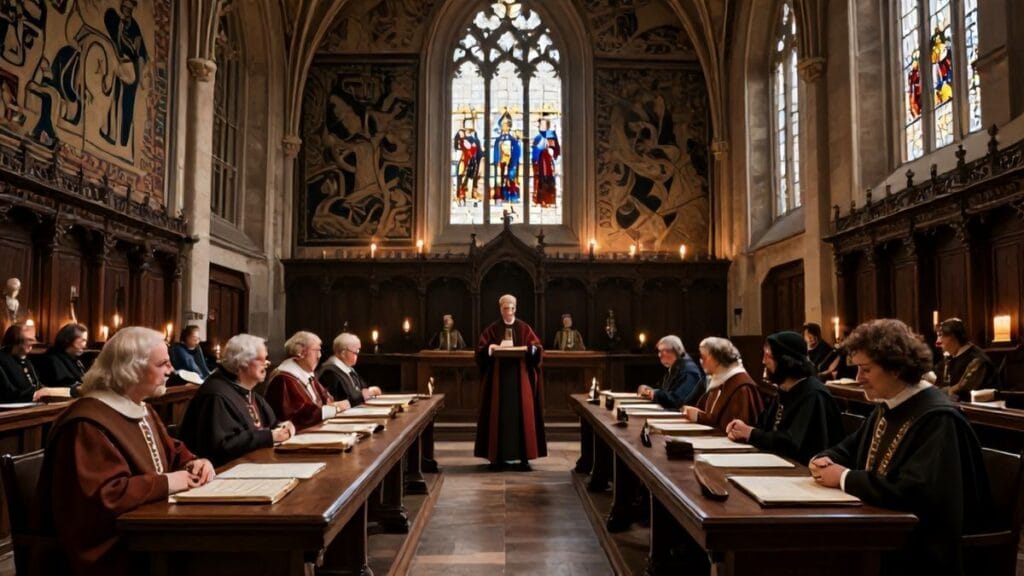
On the morning of April 22, 1418, Constance was awake before dawn. The narrow streets of this lakeside city in the Holy Roman Empire were already crowded with figures in every imaginable color and costume: friars in worn brown wool, Italian merchants in rich crimson, German knights in chain and leather, barefoot pilgrims wrapped in coarse cloaks. The chill air drifting in from the grey surface of Lake Constance carried the smell of woodsmoke, horses, and something less tangible—anticipation. This was the day the council of constance concludes, the day on which a gathering that had redrawn the map of European faith and politics was finally to end.
Inside the great cathedral—its stone walls darkened by decades of incense and candle smoke—workers moved benches, checked candelabra, and swept the flagstones. The vaulted ceiling had echoed for nearly four years with sermons, debates, accusations, and solemn chants for unity. Today, it would hear words of closure. Some in the city whispered that angels themselves might be watching, leaning down to see if Christendom had truly healed its terrible wound. Others, more cynical, said the only spirits looking on were those of the dead—men like John Hus, burned at the stake only three years before, whose memory still haunted the city like a quiet, accusing shadow.
When the bells began to toll, their long, rolling notes washed over roofs and alleyways, calling prelates, princes, legal experts, students, and servants alike toward the final solemn session. The council of constance concludes not in a sudden burst of triumph, but as the last act of a long, exhausting drama. Outside, a baker pushing a cart of bread muttered to a customer that life would now “go back to normal,” whatever that meant after such an upheaval. In distant villages, peasants might never learn the exact date of the council’s end. Yet they would feel its consequences in new taxes, new preachers, and an apparently singular pope upon the throne of Peter once more.
It is astonishing, isn’t it, to think that a city of fewer than ten thousand permanent inhabitants had hosted, at the height of the council, as many as thirty or forty thousand visitors—an international world concentrated on a small patch of cobblestone and water? In such tight spaces, rumors travelled faster than horses. Everyone in Constance that day carried a story: of kings consulting cardinals, of messengers seen racing along the lakeside road by torchlight, of prisoners marched through the streets under guard. As the bells’ reverberations faded, people knew they were not just witnessing a ceremony. They were standing inside an ending, and, perhaps, the fragile beginning of something new.
The Long Road to Constance: How Christendom Fell into Schism
To understand why the council of constance concludes in 1418, we have to step back almost half a century, to a time before Constance had become the makeshift capital of Christian hopes. In the mid-fourteenth century, the papacy itself had moved from its ancient home in Rome to Avignon in southern France. For nearly seventy years, seven popes ruled from this riverside fortress town, protected and influenced by the French crown. Critics, from Italian humanists to English reformers, spoke bitterly of a “Babylonian Captivity” of the Church—a papacy in exile, smothered under French power.
When Pope Gregory XI finally returned the papal court to Rome in 1377, he died barely a year later. Cardinals, pressured by a furious Roman crowd demanding “a Roman, or at least an Italian, pope,” elected Urban VI, hoping to calm the city. Yet Urban’s harsh temperament and impulsive reforms alienated the very cardinals who had chosen him. Within months, a majority of them had fled Rome, declared his election invalid under mob pressure, and elected another pope, Clement VII, who returned the papal court to Avignon. Europe split, and with it, Christendom itself: kingdoms, bishops, and monasteries had to decide—who was the true pope?
This was how the Great Western Schism began in 1378. For almost forty years, there were always at least two men, and eventually three, claiming to be the legitimate successor of St. Peter. Kings used the divide to play politics, recognizing the pope who best served their interests. One French chronicler, Jean Froissart, wrote with weary resignation that “the world is sick and divided, and the shepherds no longer know which shepherd to follow.” Ordinary believers watched with confusion as rival popes excommunicated each other, bishops switched allegiance, and the once unshakeable symbol of unity—the papal office—became a battlefield of lawyers, diplomats, and mercenaries.
By the early fifteenth century, the situation had grown intolerable. Theologians and canon lawyers began speaking of the Church as a whole possessing a higher authority than any single pope. If the papacy itself was poisoned by division, perhaps a general council—representing the universal Church—could heal it. Initiatives failed, attempts at negotiation collapsed. Popes and antipopes, fearing for their own survival, dragged their feet. Yet the idea of a council kept returning, like a current beneath the surface of events, gathering strength decade after decade until it would finally burst forth at Constance.
Three Popes, One Church: The Great Western Schism Unravels
By 1409, desperation produced a bold—and, in the short term, disastrous—experiment. A group of cardinals from both the Roman and Avignon obediences met at Pisa, summoned still another council, and attempted to solve the Schism on their own authority. They deposed both existing popes, Gregory XII in Rome and Benedict XIII in Avignon, and elected a new one, Alexander V. On paper, it looked like a solution. In practice, neither Gregory nor Benedict accepted the decision, and both retained powerful supporters. Christendom now had three competing popes.
In this tangled landscape, the Council of Constance would become the final stage on which this drama played out. When Alexander V died and was succeeded by Baldassare Cossa as John XXIII (not to be confused with the twentieth-century pope of the same name), the Pisan line seemed temporarily strong. John XXIII controlled Rome and much of Italy and had won the support of a crucial figure: Sigismund, King of the Romans and future Holy Roman Emperor. It was Sigismund, restless, ambitious, and acutely conscious of the empire’s role as protector of Christendom, who pressured for a new, universal council to end the Schism definitively.
The mere existence of three papal claimants was not just a theological puzzle; it had practical consequences. Every disputed bishopric, every contested monastery, every canonization or excommunication was suspect. Marriages, benefices, and legal privileges issued by a disfavored pope might later be challenged. A German merchant in Lübeck, a monk in Burgundy, a noblewoman in Prague—each lived in a world where religious authority, which ought to have been a single, steady sun, had become a sky full of rival stars, each insisting that it alone gave true light. The Church, guardian of souls, was stuck in an internal civil war.
That is why, when the council of constance concludes in 1418 with the Church recognizing only one pope, the relief was not abstract. It meant that baptisms, marriages, and judgments would rest—so people hoped—on a less fragile foundation. The long unraveling of the Great Western Schism would finally be stitched back together, albeit with seams clearly visible to anyone who looked closely.
Calling the Council: Emperor, Cardinals, and the Hope of Unity
The Council of Constance was officially summoned by John XXIII in 1413, under heavy pressure from King Sigismund. The choice of Constance, a city in the south-western reaches of the Holy Roman Empire near modern-day Switzerland, was itself a political compromise. It lay safely within imperial territory but far enough from Rome and Avignon to feel like somewhat neutral ground. The city’s good connections by road and river, and its access to Lake Constance, made it a practical crossroads for a gathering of such scale.
Sigismund envisioned the council as a grand stage upon which both his own prestige and the unity of the Church could be restored. He arrived in Constance in November 1414 in dramatic fashion, clad according to one chronicler “in a mantle of scarlet, with a golden crown, and accompanied by princes and knights as numerous as the stars on a clear night.” Behind the pageantry, however, was a hard political calculation. A reunited Church would stabilize Europe. A king who had brought such unity about would stand taller among his peers.
John XXIII, for his part, hoped that presiding over the council would strengthen his own claim to the papacy. Yet he approached Constance like a man walking along a cliff edge. He knew many cardinals and theologians blamed all three papal claimants for the prolonged scandal. If the council declared that a general council was superior even to a pope, John’s position could become very precarious. The very instrument he hoped would secure his power might instead strip it away.
Despite these tensions, the idea of a council drew support from across Europe. Univ ersity scholars—especially from Paris and Prague—had long argued for conciliar authority as a remedy for papal breakdown. Reformers hoped that beyond ending the Schism, the council might also address simony, nepotism, clerical immorality, and the financial exploitation of the faithful. With such high expectations, it is little wonder that when the council of constance concludes years later, many would feel a complex blend of gratitude and disappointment.
A World Convenes by the Lake: Crowds, Colors, and Tension
From late 1414 onward, Constance was transformed. Lodgings were hastily expanded, barns converted into dormitories, and every available room rented at inflated prices. Chroniclers describe streets packed with languages—Latin in the council chamber, but also German, French, Italian, Czech, English, Hungarian, and countless regional dialects. The city that had once been merely a trading hub suddenly became a microcosm of Christian Europe.
Bishop’s processions wound through the streets like moving tapestries: banners painted with saints and heraldic beasts, gilded crosses glittering in the thin winter light, choirs chanting in deep, measured rhythm. But alongside this sacred spectacle moved merchants, cooks, stable boys, prostitutes, and pickpockets. The council brought with it a booming economy of vice and necessity. One visitor wrote acidly that “the Holy Ghost may rule the council, but the taverns rule the nights.” Inns overflowed with visitors arguing about theology over jugs of wine, or speculating about which pope would fall first.
In this charged atmosphere, rumors were as important as official decrees. A word whispered in a tavern about a cardinal’s secret alliance, an overheard fragment of conversation between imperial envoys, could fan out across the city within hours. For ordinary residents of Constance, the council was both blessing and burden. They earned good money but endured shortages, higher prices, and occasional violence. When the council of constance concludes, some of the townspeople would sigh with relief as well as pride, eager to have their city back, quieter and less dangerous.
Yet it was not all chaos. Between December 1414 and April 1418, the council held numerous public sessions in the cathedral, carefully staged rituals of authority. Torches flickered, casting unsteady light over faces drawn from every corner of Christendom. Delegates sat according to “nations”—not modern nation-states, but broad regional groupings like the German, Italian, French, English, and later Spanish nations. Each had its own rooms for internal debate, its own power-brokers, its own fears. Outside, the lake darkened and froze, thawed and brightened with each passing winter and spring, as if nature itself were marking the council’s long and uncertain progress.
Nations in Assembly: How the Council Rewrote Representation
One of the most innovative aspects of the council was its system of voting. Instead of each bishop or abbot possessing an individual vote, delegates were grouped by “nation,” and each nation cast a single, collective vote in major decisions. This shifted influence away from sheer numbers—which would have favored Italian clergy—and toward a more balanced representation of Christendom’s regions. For the German king Sigismund, this was a welcome arrangement; for John XXIII and some of the Italian hierarchy, it was deeply alarming.
The French nation, drawing on the intellectual firepower of the University of Paris, pushed hard for a theory known as conciliarism—the idea that a general council possessed authority even over the pope in extraordinary circumstances. Influential theologians like Jean Gerson argued that the Church, as the mystical Body of Christ, could not be held hostage by a single individual’s obstinacy. “The Church,” he insisted in one sermon, “cannot be decapitated by the madness of a single head.” It was this logic that would underpin some of the council’s most daring acts.
Within the nations, debates were fierce. Some delegates feared that if a council could depose a pope, princes might learn to manipulate councils as easily as they had manipulated popes. Others saw it as the only way forward. The English nation, though numerically small, leveraged the prestige of Oxford scholars and the influence of its king to carve out a distinct role. The German nation, gathering representatives from a patchwork of principalities and bishoprics, tried to balance deference to Sigismund with its own concerns about reform.
When the decree Haec Sancta was proclaimed in 1415, declaring that a general council derived its power directly from Christ and that everyone, even the pope, was bound to obey it in matters of faith and reform, it seemed as though a new constitutional order for the Church had been born. For a moment, the universal Church appeared less like an absolute monarchy and more like an assembly. Yet history would show that this moment of conciliar supremacy was fragile and contested. As the council of constance concludes a few years later, the principles proclaimed in its middle years would already be facing a slow but determined papal rollback.
The Fall of John XXIII: Flight, Capture, and Deposition
If the council was to end the Schism, it had to confront the papal claimants themselves. John XXIII, who had convened the council, expected to manage it, perhaps to negotiate a compromise. But the momentum of conciliarism, and the depth of anger at decades of papal maneuvering, soon turned against him. His reputation hardly helped. Baldassare Cossa’s rise from Neapolitan noble to papal throne was accompanied by accusations of simony, brutality, and personal vice. Some of these reports were undoubtedly exaggerated by enemies, yet they colored every whisper that ran through Constance’s crowded streets.
As the nations increasingly favored a solution that would require all three popes to resign or be deposed, John grew nervous. In March 1415, sensing the ground shifting under his feet, he made a desperate move. Disguised, he slipped out of Constance at night and fled toward the Austrian Tyrol, hoping to regroup under the protection of Duke Frederick of Austria. When news of his flight reached the city at dawn, “a great murmur rose like the buzzing of bees,” as one observer put it. The pope had abandoned his own council.
Sigismund reacted with fury, placing Frederick under the imperial ban and sending troops in pursuit. Within weeks, John XXIII was captured and brought back into custody. The symbolism was unmistakable: the days when a pope could simply walk away from a council—and from the crisis of Christendom—were over. In May 1415, the council formally deposed John, citing not only the Schism but also a long list of alleged crimes. The Roman line’s Gregory XII, by contrast, agreed to authorize the council retroactively and then abdicate, a carefully choreographed move that preserved a legal bridge between old papal authority and new conciliar action.
Benedict XIII, the Avignon pope, retreated to the fortress of Peñíscola on the Spanish coast, refusing to yield. Isolated yet stubborn, he outlived the council itself, clinging to the title of pope until his death. But practically, by 1417, few still regarded him as the true pontiff. The path was clearing. When the council of constance concludes in 1418, the triple papacy that had once seemed an incurable disease has been cut down to a single, newly elected pontiff.
Benedict XIII and Gregory XII: The Last Obstacles to Unity
The fates of Gregory XII and Benedict XIII illustrate two very different responses to the crisis. Gregory XII, the Roman pope, was an elderly Venetian with limited political backing. His position had been weakened by years of conflict and by the abortive Council of Pisa. Yet Gregory still held a trump card: formal legitimacy in the eyes of many canon lawyers, who regarded the Pisan claimants as irregular. With careful negotiation, that legal advantage could be used to bring the Schism to an orderly end.
In a remarkable act of political choreography, Gregory authorized the Council of Constance in 1415 and then voluntarily resigned. By doing so, he reaffirmed the notion that a pope could, for the good of the Church, lay down his office. The council, in turn, treated him with a degree of respect denied to John XXIII. His cardinals, and the appointments he had made, were integrated into the new, unified papal college. It was a quiet end, almost anticlimactic in a time of high drama, but crucial in giving the council’s actions a firmer legal footing.
Benedict XIII, by contrast, chose defiance. Retreating to his coastal fortress in Aragonese territory, he surrounded himself with a dwindling circle of loyalists. From this stone island of resistance, he continued to issue bulls, appoint cardinals, and insist that he alone remained the legitimate pontiff. Over time, his support eroded. Even monarchs who had once backed him—like the kings of France and Aragon—abandoned his cause under pressure from Sigismund and the council.
Still, Benedict’s persistence was a ghost in the room at Constance. Delegates knew that as long as he lived and refused to resign, some might cling to his name. Yet the political reality was clear. When the council of constance concludes, Benedict is little more than a stubborn echo of a long-gone conflict, his distant fortress a reminder that religious authority, once fractured, never entirely returns to its previous, unquestioned state.
Faith on Trial: John Hus, Jerome of Prague, and the Flames of Constance
For many modern readers, the most haunting episodes of the council are not its constitutional maneuvers, but its trials for heresy—above all, the condemnation and execution of the Czech reformer John Hus. Hus, a priest and preacher at the Bethlehem Chapel in Prague, had become famous for his powerful sermons against clerical corruption, simony, and indulgence abuses. Influenced by the writings of the English thinker John Wycliffe, Hus argued that Christ, not the pope, was the true head of the Church, and that a sinful pope or bishop might not be obeyed in all things.
Summoned to Constance under a promise of safe conduct from King Sigismund, Hus arrived in November 1414 with a scholar’s quiet confidence and a patriot’s anxiety. He hoped to explain his views and to clear his name. Instead, he found himself swiftly imprisoned—his safe conduct set aside on the argument that the council held higher authority in matters of faith than any secular guarantee. For months, Hus languished in increasingly harsh conditions, ill and alone, as theologians and bishops dissected his writings and prepared formal charges.
The trial sessions were brutal. Hus was pressured to recant doctrines the council deemed heretical, many of them linked—fairly or unfairly—to Wycliffite positions already condemned. Surviving accounts suggest that Hus tried to distinguish what he had actually taught from what was falsely imputed to him. He offered to retract anything shown to contradict Scripture, but he would not confess to errors he believed he had not made. In one reported statement, he declared, “I would not, for a deceitful unity, betray the truth and offend my conscience before God.”
On July 6, 1415, Hus was condemned as a heretic. Stripped of his priestly garments, a mock paper miter painted with devils placed on his head, he was led outside the city walls to be burned. A crowd watched as he prayed and sang until the smoke and flames choked his voice. The execution shocked many in Bohemia, where Hus was loved not only as a preacher but as a symbol of Czech national identity over against German and papal influence. Jerome of Prague, his ardent supporter, would meet the same fate in 1416 after a long imprisonment and a momentary, soon-withdrawn recantation.
These burnings were not incidental footnotes to the council’s work; they were central to its effort to draw lines around orthodoxy and to prevent dissent from tearing the fragile unity it was trying to build. Yet they also sowed the seeds of future revolt. News of Hus’s death spread through Bohemia like sparks on dry grass, igniting the Hussite Wars that would convulse central Europe for decades. When the council of constance concludes in 1418, its leaders can claim success in uniting the papacy, but they have also created martyrs whose influence will stretch far beyond the council’s closing session.
Reforming the Church “In Head and Members”: Dreams and Delays
From its earliest days, the council was supposed to pursue three goals: an end to the Schism, the extirpation of heresy, and the reform of the Church “in head and members”—that is, at every level from the papal court down to the parish priest. Ending the Schism and condemning alleged heretics proved difficult but achievable. True reform was another matter.
The list of grievances was long. Many bishops and theologians complained of the heavy financial burdens imposed by the Curia: fees for confirmations, dispensations, and appeals that drained local churches and enriched Rome. Simony—the buying and selling of offices—was rampant. Pluralism, in which a single cleric held multiple benefices, left parishes neglected. Moral scandals among the clergy, from concubinage to drunkenness, were widely reported and bitterly resented by the laity.
In session after session, reform proposals were debated, drafted, and diluted. National rivalries complicated matters. The French wanted limitations on papal reservations and provisions; the Germans sought stricter discipline and limits on financial exactions; the Italians feared that too much curtailment of papal power would weaken the very center of the Church. Every reform plan encountered a web of vested interests—bishops protecting their privileges, cardinals guarding their income, princes bargaining for influence.
Some measures were adopted. The council issued decrees aimed at restricting simony, improving episcopal residence (requiring bishops to actually live in their dioceses), and regulating future councils. It even outlined schedules for future general councils to meet regularly, attempting to make conciliar oversight a permanent feature of Church life. Yet many of the boldest dreams of reformers like Gerson and Pierre d’Ailly remained only that—dreams. Once a new pope was safely enthroned, the incentive to accept structural limits on papal authority quickly waned.
By the time the council of constance concludes, a sense of missed opportunity hangs in the air for those who had hoped for deeper change. They had glimpsed the possibility of a Church reformed not merely by edict but by lasting constitutional transformation. Instead, they watched as political necessity drove concessions that would, in the long run, leave conciliar theory on increasingly shaky ground.
The Election of Martin V: White Smoke over a Divided World
With John XXIII deposed, Gregory XII resigned, and Benedict XIII effectively marginalized, the stage was set for a definitive act: the election of a new, universally recognized pope. In November 1417, the cardinals at Constance, augmented by a limited number of representatives from the nations, withdrew to elect a pontiff. Their choice would not just crown a man; it would signal to the world that the Great Western Schism had ended.
After intensive negotiations and politicking, the conclave chose Oddone Colonna, a Roman nobleman, who took the name Martin V. Born into one of Rome’s powerful aristocratic families, Martin was seen as a figure of moderation—respectable, diplomatically skilled, and, crucially, not too strongly tied to any of the previous obediences. His election met with broad acceptance from kings and princes across Europe. Bells rang, Te Deums were sung, and messengers were dispatched in all directions with the news: Europe once again had a single pope.
The scene when Martin V was presented to the council was heavy with symbolism. After years of division, a solitary pontifical figure appeared, vested in white, to receive the traditional acts of homage. Sigismund, who had invested so much energy in bringing about this moment, could look on with satisfaction. For many bishops and clergy present, the election was both an end to an exhausting crisis and a return to familiar patterns of hierarchy.
Yet even this triumph carried ambiguities. The election was conducted on conciliar terms, with the nations participating, yet the office itself was inherently monarchical. Conciliarists hoped Martin would accept the council’s decrees on its own superiority and commit to regular future councils. Papal absolutists, or those who at least feared endless assemblies, hoped the new pope would slowly reclaim the traditional fullness of papal authority. The tension between these visions did not dissolve with the sound of chanting in Constance’s cathedral. It merely moved into a new phase.
April 22, 1418: The Day the Council of Constance Concludes
By the spring of 1418, the great machinery of the council was winding down. The most urgent tasks—ending the Schism, condemning Hus and other alleged heretics, electing a pope—had been completed. Reform measures, though incomplete, had been articulated. Delegates were weary. Many had been in Constance for years, far from home, navigating not only debates but disease, shortages, and the daily grind of life in an overcrowded city.
On April 22, 1418, the council of constance concludes in a solemn final public session. The cathedral was once again the stage: banners, candles, the smell of incense rising like a visible prayer. Martin V presided, now secure enough in his role to oversee the closing of the very council that had made his election possible. Decrees were read, including confirmation of earlier decisions, and declarations that the council had fulfilled its mandate.
Witnesses describe a mood that mingled relief, satisfaction, and fatigue. There was no single dramatic gesture, no thunderous oration that fixed itself forever in memory. Instead, the end came with a quiet firmness. The council announced its conclusion, and the assembly, which had swelled and shrunk according to the tides of politics and war, began to dissolve. Delegates filed out into the light, each carrying away his own version of what had been achieved and what had been lost.
Outside, the world did not immediately change. Constance still smelled of horses and smoke; taverns still hummed with gossip. But something profound had shifted. The triple papacy was gone. Europe’s rulers, from the kings of England and France to the dukes of Bavaria and Burgundy, now had a single pontiff to court, confront, or resist. In monasteries and market squares, believers would slowly learn that the Church had, officially at least, healed its great division. As the council of constance concludes and the date April 22, 1418, enters the chronicle of the age, it does so not as a single volcanic eruption, but as the final glow of a long, grinding seismic shift.
After the Council: Triumph, Bitterness, and Unfinished Business
In the months following the council’s dissolution, Constance gradually emptied. Prelates and envoys departed with their retinues, leaving behind unpaid bills and worn-out friendships. Merchants counted their profits; innkeepers complained about damage to their property. For some of the city’s residents, the silence that followed the exodus was almost eerie. The lakeside town, which had once felt like the capital of the Christian world, returned to a more provincial rhythm.
Across Europe, reactions to the council’s work were mixed. Royal courts celebrated the end of the Schism. Diplomatic correspondence, once tied in complicated knots by rival obediences, could now flow more smoothly. The prestige of Sigismund rose; he could rightly claim to have been a central architect of unity. For Martin V, the next challenge was to leave Constance, return to Italy, and reestablish papal authority in a Rome that had not seen a resident pope in decades. His gradual restoration of Roman and curial structures would consume much of his pontificate.
Bohemia, however, burned with resentment. News of Hus’s execution had already sparked violent uprisings while the council was still in session. Hussite armies would soon challenge imperial forces, scripting a new chapter of religious and national conflict that no one in Constance, perhaps not even Hus himself, had fully foreseen. In this, the council’s attempt to extinguish heresy through fire and anathema had the paradoxical effect of radicalizing movements that might otherwise have remained more moderate.
Meanwhile, the permanent reform of the Church remained incomplete. Revenue streams to Rome were adjusted but not fundamentally dismantled. Promises of future councils, laid down in decrees like Frequens, would be only partially honored. Later councils at Basel, Ferrara, and Florence would revisit the question of conciliar versus papal authority, but never again with quite the same intensity or apparent decisiveness as at Constance. As one later historian observed, “The council sought to remake the Church and instead taught it to survive”—survive crises, survive challenges, but not entirely escape its own entrenched habits.
From Constance to Reformation: Echoes Across a Century
When Martin Luther nailed his theses to the church door at Wittenberg in 1517—almost exactly a century after Hus’s death—the echoes of Constance were not far away. Luther himself, reading about Hus and his trial, reportedly exclaimed, “We are all Hussites without knowing it,” recognizing in the Czech reformer a forerunner of his own protests against indulgences and corrupted authority. The council’s condemnation of Wycliffe and Hus had been meant to shore up orthodoxy; instead, their writings, scattered like contraband, became seeds for future reform movements.
The conciliar theory that flowered at Constance also left a long afterlife. While popes in the fifteenth and sixteenth centuries gradually rolled back its practical implications, the idea that a council could stand above a pope in an emergency reemerged in various forms. Gallicanism in France, for example, insisted on certain limits to papal power, emphasizing the authority of bishops and national churches. Catholic reformers during and after the Council of Trent sometimes looked back to Constance as a warning of what unchecked division could do—and as a reminder that the Church, when desperate enough, could reconsider even its most sacred institutions.
In a broader sense, the council’s management of representation—its use of nations as voting bodies—anticipated the later emergence of more formal national and territorial identities. The English nation at Constance, for example, deliberated at a time when England and France were locked in the Hundred Years’ War. Their debates were theological, yet they could not be entirely separated from political rivalries and alliances. The very idea that the Church’s universal assembly could be divided into quasi-political groupings foreshadowed the interplay between confession and state that would define early modern Europe.
It is no exaggeration to say that when the council of constance concludes, it leaves behind both a blueprint and a warning. The blueprint shows that large-scale, transnational assemblies can tackle systemic crises, but only at immense cost. The warning is that if such assemblies fail to address the deeper currents of discontent—economic, moral, spiritual—they may merely delay more radical upheavals. The Reformation, when it came, would draw upon grievances that had been articulated, and only partially answered, in the echoing halls of Constance’s cathedral.
Lives Changed Forever: Ordinary People under an Extraordinary Council
Behind the names of kings, popes, and theologians stood countless ordinary people whose lives were touched by the council in quieter, but no less real, ways. Imagine a peasant family in the Black Forest, hearing from a traveling friar that, at last, there was only one pope. For them, the news might translate into practical questions: Would tithes go up or down? Would the local priest preach differently? Would their son, studying at a distant university, return speaking of new decrees and new dangers?
In Bohemia, villagers who had heard Hus preach or repeat his sermons around their hearth fires experienced the council as a distant but devastating blow. Songs were composed lamenting his death; children grew up under the shadow of his martyrdom. For them, Constance was not the city of unity, but the place where a beloved preacher had been betrayed and burned. Their memory of the council would be drenched in bitterness, even as official chronicles recorded it as a necessary defense of orthodoxy.
Merchants and artisans in cities like Cologne, Florence, or London felt the council’s impact through shifting alliances and trade routes. The resolution of the Schism made it easier to do business across borders, but the wars that followed—especially the Hussite conflicts—could disrupt markets and raise the cost of certain goods. University students, especially in Paris, Oxford, and Prague, devoured the council’s decrees and the polemical pamphlets that followed, debating late into the night whether councils should, or could, truly constrain popes.
One contemporary chronicler in Constance, Ulrich Richental, left behind a colorful account of the council, full of details about processions, banquets, and even the clothing worn by various delegates. His narrative, part celebration and part catalog, reminds us that the council was a lived experience, not just a set of abstract decisions. He noted, for instance, the arrival of exotic envoys, the clatter of their horses on the cobblestones, the curiosity of townsfolk peeking from windows. In his pages, we glimpse a world where the high politics of faith brushed up against the everyday hunger of people trying to earn a living amid diplomatic splendor.
Memory, Myth, and Judgment: How Historians See the Council Today
Over the centuries, the Council of Constance has been remembered, reinterpreted, and sometimes mythologized. Catholic, Protestant, and secular historians alike have sifted its records, searching for turning points, moments of courage, and instances of failure. For some, Constance shines as the council that finally ended a shameful, decades-long Schism, restoring necessary unity to a fractured Christendom. For others, it is overshadowed by the executions of Hus and Jerome—evidence, in their view, of a Church more eager to crush dissent than to listen to its own prophets.
Conciliar theorists of later centuries would look back on decrees like Haec Sancta as high-water marks of a more constitutional vision of Church governance. Papalist authors, especially after the First Vatican Council in 1870 defined papal infallibility, tended to downplay or reinterpret those same texts, emphasizing instead the council’s role in supporting the papal office by resolving the Schism. Modern scholars, with access to extensive archival material, generally agree that Constance was a complex mixture of genuine idealism and hard-nosed realpolitik.
One respected historian of the twentieth century described the council as “a parliament of Christendom, at once visionary and compromised,” capturing the paradox at its heart. Another observed that “Constance solved the problems of yesterday and postponed the problems of tomorrow,” a judgment that seems particularly apt when we consider both the immediate relief following the council and the later eruption of the Reformation.
Legends have also clung to the council. In popular imagination, Constance sometimes appears as a place of dark conspiracies and secret betrayals, shaped above all by the drama of Hus’s trial. In Czech national memory, it remains, to this day, a name associated more with martyrdom than with reconciliation. For many Catholics, however, the council stands as one of the great “ecumenical councils” in the official series, a necessary waypoint in the long and uneven journey of Church history.
What remains undeniable is that when the council of constance concludes in April 1418, it closes not only a chapter of internal Church conflict, but also opens a long debate about authority, conscience, and reform that continues into the present. The questions raised in Constance—Who speaks for the Church? How are leaders held accountable? What is the cost of unity?—are not easily confined to the fifteenth century.
Conclusion
The story of the Council of Constance is one of extraordinary ambition and human limitation. For nearly four years, in a lakeside city of the Holy Roman Empire, Europe gathered its bishops, scholars, princes, and envoys to resolve a crisis that had shaken its spiritual foundations. The council ended the Great Western Schism, restored a single papacy under Martin V, and established, at least in principle, that in times of emergency, the Church could act collectively to correct its own leadership. When the council of constance concludes on April 22, 1418, it does so with a sense of relief that the worst of the chaos has passed.
Yet the council’s achievements were shadowed by tragedy and compromise. The executions of John Hus and Jerome of Prague revealed the harsh edge of its defense of orthodoxy; the incomplete reforms of “head and members” exposed the resilience of entrenched interests. Conciliar ideals of shared authority and regular assemblies soon met resistance from popes intent on reasserting traditional primacy. The voices that had called for deep moral and institutional renewal would find fuller expression not within Constance’s walls, but a century later amid the storms of the Reformation.
Even so, the council left a lasting imprint. It demonstrated that the structures of the medieval Church, for all their rigidity, could be bent under the weight of necessity. It showed that Christians—from emperors to peasants—could imagine alternative futures for their faith, even if those futures were only partially realized. And it revealed, in all its contradictory glory, the mixture of conviction, fear, courage, and calculation that characterizes human attempts to govern both souls and institutions.
To walk today through the streets of modern Konstanz is to see only faint traces of the tumult that once filled them: a plaque here, a preserved house there, a cathedral that no longer shakes with the roar of a worldwide assembly. But beneath the quiet, the questions raised in 1414–1418 still murmur. How does a community repair itself after division? What price is too high to pay for unity? In seeking answers, we continue, in our own way, the long conversation that began beside a cold lake when the world gathered to choose a single shepherd once more.
FAQs
- What was the main purpose of the Council of Constance?
The primary purpose of the Council of Constance was to end the Great Western Schism, during which multiple rival popes claimed legitimacy. The council also aimed to combat heresy, notably by condemning figures like John Hus, and to pursue reforms within the Church’s structures and moral life, though its success in this last area was limited. - When did the Council of Constance take place, and when did it conclude?
The council met in the city of Constance (in the Holy Roman Empire, now Konstanz in Germany) from November 1414. After nearly four years of sessions and negotiations, the council of constance concludes on April 22, 1418, in a final public session that formally closed its work. - How did the Council of Constance end the Great Western Schism?
The council addressed the three competing papal claimants by deposing John XXIII, accepting the resignation of Gregory XII, and effectively sidelining Benedict XIII, whose remaining support dwindled. It then organized the election of a new pope, Martin V, in November 1417, who was broadly recognized across Europe, thereby restoring a single, unified papacy. - Why is John Hus associated with the Council of Constance?
John Hus, a Czech reform preacher from Prague, was summoned to Constance to answer charges of heresy, arriving under a promise of safe conduct from King Sigismund. He was arrested, tried by the council, and condemned for doctrines deemed heretical, many linked to earlier ideas from John Wycliffe. On July 6, 1415, Hus was burned at the stake just outside Constance, an event that made him a martyr in Bohemia and a precursor of later Reformation movements. - What is conciliarism, and how did it relate to the Council of Constance?
Conciliarism is the theological and legal theory that, in certain crises, a general council of the Church has authority superior to that of the pope. At Constance, this idea was expressed in decrees like Haec Sancta, which stated that the council derived its power directly from Christ and that even the pope must obey it in matters of faith and reform. While conciliarism strongly shaped the council’s actions, especially in deposing papal claimants, its long-term influence was contested as later popes reasserted traditional papal primacy. - Did the Council of Constance successfully reform the Church?
The council did achieve some reforms, particularly in condemning simony, calling for better episcopal residence, and setting timetables for future councils. However, it fell short of the sweeping “reform in head and members” that many hoped for. Powerful interests, national rivalries, and the desire of the newly elected pope to preserve papal prerogatives limited the depth and permanence of its reforms. - What were the long-term consequences of the council’s decisions?
In the short term, the council restored papal unity and reduced the institutional chaos caused by multiple popes. In the long term, its handling of dissent and its incomplete reforms contributed to underlying tensions that would later fuel the Hussite Wars and, ultimately, the Protestant Reformation. Its debates over conciliar authority left a legacy of ideas about Church governance that continued to influence both Catholic and Protestant thought. - How do historians today evaluate the Council of Constance?
Most historians see the council as a pivotal but ambivalent moment. It is praised for resolving the Schism and for demonstrating that the Church could act corporately in the face of crisis. At the same time, it is criticized for its harsh treatment of dissenters like Hus and for missing a unique opportunity to enact deeper structural reforms. Modern scholarship tends to view it as a blend of high ideals, political pragmatism, and human frailty.
External Resource
Internal Link
Other Resources
- Encyclopaedia Britannica – general search for the exact subject
- Google Scholar – academic search for the exact subject
- Internet Archive – digital library search for the exact subject

