Table of Contents
- The Dawn of a Religious Crossroad: Hatfield in 680
- Political and Spiritual Turmoil in 7th-Century England
- The Kingdoms of Mercia and Northumbria: A Brewing Storm
- The Rise of Christianity and the Clash of Doctrines
- The Road to the Council: From Conflict to Convergence
- Convening at Hatfield: Setting the Scene for the Council
- Key Figures at the Council of Hatfield: Bishops, Kings, and Saints
- The Debate Over Roman Orthodoxy: Theology Meets Power
- Synodal Deliberations: How the Council Transformed the Church
- The Rejection of Celtic Practices: A Cultural and Religious Shift
- The Decision That Shaped England’s Christian Identity
- Immediate Political and Ecclesiastical Fallout
- The Spread and Consolidation of Roman Christianity in England
- Hatfield’s Role in the Larger European Ecclesiastical Context
- The Council’s Legacy in English Religious and Cultural History
- How Hatfield Echoes in Modern British Christianity
- Unseen Tensions: The Council’s Impact on Celtic Communities
- The Council of Hatfield in Later Medieval Chronicles
- Historiographical Debates: Revisiting Sources and Interpretations
- Conclusion: A Defining Moment at the Crossroads of Faith and Power
- FAQs
- External Resource
- Internal Link
In the golden light of an English autumn in 680, the town of Hatfield became the stage for a momentous gathering. The air was thick with anticipation, a mingling of reverence and tension as the men of the Church, alongside kings and nobles, assembled to decide the religious fate of a fractured England. This was no ordinary meeting—it was a convocation that would echo for centuries, a turning point where competing traditions of Christianity wrestled for supremacy, ultimately confirming the Roman orthodoxy that would shape the spiritual landscape of medieval England.
The Dawn of a Religious Crossroad: Hatfield in 680
Picture a chilly morning in the kingdom of Mercia, the wind rustling amber leaves, as robed bishops and secular lords rode or walked towards Hatfield, a royal villa strategically placed between warring kingdoms. The year was 680, a time when England was not yet united, fractured by competing kingdoms and divergent traditions within the Church itself. In this fraught climate, the Council of Hatfield was poised to address a question more loaded than a mere theological dispute: whose vision of Christianity would dominate the English Church?
This council is oft-overlooked by the casual student of history, yet its consequences are profound. It was the moment when Roman Christianity was emphatically confirmed against the Celtic traditions still prevalent in swathes of northern England. This was more than doctrine — it was a claim not just over scripture, but over the soul of a nation in formation.
Political and Spiritual Turmoil in 7th-Century England
To understand why the Council of Hatfield mattered so deeply, we must first immerse ourselves in the wider milieu of 7th-century England. Far from the tidy picture of a unified Christian kingdom, the land was a mosaic of rival kingdoms like Northumbria, Mercia, East Anglia, and Wessex, each with its own interests, alliances, and ecclesiastical affiliations.
Christianity itself was far from monolithic. The missions of Augustine of Canterbury a century earlier had planted the Roman Church’s authority in the south, but in the north, Irish-founded Celtic Christianity still flourished, characterized by different liturgical practices, a distinct monastic tradition, and—notably—the contentious dating of Easter. These theological differences, though seemingly arcane to modern eyes, symbolized larger tensions over identity and allegiance.
Within this volatile intersection of faith and power, the bishops and kings knew a decision was imminent. Could these divergent branches of Christianity coexist, or must one emerge triumphant? The Council of Hatfield was convened precisely to answer that.
The Kingdoms of Mercia and Northumbria: A Brewing Storm
Mercia, under King Æthelred, was growing in political influence. Northumbria, still tethered to its Celtic Christian heritage, had witnessed internal strife and changing leadership that made it vulnerable to Mercian ambitions. Religious alignment, far from a mere matter of belief, was a weapon in this complex chess game, and the outcome at Hatfield would bolster Mercia’s ascendancy.
Æthelred was no mere monarch; he was a shrewd politician who understood that religious unity under Rome’s banner could consolidate his own power and keep rebellious bishops in check. The stakes of the council extended beyond the spiritual: they delved deep into the heart of political sovereignty.
The Rise of Christianity and the Clash of Doctrines
Christianity had swept through Britain with the Roman legions and missionaries, yet for centuries it had evolved along distinct trajectories. The Roman tradition emphasized papal authority, a codified liturgy, and a particular calculation of Easter, while the Celtic tradition prized monastic independence, distinctive tonsures, and a divergent liturgical calendar.
This tug of war was more than clerical tedium; it pitted two competing visions of how the Church must relate to secular authority and how Christian identity should manifest in a land scarred by tribalism and conquest. Echoing through the halls of power was a desire for control, for order, for spiritual legitimacy.
The Road to the Council: From Conflict to Convergence
The road to Hatfield was paved with tentative alliances, previous synods, and intermittent conflicts. The Synod of Whitby in 664 had already established a precedent by endorsing Roman practices in Northumbria. Yet the Celtic tradition refused to vanish entirely, particularly in Wales and parts of northern England.
By 680, pressure mounted to clarify the religious landscape without risking an outright schism. It was King Æthelred, advised by his bishops and guided by political reality, who called for the Council at Hatfield to settle these matters definitively.
Convening at Hatfield: Setting the Scene for the Council
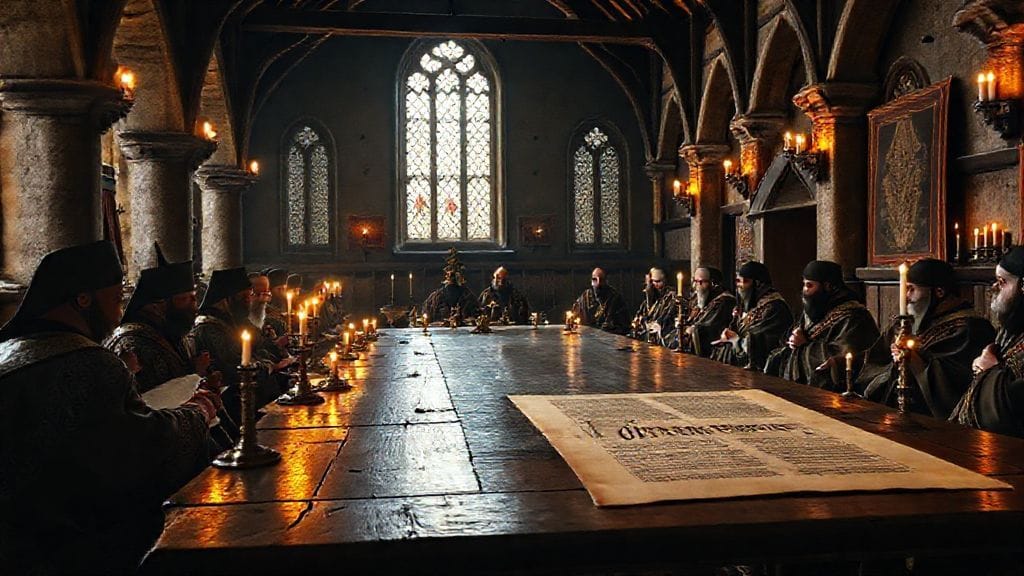
The council convened in the shadow of ecclesiastical halls adorned with crosses and relics, far from the bustle of urban centers but close to centers of power. Representatives arrived from the major kingdoms, men donned in religious vestments, bearing the weight of their dioceses—like shepherds of a fragile flock amid wolves.
The air was solemn, yet electric with tension; this was a battlefield where words would be the weapons, and consensus the prize. The gathering marked a rite of passage for the English Church, one that would confirm a decisive path forward.
Key Figures at the Council of Hatfield: Bishops, Kings, and Saints
Among the key figures was Bishop Theodore of Tarsus, Archbishop of Canterbury, a towering figure who was instrumental in organizing the Roman Church in England and championing Roman orthodoxy with vigor and compassion. His presence radiated authority—ancient wisdom tempered by the pragmatism of a church builder.
Equally important was King Æthelred of Mercia, whose political will undergirded the council’s decisions. Alongside them were bishops representing the competing traditions, including figures sympathetic to Celtic usages, though their voices would ultimately be drowned out.
The Debate Over Roman Orthodoxy: Theology Meets Power
The council was, at heart, a theological contest laden with political undertones. Central was the question of Easter’s calculation, but this was a proxy for the larger issue of the Church’s governance and cultural direction. Bishop Wilfrid, a vigorous proponent of Roman customs, argued passionately for unity with Rome as a foundation for English Christianity’s future strength and orderliness.
Opposing voices raised the banner of tradition and local identity, but their arguments were often fragmented. The writing was on the wall: the tide favored Rome’s centralized authority and liturgical discipline.
Synodal Deliberations: How the Council Transformed the Church
The formal decrees proclaimed at Hatfield anathematized Celtic practices incompatible with Roman orthodoxy, especially those regarding the tonsure and the dating of Easter. These decisions weren’t simply ecclesiastical edicts but marked the cultural and political subsumption of one tradition by another.
Yet, far from being swift and bloodless, the transition was complex. Resistance simmered in pockets, cultural memories endured, and over generations, hybrid forms sometimes emerged, but structurally, Hatfield set the template.
The Rejection of Celtic Practices: A Cultural and Religious Shift
The council’s rejection of Celtic customs reverberated deeply. The Celtic Church, with its rich monastic culture and distinctive rituals, was gradually overlaid by the Roman ecclesiastical framework. This change was not merely procedural; it altered the liturgical rhythm, clerical attire, and even the spiritual imaginations of communities.
For many in northern England, this was the loss of a familiar faith expression, a profound transformation marking the erosion of an ancient Christian heritage nurtured in isolation and infused with Irish influences.
The Decision That Shaped England’s Christian Identity
By confirming Roman orthodoxy, the Council of Hatfield laid the foundation for a unified English Church that would eventually underpin the nation’s political consolidation. It aligned England more clearly with continental Europe, strengthening ties with Rome and embedding papal authority into the fabric of English ecclesiastical and civil life.
This decision echoed into the medieval era, influencing everything from church architecture to legal structures, embedding the Gregorian mission’s legacy in the English psyche.
Immediate Political and Ecclesiastical Fallout
Politically, the council buttressed King Æthelred’s control over Mercia and expanded his influence. Ecclesiastically, it marginalized dissenting bishops and integrated the English Church into a Roman-centered ecclesiastical network that promised stability and resources.
However, these changes also alienated certain monastic communities and trapped minority traditions in a painful process of assimilation or extinction.
The Spread and Consolidation of Roman Christianity in England
Following Hatfield, an organized campaign to extend Roman liturgy, canon law, and clerical discipline rolled out across England. Monasteries were reformed, bishoprics realigned, and ecclesiastical education standardized.
This consolidation paved the way for the spectacular flowering of English medieval Christianity with its cathedrals, saints, and intellectual achievements.
Hatfield’s Role in the Larger European Ecclesiastical Context
While ostensibly a regional council, Hatfield had implications beyond England. It was part of a larger 7th-century movement where Rome asserted its primacy over diverse Christian traditions across Europe, a precursor to the evolving papal monarchy.
English compliance with Roman norms would later facilitate the island’s integration into the continent’s religious and political currents.
The Council’s Legacy in English Religious and Cultural History
The Council of Hatfield is a touchstone in England’s spiritual biography. It stands as testimony to a crucial moment when theological specificity intersected with political ambition, transforming not only religious practice but also cultural identity.
It marked the beginning of a long journey toward the medieval Church’s dominance, sculpting the English soul’s religious dimension for over half a millennium.
How Hatfield Echoes in Modern British Christianity
Even today, echoes of Hatfield’s decisions resonate. The liturgical calendar, church hierarchy, and many ecclesiastical customs remain rooted in this formative moment. The Church of England's very identity, shaped later by the Reformation and subsequent developments, owes a debt to the Roman orthodoxy sealed at Hatfield.
Recognizing this council helps us understand the deep currents that have shaped religious life and tolerance in modern British society.
Unseen Tensions: The Council’s Impact on Celtic Communities
Though the council imposed Roman orthodoxy, it did not erase Celtic Christianity overnight. Many regions maintained Celtic practices quietly or merged them with Roman rites.
These tensions reveal complex interactions between imposed structures and local identities, an enduring theme in religious history that defies simplistic narratives.
The Council of Hatfield in Later Medieval Chronicles
Medieval chroniclers referenced Hatfield to affirm the Church’s unity and emphasize the triumph of orthodoxy. Its memory was used to legitimize royal authority and ecclesiastical reforms.
Yet, the phrasing and emphasis often reflected the priorities of later historians, reminding us that the council's legacy is also a story of interpretation and remembrance.
Historiographical Debates: Revisiting Sources and Interpretations
Modern historians debate the exact proceedings and consequences of Hatfield. While records are sparse, the council is often reconstructed through later documents and correspondences, such as those of Bede and ecclesiastical letters.
These debates highlight challenges in separating historical fact from ecclesiastical myth-making and underscore the council’s symbolic weight.
Conclusion: A Defining Moment at the Crossroads of Faith and Power
The Council of Hatfield in 680 was far more than a religious synod; it was a decisive turning point where faith, politics, and culture converged to forge the future of England. At this gathering, the triumph of Roman orthodoxy reshaped the spiritual map and laid the groundwork for a unified ecclesiastical identity.
This moment reminds us that history is lived not just in battles and borders but in the quiet power of ideas and the courage of those who dare to decide their fate.
FAQs
Q1: What was the main issue addressed at the Council of Hatfield?
A1: The council primarily addressed the conflict between Roman Christian practices and the Celtic Christian traditions, focusing especially on the correct calculation of Easter and related liturgical customs.
Q2: Why was confirming Roman orthodoxy significant for England?
A2: Confirming Roman orthodoxy aligned the English Church with the broader European Christian community, strengthening political unity and ecclesiastical organization under clear, centralized authority.
Q3: Who were the most influential figures at the Council?
A3: Key figures included King Æthelred of Mercia and Archbishop Theodore of Canterbury, both instrumental in steering the council towards endorsing Roman practices.
Q4: How did local Celtic Christian communities react to the council's decisions?
A4: Many Celtic communities resisted or adapted slowly, maintaining elements of their traditions for some time despite the official rejection of their practices at Hatfield.
Q5: What impact did the Council of Hatfield have on English political power?
A5: The council reinforced the authority of Mercian rulers like Æthelred by aligning religious and political authority, contributing to Mercia’s dominance in England.
Q6: How is the Council of Hatfield remembered in ecclesiastical history?
A6: It is seen as a critical moment in establishing uniform Christian practice in England and is often referenced as a symbol of the triumph of Roman orthodoxy over Celtic traditions.
Q7: Are there surviving documents from the Council?
A7: No direct records of the council’s proceedings survive, but the event is documented indirectly through later historical sources and letters from church figures of the time.
Q8: Did the decisions made at Hatfield influence other regions in Europe?
A8: Yes, the council is part of a wider 7th-century trend toward standardizing Christian practice under Roman leadership, influencing ecclesiastical politics across northern Europe.

