Table of Contents
- The Dawn of a New Crusade: Lyon, 1245
- Europe on the Brink: Political and Religious Upheaval in the 13th Century
- Pope Innocent IV: The Visionary Behind the Council
- The Legacy of the Failed Crusades and Renewed Zeal for the Holy Land
- The Call to Arms: Preparing Christendom for War
- Gathering at Lyon: The Grand Assembly Begins
- The Papal Agenda: Beyond the Crusade
- The Political Theatre: Monarchs, Cardinals, and Ambassadors
- The Formal Proclamation: Crusading Plans Confirmed
- The Role of the Mongol Threat and Calls for Alliance
- Internal Conflicts and Controversies at the Council
- The Excommunication of Emperor Frederick II: Power Play in the Background
- Mobilizing Europe: Strategies, Promises, and Financing the Crusade
- Reactions Across Christendom: Enthusiasm and Skepticism
- The Road to the Seventh Crusade: From Council to Battlefield
- The Council’s Impact on Papal Authority and European Politics
- Chronicles and Letters: Voices from Lyon
- The Symbolism and Ceremonies of the Council
- The Forgotten Voices: Common People and Peripheral Regions
- Legacy and Historical Interpretation: Lyon 1245 in Retrospect
- How the Council Influenced Later Crusading Efforts
- The Cultural and Artistic Reverberations of the Event
- Reflections on Religion, War, and Power in Medieval Europe
- Conclusion
- FAQs
- External Resource
- Internal Link
1. The Dawn of a New Crusade: Lyon, 1245
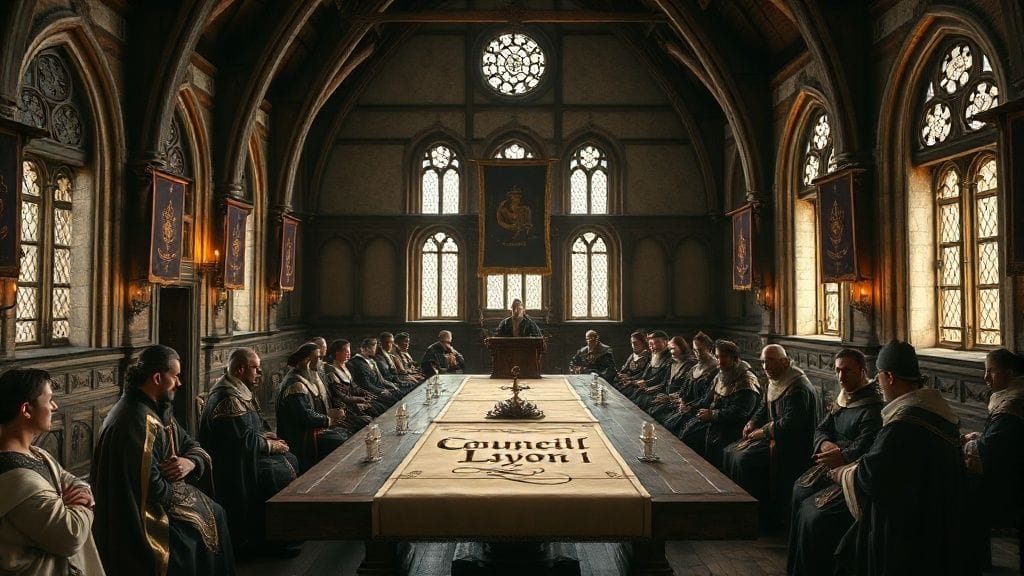
The chill of a late spring morning hung over the city of Lyon as throngs gathered beneath the soaring vaults of Saint John’s Cathedral. Lanterns flickered against stone walls still damp from night’s rain, illuminating the solemn faces of churchmen, monarchs, and envoys alike. Outside, the murmurs of Europe’s most turbulent currents coalesced into an event that promised to reshape the medieval world. It was the year 1245, a year when the Church, battered but unbowed, would once again rouse the Christian kingdoms to arms against the forces defining the era’s global balance—the Crusades.
The Council of Lyon I was not just a religious assembly; it was a moment saturated with hope, fear, and relentless ambition. Beneath the grandeur and ceremony lay a somber reality: the Holy Land, the sacred epicenter of Christian faith, floundered under the shadow of Islamic empires; Europe’s fragile political order teetered between cooperation and conflict; and the papacy, led by Pope Innocent IV, sought to assert its spiritual supremacy by reigniting the crusading fervor. The stage was set for a council that would confirm crusading plans with far-reaching consequences.
2. Europe on the Brink: Political and Religious Upheaval in the 13th Century
In the mid-13th century, Europe stood at a crossroads marked by deep fracture and transformation. Monarchs juggled fragile alliances, nobles fiercely defended territories, and church leaders wrestled with secular powers. The memory of earlier crusades, particularly the mixed outcomes of the Third and Fourth Crusades, weighed heavily on Christendom’s collective heart. The Holy Land, once captured in the First Crusade, had slipped further from Christian control, and the Christian kingdoms in the Levant were mere shadows, clinging desperately to survival.
On the religious front, the papacy grappled with challenges such as heretical movements—the Cathars and Waldensians—and the growing influence of secular rulers like Frederick II, Holy Roman Emperor. Frederick, a man of paradoxes and formidable intellect, had been excommunicated and reconciled multiple times, shaking the Church’s authority. This volatile blend of politics, religion, and diplomacy formed the backdrop against which the Council of Lyon convened.
3. Pope Innocent IV: The Visionary Behind the Council
At the heart of this grand assembly was Pope Innocent IV, a pontiff whose name would be forever entwined with the Council of Lyon I. Ascending to the papacy in 1243 amid turmoil, Innocent IV inherited a fractured Church and a European continent craving direction. A scholar and diplomat before his elevation, he understood that the Church’s strength lay in unity and decisive action.
Innocent’s vision was bold. He sought to restart the crusading spirit and strengthen papal authority not only through religious zeal but also via careful politics. His conflict with Emperor Frederick II was one of the defining antagonisms of his pontificate, culminating in a historic excommunication vote at the Council itself. But to the faithful throng in Lyon, he promised something more: the reclamation of the Holy Land and the triumph of Christendom.
4. The Legacy of the Failed Crusades and Renewed Zeal for the Holy Land
The Crusades had become both a symbol of divine mission and a cautionary tale of hubris by 1245. The earlier waves—First, Second, Third Crusades—had brought fleeting victories but ultimately failed to secure lasting Christian presence in Jerusalem. The Fourth Crusade, redirected to sack Constantinople in 1204, deepened the scars between Eastern and Western Christendom, casting a shadow over the ideal of united Christian fronts.
This worn legacy bred disillusionment but also a fervent desire for redemption. Tales of distant battles, heroic knights, and martyrdom circulated through song and scroll, inspiring new generations. The Church leveraged these sentiments to revitalize the cause, framing the upcoming crusade as a sacred duty and a chance to correct previous mistakes.
5. The Call to Arms: Preparing Christendom for War
Before the formalities began, emissaries across Europe spread the papal summons. Knights prepared their armor and horses, nobles gathered funds, and clergy preached sermons infused with both hope and warning. Crusading was more than war; it was penitence, pilgrimage, and a promise of redemption for one’s soul.
The Council was the crucible where these ambitions would be forged into concrete plans. It was meant to ensure widespread participation, assess resources, and create a clear strategy for reclaiming Jerusalem. Yet beneath the surface lurked hesitation—some rulers were reluctant, others preoccupied with domestic affairs, while many common folk dreaded the toll of war.
6. Gathering at Lyon: The Grand Assembly Begins
As spring deepened into summer in 1245, Lyon transformed into a hub of ecclesiastical and political energy. Representatives poured in from across Europe—bishops in resplendent robes, knights clad in chainmail, nobles bearing banners. The city’s narrow streets echoed with the clatter of boots and the hum of intense conversation.
Inside Saint John’s Cathedral, every seat was claimed, every whisper charged with anticipation. The Council was more than a meeting; it was a spectacle of medieval power, faith, and diplomacy. For weeks, doctrines were debated, charges laid against secular powers, and the machinery of crusading was set into motion.
7. The Papal Agenda: Beyond the Crusade
Though the crusade dominated headlines, Pope Innocent IV’s agenda was multifaceted. The Council also addressed pressing issues: combating heresy spreading in southern France, reforming Church administration, and asserting papal authority over secular rulers. The excommunication of Emperor Frederick II was a central drama, symbolizing a clash between Church and Empire that threatened the very fabric of European politics.
The Council’s minutes reveal a papacy striving to wield spiritual power with temporal effects — reflecting Innocent’s desire to unify Christendom under papal leadership, not just spiritually, but politically. In this, the crusade was a tool, a call to heroic war entwined deeply with the assertion of Pope Innocent’s primacy.
8. The Political Theatre: Monarchs, Cardinals, and Ambassadors
The Council was as much a diplomatic chessboard as a spiritual gathering. Kings and princes sent representatives, while some monarchs themselves appeared, navigating the delicate balance between loyalty and self-interest. The Kingdom of France, under Louis IX, was a crucial player; the young king, deeply pious, had already pledged himself to crusading ventures.
Cardinals from Rome and distant lands debated fiercely, each maneuvering to sway outcomes in favor of their interests or theological perspectives. The presence of foreign envoys, including those from the Mongol courts, added an international dimension to the political theatre. Every decision would ripple through the alliances and enmities shaping medieval Europe.
9. The Formal Proclamation: Crusading Plans Confirmed
One of the Council’s climaxes came when Pope Innocent IV formally confirmed plans for a new crusade. The horn sounded and the Church bell tolled solemnly as the papal bull was read aloud: Christendom was called once more to recover Jerusalem.
Innocent’s proclamation was both an exhortation and a command — a summons to knights, clergy, and commoners alike. It promised spiritual rewards—indulgences, remission of sins—while underscoring the existential threat posed by the Muslims to the Christian faith. This moment infused the entire assembly with a renewed sense of purpose, though the road ahead would be fraught with challenges.
10. The Role of the Mongol Threat and Calls for Alliance
Yet, the Council’s vision extended beyond the Levant. The Mongol Empire, sweeping from Asia into Europe’s periphery, was both a menace and a potential ally. Letters from Mongol leaders, intrigued by Christianity and interested in alliance against Muslim powers, arrived at Lyon.
The Council debated the possibility of a Christian-Mongol alliance—a diplomatic gamble that illustrated the complexity of 13th-century geopolitics. Though enthusiasm existed, skepticism prevailed. This episode underscored the global dimensions of the Crusades and the tangled web of medieval diplomacy.
11. Internal Conflicts and Controversies at the Council
Despite the spectacle, Lyon was rife with tension. Disagreements over the crusade’s conduct, its financing, and who should lead created fractures. Some nobles advocated for a focus on Iberian conquests against the Moors rather than the Holy Land. Others feared the economic burden or doubted the pope’s authority.
Moreover, the excommunication of Frederick II polarized opinions. Supporters of the emperor viewed the Council as a political tool wielded unjustly, while others saw the pope’s firm stance as necessary to preserve Christendom’s spiritual integrity. These internal conflicts mirrored the larger divisions fracturing Europe at the time.
12. The Excommunication of Emperor Frederick II: Power Play in the Background
A defining moment came with the Council’s formal excommunication of Frederick II, a daring and unprecedented move that reverberated throughout Europe. The French king and papal forces used this to justify their stand against imperial interference.
Frederick, ever enigmatic, had his own vision for a crusade but clashed with the papacy over timing and authority. His absence from Lyon highlighted the growing schism between Empire and Church—and the way religious councils had become arenas for secular power struggles.
13. Mobilizing Europe: Strategies, Promises, and Financing the Crusade
With the crusade sanctioned, practical matters moved to the fore. The Council debated tax levies, army logistics, and supply lines. Nobles pledged troops and resources, while the Church promised indulgences and spiritual benefits to participants.
The idea was to unite dozens of disparate kingdoms, regions, and factions under a single banner—a colossal task given the era’s communication and transportation limitations. Yet the optimism of Lyon was palpable, driven by a deeply felt conviction that this crusade could restore grace to a fractured Christendom.
14. Reactions Across Christendom: Enthusiasm and Skepticism
News of Lyon’s decisions spread swiftly. In France and England, fervor ignited some noble circles, while merchants and peasants viewed the crusade with apprehension. Chroniclers recorded mixed sentiments: prayerful hope among the faithful and weary resignation from those fearing the endless cycle of war.
In the Byzantine lands, memories of the Fourth Crusade’s devastation made many wary, complicating potential alliances. Muslim states, hearing of these plans, fortified defenses and anticipated the renewed threat. These variegated reactions spoke to the complexity of crusading as both holy mission and political event.
15. The Road to the Seventh Crusade: From Council to Battlefield
The Council’s confirmation at Lyon became the official springboard for what history would later call the Seventh Crusade, predominantly led by King Louis IX of France. The years following saw meticulous preparations, campaigns in Egypt, and dramatic battles—the ultimate test of the promises made beneath Lyon’s vaulted ceilings.
Though the crusade achieved mixed results, its origins in 1245 marked a pivotal moment where faith, power, and war entwined once again, echoing in the memories of Europe well beyond the medieval era.
16. The Council’s Impact on Papal Authority and European Politics
Lyon I was more than a crusading committee; it was an embodiment of papal ambition to shape Europe’s destiny. By confirming the crusade and excommunicating Frederick II, Pope Innocent IV reinforced the Church’s political weight.
The Council set precedents in Church-state relations, highlighting the papacy’s willingness to confront emperors and kings alike. This event shifted balances of power, emboldening some rulers while sidelining others, and gave the Church renewed but contested authority.
17. Chronicles and Letters: Voices from Lyon
The written accounts of Lyon 1245 provide invaluable insight. Chronicles by ecclesiastics and letters from participants reveal the mix of solemnity and spectacle, prayer and politics. Some describe vivid ceremonies, others speak of whispered intrigues and fractious debates.
These texts humanize the Council, showing it not as a monolithic institution but as a gathering of individuals—each with hopes, fears, and ambitions—woven into the tapestry of medieval history.
18. The Symbolism and Ceremonies of the Council
From the opening mass to the reading of papal bulls, the Council’s orchestration was steeped in symbolism. Crosses were borne, relics displayed, and oaths sworn, cultivating a sacred atmosphere purported to sanctify decisions.
These rituals reinforced the perception of divine backing for crusading, making the Council as much a spiritual event as a political one. The blending of faith and power was palpable, searing the council’s decisions into the collective memory.
19. The Forgotten Voices: Common People and Peripheral Regions
While monarchs and cardinals dominated narratives, the Council’s outcomes resonated far beyond Lyon’s cathedral. For peasants, craftsmen, and peripheral European communities, the call to crusade meant disruption, recruitment, and often hardship.
Many regions provided soldiers or resources reluctantly; others embraced crusading as an escape from poverty or a path to salvation. These often-unheard voices remind us that history’s grand events ripple through all strata of society.
20. Legacy and Historical Interpretation: Lyon 1245 in Retrospect
Over centuries, historians have debated Lyon’s significance. Was it a bold attempt to restore the crusading ideal or a political maneuver entangled in papal-imperial conflict? Did it accelerate Christendom’s fragmentation or reaffirm its unity?
Modern scholarship recognizes Lyon I as emblematic of medieval challenges—faith striving amidst political complexity, idealism shadowed by pragmatism. Its legacy echoes in how we understand religious war and the interplay of power and belief.
21. How the Council Influenced Later Crusading Efforts
The Council’s confirmation spurred the Seventh Crusade and influenced subsequent calls to arms. New crusading tactics, diplomacy, and financing methods found their seeds here.
Even as the crusades waned in later centuries, the spirit of Lyon continued to inspire religious militancy, shaping European identity and attitudes toward the ‘Other’—a complicated inheritance that still provokes reflection.
22. The Cultural and Artistic Reverberations of the Event
Lyon’s Council inspired manuscripts, chronicles, and ecclesiastical art, depicting crusading themes with fervor. These cultural artifacts provide a window into contemporary perceptions and propagate the crusading mythos.
Church architecture and liturgy were also affected, as crusade sermons and symbols wove into daily worship. Art and culture thus became conduits of the Council’s enduring influence.
23. Reflections on Religion, War, and Power in Medieval Europe
The Council of Lyon I stands as a testament to the medieval world’s entwined nature of religion and politics. It reveals how faith motivated conflict and how power sought religious legitimacy.
This event challenges modern readers to fathom an age where spiritual and temporal realms overlapped intricately—an era shaped by conviction, ambition, and the relentless pursuit of salvation and sovereignty.
Conclusion
The Council of Lyon I in 1245 unfolded as a defining chapter in the saga of the Crusades and medieval Christendom. It was a moment when Europe’s mosaic of kingdoms and faiths converged under the gaze of a determined pope, grappling with the weighty task of reclaiming the Holy Land while navigating treacherous political waters.
This council did more than confirm plans for war—it crystallized the entanglement of religious conviction and temporal power, illuminated the hopes and fissures of an era, and set in motion events that would echo for generations. The flickering candles of Lyon’s cathedral symbolized both illumination and shadow—faith striving, yet challenged by the complexities of human endeavor. Through its triumphs and tribulations, the Council remains a compelling testament to the enduring, turbulent dance of belief, ambition, and history.
FAQs
Q1: Why was the Council of Lyon I convened in 1245?
The Council was called by Pope Innocent IV to address multiple pressing issues, chiefly to confirm plans for a new crusade to reclaim the Holy Land, strengthen papal authority, and confront secular powers like Emperor Frederick II.
Q2: What was the significance of excommunicating Frederick II at the Council?
The excommunication marked a bold assertion of papal power over the Holy Roman Emperor, deepening the conflict between Church and Empire and setting the tone for political-religious relations in Europe.
Q3: How did the Council influence the Seventh Crusade?
By confirming crusade plans and mobilizing resources and spiritual incentives, the Council laid the groundwork that enabled King Louis IX of France to lead the Seventh Crusade, commencing shortly after.
Q4: Were there any international dimensions to the Council beyond Europe?
Yes, the Council considered diplomatic overtures from the Mongol Empire and debated potential alliances against Muslim powers, reflecting the global awareness of the era.
Q5: How did common people experience the outcomes of the Council?
For many, the Council’s decisions meant recruitment for war, economic burden through taxes, and social upheaval, illustrating that crusading affected all layers of medieval society.
Q6: What controversies arose during the Council?
Disagreements over leadership, strategy, financing of the crusade, and the validity of Frederick II’s excommunication created significant internal tensions.
Q7: How is the Council of Lyon I viewed by historians today?
Historians see it as a complex blend of spiritual zeal and political maneuvering, a pivotal moment that reveals the intertwined nature of medieval religion and power.
Q8: Did the Council resolve the issues it addressed?
While it confirmed crusading plans and asserted papal authority, many underlying conflicts persisted, and the crusades themselves experienced mixed military outcomes.

