Table of Contents
- The Gathering Storm: Europe in the Mid-13th Century
- The Split Within: Roots of the Great Schism
- The First Council of Lyon: Setting the Stage for Reunion
- Pope Gregory X and His Vision for Healing the Church
- Arrival at Lyon: A City Transformed for a Historic Meeting
- The Ambitious Agenda: Beyond Reunion to Reform
- The Attempted Reconciliation: Orthodox Delegates and Catholic Representatives Meet
- The Theological Divide: Dogma, Authority, and the Filioque Controversy
- Political Underpinnings: The Byzantine Empire’s Fragile State
- The Council’s Declarations: Proclamations of Union and Ecumenical Hope
- Reactions Across Christendom: Enthusiasm and Skepticism
- The Byzantine Emperor’s Role and the Weight of Diplomacy
- The Role of the French and Latin Nobility: Interests and Influences
- Beyond Theology: Military Alliances and the Prospect of Crusades
- The Union’s Fragile Reality: Why the Agreement Failed to Last
- Aftermath in Constantinople: Popular Resistance and Clerical Opposition
- Long-Term Impact: Lessons on Ecumenism and Church Politics
- Cultural and Artistic Echoes of the Council
- The Council in Historical Memory: A Footnote or a Turning Point?
- Conclusion: The Unfinished Dream of Christian Unity
- FAQs: Understanding the Council of Lyon II and Its Legacy
- External Resource
- Internal Link
1. The Gathering Storm: Europe in the Mid-13th Century
The year was 1274, and the city of Lyon, nestled amid the rolling hills of southeastern France, prepared itself for a gathering unlike any other in Christendom. Markets buzzed with merchants, clergy arrived in fine robes from distant lands, and the streets echoed with multilingual chatter. A palpable tension hovered in the autumn air, dense with hope and uncertainty. Europe was fractured—politically, religiously, and culturally—and the Church itself was divided by an almost four-century-old schism that had cleaved Eastern Orthodoxy from Western Catholicism.
Yet in Lyon, under the banner of peace and reunion, something extraordinary was set to take place. The Second Council of Lyon was convened not only to address internal Church reform and papal politics but to attempt the impossible: the reconciliation of the Papacy and the Byzantine Empire, the East and the West, after decades of animosity and mutual excommunication.
2. The Split Within: Roots of the Great Schism
The rupture between the Eastern Orthodox and Roman Catholic Churches was not sudden, but the slow burn of centuries. The Great Schism of 1054 had entrenched theological and political disagreements, particularly around issues such as the authority of the Pope and the insertion of the Filioque clause into the Nicene Creed by the West—one of the most contested theological points. Moreover, cultural differences, language barriers, and mutual suspicions fueled the divide.
By the mid-13th century, the schism was more than a theological debate; it symbolized a geopolitical fracture. The Byzantine Empire, once the unchallenged heir to Roman glory, was a shadow of its former self, threatened by rising powers—most notably the aggressive expansion of the Ottoman Turks—and internal instability. The Latin West, meanwhile, flourished under burgeoning monarchies and papal influence, yet the memory of the Fourth Crusade’s sack of Constantinople lingered bitterly in the East.
3. The First Council of Lyon: Setting the Stage for Reunion
The First Council of Lyon in 1245, called by Pope Innocent IV, had already set precedent for addressing critical matters: the excommunication of Emperor Frederick II, the governance of the Church, and the pressing calls for crusade. While not directly focusing on the East-West divide, this council established Lyon as a key diplomatic and ecclesiastical hub.
When Pope Gregory X ascended to the papacy in 1271, he carried with him not only the weight of spiritual leadership but a burning desire to resolve the Eastern schism, aware that Christian unity was essential against the increasing threats to Christendom from Islamic forces.
4. Pope Gregory X and His Vision for Healing the Church
Gregory X was a man of diplomacy, experience, and vision. A former papal legate and inquisitor, his understanding of the Church’s fractures was profound. From the start of his pontificate, he sought to convene a general council that would transcend internal conflicts and extend a hand of reconciliation to the Byzantine emperor, Michael VIII Palaiologos.
To Gregory, the union of Churches meant more than theological agreement; it was a strategic alliance, a bulwark against the Muslim forces in the Mediterranean, and a symbol that Christendom could overcome its divisions to protect its shared heritage.
5. Arrival at Lyon: A City Transformed for a Historic Meeting
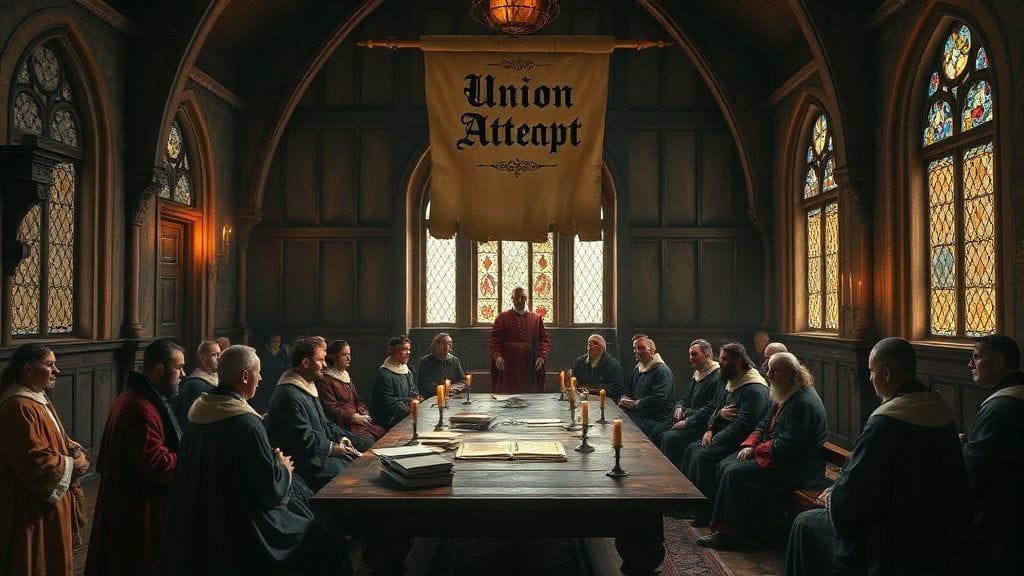
The council convened in June 1274 in a pontifical palace meticulously prepared to host hundreds of clergy, nobles, and envoys. Lyon was transformed: scaffolds rose, tapestries adorned walls, and tents sheltered the many arriving dignitaries.
Delegates came from across Europe and the Byzantine world, some traveling for weeks or months. The atmosphere was electric—painted with cautious optimism, diplomatic intrigue, and whispered fears of failure.
6. The Ambitious Agenda: Beyond Reunion to Reform
More than just a meeting for ecclesiastical reunion, the Second Council of Lyon’s agenda was expansive. Internal Church reforms were on the table: clerical discipline, the crusading effort, canon laws, and the organization of the Holy Land’s defense.
But the centerpiece remained the delicate—and explosive—issue of Church unity, a subject layered with centuries of bitterness and mistrust.
7. The Attempted Reconciliation: Orthodox Delegates and Catholic Representatives Meet
By summer’s end, the Eastern delegation arrived—a mix of high-ranking clergy and imperial representatives. Their presence signified a willingness, perhaps born more from political pragmatism than genuine theological conviction, to negotiate.
The sessions unfolded with carefully crafted speeches aimed at smoothing historical wounds through acknowledgment of shared faith and mutual respect. Yet, beneath these eloquent exchanges, the gap in doctrine and ecclesiastical authority remained wide.
8. The Theological Divide: Dogma, Authority, and the Filioque Controversy
Central to the theological debate was the Filioque clause—the phrase "and the Son" added by the Western Church to the Creed to describe the procession of the Holy Spirit. Orthodox delegates rejected this addition as unauthorized and heretical.
More fundamentally, the role of the Bishop of Rome was contested. The Western Church claimed papal primacy and universal jurisdiction, while the Byzantine tradition upheld a more conciliar and symphonic view of ecclesiastical authority.
Though the council ultimately accepted the Western position in declarations, the theological impasse foreshadowed deeper difficulties.
9. Political Underpinnings: The Byzantine Empire’s Fragile State
For Emperor Michael VIII, the union was as much a political maneuver as a religious statement. Having recaptured Constantinople in 1261 after the Latin occupation, he sought recognition and relief from Western hostility.
The union promised to ease tensions, allow for potential military alliances, and strengthen his tenuous hold on power. However, his own subjects—including influential clergy and peasants—rejected the union vehemently, viewing it as betrayal of Orthodox tradition.
10. The Council’s Declarations: Proclamations of Union and Ecumenical Hope
On July 6, 1274, the council formally proclaimed the attempted union of the Churches, declaring the filioque valid and affirming papal primacy. Pope Gregory X hailed this as a monumental victory for Christendom.
These declarations were laden with hope; prayers were offered for lasting peace and cooperation. Yet, history teaches that official pronouncements seldom guarantee grassroots acceptance.
11. Reactions Across Christendom: Enthusiasm and Skepticism
While Rome and much of Western Europe received news of the union with enthusiasm, reactions in Byzantium and among the Orthodox faithful were largely hostile.
Critics accused Emperor Michael VIII of subservience to the West, and rumors spread that the emperor’s true aim was to secure military aid, not religious harmony.
12. The Byzantine Emperor’s Role and the Weight of Diplomacy
Michael VIII’s role was pivotal but precarious. His supporters saw the union as a necessity; his opponents branded it treasonous.
His ability to enforce the council’s decrees was limited. The tension between political expediency and religious identity would soon culminate in violent confrontations and ecclesiastical resistance.
13. The Role of the French and Latin Nobility: Interests and Influences
The French crown and Latin nobility viewed the union also through a political lens. For many, especially crusading orders, a united Christendom was essential to renewing efforts to reclaim the Holy Land.
Yet, some nobles remained wary of Byzantine duplicity or skeptical of Orthodox sincerity. The interplay of faith and power made the council a complex theater of competing interests.
14. Beyond Theology: Military Alliances and the Prospect of Crusades
The council's diplomatic ambitions extended into martial plans. A united Church could mobilize crusading armies with greater efficacy, countering the threats of the Mamluks in Egypt and the advancing Turks.
But without genuine unity on the ground, these dreams encountered harsh realities—fractured alliances and differing political agendas.
15. The Union’s Fragile Reality: Why the Agreement Failed to Last
Despite formal proclamations, the union failed to bridge the divide substantively. Orthodox hierarchies in Constantinople repudiated the council’s decisions, and local churches rejected communion with Rome.
The union was effectively nullified within a few years, exemplifying the difficulty of reconciling dogma, politics, and popular faith.
16. Aftermath in Constantinople: Popular Resistance and Clerical Opposition
The emperor’s policies sparked revolts and schisms. Patriarchs who supported the union were deposed, replaced by staunchly anti-unionist clergy.
The trauma deepened divisions, and the union became a source of internal strife rather than peaceful convergence.
17. Long-Term Impact: Lessons on Ecumenism and Church Politics
Though the Council of Lyon II’s attempt at union failed, it left lasting lessons in Christian ecumenism. It highlighted the complexities of reconciling deep theological and cultural divides and foreshadowed the continuing challenges facing East-West relations.
Politically, it underscored the limitations of diplomacy disconnected from popular consent.
18. Cultural and Artistic Echoes of the Council
The council’s events inspired artistic renderings in illuminated manuscripts, frescoes, and letters, commemorating both the hope and the tragedy of reunion.
Lyon itself earned a lasting place in the religious and diplomatic history of medieval Europe.
19. The Council in Historical Memory: A Footnote or a Turning Point?
Historians often regard the Council of Lyon II as a footnote rather than a turning point due to its failure. Yet, the council’s vision and attempt at unity resonate as early gestures toward ecumenism and broader Christian identity.
In a world continually seeking bridges, its echoes remain relevant.
20. Conclusion: The Unfinished Dream of Christian Unity
The Second Council of Lyon was a moment of hope and tension, ambition and limitation—a vivid tableau of medieval Christendom’s fractured soul striving toward wholeness. Though the union proclaimed there dissolved in the realities of history, its spirit invites reflection on the enduring challenge of unity amid diversity.
It reminds us that faith, politics, and culture are tightly interwoven threads in the tapestry of human history, and that reconciliation is as much a human journey as a doctrinal one.
Conclusion
As the banners folded and the delegates dispersed from Lyon in 1274, the dream of a reunited Christendom remained elusive. The Council of Lyon II stands as a testament to both the grandeur of medieval ecclesiastical ambition and the stubborn complexities of division. It was a council that dared to hope for healing across centuries of suspicion and to envision a Church united in faith and purpose. Its failure, though palpable and deeply felt, is instructive rather than defeatist—an enduring challenge laid before the centuries to come.
Understanding this event is to glimpse the profound intertwining of theology, politics, and human aspiration, and to recognize that the pursuit of unity, even when it falters, shapes the course of history.
FAQs
Q1: What was the main goal of the Second Council of Lyon in 1274?
The primary goal was to heal the schism between the Eastern Orthodox and Roman Catholic Churches by attempting a formal union and to address Church reforms and crusading strategies.
Q2: Why was the Filioque controversy such a divisive issue?
Because the Western Church’s addition to the Nicene Creed ("and the Son") was seen by the Orthodox as an unauthorized theological innovation, raising questions about authority and doctrinal integrity.
Q3: Who was Pope Gregory X, and what role did he play?
Gregory X was the pope who convened the council with a vision of Christian unity and reform, balancing spiritual leadership with political diplomacy to address the schism.
Q4: How did Byzantine Emperor Michael VIII benefit from the union?
He sought political legitimacy, relief from Western hostility, and potential military alliances, especially against the threat of Turkish and other forces.
Q5: Why did the union ultimately fail?
The union lacked genuine grassroots acceptance, faced intense opposition from Orthodox clergy and laity, and was undermined by political and theological mistrust.
Q6: What were the broader implications of the Council of Lyon II?
It highlighted the enduring challenges of reconciling religious differences and set a precedent for future ecumenical endeavors, illustrating the intertwined nature of faith and politics.
Q7: How is the council remembered in historical memory?
Often viewed as a failed attempt, it nonetheless remains significant as an early, ambitious effort at Christian unity with lessons that resonate to this day.
Q8: Did the council influence subsequent Church councils?
Yes, although it did not achieve union, it influenced later approaches to dialogue between East and West and informed the nature of Church reform discussions.

