Table of Contents
- A Winter in Champagne: Setting the Stage for a Defining Council
- From Pilgrim Protectors to Contested Brotherhood: Origins of the Templars
- Champagne’s Rising Star: The County that Hosted a New Order
- Summoning Christendom: Why the Council of Troyes 1129 Was Convened
- The Men in the Hall: Bernard of Clairvaux, Bishops, and Princes
- Silences, Whispers, and Testimonies: How the Templars Made Their Case
- Drafting a New Rule: Monks with Swords
- Bernard’s Pen and God’s Will: Ideology Behind the Templars’ Approval
- Champagne’s Political Gamble: Local Ambition and International Power
- Knights of the Temple Take Flight: Consequences Across Christendom
- Pilgrims, Peasants, and Princes: How Ordinary Lives Were Touched
- Gold, Credit, and Stone: The Economic Legacy of a Council’s Decision
- From Troyes to the Wider World: The Order’s Expansion and Myth-Making
- Echoes of Doubt: Early Suspicions and Theological Debates
- Distant Thunder: How 1129 Foreshadowed the Templars’ Fall
- Remembering a Winter Council: Historians, Legends, and Memory
- Conclusion
- FAQs
- External Resource
- Internal Link
Article Summary: In the winter of 1129, in the bustling county town of Troyes in Champagne, churchmen and nobles gathered for what would become one of the most consequential ecclesiastical assemblies of the Middle Ages: the council of troyes 1129. There, a small, austere brotherhood of knight-monks, once little more than a rumor from the Holy Land, was formally recognized and given a rule of life. This article follows the story from the fragile beginnings of the Knights Templar to the moment they stepped into the legal and spiritual light of Western Christendom. It reconstructs the atmosphere of the council, the motives of figures like Bernard of Clairvaux, and the shrewd calculations of the counts of Champagne. It also traces how a decision made in a wintry hall in Troyes reshaped crusading warfare, medieval finance, and the lives of pilgrims from England to Jerusalem. By revisiting the council of troyes 1129, we explore how faith, ambition, and fear combined to create a new kind of institution: an international order of warrior-monks. Finally, the narrative reflects on how this council’s choices foreshadowed both the Templars’ dazzling ascent and their catastrophic fall two centuries later. The council of troyes 1129 thus stands as a turning point where local politics and global Christendom met under the sign of the cross and the sword.
A Winter in Champagne: Setting the Stage for a Defining Council
The winter air in Troyes in early 1129 would have stung the face and numbed the fingers. Smoke clung low over wooden rooftops, drifting from hearths where townspeople huddled against the chill. Horses snorted steam in the narrow streets, their hooves clattering on frozen mud. Yet amid the harsh cold, the city glowed with a strange intensity. Foreign accents floated above the market noise, silks brushed past rough wool, and cloaks bearing ecclesiastical seals marked the presence of men whose decisions could reorder Christendom.
It was here, in the heart of the County of Champagne, that the council of troyes 1129 convened—a church council that did not bear the fame of Clermont or Lateran, but one that would alter the shape of medieval Europe in quieter, more enduring ways. The streets of Troyes were familiar with crowds: fairs had already begun to transform the city into a hub of trade, where Italian, Provençal, Flemish, and German merchants bargained over cloth and spices. But the men entering the episcopal precinct this winter were not there to buy or sell. They came charged with a more solemn task: to judge the fate of a still-obscure group of warrior-monks from the distant Holy Land.
The Knights of the Temple—Templars, they were beginning to be called—were not yet the legendary figures of later chronicles. They were poor, few in number, and still half-formed as an institution. Their weapons were worn; their reputation, uncertain. Some spoke of them as holy protectors of pilgrims in Jerusalem. Others muttered about impropriety: armed men claiming to live like monks, inhabiting a space the medieval mind found unsettling, even suspect. Could violence and sanctity truly share a single habit?
Yet in this tension lay the reason why Troyes, of all places, became the stage for a momentous council. The County of Champagne in the early twelfth century was restless and ambitious, its rulers eager to fashion their domains into a crossroads of commerce, devotion, and political influence. Troyes, with its fairs and its cathedral, married spiritual authority with material wealth. To host an ecclesiastical council that might create a new kind of religious order was both an honor and a gamble—a chance to place Champagne at the very center of Christendom’s evolving response to the world beyond its eastern frontiers.
Inside the cold stone halls, beneath timbered ceilings blackened by decades of smoke, bishops, abbots, and papal legates unfolded parchment, exchanged murmured opinions, and considered how to reconcile the Gospel’s call to peace with the brutal realities of crusade and conquest. Behind closed doors, the council of troyes 1129 would interrogate the strange hybrid that the Templars represented: half-monk, half-knight, a living paradox in mail and white cloth. Outside, Troyes went about its winter business, unaware that the decisions made within its walls would echo far beyond Champagne’s borders, into the deserts of Palestine, the counting houses of Italian cities, and eventually the darkest corners of European legend.
From Pilgrim Protectors to Contested Brotherhood: Origins of the Templars
To understand why the council of troyes 1129 mattered so profoundly, we must look back to the fragile and uncertain years after the First Crusade. In 1099, Jerusalem had fallen to crusader arms in a storm of blood and jubilation. Yet victory was precarious. The Latin Kingdom of Jerusalem, carved out of conquered territories in the Levant, was a narrow, vulnerable strip of land surrounded by enemies and riven by internal rivalries. Pilgrims still came—from Normandy, from England, from the Rhineland—driven by piety and curiosity, but the roads that led them to the Holy Sepulchre were dangerous. Bandits, raiders, and hostile forces stalked the mountain passes and dusty tracks.
It was in this climate of fear and faith that a small group of knights bound themselves to a novel idea. Led, according to later sources, by Hugues de Payns, a knight from Champagne, they pledged to protect pilgrims on the road to Jerusalem, dedicating their lives not to a feudal lord, but to God alone. They lived in relative poverty, initially without a formal rule or recognized status. Around 1119, they received quarters on the Temple Mount in Jerusalem, in buildings associated with the former Al-Aqsa Mosque, giving them the name that would resonate through history: milites Templi, knights of the Temple.
They wore no legendary red cross yet; that symbol would come later, with official recognition. Instead, they were a band of lay knights attempting something audacious: to make war, in some sense, a form of prayer. They swore chastity, obedience, and communal poverty, like monks. But they also swore to fight. The contradiction was stark. Christianity had long struggled with the ethics of violence. Augustine and other theologians had carved out space for “just war,” yet the monastic ideal, codified in rules like that of Benedict, required withdrawal from the world, silence, contemplation, manual labor, and liturgical prayer. How could men who killed on the battlefield stand alongside those who chanted psalms in cloisters?
For years, the Templars existed in a liminal grey zone. In Jerusalem, some clerics supported them, impressed by their devotion and their usefulness. Others were uneasy. They were neither fully secular knights nor fully religious. Without recognition by the wider Church, their vows lacked canonical security. Their souls, and the souls of those who joined them, hovered in uncertainty. Would they be judged as brigands or as martyrs if they fell in battle?
It is astonishing, isn’t it, that such uncertainty could last as long as it did. But the distance between Jerusalem and Rome, the slowness of communication, and the Church’s own caution all contributed to delay. Rumors trickled back to Europe about these “poor fellow-soldiers of Christ,” but little concrete action followed—until men with direct ties to Champagne began to take an interest. The story of a small, endangered brotherhood on the frontline of Christian expansion would soon intersect with the ambitions of a flourishing county in northeastern France and with a monk whose pen could move kings.
Champagne’s Rising Star: The County that Hosted a New Order
In the early twelfth century, the County of Champagne stood at a crossroads—geographically, economically, and politically. Lying between the royal domains of the king of France, the German Empire, and the Burgundian lands, Champagne could have remained a quiet backwater, overshadowed by more powerful neighbors. Instead, its counts turned its position into a strength. By encouraging fairs at Troyes, Provins, and other towns, they transformed Champagne into one of medieval Europe’s most important commercial corridors. Italian merchants brought spices, silk, and exotic luxuries up from the Mediterranean; Flemish traders arrived with fine woolens; German and French buyers came to bargain and resell.
The wealth that flowed through Champagne did not only enrich merchants. It gave its rulers leverage, prestige, and visibility. The counts could finance alliances, patronize monasteries, and host major ecclesiastical gatherings. The local church hierarchy—bishops, abbots, and reform-minded clerics—found in Champagne a receptive environment, one aligned with the broader movement of Church reform sweeping Latin Christendom since the eleventh century. This movement sought to purify the clergy, free the Church from lay control, and elevate spiritual ideals. Councils were one of its favorite tools.
By 1129, Champagne’s political leadership had additional reasons to look eastward, toward Jerusalem. Members of the local nobility, including Hugues de Payns himself, had gone on crusade or sent relatives and vassals. Ties of kinship and obligation stretched from Troyes to the Holy Land. The suffering of pilgrims and the vulnerability of the crusader states were not distant abstractions; they were matters of honor and concern. A success in defending the Holy Land would redound to Champagne’s glory and cement its emerging status as a region that mattered in the grand theater of Christian geopolitics.
The choice of Troyes as the venue for the council that would decide the fate of the Templars was thus not accidental. The city had a bishop, Hatto, who could provide ecclesiastical leadership; it had a flourishing urban infrastructure capable of hosting guests; and it had a count, Thibaut II (often called Theobald II), who understood that to open his city to such a gathering was to place Champagne on the map of Christendom in a new way. Hosting the council of troyes 1129 would allow the county not merely to participate in history, but to shape it.
Moreover, Troyes was home territory for Hugues de Payns, the Templars’ leading figure, and for many of the knights whose fates depended on the council’s decisions. To stand before bishops and abbots in the streets they once rode as lay knights was to show that they had not abandoned their homeland, only redirected their loyalties toward a higher cause. The County of Champagne, in turn, could present itself as a fertile seedbed of piety and innovation, birthing not only monasteries and fairs, but a new order of holy warriors.
Summoning Christendom: Why the Council of Troyes 1129 Was Convened
The decision to convene a council was never taken lightly in the Middle Ages. It required planning, consent from powerful churchmen, and often papal involvement. By 1129, the Templars’ situation demanded such an extraordinary measure. They had operated for roughly a decade in the Holy Land, their numbers slowly increasing, their responsibilities growing. They guarded roads, escorted pilgrims, and, gradually, took part in military campaigns under the banner of the Latin Kingdom of Jerusalem.
Yet they remained canonically insecure. Potential recruits needed reassurance that their vows would be recognized and their souls safe. Donors—nobles who might give land, money, or rights—needed guarantees that the order would endure and that God would favor their generosity. Kings and princes needed clarity on how the Templars fit into the complex feudal mosaic. Were they vassals? Free agents? An arm of the Church? All these questions pressed upon the fledgling brotherhood.
At the same time, the papacy and leading reformers were pondering a wider issue: how to harness the fervor of crusading without letting it degenerate into uncontrolled violence. The First Crusade had been both a triumph and a trauma. Reports of mass slaughter, of pogroms against Jews in the Rhineland, and of internecine quarrels among crusader leaders had mixed with tales of miracles and victories. The Church was seeking mechanisms to channel the warrior energy of the nobility into stable, sanctified structures.
Here, the Templars offered a tantalizing experiment. If knights could be bound by vows, disciplined by a rule, and directed by spiritual authorities, their swords might serve as instruments of divine justice, rather than personal greed. But such an experiment could not proceed without careful thought. The council of troyes 1129 was thus convened as a forum where the Church could scrutinize, debate, and, if satisfied, embrace this new model.
In practical terms, the initiative for the council came from multiple directions. Hugues de Payns traveled to the West to plead his case, seeking patrons and approval. He found a crucial ally in Bernard of Clairvaux, the Cistercian abbot whose personal sanctity and rhetorical power made him one of the age’s most influential voices. Bernard, deeply invested in reforming Christian life, saw in the Templars a way to reconcile knighthood with holiness. Encouraged, he and others urged ecclesiastical leaders to gather and decide the matter formally.
Letters were sent, messengers dispatched. Bishops, abbots, and representatives of the papacy were summoned to Troyes. Their mandate was not limited to the Templars; medieval councils often addressed multiple issues, from clerical discipline to local disputes. But everyone knew that the question of these “poor fellow-soldiers of Christ” would be the centerpiece. Whether they would emerge as a recognized religious order or fade back into obscurity depended on what would be said and decided within the walls of the council hall.
The Men in the Hall: Bernard of Clairvaux, Bishops, and Princes
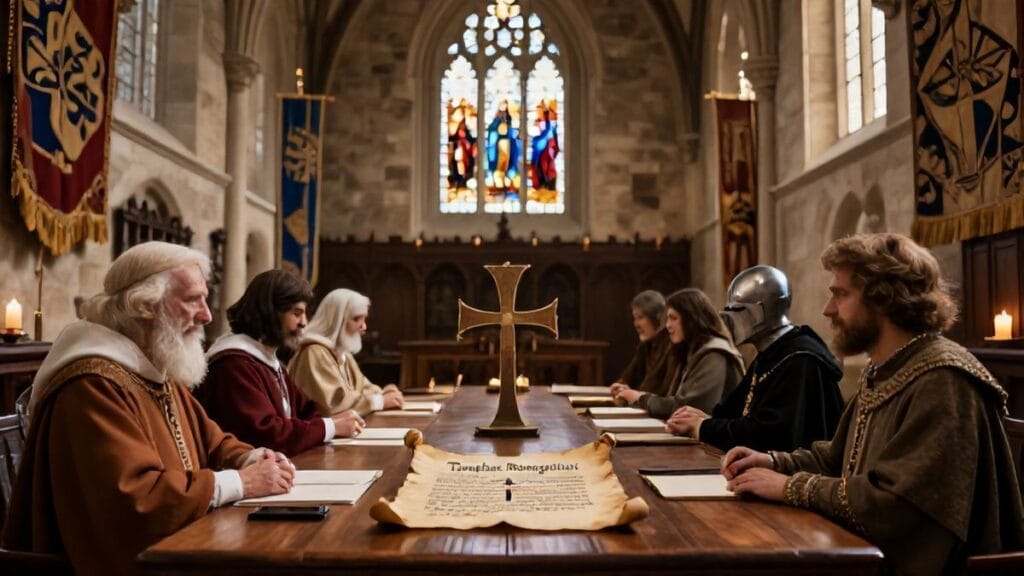
Imagine the hall where they gathered. Torches flickered, casting wavering light on tapestries and bare stone. Benches creaked under the weight of men wrapped in thick cloaks against the cold. At the center, near a simple table stacked with parchment and inkwells, sat the presiding dignitaries: bishops, archbishops, papal legates, and prominent abbots. Though the exact list of attendees is reconstructed from later accounts, we know that this was a gathering of considerable weight in the ecclesiastical hierarchy.
Chief among the influential figures was Bernard of Clairvaux. Not yet the older, weary man of later years, in 1129 he was a relatively young abbot, but his reputation already extended across Europe. Founder of the Cistercian abbey of Clairvaux, Bernard lived a life of radical austerity—thin, intense, driven by a sense of divine mission. His words carried moral authority. When he spoke, kings listened, and when he wrote, his letters traveled like sparks along the dry grass of Christendom, igniting movements and reforms.
Bernard did not preside as pope or patriarch; he was, formally, an abbot among others. Yet his influence at Troyes was palpable. He had already taken a personal interest in the Templars, listening to Hugues de Payns and pondering the theological and practical implications of their vocation. Church leaders trusted his judgment. As one medieval chronicler would later observe, Bernard’s support for the Templars was decisive—“it was his approval that persuaded many hesitant hearts.”
Around him sat other luminaries: perhaps the Archbishop of Sens, regional bishops from Rheims and Chartres, and abbots from major monasteries. Representatives of the papacy ensured that whatever was decided bore the stamp of Rome’s authority. Lay nobles may have been present as well, not as voting members, but as interested observers and patrons. Count Thibaut of Champagne, whose domains hosted the council, would have had every reason to appear, if only to signal his support and to observe the proceedings that might elevate his county’s profile.
Among these high-placed figures, the Templars themselves must have seemed almost shockingly modest. Hugues de Payns and a few companions, worn by travel and service, stood before the council as supplicants. They brought no army, no glittering retinue, only a case to be made and a hope that Christendom’s leaders would see in their rough experiment something worth preserving. In this convergence of austere monk, worldly bishop, ambitious count, and battle-scarred knight, the tension and possibility of the age were distilled.
Silences, Whispers, and Testimonies: How the Templars Made Their Case
The records of the council’s discussions have not survived in full detail. We must reconstruct the scene from later documents and from what we know of ecclesiastical practice. Councils functioned through a mixture of formal sessions and informal conversations—speeches, interrogations, readings of documents, and quiet discussions over meals or in side rooms. The Templars would have had to explain, again and again, how they lived and what they sought.
Hugues de Payns likely spoke of the origins of the brotherhood: of their vows, their quarters on the Temple Mount, their service to pilgrims. He would have described attacks on caravans, the corpses of travelers abandoned on desolate roads, and the fear felt by men and women walking in the shadow of ambush. He may have recounted specific battles, moments when Templar horses charged to break a raiding party or drove back enemy scouts. These were not tales of chivalric glory, but of hard, necessary work in a contested land.
But the council was not merely interested in battlefield stories. The bishops and abbots wanted to know: How do you pray? How do you eat? How do you sleep? What is your daily rhythm? How do you handle anger, pride, and desire—those temptations that haunt every Christian, but are sharpened in men who carry weapons? They would probe the Templars’ obedience: To whom were they accountable? How did they resolve disputes among themselves? What penances did they impose for sin?
Silences in such questioning could be perilous. If the Templars could not answer clearly, or if their answers sounded too improvised, the council might judge them unfit for formal recognition. Yet they had prepared. Whether by their own initiative or with help from sympathetic clerics, they came with an emerging pattern of life, a nascent rule that could be refined. They knew that, to survive, they had to become legible to the Church—translated from a band of zealots into a religious order.
Behind the public sessions, whispers would have carried along the corridors of the episcopal residence. Some churchmen may have doubted whether knights could truly live chastely. Others may have disliked the idea of granting papal privileges to an order that might slip beyond local control, threatening episcopal authority. On the other hand, many must have recognized the practical necessity of having disciplined, pious warriors in the Holy Land. As the chronicler William of Tyre would later write, the Latin states could not endure without such military orders to stiffen their defenses.
Amid these doubts and hopes, Bernard of Clairvaux’s opinion would have been sought. His eventual treatise in praise of the Templars, “De laude novae militiae” (In Praise of the New Knighthood), was likely already taking shape in his mind, even if it would be written after the council. In it, he would contrast the vanity and brutality of secular knights with the humble courage of these new warriors of Christ. “They fear neither men nor demons,” he wrote, “for their whole hope is in the Lord” (a later citation preserved in Cistercian collections). That sentiment must have been born, in part, from what he heard and saw at Troyes.
Drafting a New Rule: Monks with Swords
The centerpiece of the council of troyes 1129 was the creation and approval of a formal rule for the Knights Templar. In medieval Christianity, a rule was not merely a set of guidelines; it was the backbone of a spiritual community, shaping every aspect of life from the grand to the mundane. The Rule of Saint Benedict governed countless monasteries; the new Cistercian order had emerging statutes adapted to their rigorous vision. Similarly, the Templars needed a rule that would anchor them firmly in the Church’s legal and spiritual framework.
The rule drafted and approved at Troyes, later preserved in Latin and translated into vernacular languages, bore the marks of collaboration. It drew on existing monastic traditions, particularly the Benedictine and Cistercian models, while incorporating the unique needs of a military vocation. The opening clauses insisted on obedience, poverty, and chastity. The Templars were to live in community, own no private property, and submit to their superiors. They were to pray regularly, attend the liturgy when possible, and maintain a spirit of humility.
And yet, woven through this monastic fabric were threads of steel. The rule recognized the realities of warfare. It permitted the carrying of arms, the training of horses, the maintenance of armor. It prescribed discipline in battle: no knight was to flee as long as even a small standard-bearer held fast. Cowardice, disobedience, or reckless pride on the field could be punished severely, up to expulsion. The Templars were to fight not for personal glory, but in a spirit of ordered, sacrificial service.
Sumptuary regulations within the rule are particularly revealing. The brothers were to dress plainly, in white mantles symbolizing purity, without ostentatious decoration. Their food was to be simple, though sufficient to sustain men engaged in hard physical exertion. Hunting for sport was forbidden; their energies were to be directed toward their mission, not dissipated in aristocratic pastimes. Even the care of horses was regulated, reminding them that their mounts were tools for service, not status symbols.
In this way, the council of troyes 1129 did something genuinely unprecedented. It did not simply bless an existing custom; it constructed a new institutional form, fusing elements once thought incompatible. The written rule gave the Templars a fixed identity and a charter for expansion. It told recruits what they were joining, donors what they were supporting, and critics what standards to hold the order to. That the rule survived, copied and adapted, and is still studied by historians today, testifies to the lasting impact of the council’s work.
Bernard’s Pen and God’s Will: Ideology Behind the Templars’ Approval
Theological justification was essential. The Church could not simply approve a new kind of knighthood because it was useful; it had to demonstrate that such warriors were compatible with the Gospel. Bernard of Clairvaux became the architect of this ideological framework. He framed the Templars not as an anomaly, but as a remedy for a world in crisis—a world in which ordinary knights had grown corrupt, violent, and vain.
In his later treatise praising the order, written in the wake of the council, Bernard would draw sharp contrasts. Secular knights, he wrote, decorated their armor, curled their hair, and rode into battle for fame and booty. They killed for pride, and their souls were in peril. The Templars, by contrast, fought under obedience, with consciences cleansed by confession, seeking not booty but the protection of the weak and the defense of the Church. Killing under such conditions, Bernard argued, could be not only permissible, but meritorious. “The knight of Christ,” he wrote, “may kill with confidence and die yet more with confidence, for when he dies it is for himself, and when he kills it is for Christ” (a passage preserved in later Cistercian manuscripts).
Such statements may shock modern sensibilities, but in Bernard’s logic, they resolved a pressing dilemma: how to integrate the warrior aristocracy into Christian life without condoning unrestrained violence. The Templars were cast as instruments of divine justice, bound by vows that tamed their impulses and focused their force. Their poverty and communal life distinguished them from worldly knights, while their readiness to die in battle linked them to the martyrs of old.
This ideology also served political ends. By endorsing the Templars, Bernard offered princes and nobles a way to participate in the defense of the Holy Land without abandoning everything. They could support the order with donations, lands, and privileges, channeling their wealth into a cause sanctioned by the Church. In turn, they gained spiritual benefits—prayers, memorials, and the satisfaction of seeing “their” knights fight under a holy banner.
The council of troyes 1129 thus became not only a legislative assembly, but an ideological workshop. Bernard and his allies forged a language in which war could be sanctified without collapsing into mere holy fury. The Templars were to be disciplined, not fanatical; obedient to the Church, not rogue crusaders. Whether reality always matched this ideal is another question, but at Troyes, the vision was clear: a new militia, ordered by a new theology, standing between Christendom and its enemies.
Champagne’s Political Gamble: Local Ambition and International Power
While theologians and canon lawyers shaped the Templars’ rule, the secular lords of Champagne watched with shrewd interest. For Count Thibaut and his circle, the council was not only about piety; it was about power and prestige. By hosting the council and supporting the Templars, Champagne positioned itself as a key player in the crusading movement and in the Church’s reform agenda.
Local ties to the order deepened this connection. Hugues de Payns, as a native or at least a long-standing vassal in the region, linked the destiny of the Templars to Champagne’s nobility. Other Champenois knights followed him into the brotherhood, and local families made some of the earliest donations of land and rights in the West. Templar houses—preceptories—would soon begin to appear across the county, managing estates, collecting rents, and sending revenues eastward.
Politically, this was a gamble with potential dividends. If the Templars flourished, Champagne would be seen as their cradle, the land that produced and nurtured them. Pilgrims and crusaders might pass through its territory, increasing traffic and trade. The count could leverage his association with the order in negotiations with kings and neighboring princes. Moreover, by showing himself a friend of reformers like Bernard of Clairvaux, Thibaut reinforced his image as a modern, pious ruler.
Yet there were risks. The more powerful and independent the Templars became, the more they could complicate local politics. Exempt from certain taxes and ecclesiastical jurisdictions thanks to papal privileges, they could become a law unto themselves in matters of property and justice. For now, in 1129, such worries were distant. The order was still small, and its dependence on patrons like the counts of Champagne was obvious. But in the faint outline of future conflicts, one can see how decisions made at Troyes set the stage for both cooperation and tension.
For the moment, however, Champagne basked in the council’s glow. The county’s name traveled with news of the Templars’ recognition. Merchants at the fairs might hear of it from distant visitors; monks copied the acts of the council and sent them to other monasteries. In an age when reputation and memory were as valuable as coin, Troyes had secured a place in the annals of Christendom.
Knights of the Temple Take Flight: Consequences Across Christendom
Once the council of troyes 1129 had concluded its deliberations, once the rule had been approved and the Templars officially recognized as a religious order, the consequences spread with remarkable speed. What had been a fragile brotherhood gained a powerful legal and spiritual foundation. Men could now join the order knowing that their vows were valid in the eyes of the Church. Donors could give generously, confident that their gifts served a cause endorsed by bishops, abbots, and papal representatives.
Across France, England, the Iberian Peninsula, and parts of the German lands, Templar houses began to appear. Some were modest—just a few buildings on a donated estate, where brothers managed fields and livestock. Others, near major roads or ports, grew into significant centers of administration. In Jerusalem and the broader Latin East, reinforcements arrived: not only new knights, but also sergeants, squires, and support personnel. The order’s presence alongside the king of Jerusalem and other crusader lords became increasingly visible.
The Templars’ function on the battlefield evolved as well. No longer merely escorts for pilgrims, they became a disciplined heavy cavalry force, often placed in the vanguard of crusader armies. Chronicles would later describe their charges with a mixture of awe and horror, as lines of white-mantled horsemen crashed into enemy formations with unwavering determination. Their rule’s insistence on discipline—no fleeing unless heavily outnumbered, absolute obedience to the marshal’s commands—made them more reliable than many feudal levies, whose loyalty was often divided by personal ambitions.
This new role had broader implications. Crusading itself began to change under the influence of military orders like the Templars. Campaigns could be planned with the assumption of a permanent, professional core of fighters who did not disperse when the harvest season came or when a lord’s obligations expired. Defense of key fortresses, patrols of frontier zones, and rapid response to raids became more feasible. The Latin states in the East, though still vulnerable, gained a hardened spine.
Back in Europe, the Templars’ recognized status opened doors that would lead them far beyond their original mandate. Kings entrusted them with treasures and sensitive missions. Pilgrims and crusaders deposited valuables with them, retrieving equivalent sums at distant destinations. Although the order’s reputation for sophisticated finance belongs more to the later twelfth and thirteenth centuries, the seeds were planted in the decades after Troyes. Recognition made trust possible, and trust made new forms of economic activity conceivable.
Pilgrims, Peasants, and Princes: How Ordinary Lives Were Touched
It is tempting to see the council of troyes 1129 as a purely elite event—a matter of bishops, abbots, and knights. Yet its decisions rippled outward into the lives of people who would never read a rule or set foot in a council chamber. For pilgrims, the impact was immediate and tangible. Knowing that armed, vowed warriors patrolled certain routes to Jerusalem offered a measure of comfort. Inns and staging posts associated with the Templars developed along major paths, providing a semblance of security in an otherwise frightening journey.
For peasants in Champagne and other regions, the presence of Templar estates altered local rhythms. When a noble donated land to the order, tenants might find themselves answering to new lords—lords who were celibate, lived in community, and reported to distant masters in Jerusalem or Paris. In some cases, the Templars might introduce more systematic management, improving yields and infrastructure. In others, their exemption from certain obligations could create friction with neighboring lords or churches, drawing villagers into conflicts they barely understood.
Princes and kings, for their part, learned to reckon with the order as a semi-independent power. A ruler might grant the Templars privileges to secure their support in war or to claim a share in the spiritual aura surrounding them. In return, he received experienced fighters and access to a network that spanned Christendom. But such alliances could sour. If a king sought to tax the order heavily or to control its internal appointments, papal protection might shield the Templars, provoking resentment.
The council’s decision also affected families at an intimate level. When a younger son chose to enter the Templars instead of marrying, inheritance patterns shifted. Sisters, widows, and mothers appeared in charters as donors, giving land in memory of the dead or in hope of heavenly reward. Their names, often otherwise lost to history, are preserved alongside the crosses and seals of the order. Through such acts, the story of Troyes reached into village churches, rural manors, and quiet domestic grief and hope.
The social consequences were thus complex: new opportunities for pious patronage, new tensions over jurisdiction and privilege, new models of masculine identity where knighthood and monasticism intertwined. The council of troyes 1129 may have been an elite stage, but its script was played out in countless ordinary lives.
Gold, Credit, and Stone: The Economic Legacy of a Council’s Decision
Over the ensuing decades, the Templars became not only warriors and landlords, but also crucial intermediaries in the movement of money. The recognition granted at Troyes, reinforced by subsequent papal bulls, allowed them to accumulate property across Europe and to operate with a degree of autonomy that made them attractive partners for rulers and merchants. The order’s international network—houses in England, France, Iberia, and the East, all bound by a common rule and hierarchy—was perfectly suited to the needs of a slowly globalizing medieval economy.
Pilgrims, for example, could deposit funds with a Templar house in their homeland and receive a kind of draft or token that could be redeemed at a Templar establishment near Jerusalem. Such arrangements reduced the risk of robbery on the road. Kings used the order as a secure repository for royal treasures or as intermediaries for payments to distant allies and mercenaries. As historian Malcolm Barber notes in his study of the Templars, by the thirteenth century they were “bankers to kings,” though always within the constraints and ethical frameworks of their religious status.
Closer to Troyes, the order’s estates contributed to the transformation of the landscape. Fields were cleared, mills constructed, churches built or improved. Stone, timber, and labor flowed through Templar hands, leaving physical traces that can still be glimpsed in ruins and place names. Their economic activity was not unique—other monastic orders, such as the Cistercians, also played a major role in rural development—but the Templars combined agricultural management with a military and financial vocation that made their presence distinctive.
This economic power brought both admiration and envy. Some saw the Templars as efficient managers and generous supporters of local churches. Others accused them of arrogance and greed, pointing to their privileges and extensive holdings. Criticism would grow over time, especially as the original urgency of the crusades waned and the order’s wealth appeared increasingly disconnected from its founding purpose. But all of this—both prosperity and backlash—can be traced back, in part, to that moment in Troyes when a council authorized the order’s expansion and endowed it with a secure identity.
From Troyes to the Wider World: The Order’s Expansion and Myth-Making
The formalization of the Templars at the council of troyes 1129 gave chroniclers and storytellers a solid foundation for their narratives. No longer did they have to speak of an obscure band of knights in vague terms. They could describe a recognized order with a rule, a hierarchy, and a clear mission. Over time, stories of Templar exploits—both real and imagined—multiplied.
In the Holy Land, their role in battle became a staple of crusade chronicles. Authors like William of Tyre, writing later in the twelfth century, praised their courage while occasionally criticizing their rigidity or political entanglements. In Western Europe, poems and tales invoked their name as a symbol of stern piety and martial valor. Popular imagination began to surround them with an aura of mystery: what did they do in their fortified houses? What secret rituals accompanied their vows and promotions? Official documents give little support to extravagant legends, but the very combination of monastic secrecy and military might invited speculation.
The myth-making around the Templars was not confined to the Middle Ages. Centuries later, writers of the Enlightenment, Romantics, and modern novelists would project onto them fantasies of hidden knowledge, buried treasures, and clandestine conspiracies. Yet beneath these accretions, the historical reality of their birth remains anchored in the council of Troyes: a public, documented, ecclesiastical act. As one modern historian, Alain Demurger, has emphasized, the Templars were “children of the Church” before they were ever figures of legend, shaped by canonical rules and theological debates, not by secret plots.
Still, the mythic dimension cannot be entirely dismissed. Part of the council’s long-term legacy lies in the way it helped create an order that seemed to stand at the threshold between worlds: East and West, war and prayer, visible power and hidden discipline. People then, as now, were drawn to such liminal figures. The Templars’ white mantles suggested purity; their swords, deadly strength. That combination captured imaginations from Troyes to Jerusalem and beyond.
Echoes of Doubt: Early Suspicions and Theological Debates
Despite the council’s endorsement, not everyone was fully at ease with the idea of monk-knights. Theological debates about violence, property, and clerical purity continued to swirl. Some clerics worried that allowing an armed religious order might blur the boundaries between sacred and profane too dangerously. Others feared that too many resources—land, tithes, and privileges—would be diverted to an institution that, however holy its intentions, remained deeply entangled with warfare.
There were also concerns about the Templars’ internal life. Could they truly maintain chastity, living as men among men, sometimes far from the oversight of bishops and abbots? Would their poverty remain real, or would the order as a whole grow rich while individual brothers claimed personal modesty? The council of troyes 1129 had tried to address these issues through the rule, but rules are one thing, practice another.
Over time, critics emerged who accused the order of arrogance, of harshness toward locals in the East, or of meddling in political affairs beyond their remit. Some of these complaints may have been justified; others were born of jealousy or frustration. The very privileges granted at Troyes and by subsequent papal bulls—exemption from certain episcopal courts, the right to collect alms, the ability to build their own chapels—could be perceived as threats by local church authorities who saw their own jurisdiction eroded.
Nevertheless, in the decades immediately following the council, such criticisms remained secondary to the urgent need for defense in the Holy Land. The Templars’ usefulness shielded them. The Church’s endorsement was firm, and their image among laypeople, especially those inspired by crusading ideals, remained largely positive. Doubts lingered, but they did not yet overshadow the order’s mission.
Distant Thunder: How 1129 Foreshadowed the Templars’ Fall
From the perspective of later centuries, it is difficult not to see in the council of troyes 1129 the seeds of both the Templars’ greatness and their destruction. The very features that made them powerful—international reach, economic strength, papal protection, and a unique ideological aura—would later make them vulnerable when political winds shifted. The council had set them on a path that led, two hundred years later, to the dungeons of Paris and the pyres of 1314.
By giving the Templars institutional form and papal favor, Troyes helped them grow beyond the control of any single king. That transnational character was an asset while Christianity remained united in common crusading purpose. But as dynastic rivalries intensified and crusading zeal waned, a wealthy, autonomous military order could appear more like a rival than an ally to rulers jealous of their authority. When King Philip IV of France, deeply indebted and hungry for centralized power, turned against the Templars, he exploited all the latent suspicions their privileges had long inspired.
Of course, the fathers of the council could not have foreseen such a fate. They acted in response to the needs of their own time, trying to balance piety, practicality, and reform. Yet their decisions created structures that outlived the conditions that had originally justified them. The rule, the exemptions, the networks of property and houses—these continued even as the strategic situation in the Holy Land deteriorated and, eventually, collapsed with the fall of Acre in 1291.
If one listens carefully, the distant thunder of later accusations—the charges of heresy, idolatry, and corruption brought against the Templars in the fourteenth century—echo faintly back to Troyes. The council had proclaimed them holy warriors, paragons of a new knighthood. When that sanctity was later called into question, the fall from grace was all the more dramatic. The higher the ideal, the more spectacular the failure appears when painted by enemies.
Remembering a Winter Council: Historians, Legends, and Memory
Today, the council of troyes 1129 rarely appears in popular accounts with the same prominence as the First Crusade or the Templars’ dramatic suppression. Yet historians recognize it as a decisive moment—the birth certificate of an order that would leave deep imprints on medieval society. Scholarly works, from the classic studies of R. H. C. Davis to more recent syntheses by Malcolm Barber and Alain Demurger, return again and again to Troyes as the point where scattered initiatives coalesced into a coherent institution.
Reconstructing the council’s proceedings is an act of careful detective work. Surviving versions of the Templar rule, references in contemporary letters, and later chronicles all contribute pieces of the puzzle. The original minutes are lost, like so many medieval documents, to fire, neglect, or the slow erosion of time. Yet enough remains to paint a vivid, if incomplete, picture: bishops in winter cloaks, monks arguing fine points of discipline, knights waiting anxiously for a verdict that would define their lives.
In Troyes itself, the memory of the council is not always front and center amid the city’s modern life. Tourists come for the half-timbered houses, the stained glass of its churches, and the charm of its old streets. Yet beneath their feet lies a history in which merchants, monks, and warriors once converged to debate the future of Christendom. The County of Champagne that hosted the council has long since been absorbed into the French state, its counts and bishops forgotten by most. But the name “Templar” remains widely recognized, a testament to the enduring fascination sparked by that long-ago winter decision.
Between scholarly reconstructions and popular myths, the truth of the council of Troyes stands as something both modest and immense. Modest, because it was one council among many, concerned with technical matters of rule and discipline. Immense, because its outcome helped shape institutions, mentalities, and conflicts across three continents. To remember Troyes is to remember that great historical changes often begin not with battles or coronations, but with slow, careful conversations under dim torchlight, as men try to translate conviction into law.
Conclusion
In the quiet cold of early 1129, the city of Troyes hosted an event whose consequences would reverberate through centuries: the council that transformed a small, precarious brotherhood of warrior-monks into the Order of the Temple. Within the council hall, bishops, abbots, and papal envoys listened to the testimony of Hugues de Payns and his companions, weighed theological arguments, and labored over the clauses of a rule that would fuse monastic rigor with martial necessity. The county of Champagne, with its ambitious rulers and thriving fairs, provided not only a physical stage, but also a political and social environment ripe for such an experiment.
By recognizing the Templars and approving their rule, the council of troyes 1129 accomplished several things at once. It offered a spiritual home to knights seeking holiness without abandoning their vocation to fight. It gave the fragile Latin states in the Holy Land a disciplined military backbone. It created an institution whose international network would shape medieval economies and politics in ways few could have foreseen. The council channeled the restless energy of Christendom’s warrior class into a new, highly structured form that promised, at least in theory, to align the sword with the cross.
Yet the very strengths bestowed at Troyes—autonomy, wealth, prestige—contained the seeds of future conflict. As circumstances changed and crusading ideals dimmed, the Templars’ privileges and power would provoke resentment and fear, culminating in their brutal suppression two centuries later. In this sense, Troyes was both a beginning and a prophecy. It reminds us that institutions are born in specific historical moments, but they rarely remain perfectly adapted to the worlds they inherit later.
To revisit the council today is to see how deeply intertwined faith, politics, and human ambition were in the medieval imagination. The men who gathered in Troyes did not think of themselves as making “history” in our sense; they sought solutions to urgent problems of piety and security. Yet their choices shaped the fates of pilgrims and peasants, princes and preachers, from Champagne to Jerusalem. In that winter hall, under the watchful eyes of God and men, a new order stepped into the light, carrying with it the hopes and contradictions of an age.
FAQs
- What was the main purpose of the council of Troyes in 1129?
The primary purpose of the council of Troyes in 1129 was to examine, legitimize, and formally organize the Knights Templar as a religious order. Church leaders evaluated the Templars’ way of life, clarified their spiritual and military roles, and approved a written rule that defined their vows, discipline, and relationship to the wider Church. - Who played the most influential role in the council’s decision about the Templars?
Bernard of Clairvaux, the Cistercian abbot, was the most influential figure in shaping opinion at the council. His moral authority, reputation for holiness, and later treatise “In Praise of the New Knighthood” provided a powerful theological justification for the idea of monk-knights and helped secure broad acceptance of the Templars. - Why was Troyes, in the County of Champagne, chosen as the council’s location?
Troyes was chosen because it was an important ecclesiastical and commercial center within the ambitious County of Champagne. The local bishop could host a major gathering, the city had the infrastructure to accommodate attendees, and the county’s rulers were eager to enhance their prestige by supporting crusading and Church reform. The personal ties of Hugues de Payns and other early Templars to the region also made Troyes a natural choice. - What exactly did the council decide about the Knights Templar?
The council recognized the Knights Templar as an official religious order of the Church and approved a Latin rule outlining their way of life. This rule required vows of poverty, chastity, and obedience, communal living, and regular prayer, while explicitly allowing them to bear arms and fight in defense of pilgrims and the Holy Land. The decision gave the order legal status, spiritual legitimacy, and a basis for expansion. - How did the council of Troyes 1129 affect the later power of the Templars?
The council’s approval laid the foundation for the Templars’ rapid growth in wealth, influence, and international reach. With formal recognition, they could receive donations of land and money across Europe, recruit members confidently, and act as trusted agents for kings and pilgrims. Over time, this led to considerable economic and political power, which later contributed both to their central role in crusading and to the suspicions that fueled their downfall. - Did ordinary people feel the effects of the council’s decision?
Yes. Pilgrims benefited from increased security on routes to Jerusalem, thanks to the Templars’ patrols and houses. Peasants living on lands donated to the order found themselves under new lords, with changes in rent, obligations, and local justice. Nobles and townspeople gained new forms of pious patronage, donating to Templar houses in hopes of spiritual benefits. Over time, the order’s estates and financial activities helped reshape local and regional economies. - How reliable are our sources about the council of Troyes?
Our knowledge comes from later copies of the Templar rule, references in contemporary and near-contemporary chronicles, and some papal and episcopal documents. The original minutes of the council are lost, so historians must reconstruct events indirectly. While details of speeches and debates are uncertain, the fact of the council, its broad decisions, and the contents of the approved rule are well established. - Did other military orders receive similar recognition later?
Yes. Following the template established for the Templars, other military orders—most notably the Hospitallers (Order of Saint John) and the Teutonic Knights—received official recognition and rules from the Church. The precedent set at Troyes made it easier to imagine and institutionalize armed religious orders as a legitimate part of Christendom’s response to external threats.
External Resource
Internal Link
Other Resources
- Encyclopaedia Britannica – general search for the exact subject
- Google Scholar – academic search for the exact subject
- Internet Archive – digital library search for the exact subject

