Table of Contents
- A pivotal gathering in Constantinople: The Council of Trullo convenes, 692
- The twilight of an empire: Context before the Council
- Justinian II and the shaping of imperial authority
- The legacy and limitation of the Fifth and Sixth Ecumenical Councils
- Calling the Council of Trullo: aims and expectations
- Constantinople as a crucible for ecclesiastical power
- The composition of the Quinisext Council: Participants and roles
- Liturgical uniformity and canonical discipline: urgent topics on the table
- Clash of traditions: Eastern customs against Western practices
- The canons of Trullo: law, language, and life in the Church
- Controversies ignited: Marriage, clerical discipline, and feast days
- The council’s stance on clerical celibacy and the married priesthood
- The confrontation with Rome: Pope Sergius I’s rejection and aftermath
- The wider political implications: Byzantine Church and State entanglement
- Reception across Christendom: Byzantium, Rome, and the western world
- Long-term religious and legal impacts of the Quinisext Canons
- The Council of Trullo as a mirror to Byzantine society and governance
- Liturgical reforms shaping Orthodox rites for centuries
- The Council’s canonical legacy in Eastern Orthodox canon law
- Memory and historiography: The Council’s place in ecclesiastical history
- Reflections on authority: The clash between imperial and papal power
- Conclusion: Echoes of the Council of Trullo in modern Christianity
- FAQs: Unraveling the mysteries of the Quinisext Council
- External Resource
- Internal Link
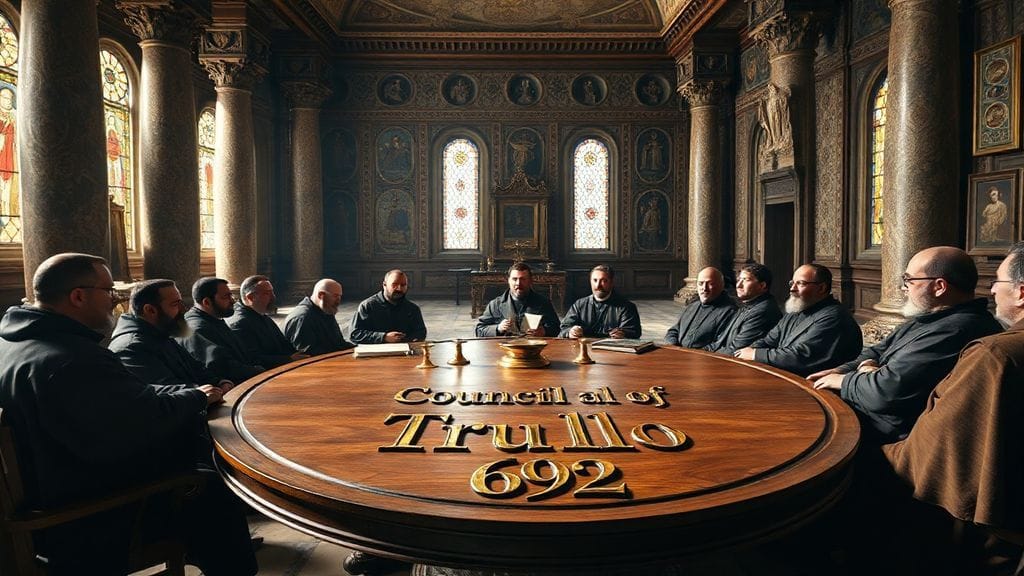
The summer of 692 in Constantinople was not marked by the calmness of the Mediterranean sun alone, but by the gathering voices and rustling robes of bishops, monks, and imperial officials. They assembled within the venerable walls of the Hippodrome — transformed into an arena not of chariot races but of theological and juridical contestation. The air was heavy with anticipation, tension, and the unmistakable aura of momentous decisions about to be etched into the annals of Christian history. The Council of Trullo, also known as the Quinisext Council, was convened under the patronage of Emperor Justinian II. This assembly would become both a legal codex and a battleground for the soul of Christendom, wrestling with the complex and delicate questions that had eluded resolution in previous ecumenical councils.
No mere theological symposium, the Council’s canons would bind the ecclesiastical law of the Eastern Orthodox Church for centuries; yet, paradoxically, it would deepen the chasm between East and West, planting ideological seeds that would sprout into centuries of ecclesiastical discord. But why did such an ostensibly legalistic council carry such profound implications? To understand the gravity of the moment, one must journey back through the turbulent decades that led Constantinople’s rulers and bishops to call for this extraordinary assembly — an event where canon law, imperial ambition, and religious identity collided under the shadow of a fracturing empire.
The twilight of an empire: Context before the Council
By the late 7th century, the Byzantine Empire was struggling to redefine itself amid internal instability and external threats. The political landscape was turbulent: the persistent loss of territories to Islamic conquests, looming Lombard pressure in Italy, and Slavic incursions in the Balkans strained imperial control. Internally, the delicate balance between Church and State was in flux. While Eastern Christianity had become intricately entwined with Byzantine imperial ideology, tensions simmered beneath the surface. The religious landscape was also complex — theological disputes from previous centuries lingered, and differences in liturgical practice and canon law between the East and West threatened ecclesiastical unity.
Emperor Justinian II, whose reign was marked by ambition and turbulence, seized upon ecclesiastical reform as a tool to strengthen imperial cohesion. After his restoration to power in 705, he sought to consolidate his authority not only politically but through religious institutions—hoping to enforce a uniform discipline that aligned with Byzantine doctrine and culture. Yet before Justinian II’s second reign, the seeds of this reform agenda were already planted.
Justinian II and the shaping of imperial authority
Justinian II, often remembered for his dramatic rise, exile, and violent return, was a figure emblematic of the era’s volatility. His first reign (685-695) ended in violent overthrow; he reclaimed the throne in 705 with a thirst for retribution and reform that would push the empire’s institutions toward unprecedented centralization. The religious dimension was crucial: Justinian II saw the Church as an indispensable pillar of imperial ideology and legitimacy. It was under his influence that the Council of Trullo was summoned around 692, initially during his first reign, to fill the gaps left by the Fifth and Sixth Ecumenical Councils — particularly in matters of canon law and ecclesiastical discipline.
The legacy and limitation of the Fifth and Sixth Ecumenical Councils
The Fifth (Constantinople II, 553) and Sixth (Constantinople III, 680-681) Ecumenical Councils had resolved key Christological controversies — but had left many canonical and disciplinary issues unresolved. Eastern bishops felt a pressing need to supplement these decisions with clearer regulations. The aim was to codify laws on clerical marriage, fasting, liturgical practices, and administrative jurisdiction — areas perennially fraught with local customs and theological ambiguity.
But Western Church authorities viewed these councils and their corollaries with suspicion; indeed, the Quinisext labeling reflects that the Council was meant to act as a kind of "Fifth and Sixth" Ecumenical Council supplement — hence “Quinisext” — to address canonical issues bypassed previously.
Calling the Council of Trullo: aims and expectations
The Council was called under imperial auspices primarily to finalize and codify ecclesiastical canons that previous councils had neglected. The name “Trullo” derives from the domed hall (trullus in Latin) in the imperial palace complex where the council met — a symbol not only of the authority of the emperor but of the intimate fusion of imperial and ecclesiastical power. The summons reflected a desire for clarity and unity in practice: to eliminate ambiguity in discipline and rites, to punish clerical transgressions effectively, and to draw firmer lines around orthodox belief and conduct.
But the Council was more than a technical exercise. It became a statement of Byzantine ecclesiastical identity and authority — an assertion that Constantinople and its patriarchs could set ecclesiastical norms independent of Rome’s influence.
Constantinople as a crucible for ecclesiastical power
The city of Constantinople was more than a backdrop; it was an active participant in the religious drama unfolding. Founded by Constantine the Great as “New Rome,” it had inherited and transformed Roman imperial and theological legacies. The patriarchate of Constantinople, now rivaling Rome, saw itself as the custodian of orthodox tradition. The Quinisext Council became an assertion of the city’s theological, liturgical, and canonical sovereignty, one intended to underscore the Eastern Church’s independence and distinctive character.
The composition of the Quinisext Council: Participants and roles
Hundreds of bishops and clerics gathered in the Trullo dome, most from the eastern provinces, including Anatolia, Syria, and parts of the Balkans untouched by Islamic advances. Western bishops notably did not participate, a silence that spoke volumes on the limits of ecclesiastical consensus. The imperial chancery tightly controlled access, underscoring the political stakes. The attendees debated vigorously yet with the goal of unanimity on the canons they would issue.
Their diverse backgrounds — monastic leaders, parish bishops, imperial officials — ensured that the documents would touch all facets of ecclesiastical life.
Liturgical uniformity and canonical discipline: urgent topics on the table
The council addressed a wide range of issues, but two themes stood out: the urge to standardize liturgical practices throughout the Byzantine world, and to impose stricter discipline upon the clergy. Among these were fasting rules, observance of feast days, the status of different types of clergy, marriage for clerics, and even funeral rites. The Quinisext Canons aimed to resolve the confusion wrought by centuries of local variation, presenting an authoritative “Byzantine way” of Christian life.
Clash of traditions: Eastern customs against Western practices
One of the Council’s most explosive elements was its frank disagreement with certain Roman practices. Among the canons that caused stir was the rejection of the Western custom of clerical celibacy beyond certain bounds, compliance with fasting traditions particular to Rome, and particular interpretations on liturgical calendar differences. Eastern bishops insisted on maintaining customs that Western counterparts regarded as irregular or even heretical.
This divergence illuminated a growing ecclesiastical divide that foreshadowed the Great Schism centuries later.
The canons of Trullo: law, language, and life in the Church
The Council issued 102 canons covering doctrinal, disciplinary, and administrative matters. These ranged from forbidding female deacons (widowhood as an exception), to rules about liturgical music, procedures for clergy ordination, and penalties for simony. A striking trait was their pragmatic approach, often tackling issues rarely addressed explicitly before.
Language played a subtle role: Greek was the lingua franca here, solidifying the council’s orientation toward an Eastern Orthodox identity distinct from Latin-speaking Rome.
Controversies ignited: Marriage, clerical discipline, and feast days
Perhaps the most hotly debated topics addressed marital status among clergy and fasting practices. The Council defended the then-current Eastern practices allowing married men to become priests (so long as they marry before ordination) but forbade clerical marriage after ordination. It also sharply criticized Western clergy’s insistence on complete celibacy and censured changes to fast days observed in Rome.
Feast days bearing local or Western origins were scrutinized, and the council emphasized adherence to the Eastern liturgical calendar.
The council’s stance on clerical celibacy and the married priesthood
The Council’s pragmatic stance on marriage—accepting married clergy but prohibiting marriage after ordination—highlighted the philosophical and theological rift between East and West. The Western Church increasingly championed clerical celibacy as a spiritual ideal and practical safeguard, while the Eastern Church maintained a more tolerant posture rooted in ancient tradition.
This fundamental divergence was a harbinger of the widening gulf between the Churches.
The confrontation with Rome: Pope Sergius I’s rejection and aftermath
Pope Sergius I refused to endorse the canons of the council, considering many contrary to Roman discipline and authority. The Quinisext Canons explicitly rejected some of the papal claims to primacy and upheld conciliarity within the Church—concepts challenging to Roman centralism.
This refusal deepened tensions between East and West, and while the council’s decisions were authoritative in the East, they were largely ignored or condemned in Rome.
The wider political implications: Byzantine Church and State entanglement
The Council of Trullo underscored the intimate relationship between the Byzantine emperor and the Church: an alliance where the emperor assumed the role of defender and legislator of faith. The canons reflected and reinforced imperial authority over ecclesiastical matters, blending religious legislation with secular governance. It was a reminder, too, that in Byzantium, religious unity was political stability.
This entanglement had consequences for both jurisdictional authority and the evolution of Eastern Orthodox ecclesiology.
Reception across Christendom: Byzantium, Rome, and the western world
While the Council’s canons became a foundational document in Eastern Orthodox canon law, they remained largely rejected or ignored in Western Christendom. Latin theologians and canonists viewed them with distrust, seeing them as assertions of East Roman ecclesiastical independence and challenges to papal supremacy.
Nonetheless, several of their rulings on discipline and administration influenced later Western reforms, albeit indirectly.
Long-term religious and legal impacts of the Quinisext Canons
Over centuries, the canons formed a core part of Eastern Orthodox canonical tradition, frequently cited and invoked as normative law. They influenced the shape of monasticism, clerical discipline, and local church governance. Their impact persists in Orthodox liturgy and church governance today.
Simultaneously, the Council’s open rebuke of Western practices symbolized an ecclesiastical boundary between Greek-speaking East and Latin-speaking West—boundaries that grew deeper with time.
The Council of Trullo as a mirror to Byzantine society and governance
In many ways, the Council of Trullo reflected the broader complexities of Byzantine society—where religion, law, and politics were inseparable threads weaving the imperial tapestry. Its canons are as much about social order and imperial self-fashioning as theological correctness. It reveals a world struggling to hold firm traditions yet accommodate new realities in a shrinking empire besieged by external and internal pressures.
Liturgical reforms shaping Orthodox rites for centuries
By standardizing a range of liturgical practices, the council established a Byzantine style of worship that elevated chant, ritual symbolism, and festal structure. This liturgical framework defined the spiritual landscape of Eastern Orthodoxy, fostering a distinct religious culture that endures.
The Council’s canonical legacy in Eastern Orthodox canon law
The Quinisext Council’s canons became foundational for canon law collections in the East, such as the Nomocanon, shaping Orthodox legal thought. It gave a measure of unity with lasting authority and became one of the few “ecumenical” councils recognized solely by the Orthodox Church.
Memory and historiography: The Council’s place in ecclesiastical history
Despite its significance, the council remains relatively obscure in broader Christian historiography, overshadowed by earlier ecumenical synods. Yet specialist scholarship views it as essential to understanding Byzantine ecclesiology, imperial theology, and the East-West divide.
Reflections on authority: The clash between imperial and papal power
The Council of Trullo epitomized the struggle for ecclesiastical primacy, where Byzantine emperors saw themselves as God’s representatives on earth, rulers of Church and State alike, while the popes insisted on spiritual supremacy. This fundamental tension reverberated through the medieval centuries and shaped the eventual crystallization of Eastern Orthodoxy and Roman Catholicism as distinct communions.
Conclusion
The Council of Trullo convened in 692 was far more than a theological footnote. It was a crucible where law, tradition, and authority intersected—where the Byzantine world sought to codify its spiritual life, defend its customs, and assert its independence from Roman influence. This richly complex council laid down legal and liturgical foundations that shaped Eastern Christianity for centuries, even as it fomented tensions that would contribute to the growing estrangement of East and West.
Walking through the solemn domed hall that day, one could feel a civilization grappling with its identity—discerning which ancient traditions to preserve, which reforms to pursue, and in whose hands the future would rest. The echoes of this moment resound still, in the liturgical chants of Orthodox cathedrals and in the enduring questions about the nature of ecclesiastical authority.
History has often been painted in sweeping strokes of battles and empires, but the Council of Trullo reminds us that the shaping of human belief and power can also be found in the delicate, determined crafting of law and faith beneath solemn domes. It reminds us of the fragile, messy, eternal human project of navigating unity and diversity—an endeavor as relevant today as it was in 692.
FAQs
Q1: What was the main goal of the Council of Trullo?
The Council sought to supplement the Fifth and Sixth Ecumenical Councils by establishing definitive canons on church discipline, liturgical practice, and clerical conduct—filling gaps and clarifying ambiguities in ecclesiastical law.
Q2: Why is the Council called “Quinisext”?
Because it was intended to act as a combined “Fifth and Sixth” Ecumenical Council, addressing issues not covered fully by those respective synods.
Q3: How did the Council’s decisions impact East-West relations?
Its canons sharply diverged from Roman practices, deepening theological and disciplinary differences and contributing to the eventual Great Schism.
Q4: Did the Western Church accept the Quinisext Canons?
No. Pope Sergius I rejected the council’s canons, viewing them as contrary to Roman tradition and papal authority.
Q5: What were some controversial canons in the Council?
They included defenses of married clergy in the East, rejection of clerical celibacy as imposed in the West, and varied liturgical fasting rules.
Q6: What role did Emperor Justinian II play in the Council?
As emperor, he initiated and supported the council to enforce religious unity that buttressed imperial authority.
Q7: Are the Quinisext Canons still relevant today?
Yes, they continue to influence Eastern Orthodox canonical law and liturgical traditions.
Q8: Why is the Council of Trullo less known than earlier Ecumenical Councils?
Possibly because it was not recognized by the Western Church and dealt primarily with disciplinary rather than doctrinal issues, making it more specialized in scope.