Table of Contents
- The Dawn of a Crusader State: Edessa in 1098
- The Geopolitical Crossroads of Upper Mesopotamia
- From Byzantine Borderland to Frankish Frontier: Background Context
- The First Crusade’s Eastern Campaign and the March to Edessa
- Baldwin of Boulogne: The Architect Behind the County’s Birth
- Negotiations, Sieges, and Alliances: The Path to Edessa’s Capture
- The Armenian Factor: Local Princes and the Dynamics of Power
- Edessa’s Strategic Significance for Crusaders and Muslims Alike
- Political Structures and Governance of the New County
- The Cultural and Religious Mosaic of Edessa under Frankish Rule
- Economic Foundations: Trade, Agriculture, and Tribute in Edessa
- Relations with Neighboring States: Byzantines, Seljuks, and Muslim Emirates
- Edessa as a Military Bulwark: Defense and Expansion
- Challenges of Legitimacy and Authority in a Fragile Principality
- The Legacy of Edessa in Crusader History and the Near East
- The Fall of Edessa (1144) and Its Impact on the Second Crusade
- Myth, Memory, and the Symbolism of Edessa in Western Christendom
- Archaeological and Historical Sources: Piecing Together Edessa’s Early Crusader Era
- Lessons from Edessa: Cultural Encounters and the Limits of Crusader Power
- Conclusion: The Enduring Echoes of Edessa’s Founding
- FAQs about the County of Edessa
- External Resource
- Internal Link
1. The Dawn of a Crusader State: Edessa in 1098
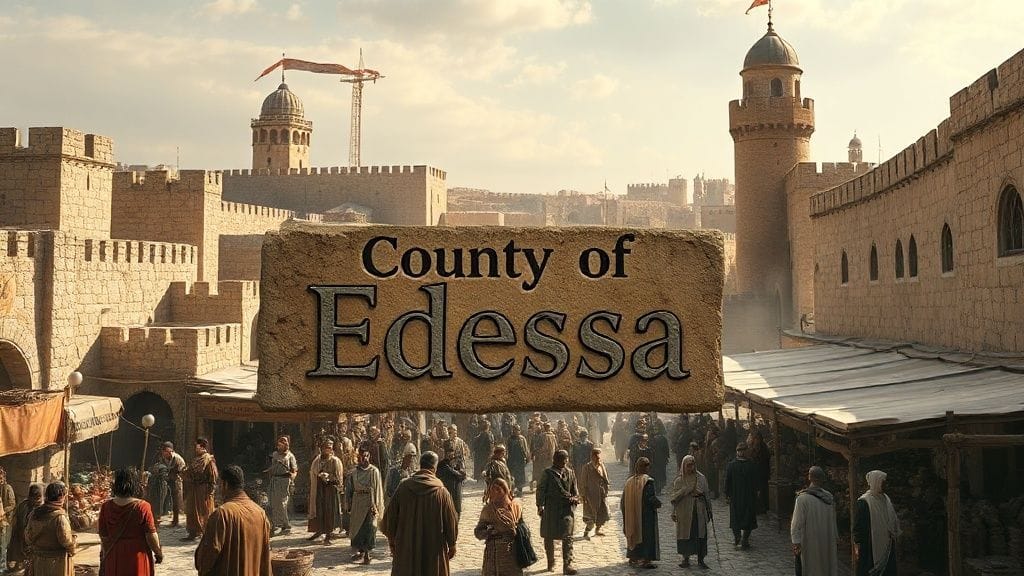
The sun hung low over the ancient city of Edessa as the first rays of dawn crept over the horizon in late 1098. The air was thick with anticipation, dust, and distant echoes of war cries — the sound not unfamiliar to this land, perched at the threshold of empires. But this day was different: after weeks of grueling marches and battles across hostile terrain, a new chapter in history was about to be written. Edessa, known today as Urfa in southeastern Turkey, was no longer a mere waypoint for weary armies or a contested fortress. It was the seedbed of the first Crusader state to be established in the Near East: the County of Edessa. This nascent principality, forged in the crucible of faith, ambition, and diplomacy, would soon embody the complexities, contradictions, and dramas that defined the Crusades.
Few moments in medieval history are as evocative as the founding of Edessa’s county — a fusion of Western knights’ dreams, Armenian nobility’s local realities, and the shifting tides of Middle Eastern politics. To understand why Edessa stood at the heart of this monumental epoch, one must unravel threads of culture, religion, and power that had intertwined for centuries in this Mesopotamian jewel.
2. The Geopolitical Crossroads of Upper Mesopotamia
Nestled between the Euphrates and Tigris rivers, Upper Mesopotamia was a land of paradoxes: a crossroads where East met West, Christendom encountered Islam, and ancient civilizations had risen and fallen for millennia. Edessa itself held a storied past as a center of Hellenistic, Roman, Byzantine, and Armenian influence — its citadel rising over a city famed for its early Christian communities and Syriac scholarship.
In the turbulent years preceding the First Crusade, this region of Upper Mesopotamia was fragmented under a mosaic of Armenian lords, Seljuk Turks, and remnants of Byzantine power. Each faction jostled for control, forming fragile alliances and rivalries. For the Crusaders advancing from the Mediterranean coast, Edessa was a key prize: it provided a buffer against Seljuk incursions, a foothold deep in the Muslim-held lands, and a symbolic gateway between West and East.
3. From Byzantine Borderland to Frankish Frontier: Background Context
The Byzantine Empire had long considered Edessa a strategic frontier city. Yet after the disastrous Battle of Manzikert in 1071, which paved the way for Turkic dominance in Anatolia, Byzantine control weakened significantly. Armenian princes, long entrenched in the city and surrounding regions, carved out semi-autonomous domains. Meanwhile, the Seljuk Turks held sway over most of northern Mesopotamia, threatening Edessa with raids and sieges.
Into this volatile landscape rode the Crusaders — Western European knights galvanized by Pope Urban II’s call in 1095. Their initial goal was Jerusalem, but circumstances and personalities shaped a more complex reality. The presence of Armenian-Christian allies around Edessa and the strategic value of the city made it irresistible to the Crusaders who sought not just pilgrimage, but power.
4. The First Crusade’s Eastern Campaign and the March to Edessa
While the main Crusader armies journeyed south toward Antioch and ultimately Jerusalem, a smaller but pivotal force under Baldwin of Boulogne veered eastward. Unlike his peers, Baldwin understood that frontier politics and alliances could be as effective as outright conquest. After leaving the main body, he made contact with Armenian lords and local leaders who viewed the Franks as potential protectors against Seljuk oppression.
His march toward Edessa was a combination of tactical military engagements and deft diplomacy. Baldwin’s careful maneuvers opened a pathway to the city, which itself was vulnerable to attack — in the midst of regional power plays and internal dissent.
5. Baldwin of Boulogne: The Architect Behind the County’s Birth
Few figures define the birth of the County of Edessa more than Baldwin of Boulogne, the younger brother of Godfrey of Bouillon. Ambitious and pragmatic, Baldwin’s decision to break away from the main Crusader thrust toward Antioch altered the course of history.
Baldwin displayed a remarkable blend of martial prowess and political savvy. Recognizing the importance of local Armenian allies, especially the ruler Thoros of Edessa, Baldwin negotiated his entry into the city not with brute force alone but leveraging family ties through marriage and promises of protection. The boldness of taking control in 1098 reflected his shrewd understanding that the Crusader movement needed strong territorial bases, not just symbolic trophies.
6. Negotiations, Sieges, and Alliances: The Path to Edessa’s Capture
Thoros, an Armenian prince ruling Edessa, found himself cornered between external threats and internal dissent. Sources suggest that Thoros may have invited Baldwin in as a protector, or at least tolerated his presence to counterbalance Seljuk pressure. Yet Baldwin’s ambitions soon became clear: he would not be a mere guest.
Accounts differ over whether Baldwin seized Edessa by force or through political machinations. Amid the complicated network of local loyalties, Baldwin convinced or compelled Thoros to relinquish power. On November 9, 1098, Baldwin was proclaimed Count of Edessa, marking the founding of the first Crusader state.
This peaceful—or quasi-peaceful—transfer of power was notable. Unlike the bloody siege of Antioch or the brutal capture of Jerusalem a year later, Edessa’s establishment featured complex negotiation, familial alliance (Baldwin married Arda of Armenia), and opportunistic diplomacy.
7. The Armenian Factor: Local Princes and the Dynamics of Power
Armenians had inhabited the region for centuries, serving as a buffer against Muslim invasions and nurturing a distinct cultural and religious identity. Their role during the First Crusade was pivotal. Armenian lords, often at odds with each other, saw in the Frankish knights a chance to regain stability and resist the Seljuks.
Baldwin’s alliance with Armenian nobility was not just convenient; it was essential for holding Edessa. Armenian subjects formed much of the population and military manpower. The intermingling of Frankish and Armenian customs, law, and faith would forge a unique socio-political fabric in the County of Edessa.
8. Edessa’s Strategic Significance for Crusaders and Muslims Alike
Edessa was more than a symbolic prize; it was a gateway to Upper Mesopotamia, controlling vital routes between Anatolia, Syria, and Iraq. For the Crusaders, it served as an outpost protecting the eastern flank from Muslim retaliation. For Muslim rulers, recapturing Edessa was vital to securing their northern borders.
Its location near the Taurus Mountains and the great rivers of the region made Edessa a natural fortress, with walls and defenses improved over centuries. The city’s hinterland produced grain and textiles, enriching the county and sustaining its military ventures.
9. Political Structures and Governance of the New County
Once Baldwin established himself as Count, he set about instituting Western feudal governance on a landscape dominated by Armenian customs. The county adopted a hybrid structure, combining Frankish feudal law with local Armenian traditions, all underscored by the overarching influence of the Latin Church.
Count Baldwin became both a warrior lord and administrator, collecting taxes, enforcing laws, and maintaining a militia composed of both Franks and Armenians. This fusion was pragmatic, reflecting the need to govern a diverse populace with often competing loyalties.
10. The Cultural and Religious Mosaic of Edessa under Frankish Rule
Edessa was a crucible of religious diversity. It housed Armenian Apostolics, Syriac Orthodox Christians, Latins, Muslims, and Jews — all living in a delicate balance. The arrival of Western knights introduced Latin Christianity into this mosaic, necessitating accommodation and sometimes conflict.
Monasteries, churches, and religious schools thrived, reflecting centuries-old traditions. The county became a vibrant cultural crossroads, where Latin and Armenian liturgies coexisted, and where knowledge from Muslim scholars mingled with Christian intellectual life.
11. Economic Foundations: Trade, Agriculture, and Tribute in Edessa
Surrounded by fertile plains, Edessa was an agricultural hub producing wheat, olives, and grapes. The Euphrates River facilitated trade, allowing merchants to move goods between the Mediterranean and the interior of the Islamic world.
The county levied taxes on trade caravans and rural peasants alike, funding its defenses and court. Craft industries, especially textiles, flourished under the relative stability Baldwin introduced. Nevertheless, sustaining this economy required steady control over the surrounding countryside amid constant threats.
12. Relations with Neighboring States: Byzantines, Seljuks, and Muslim Emirates
Edessa’s emergence disrupted local balances. The Byzantines, while weakened, still viewed Edessa as part of their sphere, creating tension with the Latin Crusaders. The Seljuk Turks, fragmented yet powerful, regarded the county as a thorn in their flank.
Moreover, Edessa negotiated with neighboring Muslim emirs, sometimes forging uneasy truces or alliances to counter greater threats. The tangled diplomacy revealed the pragmatism of medieval politics — faith notwithstanding.
13. Edessa as a Military Bulwark: Defense and Expansion
From its inception, the county faced relentless pressure. Its survival depended on sturdy fortifications and a military ready to respond swiftly. Baldwin and his successors launched raids and counterattacks, seeking not just to defend but to expand territory.
The county extended its reach to cities like Turbessel and fortified key passes, creating a belt of strongholds against Muslim incursions. Yet the resources and manpower were limited; every victory was fragile.
14. Challenges of Legitimacy and Authority in a Fragile Principality
Despite Baldwin’s success, Edessa remained precarious. Rival Crusader states eyed it with suspicion, and local Armenian nobles sometimes chafed under Frankish rule. Maintaining unity required constant vigilance.
Authority was contested not only by external foes but internal factions. The mix of cultures, languages, and religions created cracks that could, and eventually would, be exploited.
15. The Legacy of Edessa in Crusader History and the Near East
Though often overshadowed by Jerusalem or Antioch, Edessa represented the first true Crusader polity. It was the blueprint for Latin states in the East — combining conquest, alliance, and colonization in a volatile region.
Its establishment demonstrated that Crusaders were not merely pilgrims or warriors but state-builders. Yet it also revealed the limits of Western power in the East.
16. The Fall of Edessa (1144) and Its Impact on the Second Crusade
No story of Edessa is complete without its tragic fall. In 1144, after nearly half a century of resilience, the city was captured by Zengi, the powerful atabeg of Mosul and Aleppo. The loss shocked Christendom and sparked the call for the disastrous Second Crusade.
Edessa’s fall underscored the vulnerability of Crusader states and the growing strength of Muslim powers, heralding a shift in the Crusades’ trajectory.
17. Myth, Memory, and the Symbolism of Edessa in Western Christendom
The city’s Christian heritage and Christian kingship turned Edessa into a poignant symbol in medieval imagination. Legends, chroniclers, and troubadours celebrated its rise and mourned its fall.
Edessa’s story was woven into broader narratives of holy war, martyrdom, and divine justice, resonating deeply in Western lore.
18. Archaeological and Historical Sources: Piecing Together Edessa’s Early Crusader Era
Understanding Edessa relies on a patchwork of chronicles — from Fulcher of Chartres to Syriac and Armenian sources — and archaeological evidence. Each adds texture but also raises questions about bias, perspective, and cultural memory.
Recent excavations and scholarship shed new light on daily life, fortifications, and intercultural exchanges in the county.
19. Lessons from Edessa: Cultural Encounters and the Limits of Crusader Power
Edessa teaches us about the porous boundaries between “East” and “West,” the complexity of medieval identities, and the challenges of implanting foreign rule over diverse societies.
Its ultimate fate illustrates the resilience of local powers and the difficulties Crusaders faced beyond initial conquests — lessons echoed in many colonial ventures thereafter.
20. Conclusion: The Enduring Echoes of Edessa’s Founding
The founding of the County of Edessa in 1098 was more than a military milestone — it was a historic confluence of ambition, faith, and culture at a moment when worlds collided. It encapsulates the glory and tragedy of the Crusades, revealing how fleeting power can be amid a sea of shifting loyalties.
Edessa remains a symbol of the medieval world’s complexity: where sword met scripture, and diplomacy interwove with warfare. Its legacy lives on in history’s pages, a testimony to human courage and fragility on a turbulent frontier.
Conclusion
The story of Edessa’s founding is a tapestry of ambition, faith, and survival that stands as a vital testament to the complexity of the Crusades. It reveals how the Crusaders were not mere religious fanatics but pragmatic lords seeking to root themselves in an ancient and contested land, navigating a labyrinth of alliances and enmities. Yet it also reminds us of the fragility of such constructs — how quickly fortunes turn, how cultures converge and conflict, and how history remembers both triumph and loss.
Today, Edessa’s ruins whisper tales of vanished worlds, challenging us to look beyond simplistic narratives and appreciate the human dramas that shaped the medieval Near East. The County of Edessa, though ephemeral, remains woven into the fabric of history as a beacon of cultural encounter, political ingenuity, and the enduring struggle for identity and power.
FAQs about the County of Edessa
Q1: Why was Edessa important to the Crusaders?
A1: Edessa was strategically located controlling routes between Anatolia and Syria. As the first Crusader state established, it provided a vital eastern frontier against Muslim powers and served as a base for further military and political operations.
Q2: Who founded the County of Edessa and how?
A2: Baldwin of Boulogne founded the county in 1098 by seizing control of the city through a mixture of alliance with local Armenian rulers and political maneuvering. He became the first Count of Edessa after the Armenian prince Thoros either abdicated or was deposed.
Q3: What role did the Armenian population play in Edessa?
A3: Armenians formed the majority population and elite in Edessa, providing local knowledge, manpower, and political structures that the Crusaders adapted. Their cooperation was essential for the county’s survival and administration.
Q4: How did Edessa differ from other Crusader states?
A4: Edessa was unique as the earliest Crusader principality, deeply integrated with local Armenian politics, and less directly connected to Western European nobility than other states like Jerusalem or Antioch. It was also more exposed and vulnerable due to its geographical position.
Q5: Why did Edessa fall in 1144?
A5: Edessa fell due to military pressure from Zengi, who exploited internal divisions and the county’s isolation. Its loss was a critical setback for Crusader efforts and precipitated the Second Crusade.
Q6: How is Edessa remembered in medieval chronicles and Western memory?
A6: Medieval chroniclers portrayed Edessa as a symbol of Christian valor and martyrdom, lamenting its loss. It became emblematic of the contest between Christianity and Islam, inspiring crusading zeal and artistic representation in Europe.
Q7: What sources historians rely on to study the County of Edessa?
A7: Historians use Latin chronicles like those of Fulcher of Chartres, Armenian and Syriac texts, Muslim chroniclers, and archaeological findings to reconstruct Edessa’s history, each offering complementary but sometimes conflicting perspectives.
Q8: What lessons does the County of Edessa offer for understanding medieval cultural encounters?
A8: Edessa exemplifies the fluidity and complexity of identities in frontier regions, showing that medieval encounters were not simple clashes but involved negotiation, coexistence, and hybrid political models.

