Table of Contents
- Dawn of a New Era: The Birth of a Kingdom
- The Iberian Canvas: A Peninsula in Turmoil
- From County to Kingdom: The Ambitions of Afonso Henriques
- The Battle of Ourique: Legend and Reality Intertwined
- The Assembly of Lamego: Foundation of Sovereignty
- The Role of the Church: Legitimizing a New Dynasty
- Challenges to Independence: Castile and León’s Shadow
- Diplomacy and Defiance: Negotiations with Alfonso VII
- The Years of Consolidation: 1140–1143
- Papal Recognition: The Final Seal of Sovereignty
- Cultural and Social Transformation under Early Portuguese Rule
- The Power Struggles within Portugal’s Nobility
- Military Innovations and the Reconquista Context
- The Role of Guimarães: Cradle of the Nation
- Legacy of the Kingdom’s Birth: A National Myth Takes Shape
- Portugal’s Place in Medieval Europe Post-1143
- How the Kingdom’s Creation Influenced Iberian Politics
- Reflections on National Identity and Historical Memory
- The County’s Transition in Retrospect: Myth vs. History
- Conclusion: Crafting a Nation from the Shadows of Empires
- FAQs on the Founding of the Kingdom of Portugal
- External Resource
- Internal Link
1. Dawn of a New Era: The Birth of a Kingdom
It was the year 1139, a sweltering summer afternoon in the rolling hills near Guimarães. The air hummed with the anticipation of men who had tasted war and dreamed of freedom. Afonso Henriques, count of Portugal, stood tall, his armor gleaming under the Iberian sun, his gaze fixed on the horizon where the past and future collided. That day, amidst the clash of swords and the roar of his loyal troops, a county whispered into history – it was proclaimed a kingdom.
For centuries, the lands that now form Portugal were fragments — territories nestled between the larger kingdoms of León and Castile, surrounded by the ever-pressing presence of Moorish Al-Andalus to the south. But the Battle of Ourique, where Afonso’s forces reputedly overcame a superior Muslim army, sparked not just a military victory but a profound political revolution: the transformation from a noble county into a sovereign kingdom.
Yet, as with all births of nations, this moment was neither inevitable nor simple. The story woven between 1139 and 1143 is one rife with ambition, charisma, religious symbolism, and strategic acumen, all playing out on the turbulent stage of medieval Iberia. This article plunges into those years of profound change, revealing how Portugal rose from fragmented lands to a kingdom recognized by the greatest powers of Christendom.
2. The Iberian Canvas: A Peninsula in Turmoil
The early 12th century Iberian Peninsula was a chessboard of competing powers, fraught with shifting alliances and ceaseless conflict. After the fragmentation of the Carolingian Empire and the collapse of the Visigothic kingdom centuries prior, Christian and Muslim realms coexisted in a tenuous, often hostile balance.
To the north, the kingdom of León and its progeny, Castile, vied fiercely for dominance. To the south, Al-Andalus, the Muslim-controlled territories, were gradually being pushed back by the Reconquista—a centuries-long campaign by Christian states to reclaim land. Amidst this turbulence, the County of Portugal held a special position: a borderland carved out by noble families, vassals to León but increasingly independent in their aspirations.
The county had been established in the late 9th century, granted to Vímara Peres following Christian reconquest campaigns. However, by the early 12th century, its rulers became far more than mere provincial counts—they harbored royal ambitions fueled by military success and surging local support.
3. From County to Kingdom: The Ambitions of Afonso Henriques
Born circa 1109, Afonso Henriques emerged early as a pivotal figure destined to reshape the political map. Son of Henry of Burgundy and Theresa of León, himself the daughter of King Alfonso VI, he inherited a complex identity—a noble tied to the Leónese crown yet increasingly distinct.
The young count was ambitious, skilled, and fiercely independent. Tensions with his mother, who ruled as regent after Henry of Burgundy's death, escalated into civil conflict. Afonso's decisive victory at the Battle of São Mamede in 1128 was not only a personal triumph but a declaration that the County of Portugal was stepping onto a path of self-determination.
His vision extended beyond mere autonomy; he sought to transform the county into a kingdom that could stand alongside its powerful neighbors. Such an aspiration would define Portuguese history in the years to come.
4. The Battle of Ourique: Legend and Reality Intertwined
Few events in Portuguese history are as mythologized as the Battle of Ourique, fought in July 1139. The narrative tells of Afonso Henriques leading a small Christian force against a vastly superior Moorish army. According to legend, on the eve of battle, Afonso was visited in a dream by Christ himself, who promised victory. Inspired, he rallied his men to a decisive triumph.
Historical details are more elusive; some sources question the scale or even the occurrence of the battle as described in legends. Yet, what is undeniable is that this confrontation marked a turning point. It was after Ourique that Afonso was proclaimed “king” by his troops, an informal recognition signaling a break from the title of count.
Whether divinely sanctioned or strategically orchestrated, the Battle of Ourique became a foundational myth, embedding divine favor into the legitimacy of Portugal's sovereignty.
5. The Assembly of Lamego: Foundation of Sovereignty
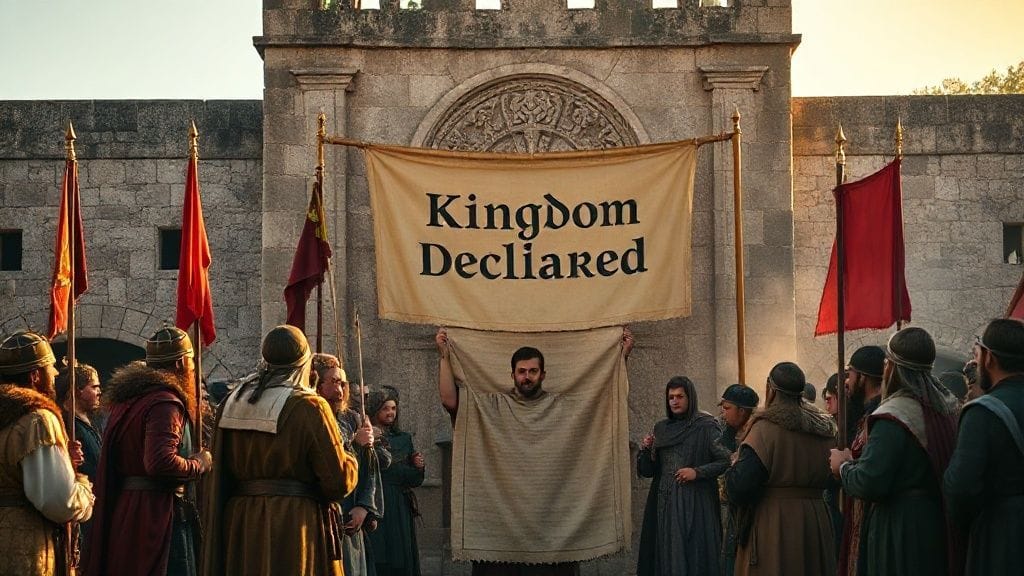
Not long after Ourique, it is believed—though debated by historians—that an assembly was held in Lamego, where local nobles, clergy, and knights gathered to ratify the creation of the Kingdom of Portugal. Amidst the dimly-lit stone halls, agreements were made to establish laws, succession, and governance structures separate from León.
Though some scholars question the authenticity of this assembly—due to the scarcity of contemporaneous records—the legend endures as a symbolic moment when Portugal asserted its sovereignty not just militarily but institutionally.
This event helped cement the new kingdom’s claim to legitimacy, marking the transition from a feudal county to an independent political entity on the European stage.
6. The Role of the Church: Legitimizing a New Dynasty
In medieval Europe, political power and religious sanction went hand in hand. No kingdom could truly claim legitimacy without the blessing of the Church. Afonso Henriques was acutely aware of this.
Throughout the years following 1139, the budding kingdom sought close ties with the Papacy and the ecclesiastical hierarchy. The establishment of new bishoprics within Portuguese territory was a conscious effort to create a religious infrastructure ripe for independent governance.
The Church’s support was double-edged: while granting legitimacy, it also imposed ecclesiastical oversight and expectations. Afonso’s careful navigation of this relationship revealed his political acumen, balancing piety and pragmatism.
7. Challenges to Independence: Castile and León’s Shadow
Despite his battlefield triumphs and noble alliances, Afonso Henriques faced persistent resistance from the neighboring Christian kingdoms, particularly León and Castile, which viewed the County of Portugal as a rebellious province rather than an equal.
Alfonso VII of León, Afonso’s cousin and rival, was not disposed to accept the fragmentation of his realm lightly. Negotiations, skirmishes, and diplomatic maneuvering marked the years following 1139 as the young kingdom fought to assert itself amid regional power politics.
The persistent tension underscored the precariousness of Portugal’s newfound sovereignty, which required both military defense and political finesse to survive.
8. Diplomacy and Defiance: Negotiations with Alfonso VII
Between 1140 and 1143, a series of events unfolded in which diplomacy largely shaped the survival of the Portuguese kingdom. Afonso Henriques engaged in complex negotiations with Alfonso VII, who had proclaimed himself Emperor of all Spain.
Although tensions remained high, these talks culminated in the Treaty of Zamora in 1143, a milestone moment wherein Alfonso VII recognized Afonso Henriques as King of Portugal—albeit with conditions. This acknowledgment was critical, as it transformed a contested claim into an officially accepted status within Iberian politics.
But the road to peaceful coexistence was still fraught with uncertainty. Every inked signature masked deeper struggles for power.
9. The Years of Consolidation: 1140–1143
Following the Battle of Ourique and the diplomatic milestones, Afonso Henriques concentrated on consolidating his kingdom’s territorial integrity and internal governance.
He embarked on campaigns to expand into Muslim-held territories southwards, continuing the Reconquista in earnest. Simultaneously, he worked to fortify political institutions, promote settlement, and establish economic frameworks to sustain his realm.
These efforts laid the foundations of a durable Portuguese state, one that could survive beyond the reign of its founder.
10. Papal Recognition: The Final Seal of Sovereignty
While the Treaty of Zamora acknowledged Portugal’s royal status on the peninsula, papal recognition was essential to cement its sovereignty in Christendom.
In a landmark development, Pope Alexander III granted Portugal the right to establish its own diocese and recognized Afonso Henriques’s title. This papal endorsement insulated Portugal from claims by León and Castile and bolstered Afonso’s legitimacy in the eyes of European monarchs.
The Church’s recognition thus was not simply ceremonial; it was a critical instrument for nation-building.
11. Cultural and Social Transformation under Early Portuguese Rule
As the political structure shifted, social realities also evolved. The nascent kingdom attracted settlers from various regions, mixing local Galician-Portuguese culture with influences from northern Europe, reflecting the crusading spirit of the times.
Feudal relations became redefined under a monarchy seeking to centralize power. Religious festivals, vernacular literature, and the codification of laws began to foster a shared cultural identity.
The period sowed the seeds of what would mature into the distinct Portuguese language and traditions.
12. The Power Struggles within Portugal’s Nobility
Nation-building, however, never erased the tensions within the Portuguese elite. The nobility, invested in their own landholdings and privileges, frequently challenged royal authority.
Several rebellions erupted in the early years of the kingdom, as local lords resisted attempts at centralization. Afonso Henriques had to skillfully balance force with negotiation, rewarding loyalty while quashing dissent.
These internal dynamics shaped the kingdom’s political culture for generations.
13. Military Innovations and the Reconquista Context
Portugal’s emergence as a kingdom was deeply intertwined with the Reconquista—the Christian reconquest of Iberia from Muslim rule.
Afonso’s armies adopted and adapted military techniques from both Christian and Muslim adversaries. Fortifications were strengthened, cavalry tactics refined, and alliances forged with crusading knights from across Europe.
This martial evolution not only ensured territorial gains but also fostered a unique identity grounded in religious and military valor.
14. The Role of Guimarães: Cradle of the Nation
Guimarães, often hailed as the “birthplace of Portugal,” played a central role during these formative years.
It was both the political heart and symbolic center of the new kingdom, where Afonso Henriques established his court and demonstrated his power.
Today, Guimarães remains a powerful emblem of Portuguese identity, preserving the memory of these early struggles and triumphs.
15. Legacy of the Kingdom’s Birth: A National Myth Takes Shape
As centuries passed, the events from 1139 to 1143 transformed into richly embroidered legends that fed Portuguese national pride.
The Battle of Ourique, the Assembly of Lamego, and Afonso’s heroic image became pillars of a collective memory that shaped how Portuguese saw themselves—brave, independent, and divinely chosen.
This mythmaking was crucial in sustaining a cohesive national identity through later periods of turmoil.
16. Portugal’s Place in Medieval Europe Post-1143
With papal and regional recognition secured, Portugal entered the family of European kingdoms as a small but determined player.
Its strategic Atlantic coast presented new opportunities for maritime expansion, while its position on the Iberian frontier continued to influence continental politics.
Portugal’s emergence thus signaled the beginning of its extraordinary journey from a local kingdom to a global empire centuries later.
17. How the Kingdom’s Creation Influenced Iberian Politics
Portugal’s declaration and assertion of kingdomhood altered the delicate balance among Iberian powers.
It forced León and Castile to recalibrate alliances, sparked rivalries, and complicated the dynamics of Reconquista campaigns.
In effect, Portugal’s rise contributed to the political mosaic that would ultimately shape the modern borders of the peninsula.
18. Reflections on National Identity and Historical Memory
The founding of Portugal remains a potent narrative of self-determination and resilience.
Modern Portuguese identity continues to draw from the stories forged in these early years, embodying values of courage, faith, and independence.
Historians explore how myth and fact blend in this saga, revealing the intricate processes of nation-building.
19. The County’s Transition in Retrospect: Myth vs. History
Separating legend from documented reality is a challenge that historians have wrestled with for centuries.
While the precise details of battles and assemblies may blur, the overarching truth of transformation from county to kingdom stands firm.
This enduring ambiguity invites continued exploration and appreciation of medieval Portugal’s complexity.
20. Conclusion: Crafting a Nation from the Shadows of Empires
The years 1139 to 1143 mark not just the birth of a kingdom but the emergence of a new identity forged amid turmoil and hope.
Afonso Henriques, through courage and cunning, transformed a contested county into a sovereign state, setting Portugal on a path that would resonate for centuries.
This story is a testament to the human capacity to reshape destiny, to claim autonomy against overwhelming odds, and to build a nation not just through conquest but through faith and community.
Conclusion
Portugal’s transition from county to kingdom was far from a simple act of historical happenstance. It was the culmination of fierce battles, intricate diplomacy, religious endorsement, and above all, the indomitable will of a people and their leader. This emergence embodied more than political sovereignty—it encapsulated the dreams and aspirations of a medieval society yearning for recognition and permanence.
In an age dominated by empires and competing crowns, the proclamation of the Kingdom of Portugal stood as a beacon of possibility. Its legacy invites us to reflect on how nations are born—not just from grand battles or treaties signed on parchment, but from the stories passed down, the myths embraced, and the unyielding human spirit striving for selfhood.
The County of Portugal’s proclamation of kingdomhood between 1139 and 1143 is therefore more than history: it is a narrative of courage, faith, and identity that continues to inspire.
FAQs on the Founding of the Kingdom of Portugal
Q1: What were the main causes behind Portugal’s transition from county to kingdom?
Portugal’s transition was fueled by a mix of military success, especially the Battle of Ourique, political ambition of Afonso Henriques, local noble support, and the desire for sovereignty distinct from the Kingdom of León.
Q2: How reliable is the legend of the Battle of Ourique?
While the battle is historically attested, many legendary elements—such as the divine vision—were shaped by later chroniclers and serve more to symbolize legitimacy rather than provide a factual account.
Q3: What role did the Church play in establishing the Kingdom of Portugal?
The Church was crucial, offering religious legitimacy through papal recognition and establishing ecclesiastical institutions that anchored the kingdom politically and spiritually.
Q4: How did neighboring kingdoms react to the emergence of Portugal?
Initially, León and Castile contested Portugal’s independence through military and diplomatic pressures, but treaties like Zamora in 1143 solidified recognition amid ongoing rivalry.
Q5: Why is Guimarães considered the “cradle” of Portugal?
Guimarães was the political and symbolic center of the early kingdom, where Afonso Henriques consolidated power and from where foundational events are associated.
Q6: How did the creation of the kingdom influence the Reconquista?
Portugal’s formation intensified Christian efforts to reclaim lands from Muslim control, with subsequent campaigns expanding territory southward.
Q7: When did the Pope officially recognize the Kingdom of Portugal?
Papal recognition came in the 1140s, notably under Pope Alexander III, which officially endorsed Afonso Henriques’s claims and bolstered political legitimacy.
Q8: How did this early period shape Portuguese national identity?
The period created enduring myths and institutions that fostered a distinct sense of identity rooted in independence, faith, and martial valor.

