Table of Contents
- The Dawn of a Maritime Empire: Crown of Aragon in the Early 14th Century
- Seeds of Expansion: Political and Economic Pressures in the Iberian Peninsula
- Mediterranean Stakes: The Strategic Value of Sardinia and Sicily
- The Sardinian Conquest Begins: From Ambitions to Armadas
- Kingdoms and Keys: The Struggle for Sicily’s Soul
- The Aragonese Crown’s Naval Supremacy: Mastery of the Western Mediterranean
- Rivalries on the Waves: The Genoese and the Crown of Aragon
- The Role of the Catalan Company and Mercenary Forces
- The Black Death and Its Impact on Mediterranean Politics
- Diplomatic Maneuvers: Marriages, Treaties, and Alliances
- Economic Shifts: Trade Networks and the Bourgeoisie Rise
- The Flourishing of Catalan Culture and Law in New Territories
- Resistance and Rebellion: Sardinian and Sicilian Local Responses
- The Battle of Falconaria and Military Turning Points
- The Crown of Aragon as a Mediterranean Powerhouse: Governance and Administration
- Cultural Fusion and Religious Influence in Conquered Lands
- The Decline of Byzantine and Angevin Influence in the West Mediterranean
- Long-Term Consequences: The Rise of a Mediterranean Confederation
- The Crown of Aragon’s Legacy in Modern Mediterranean History
- Conclusion: The Mediterranean World Transformed by Aragonese Ambitions
- FAQs: Understanding the Crown of Aragon’s Mediterranean Expansion
- External Resource
- Internal Link
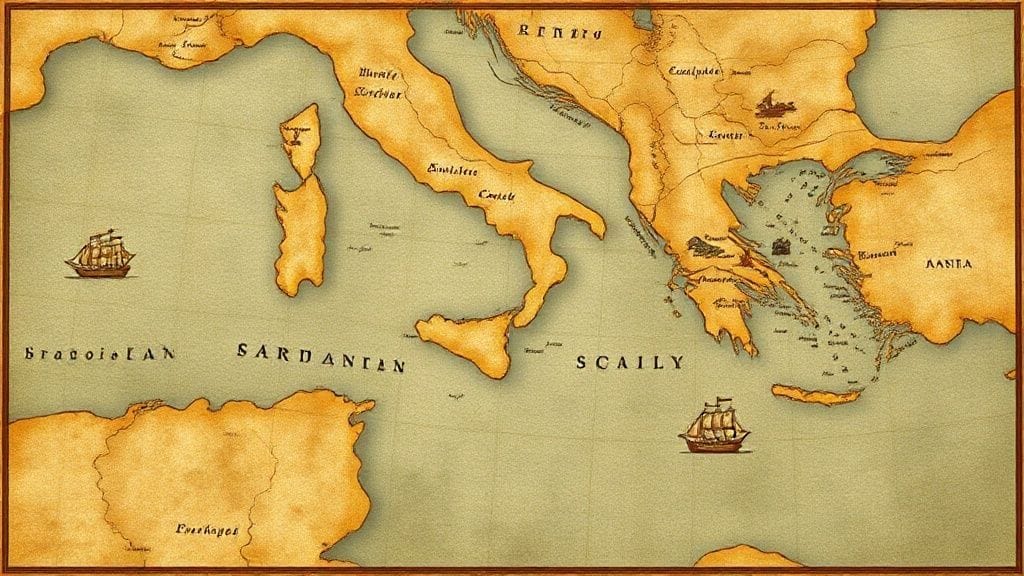
The cerulean waves of the western Mediterranean, kissed by the golden light of a setting sun, concealed beneath them a restless history of conquest, ambition, and empire-building in the tumultuous 14th century. It was in this mosaic of islands, peninsulas, and emergent powers that the Crown of Aragon forged a maritime empire, stretching its influence over strategic realms such as Sardinia and Sicily. Far beyond mere territorial gains, the expansion was a grand narrative of commerce, naval prowess, and cultural fusion that reshaped the political map of the Mediterranean forever.
1. The Dawn of a Maritime Empire: Crown of Aragon in the Early 14th Century
By the early 1300s, the Crown of Aragon was more than just a kingdom on the northeastern edge of the Iberian Peninsula. A composite monarchy uniting Aragon, Catalonia, and later Valencia, it was on the cusp of transformation—from a landlocked power to a genuine maritime empire. Bound by shared culture and restless ambition, its rulers eyed the Mediterranean kingdoms as keys to unlocking broader influence.
The early 14th century was a time when the Mediterranean was the vibrant crossroads of cultures and commerce, teeming with Genoese and Venetian fleets, Angevin claims from Naples, Byzantine remnants, and the Muslim emirates of the south. In such an intense arena, power meant access to ports, naval bases, and control over sea lanes.
2. Seeds of Expansion: Political and Economic Pressures in the Iberian Peninsula
The Crown of Aragon’s expansion was born from internal dynamics as much as external opportunity. The Aragonese monarchy, under rulers like James II and his successor Alfonso IV, wrestled with a complex patchwork of regional identities and the need to bolster their financial base. The peninsula’s resources alone weren’t enough to satisfy the ambitions of an expanding nobility and merchant class.
Commercial interests played a decisive role. The prosperous Catalan merchants sought new markets and safer maritime routes that would circumvent rival powers. Moreover, ongoing conflicts with Castile and naval skirmishes with North African corsairs underscored the strategic necessity to secure islands as naval bastions.
3. Mediterranean Stakes: The Strategic Value of Sardinia and Sicily
Nestled strategically between the eastern and western basins of the Mediterranean, Sardinia and Sicily were jewels coveted by multiple powers. Sicily, long contested between the Angevin kings of Naples and the Aragonese descendants of the Sicilian Vespers uprising, was an island of fertile lands, strong fortresses, and a bustling population.
Sardinia, though more remote and less prosperous, represented a critical link in controlling western Mediterranean sea lanes and disrupting rival maritime networks. Its fragmented indigenous giudicati (judgeships), vulnerable to outside interference, made it an attractive prize for Aragonese expansionists.
4. The Sardinian Conquest Begins: From Ambitions to Armadas
In the mid-1320s, the Crown’s gaze turned decisively toward Sardinia, initiating campaigns that were as much political theatre as brutal conquest. The Sardinian giudicati, weakened by internal feuding and pressure from Pisa and Genoa, offered a terrain ripe for opportunistic intervention.
Armed fleets dispatched from Barcelona and Valencia transported troops and supplies, while new coastal fortresses were erected to secure footholds. The campaigns to subjugate Sardinia combined military might with alliances forged amongst local factions—often turning erstwhile enemies into vassals under Aragonese overlordship.
5. Kingdoms and Keys: The Struggle for Sicily’s Soul
Sicily’s tumultuous history in the 14th century is deeply intertwined with the Crown of Aragon’s destiny. The island’s revolt in 1282—the Sicilian Vespers—had expelled Angevin control and invited Peter III of Aragon to claim its throne. However, this led to protracted conflicts known as the War of the Sicilian Vespers, which stretched well into the 14th century.
The struggle during the 1320s to 1380s involved multiple Aragonese monarchs seeking to consolidate their hold against Angevin claimants and internal barons. The island’s cities—Palermo, Messina, Catania—became battlegrounds and havens of political intrigue, while the Crown's administrative reforms tried to weave Sicily’s patchwork of claims into a coherent kingdom.
6. The Aragonese Crown’s Naval Supremacy: Mastery of the Western Mediterranean
The expansion wouldn’t have been possible without mastery of the seas. The Aragonese developed one of the most formidable navies of the era. Catalan shipbuilders constructed nimble galleys, armed with catapults and archers, while sailors and marines honed tactics that blended speed, surprise, and boarding prowess.
Naval battles became exhibitions of cunning and power—the famous Battle of Cape Orlando (though a little earlier, in 1299) had settled early dominance, but skirmishes and blockades throughout the 14th century cemented Aragonese control over key routes and ports.
7. Rivalries on the Waves: The Genoese and the Crown of Aragon
Yet, the sea was never uncontested. The Republic of Genoa, fiercely protective of its commercial interests in the western Mediterranean, clashed repeatedly with Aragonese fleets. Genoese alliances with local Sardinian lords and Sicilian magnates often complicated the Crown’s efforts.
The 14th century saw a series of naval engagements and commercial rivalries that shaped Mediterranean diplomacy. Though Genoa remained powerful, the Crown of Aragon increasingly eclipsed it in political influence, turning from mere regional rivalries into lasting imperial ambition.
8. The Role of the Catalan Company and Mercenary Forces
The Catalan Company, a renowned mercenary group originally formed to fight in the Byzantine territories (later of course famous for their exploits in Greece), played a subtler but no less vital role. These soldiers-of-fortune brought military experience and discipline, sometimes fighting directly under Crown orders, sometimes acting semi-autonomously to secure gains or defend coastal holdings.
Their loyalty often fluctuated, coloring the Crown’s military campaigns with intrigue and occasional mutiny, but ultimately their strategic impact helped extend and secure Aragonese territories.
9. The Black Death and Its Impact on Mediterranean Politics
No narrative of the 14th-century Mediterranean is complete without the shadow of the Black Death, which struck Europe and the Mediterranean with brutal force from 1347 onwards. The pandemic decimated populations, disrupted economies, and altered political dynamics in ways both immediate and lasting.
For the Crown of Aragon, the plague created both hardships and opportunities. Military campaigns slowed, yet the resulting demographic shifts weakened rivals, facilitating further conquests and reorganization. It also heightened the Crown’s need to stabilize and administer newly acquired territories with new legal and health infrastructures.
10. Diplomatic Maneuvers: Marriages, Treaties, and Alliances
While fleets battled across the waves, the Crown’s diplomacy unfolded with equal complexity on land. Royal marriages cemented alliances with Naples, local Sardinian nobility, and even the papacy. Treaties such as the Treaty of Anagni (1295, earlier but influential throughout the century) shaped claims to Sicily and Sardinia.
The Crown’s ability to balance warfare and diplomacy was key. Alliances with the Knights Hospitaller and the Kingdom of Castile, along with negotiations with the Papal States, underscored the intricate dance of power.
11. Economic Shifts: Trade Networks and the Bourgeoisie Rise
Expansion brought new economic vitality. The Aragonese opened trade routes connecting the western Mediterranean ports to Catalonia’s wealthy cities. Sardinia became a crucial source of grain, minerals, and manufactured goods, enriching merchants and nobles alike.
The rise of a bourgeoisie class, especially in Barcelona and Valencia, paralleled the acquisition of new territories. Guilds and merchant corporations gained importance, funding naval expeditions and stabilizing governance.
12. The Flourishing of Catalan Culture and Law in New Territories
Beyond conquest, the Crown’s imprint on language, culture, and law took root. The celebrated Catalan language and its legal traditions—most notably the “Usatges of Barcelona”—were introduced to Sardinia and Sicily, influencing administration and jurisprudence.
This cultural diffusion was not without friction; it sometimes bred resentment but ultimately created enduring links, weaving diverse peoples into a shared political identity.
13. Resistance and Rebellion: Sardinian and Sicilian Local Responses
Yet, conquest was met with resistance. Sardinian giudicati remnants clung to autonomy, while Sicilian barons and cities rebelled intermittently. The island’s inland populations, less touched by Aragonese rule, fostered insurrections and banditry.
These tensions forced the Crown to balance repression with concessions, a delicate governance strategy to integrate diverse and restive populations without fracturing authority.
14. The Battle of Falconaria and Military Turning Points
Military history remembers key battles such as the Battle of Falconaria (1299) and later engagements in the ongoing conflicts for Sicily and Sardinia. These fought on island soil or in naval combat were pivotal in determining control.
Each victory or setback shaped negotiating positions and the pace of territorial integration, reflecting the ferocity and determination of Aragonese forces in an age when control of even a tiny fortress could tip wider conflicts.
15. The Crown of Aragon as a Mediterranean Powerhouse: Governance and Administration
By the late 14th century, the Crown had evolved sophisticated mechanisms to govern its extended dominions. Viceroys and councils administered Sardinian and Sicilian territories, borrowing from models used in Catalonia while accommodating local customs.
Institutions to collect taxes, maintain justice, and oversee defenses were established, marking the Crown of Aragon as a forerunner in early modern imperial administration.
16. Cultural Fusion and Religious Influence in Conquered Lands
In Sardinia and Sicily, layers of culture—Latin, Byzantine, Islamic—influenced by Aragonese presence created rich tapestries. Churches and cathedrals were rebuilt or expanded, while the Catholic Church reinforced its authority.
Religious orders played roles in social organization, education, and diplomacy, promoting Latin Christianity amid diverse populations, some of whom retained older traditions or ethnic identities.
17. The Decline of Byzantine and Angevin Influence in the West Mediterranean
The expansion of Aragonese power coincided with the gradual retreat of Byzantine authority in the western Mediterranean and the diminishing Angevin claims over Sicily. This realignment opened space for new powers to rise and old ones to adapt or fall.
By the end of the 14th century, the Crown of Aragon emerged as a clear western Mediterranean hegemon, a status incomprehensible mere decades earlier.
18. Long-Term Consequences: The Rise of a Mediterranean Confederation
The political union under the Crown of Aragon sowed seeds for a Mediterranean confederation of sorts—an interconnected realm stretching from the Iberian Peninsula, through the Balearic Islands, to Sardinia, Sicily, and Naples.
It established trade networks, military structures, and cultural links that would influence Mediterranean geopolitics and identity for centuries to come.
19. The Crown of Aragon’s Legacy in Modern Mediterranean History
Looking beyond the Middle Ages, the Crown of Aragon’s legacy endures. Its maritime empire laid foundational grids for Spain’s later imperial ventures, influenced Mediterranean legal and cultural systems, and shaped the modern identities of Catalonia, Sardinia, and Sicily.
Though eventually absorbed into the broader Spanish monarchy, the Aragonese Mediterranean expansion remains a remarkable chapter of medieval statecraft, maritime innovation, and cultural exchange.
Conclusion
The story of the Crown of Aragon’s Mediterranean expansion from the 1320s to the 1380s is nothing short of a historical epic. It is a tale of visionaries and conquerors who dared to rewrite the rules of power upon the waves and the islands of the western Mediterranean. Against the tide of rivalries, pandemic devastation, and local resistance, the Crown emerged not merely as a conqueror but as a builder of complex political, economic, and cultural networks.
This expansion was more than land and sea; it was about transforming identities, fostering new ideas, and seeding connections that remind us even today how the fortunes of kingdoms are interwoven with the tides of history. The Crown of Aragon did not simply claim territories—it gave birth to a Mediterranean world that echoed through centuries.
FAQs
Q1: What motivated the Crown of Aragon to expand into Sardinia and Sicily?
Economic ambition, strategic naval interests, and political necessity converged to push the Crown towards conquest. Control over these islands secured critical trade routes and offered bases against rival powers like Genoa and Naples.
Q2: How did the Crown of Aragon manage to maintain control over such diverse territories?
Through a combination of military strength, diplomatic alliances, institutional governance including viceroys and councils, and cultural integration using Catalan law and customs adapted locally.
Q3: What role did naval power play in this expansion?
Naval supremacy was crucial. The Aragonese fleet’s mastery of galleys and maritime tactics allowed them to project power across the islands and seas, winning key battles and protecting trade routes.
Q4: Did local populations resist Aragonese rule?
Yes, both Sardinian and Sicilian locals often resisted through rebellions and alliances with rival powers. The Crown had to balance repression and concessions to stabilize control.
Q5: How did the Black Death affect the expansion?
The plague caused demographic and economic disruptions but also weakened rival powers, indirectly aiding Aragonese consolidation of territories.
Q6: What cultural impacts did this expansion have?
Catalan language and legal traditions spread to the islands, influencing local cultures. Aragon also promoted Catholic institutions and imported administrative models.
Q7: How did the Crown of Aragon’s power affect other Mediterranean states?
It shifted the balance of power, diminishing Byzantine and Angevin influence, challenging Genoese maritime dominance, and creating a new Mediterranean confederation.
Q8: What is the modern-day relevance of this historical period?
The century of expansion shaped regional identities, legal traditions, and cultural ties in Catalonia, Sardinia, and Sicily, echoing in contemporary Mediterranean history.

