Table of Contents
- The Dawn of August 16, 1960: A Nation Emerges
- Cyprus under Colonial Rule: Seeds of Discontent
- The Interwoven Histories of Greeks and Turks on the Island
- The Rise of Nationalism and the Quest for Independence
- The Role of British Colonial Authorities: Between Control and Concession
- The Enosis Movement and Greek Cypriot Aspirations
- Turkish Cypriot Reactions and the Fear of Marginalization
- International Interests: Greece, Turkey, Britain, and the Cold War Context
- The Zurich and London Agreements: Crafting a Bi-communal Republic
- Political Architects of Independence: Makarios, Faizal, and Their Allies
- The Ceremonial Proclamation in Nicosia: Scenes and Sentiments
- Public Celebrations and Collective Dreams for the New Republic
- Early Challenges and the Fragility of the New Political Order
- Communal Tensions: From Hope to Fracture
- The Legacy of August 16, 1960: A Divided Island’s Resurrection
- Cyprus Independence in World Perspective: Cold War and Decolonization
- Cultural Renaissance and National Identity Building
- The Aftermath: Towards the Conflict of 1974 and Beyond
- Personal Stories: Voices from the Day and its Echoes
- Remembering August 16: Commemoration and Historical Debate
- The Cyprus Question Today: Continuities and Change
- Conclusion: Cyprus’s Independence – A Lesson in Fragility and Resilience
- FAQs: Unraveling the Complex Threads of Cyprus’s Independence
- External Resource
- Internal Link
The dawn of August 16, 1960, broke over Nicosia with a brilliant Mediterranean sun casting long shadows on a city poised at the crossroads of history. The air was thick with anticipation, the murmurs of a crowd that had gathered promising a new chapter — one of sovereignty, self-rule, and a fragile hope for peace. Flags fluttered, faces glowed with pride and uncertainty, and the sound of orchestras filled the squares. At that moment, Cyprus was no longer a colonial possession; it was a republic, carved out of decades of struggle, sacrifice, and the elusive dream of unity. Yet, beneath the festive veneer, tensions whispered of hardships to come — communal suspicions that would test the very fabric of the new state.
Cyprus under Colonial Rule: Seeds of Discontent
To understand the momentous proclamation of independence on August 16, 1960, one must first grasp the colonial context that preceded it. For nearly eight decades, Cyprus had been under British dominion, a strategic outpost in the eastern Mediterranean. From 1878, when Britain formally assumed administrative control from the Ottoman Empire, to 1960, the island’s fate was tied to imperial calculations more than local aspirations. Yet, beneath British flags and governors, the island’s two principal communities — Greek Cypriots, comprising about 80% of the population, and Turkish Cypriots, roughly 18% — lived increasingly divergent lives shaped by history, religion, and identity.
The Greek Cypriots nurtured a passionate desire for Enosis, the union with Greece, harking back to a shared Hellenic heritage. This nationalist yearning was both cultural and political, fueled by growing disillusionment with colonial rule perceived as foreign and exploitative. Meanwhile, Turkish Cypriots, a smaller but vocal minority, feared that Enosis would render them second-class citizens or worse. They advocated for either continued British oversight or partition of the island (the so-called Taksim), a division that would preserve Turkish communal integrity.
The British, meanwhile, found themselves stuck in this bicommunal friction, trying to balance their imperial interests with the islanders’ competing demands. Cyprus’s geopolitical position — controlling key sea lanes and air routes — made it too valuable to relinquish simply, especially amid the Cold War’s anxieties.
The Interwoven Histories of Greeks and Turks on the Island
The history of Cyprus was always marked by the coexistence of these two groups, sometimes peacefully, often contentiously. For centuries, the island had been under various powers — Byzantine, Frankish Lusignan, Venetian, Ottoman — each layering new identities and social hierarchies. The Ottoman era, beginning in 1571, introduced Turkish settlers and institutionalized a millet system that granted religious communities relative autonomy but also segregated them.
By the 20th century, this historical mosaic produced a unique but delicate coexistence. Greek Orthodox Christians and Muslim Turks lived side by side, shared marketplaces and families, though often kept apart by school curricula, religious rites, and language. As nationalism rose in Europe and the Balkans, Cyprus became a microcosm of ethno-religious competition and cultural assertion. Newspapers, political clubs, and youth movements fomented differing narratives — Greeks speaking of reclaiming “Hellenic soul,” Turks of protecting “Turkishness.”
This dual narrative would define the island’s political drama into the late 20th century.
The Rise of Nationalism and the Quest for Independence
After World War II, the winds of decolonization swept through empires, stirring Cyprus’s own aspirations. The Greek Cypriot majority, emboldened by Greece’s liberation from Axis occupation and its own civil war, intensified calls for Enosis. The island became a focal point for political activism, and in 1955, the National Organization of Cypriot Fighters (EOKA) launched an armed struggle against British rule. Its charismatic leader, General Georgios Grivas, became a symbol of determined resistance.
However, the urban Turkish Cypriot community feared the consequences of this fight and formed their own paramilitary group, the Turkish Resistance Organization (TMT), committed to preserving their community’s rights and resisting Enosis. What began as a nationalist campaign morphed into communal violence and escalating tensions, drawing international concern.
The Role of British Colonial Authorities: Between Control and Concession
Britain’s reaction to this escalating conflict vacillated between repression and negotiation. The British deployed tough security measures: arrests, curfews, and military patrols. Yet, as international pressure mounted and the conflict drained resources and goodwill, Britain slowly opened the door to compromise. They realized that maintaining a colonial grip in a fiercely contested island was untenable.
Behind the scenes, British officials sought to broker a solution, balancing Greek and Turkish demands, and cautiously managing relations with London’s NATO allies, Greece and Turkey. The island’s stability was deemed critical not only for regional security but also for Cold War dynamics, as Cyprus’s location made it a pivotal listening post and staging area.
The Enosis Movement and Greek Cypriot Aspirations
EOKA’s guerrilla campaign succeeded in rallying Greek Cypriot public opinion and international sympathy, but it came at a cost. The bloodshed hardened communal divides and complicated Britain’s attempts at creating a unified polity. Archbishop Makarios III, a towering figure both politically and spiritually, emerged as a unifying leader for Greek Cypriots. While initially a supporter of Enosis, Makarios demonstrated political pragmatism by accepting independence under a power-sharing constitution — hoping it would someday lead to union with Greece but recognizing immediate realities.
His charisma, combined with diplomatic skill, helped bring international visibility to Cyprus’s case and paved the way for political negotiations.
Turkish Cypriot Reactions and the Fear of Marginalization
For Turkish Cypriots, the post-EOKA years were marked by fear and political mobilization. Leaders like Dr. Fazıl Küçük championed communal rights and opposed Enosis, advocating for constitutional safeguards. The Turkish government, wary of losing influence and concerned for their kin, supported calls for partition as a safeguard.
This posture made any agreement complicated. Turkish Cypriots demanded autonomy, equality in governance, public service, and security provisions to prevent domination by the Greek majority. These demands found reflection in the final independence agreement, which prescribed detailed power-sharing mechanisms.
International Interests: Greece, Turkey, Britain, and the Cold War Context
Cyprus’s fate was not shaped in isolation. The island was a chessboard for a trio of regional powers and an imperial state. Greece’s ambitions for Enosis collided with Turkey’s determination to protect Turks on Cyprus. Britain sought to maintain strategic military bases while facilitating a stable, amicable resolution.
The United States and NATO also monitored developments closely, fearing that conflict might draw in Soviet influence or destabilize the Eastern Mediterranean. These geopolitical calculations influenced the structure and timing of independence.
The Zurich and London Agreements: Crafting a Bi-communal Republic
In 1959, after lengthy negotiations in Zurich and London, Britain, Greece, and Turkey agreed on a framework for Cypriot independence, rejecting both full Enosis and partition. The agreements established the Republic of Cyprus as a unitary state with a complex consociational constitution designed to balance Greek and Turkish interests.
Key features included a Greek Cypriot president and a Turkish Cypriot vice president, separate communal chambers, proportional representation in civil service and military, and guaranteed rights. British sovereign base areas on the island were also formally retained.
This diplomatic compromise was hailed internationally but foreshadowed inherent tensions due to its cumbersome arrangement.
Political Architects of Independence: Makarios, Faizal, and Their Allies
On August 16, 1960, Archbishop Makarios III was inaugurated as the first President of Cyprus with Dr. Fazıl Küçük as Vice President. These men personified the fragile partnership between the island’s communities. Makarios, blending ecclesiastical authority and national leadership, was the embodiment of Greek Cypriot hopes; Küçük symbolized Turkish Cypriot presence and guarantees.
They faced the monumental task of stitching together a new nation amid deep mistrust, communal grievances, and external scrutiny.
The Ceremonial Proclamation in Nicosia: Scenes and Sentiments
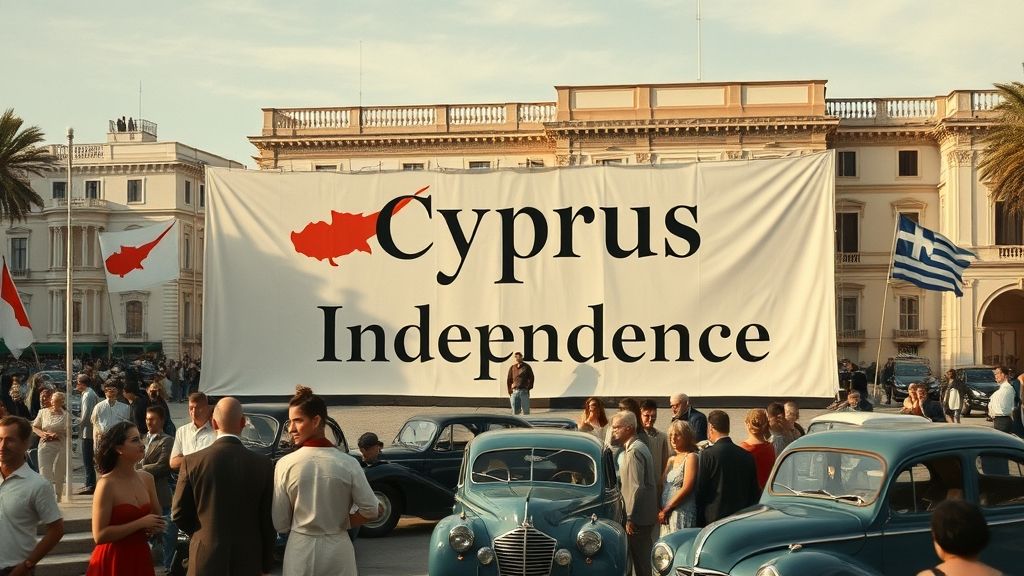
The independence ceremony in Nicosia was both joyous and ceremonious. Crowds thronged the capital’s streets, waving Greek and Turkish Cypriot flags alongside the new national emblem symbolizing unity. Speeches were delivered with hopeful zeal; military parades and cultural performances celebrated an island reborn.
Yet, observers noted the guarded faces amid the crowds, understood in hindsight as an unspoken awareness that peace was tentative and the road ahead uncertain.
Public Celebrations and Collective Dreams for the New Republic
The general population, after years of conflict and hardship, embraced this moment as a triumph. Streets surged with jubilation, families gathered for feasts, and cultural organizations staged events celebrating diversity and ethnic heritage.
Schools introduced lessons on citizenship, and newspapers carried editorials preaching unity. The newly independent Cyprus awakened to the promise of self-determination, economic development, and international recognition.
Early Challenges and the Fragility of the New Political Order
However, the honeymoon was brief. The elaborate constitutional arrangements created institutional deadlock. Disagreements over representation, administration, and security soon surfaced. Communal councils clashed; distrust simmered beneath the surface.
Economic disparities and patronage networks complicated governance. Armed incidents and political provocations punctuated the first years, undermining confidence.
Communal Tensions: From Hope to Fracture
Between 1963 and 1964, Cyprus was engulfed in violent clashes between Greek and Turkish communities. The constitutional arrangements failed to resolve underlying ethnic rivalries and competing nationalisms. The collapse of government institutions and the intervention of the United Nations marked the beginning of a protracted conflict.
Cyprus’s dream of a bicommunal republic seemed increasingly elusive.
The Legacy of August 16, 1960: A Divided Island’s Resurrection
Despite ensuing conflicts, the 1960 independence remains a pivotal moment — a foundation and reminder of the island’s aspirations. It endowed Cyprus with international status, a symbolic unity, and a shared history of freedom from colonial rule.
The struggles that followed transformed the island but also traced their origins to that foundational compromise.
Cyprus Independence in World Perspective: Cold War and Decolonization
Cyprus’s emergence was part of the larger wave of postwar decolonization, shifting the global order toward national sovereignty. Yet the Cold War’s fraught politics complicated this journey, as superpowers and regional states sought influence.
Cyprus became a microcosm where local nationalism and global geopolitics intersected.
Cultural Renaissance and National Identity Building
The 1960s witnessed a blossoming of Cypriot arts, literature, and cultural identity. Efforts to promote bilingualism, folk traditions, and shared histories were both state-sponsored and grassroots. The island’s complex heritage was embraced even amid political divisions.
The Aftermath: Towards the Conflict of 1974 and Beyond
The failure of post-independence power-sharing and renewed violence culminated in Turkey’s military intervention in 1974 following a Greek-supported coup. The island was effectively divided, a situation that endures.
Nevertheless, the independence proclamation remains a key touchstone in Cypriot collective memory.
Personal Stories: Voices from the Day and its Echoes
From elders recalling the euphoria of August 16, to families split by the conflicts that followed, personal testimonies add human depth. These accounts capture the hopes, fears, and complex emotions that statistics cannot convey.
Remembering August 16: Commemoration and Historical Debate
Annually, ceremonies remember independence, reflecting on progress and challenges. The day provokes debate about communal coexistence, national identity, and the unresolved conflict.
The Cyprus Question Today: Continuities and Change
Today, Cyprus remains divided, yet EU membership, peace negotiations, and civil society efforts signal ongoing attempts to reconcile. The legacy of independence guides discussions about the island’s future and identity.
Conclusion
The proclamation of Cyprus’s independence on August 16, 1960, was a moment of profound hope and profound contradiction. It was the culmination of a long struggle against colonial rule and a bold experiment in bi-communal governance, born out of compromise and fraught with tension. The joy of liberation mingled with the fears of division; the promise of unity coexisted uneasily with entrenched mistrust.
Through decades of conflict, displacement, and political deadlock, the island and its people have navigated an extraordinary journey — one marked by resilience, heartbreak, and a persistent quest for peace. Cyprus’s independence remains a luminous reminder that sovereignty alone does not heal centuries of division, but it does grant the space for new stories to be written — stories of coexistence, of justice, and of hope.
August 16, 1960, stands as an emblematic chapter, inviting the world to witness not just a political event, but the complex human drama of an island forever at the crossroads of history.
FAQs
Q1: Why was Cyprus’s independence declared on August 16, 1960?
A1: The date marked the culmination of years of negotiation and conflict involving Cypriots and their colonial rulers, alongside Greece and Turkey. August 16 was chosen following the Zurich and London Agreements that set the terms for independence.
Q2: Who were the key figures in Cyprus’s independence?
A2: Archbishop Makarios III, the first President of Cyprus, and Dr. Fazıl Küçük, the Vice President, were pivotal leaders symbolizing the island’s Greek and Turkish communities, respectively.
Q3: What were the major causes leading to Cyprus's independence?
A3: Colonial rule, rising nationalism among Greek Cypriots, the Enosis movement, and Turkish Cypriot fears of marginalization contributed to decades of conflict and ultimately the push for sovereign nationhood.
Q4: How did the British approach Cyprus’s independence?
A4: Britain initially sought to maintain control but ultimately brokered a compromise allowing independence, with the retention of military bases, to protect strategic interests and manage intercommunal tensions.
Q5: What were the main features of Cyprus’s 1960 constitution?
A5: The constitution established a power-sharing government with a Greek Cypriot president and Turkish Cypriot vice president, communal chambers, and quotas in administration and security forces.
Q6: Why did communal tensions persist after independence?
A6: Deep-rooted ethnic mistrust, constitutional complexities, and competing nationalist ambitions led to political deadlock and sporadic violence.
Q7: How is Cyprus’s independence remembered today?
A7: Independence is commemorated as a symbol of sovereignty and hope, though remembrance is often tempered by reflection on the island’s subsequent division and ongoing conflict.
Q8: What is the current status of the Cyprus issue?
A8: Cyprus remains divided between the internationally recognized Republic of Cyprus and the Turkish Republic of Northern Cyprus, recognized only by Turkey, with ongoing UN-led reunification talks.