Table of Contents
- The Dawn of a New Mission: Cyril and Methodius Set Out for Moravia
- The Byzantine Empire at the Crossroads: Context of the 9th Century
- The Great Moravian Realm: A Kingdom Poised for Transformation
- Lords of Letters: The Brothers’ Early Lives and Call to Service
- Constantinople’s Strategic Vision: Why Sending Cyril and Methodius?
- The Journey West: Crossing Borders and Cultures
- Crafting the Glagolitic Alphabet: A Revolution in Writing
- Baptizing Language: Translating the Scriptures into Slavic Tongue
- Diplomatic Tensions: The Clash with Frankish Clergy
- The Arrival in Moravia: Introducing a New Faith and Culture
- The Role of Moravian Prince Rastislav: Protector and Patron
- The Struggle for Religious Autonomy: Between Rome and Constantinople
- The Spread of Old Church Slavonic: A Lingual Renaissance
- The Trials of Methodius: Imprisonment and Persistent Faith
- The Death of Cyril and the Continuing Mission
- Legacy Beyond Moravia: The Impact on Slavic Nations
- The Birth of Slavic Literacy: Education and Identity
- The Political Ripples: Moravia’s Influence on Europe’s Map
- Forgotten for a Time: The Eclipse of the Slavic Church
- Rediscovery and Reverence: Cyril and Methodius in Modern Memory
- The Saints Who Built a Nation’s Soul
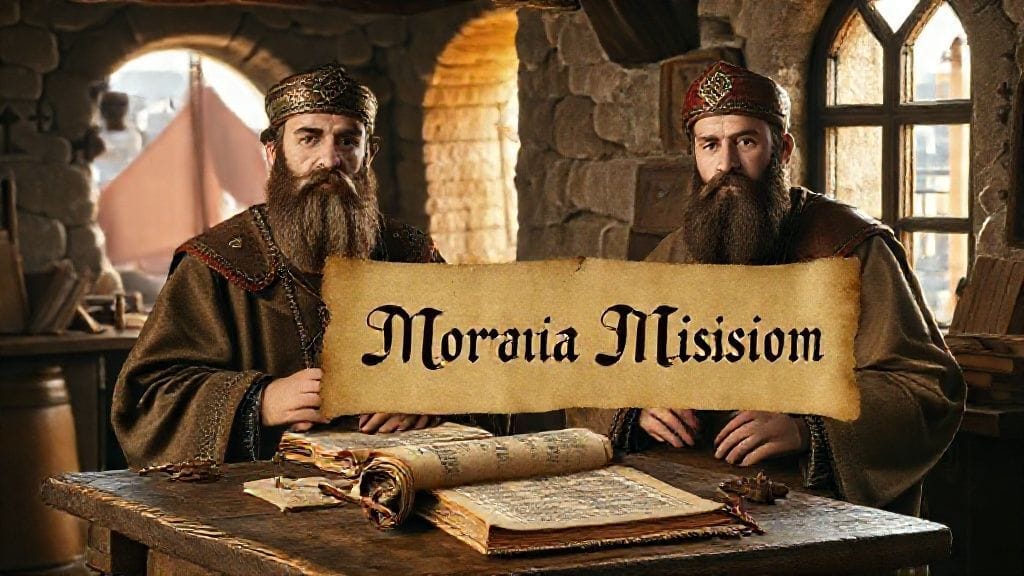
From the misty banks of the Danube to the cathedral shadows of Constantinople, two brothers—Cyril and Methodius—emerged in the ninth century as unlikely pioneers of cultural transformation. Their mission, commissioned in 862-863, carried more than holy scripture; it was a mission of identity, language, and geopolitical strategy that reshaped the Slavic world forever.
The Dawn of a New Mission: Cyril and Methodius Set Out for Moravia
Imagine the heart of Central Europe in the early 860s—a patchwork of tribal domains, nascent kingdoms, and rival empires. Among these, Great Moravia stood as a blossom amidst thorns, eager to assert itself not only militarily but culturally and spiritually. Into this tense and fertile landscape, Byzantine Emperor Michael III and Patriarch Photius dispatched two brothers, Constantine (later Cyril) and Methodius, with a multifaceted mission: to convert the Moravians to Christianity using their own tongue, crafted in a script unfamiliar to East and West alike.
This was not merely a religious expedition—it was a deliberate and unprecedented cultural intervention. The brothers became architects of a Slavic orthodoxy, bridging political fissures and linguistic divides with something profoundly human: the power of language itself.
The Byzantine Empire at the Crossroads: Context of the 9th Century
The Byzantine Empire of the mid-9th century stood at a tumultuous juncture. Rome’s influence was waning in regions north of the Alps, while the Frankish Empire, under Louis the German and later Charles the Bald, sought to consolidate Christian authority over Slavic lands. Simultaneously, Great Moravia emerged as a political buffer zone, an independent player caught between two great powers.
Byzantium, the imperial capital, spoke Greek and followed Orthodox rites, but it looked westward with strategic intent. The empire’s elite saw in Moravia an opportunity: by promoting Christianity in the vernacular Slavic language, they could establish religious and cultural influence that would counterbalance the Latin Church aligned with the Franks. This was a chess game of faith and empire, where every bishopric and letter mattered.
The Great Moravian Realm: A Kingdom Poised for Transformation
Great Moravia had consolidated under Prince Rastislav, a ruler who understood that power was not only a question of armies and alliances but of spiritual allegiance. Rastislav aspired for autonomy from Frankish overlords, and an independent church was central to that ambition. The decision to invite Byzantine missionaries was both a bold assertion of sovereignty and a wish to distance Moravia from Latin clerical dominance.
The Moravian people, diverse and fragmented, had relied until then on a patchwork of pagan rites and sporadic Christian contact. The arrival of Cyril and Methodius promised not just conversion but cultural unity. The stakes were enormous: the shape of their faith would echo into the centuries.
Lords of Letters: The Brothers’ Early Lives and Call to Service
Constantine and Methodius were no ordinary missionaries. Born in Thessalonica, a melting pot of cultures at the edge of Byzantium, they had grown up fluent in Slavic and Greek. Constantine was a scholar, a man of intellect versed in philosophy and theology; Methodius, his elder, had risen through ecclesiastical ranks.
Their background made them uniquely suited to this mission. Constantine’s invention of a written alphabet—the Glagolitic script—was a masterpiece designed to faithfully convert Slavic sounds into letters, solving a problem that had challenged Christian missionaries for centuries: how to preach and administrate in a language the people could understand.
Constantinople’s Strategic Vision: Why Sending Cyril and Methodius?
Why send these particular envoys, and why now? For Constantinople, the mission to Moravia was a chance to project soft power through culture and religion. The empire had recently faced internal revolts and external threats, from Bulgars to Arabs to rival Levantine factions. Expanding influence peacefully into Slavic realms was both a pragmatic and ideological endeavor.
Emperor Michael III and Patriarch Photius viewed Slavic peoples as a blank slate for Orthodox Christianity, unburdened by Latin traditions. By empowering the Slavs to worship and read scripture in their language, Byzantium aimed to create a loyal, culturally tied Christian sphere extending into Europe’s heartland—right where Frankish ambitions loomed large.
The Journey West: Crossing Borders and Cultures
The brothers’ journey was perilous, crisscrossing political frontiers and linguistic landscapes. They traveled from Constantinople through the Balkans, facing not only geographical hardship but also skepticism from local elites and hostility from rival missionaries.
Arriving in Moravia, they found a people at once curious and cautious. The brothers’ willingness to respect and elevate the vernacular carved a path of trust, but their foreign origin and Byzantine backing also aroused doubts—a reminder that religion was never far from politics.
Crafting the Glagolitic Alphabet: A Revolution in Writing
One of the mission’s most extraordinary achievements was the creation of the Glagolitic alphabet. Unlike Latin or Greek scripts, Glagolitic was entirely new, artfully constructed to represent the unique sounds of the Slavic tongue.
It was not just a writing system but a cultural manifesto: a statement of independence and identity. This alphabet enabled the transcription of biblical texts, liturgies, and legal codes, making scripture accessible to common people and clergy alike.
Baptizing Language: Translating the Scriptures into Slavic Tongue
Translation of the Bible and liturgical texts into Old Church Slavonic was nothing short of revolutionary. In an era when Latin and Greek dominated religious life, placing sacred words in the language spoken by the masses was both empowering and contentious.
The brothers faced theological opposition, particularly from German clergy who insisted on Latin as the sole liturgical language. But Constantine and Methodius argued that true conversion required understanding and participation; faith had to live in the language of the soul.
Diplomatic Tensions: The Clash with Frankish Clergy
The mission ignited fierce rivalries. Frankish bishops, wielding political and ecclesiastical power, saw the Byzantine-sponsored Slavic liturgy as a threat to their dominion and the unity of Christendom.
They accused Cyril and Methodius of heresy and undermining ecclesiastical order, leading to trials and denunciations. The brothers’ campaign for religious autonomy became entangled in a broader power struggle for control over the Slavic peoples.
The Arrival in Moravia: Introducing a New Faith and Culture
In Moravia itself, the impact was immediate and profound. The brothers baptized converts, established schools, and ordained clergy who used the Slavic liturgy. Entire communities found their faith enriched by a sense of cultural belonging.
For many Moravians, the mission was a revelation: God’s word was no longer distant and foreign but intimately tied to their own history and voice.
The Role of Moravian Prince Rastislav: Protector and Patron
Prince Rastislav’s support was essential. He shielded Cyril and Methodius from political adversaries and used the mission as a diplomatic tool to assert independence from Frankish overlordship.
Rastislav’s vision of a Moravian church independent of Western control was radical and risky, but with the brothers’ help, he built the foundation for a spiritual and political alternative in Eastern Europe.
The Struggle for Religious Autonomy: Between Rome and Constantinople
After Cyril’s death in 869, Methodius continued the mission amid mounting pressures. Rome, under Pope Adrian II and later John VIII, initially sanctioned the use of Old Church Slavonic but was wary of Byzantine influence.
The delicate balance between competing religious authorities highlighted the baptism of Christian Europe’s future into complex geopolitical entanglements, where theology was inseparable from power.
The Spread of Old Church Slavonic: A Lingual Renaissance
Old Church Slavonic did not remain confined to Moravia. Over the following centuries, it spread through Bulgaria, Croatia, Serbia, and beyond, becoming the liturgical language of many Slavic Orthodox churches.
This linguistic legacy was instrumental in forming national identities and preserving local cultures against later waves of foreign domination.
The Trials of Methodius: Imprisonment and Persistent Faith
Despite papal recognition, Methodius suffered imprisonment by Frankish authorities who viewed his mission as insubordination. His resilience during captivity and eventual release reflected both the precariousness and tenacity of this cultural movement.
His story became emblematic of the fight to preserve linguistic and religious freedom amid the tides of empires.
The Death of Cyril and the Continuing Mission
Cyril’s death in Rome from illness did not halt the mission; his brother and followers carried forth the vision. They laid foundations for Slavic Christian literature and education that endured long after political fortunes shifted.
Their legacy was cemented by the continuing efforts of disciples who spread the alphabet, scriptures, and liturgy across Eastern Europe.
Legacy Beyond Moravia: The Impact on Slavic Nations
The influence of Cyril and Methodius extended well beyond their initial mission. Their work was the seed of Slavic literacy, Orthodox religious traditions, and cultural unity in countries as diverse as Bulgaria, Russia, and Serbia.
Their synthesis of faith and language fostered national identities during centuries of political change.
The Birth of Slavic Literacy: Education and Identity
The establishment of Slavic liturgy created the first major written culture for many Slavic peoples, enabling the growth of literature, legal traditions, and historical consciousness.
Schools and scriptoria were founded, producing manuscripts that remain treasured cultural relics.
The Political Ripples: Moravia’s Influence on Europe’s Map
Moravia’s assertion of an independent church and the cultural empowerment of its people reverberated across Europe, influencing the balance of power between East and West.
Though Great Moravia eventually declined, its intellectual and religious achievements lived on in successor states.
Forgotten for a Time: The Eclipse of the Slavic Church
Following the fall of Great Moravia to Magyar invasions, the Slavic liturgy and church mission faced decline. Latin rites reasserted dominance in many regions, and the legacy of Cyril and Methodius risked being forgotten.
Yet, the memory persisted underground, awaiting rediscovery centuries later.
Rediscovery and Reverence: Cyril and Methodius in Modern Memory
The renaissance of Slavic nationalism in the 19th century revived interest in Cyril and Methodius, who became icons of cultural pride and unity.
Today, their feast days are celebrated across Eastern Europe, honoring their role as apostles of the Slavs and guardians of language.
The Saints Who Built a Nation’s Soul
Ultimately, Cyril and Methodius were more than missionaries; they were architects of a new civilization. By elevating the Slavic language and embedding faith into local culture, they gave voice and vision to generations.
Their mission in 862–863 was a turning point—not only in religious history but in the making of European identity itself.
Conclusion
The commissioning of Cyril and Methodius for Moravia at the dawn of 862 was more than a simple clerical dispatch; it was a profound experiment in cultural diplomacy and spiritual innovation that changed the course of European history. Through courage, intellect, and devotion, two brothers transformed not only the religious landscape but the very way a people understood themselves.
Their story is a testament to the power of language as a vessel of faith and identity, a reminder that the deepest revolutions begin not with armies, but with letters and voices speaking in the tongue of the heart.
The echoes of their mission still resonate in the languages, churches, and souls of millions today—a legacy as vibrant and enduring as the written word itself.
FAQs
1. Who were Cyril and Methodius, and why were they chosen for the mission to Moravia?
Cyril and Methodius were brothers from Thessalonica, educated and fluent in both Greek and Slavic languages. Their unique linguistic skills and deep theological knowledge made them ideal envoys to spread Christianity in a culturally sensitive way among Slavic peoples.
2. What was the political significance of the mission?
The mission aimed to establish Byzantine influence in Central Europe by creating a Slavic Christian church independent of Frankish and Latin control, thus shaping political alliances and territorial control.
3. Why was the creation of the Glagolitic alphabet important?
It was the first script designed specifically for the Slavic language, enabling the translation of Christian texts and fostering literacy and cultural identity among Slavic peoples.
4. How did Frankish clergy react to the mission?
They opposed it vigorously, seeing the Slavic liturgy as a threat to Latin ecclesiastical dominance and their political influence, leading to conflicts and the imprisonment of Methodius.
5. What legacy did Cyril and Methodius leave behind?
Their work laid the foundation for Slavic literary culture, religious traditions, and national identities. They are regarded as the “Apostles to the Slavs” and saints in both the Eastern Orthodox and Roman Catholic Churches.
6. How is the mission of Cyril and Methodius remembered today?
Their contributions are celebrated in many Slavic countries, especially on their feast day, February 14 (Julian Calendar) or May 11 (Gregorian Calendar), as symbols of cultural pride and religious heritage.
7. Did their mission succeed immediately?
While they faced significant opposition and political struggles, the mission ultimately succeeded in establishing a Slavic liturgical tradition that endured and expanded beyond Moravia.
8. What role did Prince Rastislav play?
Rastislav was the Moravian ruler who invited Cyril and Methodius, seeking religious and political independence from the Frankish Empire. He supported their work as a means of solidifying his realm’s identity and sovereignty.

