Table of Contents
- A King on His Deathbed: London, 23 April 1016
- From Boy King to Beleaguered Ruler: The Making of Æthelred
- England Under Siege: The Viking Storm Before 1016
- Courtly Intrigue and Family Shadows: The Ghost of Edward the Martyr
- Tribute, Treachery, and Danegeld: Paying for Peace with Silver and Blood
- The Fateful Alliance with Normandy and Queen Emma’s Influence
- The Road to Crisis: Sweyn Forkbeard, Cnut, and the Shattered Crown
- The Siege of London and the Last Winter of Æthelred’s Life
- The Death of Æthelred the Unready: A King’s Final Hours
- Funeral Rites and Silent Stones: Burying a Contested Legacy
- Edmund Ironside, Cnut, and the Battle for a Dead King’s Kingdom
- Voices of the Chroniclers: How Medieval Writers Judged Æthelred
- The People Beneath the Crown: Fear, Famine, and Faith in 1016
- Law, Lordship, and Collapse: What Æthelred’s Reign Did to England
- Myths, Nicknames, and Misreadings: Was He Truly “Unready”?
- From Ruin to Renewal: How Cnut Used Æthelred’s Death to Forge a North Sea Empire
- Memory, Blame, and Rehabilitation: Rewriting Æthelred in Modern History
- Conclusion
- FAQs
- External Resource
- Internal Link
Article Summary: On 23 April 1016, as London strained under Viking pressure and the English kingdom seemed ready to fracture, the death of aethelred the unready closed one of the most turbulent chapters in early English history. This article traces how a boy king, crowned amid bloodshed, became the embattled monarch whose decisions shaped England’s fate on the eve of conquest. Moving from palace plots and Viking raids to the emotional atmosphere of a city under siege, it follows Æthelred’s final days and the bitter struggle that followed his passing. It examines how chroniclers, clerics, and later historians turned the death of aethelred the unready into a symbol of failure, even as they relied on partial and hostile sources. We explore the human costs of tribute, war, and betrayal on ordinary people living through years of invasion. The narrative then turns to Edmund Ironside and Cnut, showing how they fought over the shadow of Æthelred’s reign and how Cnut reshaped the kingdom he inherited. Across the centuries, the memory of the death of aethelred the unready has been retold, simplified, and challenged, revealing as much about those who judged him as about the king himself. In the end, the death of aethelred the unready stands not just as the fall of a ruler, but as a hinge-point between Anglo-Saxon England and a new, Scandinavian-dominated order.
A King on His Deathbed: London, 23 April 1016
In the spring of 1016, London smelled of smoke and damp wool. The river Thames, swollen with rain and choked with the traffic of war, carried barges packed with grain, armed men, and frightened families who had slipped past enemy lines. Beyond the city walls, Viking encampments smoldered—fleeting, shifting rings of firelight against the darkness—while inside the crammed streets, fear moved as silently as the night fog.
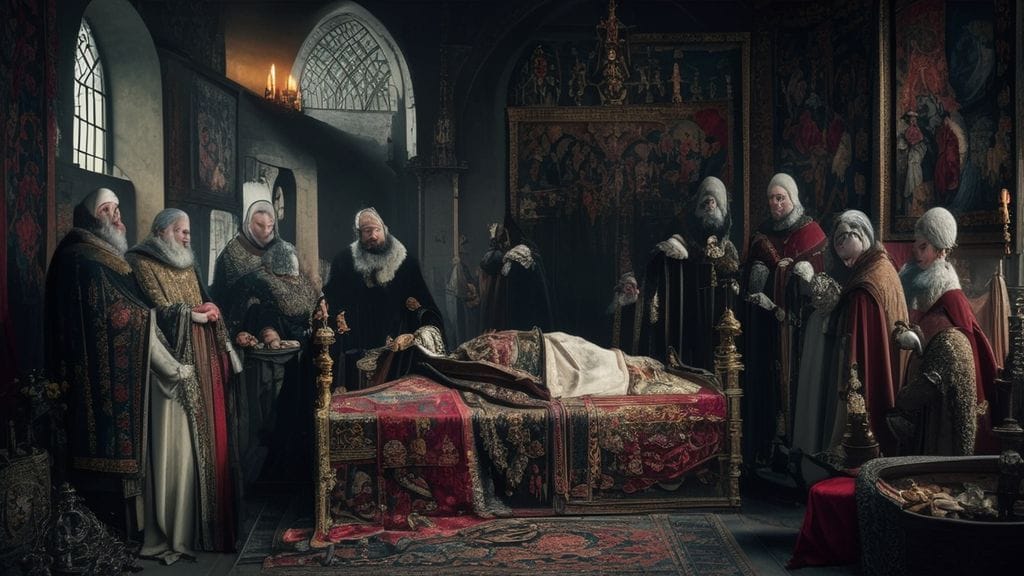
Within this tense, crowded city, in some shuttered royal chamber whose exact location is lost to us, the king of the English lay dying. Æthelred, whom later generations would cruelly name “the Unready,” was nearing the end of a reign that had begun with a murder and unfolded under the shadow of an unending war. The death of aethelred the unready did not come with the grandeur of triumph returned from campaign or the quiet dignity of old age in peace; it came instead with the dull ache of illness, political failure, and a kingdom splitting at the seams.
Outside, men argued about oaths and loyalties—whether to hold faith with the old king’s house or to turn to the rising star of the Danish prince Cnut. Inside, Æthelred’s household, churchmen, and his remaining loyal thegns clustered in darkened corridors, speaking in urgent whispers, watching servants hurriedly pass between chapel and bedchamber. They knew that every labored breath, every fit of fever, shortened the time England had left to decide its future. The dying king’s word, if he could summon the strength to give it, might yet sway the lords of the realm.
But this was only the beginning of the story of that day. The death of a king is never just a private moment; it is a political earthquake. The death of aethelred the unready would send tremors through courts from London to Winchester, from the monasteries of Wessex to the halls of Scandinavian warlords across the North Sea. It would be recounted in annals and chronicles, retold and reshaped until the man himself, Æthelred, blurred into an emblem of failure. To understand that final moment on 23 April 1016, we must walk back through the years that led him to that bed in London, and the long, bitter road that had turned a young king into a symbol of ruin.
From Boy King to Beleaguered Ruler: The Making of Æthelred
Æthelred was not born to a peaceful inheritance. When he came into the world around 966, his father, King Edgar, presided over what many English churchmen considered a golden age. Edgar the Peaceable, as the monks liked to call him, held together a kingdom that had grown from the scattered Anglo-Saxon realms into something approaching a unified state. Yet even in the glow of that success, the seeds of future disaster were already rooted in the royal family.
Edgar left behind two sons from two different queens: Edward, older and born of Æthelflæd (sometimes called Wulfthryth), and Æthelred, born of Ælfthryth, a woman whose ambition would echo through later accusations and legends. When Edgar died in 975, his kingdom did not slide seamlessly into the hands of one heir. Instead, factions coalesced—monastic reformers and powerful nobles favoring Edward, others backing Æthelred, who was still a child. The court became a place of suspicion, gossip, and quiet plotting.
In 978, everything changed at Corfe. There, the teenage King Edward arrived to visit his half-brother Æthelred and his stepmother. What happened in the courtyard at Corfe is still debated, but from the Anglo-Saxon Chronicle and later accounts comes a grim consensus: Edward was stabbed to death by men attached to the household of Ælfthryth. Some stories claim that he was offered a drink, only to be assaulted as he sat on his horse; others that he was lured into the hall and murdered. However it occurred, his blood soaked the royal earth, and Æthelred, perhaps only ten or eleven years old, suddenly became king.
The boy did not choose this path, but he was made to walk it. His coronation at Kingston-upon-Thames, where many English kings had been crowned, could not scrub away the stain of fratricide. Chroniclers, especially those who admired the pious Edward, later named him “Edward the Martyr” and suggested that Æthelred’s reign was cursed from the start. One can imagine the child-king standing beneath the weight of the crown, his small neck straining, aware that certain pairs of eyes in the gathered crowd regarded him as a usurper who had gained the throne by blood.
In this charged atmosphere, the young Æthelred depended on advisors—ealdormen, bishops, and his formidable mother. The balance of power at court shifted and reshaped itself around him, with powerful magnates vying for influence. The king’s will, in those early years, was that of a boy molded by the competing hands of others. By the time he reached manhood, the habits of compromise, delay, and political calculation had already set in, even as far more dangerous forces gathered on England’s coasts.
England Under Siege: The Viking Storm Before 1016
To understand Æthelred’s reign, one must imagine the sound that haunted it: the slap of oars against the waves and the creak of longships closing in on unprotected shores. Viking raiders had troubled England since the late eighth century, but in the decades before 1016, their presence took on a new, punishing rhythm. No longer just sudden, opportunistic strikes, these were campaigns—organized, repeated, often wintering in English territory and returning year after year.
In the 980s and 990s, while Æthelred was still settling into power, fleets appeared along the English coasts with unnerving frequency. The Anglo-Saxon Chronicle records raids on Southampton, Thanet, Cheshire, and beyond. Monasteries that had once sheltered under the protective patronage of King Edgar now watched smoke rise from nearby settlements. Townsfolk in coastal communities learned to read the horizon with dread, scanning for the thin silhouettes of dragon-prowed ships.
The raids were more than military events; they were psychological assaults on a kingdom that had believed itself secure. Under Alfred the Great and his successors, the English had come to see themselves as a people able to resist and even push back the Danes. Now, once again, they found themselves on the defensive. The king’s advisors had to decide, again and again, how to respond. Muster the fyrd—the levied army of free men—and risk defeat in open battle? Fortify burhs and wait out the storm? Or, as became increasingly common, pay for peace?
Throughout these early phases of conflict, Æthelred’s reputation among his own people and among later historians began to darken. The image of a ruler beset but resolute never quite emerged. Instead, the English court attempted a mixture of military resistance and negotiation that often seemed to satisfy neither arm of policy. When battles were lost, the sense of vulnerability deepened. When negotiations were attempted, they too frequently ended in betrayal or renewed attacks.
Yet behind the celebrations of the rare victories, like the English success at Maldon in 991 before its fateful end, something more corrosive was at work: mistrust between king and nobles, and an uneasy sense that unity was slipping away. It’s astonishing, isn’t it, how a kingdom that had once felt so consolidated could begin to crumble under the pressure of repeated, almost seasonal foreign incursions? And still, the worst was yet to come.
Courtly Intrigue and Family Shadows: The Ghost of Edward the Martyr
The ghost of Edward the Martyr hovered over Æthelred’s reign in more ways than symbolic. In the decades after his murder, Edward became the object of local veneration. His body, exhumed and translated to Shaftesbury, gathered a reputation for miracles. Pilgrims came to pray at his shrine, and whispers of his sanctity spread along monastic networks. When a murdered king is declared a saint, it is not a comfortable thing for his successor.
For Æthelred, this sanctification posed a perpetual, silent accusation. Even if he had played no direct part in the crime at Corfe, many no doubt believed that his mother had, and that his kingship was born from that blood. Politics, piety, and memory entwined. Every time a monk penned another glowing line about Edward’s virtues, every time a new miracle was celebrated, the contrast with the living king grew sharper.
Courtly intrigue did not end with Edward’s death. Æthelred’s own circle was riven by rivalry. Powerful figures like Ealdorman Leofwine, Ealdorman Ælfric, and later Eadric Streona emerged, each with their own followings, estates, and agendas. Eadric, in particular—his surname “Streona” often translated as “the Acquisitive” or “the Grasper”—became a symbol of treacherous opportunism. His rise in the 1000s coincided with some of the most disastrous episodes of the reign, including notorious acts of betrayal in battle.
Inside the royal household, family dynamics added further complexity. Æthelred’s first wife, Ælfgifu of York, had provided him with sons, including Edmund—later known as Edmund Ironside. But political calculations led Æthelred to seek an alliance across the Channel. This would bring a new queen into the story, and with her would come new heirs and new divisions within the royal bloodline.
In this atmosphere, the king’s decisions can be read not simply as misjudgments of policy, but as the flailing choices of a man constantly trying to manage mistrust: between old and new families, between powerful nobles, between church and crown. The sense that the kingdom was haunted—by a murdered brother, by the expectations of dead ancestors, by the looming threat of divine judgment—pervaded the age. When the death of aethelred the unready finally came, it would feel to some like the inevitable working out of a long-standing curse.
Tribute, Treachery, and Danegeld: Paying for Peace with Silver and Blood
One of the most infamous features of Æthelred’s rule was his repeated resort to tribute, known as Danegeld. Time and again, when Viking forces threatened English shores, the court agreed to buy them off—handing over enormous sums of silver in the hope of securing at least a temporary respite. In 991, after the death-strewn defeat at Maldon, the English agreed to pay 10,000 pounds of silver. Larger payments followed, reaching an astounding 36,000 pounds in 1007 and finally 48,000 in 1012.
Viewed from the vantage point of modern judgment, these payments often appear as acts of cowardice or shortsightedness: the king perpetually “unready,” slow to fight, too willing to enrich his enemies. Yet, in the moment, the people weighing these choices faced agonizing calculations. The cost of raising armies was high; the cost of losing battles higher still. Every silver coin melted down for tribute represented the labor of English peasants, the rents of estates, the treasures of monasteries. But every skirmish avoided also meant fewer burnt villages, fewer widowed wives, fewer children taken as slaves.
Still, the policy had grim consequences. As one later chronicler acidly noted, paying Danegeld only taught the Vikings how rich England was and how much it feared them. Each payment spread word across the Baltic and Scandinavian world: this island kingdom was a place of abundant treasure and deep anxieties. More warlords came, drawn not just by plunder but by the possibility of shaping policy and extracting regular tribute. The line between raider and quasi-official mercenary blurred dangerously.
Worse yet, the flow of silver out of England had a political effect at home. Taxation grew heavier, and resentment followed. The more people felt squeezed to pay off foreign armies, the more they questioned the competence and courage of their own rulers. Local lords, obligated to assist in gathering tax and defending the shires, might look to their own interests and begin to think of alternative loyalties—particularly as the prestige of Scandinavian leaders like Sweyn Forkbeard and his son Cnut grew.
The constant negotiation and the occasional catastrophic betrayal gave Æthelred’s government a reputation for shiftiness. Alliances made in crisis were sometimes abandoned just as quickly. The king’s failure to build a stable, trusted network of loyal magnates did as much damage as any lost battle. Thus, by the time the death of aethelred the unready approached, the very mechanisms by which the realm held together—taxation, oaths, and mutual defense—were strained nearly to breaking.
The Fateful Alliance with Normandy and Queen Emma’s Influence
Amid the chaos, Æthelred sought anchor beyond the North Sea world. Around 1002, he married Emma of Normandy, sister of Duke Richard II. This union was meant not only to legitimize his rule through a prestigious foreign alliance, but to establish a counterweight to Scandinavian power. If Danish fleets came, the logic ran, perhaps Norman ports could be discouraged from offering refuge or support. Through Emma, the Norman duchy and the English kingdom would be bound by blood.
Emma’s arrival in England brought a different cultural flavor to the royal court. Raised in a ducal household that had long experience balancing Frankish, Norse, and ecclesiastical interests, she was no passive consort. Over time, she carved out a political space for herself, sponsoring charters, endowing religious houses, and operating as a patron. Her children—most notably Harthacnut and the future Edward the Confessor—would later play crucial roles in the shifting dynastic politics of both England and Normandy.
But Emma’s marriage also deepened tensions within the royal family. Æthelred already had sons from his first marriage, and now a second line of potential heirs grew up in the royal hall. Factions could form around these young princes, as ambitious nobles chose which possible future to back. The very alliance meant to stabilize the dynasty ended up giving later power-brokers an alternative set of claimants to champion.
On the international stage, the Norman link was a double-edged sword. While it brought the prestige of continental connections and perhaps some curbs on Viking cooperation with Norman ports, it also drew England into the complex web of northern French politics. Moreover, as the years passed and Emma’s sons grew, the memory of this union would provide the later Norman duke William with a slender but usable thread of hereditary justification when he looked across the Channel with conquest in mind.
Inside that shuttered bedchamber in 1016, as the death of aethelred the unready drew near, Emma would have stood in a uniquely painful position. She had children who might yet claim the English throne, children whose Norman relatives had a keen interest in English affairs, and stepchildren like Edmund Ironside whose courage and popularity made them formidable rivals. Around the deathbed of Æthelred swirled not just grief, but the quiet calculations of future claimants, each with their own retinues, their own hopes, their own fears.
The Road to Crisis: Sweyn Forkbeard, Cnut, and the Shattered Crown
If Æthelred’s earlier troubles had been severe, the arrival of Sweyn Forkbeard turned crisis into catastrophe. Sweyn, king of Denmark and a seasoned war leader, began to mount serious campaigns against England at the turn of the millennium. He was no mere raider; he came as a conqueror, with fleets and ambitions to match. In 1003 and 1004, 1006 through 1007, and again in 1009, the Danes ravaged the English coasts and inland territories, culminating in a devastating series of attacks led by Thorkell the Tall.
Some scholars have linked Sweyn’s fury to a particular event: the St. Brice’s Day massacre of 1002, when Æthelred ordered the killing of Danes living in England, possibly including members of Sweyn’s own family. The order, likely driven by fear of an internal rising, resulted in brutal violence against communities of Scandinavians who had settled in English towns. The Chronicle mentions this edict briefly, but later sources and archaeological evidence—such as a mass grave in Oxford—hint at the horror of the day. If Sweyn needed a casus belli, this massacre offered it in blood-red letters.
By 1013, the pressure was unbearable. Sweyn launched a major invasion, and one English region after another submitted. The king’s authority seemed to crumble as magnates weighed their chances and made accommodations with the invader. London held out fiercely, but much of the country bowed to Sweyn. Faced with overwhelming force and wavering support, Æthelred fled to Normandy with Emma and their children, seeking refuge at his brother-in-law’s court.
For a brief time, it appeared that the story of Æthelred’s reign might simply end in exile. Sweyn Forkbeard styled himself “king of England,” and many of the English elite swore oaths to him. But fate intervened. Sweyn died suddenly in early 1014—some say from a fall, others whisper of divine judgment. The throne he had seized so spectacularly was now contested once more. English magnates called for Æthelred to return, but with conditions: he must rule more justly, listen more wisely, and mend the frayed relationship between crown and nobility.
Æthelred came back, but he returned to a kingdom he no longer fully controlled. Sweyn’s son, Cnut, refused to accept defeat. Gathering ships and warriors from Denmark and beyond, he resumed the struggle for England. The stage was set for a grinding civil war: Æthelred in London, his son Edmund Ironside fighting with desperate valor across the shires, and Cnut pressing them both with disciplined Scandinavian forces. By the time we reach 1016, the year of the king’s death, the English crown was less a symbol of unity than a prize being fought over on trampled fields and river crossings.
The Siege of London and the Last Winter of Æthelred’s Life
In the winter of 1015–1016, London was a city under siege in more than one sense. Cnut’s army moved across England, winning allegiances by might or persuasion. Eadric Streona, whom Æthelred had raised high and trusted far too much, shifted his loyalties between king and Dane in a display of cynical self-interest that appalled later chroniclers. Edmund Ironside, refusing to accept defeat, gathered forces to challenge Cnut in a series of fierce engagements.
Æthelred himself, by this time, was an ailing man. The decades of rule, the weight of accusations and reversals, the strain of constant warfare, all lay heavy on his body. The Anglo-Saxon Chronicle tersely notes that he “died at London” on St. George’s Day, 23 April 1016, but it offers no dramatic death scene, no recorded last words. Historians infer from the timing that Æthelred’s final months were spent watching, perhaps helplessly, as his son waged the campaigns that he could no longer personally lead.
London, with its fortifications and its strategic position on the Thames, was a crucial stronghold. The city had resisted Sweyn and would resist Cnut as well. For ordinary Londoners, this meant shortages of food, the constant threat of attack, and the psychological weariness of hearing war horns and rumors in equal measure. The royal presence meant some influx of resources, but also the burden of housing troops, feeding officials, and living under the gaze of a desperate court.
In the halls near the river, counselors debated how to hold the kingdom together. Should they negotiate with Cnut? Should they throw all their support behind Edmund and press for one decisive battle? Or should they attempt some uneasy partition of the realm? Each choice carried promises and perils. Yet as Æthelred’s health deteriorated, one reality grew clearer: the center of decision-making would soon shift from the old king to the next generation.
Imagine, for a moment, the sensory world of that last winter. The smoky tang of fires burning continuously against the cold. The clatter of blacksmiths reforging scavenged iron into spearheads and rivets. The low chanting of priests conducting intercessory services, pleading with God to spare the city and its king. And, behind closed doors, the rasping breaths of Æthelred himself as illness tightened its grip. The death of aethelred the unready was approaching, not as a sudden shock, but as an almost inevitable conclusion to a winter of attrition.
The Death of Æthelred the Unready: A King’s Final Hours
On 23 April 1016, St. George’s Day, the struggle ended—for Æthelred, if not yet for England. The sources do not give us a detailed account of his last moments, but by piecing together the context, we can sketch the scene. The king likely died in a royal lodging within the London walls, surrounded not by cheering subjects but by anxious clergy, loyal household servants, and a fragmentary court already thinking of what came next.
One can picture a bishop—perhaps the archbishop of Canterbury if he could be present, or a local bishop—leaning close to the dying king, offering the final rites: confession, absolution, the anointing with holy oil, the Eucharist if Æthelred could still take it. In an age that feared damnation and saw kings as responsible not only for their souls but for the souls of their people, these rituals mattered deeply. A bad death—a death without sacraments—could be interpreted as a sign of divine wrath. Whatever his failings, Æthelred seems to have been spared that final humiliation.
Outside the chamber, the whispers would have quickened. Who would be king now? Edmund, Æthelred’s warrior son from his first marriage, was the obvious candidate, but Emma’s children also had claims, and Cnut’s armies loomed close. Allies and enemies waited for clarity: would Edmund be immediately hailed by the Londoners as king, or would there be hesitation and division?
When the last breath left Æthelred’s body, an era ended. The death of aethelred the unready was not just the passing of a man; it was the collapse of a certain vision of royal authority. For years, English kings had claimed to stand at the center of a Christian, orderly kingdom capable of defending its borders and dispensing justice. Under Æthelred, that image had shattered. His nickname—derived from the Old English “unræd,” meaning “ill-advised” rather than “unready”—would crystallize his reputation as a ruler whose counsel and policies had failed his people.
In that instant, however, the people in the room likely thought less in terms of historical judgment than in immediate loss and danger. Some had served him for decades; for them, grief and loyalty mingled with a quiet sense of relief that the burden was finally removed from a man who had often seemed crushed by it. For others, the death opened opportunity. The assets of the late king—his personal followers, his treasure, his lands—were now to be reallocated in the swirl of succession. And beyond those walls, the world waited to see which banner would fly above London’s gates.
Funeral Rites and Silent Stones: Burying a Contested Legacy
The Chronicle tells us that Æthelred was buried at Old St Paul’s in London, the cathedral that once stood where the later Gothic structure, and now the modern dome, would rise. The original building, with its timbered roof and Romanesque lines, is long gone, destroyed in the Great Fire of 1666. His tomb disappeared with it. Yet, for a time, his body lay in a place of honor at the heart of the city he had so desperately tried to hold.
The funeral rites of a king were more than personal mourning; they were public theater. Processions of clergy in vestments, the glow of beeswax candles, the solemn intoning of Latin prayers—all these elements spoke to a population in need of reassurance. The church would remind them that kings, too, must answer to God, that mortality is the common lot, and that the order of things would continue, even after such a destabilizing loss.
At the same time, burial in London, rather than in the old royal mausoleums at Winchester, carried a message. It underscored how much Æthelred’s last years had been bound to the defense of the city. It also, perhaps unintentionally, symbolized his distance from the smooth line of West Saxon rulers who had been laid to rest along the Itchen. He was an outlier: a king whose reign had been defined by external pressures and internal fracture, whose end came not in the soft hills of the old heartland but in the besieged capital of a burning realm.
Those who stood by the grave as earth fell on the coffin would have heard the familiar formulas of the liturgy, asking that God receive the soul of His servant Æthelred. Among the congregants were likely men who blamed him for their losses and others who believed him the tragic victim of impossible circumstances. His queen, Emma, must have watched with a complex tangle of emotions: sorrow, perhaps, but also a cold recognition that her own future, and that of her children, would now be determined in negotiations and conflicts far from this quieted stone.
Today, no visitor to St Paul’s can lay a hand on Æthelred’s tomb; it has vanished into ash and memory. But for several generations, Londoners could have pointed out where the embattled king lay. And for a long time afterward, when chroniclers spoke of the death of aethelred the unready, they did so in the knowledge that somewhere under their own streets, the bones of that much-discussed monarch rested in silence, beyond praise and blame.
Edmund Ironside, Cnut, and the Battle for a Dead King’s Kingdom
The moment Æthelred died, the struggle for England sharpened. Edmund, later surnamed “Ironside” for his toughness in battle, stepped into the breach. Young, vigorous, and already tested in war, he represented a different style of kingship from his father’s: active, martial, defiant. London, at least, accepted him as king, and for a brief, blazing season, Edmund seemed capable of turning the tide.
But Cnut was no fleeting invader. Commanding a powerful fleet and drawing on resources from Denmark and perhaps from recently subdued Norway, he advanced systematically. The year 1016 became a brutal chess match played with men’s lives, as Edmund and Cnut clashed at Penselwood, Sherston, and Brentford. Edmund’s courage was undeniable. When others faltered, he rode into battle, rallying troops, winning admiration even from opponents.
Yet the fissures that had undermined Æthelred’s rule persisted. Eadric Streona’s betrayals—switching sides at critical moments, undermining Edmund’s campaigns—proved devastating. Regional loyalties and local fears complicated the king’s attempts to raise unified forces. The devastating climax came at the Battle of Assandun (often identified with Ashingdon in Essex) later in 1016. There, in a bloody encounter, Cnut’s army defeated Edmund’s. The field, according to tradition, was soaked with the blood of England’s bravest.
After Assandun, the two men met, not on the battlefield but across a negotiating table. At Olney, they agreed to partition the kingdom: Edmund would retain Wessex, the old heartland of his dynasty, while Cnut took control of the north and east. It was an uneasy compromise, a kind of breathing space after a year of disaster. Had Edmund lived, perhaps a new, dual monarchy might have developed, or another war might have decided the question once and for all.
But Edmund died only weeks later, in November 1016. With his passing, Cnut moved swiftly to claim authority over all of England. The death of aethelred the unready had paved the way for Edmund’s brief, heroic interlude; Edmund’s own death now opened the door fully to the Scandinavian conqueror. The English crown, tarnished and contested, came to rest on a Danish head.
Voices of the Chroniclers: How Medieval Writers Judged Æthelred
Our understanding of Æthelred is filtered through the pens of medieval chroniclers, and their verdict on him was harsh. The Anglo-Saxon Chronicle, especially in its post-Conquest versions, presents his reign as a litany of disasters and misjudgments. It emphasizes the repeated tributes, the failures in battle, the betrayals by his own men. Later writers, such as William of Malmesbury in the twelfth century, would sharpen this critique, painting Æthelred as foolish, indolent, or simply cursed.
William of Malmesbury famously claimed that “the wise man will be able to see in his example how great a crime it is to slay a brother,” making a direct link between Edward the Martyr’s murder and the calamities that followed. For him, Æthelred’s misfortunes were divine punishment, a moral lesson written in blood and fire. Other chroniclers echoed this theme, weaving together political failure with spiritual condemnation.
Yet, as modern historians have pointed out, these accounts are not neutral records. They were shaped by the interests and perspectives of monastic communities, Norman overlords, and ecclesiastical reformers. After the Norman Conquest, it benefited Norman rulers to present the late Anglo-Saxon kings as weak, divided, and unfit. That way, their own seizure of power could be cast as a necessary remedy to chaos. The image of Æthelred as “Unready”—misunderstood from “unræd,” ill-advised—fit neatly into this narrative.
Recent scholarship has attempted to complicate this picture. Researchers have re-examined charters, law codes, and coinage to show that Æthelred’s regime was not simply a shambles. It continued to legislate, to mint standardized currency, to negotiate and manage a complex web of local authorities. One historian, Simon Keynes, has argued that while the king certainly made grave errors, his government still displayed notable administrative sophistication, particularly in raising the large sums of Danegeld that were so bitterly remembered.
In this light, the death of aethelred the unready takes on a slightly different tone. Rather than the overdue end of an unmitigated disaster, it can be seen as the demise of a ruler trapped between escalating Viking aggression, treacherous nobles, and a population exhausted by war and taxation. The chroniclers’ voice is powerful, but it is not the only possible verdict.
The People Beneath the Crown: Fear, Famine, and Faith in 1016
While kings and warlords battled for thrones, the vast majority of England’s people lived lives measured in harvests, rents, and the changing of the liturgical year. For them, the reign of Æthelred and the turbulent months around his death were years of relentless uncertainty.
Viking raids meant not just the immediate slaughter of defenders, but the burning of barns, the theft of livestock, the destruction of tools. A single raid could strip a village of its capacity to feed itself, turning families into refugees on the roads. When tribute was raised to pay off invaders, the burden fell heavily on peasant households and on monastic estates, which in turn depended on tenants. Extra taxes translated into leaner winters, fewer animals kept over the cold months, less ability to weather a failed crop.
Famine and disease followed in the wake of war. Malnutrition weakened bodies, making them more vulnerable to epidemics. The shared miseries of the period seeped into the fabric of religious life. Sermons thundered about sin and divine anger. Pious men and women founded or endowed churches and monasteries in the hope of securing protection or at least mercy. The church acted as both spiritual refuge and, when it could, material aid—distributing alms, organizing relief from stores, providing shelter to the displaced.
Yet, for ordinary people, the identity of the king might, at times, feel almost abstract. Whether it was Æthelred, Edmund, or Cnut on the throne, the immediate question in a given village was simpler: would this year bring raids, or would it bring peace? Would the local lord demand harsher dues to fund a campaign or tribute, or would he protect his tenants from the worst of the exactions? The majesty of kingship, so carefully cultivated in royal halls, often dissolved into the practical realities of survival at the village level.
And still, rituals of loyalty and identity persisted. In assemblies, free men swore oaths to the king. Coins bearing Æthelred’s image passed from hand to hand in markets, a small, daily reminder of the distant figure whose policies shaped the larger world. When the death of aethelred the unready occurred, some may have learned of it only weeks or months later, through traveling merchants, priests, or royal messengers. For them, the news may have seemed less a personal tragedy and more a new uncertainty added to a life already crowded with them.
Law, Lordship, and Collapse: What Æthelred’s Reign Did to England
Despite the struggles of his reign, Æthelred did not preside over an entirely lawless kingdom. In fact, several important law codes date from his time, reflecting attempts to regulate everything from ecclesiastical privileges to the obligations of landholders and the handling of crimes. These codes, often issued in consultation with bishops and nobles, suggest a continuing belief in the capacity of king and council to maintain order.
One striking feature of Æthelred’s legislation is the emphasis on mutual obligation—the duties of lords to their men, and vice versa; the responsibilities of communities to pursue thieves and report wrongdoers; the role of oaths and sureties in binding people into networks of accountability. In an age without a large standing army or centralized bureaucracy, such mechanisms were how authority actually functioned. When they worked, they created a kind of distributed order; when they failed, society frayed.
The pressures of continuous warfare and tribute collection, however, strained these systems. As wealth was siphoned off to pay Danegeld or to equip campaigns, lords might seek to recoup their losses by increasing dues or encroaching on neighboring lands. Disputes over property, jurisdiction, and inherited rights multiplied. The king’s court, theoretically the apex of justice, may have found itself overwhelmed by competing claims and the simple difficulty of enforcing decisions in distant shires.
Moreover, as major ealdormen died in battle or fell from favor, their territories were reassigned, sometimes creating new, less stable power arrangements. The spectacular rise and fall of figures like Eadric Streona are emblematic of this volatility. With each twist in his fortunes, swathes of England found themselves under new management, with all the disruption that implied for local elites and peasantry alike.
By the time the death of aethelred the unready came, England remained, on paper, a unified kingdom with a functioning legal and administrative framework. Yet that framework was fragile. The crown’s authority could be and was contested; oaths could be reinterpreted or broken; laws could be ignored in the face of sheer military force. Cnut, when he took power, would inherit both the tools of this system and the problems it had failed to solve.
Myths, Nicknames, and Misreadings: Was He Truly “Unready”?
Æthelred’s nickname has done more than almost any other single factor to shape his posthumous reputation. “Unready,” in modern English, suggests laziness, indecision, a man perpetually unprepared. But the original Old English term, “unræd,” meant something closer to “bad counsel” or “ill-advised.” It was a grim pun: Æthelred’s name itself can be read as “noble counsel,” so “Æthelred Unræd” is a kind of bitter joke—“Noble counsel, no counsel.”
Over the centuries, the subtlety of the wordplay was lost, and the king’s image hardened into caricature. Schoolbook histories and popular retellings often present him as a pathetic figure who simply bumbled through his reign, failing at every turn. This is convenient storytelling, but it obscures as much as it reveals. Æthelred did make serious mistakes: the St. Brice’s Day massacre, the reliance on often-broken treaties and tribute, the tolerance or encouragement of men like Eadric Streona. Yet he also faced unprecedented challenges: larger, more organized Viking assaults, a geographically exposed realm, and powerful regional magnates whose loyalty could not be taken for granted.
Modern historians have debated just how personally culpable Æthelred was. Some see him as weak, easily manipulated by factions at court, incapable of imposing the kind of centralized will that Alfred or Edgar had displayed. Others argue that the structural problems of the time—demographic pressures, Scandinavian state-building, shifting patterns of trade—would have tested even the strongest ruler. In this view, he becomes a tragic figure more than a villain: a man born into a poisoned inheritance, trying to hold back forces he barely understood.
One of the most telling aspects of the myth is how little we actually know of Æthelred’s inner life. No letters or personal reflections survive; his voice is heard only through formal charters and the slanted reports of others. The death of aethelred the unready has thus become, in many histories, less the end of a complex human life than a convenient narrative milestone: the point at which scholars can say “and then came the Danes” or “and then England fell.” Stripping away the nickname’s distortions is part of recovering not just this king, but the human texture of the age he inhabited.
From Ruin to Renewal: How Cnut Used Æthelred’s Death to Forge a North Sea Empire
When Cnut finally secured the English throne in the wake of Æthelred’s and Edmund Ironside’s deaths, he did not simply preside over conquered territory. He set about reshaping England into a key pillar of a vast North Sea empire that would, at its height, encompass Denmark, England, and Norway, with influence stretching into Sweden and Scotland. The institutions and resources that Æthelred’s government had strained to maintain now became tools in Cnut’s hands.
Cnut retained much of the existing administrative system: the shires, the ealdormen (soon renamed earls), the royal councils. He relied on English churchmen and nobles, even as he placed Danish warriors in critical positions. This blend of continuity and innovation helped to stabilize a realm exhausted by years of war. The Danegeld system, for instance, evolved into a more regularized taxation known as the heregeld, used to support a standing fleet that could both defend and project royal power.
To cement his legitimacy, Cnut made a decision heavy with symbolism: he married Emma of Normandy, the widow of his former enemy. In doing so, he forged a connection to the previous dynasty and, through Emma, to the prestigious Norman court. Emma herself, remarkable survivor and adapter that she was, now stood as queen to a second king of England, bridging the divide between Anglo-Saxon and Scandinavian rule.
Religiously, Cnut crafted the image of a Christian king in the mold favored by contemporary church reformers. He made generous donations to monasteries, supported church building, and corresponded with the papacy. In one famous letter, he described his pilgrimage to Rome and his efforts to secure relief from certain burdens on English churchmen—an image of pious kingship sharply at odds with the raiding ancestry of many of his followers. As historian Timothy Bolton has noted, Cnut’s reign can be seen as a conscious attempt to present himself as both a just Christian king and an effective conqueror.
None of this alters the stark fact that Cnut’s rise was built on the ruins of Æthelred’s failures. Without the crisis-ridden final decade of Æthelred’s rule, without the death of aethelred the unready at precisely the moment when Scandinavian power reached its peak, there might never have been a North Sea empire centered on England. In a bitter twist, the administrative achievements and resources that had made the English kingdom so tempting a prize now helped to sustain a foreign dynasty that would redefine the political map of northern Europe.
Memory, Blame, and Rehabilitation: Rewriting Æthelred in Modern History
The story of Æthelred did not end in 1016, or even with the fall of Cnut’s line and the coming of the Normans in 1066. It has been retold and reinterpreted by generations of historians, each bringing their own questions and biases. In the nineteenth century, Victorian scholars often embraced the chroniclers’ condemnation, fitting Æthelred neatly into a larger narrative of English decline and renewal. He stood as the failure whose weakness necessitated later, stronger rulers.
Twentieth- and twenty-first-century historians, however, have chipped away at this simplified picture. The careful analysis of charters, coins, and legal texts has revealed a more intricate, sometimes contradictory story. Economic historians have examined the scale and organization of Danegeld payments, noting that they required a sophisticated fiscal apparatus, however resented it may have been. Political historians have traced regional power networks, trying to understand why Æthelred struggled to command lasting loyalty from some magnates.
There is no full exoneration on offer. Few would argue that Æthelred was a great king manqué. But the pendulum has swung away from pure moral condemnation toward a more contextual understanding. In this sense, the death of aethelred the unready has become a focal point for debates about how we judge rulers: by outcomes alone, by intentions, by structural constraints, or by some blend of all three.
In popular culture, Æthelred still appears occasionally as the hapless monarch of caricature, especially in narratives that speed quickly from Alfred “saving” England to the drama of 1066. But among specialists, his reign is now recognized as a key transitional period: the moment when the limits of the late Anglo-Saxon state were brutally exposed by external invasion and internal fissure. His failures are instructive not just as warnings, but as windows into the immense challenges of ruling a kingdom in an age of rapid geopolitical change.
In the end, perhaps the most honest way to remember Æthelred is neither as the punchline his nickname suggests nor as a misunderstood hero, but as a flawed, embattled king grappling, often unsuccessfully, with forces that would have tested any ruler of his time. The silence of the grave at St Paul’s conceals a life that still provokes argument—a sign, perhaps, that his story continues to matter.
Conclusion
On that April day in 1016, when the king’s breath finally failed in a darkened London chamber, few could have foreseen the long shadow that moment would cast. The death of aethelred the unready brought an end to a reign marked by fear, tribute, and war, but it did not bring peace. Instead, it cleared the stage for Edmund Ironside’s desperate stand and for Cnut’s eventual creation of a North Sea empire. The funeral at St Paul’s, the whispered calculations in noble halls, the quiet sighs of relief or despair among common folk—these formed the human texture of a turning point in English history.
Seen from a distance of a thousand years, Æthelred’s life and death invite both judgment and sympathy. He failed in crucial ways: to unify his magnates, to respond effectively and consistently to the Viking threat, to prevent atrocities that inflamed his enemies. Yet he also ruled in a world of constrained options, where every choice risked disaster and where the very tools of governance—taxation, law, religion—could be turned against him. His nickname, so long a simple label of incompetence, turns out on closer examination to encode a more complex accusation about counsel and decision-making.
What remains, above all, is the sense of a hinge in time. With Æthelred’s passing and the violent struggles that followed, Anglo-Saxon England moved decisively into a new phase of its existence, no longer insulated from the wider currents of Scandinavian and continental power. The institutions that survived him—shire courts, coinage, royal councils—would be used and reshaped by conquerors from Cnut to William the Conqueror. The story of England as a kingdom, and later as a nation, cannot be told without passing through that cramped bedchamber in besieged London, where a tired, embattled king finally laid down his burdens.
FAQs
- Who was Æthelred the Unready?
Æthelred the Unready was king of the English from 978 to 1013 and again from 1014 until his death in 1016. Crowned as a child after the murder of his half-brother Edward the Martyr, he ruled during a period of intense Viking pressure and internal political turmoil, earning a posthumous reputation as a poorly advised and often ineffective monarch. - Why is he called “the Unready”?
The epithet “Unready” comes from the Old English “unræd,” meaning “ill-advised” or “without good counsel,” rather than “unprepared.” It forms a pun with his given name, Æthelred, which can mean “noble counsel.” The nickname reflects later chroniclers’ judgment that his decisions and advisors led England into disaster. - When and where did Æthelred die?
Æthelred died on 23 April 1016 in London, England, most likely within the walls of the city while it was under threat from the forces of the Danish prince Cnut. His death occurred in the midst of a civil war over the English crown. - How did the death of Æthelred affect the English succession?
Æthelred’s death immediately elevated his son Edmund Ironside to kingship in London, but Cnut’s armies continued to contest control of the realm. After a series of battles and a brief partition of the kingdom between Edmund and Cnut, Edmund’s own death in late 1016 allowed Cnut to take full control of England. - Where was Æthelred buried?
According to the Anglo-Saxon Chronicle, Æthelred was buried at the old St Paul’s Cathedral in London. The medieval cathedral and his tomb were destroyed in the Great Fire of London in 1666, so no physical trace of his burial place survives today. - Did Æthelred really massacre the Danes in England?
In 1002, Æthelred ordered the killing of Danes living in England on St. Brice’s Day, likely out of fear of an internal uprising. The extent of the massacre is debated, but written sources and archaeological discoveries, such as a mass grave in Oxford, support the conclusion that the event involved significant violence and helped provoke renewed Danish fury. - How did Viking raids shape his reign?
Viking raids and invasions were the defining challenge of Æthelred’s rule. They forced him to levy heavy taxes, pay large tributes (Danegeld), and repeatedly raise armies. The constant external pressure exacerbated internal divisions, undermined royal authority, and set the stage for the eventual conquest of England by Cnut. - Was Æthelred entirely to blame for England’s collapse?
Most historians agree that while Æthelred made grave errors, he was not solely responsible for England’s crises. Structural factors—such as the growing power and organization of Scandinavian kingdoms, England’s wealth as a tempting target, and the ambitions of powerful regional nobles—also played crucial roles in the kingdom’s eventual subjugation. - How did Emma of Normandy influence events around Æthelred’s death?
Emma of Normandy, Æthelred’s second wife, brought a valuable alliance with Normandy and bore children who later had claims to the English throne. After Æthelred’s death, she navigated the changing political landscape by marrying Cnut, thereby maintaining her position and influence and linking the old Anglo-Saxon dynasty to the new Danish regime. - How do modern historians view Æthelred compared to medieval chroniclers?
Medieval chroniclers generally condemned Æthelred as weak and ill-advised, using his reign as a moral lesson on bad kingship. Modern historians tend to offer a more nuanced assessment, acknowledging his failures but also emphasizing the extraordinary difficulties he faced and recognizing the administrative sophistication that persisted under his rule.
External Resource
Internal Link
Other Resources
- Encyclopaedia Britannica – general search for the exact subject
- Google Scholar – academic search for the exact subject
- Internet Archive – digital library search for the exact subject