Table of Contents
- A Winter Morning in Constantinople: The Final Day of John I Tzimiskes
- From Armenian Frontier Noble to Emperor of the Romans
- The Murder of Nikephoros II and the Shadow Over a Reign
- An Empire at War: Campaigns Against Arabs, Rus, and Bulgarians
- The Glittering Capital and the Emperor’s Lonely Vigil
- Illness in the Sacred Palace: The Last Weeks of John I
- The Night of January 9–10, 976: An Emperor Dies Behind Closed Doors
- Poison, Judgment, or Providence? Debating the Cause of Death
- Mourning in Byzantium: Funeral Rites and Imperial Ceremony
- Young Basil II and Constantine VIII: Power Vacuums and Quiet Coups
- The Military Aristocracy and the Battle for the Throne
- Church, Patriarch, and the Moral Reckoning of a Warrior-Emperor
- Echoes on the Frontiers: How Enemies and Allies Read the News
- Social Ripples: Soldiers, Peasants, and Bureaucrats After the Emperor’s Death
- From Tzimiskes to Basil II: Continuity, Rupture, and Unfinished Wars
- Memory, Chronicle, and Legend: How Historians Judge John I
- What If He Had Lived? Counterfactual Paths for Byzantium
- Conclusion
- FAQs
- External Resource
- Internal Link
Article Summary: On a cold January day in 976, the death of emperor John I Tzimiskes in Constantinople ended a remarkable, turbulent reign that had reshaped the Byzantine Empire’s frontiers and court politics. Rising from the Armenian frontier aristocracy to the imperial throne through war and assassination, John’s life was a tapestry of ambition, piety, and ruthless calculation. This article follows the final weeks of his life, the mysterious circumstances of his passing, and the political storm that followed. We examine competing accounts of the death of emperor john i tzimiskes, from illness to poison, and explore how his departure redrew the balance of power in the empire. The narrative moves from the candlelit chambers of the Great Palace to distant frontiers, tracing the reactions of soldiers, peasants, generals, and foreign rulers. It also considers how later chroniclers framed his death—as divine judgment, tragic loss, or necessary turning point. Through cinematic storytelling and critical analysis, we see how the death of emperor John I Tzimiskes became more than a court event; it became a hinge in Byzantine history. In doing so, we discover how one man’s final breath altered the fate of emperors yet to come.
A Winter Morning in Constantinople: The Final Day of John I Tzimiskes
The morning of January 10, 976, rose pale and cold over Constantinople. A thin winter mist clung to the domes and colonnades, softening the jagged silhouettes of the city’s countless churches and palaces. Along the Golden Horn, sailors stamped their feet against the frost, and the breath of oxen hauling carts of grain rose in silver clouds. Yet inside the Great Palace, behind its walls of marble and porphyry, the air was heavy, warm, and close. Courtiers spoke in murmurs, eunuchs padded on soft sandals through dim corridors, and the scent of incense mingled uneasily with the bitter sharpness of medicine.
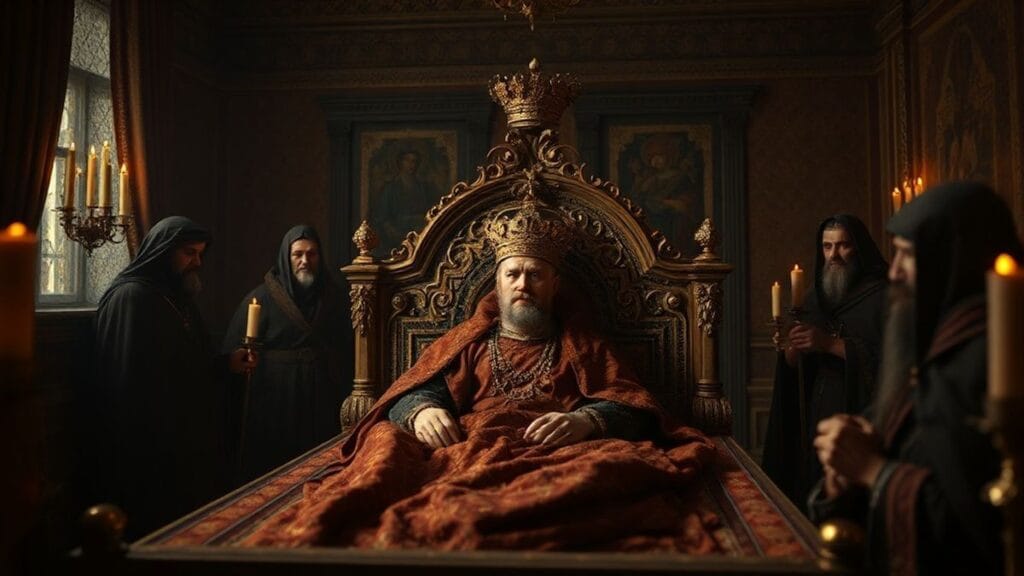
In one of the inner chambers, screened from the gaze of almost everyone, lay the emperor of the Romans: John I Tzimiskes. Only a few years earlier, he had ridden at the head of glittering armies, the terror of enemy commanders from Syria to Bulgaria. Now he struggled to breathe beneath embroidered covers, his once powerful frame shrunken, his face marked by the unmistakable shadow of approaching death. The death of emperor John I Tzimiskes, though not yet publicly declared, had already begun in those restless, fevered hours before dawn, when courtiers waited for a summons that did not come.
Even in illness, the emperor’s presence was felt in the palace. Guards still stood rigid at their posts near the Chrysotriklinos, the great throne room; the imperial banners hung unmoving in the stagnant air. Messengers came and went from the city’s churches, bringing relics, seeking blessings, arranging prayers. The empress-dowager Theophano was long gone, exiled to a convent, but her memory haunted these rooms. The young co-emperors, Basil and Constantine, waited in their own quarters, careful not to appear eager, aware that a single misstep in these days could mean exile or death.
Outside, few knew the gravity of the moment. Rumors had circulated that the emperor was unwell, that he had returned from his last campaign thinner, weaker, changed. Some whispered of a wasting disease, others of divine punishment for sins long past. But ordinary citizens still went about their business, buying bread in the markets, praying before icons, bargaining over silks and spices. The empire’s wheels turned on habit, even as its guiding hand faltered.
But this was only the beginning of the story. To understand what it meant for John to be lying on that bed, his life ebbing away, one had to remember the road that had brought him here: the distant Armenian highlands of his birth, the thunder of hooves in battle after battle, the night when another emperor’s blood had stained the floors of this same palace. The death of emperor John I Tzimiskes was not merely the end of a man; it was the final act of a drama that had unfolded for decades across battlefields and council chambers, in whispered conspiracies and shouted acclamations. In those last hours, even as his body failed, the long shadows of his past decisions stretched across the future of Byzantium.
From Armenian Frontier Noble to Emperor of the Romans
John’s story began far from the marble splendor of Constantinople, in the rugged lands of the eastern frontier. Born around 925, probably of Armenian origin, he came from a line of military aristocrats who had learned to live—and prosper—on the empire’s dangerous borders. These were lands where the call to prayer from distant minarets mingled with church bells, where raiders crossed the mountains with terrifying speed, and where survival depended on the sword as much as on imperial law.
From an early age, John Tzimiskes learned the craft of war. Horses, armor, and tactics were as familiar to him as prayers and scripture. The frontier families cultivated a special kind of loyalty to the empire: not the polished loyalty of court sycophants, but the raw, almost desperate loyalty of those who knew that if Constantinople fell weak, their homes would burn first. Yet their ambitions were not confined to their estates. Over the tenth century, men from these martial clans—like the famous Phokas family—began to dominate not only the army but the imperial palace itself.
John’s career rose under the patronage of his powerful uncle Nikephoros Phokas, one of the greatest generals of his generation. Under Nikephoros, the empire retook great swathes of territory from the Arabs: Crete, Cilicia, and parts of northern Syria. John proved himself an audacious cavalry commander—small in stature, as his nickname “Tzimiskes” (perhaps meaning “short one”) suggests, but ferocious in battle. Chroniclers describe him as quick-witted, bold, and exceptionally skilled at leading men.
The empire he served was both resurgent and fragile. Economically, Byzantium was flourishing. Its gold coin, the nomisma, was trusted across the Mediterranean. Its silks were coveted from Baghdad to Venice. Yet this prosperity concealed deep fissures: tensions between the old civil bureaucracy of the capital and the rising military aristocracy of the provinces, competition between great families, and the growing habit of generals turning their battlefield prestige into political power.
This was the world that shaped John I Tzimiskes long before the death of emperor John I Tzimiskes would become a subject for chroniclers and monks. The habits he acquired—decisive action, ruthless realpolitik, skillful command—were the same ones that would one day place a crown on his head and stain his legacy with blood. It is astonishing, isn’t it, how a life forged on the edges of empire can end in the very heart of imperial splendor, shaping the destiny of millions?
The Murder of Nikephoros II and the Shadow Over a Reign
To understand the suspicions that later clung to John’s own death, one must first recall the violent path by which he ascended the throne. In 963, his uncle Nikephoros II Phokas, acclaimed as a war hero, had seized the imperial crown, marrying the young empress Theophano, widow of Romanos II. Nikephoros’s reign was austere, marked by monastic piety and harsh fiscal policies. He enriched the church, tightened the purse strings, and, in the eyes of many, neglected the ceremonial and generous image expected of a Roman emperor.
While Nikephoros campaigned against the Arabs, John continued to shine as a commander. Yet a subtle rivalry grew between uncle and nephew, between the older general who now claimed the purple and the younger man whose charisma endeared him to the troops. Theophano, ambitious and marginalized, watched both with keen interest. By the mid-970s, tensions at court were palpable. Nikephoros, wary of threats, began sidelining John, driving him from the capital. That choice would prove fatal.
On the night of December 10, 969, the Great Palace became a stage for treachery. John Tzimiskes, secretly smuggled into the palace by conspirators loyal to him, made his way to the emperor’s private chambers. Theophano is thought by many Byzantine sources to have opened the way, though her exact role remains debated. In the darkness, Nikephoros II, the once-invincible general, was beaten to death on the cold floor, his own nephew among the assassins.
It was a crime that shocked the empire but did not paralyze it. By dawn, John had moved swiftly. He presented himself to the people as the new emperor, claiming to act for the stability of the empire and the protection of the young princes, Basil and Constantine. The patriarch Polyeuktos, however, refused to crown him unless he expelled Theophano and publicly repented for the murder. John accepted, banishing his former ally to a convent and staging a performance of contrition. Only then was he crowned John I Tzimiskes, emperor of the Romans.
This original sin hung like a cloud over his reign. Despite his later piety and successes, chroniclers never entirely forgot that his path to power had been paved with an emperor’s blood. Later theologians and historians would see in the death of emperor John I Tzimiskes a kind of moral symmetry, even divine retribution: the man who rose by murder died, perhaps, by poison. As Leo the Deacon, a contemporary historian, cautiously suggests, “God is not mocked; He weighs the scales of kings” (a paraphrased sentiment from his narrative). Whether one believes that or not, the memory of that bloody night in 969 was never far from those who watched John’s final illness unfold.
An Empire at War: Campaigns Against Arabs, Rus, and Bulgarians
Once secure on the throne, John I Tzimiskes did not linger in the safety of the palace. He was, at his core, a soldier, and the empire faced enemies on multiple fronts. His reign, though short—less than seven years—was a whirlwind of campaigns that expanded Byzantine power and projected its influence deep into enemy lands.
First came the eastern front, where the Abbasid Caliphate and a mosaic of Muslim emirates still held territory lost to the empire centuries before. John continued the work of Nikephoros, pressing into Syria. In 974–975, his armies swept through the region, seizing key fortresses, raiding as far as Damascus, and capturing cities whose names rang with biblical resonance. Although these conquests were not always permanent, they signaled that the empire was now an offensive force, no longer content to defend its borders.
Then there was the northern front. The Rus’ had already tasted Byzantine power, but their ambitions remained. In the Balkans, the fragmented post-Bulgar state offered both opportunity and danger. John’s campaigns here were complex: part diplomacy, part brutal war. He maneuvered among Slavic princes, sent envoys across the Danube, and used both steel and silver to secure allegiance. These efforts laid groundwork that his successor, Basil II, would later turn into decisive victory over Bulgaria, but at the time they were perilous and uncertain.
The empire under John glittered in military glory but was strained by the costs of war. Soldiers expected payment and reward; generals demanded estates and titles. Victories abroad often translated into burdens at home, as the treasury scrambled to pay for campaigns and the peasantry bore the weight of taxes. John walked a narrow line, trying to satisfy the army without alienating the civil elite and the church.
All this makes the death of emperor John I Tzimiskes all the more dramatic. When he fell ill in 975–976, he did so at the height of his reputation, with fresh triumphs in Syria still echoing in the songs of his troops. Many must have expected more years of conquest, perhaps even a decisive blow that would reshape the religious and political map of the Near East. Instead, the empire’s warhorse was suddenly led from the field, back through the Theodosian Walls, into the silent rooms of the palace, where the battles waged were against weakness, disease, and fear.
The Glittering Capital and the Emperor’s Lonely Vigil
Constantinople in the 970s was a city of superlatives. Its population may have approached 300,000—vast by medieval standards—crowded into neighborhoods that clung to hillsides, markets that spilled into squares, and harbors bristling with masts. The Hippodrome still pulsed with color and noise on race days; the Great Church of Hagia Sophia, with its immense dome, dominated the skyline like a stone miracle. Foreign envoys, pilgrims, and merchants from across Europe and the Near East moved through its streets, dazzled and sometimes intimidated.
Yet for the emperor, especially an emperor in decline, the city’s grandeur could feel like a cage. The Great Palace complex, stretching from the Hippodrome to the Sea of Marmara, was a world unto itself: gilded halls, echoing courtyards, mosaics that shimmered in candlelight. Protocol shaped every movement, every word. Even in illness, ritual surrounded John. There were appointed times for physicians to visit, for priests to pray, for high officials to be admitted or turned away.
As his health worsened, the world narrowed to a few rooms and a few faces. The eunuchs who had always been the invisible machinery of court life now became the emperor’s closest companions. They managed access to his bedside, recorded his orders, and reported whispered conversations to interested ears. The young co-emperors, Basil and Constantine, approached with carefully schooled expressions, hiding their anxiety behind formality.
Outside those rooms, however, the city continued its own rhythm. Artisans hammered metal in their workshops, scribes copied manuscripts in monasteries, and shipbuilders repaired warships in the imperial harbors. News of the emperor’s illness spread in fragments. Some said he had returned from campaign with a stomach ailment; others muttered that it was a slow-acting poison, perhaps slipped into his food by those who wished for a change on the throne. In taverns and in the arcades of churches, citizens weighed these rumors against what they knew—or thought they knew—of John’s character and his past.
Yet behind the celebrations of victory and the daily bustle of imperial life, there was a palpable sense of uncertainty. The empire had seen rapid changes of ruler: Romanos II, Nikephoros II, and now John, all within a short span. Each transition had been marked by intrigue, sometimes by violence. As the emperor’s condition deteriorated, the question everyone avoided speaking aloud became unavoidable in private: who would truly rule when he was gone?
Illness in the Sacred Palace: The Last Weeks of John I
The sources do not agree on the precise nature of John’s illness, but they concur on its seriousness and relatively swift course. Returning from his eastern campaigns, he was, according to some accounts, already suffering. The rigors of marching, the strain of command, and perhaps years of accumulated wounds and fatigue may all have played their part. Middle age for a tenth-century warrior was already an achievement; John was around fifty when he died, an age at which many of his contemporaries were already long in the grave.
One recurring report speaks of a “consumption of the bowels” or a painful intestinal disease. The language of medieval medicine was imprecise, more descriptive than diagnostic in modern terms. It might refer to dysentery, an infection, a chronic ulcer, or something we would now call cancer. Physicians of the day prescribed diet changes, herbal concoctions, and spiritual remedies: prayers, relics, and processions to invoke divine mercy.
Within the palace, each failed remedy must have increased tension. The patriarch and leading bishops would have been summoned to perform liturgies; monks brought relics of saints from nearby monasteries; the emperor may have received communion repeatedly, hoping for healing. In such settings, medicine and religion intertwined. To many Byzantine observers, illness in an emperor was never merely physical—it was a sign, a message, perhaps a warning from God.
In these weeks, the death of emperor John I Tzimiskes slowly ceased to be an abstract fear and became an approaching reality. His courtiers watched his body weaken, heard his voice fade, and saw his once-firm hand tremble. Yet even then, he remained emperor. Orders were still issued in his name; his signature, however shaky, still carried legal weight. Decisions about frontier garrisons, tax assessments, and diplomatic envoys all passed through the sickroom, turning that space into the very nerve center of the empire.
One can imagine the silence between the visits of physicians, the murmured discussions among eunuchs in the outer hall, the clinking of spoons against ceramic vessels of medicine. John, who had once led cavalry charges, now measured his days in sips of diluted wine and the slow movement of shadows along the painted walls. Outside, winter deepened, the sea winds grew harsher, and the city wrapped itself against the cold, unaware that history itself was shivering in a bedroom above them.
The Night of January 9–10, 976: An Emperor Dies Behind Closed Doors
On the night of January 9–10, 976, the Great Palace must have felt unnaturally hushed. The lamps burned low in corridors thick with tapestries, muffling sound. Servants moved like ghosts. The guards at the doors to the imperial quarters stood with a heightened awareness; even the clatter of a dropped spear could echo like a thunderclap in such a moment.
Inside the emperor’s chamber, the atmosphere was denser still. John I Tzimiskes, feverish and weakened, lay surrounded by a reduced circle of attendants: a physician or two, key eunuchs, perhaps a trusted general or relative. The young Basil and Constantine may have been kept at a distance, their presence too politically charged for such an intimate, precarious setting. The patriarch or a leading cleric likely stood nearby, ready to administer the final sacraments.
No chronicle provides a minute-by-minute account. But Byzantine ceremonial tradition suggests what must have transpired. As his breathing grew labored, prayers were recited: the Creed, the Lord’s Prayer, litanies for the departing soul. If he was conscious, John might have murmured a final confession, naming sins both personal and political, seeking absolution for the murder of Nikephoros II and any injustices of his reign. Perhaps he asked that wrongs he had done be righted, that enemies be forgiven or punished, that the young emperors be protected from ambitious generals.
Then, some time in the early hours of January 10, his body yielded. The death of emperor John I Tzimiskes came not on a battlefield, beneath a storm of arrows, but in the soft suffocation of an inner room, accompanied not by war cries but by whispered prayers. When his chest rose no more, an eerie stillness would have followed, as those present registered the transformation: the man they had served, feared, or loved was now a corpse, his authority evaporated in an instant.
Protocol rushed in to fill the void. The doorways were guarded more tightly; word was sent, first to the highest officials, then to the heirs. The body would be washed, anointed, and draped in imperial vestments, the purple now a shroud rather than a symbol of active rule. Outside, the city still slept, unaware that it was waking to a different world than the one it had known the day before.
In those first secret hours after his death, decisions were already being made that would shape the future. What message would be issued to the people? How would the succession be framed? Would his illness be presented as a natural end, or would whispers of poison be suppressed—or subtly encouraged? While John’s soul, in the eyes of the faithful, began its journey to divine judgment, the business of politics continued, relentless as ever.
Poison, Judgment, or Providence? Debating the Cause of Death
From the moment news began to spread, the manner of John’s death became a subject of speculation. To some, the rapid decline of a relatively vigorous emperor, fresh from victory, seemed suspicious. To others, his previous sins and the moral order of the universe demanded a narrative of divine punishment. Between these interpretations lay a murky space where rumor, theology, and politics mingled.
Several later chroniclers whisper of poison. Some suggest that powerful figures at court—perhaps members of the civil bureaucracy who feared his martial dominance, or rival nobles resenting his partiality toward certain families—might have seen opportunity in his removal. Poison was not unknown in Byzantine politics; it was a weapon that left no visible sword wounds and could be blamed on “natural” causes. Yet no source provides concrete evidence: no confession, no discovered vial, no eyewitness report of the deed itself.
Contemporaries like Leo the Deacon, writing close to the events, are more cautious. He frames John’s death within a moral narrative, hinting that his end may have been a form of divine retribution for the murder of Nikephoros II, without explicitly accusing any human agent. Another historian, John Skylitzes, writing later, weaves the event into a broader tapestry of rise and fall among the great generals of the age, stressing the vanity of earthly glory. In such texts, the death of emperor John I Tzimiskes becomes a sermon as much as a report: no emperor, however victorious, escapes the judgment of God.
Modern scholars, looking at the available evidence, tend to be skeptical of the poison theory. The symptoms described could fit a range of natural illnesses, particularly given the hardships of campaigning and the limited medical care of the era. One may reasonably conclude that, while poison cannot be ruled out, it remains unproven. Yet in Byzantine culture, the question itself mattered almost as much as the answer. To suggest poison was to suggest that the imperial court was a nest of vipers, that ambition could strike even at the crowned head. To insist on natural illness was to emphasize the fragility of human life and the mysterious will of God.
In the candlelit chapels where prayers for his soul were said, people likely saw his death in a religious frame: God had allowed him power and then taken it away. Among soldiers who had followed him, the narrative might have been different: their champion, perhaps, had been cut down by schemers in silk. Each group, consciously or not, used the death to confirm its own fears and hopes about the empire’s future.
Mourning in Byzantium: Funeral Rites and Imperial Ceremony
Once the emperor was dead, the machinery of ceremonial mourning moved into action. The Byzantine Empire, heir to Roman and Christian traditions, choreographed the death of its rulers with elaborate care. Every step—from the washing of the body to the final interment—was imbued with symbolism.
John’s body was prepared according to both court protocol and Christian rites. Clothed in imperial garments, perhaps with the loros (the embroidered scarf of high office) draped over him, he was displayed for veneration. High officials, clergy, officers of the army, and selected citizens would have filed past, bowing, kissing his hand or the hem of his robe, crossing themselves. The sight was meant to impress upon all the reality of his passing: the man who had commanded armies now lay motionless, an object of respect but no longer of command.
The funeral liturgy, almost certainly held in or near Hagia Sophia, would have echoed with chants and incense. Choirs sang psalms of lament and hope; priests intoned prayers for mercy upon the departed soul. The patriarch, in his own brilliant vestments, might have preached a homily that balanced praise for the emperor’s deeds with sober reminders of human mortality. It would not be surprising if he alluded—obliquely—to the earlier murder of Nikephoros II and the mysterious symmetry of John’s own death, though always within the safe language of providence rather than accusation.
John’s burial place holds symbolic significance. He is thought to have been interred in the Church of Christ Chalkites near the palace, which he had himself restored. To be buried near an institution one had patronized was common among emperors; it linked the memory of the ruler to the sacred space he had enhanced. Mourners leaving the church would have seen his tomb as both a warning and an inspiration.
For the city’s ordinary residents, the funeral was a spectacle as well as a spiritual event. Streets along the procession route would have been lined with onlookers. Some may have wept sincerely; others, hardened by past upheavals, may have watched with a more pragmatic eye, already wondering what the new regime would mean for taxes, for military service, for daily stability. In this way, the death of emperor John I Tzimiskes unfolded not only in courtly whispers and theological texts, but in the crowded, noisy life of Constantinople itself, a public drama in which all were, in some sense, participants.
Young Basil II and Constantine VIII: Power Vacuums and Quiet Coups
With John gone, the empire formally reverted to the rule of the legitimate Macedonian dynasty: Basil II and his younger brother Constantine VIII, the sons of Romanos II and the long-exiled Theophano. They had been co-emperors in name since childhood, but always under the shadow of regents and military strongmen—first Nikephoros II, then John I Tzimiskes. Now, at last, they were emperors in their own right, though not yet in full control.
Basil, in particular, had grown up in an atmosphere of danger and manipulation. He had seen his mother exiled, his father die young, and two military uncles seize the throne in rapid succession. These experiences would later shape his famously suspicious, iron-willed character. In 976, however, he was still young, probably around eighteen. The court’s great men might have imagined they could continue to rule through him, using his legitimacy while quietly guiding or overriding his decisions.
In the short term, continuity was emphasized. Proclamations to the populace and the army likely framed John’s death as a natural, lamentable event, while emphasizing that there was no break in dynastic rule. Soldiers were assured that their pay and privileges would be maintained; officials were reminded of their loyalty to the purple, not merely to an individual emperor. This rhetoric aimed to prevent mutiny or usurpation during the fragile transition.
Yet beneath the surface, a quiet coup of sorts was already under way. Influential courtiers and generals moved to position themselves around the young emperors, seeking control of key offices: the command of the eastern armies, the governorships of rich provinces, the headship of the imperial household. Every appointment made in the weeks after John’s death had long-term implications. Some figures would go on to rebel, like Bardas Skleros, whose uprisings against Basil II would test the empire’s resilience. Others would become pillars of the new regime.
In this sense, the death of emperor John I Tzimiskes marks a hinge between two eras. The age of soldier-emperors from the great military clans did not end with him, but his passing opened the door to a reassertion of dynastic and bureaucratic authority under Basil II. That transition would not be smooth; it would involve civil war, purges, and a careful balancing act between center and periphery. But in the quiet hours after John’s death, as oaths were renewed and offices reassigned, the first steps on that path were already being taken.
The Military Aristocracy and the Battle for the Throne
The tenth century had seen the rise of a formidable military aristocracy in Anatolia: families like the Phokas, Maleinos, Skleros, and others. John I Tzimiskes was both a product and, ultimately, a rival of this group. His elevation to the throne had been supported by some of these clans, but as emperor he tried to balance their power with that of the central administration and the church.
After his death, their ambitions surged. Many among them had little interest in a strong, independent Basil II. A young, inexperienced emperor could be molded, perhaps dominated, or even replaced if necessary. Bardas Skleros, a seasoned general, emerged as one of the first to challenge the new order. Within a year or two of John’s passing, he would raise the banner of rebellion, claiming, as usurpers often did, to restore stability and protect the empire from corrupt influences.
The pattern was familiar: a victorious general, popular with the troops, sensing weakness at the center, gambles on seizing the throne. In this light, the death of emperor John I Tzimiskes removed a crucial buffer. John had the military prestige and personal networks to keep these ambitious men in check. Without him, Basil II had to face them more or less directly, guided by his own instincts and a small circle of loyalists.
Skleros’s rebellion drew in factions from across the empire—soldiers, local magnates, even elements of the Armenian nobility. It showed that the foundations laid under John—administrative reforms, military successes, diplomatic ties—were not yet strong enough to prevent internal fracture. Basil would spend much of the next decade fighting, negotiating, and gradually wearing down these aristocratic challengers, forging in that struggle the steely reputation that would later earn him the epithet “Bulgar-Slayer.”
Had John lived longer, it is possible that these revolts would have been delayed or taken a different form. His presence, at once feared and respected among the military elite, might have deterred open rebellion or channeled their ambitions outward, against external foes. Instead, his absence turned the empire’s martial energies inward for a time, as Byzantium fought itself while its neighbors watched carefully from across every border.
Church, Patriarch, and the Moral Reckoning of a Warrior-Emperor
The Byzantine church, and especially its patriarchs, stood in an uneasy relationship with warrior-emperors like John. On the one hand, successful campaigns against Muslim powers were celebrated as victories for Christianity itself. Churches were endowed with new lands and treasures, icons were commissioned in thanksgiving, and official sermons praised the emperor as a defender of the faith. On the other hand, the church also served as the custodian of moral teaching, reminding emperors that their power was granted by God and could be taken away.
John’s earlier entanglement with the patriarch Polyeuktos over the murder of Nikephoros II had set a precedent. By forcing John to publicly repent and exile Theophano, Polyeuktos had asserted the church’s right to moral oversight over even the highest ruler. Throughout his reign, John made gestures to align himself with ecclesiastical expectations: he supported monasteries, funded restoration of churches, and cultivated a pious image, perhaps in part to counterbalance the stain of his usurpation.
With his death, the church had an opportunity—and perhaps a duty—to interpret the event for the faithful. Funerary homilies, liturgical commemorations, and later histories written by clerics all contributed to a posthumous image of the emperor. Some texts emphasize his piety and military achievements, casting him as a flawed but ultimately devout ruler whose sins were balanced by his services to the Christian commonwealth. Others lean more heavily on the theme of divine justice, implying that his early death was a reminder that no bloodstained crown goes unjudged.
One medieval source, echoing a sentiment found across Byzantine religious literature, observes that “kings and beggars alike stand naked before the Lord at the hour of their departure” (a paraphrased thought present in homiletic traditions of the era). In such a frame, the death of emperor John I Tzimiskes is not merely a political turn but a spiritual lesson. For monks in remote monasteries, copying texts and meditating on the impermanence of earthly glory, his story became one among many that illustrated the same truth: victory and power last only for a moment; what matters, in the long run, is the state of the soul.
Yet the church was not merely a commentator. It was an active player in the transition. The patriarch’s recognition of Basil II and Constantine VIII, the anointing of the young emperors, the prayers offered for their success—all these actions helped legitimize the new regime. In supporting continuity after John’s death, the church ensured its own continued influence, standing as both conscience and partner to imperial power.
Echoes on the Frontiers: How Enemies and Allies Read the News
News of John’s death did not stop at the Theodosian Walls. Messengers carried the tidings along the imperial roads and sea lanes to the empire’s frontiers and beyond. For Byzantium’s enemies and allies, the death of emperor John I Tzimiskes was both a shock and an opportunity.
In the Muslim world, especially among the states bordering Syria and Mesopotamia, John’s campaigns had left a deep impression. He had sacked cities, taken fortresses, and briefly advanced the Byzantine banner into regions that had not seen it for centuries. Rulers who had negotiated uneasy truces or paid tribute to buy peace now saw the possibility of renegotiating terms. A young, untested emperor in Constantinople could be pressured in ways that John, with his battlefield experience, might have resisted.
The Rus’ and other powers around the Black Sea also watched closely. Trade agreements, marriage alliances, and military pacts were often tied as much to individual emperors as to the empire itself. A change at the top meant a chance to secure better terms or, conversely, forced reconsideration of existing treaties. Envoys who had once knelt before John now found themselves dealing with Basil II, gauging his strength, his temperament, and his willingness to project power.
In the Balkans, the fragmented remnants of Bulgarian authority and various Slavic polities likely weighed their options. John’s brief but forceful interventions had reminded them of Byzantine might. His death raised the question: would the empire now turn inward to manage succession and rebellious generals, or would it continue to press its claims in the region? For them, as for all of Byzantium’s neighbors, the answer would determine whether the next decade brought war, diplomacy, or a precarious peace.
Some may have interpreted the emperor’s sudden death in religious terms of their own. For Muslims, it could be read as a sign that God had humbled an aggressor; for Christian neighbors, as a reminder that even the mightiest Christian empire was subject to divine will. Thus, the ripples of his passing extended not only through the corridors of Constantinople but across the many faiths and cultures that bordered—and contested—the Roman oikoumene.
Social Ripples: Soldiers, Peasants, and Bureaucrats After the Emperor’s Death
While the chronicles focus on emperors, generals, and patriarchs, the death of a ruler also affected ordinary lives in quieter, less dramatic but no less real ways. For soldiers stationed on distant frontiers, the death of emperor John I Tzimiskes might first have been signaled by a change in pay chests arriving late, or by new commanders appearing with different priorities. Loyalty oaths were renewed in the names of Basil and Constantine; imperial images on standards and coins would slowly shift to reflect the new regime.
For peasants in Anatolia, the Balkans, and other provinces, news came more slowly, carried by traveling merchants, priests, or tax officials. They might learn that the emperor had died only weeks or months later, and even then the information came embedded in practical consequences: changes in tax rates, new regulations, new demands for supplies to support ongoing or future campaigns. Most of them never saw John in life or in death; their relationship to him was mediated by the agents of the state who appeared in their villages.
In the sprawling bureaucracy of Constantinople, the emperor’s death meant both risk and opportunity. Some officials, closely tied to John’s household, might find themselves sidelined or reassigned as the new emperors rearranged their staff. Others, long frustrated by the dominance of military men, saw a chance to expand the influence of the civil administration. Records were updated, seals recut, protocols adjusted. The parchment trail of empire, in some ways, offers a more precise record of transition than the grandiose narratives of battle.
Economically, imperial death could cause instability. Merchants might delay major ventures until the political situation clarified; foreign traders might demand higher margins to offset perceived risk. Yet the Byzantine system was designed to endure such shocks. Its administrative inertia, so often a source of frustration to reform-minded emperors, now served as a stabilizing force. Life for many continued much as before, the machinery of taxation, law, and local governance absorbing the change at the top with a kind of grudging resilience.
Even so, in songs and stories, the memory of John’s campaigns lingered. Veterans told tales in taverns of the time they had followed the short, fierce emperor into battle against the Saracens or Bulgarians. Widows and orphans of fallen soldiers might remember him less fondly, associating his name with the wars that had taken their loved ones. In countless small ways, his death marked the end of a chapter not only in statecraft but in the lived experiences of thousands across the empire.
From Tzimiskes to Basil II: Continuity, Rupture, and Unfinished Wars
In retrospect, historians often draw a straight line from John I Tzimiskes to Basil II, seeing in them two complementary figures in the making of a stronger, more territorially expansive Byzantium. John advanced the frontiers, struck fear into enemies, and demonstrated the offensive capabilities of the imperial army. Basil, inheriting that momentum, would later secure spectacular victories, especially against Bulgaria, and preside over what is often seen as a high point of medieval Byzantine power.
Yet the transition was not smooth, and the continuity was not guaranteed. Basil inherited not only opportunities but problems: rebellious generals, strained finances, and neighbors ready to test the limits of his resolve. Many of John’s wars remained unfinished. The gains in Syria required constant defense; the delicate balance in the Balkans needed careful management; the ever-shifting alliances along the eastern frontier had to be renewed or renegotiated.
Basil’s early years were dominated less by external conquest than by internal consolidation. He faced the challenge of taming the military aristocracy that had produced John and his predecessors. In a sense, Basil’s long struggle against figures like Bardas Skleros and Bardas Phokas can be seen as the empire’s belated attempt to assert civilian, dynastic control over the warlike households that had come to dominate politics. The death of emperor John I Tzimiskes removed from the stage a man who could speak their language, share their background, and perhaps mediate between center and periphery. Basil, more aloof and determined, chose confrontation instead.
Over time, this confrontation worked. By the end of his reign, Basil had weakened the great families, enhanced the power of the central government, and used the disciplined army he forged to annihilate Bulgaria and project power deep into the Caucasus. It is tempting to imagine John looking down—if one indulges in such imagery—and approving of the martial vigor but perhaps wincing at the long, painful internal wars that made it possible.
Without John’s earlier campaigns, Basil’s later triumphs would have been more difficult. Yet without John’s death, Basil might never have had the chance to become the ruler he did. History often turns on such paradoxes: a loss in one moment creates the conditions for success in another. The relationship between the two emperors, separated by a grave but linked by policy and consequence, exemplifies this dynamic.
Memory, Chronicle, and Legend: How Historians Judge John I
Over the centuries, the figure of John I Tzimiskes has been refracted through many lenses. Contemporary and near-contemporary historians like Leo the Deacon, John Skylitzes, and others present him as a brave, capable ruler whose military achievements earned him esteem even from those who disapproved of his path to power. Later Byzantine writers, living in eras when the empire’s fortunes had waned, looked back at his reign as part of a lost golden age, when emperors still rode with their armies and Rome’s eastern heir commanded respect from Cairo to Kiev.
The death of emperor John I Tzimiskes, in these narratives, often serves as a narrative pivot. Leo the Deacon, for instance, describes his passing with a certain gravity, almost as if closing the curtain on a heroic drama. He does not dwell at length on accusations of poison but underscores the emperor’s piety and the transience of life. Modern scholars, reading between the lines, see an implicit tension: admiration for the man’s achievements, unease about his methods, and uncertainty about the true cause of his death.
Western medieval chroniclers, when they mention him at all, tend to do so in the context of broader stories about Byzantium’s relations with the Latin world and the Muslim states. For them, he is one among several emperors who display eastern cunning and military skill. Eastern Christian traditions, especially in Armenian historiography, sometimes highlight his ethnic origins, seeing in him a figure who bridged cultures and loyalties.
In modern historiography, John is often viewed as a “soldier on the throne,” part of a sequence of military emperors who restored Byzantine strength in the tenth century. Debates continue over his motives in killing Nikephoros II, his relationship with Theophano, and the long-term impact of his campaigns. Some emphasize his role in stabilizing the empire after a turbulent period; others argue that his reliance on the military aristocracy delayed necessary reforms that Basil II would have to impose later.
What is striking is how his death continues to invite interpretation. Was he cut down at the height of his powers, depriving the empire of a needed leader? Or was his early departure a grim but necessary precondition for the emergence of a different kind of order under Basil? In choosing among these narratives, historians do not merely recount facts; they shape the meaning of those facts for future generations.
What If He Had Lived? Counterfactual Paths for Byzantium
Speculation is not history, but it can illuminate the stakes of historical events. To ask what might have happened if John I Tzimiskes had not died in 976—whether by illness, poison, or providence—is to clarify what his presence meant at that moment. Imagine, for instance, that he had lived another decade.
With ten more years, John might have consolidated the gains in Syria, perhaps turning some of his conquests into more permanent additions to the empire. He could have pressed more aggressively into Mesopotamia, exploiting divisions within the Muslim world. In the Balkans, he might have preempted later conflicts by strengthening Byzantine authority over key cities and routes, or by forging more durable alliances with local rulers.
At home, a longer reign could have further entrenched the military aristocracy’s power at court. John, as one of their own, might have been less inclined than Basil II to break their influence. This might have led to a more federated empire, with powerful regional magnates wielding semi-autonomous authority under a respected but not absolute emperor. Such a structure could have been more flexible—or more vulnerable to fragmentation.
For Basil II, the implications would have been profound. The young prince might have matured in the shadow of a successful elder emperor, perhaps inheriting the throne later in life, with different experiences and advisors. The fierce independence that defined his actual reign may have been tempered, or redirected. Without the crucible of early rebellions, he might never have developed the relentless focus that made him such a formidable ruler.
Internationally, a longer-lived John might have altered the timing and nature of encounters with emerging powers, including the early Kievan Rus’ state and, farther ahead, the rising Seljuk Turks. A stronger, more aggressively expansionist Byzantium in the late tenth century could have redrawn borders in ways that later conflicts would play out differently.
Counterfactuals remain unanswered, of course. Yet they highlight one essential truth: the death of emperor John I Tzimiskes was not merely an isolated event. It was a fork in the road of history. Byzantium took one path; we can only guess at the vistas that might have opened had it taken another.
Conclusion
On that winter morning in 976, when the lamps burned low in the Great Palace and the body of John I Tzimiskes lay robed in imperial purple, few could have grasped the full implications of what had just occurred. A man who had risen from the Armenian frontier, who had seized a throne in blood and then wielded it with remarkable energy, had come to an end in a quiet room, surrounded not by soldiers but by priests and courtiers. The death of emperor John I Tzimiskes brought to a close a brief but pivotal reign, one that linked the violent struggles of the mid-tenth century to the imperial zenith of Basil II.
His life encapsulated many of the tensions of his age: between military aristocracy and central authority, between piety and ruthless ambition, between expansion abroad and stability at home. His death, shrouded in a mix of medical ambiguity and political suspicion, continued those tensions in another register. Theories of poison, tales of divine judgment, and sober modern diagnoses all circle around the same void: the moment when a single heartbeat stopped, and with it one set of possibilities for the empire.
In the aftermath, Byzantium proved both fragile and resilient. Rebellions flared, borders were tested, but the system endured. Basil II would eventually forge a new equilibrium, one that owed much to the foundations John had laid—and to the space his absence created. As chroniclers and historians have returned again and again to this episode, they have found in it a rich subject for reflection on power, morality, and fate.
Ultimately, the story of John I Tzimiskes, and of his final hours in Constantinople, reminds us that history is shaped by both the grand sweep of social forces and the intimate, mortal limits of individual lives. An emperor can command armies and redraw maps, but he cannot command his own eternity. In that sense, the long echoes of his reign and his death speak to something universal: the way in which every end, however sudden or mysterious, becomes the starting point for new stories, new struggles, and new hopes in the unfolding human drama.
FAQs
- Who was John I Tzimiskes before he became emperor?
John I Tzimiskes was a member of the Armenian frontier nobility and a gifted general in the Byzantine army. He rose under the patronage of his uncle Nikephoros II Phokas, participating in major campaigns against Muslim powers and gaining a reputation for courage, tactical skill, and charisma among the troops. - How did John I Tzimiskes come to power?
He came to power through a palace coup in 969, orchestrating the assassination of his uncle, Emperor Nikephoros II, inside the Great Palace. With support from elements of the military and, likely, Empress Theophano, he seized the throne, later securing coronation only after publicly repenting and exiling Theophano at the insistence of Patriarch Polyeuktos. - What were the main achievements of his reign?
John’s short reign was marked by impressive military campaigns. He pushed deep into Syria, taking key cities from Muslim rulers, reinforced Byzantine influence in the Balkans, and stabilized several frontiers. His successes demonstrated the renewed offensive strength of the empire and laid groundwork that his successor, Basil II, would later build upon. - How did Emperor John I Tzimiskes die?
He died in Constantinople on January 10, 976, after a period of serious illness following his eastern campaigns. Sources describe a painful intestinal disease, but details are vague. Some later accounts suggest he might have been poisoned, yet no conclusive evidence exists, and many modern historians consider natural causes more likely. - Why do some sources claim he was poisoned?
The combination of his relatively sudden decline, his powerful position, and the violent precedents of Byzantine politics fueled suspicions of poison. Opponents and moralistic chroniclers also found it fitting, in a narrative sense, that a ruler who had gained power through assassination might himself fall victim to hidden violence or divine retribution. - What immediate impact did his death have on the empire?
His death returned formal power to the young co-emperors Basil II and Constantine VIII, creating a power vacuum that ambitious generals and aristocratic families rushed to exploit. It set the stage for internal rebellions, especially those led by Bardas Skleros and Bardas Phokas, and forced Basil II into a long struggle to assert genuine, independent authority. - How did the church view John I Tzimiskes and his death?
The church had a complex view of John. It criticized the murder of Nikephoros II but appreciated his piety, patronage, and defense of Christian territories. After his death, ecclesiastical texts often framed his life and end as a reminder of the transience of earthly glory and the inevitability of divine judgment, balancing praise and moral warning. - Where was John I Tzimiskes buried?
He is believed to have been buried in the Church of Christ Chalkites near the imperial palace, a church he had restored. This burial location linked his memory to a sacred space associated with his own acts of patronage, a common practice among Byzantine emperors. - How is John I Tzimiskes remembered by historians today?
Modern historians generally regard him as a capable and energetic military emperor who contributed significantly to the resurgence of Byzantine power in the tenth century. At the same time, they debate the moral and political implications of his usurpation and consider his reign an important, if brief, precursor to the more famous rule of Basil II. - What is the significance of his death in the broader arc of Byzantine history?
His death marked the end of a sequence of strong soldier-emperors closely tied to the Anatolian military aristocracy and opened the way for Basil II’s long, transformative reign. It also crystallized longstanding tensions between military elites, the central bureaucracy, and the church, making his passing a key turning point in the evolution of Byzantine governance and imperial identity.
External Resource
Internal Link
Other Resources
- Encyclopaedia Britannica – general search for the exact subject
- Google Scholar – academic search for the exact subject
- Internet Archive – digital library search for the exact subject