Table of Contents
- A Spring Evening in Cappadocia: The Last Hours of Tacitus
- From Senator to Emperor: The Unlikely Rise of Marcus Claudius Tacitus
- An Empire on the Edge: Rome in the Crisis of the Third Century
- The Campaign in the East and the March to Tyana
- Tyana, Frontier City: Stage for an Imperial Tragedy
- Whispers in the Night: Plots, Fevers, and Fear in the Imperial Camp
- The Death of Emperor Tacitus: Conflicting Tales and Silent Witnesses
- Murder, Illness, or Fate? Ancient Sources in Bitter Disagreement
- Soldiers, Senators, and Commoners: How the News Spread
- Power Vacuum on the Frontier: The Scramble for the Purple
- Tacitus’s Short Reign: What He Tried to Save
- Tyana After the Emperor: Memory, Myth, and Local Legend
- The Human Cost: Families, Fears, and Lives in the Shadow of the Crisis
- Historians, Inscriptions, and Gaps: Reconstructing a Vanishing Life
- From Tacitus to Probus: The Continuing Struggle for Stability
- How the Death of Emperor Tacitus Shaped the Late Roman Imagination
- Echoes in the Dust: The Archaeology of Tyana and the Eastern Marches
- Legacy in a Time of Ruin: Remembering a Forgotten Emperor
- Conclusion
- FAQs
- External Resource
- Internal Link
Article Summary: This article follows the brief, turbulent reign and dramatic end of the Roman emperor Marcus Claudius Tacitus, focusing on his final days in Tyana, Cappadocia, in April 276. In a narrative that combines historical analysis with cinematic storytelling, it traces his journey from elderly senator to reluctant ruler of an embattled empire. The death of emperor Tacitus becomes a lens through which we explore the fragile politics of the third-century crisis, when armies made and unmade emperors at swordpoint. We move through the dust and tension of the eastern frontier, where campaigns against Gothic and eastern enemies framed his last campaign. The article weighs conflicting ancient accounts that alternately describe assassination, fever, and internal conspiracy as the cause of his demise. It also examines how the death of emperor Tacitus impacted soldiers, provincial cities like Tyana, and the Roman Senate. By following the swift struggle for succession that followed the death of emperor Tacitus, we see how his passing accelerated the cycle of military coups. Finally, the article reflects on the memory, archaeology, and legacy surrounding the death of emperor Tacitus, and why such a brief reign still matters for understanding Rome’s long fall.
A Spring Evening in Cappadocia: The Last Hours of Tacitus
The spring of 276 in Cappadocia did not come with quiet breezes and gentle warmth. It came with the grinding march of iron-shod boots, the clatter of pack animals, and the low murmur of voices carrying through the dusk around the city of Tyana. There, in the eastern highlands of Anatolia, an old man wore the purple of Rome and struggled under its weight. Marcus Claudius Tacitus, senior senator turned emperor, was encamped near Tyana, his command tents pitched among the rocky outcrops and sparse fields that guarded the approaches to the east.
Inside the imperial tent, oil lamps burned low, casting wavering circles of light on maps, wax tablets, and the anxious faces of staff officers. This was not how Tacitus had imagined the twilight of his life. For decades he had been a man of the Senate, a figure of legality and tradition, a descendant—so it was piously claimed—of the historian Cornelius Tacitus, that great chronicler of Rome’s earlier emperors. Now, in his seventies, he had become the protagonist of a new and dangerous chapter. Surrounded by soldiers whose loyalty was as fragile as the spring weather, he confronted rumors of mutiny, reports of raids, and, though he may not yet have grasped it, the closing horizon of his own life.
Outside, the camp did not sleep. Messengers came and went from outlying detachments; guards whispered about pay, provisions, enemies seen in the distance. Some spoke of omens—of birds flying in strange patterns over Tyana’s walls, of a sudden chill that fell over the camp at sunset. Others muttered darker suspicions: that the emperor’s family interfered in military affairs, that certain commanders chafed under the authority of an elderly civilian-turned-augustus. Between the flicker of torches, a single phrase moved from lip to lip: “Things cannot go on like this.”
It is within this charged atmosphere that the death of emperor Tacitus would soon unfold, an event that would echo not through grand marble halls in Rome, but through the dusty streets of a frontier city. This was no ceremonial passing in a palace bed. It was a death on the march, in the midst of the empire’s long crisis, far from the ancient capital whose fate he was trying, however briefly and imperfectly, to steady.
But this was only the beginning of the story. To understand why the passing of this relatively obscure emperor mattered, we must step back—into the Senate houses of Rome, the battlefields of the Danube and the East, and the swirling instability of the third century when the purple had become a perilous shroud.
From Senator to Emperor: The Unlikely Rise of Marcus Claudius Tacitus
Long before he pitched his tent at Tyana, Marcus Claudius Tacitus had already lived the sort of life that, in an earlier age, would have taken a Roman noble to a comfortable retirement, not to an imperial throne. Born, most likely, in the early years of the third century, he rose through the cursus honorum, the ladder of offices that still structured the careers of Rome’s elite. He served as consul, the republic’s ancient magistracy now turned into a ceremonial office marking high status. He sat in the Senate, debated laws, oversaw provincial matters, and watched emperors come and go with alarming speed.
By the time he was an old man, the empire had been shattered by decades of civil war, invasions, and disease. Between 235 and 270, emperors rose from the ranks and fell to the knives of their own soldiers with dizzying frequency. The names themselves—Maximinus, Philip, Decius, Valerian, Gallienus, Claudius Gothicus, Aurelian—blur together into a grim procession of battle-hardened rulers whose reigns were counted in months rather than decades. Tacitus himself had survived them all by being, above all, a senator and not a general, a man of words and law rather than swords.
When the emperor Aurelian was assassinated in 275, the empire stood at another crossroads. Aurelian had been a restorer, reuniting breakaway provinces and striking fear into the enemies of Rome. Yet behind the celebrations of his victories lay a darker reality: the emperor’s severity, his rash executions, and the fear he inspired in his own court ultimately led to his undoing. Aurelian fell to a conspiracy among his officers, stabbed to death on campaign. His death opened a void at the pinnacle of power.
What followed was extraordinary. For the first time in many years, the army did not simply proclaim the next general who shouted loudest. Instead, according to the account preserved in the later Historia Augusta and echoed in fragments by other chroniclers, the soldiers invited the Senate of Rome to choose a new emperor. Whether this gesture sprang from genuine respect or from calculation—a way to shift blame for any coming chaos—is a matter of debate. Yet the Senate seized the moment and turned to a familiar, reassuring figure: Marcus Claudius Tacitus.
He was old, wealthy, and, crucially, not associated with any particular faction of the army. In the dusty curia, senators reportedly hailed him as a new Nerva, a stabilizing elder statesman who might oversee a peaceful transition. Tacitus is said to have hesitated, protesting his age and weakness, but the Senate would not relent. At last he accepted the purple, perhaps flattered, perhaps resigned, perhaps terrified. In short order, messengers raced to the frontiers with the news: a civilian senator, not a career soldier, now bore the weight of the empire.
It’s astonishing, isn’t it? In an age of barracks emperors, the Senate managed to place one of its own in command. Yet behind the celebrations in Rome, behind the rhetoric about restored senatorial dignity, there lurked a dangerous reality: an emperor who did not fully command the loyalty of his armies. That disjunction between legal authority and military power would follow Tacitus all the way to Tyana, where it would play a central role in the final act of his story.
An Empire on the Edge: Rome in the Crisis of the Third Century
To understand the pressures crowding in on Tacitus as he marched into Cappadocia, we must situate him within the broader catastrophe historians call the Crisis of the Third Century. The Roman Empire in the mid-200s was still vast, stretching from Britain to the Euphrates, from the Rhine to the deserts of Africa. But territorial size concealed structural fragility. Plague, perhaps a recurrence of a disease like smallpox, had ravaged populations and armies. Tax revenues shrank as fields lay fallow and cities depopulated. Germanic groups crossed the frontiers in greater numbers, sensing imperial weakness; in the East, the aggressive Sasanian rulers of Persia pressed hard against Rome’s borders.
The political system had also corroded. The old fiction of a semi-hereditary principate, where emperors carefully groomed successors and the Senate ratified their choices, had given way to a brutal logic: the emperor was whoever the army obeyed. Power now rose from the provinces, forged on distant frontiers where generals commanded legions that dwarfed any forces available to the Senate. Emperors were made at Cologne, at Sirmium, at Antioch. Their coinage debased to pay for soldiers’ donatives; their portraits changed faster than the dye could dry on official banners.
The period around 270 had seen some stabilization under Claudius II “Gothicus” and then Aurelian, who clawed back breakaway Gallic and Palmyrene empires. Yet each success had depended on a single charismatic warlord holding together a fractious military aristocracy. When Aurelian died, the delicate equilibrium shattered again. It was into this world of brittle loyalties and exhausted resources that Tacitus stepped as emperor.
His task was immense. He had to reassure senators that their dignity mattered, soothe soldiers worried about pay and glory, and confront external enemies emboldened by each sign of Roman weakness. In particular, Gothic and other northern groups had pushed deep into Asia Minor; Aurelian’s campaigns had not fully secured the region. The eastern provinces remained vulnerable, scarred by past Persian invasions and local revolts. For an old senator, whose experience lay more in law codes than in logistics, the challenge was almost insurmountable.
Yet Tacitus did not simply retreat into ceremonial roles. Sources suggest that, once accepted by the armies, he personally set out to lead operations in the East. It was likely on such a campaign, attempting to defend the empire’s battered eastern approaches, that he made his way toward Tyana—carrying with him not just the imperial standards, but also the accumulated crises of an entire century.
The Campaign in the East and the March to Tyana
Not long after his elevation, Tacitus turned his attention eastward. Gothic and Herulian raiders, among others, had used the chaos of recent decades to push by sea and land into Asia Minor, threatening coastal cities and interior routes. Aurelian’s death had given them breathing room; they tested Roman defenses again, probing for weakness. For an emperor seeking to earn legitimacy from the army, a vigorous campaign offered both necessity and opportunity.
Ancient accounts, such as those later summarized by the historian Zosimus and hinted at in the fragmentary Epitome de Caesaribus, describe Tacitus claiming notable victories over northern raiders in the East. Whether these triumphs were as sweeping as advertised is impossible to know, but Roman propaganda likely played up every success. The emperor needed to appear as a capable commander, not merely as a Senate-appointed figurehead.
The route of his campaign would have drawn him deeper into Anatolia, along routes that wound past ancient cities, military outposts, and sacred sites. Tyana, in Cappadocia, loomed as a critical node. Situated near key passes that connected central Anatolia with Syria and the Euphrates frontier, Tyana had long been a strategic city—a place where armies gathered, rested, and resupplied before pushing on toward the eastern deserts or the rugged northern highlands.
As Tacitus moved with his entourage and legions, the imperial train stretched for miles: officers on horseback; supply wagons groaning with grain, weapons, and coins; scribes guarding chests of documents; envoys from local cities pressing their petitions. The march was not simply a military maneuver; it was a moving court, with intrigues unfolding under canvas, deals cut in the shadows of tents, and jealousies simmering in the ranks of the officer corps.
Somewhere along this line of march, tension began to thicken. There are hints in later sources that discontent grew among certain units—perhaps over distribution of plunder, perhaps over perceived favoritism toward officers linked to the Senate, perhaps simply from exhaustion and fear. Tacitus, old and by some accounts increasingly frail, depended heavily on relatives and trusted advisers. One name surfaces in the tradition: his half-brother Florianus, a man who would soon loom large in the succession struggle that followed.
By the time the imperial army reached the vicinity of Tyana in early April 276, the stage was set. The empire’s eastern campaign paused near this Cappadocian stronghold, and with the pause came something more dangerous than open battle: time for resentments to harden into plots. In that uneasy stillness, with the snow still clinging to distant peaks and the winds of the Anatolian plateau cutting cold at night, the fate of the emperor took a dark turn.
Tyana, Frontier City: Stage for an Imperial Tragedy
Tyana was no anonymous outpost. Known in antiquity as a city linked to the philosopher and wonder-worker Apollonius of Tyana, it carried spiritual associations as well as strategic importance. Located near the Cilician Gates—the vital mountain pass connecting central Anatolia to the Mediterranean coast—Tyana served as a gatekeeper between Roman heartlands and eastern theaters of war. Its walls had seen the banners of legions and the processions of provincial dignitaries; its markets mingled local Cappadocians, Greek-speaking merchants, and Latin-tongued officials.
When Tacitus arrived, the city must have swelled with the arrival of imperial forces: recruits crowding the inns, armorers working late into the night, administrators frantically requisitioning supplies. The local elite, keen to display loyalty, likely organized receptions, banquets, and sacrifices to the gods on behalf of the emperor’s health and the safety of the empire. Public rituals masked private anxieties, for any city that hosted the emperor also risked entanglement in the lethal politics surrounding him.
Yet behind the celebrations lay the sharp edge of frontier reality. Recent years had brought incursions that tested Tyana’s defenses and strained its resources. The inhabitants would have remembered, perhaps with a shudder, tales of Gothic fleets ravaging the Black Sea coasts, of Persian armies pressing into Syria and Cilicia. War was no abstraction here; it was a recurring visitor. Tacitus’s presence, with its promise of imperial protection, came as both reassurance and threat. Where emperors dwelt, assassins sometimes followed.
Within the city’s shadows, rumors would have begun to circulate. Some claimed the emperor was ill; others that he was furious with certain units and planned harsh punishments; still others that influential officers were plotting a change of leadership. No written Cappadocian diary has survived to tell us what a local merchant, priest, or city councilor thought in those days. Yet the scale of the events unfolding suggests they would have watched the movements of soldiers and the comings and goings of messengers with growing unease.
Tyana thus became more than a geographic marker. It was the living backdrop of a drama in which an aged ruler, far from Rome, found his power slipping away not under the assault of barbarian armies but under the crushing weight of internal suspicion and fatigue. Here, amid stone streets and hilltop shrines, the death of emperor Tacitus would soon transform from rumor into reality.
Whispers in the Night: Plots, Fevers, and Fear in the Imperial Camp
In later retellings, the last days of Tacitus become a tangle of whispers: of sudden illness, of conspiracies hatched in darkness, of soldiers pressing closer around their emperor with expressions that mixed obedience and calculation. Attempting to reconstruct those nights near Tyana is like listening through a thick curtain. We hear muffled voices—reporters from the past—Aurelius Victor, the anonymous author of the Epitome, the compilers of the Historia Augusta, Zosimus—yet their stories do not fully agree.
What they share, however, is a sense of tension. Tacitus, they suggest, was growing weaker, whether from age, exhaustion, or disease. Some traditions claim that he was struck by fever, perhaps brought on by the strains of campaigning in a harsh climate. Others imply that he was increasingly isolated, relying heavily on a small circle of family and loyalists, alienating powerful generals in the process. An old senator transplanted into the brutal world of winter encampments and sudden marches could not easily adapt.
Imagine the camp at night: the emperor’s tent guarded by elite troops, their spears gleaming in torchlight. Outside the inner cordon, groups of officers talk in low tones. They discuss orders, supply lines, the next move. But inevitably, the conversation turns to the emperor himself. “He is too old,” one might say. “He leans too much on Florianus,” says another. A third glances around before muttering, “The men grumble. They say they followed Aurelian through fire and blood, and now they are asked to trust a gray-haired senator from Rome.” Every such conversation, repeated across many tents, chisels away a little more of the emperor’s authority.
Under these conditions, fear is everywhere. Tacitus, if he sensed the unease, may have tightened security, increasing the guards around his person, scrutinizing letters, reassigning officers. But such measures often feed the very paranoia they seek to quell. An officer transferred from a prestigious command might ask himself: is this caution or suspicion? And what if the emperor, in a fit of fear, decides to purge his staff? In a world where emperors died by their own guards’ hands, such questions were not rhetorical.
Yet in some accounts, there is also the simple, stark presence of illness. The Anatolian plateau in early spring is treacherous—days of deceptive warmth punctuated by nights of crushing cold. Old bones ache; lungs strain. A fever striking an elderly man in these conditions could quickly become fatal even without a dagger’s thrust. It is possible that Tacitus’s enemies did not need to murder him; time and climate may have done their work.
And still, somewhere beyond the reach of certainty, a more sinister possibility lingered: that some of these whispers hardened into resolve and that the death of emperor Tacitus in Tyana would be no accident of nature but the result of human hands.
The Death of Emperor Tacitus: Conflicting Tales and Silent Witnesses
In April 276, the fragile balance snapped. The accounts are confusing, but they agree on the essential point: near Tyana, in Cappadocia, the emperor Tacitus died, leaving the empire once again without a ruler. What remains contested is almost everything else: how he died, who was responsible, and what his final moments looked like.
One tradition, preserved in the epitomized biographies of later antiquity, claims that Tacitus was murdered by his own soldiers. In this story, discontented troops, perhaps angered by disciplinary measures or fearful of impending punishment, stormed into his presence and struck him down. The scene would have been sudden and brutal—the emperor surrounded, bodyguards overwhelmed or complicit, the purple cloak stained with his own blood. It fits the pattern of so many third-century reigns: loyalty reversing in an instant, power transferred through assassination.
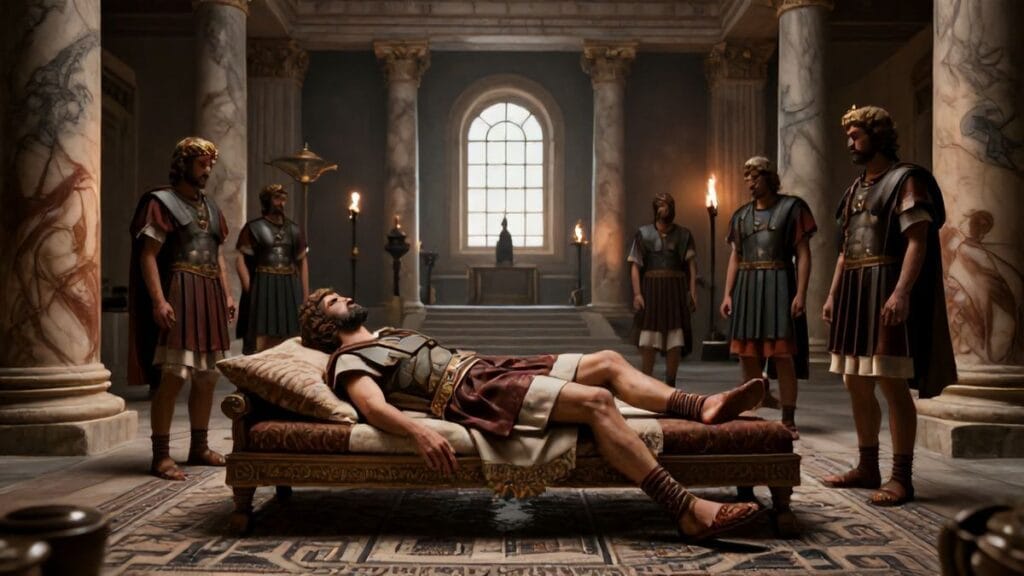
Another account describes a more private death. Tacitus, it suggests, succumbed to illness—most often described simply as a “fever”—after the strains of campaigning and the hardships of the march proved too much for his aged frame. In this version, there is no dramatic confrontation, no clash of swords around the imperial tent. Instead, the emperor lies in bed, attended by physicians and anxious courtiers, his life slipping away as the camp waits outside. Officers gather, already calculating the succession, while within his tent the old man fades quietly into history.
Yet a third narrative blends the two, implying that his death, though outwardly attributed to illness, may have been hastened by poison or at least by deliberate neglect. In a world where political murder often hid behind natural causes, a fever could conveniently mask the hand of an ambitious general. It is telling that suspicion falls not on foreign foes but on his own entourage. Roman emperors of this era lived in a cage of invisible daggers.
Modern historians, weighing these traditions, have reached no consensus. As one scholar drily observed, “The death of Tacitus reveals more about our sources than about the emperor himself.” Still, all agree on the setting. Somewhere near Tyana, in the midst of a campaign that was meant to prove his worth, Tacitus’s body failed—or was made to fail—and with it the thin thread of continuity he represented. The death of emperor Tacitus thus becomes emblematic of the age: an end shrouded in uncertainty, occurring far from Rome, at the intersection of military frustration and political fragility.
We have no eye-witness letter, no diary entry from a centurion who stood guard that night, no inscription in Tyana commemorating the imperial passing. The witnesses have long since fallen silent, their memories scattered like dust across Cappadocia’s stony fields. All that remains are scraps of narrative and the cold logic of the time, which tells us that any emperor in such a situation walked a narrow ridge between illness, mutiny, and despair. On that ridge, one day in April, Tacitus slipped—and never returned.
Murder, Illness, or Fate? Ancient Sources in Bitter Disagreement
The ambiguity surrounding the death of emperor Tacitus is no accident. It arises from the nature of our sources—late, biased, and entangled with their own agendas. To write about his final days is to navigate competing voices, each seeking to impose a particular meaning on his end.
The Epitome de Caesaribus, a brief Latin compilation from the late fourth century, suggests that Tacitus died of disease, an honorable if unremarkable end for an elderly ruler worn down by travel and responsibility. This version presents him as a tired but earnest emperor, whose health simply could not endure the strain. It fits nicely with a view of the period that emphasizes the overwhelming burdens of rule rather than sinister conspiracies.
Zosimus, writing in Greek in the early sixth century, adds a sharper edge. In his New History, he hints that Tacitus’s death was more sudden and more violent than a natural illness might imply, opening the door to the idea of murder. Zosimus wrote in a Christianized empire looking back with a critical eye on the pagan past, eager to show how the old imperial system devoured itself. A murderous end at the hands of mutinous soldiers suited his narrative of decline.
The notoriously unreliable but fascinating Historia Augusta presents perhaps the most elaborate portrait. While historians caution against taking its details at face value, this collection of imperial biographies often preserves older traditions in distorted form. It suggests that Tacitus, facing growing discontent, tried to assert control and was killed by soldiers for his troubles. “He was slain in a plot by his own men,” it claims in one passage—a line that has tempted many to imagine the emperor dragged from his tent as the camp erupted in violence.
Modern historians must read these accounts with caution. As Ronald Syme and other twentieth-century scholars showed, works like the Historia Augusta are riddled with invention, yet they sometimes embed genuine memories under layers of rhetoric. Meanwhile, brief references in other chronicles, such as those attributed to Eutropius and Aurelius Victor, offer only scant confirmation or contradiction.
It is in the spaces between these fragmented testimonies that interpretation takes root. Some scholars argue that natural causes are most likely; the combination of age, climate, and stress makes a fatal fever entirely plausible. Others lean toward assassination, seeing Tacitus’s position—an elderly, Senate-appointed emperor in command of hardened troops—as intrinsically unstable. In their view, the death of emperor Tacitus by natural means would almost be the greater surprise.
Perhaps the most honest conclusion is that we will never know. The truth died with the men who shared those cramped Cappadocian tents. Yet the very uncertainty is revealing. It reminds us that in the third-century Roman world, the boundary between fate and political violence had grown perilously thin. When an emperor died, illness and intrigue walked hand in hand, and even contemporaries might not dare to say which had struck the final blow.
Soldiers, Senators, and Commoners: How the News Spread
When Tacitus died near Tyana, the first to feel the shock were the soldiers. In an imperial camp, news traveled faster than any herald. A shuttered tent here, an urgent conference of officers there, the sudden tightening of guards around key points—every sign fed a whirlwind of speculation. “The emperor is sick.” “No, he is already dead.” “They hide his body so they can plan the succession.” Within hours, certainty—true or not—had settled into the ranks: the emperor was gone.
For the ordinary legionary, the implications were immediate and personal. An emperor’s death often meant unpaid donatives, delayed promotions, and the possibility of marching under a new commander who might be more demanding or less generous. Worse, it meant uncertainty about whether the army would split in support of rival claimants. A soldier serving near Tyana in 276 had likely lived through multiple reigns already, each change accompanied by oaths, new portraits on shields and standards, and, too often, civil war.
Officers reacted differently. For some, Tacitus’s death opened a path to advancement. For others, particularly those closely tied to the deceased emperor or his family, it spelled danger. An ambitious general might see opportunity where a cautious administrator saw only risk. Around the campfires, names began to be whispered: Florianus, Tacitus’s half-brother; Probus, a respected general serving in the East; perhaps other commanders whose ambitions are now lost to memory.
Beyond the camp, the news moved more slowly but with equal impact. Messengers rode out from Tyana along imperial roads, bearing sealed letters to neighboring garrisons and provincial capitals. In the city itself, word filtered into the markets. A baker heard from a customer that the emperor’s entourage had canceled a planned procession. A priest at a local temple noticed that sacrifices on behalf of the emperor’s health had suddenly added an element of urgency. On street corners, people asked the same question that had haunted Roman subjects for decades: “Who is emperor now?”
In Rome, the Senate would not learn of Tacitus’s fate for weeks, perhaps months. The slowness of communication was itself a political factor. By the time official envoys bearing confirmation of his death reached the capital, the question of succession might already be settled on distant frontiers. The senators who had once felt empowered by their role in raising Tacitus now faced the bitter realization that they remained spectators in the brutal game of imperial politics. For them, the death of emperor Tacitus was both a personal loss and a symbolic one—the fading of their brief illusion of influence.
For provincial subjects across the empire, the emperor’s death was at once momentous and distant. In some cities, local councils would order statues and inscriptions updated, replacing Tacitus’s name with that of his successor. In others, people might scarcely bother to memorize another imperial title, knowing it could change again at any moment. As a later chronicler observed of this era, “The names of the emperors were many, but the miseries of the people were one.”
Power Vacuum on the Frontier: The Scramble for the Purple
With Tacitus’s body—whether still warm or long since cold—the eastern army faced a decisive choice. Would they wait for instructions from Rome, pretending that the Senate still held the keys to imperial power? Or would they, as legions had done repeatedly in the third century, seize the moment and proclaim a new emperor of their own?
The answer was swift. Tacitus’s half-brother, Florianus, is reported in several sources as having taken immediate command. Some traditions claim that Tacitus had already designated him as a key figure, perhaps even as a successor in everything but name. Florianus, with access to the imperial treasury and control of significant eastern forces, moved to secure his position. He sent letters announcing that he had assumed the title of augustus, framing his rule as a natural continuation of his brother’s.
Yet not all accepted this familial succession. In the East, another figure emerged: Marcus Aurelius Probus, a seasoned general of Illyrian origin, renowned for his military skill and discipline. Probus had served under Aurelian and knew the rough calculus of power in the crisis years. According to later accounts, including those attributed to Zosimus and the Epitome, his troops proclaimed him emperor around the same time that Florianus asserted his claim.
The stage was set for yet another civil war. The death of emperor Tacitus had not brought peace; it had merely shifted the battleground from the emperor’s sickbed—or bloodstained tent—to the wide spaces between Anatolia and the Balkans. Florianus, with a base closer to Asia Minor and control of the eastern army, at first enjoyed a numerical advantage. Probus, however, held the loyalty of hardened frontier troops and possessed a reputation for strategic cunning.
In this contest, Tyana appeared again, now less as a setting for tragedy and more as a waypoint in the movements of rival armies. Florianus attempted to hold the advantages Tacitus had left him: treasury, supplies, and the symbolic continuity of family rule. Probus relied on speed, maneuvering through territories that had seen too many imperial banners to care which crest fluttered above them.
The struggle was short but intense. Within months, Florianus’s support crumbled; he was either killed by his own men or compelled to kill himself, depending on which source one follows. Probus emerged victorious, another soldier-emperor in a line that would continue until Diocletian finally imposed a more lasting order. The older man from the Senate, whose brief reign had raised flickering hopes for a different balance between civil and military power, was now only a memory—a prelude to yet another general’s ascension.
Tacitus’s Short Reign: What He Tried to Save
To view Tacitus only through the lens of his death near Tyana would be to do him an injustice. However brief his reign—modern estimates range from six to nine months—he nonetheless made decisions that shaped the course of the crisis years, if only in small ways. In those months, he attempted something almost quixotic: to restore a measure of senatorial dignity in an age dominated by generals.
Upon his elevation, Tacitus is said to have honored the Senate, reaffirming its traditional privileges and involving it more visibly in governance. Whether these gestures had practical effects is unclear, but symbolically they mattered. In a time when the purple seemed to spring from the barracks rather than the curia, Tacitus’s rise suggested that the ancient order had not entirely collapsed. Some historians, drawing a parallel with Nerva after Domitian, see in him a figure of transition—a placeholder meant to stabilize politics until a more vigorous, military-minded successor could be chosen. If so, the plan was tragically short-lived.
In foreign policy, Tacitus’s eastern campaigns represented a continuation of Aurelian’s aggressive stance toward raiders and nomadic groups threatening Anatolia and the Black Sea regions. Victory proclamations minted on coins and echoed in panegyrics claimed he had inflicted serious defeats on Goths and Heruli. One may suspect exaggeration, but even modest success mattered. Every repelled raid, every pacified region, bought Rome a little more time.
Economic policy under Tacitus remains obscure, but he inherited Aurelian’s efforts to shore up the currency and stabilize the food supply. Any steps he took were inevitably constrained by the fiscal exhaustion of the empire. The late third century was an era of band-aid measures, not structural reform. Yet even band-aids can stave off bleeding, and Tacitus’s continuation of certain policies likely prevented worse dislocation in the short term.
Perhaps his most important contribution, ironically, lay in what his reign revealed rather than what it achieved. The Senate’s ability to install an emperor at all indicated that the institutions of the early principate were not entirely dead. But the quick unravelling of his authority on the frontier, culminating in his contested death at Tyana, exposed the limits of senatorial power in a militarized state. The experiment had been tried—and had failed. The lesson would not be forgotten.
In this sense, the death of emperor Tacitus marks a turning point. After him, the dream of a primarily senatorial princeps, chosen in the capital and obeyed across the provinces without military backing, became ever more remote. The empire moved toward a new reality, in which emperors would be tough, often provincial soldiers, their legitimacy rooted in barracks and battlefields rather than in the marble of the Forum.
Tyana After the Emperor: Memory, Myth, and Local Legend
What did Tyana make of the imperial drama that had played out in its shadow? Official Roman history, written mostly in distant capitals, offers little insight. Yet the city’s own traditions, pieced together from inscriptions, late antique texts, and archaeology, suggest a place keenly aware of its role in the empire’s fortunes.
Tyana had long claimed renown as the home of Apollonius, the first-century philosopher whom some pagans later celebrated almost as a rival figure to Christ. In late antique biographies of Apollonius, such as Philostratus’s earlier Life of Apollonius of Tyana, the city appears as a locus of wisdom and miraculous events. By the time of Tacitus, this intellectual aura intertwined with its strategic function. An emperor dying near Tyana would inevitably feed local legend, even if later written sources are silent on specific stories.
It is not difficult to imagine how the tale might have grown in Cappadocian households. Generations later, a grandmother could point toward the hills outside town and say, “There, long ago, an emperor of the Romans died in his tent.” Children might ask whether he was wicked or just, whether the gods were angry or merciful. Some might even link his passing to Apollonius, weaving a story in which the philosopher’s spirit foresaw or commented on the imperial fate. Such narratives, oral and unrecorded, are lost to us; but the human impulse to tie great events to local landscapes remains constant across ages.
Archaeological remains around modern Kemerhisar, identified with ancient Tyana, show a city that continued to thrive into the late Roman and Byzantine periods: aqueducts, baths, defensive walls. Tacitus’s death did not doom Tyana; rather, it added another layer to its long history of encounters with power. Subsequent emperors would pass through or near the region. The memory of one old senator dying there would blend into a broader pattern of imperial traffic across Anatolia.
Yet on a subtler level, the association lingered. In times of crisis, communities often construct meaning by anchoring distant, imperial events to their own streets and fields. Tyana, like many frontier cities, lived with the knowledge that emperors could appear suddenly and vanish just as quickly, their presence bringing both opportunity and peril. The death of emperor Tacitus near its walls crystallized that ambivalence: the city had hosted the apex of Roman authority, only to see it collapse into a bier carried away under guard.
The Human Cost: Families, Fears, and Lives in the Shadow of the Crisis
Imperial deaths are often narrated as chess moves in a political game, but beneath the chronicles lie countless private tragedies and adjustments. The passing of Tacitus, and the turmoil it unleashed, reshaped the lives of thousands of ordinary people—soldiers, camp followers, slaves, merchants, and families spread across the empire.
In the camp near Tyana, some of the emperor’s attendants had likely served him since his senatorial days. Secretaries who had followed him from the quiet routines of Rome’s curia now watched as their patron’s body was prepared for transport or burial. These men, whose careers were tied to his favor, suddenly found themselves unmoored. Would the next emperor retain them, or mark them as remnants of a failed regime?
In Rome, a household somewhere on the Palatine or in another elite quarter would hear that their aged relative, now emperor, was dead. Imagine the conflicting emotions: grief at the loss of a family member, pride that he had worn the purple at all, fear that association with a dead emperor might become a liability. Widows, nephews, and distant cousins would quietly alter their strategies—aligning themselves with rising figures, emphasizing different parts of their genealogies in public inscriptions.
Among the soldiers, the human cost was grimmer. Tacitus’s eastern operations had already meant hard marching, exposure to disease, and clashes with raiders. Each turn of the imperial wheel could send units marching again, to new frontiers and fresh dangers. A centurion who had just begun to build a reputation under Tacitus’s command might now find himself reassigned, demoted, or entangled in civil strife between Florianus and Probus. Behind every imperial casualty figure lay mothers, wives, and children left in provincial towns or military colonies from Gaul to Syria, anxiously awaiting news that might never come.
For the inhabitants of frontier regions like Cappadocia, the constant flux of emperors translated into a chronic state of uncertainty. Tax demands might rise to fund a new claimant’s donative to the troops. Defensive works begun under one ruler could be abandoned under another. A village promised protection by Tacitus’s commissioners might see those promises vanish when his seal lost its authority. The abstract phrase “the crisis of the third century” thus concealed an everyday reality of interrupted harvests, fluctuating coin values, and long lines at granaries.
One late Roman writer, looking back on this period, lamented that “the world was worn out by its emperors.” The line, often cited by modern historians, captures the exhaustion that must have permeated the empire. The death of emperor Tacitus added one more turn to this grinding cycle, his individual fate emblematic of a generation that knew too many rulers and too little peace.
Historians, Inscriptions, and Gaps: Reconstructing a Vanishing Life
Our knowledge of Tacitus’s reign and death rests on precarious foundations. The main narratives come from writers who lived a century or more after his time, piecing together information from now-lost histories, imperial records, and oral traditions. “Of Tacitus we can say more of how he died than how he ruled,” one modern historian notes, pointing to the imbalance in the surviving material.
Ancient inscriptions offer scattered confirmation of his existence and authority: dedications naming him as emperor, milestones marking roads restored under his reign, coins bearing his image and titles. These material traces anchor him in the physical world. A soldier who handled a silvered antoninianus with Tacitus’s stern profile; a provincial governor who signed documents dating “in the consulship of Tacitus”—for them, he was no abstraction. Yet the majority of such artifacts have been lost, melted down, worn away, or buried without record.
The literary sources are equally fragmentary. Eutropius, in his concise Breviarium, devotes only a few lines to Tacitus, noting his senatorial origins and short rule. Aurelius Victor offers slightly more color, but still skirts details of his death. The Historia Augusta, with its theatrical flair, gives us anecdotes that may say more about the author’s imagination than about the emperor. Zosimus, writing centuries later under the shadow of the empire’s Christianization, selects episodes that fit his broader narrative of decline.
Modern historians have spent considerable effort sifting these accounts, comparing them with numismatic evidence and scattered references in other texts. In doing so, they reconstruct not only the events themselves but also the layers of interpretation that have encrusted them over time. For instance, the claim of Tacitus’s descent from the famous historian Cornelius Tacitus is now widely doubted, seen as a later embellishment meant to give this emperor a prestigious intellectual pedigree. Yet that very claim reveals how important literary legacy remained, even in an age dominated by soldier-emperors.
In this web of sources and silences, the death of emperor Tacitus stands as both a historical event and a historiographical puzzle. Each retelling, from late Roman compilers to nineteenth-century German scholars to contemporary researchers, frames it slightly differently—focusing on senatorial authority, military mutiny, or the inexorable march of structural crisis. The gaps invite interpretation, and interpretation, in turn, shapes how we remember not only Tacitus but the era he briefly tried to govern.
From Tacitus to Probus: The Continuing Struggle for Stability
After Florianus’s brief and ill-fated attempt to claim the purple, Probus emerged as the dominant figure. Compared to Tacitus, Probus embodied the opposite pole of imperial identity: a hardened career soldier whose legitimacy flowed primarily from the army. His reign (276–282) would be more substantial, marked by campaigns that secured frontiers and efforts to restore order within the provinces.
Probus’s ascent underscores what Tacitus’s death had already demonstrated: that by the late 270s, the empire’s survival depended less on senatorial consensus than on militarized leadership. In some respects, Probus continued policies Tacitus had either initiated or inherited—defense of the eastern provinces, suppression of raiding groups, attempts to stabilize the economy. Yet he did so with a different base of support and a different style of rule. Where Tacitus symbolized a last flicker of the old senatorial ideal, Probus personified the pragmatic, soldierly realism that would culminate in Diocletian’s reforms.
Still, Probus’s own fate—ultimately killed by his own troops near Sirmium—shows how deeply the problem ran. Emperors were trapped in a paradox: they needed the army’s support to rule, but the more they empowered military elites, the more they exposed themselves to overthrow by those very forces. Tacitus’s end near Tyana, whether by fever or blade, thus forms part of a recurring pattern that continued with chilling regularity.
When later historians, such as the fifth-century writer Orosius, surveyed the third century, they saw a time of near-constant turmoil punctuated by short-lived attempts at restoration. In that sense, the story from Tacitus to Probus is representative rather than exceptional. Each emperor inherited not a stable machine of state but a set of crises in motion—frontier wars, rebellions, economic decay—and each attempted, with varying degrees of brutality and vision, to manage them. The death of emperor Tacitus was one more fracture in the brittle shell of imperial continuity, hastening the emergence of new forms of rule that would, for better or worse, carry Rome into its late antique transformation.
How the Death of Emperor Tacitus Shaped the Late Roman Imagination
In the long arc of Roman history, Tacitus occupies a modest place. Few schoolchildren memorize his name; few monuments in Europe bear his likeness. Yet within late Roman and early Byzantine literature, figures like him—brief, embattled, and often violently removed—served as examples in moral and political reflection. His death, retold with varying emphases, helped shape how later generations understood the perils of power.
Christian authors, looking back on the crisis century, sometimes highlighted the instability of pagan emperorship to contrast it with the supposed spiritual stability of the Christian order. A short-lived, elderly emperor elevated by the Senate only to die on campaign lent itself to sermons about the vanity of worldly honor. Pagan intellectuals, meanwhile, might see in Tacitus’s rise and fall a tragedy of misalignment between virtue and fortune. A man trained in law and rhetoric was thrust into the brutal role of warlord-king, and the mismatch proved fatal.
In rhetorical schools, teachers could use Tacitus as a subject for declamations: “Compose a speech by Tacitus addressing his mutinous troops,” or “Write the letter by which the Senate announces the death of emperor Tacitus to the provinces.” Through such exercises, his story acquired a second life as a pedagogical tool, sharpening students’ skills while reinforcing lessons about the fragility of political structures.
Even the claim of his descent from the historian Cornelius Tacitus carried symbolic weight. It suggested a closing of a historical circle: the great narrator of imperial vice and folly supposedly giving rise, generations later, to an emperor who would himself fall victim to those same forces. Whether or not the genealogy was real, its persistence in the tradition testified to the human desire to find patterns in the chaos of history.
In this way, the death of emperor Tacitus resonated beyond its immediate military and political consequences. It became part of a collective repertoire of stories about how rulers fall—through age, ill health, betrayal, or blind fate. Late Roman writers used such stories as mirrors in which to see their own troubled times, and in those reflections, the old man who died near Tyana continued to speak, however faintly, to generations he would never have imagined.
Echoes in the Dust: The Archaeology of Tyana and the Eastern Marches
Today, anyone standing among the ruins near the modern village of Kemerhisar in Turkey, where ancient Tyana once thrived, might struggle to connect the scattered stones with the drama of 276. Yet archaeology provides a quiet counterpoint to the noisy chronicles, reminding us that the landscape itself holds traces of Tacitus’s world.
Remains of aqueducts, streets, and public buildings attest to Tyana’s continued importance in the later Roman and Byzantine periods. Defensive walls, some strengthened in response to the very kinds of threats Tacitus campaigned against, reveal a city accustomed to living on alert. Inscriptions mentioning emperors, though rarely detailed, anchor specific reigns in place: a dedication here to Aurelian, another to Probus or later rulers. Tacitus’s own name appears less frequently, a sign of his brief tenure, but the continuity of urban life bridges the gap between these short-lived regimes.
Along the routes that imperial armies used—passes, river crossings, and staging posts—archaeologists have unearthed the material remnants of military logistics: fort foundations, supply depots, weapon fragments. These features recall the columns of troops that once threaded through the region, including those that followed Tacitus to Tyana. Every coin with his portrait found in a farmer’s field, every small bronze seal with an imperial insignia, whispers of lives once organized around his authority.
Such finds do not tell us directly how he died, but they contextualize the event. They show the infrastructure that enabled emperors to project power across distances, and the fragility of those efforts when leadership faltered. They also remind us that the death of emperor Tacitus did not cause the fabric of the East to disintegrate. Roads continued to carry goods; cities continued to negotiate their place within imperial hierarchies; people adapted, as they always do, to the shifting faces of power.
In recent decades, scholars combining archaeological data with re-readings of textual sources have tried to paint a fuller picture of third-century Anatolia. Their work suggests a region of remarkable resilience amid turmoil. Tyana and its neighbors absorbed shock after shock: invasions, imperial overthrows, economic dislocation. Tacitus’s passing was one more gust in a long storm—felt, certainly, but not decisive in itself. That resilience is part of his story too, even if it unfolds largely in the background of our narratives.
Legacy in a Time of Ruin: Remembering a Forgotten Emperor
How, then, should we remember Tacitus? He was neither a transformative reformer like Diocletian nor a conqueror like Aurelian. His time on the throne was too short to leave a monumental architectural imprint, too constrained to reshape institutions, too precarious to allow for ambitious social programs. Measured by the traditional scales of imperial greatness, he barely registers.
Yet greatness is not the only measure of historical significance. Tacitus’s life and death illuminate a transitional moment: the last serious attempt, before Diocletian, for the Senate to assert a role in the making of emperors. His senatorial background, his gray hair beneath the laurel wreath, his march toward Tyana with all the hesitations and hopes it contained—these elements make him a symbol of an older Rome trying, and failing, to survive in a changed world.
The death of emperor Tacitus near Tyana compressed into a single event many of the era’s pathologies: uncertain succession, contested legitimacy, potential mutiny, the crushing weight of continuous warfare on aging leaders and exhausted troops. To study him is to study the anatomy of imperial fragility. He shows us how an empire can be both vast and vulnerable, how institutions can persist in form while crumbling in function.
Moreover, his story offers a cautionary tale about the distance between legality and power. Formally, Tacitus was emperor by senatorial acclaim and, later, military acceptance. He issued laws, minted coins, commanded armies. But when the alignment between institutions and armed force faltered—when an elderly senator’s authority failed to command the unreserved loyalty of hardened soldiers—his position became untenable. No law on a wax tablet, no senatorial decree, could shield him from the combination of illness, plot, and fatigue that awaited him at Tyana.
In remembering Tacitus, then, we honor not a glorious conqueror but a fragile survivor of a brutal age, an old man who tried, briefly, to carry an impossible burden. His death, obscure and contested as it is, reminds us that empires are lived from within as much as they are mapped from above. The story ends not just with an entry in a chronicle—“Tacitus died in Tyana”—but with a quiet, human image: an aging ruler, far from home, lying in a tent under a Cappadocian sky, listening to the murmur of soldiers’ voices outside, not knowing that history would soon speak of him in the past tense.
Conclusion
Near the city of Tyana in Cappadocia in April 276, the Roman Empire watched another of its emperors slip into the shadows. The death of emperor Tacitus, whether by fever, dagger, or a confusing blend of both, encapsulated the brutal uncertainties of the third century—a time when power was both desperately needed and fatally dangerous to wield. His brief reign began with an extraordinary gesture of senatorial initiative and ended amid the cold necessities of military politics, as rival claimants and hardened troops turned his legacy into an afterthought in their campaigns for the purple.
By retracing his path from elderly senator to frontier commander, and finally to a body lying in or near a humble campaign tent, we glimpse an empire struggling to reconcile its republican traditions with a militarized reality. Tacitus’s rise showed that the Senate could still, in exceptional circumstances, shape the succession; his fall proved how shallow that influence had become without the unambiguous support of the armies. In Tyana’s fields, the grand claims of Roman law met the hard edge of barracks logic—and lost.
At the same time, the event’s very obscurity—the clashing accounts, the lost eyewitnesses, the archaeological silences—teaches us how history itself is made and unmade. We work with fragments, hearing competing voices of chroniclers, weighing coins and inscriptions against rhetoric and rumor. Out of these shards emerges not a definitive answer about exactly how Tacitus died, but a clearer sense of why his death mattered. It symbolized the exhaustion of an old order and the dangerous birth of a new one, in which emperors would be, above all, survivors of their own armies.
In the end, Tacitus’s story is less about triumph than about endurance—his own, and that of the empire he tried to guide for a fleeting moment. The old man who set out from Rome to restore some measure of dignity to its institutions never returned; but in his failure, we see the contours of Rome’s transformation. From Tyana’s windswept plateau, the road leads onward to Probus, to Diocletian, and to the reshaped world of late antiquity. Tacitus stands at that crossroads, a nearly forgotten figure whose final journey still casts a long, if faint, shadow across the history of empire.
FAQs
- Where and when did Emperor Tacitus die?
Emperor Marcus Claudius Tacitus died near the city of Tyana in Cappadocia, in the eastern part of the Roman Empire, around April 276 CE. Ancient sources do not give a precise day, but they consistently place his death during a campaign in the East, after only a few months on the throne. - What caused the death of Emperor Tacitus?
The exact cause of the death of emperor Tacitus is disputed. Some ancient accounts say he died of a sudden fever brought on by age and the hardships of campaigning, while others hint that he was murdered by his own soldiers, possibly in a mutiny. Modern historians generally agree that we cannot be certain and that both illness and political violence were plausible in the conditions of the third-century crisis. - Why was Tacitus chosen as emperor despite his age?
Tacitus was a senior senator with a long career and considerable wealth, seen as a respectable and stabilizing figure after the assassination of Aurelian. The army, unusually, allowed the Senate to select the new ruler, and the senators chose Tacitus as a compromise candidate who could symbolize a return to traditional, civilian-led government. His advanced age was both a perceived virtue—he was unlikely to become a long-term tyrant—and a serious liability once he had to lead armies in the field. - What role did Tyana play in Tacitus’s final days?
Tyana, a strategic city in Cappadocia near crucial passes linking Anatolia with the eastern frontiers, served as the staging ground for Tacitus’s eastern operations. It was in or near the imperial camp around Tyana that he fell ill or was attacked, and where news of his death first spread among the troops. The city became the backdrop for the power vacuum and succession struggle that followed. - Who succeeded Tacitus after his death?
After Tacitus died, his half-brother Florianus quickly attempted to claim the purple, using his control of eastern forces and the imperial treasury. Almost simultaneously, the general Probus was proclaimed emperor by troops in the East. A brief civil war ensued, ending with Florianus’s death and Probus’s victory. Probus then ruled the empire from 276 to 282 CE. - How long did Tacitus rule as Roman emperor?
Tacitus’s reign was very short, lasting roughly from late 275 to April 276 CE—probably between six and nine months in total. This brevity is typical of many third-century emperors, whose rule was often cut short by assassination, usurpation, or battlefield death. - Was Emperor Tacitus really related to the historian Tacitus?
Later sources, especially the notoriously unreliable Historia Augusta, claim that Emperor Tacitus was descended from the famous historian Publius Cornelius Tacitus. Most modern scholars consider this genealogy doubtful, seeing it as a flattering legend invented to give the emperor an illustrious literary ancestor. There is no solid contemporary evidence to confirm the connection. - What does Tacitus’s death tell us about the Crisis of the Third Century?
Tacitus’s death near Tyana highlights the instability that defined the Crisis of the Third Century: emperors dependent on the army’s favor, short reigns, contested successions, and constant frontier threats. His fall underscores the weakness of senatorial authority in a militarized empire and illustrates how even a legally chosen, respectable ruler could not survive long without unshakeable support from the troops. - Is there any archaeological evidence directly linked to Tacitus in Tyana?
Direct archaeological evidence specifically tying Tacitus to Tyana—such as inscriptions naming him in connection with the city or a commemorative monument to his death—has not been found. However, coins from his reign and broader remains of Roman military and civic infrastructure in the region provide context for his presence there and the strategic importance of Cappadocia during his campaigns. - Why is Tacitus considered a relatively “forgotten” emperor?
Tacitus is often overshadowed by more prominent emperors because his reign was so brief, he initiated no major reforms, and he left behind no grand building projects. The confusion and brevity of the sources about him further blur his historical profile. Nonetheless, his story offers valuable insight into the political dynamics and vulnerabilities of the empire at a crucial turning point.
External Resource
Internal Link
Other Resources
- Encyclopaedia Britannica – general search for the exact subject
- Google Scholar – academic search for the exact subject
- Internet Archive – digital library search for the exact subject