Table of Contents
- A Summer of Shadows: Setting the Scene in Martel, 1183
- The Making of a Young King: Childhood in a Restless Empire
- A Crown Without Power: The Coronation of a Living Heir
- Brothers at War: Rivalries within the Plantagenet Dynasty
- The Road to Rebellion: Knights, Honor, and the 1173–74 Uprising
- Between Tournament Glory and Political Frustration
- The 1183 Campaign in Aquitaine: Siege, Plunder, and Desperation
- Illness before Martel: A Prince’s Body Begins to Fail
- Encircled by Fate: The Siege at Martel in June 1183
- The Last Confession: Penance, Relics, and the Deathbed of a Young King
- News That Shook an Empire: Reactions to the Death of Henry the Young King
- A Father’s Grief, A Mother’s Silence: Henry II and Eleanor of Aquitaine
- The Brothers Who Survived: Richard, Geoffrey, and John after 1183
- Reputation in Ink: How Chroniclers Remembered the Young King
- What Might Have Been: Alternate Paths for the Angevin Empire
- Politics of Memory: Tombs, Relics, and the Absent King
- Legacy in History and Legend: From Tournament Hero to Tragic Heir
- Why the Death of Henry the Young King Still Matters Today
- Conclusion
- FAQs
- External Resource
- Internal Link
Article Summary: In June 1183, in the small town of Martel in southern France, a young man who had once been crowned king in his father’s lifetime lay dying, far from the throne he had been promised. This article follows the arc of Henry the Young King’s short life, from his privileged yet constrained childhood within the vast Angevin Empire to the bitter conflicts that erupted among Henry II’s sons. The death of Henry the Young King becomes the dramatic centerpiece for examining the fragility of medieval power, the weight of ambition, and the emotional cost of dynastic politics. We trace his transformation from a glittering tournament champion into a desperate rebel encircled at Martel, suffering from fever and perhaps dysentery. Through eyewitness chronicles, we reconstruct his final acts of penance and generosity as he faced the end. Beyond the personal tragedy, the narrative explores how his death shifted the political balance among his brothers Richard, Geoffrey, and John, and reshaped the future of England and France. By the end, the death of Henry the Young King emerges not as a footnote but as a pivotal turning point in medieval European history, one that still invites reflection on youth, power, and lost possibilities.
A Summer of Shadows: Setting the Scene in Martel, 1183
On an early summer day in 1183, the town of Martel in Quercy—today a quiet corner of southwestern France—was anything but peaceful. Dust hung over the low stone houses, stirred by the tramping of hooves and the movement of armed men. Canvas tents crowded the fields outside the walls; pennons snapped in the warm wind; cooks bent over smoky fires, preparing meals for soldiers who might, at any moment, be called to arms. Within this tightening ring of steel lingered a sense of expectancy and dread, for the camp was not merely a garrison—it was a cage.
At the center of that cage lay Henry, eldest surviving son of Henry II of England, already crowned as “king” years earlier, yet king in name only. Now, in Martel, he was surrounded not by the rituals of courtly splendor but by the raw elements of war and illness. The death of Henry the Young King, which would occur here on 11 June 1183, was still days away, but its shadow had already begun to fall. Henry’s body had weakened from fever and exhaustion after months of campaigning across Aquitaine, and his cause, too, was failing. Supplies were short, his allies uncertain, and his father’s forces were drawing nearer. Each day shrank his realm of possibility.
It is astonishing, isn’t it, to imagine that this young man, scarcely in his late twenties, had once been crowned amid blazing candles and soaring chant in Westminster Abbey, draped in cloth-of-gold, hailed as the future of a sprawling Angevin Empire that stretched from the Scottish borders to the Pyrenees? Yet behind the celebrations that marked his life—his marriage, his coronation, his glittering tournaments—there had long been a hollow space where real power should have resided. Martel became the place where all those tensions came home to roost, where the gap between title and authority, between promise and reality, finally broke the man who bore them.
To understand why the death of Henry the Young King in this otherwise modest town mattered so profoundly, one must step back into the larger drama of the twelfth century: an age when kings were warriors, borders were fluid, and dynasties held together only so long as ambition could be contained within a single family. The camp outside Martel was not merely a military position; it was the visible symptom of a deeper sickness within the Plantagenet house.
The Making of a Young King: Childhood in a Restless Empire
Henry the Young King was born in February 1155, in the early, uncertain years of his father Henry II’s reign. England had just emerged from a period of civil war and chaos known as the Anarchy, during which rival claimants to the throne had plunged the realm into devastation. Henry II, energetic and ruthless, had clawed back control of England and much of France—Normandy, Anjou, Maine, and, through his marriage to the legendary Eleanor of Aquitaine, the vast duchy of Aquitaine as well.
Into this universe of shifting loyalties and newly restored authority, the infant Henry came as both promise and insurance. To many contemporaries he embodied the hope that the hard-won peace might endure beyond his father’s lifetime. Yet even as a child, his existence also represented something more fragile: the question of how an empire that was really a patchwork of legal traditions and feudal loyalties could be passed from one generation to the next without tearing itself apart.
His parents’ marriage, though luminous in legend, was tempestuous in reality. Eleanor of Aquitaine was no passive consort; she had once been queen of France and had crusaded to the East. Intelligent, politically astute, and fiercely proud, she brought with her a different culture, the courtly refinement of southwestern France, and a sense that nobility involved more than brute force. The young Henry grew up moving between these worlds: the stern, administrative court of his father, shaped by chancery clerks and legal reforms, and the more artistic, troubadour-haunted spheres of his mother’s domains.
From the beginning he was groomed for kingship, but it was a fragmented preparation. He was taught Latin prayers and the rituals of the Church, the proper deportment of a prince, the handling of weapons, the skills of horsemanship. He learned how to move through great halls cloaked in authority, how to accept homage and gifts, how to smile at men whose loyalty was always slightly conditional. He would have heard stories of his royal ancestors, of William the Conqueror and the great Norman dukes. But beneath the pageantry lurked a silently ticking problem: Henry II’s empire was personal, not institutional. It clung to the man, not to the crown.
The boy would also have been aware, even in childhood, of his father’s tireless restlessness. Henry II rarely stayed long in one place, roving ceaselessly between England and the Continent to administer justice and quell unrest. For a child, such a father could be awe-inspiring, but also distant and unpredictable. The young Henry basked in his father’s prestige while sensing, perhaps unconsciously, that he himself was more symbol than actor in the empire’s drama. This tension—between the king he was meant to be and the boy he actually was—would leave scars that later manifested in rebellion.
A Crown Without Power: The Coronation of a Living Heir
In June 1170, still a teenager, Henry was crowned at Westminster Abbey as king of England. The ceremony dazzled observers. Candles blazed, incense thickened the air, and the choirs’ voices rose beneath the high stone vaults. Anointed with holy oil, crowned with a diadem, clad in sumptuous robes, the youth became “King Henry,” while his father remained the reigning monarch. It was a curious experiment—an attempt by Henry II to secure the succession through a living coronation, a practice not unknown in France but unusual in England since the Norman Conquest.
For the young man at the center of it, the day must have seemed like a confirmation of all his childhood expectations. Chroniclers remarked on his charm and beauty, the way he carried himself with an easy, open nobility. Guests feasted; gifts were distributed; the realm, on the surface, rejoiced. Yet behind the celebrations another reality waited. The coronation conveyed dignity, not power. Henry II had no intention of relinquishing real control of the government, the courts, or the revenues of his lands.
The result was a paradox: Henry the Young King was royalty twice over—by blood and by ceremony—yet he found himself dependent on his father for money, for authority, and even for a meaningful role in politics. He had the symbol of office but not the substance. When he issued charters, they often required his father’s confirmation. When he traveled, he did so more as an honored guest than as an autonomous ruler.
This arrangement bred frustration. The young Henry’s household expanded as befit a king, and he cultivated friendships with ambitious knights and barons eager for advancement. They expected patronage, offices, and lands, but the Young King could give them little beyond hospitality and perhaps a share of his charisma. The more his circle swelled, the more money he needed. Yet his father, wary of fueling independent power, kept him on a relatively short financial leash. Tensions simmered beneath a veneer of familial cooperation.
Even the coronation itself sowed grievances. Eleanor of Aquitaine, Henry’s mother, felt slighted that she had not been given a central role, and the omission of the archbishop Thomas Becket (then in exile and out of favor with Henry II) stirred ecclesiastical resentments. When Becket returned and was murdered later that same year in Canterbury Cathedral, some saw ominous signs in the way the coronation had been handled. A crown bestowed in haste, under political shadow, seemed from the outset a fragile thing.
Brothers at War: Rivalries within the Plantagenet Dynasty
Henry the Young King was not alone in his family. He had three younger surviving brothers—Richard, Geoffrey, and John—each with their own ambitions and assigned inheritances. Henry II, like many medieval rulers of composite realms, tried to arrange the future by dividing responsibilities among his sons while preserving ultimate authority for himself. Henry the Young King would have England and Normandy; Richard would inherit Aquitaine through Eleanor; Geoffrey would become duke of Brittany through marriage; John, the youngest, was initially landless, earning the ironic nickname “Lackland.”
On parchment, the plan made sense. In reality, it fostered envy and suspicion. The Young King viewed himself as the natural leader among his siblings by virtue of seniority and crown. Yet his brothers were growing up amid the same culture of chivalry and feudal expectation, and each demanded real territories to rule, not just the promise of future dominion. Henry II encouraged competition, perhaps believing he could better control sons who vied against one another than a united front that might challenge him directly.
The relationships among the brothers were complicated, capable of genuine warmth and deep resentment. Richard in particular, intense and fiercely independent, resented any suggestion that he should submit to the Young King’s authority without definition of rights and lands. Geoffrey, intelligent and cunning, navigated between them with a pragmatist’s eye, sometimes allying with one, sometimes with the other. John, still a child during much of this turmoil, watched from the margins, absorbing the lesson that family affection came second to political advantage.
In such an atmosphere, the death of Henry the Young King would later become more than a personal loss; it would reorder the hierarchy of their world. But long before that final reckoning at Martel, the seeds of disaster were sown in daily slights, contested castles, and the relentless question of who would hold what when Henry II finally died. Underneath the great Angevin tapestry of territories, lines were already fraying.
The Road to Rebellion: Knights, Honor, and the 1173–74 Uprising
In 1173, Henry the Young King exploded. The trigger, historians often argue, was Henry II’s decision to grant valuable castles and lands to John at the expense of what Henry the Young King perceived as his own share. Already smarting from his lack of independent authority, the Young King now saw his inheritance threatened from below by his youngest brother. At the same time, magnates in England and Normandy, tired of Henry II’s firm hand, looked to the frustrated heir as a rallying point.
Encouraged, perhaps, by his mother Eleanor and by the king of France, Louis VII, the Young King fled his father’s court and sought support abroad. The result was the Great Rebellion of 1173–74, which engulfed much of Henry II’s domains. Many nobles, bound to the Young King by oaths or attracted by the promise of change, joined his banner. Richard and Geoffrey also turned against their father, and suddenly the Angevin Empire seemed poised to tear itself apart from within.
For the Young King, the rebellion was a chance to claim the power that his coronation had promised but never delivered. He issued charters as if he were already an active monarch, promised rewards to his followers, and tried to build the image of a generous, open-handed lord, in stark contrast to his father’s stern pragmatism. Yet he remained, in many ways, a figurehead. The real strategists were experienced barons and foreign rulers, each with their own agendas. While the Young King rode and presided, others decided where and when to strike.
Over the following months, Henry II demonstrated why he had become one of the most formidable rulers of his century. Tirelessly crisscrossing his lands, he crushed the rebellion piece by piece. Castles were besieged and taken, rebels defeated and punished. Even as he faced threats on multiple fronts, his authority held. By 1174, the revolt sputtered out. The Young King, his resources spent and his allies worn down, was forced into submission.
The peace that followed was uneasy. Henry II forgave his sons formally, but trust had been shattered. The Young King, now a proven rebel, returned to a life much like the one he had known before: outward honors without real power, a brilliant mantle on a restrained role. For a proud and restless prince, this was an intolerable purgatory. The rebellion had shown him both the thrill of real political action and the consequences of challenging his father. He had gambled and lost, and in losing, he trapped himself even more tightly between expectation and reality.
Between Tournament Glory and Political Frustration
After the failed rebellion, Henry the Young King found his life drifting toward an unexpected arena: the tournament field. Deprived of a genuine political sphere, he embraced the world of chivalric display with an almost feverish enthusiasm. Across northern France, great gatherings of knights came together for tournaments that were only half sporting event, half controlled warfare. There, in front of cheering crowds and noble spectators, men could win fame, ransoms, and fortune.
The Young King excelled. Contemporaries marveled at his skill in the saddle, his generosity to comrades, and his willingness to spend lavishly. He became the visible embodiment of the ideal chivalric prince: brave, open-handed, approachable, and convivial. Chroniclers described how he gave rich gifts, ransomed captured knights graciously, and maintained a glittering court that drew ambitious warriors from across Europe. This, at last, was a realm he could truly rule—the realm of reputation and honor.
But the cost was immense. Tournaments were expensive, and the Young King, still lacking a solid revenue base of his own, sank ever deeper into debt. His household demanded payment; his knights expected largesse; his armor, horses, and equipment consumed gold. Again he turned to his father for funds, and again he found the money grudging, often insufficient, and tied to conditions. The gap between the appearance of princely majesty and the underlying financial reality grew wider.
Here we see the paradox of his character. In the chronicles of Roger of Hoveden and Ralph of Diceto, Henry appears as both admirable and flawed: noble-hearted yet imprudent, generous to the point of wastefulness, charming but politically naive. The same qualities that won him love on the tournament field undermined his standing as a reliable heir. Henry II and his counselors could not entrust the future of the empire to a man who seemed so unable to control his spending or his companions.
Over time, the Young King’s life split into two unconnected halves. On the one side stood his father’s austere world of audits, charters, and legal reforms, from which he was largely excluded. On the other side lay a carnivalesque landscape of banners, lances, and accolades. The more he thrived in the latter, the more he seemed alien to the former. Yet behind the celebrations, a question pressed in: what would become of a prince whose fame derived from contests of sport, not from the business of ruling?
The 1183 Campaign in Aquitaine: Siege, Plunder, and Desperation
By the early 1180s, the fragile balance within the Angevin family had once again begun to crack. Richard, ruling in Aquitaine but facing resistance from its turbulent nobles, found himself in conflict with his father and brothers. Henry II, as ever, tried to reshuffle loyalties and resources to preserve his overarching authority. The Young King, meanwhile, looked for new means to assert himself, and Aquitaine offered an opportunity.
In 1182 and early 1183, tensions flared into open conflict. The Young King aligned with discontented barons in Aquitaine, chafing under Richard’s rule, and moved south to support them. The campaign that followed was messy, opportunistic, and violent. Instead of standing as a principled struggle for succession, it often looked like a war of raids and counter-raids, of castles seized and villages burned.
The Young King’s army, hungry and underfunded, turned increasingly to plunder to sustain itself. Chroniclers report that he extorted churches and demanded tribute from towns, including the great shrine of Rocamadour. Such acts shocked contemporaries, who expected a Christian prince to defend holy places, not despoil them. Yet his need was pressing. With strained finances and allies whose loyalty depended on regular pay, he saw little choice.
It is in this downward spiral that the road to Martel begins to come into focus. The death of Henry the Young King was not a sudden, isolated tragedy. It was the culmination of years of misalignment between his role and his reality, now intensified by a campaign that stripped away the remaining illusions. His moral standing, once burnished by generosity, began to tarnish. Even those who loved him had to reckon with the unsettling image of a crowned son raiding sacred sites to feed his followers.
Meanwhile, Henry II moved to counter this new revolt, and Richard, though embattled, remained a formidable foe. Step by step, the Young King’s position eroded. His forces could not win a decisive battle; his supply lines frayed; the loyalty of his allies wavered as prospects dimmed. By the spring of 1183, he had withdrawn with his remaining troops toward Martel, a strategic town in Quercy. There, surrounded by enemies and running out of time, his body itself began to fail.
Illness before Martel: A Prince’s Body Begins to Fail
The precise nature of the illness that carried off Henry the Young King has long been debated. Medieval chroniclers describe fever, weakness, and an inability to travel, suggesting some form of acute infection, perhaps dysentery or typhoid—conditions all too common in military camps. Modern historians, reading between the lines of their accounts, tend to agree that his death was brought on more by disease than by wounds.
As winter turned to spring in 1183, the Young King’s health deteriorated. He had spent months on campaign, riding hard, sleeping rough, eating irregularly, and relying on whatever food and water could be obtained by his foraging parties. The camps of medieval armies were breeding grounds for illness: crowded, unclean, and short on effective medical care. Even a robust man could suddenly succumb; for someone already worn down by stress and exertion, the danger was greater still.
We can imagine the symptoms emerging gradually—a bout of stomach pain, perhaps, or a low fever that he tried to ignore. A prince like Henry had been trained to endure hardship, to laugh off discomfort in front of his knights. But the pain would have grown sharper, the fever higher. Riding became an ordeal; long councils of war impossible. He was carried more often in a litter, and eventually even that became too exhausting. At Martel, he could go no farther.
Here, the physical and the political intersected. A healthy Young King might still have negotiated, slipped away, or rallied his forces for one last attempt. A sick one, confined and weakening, watched his circle shrink. Messengers went out; urgent pleas for aid and reconciliation were sent to his father and to ecclesiastical authorities. But the empire was wide, travel slow, and suspicion thick. As his body declined, his chances of salvage—military, political, spiritual—narrowed with it.
In this fragile state, the death of Henry the Young King began, in the eyes of contemporaries, to take on the character of a divine judgment. Medieval minds were quick to read moral meaning in illness. Had he not rebelled twice against his father? Had he not plundered churches and shrines? Was his sudden incapacity not a chastisement from God? Even sympathetic chroniclers, who admired his qualities, could not ignore the timing. Yet within the camp at Martel, the prince himself, sweating and shivering on his bed, faced less the abstract question of providence than the immediate terror of dying far from the great halls and cathedrals where a king was supposed to end his days.
Encircled by Fate: The Siege at Martel in June 1183
By early June, Martel was effectively under siege. Henry the Young King and his remaining forces, weakened by months of campaigning and hunger, faced the tightening grip of royal and loyalist troops. While this was not a massive, set-piece battle in the style of later centuries, it was deadly serious: a prince, crowned and anointed, found himself trapped with few options for escape.
Inside Martel, the atmosphere must have been heavy with fear and uncertainty. Supplies were running low; the camp stank of illness and unwashed bodies. Knights bickered, some perhaps considering desertion, others still clinging to hope that negotiations might rescue them. The Young King himself, wracked by fever, drifted in and out of clarity. Messages came and went, but the relief he needed—military and medical—did not arrive.
The death of Henry the Young King, though still days away, had already begun to shape the actions of those around him. Advisors urged him to seek public reconciliation with his father; clerics pressed him to perform acts of contrition. News spread among the troops that their leader was gravely ill, undermining morale. The very title that had once made him a symbol of unity now became the focus of whispered speculation: what would happen if the crowned heir died here, in a besieged town in Quercy?
Outside the walls, royal forces tightened their circles. The landscape around Martel, with its rolling hills and stony outcrops, became a chessboard of positions. Scouts rode, captains conferred, and all knew that time was on the side of the besiegers. They did not need to storm the town at great cost; they only had to wait. Every day Henry’s condition worsened, and with it, the cohesion of his following dissolved.
For the people of Martel, most of them simple townsfolk and farmers, this was a catastrophe they had not chosen. Their town, drawn into high politics by geography and misfortune, was now the stage for a dynastic crisis. They saw unfamiliar banners on the horizon, soldiers demanding food and lodging, and the frightening spectacle of a royal camp turning into a makeshift infirmary. Later, when chroniclers wrote of these days, they focused on princes and kings, but for those on the ground, the siege meant empty larders, smashed fences, and the sense that the great and powerful played out their conflicts with little regard for those caught beneath.
The Last Confession: Penance, Relics, and the Deathbed of a Young King
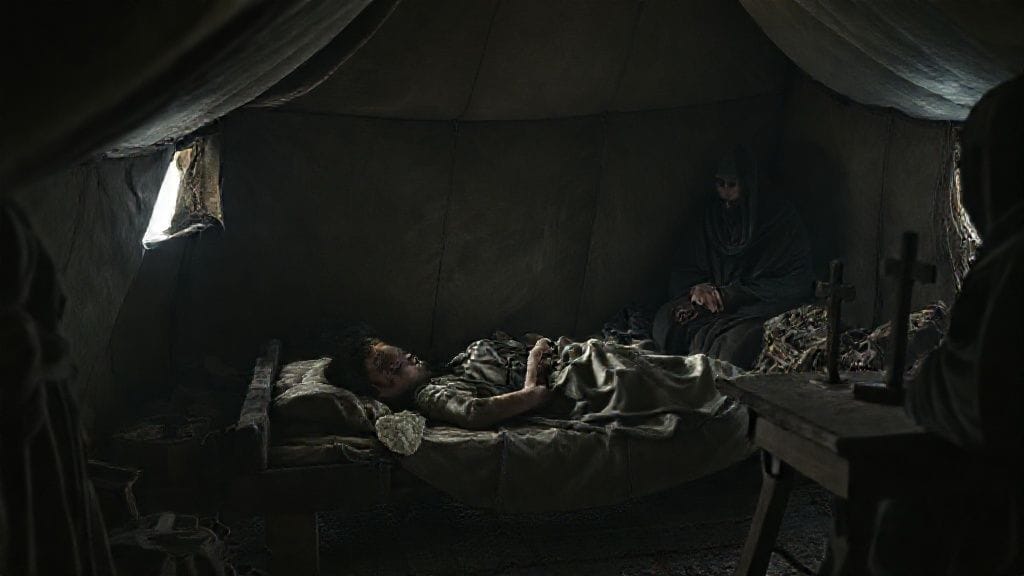
In the final days before 11 June 1183, as his fever climbed and his strength ebbed away, Henry the Young King turned his attention to his soul. Medieval belief held that a good death required preparation: confession, penance, restitution to those wronged, and reconciliation with God and, if possible, with one’s enemies. On his sickbed in Martel, the prince, once radiant on tournament fields and in coronation robes, now lay pale and weak, his body wasted by illness. But this was only the beginning of his last transformation.
According to contemporary chroniclers such as Roger of Hoveden, Henry requested the presence of churchmen and made a full confession of his sins. He recognized, they say, that he had sinned especially in rebelling against his father and in despoiling religious houses. In a dramatic gesture of humility, he is said to have asked to be laid upon a bed of ashes with a noose around his neck—a sign of penance—and to hold in his hands the holy relics he had once seized. Whether every detail of this scene is literally true or shaped by later moralizing is uncertain, but it captures the essence of his final hours: a prince searching desperately for forgiveness.
He also distributed what remained of his possessions to his followers and to the poor, perhaps hoping to balance the accounts of his life through acts of charity. Symptoms of his illness—thirst, weakness, delirium—would have made these efforts arduous. Yet the chroniclers present him, at the end, as lucid enough to understand that his earthly prospects were finished and that only the state of his soul remained within his power to affect.
Messages went out to Henry II, pleading for reconciliation. It is widely believed that the elder king, though furious with his son’s repeated rebellions, nevertheless felt the pull of blood and piety. But distance and mistrust thwarted them. By the time envoys could ride and return, the Young King was beyond recall. Whether he died with the certainty of his father’s forgiveness is unknown; what we know is that he died without seeing him.
The death of Henry the Young King itself came quietly, or so the sources suggest. On 11 June 1183, in a camp turned infirmary, beneath the canvas and rough timbers of his pavilion, the once-hoped-for heir of England and Normandy breathed his last. He was around twenty-eight years old. No great chronicler stood at his bedside; no public mourner’s procession followed immediately. Instead, news filtered slowly outward: the crowned son, the Young King, was gone, taken not by the sword but by disease, leaving behind an empire momentarily stunned and suddenly unbalanced.
News That Shook an Empire: Reactions to the Death of Henry the Young King
Word of the Young King’s death traveled along the roads and rivers of the Angevin world, carried by couriers who rode day and night. In courts and castles, the first reaction was often disbelief. How could a prince in the prime of life, still recently seen galloping through tournament lists, already be dead? In an age familiar with sudden mortality, people nevertheless found his passing abrupt and uncanny.
In England, barons and bishops who had once sworn fealty to him as co-king now faced a strange adjustment. Their oaths had been framed with the expectation that he would eventually succeed his father; now that future had vanished. For some, this was a cause for quiet relief: Henry II, still vigorous, would continue to rule without the complication of a crowned but impatient heir. For others, especially those who had supported the Young King in rebellion or pinned hopes of reform on his ascension, the news brought grief and anxiety. Without him, the road ahead seemed uncertain.
In France, King Louis VII and his son Philip Augustus took careful note. The Young King had often been a thorn in Henry II’s side, an internal rival whose frustrations weakened the empire from within. His death removed one unpredictable element from Angevin politics but also opened new possibilities. Philip Augustus, a calculating and determined monarch, understood that the death of Henry the Young King rearranged the pieces on the board. He would soon exploit the rivalries among the surviving brothers for his own advantage.
Among ordinary people, the reaction blended sorrow with fatalism. Stories began to circulate of the prince’s last acts of repentance, his generosity to the poor even on the edge of death, and his confession of filial and spiritual faults. The image of a beautiful young king dying humbly on ashes, relics in hand, spoke deeply to a culture that valued penitence and saw the world as a stage upon which divine drama played out.
Chroniclers took up their pens to record the passing. One famously wrote of him that he was “a prince of great nobility, but light in counsel,” capturing the ambivalence of his era’s judgment. The death of Henry the Young King became, almost immediately, a mirror in which contemporaries examined not just the man himself but the dangers of shared kingship, the perils of unbridled generosity, and the fragility of dynastic plans.
A Father’s Grief, A Mother’s Silence: Henry II and Eleanor of Aquitaine
When the news reached Henry II, he is said to have been overwhelmed. This was the son who had rebelled against him twice, who had allied with his enemies and challenged his authority. Yet he was also the boy he had once held in his arms, the youth he had crowned in the hope of securing a lasting dynastic order. A medieval chronicle relates that the king, upon learning of the death of Henry the Young King, “fell to the ground in a faint,” and when he recovered, he shut himself away in private grief.
The emotional landscape of this moment is difficult to map with precision, but we can see its outlines. Henry II had been a harsh father in political terms, but he was not devoid of feeling. His anger toward his sons came from a mixture of fear, disappointment, and perhaps a reflection of his own youthful rebellions. To outlive a child, especially one set apart as heir, cut against the natural order. For Henry II, it also posed a practical question: to whom would the empire pass now?
Eleanor of Aquitaine, imprisoned by her husband since the earlier rebellions, likely learned of her son’s death in confinement. The records do not dwell on her reaction, but one can imagine the blow. Eleanor, who had once presided over courts of poetry and politics, now had to confront, in isolation, the loss of a son who—despite his faults—embodied so much of the culture she loved: chivalry, generosity, and the pageantry of high nobility. Her silence in the sources is as eloquent as any speech. She could not attend his deathbed, could not arrange his burial, could not publicly mourn. Her grief, stifled by walls and guards, had to remain largely inward.
The death also altered the subtle psychological web linking father, mother, and children. Henry II, still holding Eleanor captive, now had to reckon with the fact that the son who had perhaps most openly mirrored his own ambition and pride was gone. Eleanor, watching from captivity as Richard’s star rose and John’s fate evolved, carried the knowledge that the careful marital and dynastic arrangements she had helped forge were unraveling in ways she could no longer influence. The family wound that opened at Martel would never fully heal.
The Brothers Who Survived: Richard, Geoffrey, and John after 1183
With Henry the Young King gone, the line of succession shifted dramatically. Richard, already a seasoned warrior and ruler in Aquitaine, moved to the front as the primary heir to Henry II’s core realms. Geoffrey, duke of Brittany by marriage, continued to maneuver in the complicated politics of northwestern France. John, still the youngest and least established, waited and watched as opportunities and dangers multiplied.
Richard’s relationship with his father remained fraught. Henry II, reluctant to cede control, dithered over formally designating him as heir to England and Normandy. The death of Henry the Young King had removed one rival but had not resolved the underlying struggle between a powerful ruling king and his ambitious adult son. Conflict simmered on, eventually erupting into further confrontations in the late 1180s. The absence of the Young King did not bring peace; instead, it clarified the stakes of the next round of dynastic contention.
Geoffrey, clever and politically agile, saw in his brother’s death both loss and opportunity. He was now closer in line to real influence over parts of the Angevin Empire, and he did not hesitate to press his claims when chance allowed. Yet his own story would end abruptly; in 1186 he died in a tournament accident in Paris, another young prince whose physical prowess could not shield him from fate. The pattern of early death haunted the family.
John’s path, reshaped by the death of Henry the Young King, eventually led him to a crown he had once seemed unlikely to wear. The nickname “Lackland” would prove ironic: through a combination of inheritance, political maneuvering, and the untimely deaths of his brothers, he became king of England in 1199. Yet his troubled reign, marked by baronial revolt and the loss of continental territories, suggests that the Plantagenet legacy was as much curse as blessing.
In this way, the death of Henry the Young King stands at a critical crossroads. It removed a flawed but possibly conciliatory figure who might have bridged the gap between his father’s harsh realism and his brothers’ fierce independence. In his absence, the empire moved inexorably toward the dramatic showdowns of the 1190s and early 1200s, culminating in Richard’s lionized crusades, John’s humiliations, and the gradual disintegration of Angevin dominion in France.
Reputation in Ink: How Chroniclers Remembered the Young King
The image of Henry the Young King that has come down to us is largely the creation of medieval chroniclers, men who wrote from monasteries and royal courts, mixing eyewitness testimony with moral reflection. Their accounts are not uniform. Some praised him as an embodiment of chivalry; others criticized his frivolity and lack of judgment. Between their lines, a complex portrait emerges, painted in shades of admiration and regret.
William of Newburgh, an English historian writing in the late twelfth century, described the Young King as gracious and beloved but prone to listening to poor counsel. Ralph of Diceto remarked on his liberality and charm but noted his inconsistency. Roger of Hoveden recorded the dramatic details of his last penance, emphasizing the instructive power of such a death for future generations. Each of these writers used the story of his life—and especially the death of Henry the Young King—as a kind of moral case study.
They highlighted how early honors, unaccompanied by real responsibility, can distort a young prince’s character. They warned against the dangers of excessive generosity that outstrips resources. They pointed to the perils of rebellion, not just in worldly terms but in the realm of the soul, where filial disobedience mirrored disobedience to God. Yet they also found room for sympathy. His final acts at Martel, humble and devout, allowed them to present him as a sinner who repented sincerely—a narrative that fit comfortably within Christian notions of redemption.
It is worth noting that these chroniclers wrote in a world still reeling from the murder of Thomas Becket and grappling with questions about royal authority, conscience, and the Church. The Young King’s story intersected with these larger debates. Here was a prince who had participated in the politics that surrounded Becket’s fall, whose coronation had been one of the flashpoints of that conflict, and whose own death seemed to many like another divine commentary on the ambitions and failings of the Plantagenet house.
Modern historians, reading these sources, often caution against taking every detail at face value. Yet they recognize that the emotional texture of the chronicles—the sorrow, the disappointment, the lingering affection—captures something real about how Henry was perceived. He was, as one might say today, a man out of place: born to rule a system that gave him trappings before substance, praise before responsibility, and fame before maturity.
What Might Have Been: Alternate Paths for the Angevin Empire
Speculation is dangerous in history, yet irresistible. What might have happened if Henry the Young King had not died at Martel in 1183? If his fever had broken, if his strength had returned, if reconciliation with his father had been secured in time? Such questions illuminate, if only by contrast, the path that reality took.
Had he survived, one scenario imagines Henry II gradually ceding more authority to him in England and Normandy, while Richard continued to dominate Aquitaine. The empire might have evolved into a more stable dual structure: an elder king overseeing, a younger king actively ruling, with clear demarcation of domains. In such a world, Richard’s future might have lain more firmly in the south, and John could have remained a secondary figure. The eventual disintegration of Angevin territories in France might have been slowed or reshaped.
Alternatively, the rivalry between the Young King and Richard could have intensified, leading to further civil wars that weakened the empire even more quickly. The Young King’s debts and his taste for tournaments suggest that, without a fundamental change in his character, he might have continued to strain the finances and stability of the realms under his control. In that light, some contemporaries may have privately felt that his early death, heartbreaking as it was, spared the empire even greater internal strife.
History, of course, offers no definitive answers to such counterfactuals. Yet the very exercise underscores the significance of Martel. The death of Henry the Young King was not just the loss of a single life; it was the closing of a branch on a dynastic tree whose remaining limbs would bear the heavy, twisting fruit of crusade, rebellion, and territorial loss. When we imagine alternate futures, we also better appreciate the particular, contingent path that the twelfth century actually took.
Politics of Memory: Tombs, Relics, and the Absent King
After his death, Henry the Young King’s body did not remain in Martel. His followers, still loyal in mourning, arranged for his remains to be transported north for burial. Eventually, he was interred in Rouen Cathedral in Normandy, a city that had long been central to his family’s power. There, beneath stone arches and stained glass, the once-peripatetic prince gained a place of stillness at last.
The choice of Rouen, rather than, say, Westminster in England or Fontevraud in Anjou (the great Plantagenet necropolis where Henry II and Eleanor would rest), is telling. It reflects both the complexity of his status and the practical realities of war and travel at the time of his death. Rouen was accessible, loyal, and symbolically significant. Yet his absence from the primary royal burial sites contributes, subtly, to his later marginalization in popular memory. Visitors to Fontevraud see the effigies of Henry II, Eleanor, and Richard the Lionheart, but not the Young King who predeceased them all.
Over time, his tomb and memory became part of local devotional and political landscapes. Stories of his final penance at Martel and his charitable acts at the moment of death lent him an aura of piety, even sanctity, in some circles, though he was never seriously proposed for canonization. The relics he had once taken, and then clutched in contrition, formed part of the moral narrative told by monks and priests who sought to instruct the faithful on the dangers of pride and the power of repentance.
The politics of memory also played out in how later Plantagenet rulers regarded him. Richard and John, preoccupied with their own reigns and struggles, had little incentive to celebrate a brother whose life story served as a warning against the very kind of restless ambition they themselves embodied. Henry the Young King faded gradually into the background, a figure more vividly recalled in Latin chronicles than in public ritual or royal propaganda.
Yet if his physical commemoration was modest compared to that of his parents and brothers, his story remained embedded in the cathedrals and manuscripts of the regions he had once traversed. Pilgrims and travelers who paused at Rouen, hearing of the young king buried there, might have reflected on the precariousness of high birth and the strange ways in which glory and grief intertwined.
Legacy in History and Legend: From Tournament Hero to Tragic Heir
Across the centuries, Henry the Young King’s image evolved. In some later retellings, he appears as a romantic figure: handsome, reckless, brave, a quintessential knight-prince undone by circumstance. In others, he stands as a cautionary example of wasted potential, a man given every advantage yet unable to convert them into lasting achievement. Modern historians, with access to a wider range of sources and a more skeptical eye, tend to situate him somewhere in between.
His love of tournaments and extravagant generosity have made him particularly appealing to those interested in the culture of chivalry. He appears in studies of medieval knighthood as one of the first royal figures to treat the tournament circuit almost as a parallel court, using it to build networks and prestige. In this sense, he was ahead of his time, recognizing that public spectacle could translate into soft power. But the same qualities that made him a hero to knights—his willingness to spend, his indulgent nature—made him dangerous to the careful fiscal and administrative structures his father was building.
The death of Henry the Young King also casts a long shadow over how we think about medieval monarchy. It underscores the fact that succession was not a smooth, legalistic process but a hazardous journey through human frailty, family conflict, and sheer chance. One acute illness in a camp at Martel could reshape the destinies of kingdoms. The elaborate coronation at Westminster, the oaths, the ceremonies—all of it proved powerless against a fever in a canvas pavilion thirteen years later.
In literature and popular culture, he has been less prominent than his parents or his brother Richard, yet where he does appear, he often steals the scene. Playwrights and novelists find in him an ideal vehicle for exploring themes of youth, expectation, and rebellion. He is the son who both loves and hates his father, the brother who both competes and bonds, the king who is yet not a king. The pathos of his story lies in that tension: he is always almost something greater than he manages to become.
Why the Death of Henry the Young King Still Matters Today
In a world far removed from twelfth-century Martel, why should we still care about the death of Henry the Young King? The answer lies not only in its political consequences but also in its human resonance. His story speaks to enduring questions about power, identity, and the burden of expectation.
First, his life illustrates the dangers of granting titles without responsibilities, of raising someone to symbolic heights without providing the tools and authority to act meaningfully. The frustrations that drove him into rebellion were not simply personal failings; they were structural contradictions within the Angevin system of governance. Modern readers, accustomed to seeing similar tensions in corporate, political, or even family contexts, can recognize the corrosive effects of such arrangements.
Second, the circumstances around Martel—the illness, the siege, the hurried acts of penance—remind us that beneath the grandeur of medieval monarchy lay bodies as vulnerable as any peasant’s. The death of Henry the Young King strips away the armor and heraldry to reveal a young man, frightened and repentant, reaching for spiritual solace in his final hours. This humanizes a figure who might otherwise seem distant, preserving in our minds not just a political statistic but a person whose fears, regrets, and hopes echo through time.
Third, the repercussions of his death illustrate how individual fates can redirect the stories of entire societies. Without Henry’s premature end, Richard’s reign, the Third Crusade, John’s succession, even the later signing of Magna Carta might have unfolded differently. History is not an impersonal machine; it is a web woven from millions of lives, among which certain threads—like that of the Young King—carry exceptional weight.
Finally, the way his contemporaries wrote about him offers us a window into medieval values. They saw in the death of Henry the Young King a moral lesson about pride and repentance, generosity and imprudence, filial loyalty and rebellion. When we read those accounts today, aware of their biases yet moved by their emotion, we participate in a centuries-long conversation about what it means to live—and die—well under the gaze of both history and eternity.
Conclusion
On 11 June 1183, in a beleaguered camp outside Martel, the life of Henry the Young King came to an end. He died not on a battlefield amid clashing steel, nor in the solemn quiet of a royal palace, but in a place that symbolized his whole existence: a crossroads of ambition and limitation, spectacle and vulnerability. His death closed the brief chapter of a co-kingdom that had never become a true reign. It also opened a new and uncertain phase in the history of the Angevin Empire.
Through his childhood in a restless empire, his coronation as a king without power, his rebellions, his dazzling tournament career, and his final campaign in Aquitaine, we see a man caught between the old world of feudal honor and the emerging realities of centralized royal administration. The death of Henry the Young King crystallizes that tension, transforming it into a story that later generations could contemplate, criticize, and mourn. It was both personal tragedy and political pivot point.
In the reactions of his father Henry II, his imprisoned mother Eleanor, and his surviving brothers, we glimpse the emotional and strategic consequences of his loss. In the chronicles that record his penitent deathbed scene, we see how medieval people sought to make sense of power, failure, and redemption. And in the long echo of his absence—felt in the careers of Richard, Geoffrey, and John—we perceive the delicate balance of forces that held the Angevin world together, and the ease with which that balance could be upset.
Today, when we remember Martel and the dying prince within its orbit, we are reminded that history often turns not on grand designs alone but on the fragile health, flawed choices, and unfinished lives of individuals. Henry the Young King never became the ruler he was anointed to be, yet his short life and untimely death helped shape the fate of kingdoms and the stories we tell about them. In that sense, his shadow still falls quietly across the pages of medieval history, a faded yet indelible imprint of youth, hope, and irrevocable loss.
FAQs
- Who was Henry the Young King?
Henry the Young King was the eldest surviving son of King Henry II of England and Eleanor of Aquitaine, born in 1155. Crowned as co-king of England in 1170 while his father still reigned, he carried the title of king but never exercised real independent power. He became famous for his charm, generosity, and prowess in tournaments, as well as for rebelling twice against his father. - When and where did the death of Henry the Young King occur?
The death of Henry the Young King took place on 11 June 1183, near the town of Martel in the region of Quercy in what is now southwestern France. He was encamped there with his forces during a campaign in Aquitaine when he fell gravely ill and died, likely from an acute infection such as dysentery or typhoid. - Why was Henry called “the Young King”?
He was called “the Young King” because he had been crowned during his father’s lifetime, creating the rare situation of two kings Henry ruling simultaneously. The epithet distinguished him from Henry II and emphasized that he was the junior partner in kingship, with honor but without the full authority or responsibilities normally associated with the crown. - What were the main causes of his conflict with Henry II?
The conflicts stemmed from Henry the Young King’s frustration at having royal status without real power or adequate income, and from Henry II’s reluctance to share control of his vast empire. Disputes over inheritance, especially when Henry II granted lands to the youngest son John, and the influence of discontented nobles pushed the Young King into open rebellion in 1173–74 and again in the early 1180s. - How did his death affect his brothers Richard, Geoffrey, and John?
His death moved Richard closer to becoming the principal heir to Henry II’s core territories, while Geoffrey’s position in Brittany became more important and John’s prospects improved dramatically. The removal of the Young King reshaped internal family politics, eventually helping pave the way for Richard’s reign as king of England and, later, John’s contested succession. - Where was Henry the Young King buried?
After his death at Martel, his body was transported north and buried in Rouen Cathedral in Normandy, a key center of Plantagenet power. Unlike his parents Henry II and Eleanor of Aquitaine, and his brother Richard the Lionheart, he was not interred at Fontevraud Abbey, which later became the primary dynastic burial site. - Why do historians consider the death of Henry the Young King significant?
Historians consider it significant because it abruptly altered the line of succession within the Angevin Empire and reshaped the political dynamics among Henry II’s surviving sons. His death also highlights the risks of shared kingship, the vulnerabilities of medieval rulers to sudden illness, and the broader tensions between feudal chivalry and emerging centralized monarchy. - Did Henry the Young King leave any children?
No, Henry the Young King left no surviving legitimate children. His marriage to Margaret of France, daughter of King Louis VII, produced at least one son, William, who died in infancy. The absence of heirs further diminished his long-term dynastic impact and meant that his inheritance claims reverted to his brothers. - How reliable are the accounts of his final penance and deathbed scene?
The accounts, primarily from chroniclers like Roger of Hoveden, are colored by moral and religious concerns, emphasizing repentance and divine judgment. While the broad outline—illness at Martel, confession, and acts of charity—is widely accepted, specific dramatic details, such as lying on ashes with a noose around his neck, may be stylized or exaggerated to convey moral lessons. - What lessons did contemporaries draw from the death of Henry the Young King?
Contemporaries saw in his death a warning about the dangers of pride, prodigality, and rebellion against legitimate authority, both paternal and royal. They also drew cautionary lessons about crowning heirs too soon, granting them honor without sufficient structure or discipline. At the same time, his last acts of repentance allowed them to celebrate God’s mercy and the possibility of redemption even for wayward princes.
External Resource
Internal Link
Other Resources
- Encyclopaedia Britannica – general search for the exact subject
- Google Scholar – academic search for the exact subject
- Internet Archive – digital library search for the exact subject