Table of Contents
- A November Death in Baghdad: Setting the Stage for Empire Unraveling
- From Steppe to Sultanate: The Rise of Malik-Shah I
- An Empire at Its Zenith: Power, Wealth, and Fragile Harmony
- The City of the Caliphs: Baghdad on the Eve of Tragedy
- Courts, Viziers, and Assassins: Hidden Fault Lines in the Seljuk World
- The Final Journey: Malik-Shah’s Last Campaigns and Return to Baghdad
- Poisoned or Struck by Fate? The Mysterious Death of Malik-Shah I
- A Palace in Shock: Nightfall over the Seljuk Court
- Nizam al-Mulk’s Shadow: A Vizier’s Death and a Sultan’s Undoing
- Widows, Sons, and Pretenders: The Succession Crisis Erupts
- From Unity to Fracture: The Empire Splinters Overnight
- The Abbasid Caliphate Reacts: Between Gratitude and Fear
- On the Frontiers of Christendom: How the West Saw a Sultan’s Fall
- The Long Echo: How the Death of Malik-Shah I Opened the Road to the First Crusade
- Everyday Lives in Turmoil: Merchants, Peasants, and Scholars after 1092
- Memory, Chronicles, and Legend: How Historians Reconstructed His Final Days
- What If He Had Lived? Counterfactual Paths of the Seljuk World
- Conclusion
- FAQs
- External Resource
- Internal Link
Article Summary: On 19 November 1092, in the fabled city of Baghdad, the sudden death of Malik-Shah I shattered the fragile balance of power that had held together a vast Seljuk empire. This article follows the arc from his meteoric rise to the quiet room where his life allegedly ended by poison, unpacking the political intrigues and human vulnerabilities hidden behind imperial grandeur. Through the lens of the death of malik shah i, we witness how a single moment could unmake years of conquest, reform, and religious patronage. The narrative moves from the steppe origins of the Seljuks to the dim corridors of the Abbasid capital, where courtiers, relatives, and enemies all stood to gain from the Sultan’s demise. We examine how his disappearance opened the way to internal wars, weakened Muslim unity, and indirectly eased the advance of the First Crusade. Along the way, merchants, peasants, scholars, and soldiers step out of the shadows, showing how distant dynastic struggles struck everyday lives. By the end, the death of malik shah i appears not as an isolated tragedy, but as a turning point in the medieval Middle East. His story reminds us that empires do not simply fall—they unravel, thread by human thread, in rooms where whispers matter more than armies.
A November Death in Baghdad: Setting the Stage for Empire Unraveling
On a cool November night in 1092, the streets of Baghdad lay under a sky veiled by thin clouds and the smoke of countless lamps. In the distance, the Tigris flowed in patient darkness, reflecting only the faintest shimmer of the city’s lights. Within the city walls, where caliphs had dreamed and scholars had argued for centuries, rumors began to stir like a rising wind. Somewhere beyond the alleys of merchants and the quarters of artisans, in a palace where Seljuk banners hung beside Abbasid calligraphy, a sultan lay dying—or perhaps, some would later swear, already dead.
The man whose labored breaths haunted those corridors was Malik-Shah I, Great Seljuk Sultan, heir to Alp Arslan, master of an empire that stretched from the highlands of Anatolia to the heart of Persia and beyond. Under his rule, the Seljuk realm had become the foremost power in the Islamic world. His armies had carried victory to the frontiers of Byzantium, his officials had imposed order on far-flung provinces, and his vizier, Nizam al-Mulk, had given his name to an entire age of reform and learning. Yet in Baghdad, on 19 November 1092, the death of Malik-Shah I turned military triumph and bureaucratic achievement into precarious memories.
News traveled unevenly. A guard heard hushed voices behind a carved wooden door; a servant glimpsed rushing attendants, their faces pale, carrying bowls of water and folded cloths; a courtier caught the faint metallic smell of medicine—or poison—lingering in the air. Beyond the palace walls, nothing seemed different at first. Lanterns still swung over the markets, scholars still debated in madrasa courtyards, the muezzin still called the faithful to prayer. But this was only the beginning of a transformation that would alter the political and spiritual map of the Middle East.
To understand why the death of malik shah i matters so profoundly, one has to look backward as well as forward. Behind that fateful night lay a half-century of Seljuk ascent, of tribal chiefs becoming emperors, of nomads remaking urban worlds. Ahead lay the chaos of civil war, the humiliation of disunity, and the unintended opening given to new invaders from the West: the Crusaders. It is astonishing, isn’t it, how fragile power can be—how it can depend on one man’s continued heartbeat?
The November chill in Baghdad in 1092 was not just seasonal; it was political. The Sultan’s failing health coincided with whispers of betrayal, the recent assassination of his legendary vizier, and the restless ambitions of his relatives and rivals. Whether Malik-Shah died of sudden illness, slow poison, or the metaphysical decree of fate, his passing thrust a proud empire into an uncertain dawn. The story that follows is not only about a single death. It is about the unraveling of a world carefully woven by sword, pen, and prayer.
From Steppe to Sultanate: The Rise of Malik-Shah I
Malik-Shah’s final days in Baghdad cannot be separated from his origins on the distant frontiers of the Islamic world. Born in 1055, he came into a family that was itself still negotiating its transformation from tribal confederation to imperial dynasty. The Seljuks, of Turkic steppe origin, had carved their way into Iranian and Iraqi lands earlier in the century, first as energetic military allies, then as overlords imposing their own will on sultans and caliphs alike.
Malik-Shah’s father, Alp Arslan, earned his place in history with the resounding victory at Manzikert in 1071, where Byzantine power in Anatolia was dealt a staggering blow. As a young prince, Malik-Shah grew up in camps that smelled of horse sweat and leather, but also visited cities ringing with the call to prayer and filled with Persian and Arabic books. His life bridged worlds: the nomadic and the urban, the Turkic and the Persian, the sword and the pen.
When Alp Arslan died in 1072, Malik-Shah was still a teenager—perhaps no more than seventeen. His accession was contested, and in that turbulent transition one can already glimpse the seeds of later strife. It was only through a careful alliance with his father’s vizier, Nizam al-Mulk, and through decisive victories over rival claimants, that Malik-Shah consolidated his position. The youth from the steppe became Sultan not by birthright alone, but by war, negotiation, and a keen understanding of how much he needed those more experienced than himself.
For contemporaries observing this ascent, Malik-Shah’s reign appeared almost providential. Chroniclers would later write of his justice, his apparent piety, and his capacity to listen to counsel. Under him, the Seljuk state began to feel less like a loose coalition of warlords and more like an organized empire. He oversaw the appointment of governors, the distribution of military fiefs (iqtāʿ), and the construction of schools and caravanserais. Yet even at this height, his power balanced precariously on human relationships—none more important than that with Nizam al-Mulk.
The young Sultan’s reliance on his vizier was both his strength and his vulnerability. Nizam al-Mulk was a master bureaucrat, an architect of institutions, and the author of the famous Siyāsat-nāma (“Book of Government”), which outlined principles of rule drawn from Islamic and Persian traditions. Together, Sultan and vizier directed a realm that fused military vigor with administrative sophistication. And yet, by binding his fortunes to such a towering figure, Malik-Shah ensured that any shift in that partnership—any fracture—could reverberate throughout the empire. Decades later, when historians tried to explain the swift disintegration that followed the death of malik shah i, they would point not only to the Sultan himself but also to the intricate, fragile web of loyalties spun around him from his earliest days in power.
An Empire at Its Zenith: Power, Wealth, and Fragile Harmony
By the 1080s, the Seljuk Empire under Malik-Shah stretched over an astonishing expanse: from the plains of Central Asia to the Mediterranean’s eastern shores, from the Armenian highlands to the edges of the Arabian deserts. The sultan’s name was invoked in Friday sermons from Isfahan—his favored capital—to Aleppo, Mosul, and beyond. His banners flew over fortresses in Anatolia and garrison towns deep in Iran. Merchants traveled across his domains with letters of safe conduct, scholars found patronage at his courts, and armies answered his call.
The empire’s greatness, however, was a composite creation. In the cities, Persian bureaucrats and Arab jurists kept the machinery of governance turning. In the countryside, Turkic tribal forces provided the military backbone that had first propelled the Seljuks to power. Malik-Shah and Nizam al-Mulk had managed something rare: a workable synthesis between migrating warrior elites and established urban societies. Madrasa networks—often called Nizamiyya schools after the vizier—trained generations of Sunni scholars, reinforcing doctrinal unity and countering the spread of rival sects, particularly Shi‘i influences and the targeted proselytism of the Ismailis.
From a distance, such unity looked solid, even inevitable. But from within, the empire’s structures revealed hairline cracks. The very iqtāʿ system that funded cavalrymen and provided social mobility also created semi-autonomous power centers. Regional rulers, many of them Seljuk princes—brothers, cousins, sons of Malik-Shah—governed in his name yet nursed ambitions of their own. The Abbasid Caliph still sat in Baghdad, a revered spiritual figure whose legitimacy the Seljuks claimed to defend—but also a subtle political rival, wary of any encroachment on his prerogatives.
Yet behind the celebrations of victory, a paradox persisted. The empire’s stability hinged heavily on Malik-Shah’s personal authority and his ability to mediate between competing interests. The death of malik shah i, whenever it might come, would thus be more than a private tragedy. It would remove the keystone of an unstable arch. As long as he lived, he could arbitrate disputes among princes, replace disloyal governors, and balance Sunni orthodoxy with practical tolerance. Without him, the empire’s myriad elements might remember that they had been separate before they had been forced to be one.
Still, in the late 1080s and early 1090s, few could imagine the swiftness with which things would fall apart. Malik-Shah presided over grand public ceremonies, distributed alms, sponsored astronomers to refine the calendar, and appeared in the chronicles as a ruler under whose reign justice flourished and roads became safer. That veneer of order, however, concealed a gnawing question: what would happen when this sultan, too, had to answer to death?
The City of the Caliphs: Baghdad on the Eve of Tragedy
Baghdad, the stage upon which the final act of Malik-Shah’s life unfolded, was itself a character in the drama. Founded in the eighth century by the Abbasids as the “City of Peace,” it had long since outlived its first grandeur. By 1092, its circular original design had dissolved into sprawling neighborhoods, markets, mosques, and palaces. Still, the city remained the symbolic heart of the Islamic world, home to the Caliph and magnet for scholars and traders.
When Malik-Shah entered Baghdad, he was not just a visitor; he was the armed protector of a caliph who could bless his authority but not resist his armies. The presence of Seljuk troops near the capital was a tangible reminder that real power now lay with the sultan. Yet, as one chronicler later suggested, “In Baghdad, one walks over the bones of caliphs and slaves alike, and the dust remembers everything.” The city had witnessed coups, assassinations, and palace intrigues long before the Seljuks arrived. It was a place where poison was as much a political instrument as the sword.
On the eve of Malik-Shah’s death, Baghdad buzzed with conflicting energies. The markets were filled with goods from as far as India and Byzantium, attesting to the trade networks that the Seljuk peace had enabled. In the shadow of the great mosques, religious debates swirled between defenders of different legal schools and theological positions. In hidden corners, Ismaili agents and sympathizers whispered about resistance to Seljuk-backed Sunnism, while Sufi mystics gathered circles of followers seeking a more personal path to God.
The city’s geography mirrored its divisions. Around the caliphal palace, the architecture spoke of faded glory—golden domes, blue tiles, vast courtyards. On the outskirts, poor quarters pressed against the city walls, their residents watching with unease as armed horsemen clattered past. For the wealthy, the arrival of Malik-Shah’s court meant both opportunity and risk: new patronage, but also the possibility of being drawn into deadly rivalries. For the poor, the death of malik shah i would not initially carry a name; it would be felt instead as a change in tax demands, a shift in the behavior of soldiers, a new uncertainty in the price of bread.
Within this complex urban organism, the Sultan’s presence disrupted existing balances. He arrived at a tense moment in his relationship with the Abbasid Caliph, and only weeks after the violent loss of the one man who had long held his political world together—Nizam al-Mulk. The air in Baghdad in November 1092 was thick not only with autumn’s dampness, but with anticipation. Something was about to break. Few, however, predicted that the break would come at the very top of the Seljuk pyramid.
Courts, Viziers, and Assassins: Hidden Fault Lines in the Seljuk World
To grasp the forces pressing in on Malik-Shah in his final days, one must descend into the labyrinth of Seljuk court politics. The Sultan presided over a realm where loyalty was personal, not abstract. Courtiers rose and fell by their proximity to him; regional commanders watched each gesture from the capital for signs of favor or dismissal. In this environment, a nod could enrich a family for generations, while a frown could send a man to the torturer or the executioner.
Centrally placed in this dangerous ballet was the figure of the vizier. For decades, Nizam al-Mulk had been more than an administrator; he was the empire’s memory, conscience, and nervous system. His network of officials, judges, and school founders provided cohesion across languages and landscapes. But such power also fostered enemies—within the court, among rival bureaucratic factions, and especially among the Ismailis, whose militant branch, later known as the Assassins, saw in him a primary architect of Sunni suppression.
In October 1092, a month before Malik-Shah’s own death, Nizam al-Mulk was killed on the road, reportedly by a dagger-wielding Ismaili disguised as a Sufi. One version has the assassin approaching the vizier under the pretense of asking a question, then plunging the blade into his chest. Another suggests the plot had deeper roots and that court rivals quietly celebrated his demise. Either way, the blow was devastating. The Seljuk Empire lost not just a minister but its chief stabilizing force.
Some historians, like the modern scholar Carole Hillenbrand, have emphasized how the near-simultaneous deaths of Nizam al-Mulk and Malik-Shah unraveled the existing order with brutal speed. The death of malik shah i, coming so soon after that of his vizier, felt almost cosmic in its irony: empire-builder and empire-ruler departing the stage one after the other, leaving behind ambitious generals, anxious princes, and a court steeped in suspicion.
It is in this atmosphere that stories of poison and intrigue around the Sultan’s final days emerge. Rival wives at court, anxious to secure the succession for their sons; disaffected commanders, fearful of dismissal; Abbasid agents, wary of Seljuk encroachment; Ismaili conspirators, emboldened by their apparent success against Nizam al-Mulk—each group had something to gain from a shift in power. Baghdad’s corridors of authority thus became echo chambers for rumor, making it nearly impossible to separate fact from fearful imagination. What is certain is that by the time Malik-Shah entered Baghdad in late 1092, he was already surrounded by invisible enemies and visible rivals.
The Final Journey: Malik-Shah’s Last Campaigns and Return to Baghdad
In the months preceding his death, Malik-Shah was not a man in quiet retirement. He remained a ruler in motion, overseeing campaigns, inspecting provinces, and trying to bind together the immense territories he had inherited and expanded. As he moved, messengers galloped along dusty roads bearing orders, tax registers, and intelligence reports from frontier commanders watching Byzantines, Armenians, and rebellious emirs.
Some sources speak of a planned expedition toward Baghdad to reassert control over the Abbasid Caliph and to adjust, perhaps forcefully, the delicate balance of power between sword and spiritual authority. Others emphasize his concern with internal dissent—both political and religious. What is beyond doubt is that his last journey brought him ever closer to the city where caliphs once commanded armies, and where now a sultan would confront the limits of his own dominion.
Travel in the eleventh century was arduous even for rulers. The Sultan’s entourage included military guards, administrative staff, family members, and religious scholars. Tents were raised and lowered daily, food supplies carefully managed, and security constantly monitored. In these roving courts, decisions of massive consequence were made under canvas, by lamplight, amid the hum of servants and the stamping of horses.
As Malik-Shah approached Baghdad, the memory of Nizam al-Mulk’s recent assassination must have weighed on him. The killing of his vizier had taken place not in some remote frontier skirmish but in the heart of his realm, orchestrated—or so it seemed—by an enemy that relied on stealth rather than open battle. If the Sultan’s faith in his own invincibility had been shaken, he did not show it publicly. But scholars who reconstruct his final weeks often sense a subtle shift: a ruler who had spent years on firm ground now treading more carefully, aware that the blades aimed at him might be hidden, not raised in open revolt.
By the time he reached the outskirts of Baghdad, late in 1092, Malik-Shah was at once at the pinnacle of his power and more exposed than ever before. He came not as a supplicant but as a sovereign overseeing a caliph. Yet even for a sultan, entry into Baghdad involved careful choreography. The Caliph’s representatives would meet him with honors, processions would be organized, and prayers would be said jointly to display unity. The spectacle of cooperation, however, could not erase the underlying tension. Within weeks—or perhaps only days—of his arrival, the empire he embodied would be forced to imagine a world without him.
Poisoned or Struck by Fate? The Mysterious Death of Malik-Shah I
The precise circumstances of Malik-Shah’s final hours have long fascinated historians, precisely because the sources are both tantalizing and contradictory. What they agree upon is this: in Baghdad, in mid-November 1092, the Sultan suddenly fell ill after a meal, and within a short span—some accounts say days, others even less—he was dead. The death of malik shah i came with unnerving speed.
Many chroniclers suggest poison. In their telling, the Sultan ate game birds or some delicacy prepared within the palace kitchens, soon experiencing agonizing pain, fever, or paralysis. Suspicion immediately fell on those with access to his food: palace servants, physicians, and perhaps more ominously, members of his own household with the motive to eliminate him at a critical political moment. Given that Nizam al-Mulk had been assassinated only weeks earlier, it seemed to many contemporaries that a hidden enemy was systematically dismantling the empire’s leadership.
Other sources, more cautious or perhaps more pious, frame Malik-Shah’s death as a sudden visitation of illness—“a decree of God” that struck unexpectedly. Disease was omnipresent in medieval cities, and even rulers lived under the shadow of epidemics and mysterious fevers. A natural explanation remains entirely plausible. Yet, in an age when political murder by poison was hardly unknown, coincidence could look all too much like conspiracy.
Modern historians remain divided. Some, drawing on the sequence of events, see an assassination plot as likely, perhaps orchestrated by court rivals or even with the tacit approval of the Abbasid Caliphate. Others emphasize the lack of definitive evidence. As the historian C. E. Bosworth noted in his work on the Seljuks, “the suddenness of Malik-Shah’s death invites speculation, but speculation is a poor substitute for proof.” Nonetheless, the fact that so many near-contemporary writers accepted or at least recorded the possibility of poison suggests that the rumor itself shaped how people understood what followed.
Inside the palace, the atmosphere must have been suffocating. Physicians hovered over the Sultan, mixing remedies from herbs and minerals, consulting each other in hushed voices; servants wept or pretended to, uncertain which display of emotion might later be held against them. Advisors began, almost instinctively, to calculate: if he died tonight, who would control the guards at dawn? Who would seize the treasury? Who would speak first to the Caliph?
Malik-Shah, who had commanded thousands and overseen vast lands, now lay reduced to the frailty of a single body failing in a single room. As pain, fever, or delirium overcame him, the empire outside his chamber kept breathing, unaware that its political lungs were about to collapse. In that confined space, the death of malik shah i became more than a physical event; it became the invisible starting gun for a race among his heirs, rivals, and enemies to claim what pieces of his legacy they could.
A Palace in Shock: Nightfall over the Seljuk Court
When the final moment came—whether at night, as many imagine, or in the dim light of morning—the palace in Baghdad entered what might best be called a controlled panic. A ruler’s death was not simply announced; it was managed. The first priority was secrecy. Only a handful of confidants, physicians, and immediate attendants would have known at once that the Sultan’s heart had stopped. Outside his chamber, guards still stood at attention, unaware of the shift that had just taken place in the fabric of power.
In that brief interval between death and disclosure, decisions were made that would shape the entire succession crisis. Keys to the treasury were secured—or stolen. Seals of office were hidden, forged, or handed to favored candidates. Messages were drafted in haste to provincial commanders and regional governors, each version tailored to encourage loyalty to one or another claimant. Every minute mattered, for in a world where news traveled by horse and rumor by word of mouth, the first narrative to reach a city could tilt its allegiance.
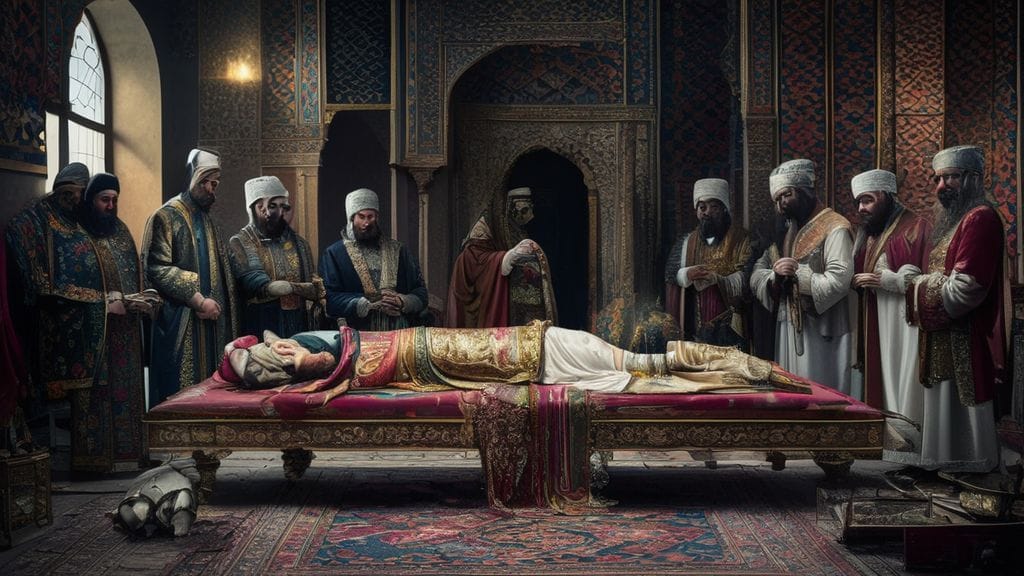
Then the news began to seep outward. Some accounts describe wailing within the palace, the ritual cries of mourning women, the low chanting of verses from the Qur’an, and the hurried consultations of qadis (judges) called to oversee the formalities of death. The body of Malik-Shah, once attended by courtiers seeking favor, now became an object to be washed, wrapped, and prepared for burial according to Islamic rites. Yet even this sacred process was laden with politics: where would he be buried, and who would preside over the funeral prayers?
Beyond the palace walls, the reaction was more muted. The death of malik shah i did not immediately produce riots or celebrations. Instead, it produced uncertainty. Soldiers wondered who would next pay their wages. Merchants worried about the continuity of trade protections and tax arrangements. Religious scholars speculated about the balance between Sultan and Caliph in the absence of the powerful Turkic ruler who had so recently dominated Baghdad’s political stage.
In the hours and days that followed, the palace became both a mausoleum and a battlefield of words. Advisors sought audiences with potential successors; wives and concubines of the late Sultan maneuvered for advantage on behalf of their sons. Outside, the Caliph’s own circle debated how forcefully to assert Abbasid authority in the vacuum. Night seemed to stretch longer than usual over Baghdad, as if the city itself were holding its breath, waiting to see whether the empire that had filled so many horizons would survive its master.
Nizam al-Mulk’s Shadow: A Vizier’s Death and a Sultan’s Undoing
The drama unfolding in Baghdad in November 1092 cannot be disentangled from what had happened only weeks earlier, far from the city. On the road between Isfahan and Baghdad, Nizam al-Mulk’s life had ended in a sudden flash of steel that would reverberate through the Seljuk world. His death, almost as shocking as the Sultan’s, had already sent the empire trembling. Together, they mark a double catastrophe: the executioner’s knife for the vizier, the suspected poison—or sudden illness—for the sultan.
For years, critics of the powerful vizier had whispered that he was too powerful, that he overshadowed Malik-Shah, that his family dominated key posts across the bureaucracy. His enemies saw in his assassination—whether or not they had a hand in it—a chance to reshape the balance of power. But with Nizam al-Mulk gone, Malik-Shah found himself without the one advisor who might have guided the empire through the looming succession storms.
Some accounts suggest that Malik-Shah had already grown weary of Nizam al-Mulk’s dominance and may have welcomed his departure. Others refute this, stressing the depth of their partnership. Regardless of the truth, the practical effect was the same: the state, having lost its principal architect, had no ready replacement at hand. When the death of malik shah i followed so swiftly, it ensured that no new vizierial figure would have time to assert authority and coordinate a smooth transition.
In later centuries, chroniclers would look back at this brief, terrible interval and see it as a hinge in history. A Persian writer, reflecting on the deaths of both men, wrote that “the world lost its arch and its pillar,” capturing the sense that structure and support had vanished together. Nizam al-Mulk’s shadow thus falls over the Baghdad palace where Malik-Shah drew his last breath. His absence left space for chaos to enter.
Intriguingly, the twin deaths also shaped how the emerging Ismaili movement was perceived. Having been blamed—often plausibly—for the assassination of the vizier, the Ismailis quickly became the favored suspects in any whispered theory about the Sultan’s own fate. Whether or not they were involved in Malik-Shah’s end, the mere association with such high-profile killings lent their cause an aura of terrifying capability. A new age of targeted political violence had been announced, and the Seljuk elite, already nervous, saw in every shadow a blade.
Widows, Sons, and Pretenders: The Succession Crisis Erupts
An empire built around a single ruler’s authority must, at some point, confront the problem of succession. For Malik-Shah, this problem arrived with brutal clarity the moment he died in Baghdad. He left behind multiple sons by different wives and concubines, as well as brothers and cousins who governed distant provinces. Each of these men now had reason to imagine himself on the throne—or at least in control of a portion of the realm.
One of the most influential figures in the immediate aftermath was Terken Khatun, one of Malik-Shah’s wives, often portrayed as ambitious and politically astute. She favored the succession of her young son, Mahmud, a child whose minority would, conveniently, give her significant power as regent. Others supported older sons, such as Barkiyaruq, who had their own support bases among military commanders and provincial elites. Meanwhile, in the Seljuk heartlands and on the frontiers, rumors of the Sultan’s death prompted local power-holders to consider breaking away or pursuing their own claims.
The palace in Baghdad thus became a crucible of competing agendas. In the first weeks, proclamations were issued in the name of different candidates depending on who controlled which scribes and which segments of the army. Some cities heard the khutba—the Friday sermon—delivered in the name of Mahmud, others in that of Barkiyaruq or rival claimants. The uniformity that had for a decade signaled Seljuk dominance fractured almost overnight into a patchwork of divided loyalties.
The death of malik shah i turned succession from an orderly handover into a scramble. Families suddenly weighed which branch of the Seljuk clan to support. Merchants hedged their bets by sending gifts to multiple courts. Religious leaders, mindful of their own safety, adopted cautious language, praying for “the just ruler” without always naming him. The result was not immediately full-scale war, but rather a tense, extended moment of political improvisation, in which every actor tried to read the shifting balance of power and move just fast enough to secure advantage without risking ruin.
In this turmoil, the figure of the Caliph in Baghdad gained renewed importance. If he chose to endorse one candidate over another, it could lend a veneer of sacred authority to that contender. Yet the Caliph also knew that too bold a stance could provoke a military response from disgruntled Seljuk commanders. Thus, even the spiritual head of Sunni Islam found himself making calculations shaped by fear and opportunity, his decisions traced back to a deathbed in which he had played no direct part.
From Unity to Fracture: The Empire Splinters Overnight
What had taken decades to assemble began to break apart within mere months. The Seljuk Empire had never been a monolithic state; it was a mosaic glued together by Malik-Shah’s authority and the bureaucratic networks shaped by Nizam al-Mulk. With both gone, the glue softened. The sultanate’s various regions—Anatolia, Iraq, Iran, Syria, Central Asia—each followed their own trajectories as local rulers seized the opportunity to assert autonomy.
In Iran, Barkiyaruq emerged as a leading contender, supported by significant segments of the military elite. His claim, however, was contested by those loyal to the child Mahmud and to other branches of the family. Skirmishes and battles followed, as each side tried to secure major urban centers and strategic routes. Cities that had enjoyed nearly two decades of relative stability now found themselves changing hands multiple times, with all the attendant violence and disruption.
In Anatolia, the so-called Rum Seljuks, who had already begun to operate with considerable independence, interpreted the crisis as further justification for their autonomy. They continued their pressures on Byzantine territories but now with even less coordination with the central power. In Syria and the Jazira, ambitious emirs maneuvered to create quasi-independent principalities, negotiating directly with nearby powers without necessarily deferring to any universally recognized Great Sultan.
The death of malik shah i thus had a cascading effect. Without an undisputed Great Seljuk to impose unity, the empire reverted to what its tribal origins had always suggested it might become: a network of related but rivalry-plagued dominions. This fragmentation did not mean immediate collapse; many of the new or semi-independent rulers governed effectively in their own right. But the collective weight of the Seljuks as a single, coordinated force—the very thing that had once terrified Byzantium and impressed the Abbasids—was diminished.
Travelers who had once crossed the empire under the umbrella of a single sovereign now had to navigate a more complex political landscape, securing safe-conduct from multiple rulers. Scholars seeking patronage found their choices multiplied but also riskier, for aligning with one patron could make them enemies of another. The Seljuk world did not disappear; it shattered into competing centers, each looking back to Malik-Shah’s era as a lost golden age they might invoke but not restore.
The Abbasid Caliphate Reacts: Between Gratitude and Fear
For the Abbasid Caliph resident in Baghdad, the Seljuk presence had always been a double-edged sword. On one hand, the Seljuk sultans had defended Sunni Islam against internal and external enemies, restoring a measure of political order after a century of turbulence. On the other, they had turned the Caliph from a temporal sovereign into a largely symbolic figure, with real power wielded by Turkic rulers who called themselves protectors but acted as masters.
The death of malik shah i thus presented the Abbasids with a paradoxical opportunity. With the overpowering Sultan gone, the Caliph could hope to regain some of the political initiative lost to the Seljuks. Indeed, the succession crisis meant that no single Sultan could immediately dominate Baghdad as Malik-Shah had. In the short term, this allowed the Caliph to play a more active role in arbitrating between rival claimants, conferring or withholding symbolic legitimacy.
And yet, the Caliph and his advisors were not blind to the risks. The Seljuk fragmentation also meant that the unified military shield that had protected Iraq and the core Abbasid territories from external threats was now weakened. A strong Sultan could deter invasions and suppress rebellions; multiple contending princes might invite them. The Caliph’s enhanced room for maneuver in court politics thus came at the price of greater exposure to regional instability.
Within Baghdad, the Caliph’s chancery produced careful letters, couched in pious language, addressing the crisis. Publicly, he called for unity, justice, and adherence to God’s law. Privately, he weighed which Seljuk branch might best serve Abbasid interests. The emerging pattern suggested that the Caliph preferred a weaker, divided Seljuk world to a unified, overwhelming one—but not so weak and divided as to collapse under external pressure.
This balancing act would define Abbasid-Seljuk relations for years to come. The aftermath of Malik-Shah’s death nudged the Caliphate away from complete political marginalization, but it did not restore its eighth- and ninth-century glory. Instead, the Abbasids adapted to a new role: brokers amid fragmentation, lenders of legitimacy in a marketplace of competing powers, trying to ensure that no single figure again attained the dominance Malik-Shah had once enjoyed.
On the Frontiers of Christendom: How the West Saw a Sultan’s Fall
While the death of malik shah i and the subsequent Seljuk fragmentation were primarily events within the Islamic world, their implications quickly rippled outward, reaching the distant courts of Christian Europe and Byzantium. Information traveled slowly but persistently along the trade routes that linked the eastern Mediterranean and the Middle East to Italy, France, and the German lands. Merchants, pilgrims, and envoys carried news of a “great Sultan” who had died, leaving his lands troubled and divided.
For the Byzantine Empire, reeling since Manzikert and struggling to hold onto its Anatolian territories, the news offered a sliver of hope. A divided Seljuk front might provide opportunities to reclaim lost fortresses, negotiate separate truces with regional rulers, or at least find breathing space from relentless pressure. Emperor Alexios I Komnenos, a shrewd diplomat and survivor, was quick to recognize that internal Muslim conflicts could create openings for Byzantine diplomacy and military action.
In Western Europe, understanding of Islamic politics was far cruder, but key messages still got through. Stories circulated of Turks at odds with each other, of Muslim princes fighting over cities sacred to both faiths, of a moment of weakness among the peoples who had once seemed unstoppable. By the late 1090s, when Pope Urban II called for what would become the First Crusade, the geopolitical reality in the eastern Mediterranean had been shaped, in part, by the disunity that followed Malik-Shah’s fall.
Chroniclers of the Crusades would sometimes mention Seljuk rulers, often in confused or generalized terms, but rarely grasped the details of their internal struggles. To them, the death of a distant sultan was but one more turning of fortune’s wheel. Yet, from a broader perspective, the very possibility of a large-scale Latin Christian expedition moving through Asia Minor and toward the Levant depended on a landscape in which no single Muslim power could easily unite the region in defense. That landscape emerged directly out of the succession battles and regional fragmentation that Malik-Shah’s death unleashed.
Thus, from castles in Normandy to cathedrals in Germany, whispers of turmoil in the East combined with religious zeal, political ambitions, and social pressures to set the stage for a new kind of confrontation. The great irony is that a death mourned or feared in Baghdad would, within a decade, have consequences on the walls of Antioch and Jerusalem.
The Long Echo: How the Death of Malik-Shah I Opened the Road to the First Crusade
Historians often warn against simple cause-and-effect stories, yet some moments seem to radiate consequences in all directions. The death of malik shah i is one of them. Without it, the First Crusade might still have taken place—driven by Latin Christendom’s internal dynamics, papal ambitions, and the precarious position of Byzantium. But with Malik-Shah gone and the Seljuk world divided, the Crusaders encountered a Middle East unable to mount a unified, coordinated response.
In the years between 1092 and 1096, when the first waves of Crusaders began their march, the Seljuk realms were busily engaged in their own conflicts. Rival sultans and emirs fought over cities like Mosul, Rayy, and Isfahan. In northern Syria and Anatolia, local rulers sought to consolidate their positions, sometimes making temporary alliances with Christian powers or at least tolerating their presence in hopes of gaining advantage over Muslim rivals. When the Crusaders arrived, they stepped into a theater already crowded with actors locked in their own dramas.
One can trace specific lines of influence. Had there been a strong, undisputed Great Seljuk Sultan—someone with the authority Malik-Shah had wielded at his height—he might have coordinated the defense of Asia Minor, rallied Syrian emirs, and ensured that news of the invaders’ progress was shared swiftly and acted upon. Instead, the fragmented Seljuk polities often reacted in isolation, underestimating the scale and determination of the Crusading hosts. When cities fell—Nicaea, Antioch, Jerusalem—they did so not because Muslim resistance was absent, but because it was uncoordinated, undermined by rivalries and mutual suspicion.
Modern scholars such as Jonathan Riley-Smith have noted that internal Muslim divisions were a crucial, if not the only, factor in Crusader successes. Those divisions, in turn, cannot be separated from the vacuum created by Malik-Shah’s sudden disappearance. The road the Crusaders walked was not physically built by his death, but it was cleared of some formidable obstacles—particularly the specter of a united Seljuk response under a single commanding figure.
Viewed from this angle, Malik-Shah’s death acquires a global dimension. What began as a mysterious, possibly poisoned end in a Baghdad palace evolved into one of the hidden preconditions for a seismic clash between Latin Christendom and the Islamic world. The echoes of that clash would continue for centuries, molding identities and memories on both sides of the Mediterranean.
Everyday Lives in Turmoil: Merchants, Peasants, and Scholars after 1092
Great political events often appear in chronicles as the actions of kings and generals, but their true measure lies in the experiences of those whose names did not survive. The death of malik shah i, though recorded in the writings of court historians, also transformed the daily rhythms of farmers in the Tigris valley, traders in Isfahan’s bazaars, and students in Nishapur’s madrasas.
For peasants, the most immediate changes came through taxation and security. A strong central authority, for all its demands, could at least provide predictable patterns of tax collection and protection from bandits. In the years following 1092, as rival claimants fought and provincial rulers asserted themselves, those patterns broke down. Some villages found themselves taxed twice—once by an emir loyal to one Seljuk prince, again by troops claiming allegiance to another. Others faced forced conscription or the requisitioning of grain and animals by passing armies.
Merchants, whose caravans had traversed the empire under the umbrella of Seljuk power, now had to renegotiate their routes. Letters of safe conduct from one ruler might not be recognized in another’s domain. Some opted to diversify their journeys, dealing with a wider array of city-states and local powers, which could bring both profit and danger. Still, the commercial vitality of cities like Baghdad, Isfahan, and Aleppo did not disappear. Trade adapted—even flourished in some places—as new centers of power competed to attract merchants through tax incentives or protection guarantees.
Scholars and students were perhaps more resilient than one might imagine. The madrasa network built under Nizam al-Mulk continued to function, though some institutions now shifted allegiances to new patrons. The intellectual life of the Islamic world remained rich, with jurists, theologians, and philosophers continuing debates that had begun years before Malik-Shah’s birth. Yet even for them, the underlying instability meant that patronage could be fickle, and the threat of being caught on the wrong side of a political shift was ever-present.
On an emotional level, the sense of living after a golden age was palpable. Older generations recalled the relative peace and prosperity of Malik-Shah’s strongest years, contrasting them with the uncertainty of the post-1092 landscape. As one later writer put it, “In the days of Malik-Shah, men slept with their doors unbarred; after him, even kings feared the night.” Whether or not this was literally true, it captures the collective memory of a time when order seemed achievable, now replaced by a feeling that history had veered off course.
Memory, Chronicles, and Legend: How Historians Reconstructed His Final Days
Everything we know about Malik-Shah’s death and its context comes to us through layers of narrative—Arabic, Persian, Latin, and later European. Chroniclers wrote with agendas, loyalties, and fears; their pens could conceal as much as they revealed. In reconstructing the final days in Baghdad, modern historians sift through these texts, comparing versions, weighing silences, and asking why certain details were emphasized while others faded into oblivion.
Medieval Muslim historians such as Ibn al-Athir and later writers like Rashid al-Din preserved key elements of the story: the sudden illness, the proximity to Nizam al-Mulk’s assassination, the rapid fragmentation that followed. Some insinuated poison; others avoided accusations that might implicate powerful families or sacred figures like the Caliph. The Ismailis, for their part, came to be known in both Muslim and Christian sources as masters of stealthy political killing, their reputation sometimes based on solid fact, sometimes inflated by fear.
Modern scholars treat these accounts with caution. They cross-reference them with numismatic evidence (changes in coin inscriptions indicating shifts in recognized rulers), with architectural projects (whose names are commemorated on foundations), and with documentary fragments preserved in archives and genizahs. Through this painstaking work, they have confirmed the basic outline: Malik-Shah died unexpectedly in Baghdad on 19 November 1092, that his death was widely suspected to be unnatural, and that it precipitated a swift and dramatic political realignment.
At the same time, the more intimate details—the expression on his face, the exact words spoken in his last hours, the identity of the person who brought him his final meal—are likely lost forever. Here, legend creeps in, filling gaps with imagined dialogues and moral lessons. Some stories present Malik-Shah’s end as divine punishment for overreaching; others depict him as a tragic hero cut down by treachery. Each retelling says as much about the storyteller’s world as it does about the eleventh century.
Citation to one modern authority captures this complexity well. As the historian R. Stephen Humphreys notes in a broader study of Islamic history, “Events like the death of a ruler are never mere ‘facts’; they are interpreted, contested, and reinterpreted by every generation that needs them to make sense of its own anxieties.” The death of malik shah i, then, is not only a medieval event but an ongoing mirror in which later societies see reflections of their fears about power, legitimacy, and fate.
What If He Had Lived? Counterfactual Paths of the Seljuk World
History, as it happened, left the Seljuk Empire fractured and the Islamic Near East vulnerable to new kinds of incursions. But what if Malik-Shah had not died that November in Baghdad? What if the suspected poison had never touched his lips, or the sudden illness had been cured by a skilled physician? Exploring these questions does not change the past, but it can illuminate the contingencies that shaped it.
If Malik-Shah had lived another decade, he might have had time to resolve the succession question more firmly. He could have designated and enforced a single heir, reducing the scope for later civil wars among his sons. With his authority intact, he might have contained or divided Ismaili influence more effectively, perhaps making further high-profile assassinations less likely. A living Malik-Shah might even have rebuilt some of the trust or at least stable coexistence that had existed between his court and the Abbasid Caliph.
On the military front, an extended reign could have meant more focused campaigns against Byzantium or other frontier powers, consolidating Seljuk gains and perhaps limiting the space into which the First Crusade would later push. Facing a united and confident Seljuk Empire led by a seasoned Sultan, the Crusaders might have encountered fiercer, more coordinated resistance, altering the outcomes at key sieges and battles.
Yet counterfactuals must acknowledge internal dynamics as well. Malik-Shah was not immortal, and the structural tensions within the Seljuk system—between central and provincial authorities, between different ethnic and religious constituencies—would not have vanished. Perhaps his survival would have delayed fragmentation rather than prevented it. Perhaps the very networks of power he nurtured would have themselves produced a future crisis once he finally passed.
Still, contemplating these alternative paths underscores just how pivotal his actual death was. The death of malik shah i did not simply mark the end of one life; it determined the timing and manner in which a whole system shifted from relative coherence to open contestation. The world that emerged—the world of Crusades, regional sultanates, and contested frontiers—was one among several that could have been. Fate, or human hands, chose this one.
Conclusion
On 19 November 1092, in a room in Baghdad whose exact location has long been lost, the breath of a single man ceased—and with it, an entire political cosmos began to wobble on its axis. Malik-Shah I, who had risen from the legacy of the steppe to become master of an empire, died suddenly amid whispers of poison, after years of building a fragile yet impressive order. His reign had woven together disparate lands, peoples, and traditions into a functioning whole. His death tore visible holes in that fabric.
We have followed the story from the early days of Seljuk ascent to the moment when Malik-Shah’s body was wrapped for burial, from the whispered plots of courtiers to the anxious movements of provincial rulers. We have seen how the death of malik shah i triggered a succession crisis, encouraged regional fragmentation, reshaped Abbasid-Seljuk relations, and indirectly prepared the ground on which the First Crusade would find unexpected success. Along the way, we have watched merchants, peasants, and scholars adjust their lives to new uncertainties, and we have listened to the voices of chroniclers who tried to make sense of a world that suddenly felt less stable.
Whether Malik-Shah died by poison or natural illness may never be known with certainty, and perhaps, in the end, that detail is less important than the larger pattern his death reveals. Empires often depend on the charisma, skill, and continued survival of a few key individuals. When those individuals vanish, the structures they sustained can crumble with astonishing speed. Yet history is not merely a record of collapse. New forms, new rulers, new ideas arise from the ruins, carrying with them the memories—sometimes idealized—of what came before.
Malik-Shah I remains, in that sense, a liminal figure: the last great Seljuk sovereign before fragmentation; the ruler whose twilight cast shadows that reached as far as Jerusalem’s walls and beyond. His life testified to the possibilities of political synthesis in the medieval Islamic world; his death exposed its fault lines. And Baghdad, city of caliphs and sultans, kept his secret—how exactly he died—even as it bore witness to the profound transformations his departure set in motion.
FAQs
- Who was Malik-Shah I?
Malik-Shah I was the third Great Seljuk Sultan, ruling from 1072 to 1092. Under his leadership, the Seljuk Empire reached its greatest territorial extent and political influence, stretching from Central Asia to Anatolia and the Levant, and exercising a dominant role over the Abbasid Caliphate in Baghdad. - When and where did Malik-Shah I die?
He died on 19 November 1092 in Baghdad, the Abbasid capital. His presence there reflected the close yet tense relationship between Seljuk military power and Abbasid religious authority at the time. - Was Malik-Shah I poisoned?
Many medieval sources suggest that Malik-Shah’s sudden illness after a meal in Baghdad was caused by poison, possibly administered by palace insiders or political rivals. Modern historians acknowledge that poisoning is plausible but unproven, as the available sources are contradictory and often shaped by rumor and later agendas. - How did the death of Malik-Shah I affect the Seljuk Empire?
His death triggered an intense succession crisis among his sons, relatives, and regional commanders. Within a short time, the unified Seljuk Empire fragmented into rival sultanates and principalities, weakening central authority and turning the once-cohesive realm into a patchwork of competing powers. - What role did Nizam al-Mulk play in this story?
Nizam al-Mulk was Malik-Shah’s powerful vizier and chief architect of Seljuk administration. His assassination, only weeks before the Sultan’s death, robbed the empire of its principal stabilizing figure. The near-simultaneous loss of both ruler and vizier greatly accelerated the collapse of Seljuk unity. - Did Malik-Shah’s death influence the First Crusade?
Indirectly, yes. The fragmentation following his death meant that when the First Crusade began in 1096, the Muslim Near East lacked a single strong leader capable of coordinating an effective, unified response. This disunity contributed to the Crusaders’ early successes in Anatolia and the Levant. - How did Malik-Shah’s death impact ordinary people?
For peasants and townspeople, the consequences appeared in the form of shifting allegiances, inconsistent taxation, and episodes of violence as rival claimants fought for control. Merchants faced new hazards on trade routes, while scholars and officials had to navigate a more unstable world of patronage. - What do historians rely on to reconstruct his final days?
They draw on medieval Arabic and Persian chronicles, numismatic evidence, architectural inscriptions, and, where possible, documentary fragments. By comparing different accounts and cross-referencing them with material evidence, historians build a cautious but coherent picture of the events surrounding his death. - How is Malik-Shah I remembered in Islamic historical tradition?
He is often remembered as a just and capable ruler who presided over a period of prosperity and relative stability, sometimes described as a kind of golden age for the Seljuks. His sudden death is frequently portrayed as a turning point that ushered in political fragmentation and vulnerability to external threats. - Why is the death of Malik-Shah I considered historically significant today?
His death marked the end of effective centralized Seljuk rule and set off a chain reaction of events that reshaped the Middle East. It illuminates how the fate of empires can hinge on the health and survival of a few crucial individuals, and how a single death can alter the trajectories of regions, religions, and even global conflicts like the Crusades.
External Resource
Internal Link
Other Resources
- Encyclopaedia Britannica – general search for the exact subject
- Google Scholar – academic search for the exact subject
- Internet Archive – digital library search for the exact subject