Table of Contents
- A Summer Death at Melun: The King Who Slipped into Legend
- A Fragile Crown: France on the Eve of Philip’s Birth
- Child on the Throne: The Making of a Capetian King
- Between Altar and Sword: The Early Struggles of Philip I
- The King and His Great Vassals: A Realm of Restless Lords
- Love, Scandal, and Excommunication: Bertrade d’Anjou Enters the Stage
- The Church Strikes Back: Censures, Councils, and a Tarnished Crown
- Philip I and the Long Shadow of the First Crusade
- Father and Son: Louis as Co-King and the Future of the Dynasty
- The Final Years at Melun: An Aging King in a Changing World
- 29 July 1108: The Death of Philip I of France at Melun
- Funeral, Burial, and Memory: From Melun to Saint-Benoît-sur-Loire
- Contested Legacies: How Chroniclers Judged Philip I
- From Weak King to Founding Figure: The Long-Term Impact of His Reign
- France After Philip: The Early Rule of Louis VI and the Shaping of Royal Power
- Love, Morality, and Power: Reassessing the Scandal at the Heart of His Life
- The Death of Philip I of France in Historiography and Popular Imagination
- Conclusion
- FAQs
- External Resource
- Internal Link
Article Summary: On 29 July 1108, in the royal stronghold of Melun, the long and contested life of Philip I of France came to an end, marking a turning point for the Capetian dynasty and for the future kingdom of France. This article traces not only the death of Philip I of France but the world that shaped him, from his childhood on a fragile throne to the turbulent politics that defined his reign. It explores how a king criticized for weakness and scandal nonetheless preserved the monarchy through war, excommunication, and shifting alliances. We follow the drama of his illicit love for Bertrade d’Anjou, the shock of papal censure, and the uneasy coexistence with a powerful nobility. The narrative then moves to his final days at Melun and the careful transition of power to his son, Louis VI. Throughout, we examine how contemporaries and later historians judged the death of Philip I of France, sometimes harshly, sometimes with reluctant admiration. By placing the death of Philip I of France within its broader historical setting, the article shows how an embattled king helped lay the groundwork for a more centralized French monarchy. In doing so, it invites us to look again at the quiet but decisive role of his reign in the long story of medieval Europe.
A Summer Death at Melun: The King Who Slipped into Legend
On a warm July day in the year 1108, the fortress town of Melun lay beneath a heavy, pressing sky. The River Seine moved slowly past its walls, swollen by summer rains, reflecting the low clouds that drifted over rooftops and church towers. Inside the royal residence, separated from the murmurs of the town by stone and ceremony, France’s long-reigning monarch struggled for breath. The death of Philip I of France was not marked by the clash of armies or the shouting of crowds. Instead, it unfolded in a chamber lit by candles and cooled only by the movement of anxious attendants—priests, courtiers, and perhaps a son waiting to inherit a fragile crown.
Philip had been king for nearly half a century, a lifetime in an age when men often died before their fortieth year. When he first wore the crown, William the Conqueror had not yet landed in England, the word “crusade” had not been pronounced from a papal pulpit, and the Capetian kings still ruled little more than a patchwork of lands around Paris and Orléans. By the time the death of Philip I of France took place at Melun, the map of Western Christendom had changed beyond recognition. A Latin kingdom stood in Jerusalem; Norman dynasties ruled England and southern Italy; the Capetians had survived, almost quietly, amid these storms.
Yet behind the stillness of that final scene lay a life marked by conflict, scandal, and bitter judgment. To many of his contemporaries, Philip was a disappointing king—too fond of comfort, too cautious in war, too willing to set aside sacred vows for the sake of passion. Chroniclers, most of them churchmen, did not hesitate to condemn him. One monk acidly remarked that he preferred the bed of another man’s wife to the company of his bishops. It is astonishing, isn’t it, that a king who reigned so long could be remembered more for his sins than his statecraft?
But this was only the beginning of his story. To understand what it meant for France when the death of Philip I of France was whispered through the halls of Melun, we must pull back from that bedside and look at the broader canvas: the world that birthed him, the forces that shaped his reign, and the legacy that followed him to the grave. Only then can we see how the quiet passing of this embattled monarch helped ensure that the Capetian line did not collapse in an age when kings were often little more than first among warlords.
A Fragile Crown: France on the Eve of Philip’s Birth
When Philip was born around 1052, probably in Champagne, the title “King of the Franks” sounded more impressive than it truly was. His father, Henry I of France, traced his lineage back to Hugh Capet, the man who had seized the throne in 987. But more than sixty years later, the Capetian crown still rested on uncertain foundations. Paris was not yet the unquestioned heart of a kingdom; it was merely the key stronghold in a royal domain hemmed in by powerful nobles—Counts of Flanders to the north, Dukes of Normandy to the northwest, Counts of Anjou and Blois, Dukes of Aquitaine in the distant south. France existed less as a unified state than as a loose constellation of lordships, each guarded by its own network of fortresses and oaths.
The Capetian kings possessed direct authority over a relatively small territory, the domaine royal, stretching roughly from Paris through Orléans and down toward the Loire. Beyond these lands, their authority was more symbolic than real, expressed through ceremonies, coinage, and occasional interventions. A count or duke might kneel to swear fidelity at the king’s coronation, but once he returned to his own lands, the crown’s presence often faded into abstraction. It was a world in which royal weakness could easily mean royal extinction.
Henry I had wrestled with this problem for most of his reign. He fought William, Duke of Normandy, in a losing effort to curb Norman expansion. He struggled with the great lords of Champagne and Aquitaine. At the same time, he confronted internal threats from his own brother and rivals who believed the Capetian claim far from sacred. It was in this atmosphere of chronic insecurity that the young Philip was raised—a child expected to preserve a dynasty that had not yet proven it could endure.
To shore up the monarchy, Henry I resorted to a technique that would become a Capetian hallmark: associating his son with him on the throne during his own lifetime. It was a solution inspired partly by Carolingian tradition, partly by fear. If the king died unexpectedly, a child might be swept aside before he could be crowned. But if that child were already an anointed king, the shock of succession would be softened. Thus, the history of the death of Philip I of France cannot be separated from this precautionary strategy; his life as a ruler began long before his father’s last breath.
Child on the Throne: The Making of a Capetian King
In 1059, when Philip was probably no more than seven years old, the great church of Reims filled with incense, chant, and expectation. Here the boy was consecrated king in a ceremony that linked him to centuries of royal ritual. The archbishop anointed his head with holy oil from the legendary Sainte Ampoule, the sacred vial that was said to have descended from heaven for the baptism of Clovis. The message of this rite was clear: Philip, though a child, was not simply the son of a king; he was God’s chosen ruler, bound to the kingdom by a sacramental bond.
The practical effect, however, was more modest. For nearly a decade, Philip remained a largely symbolic figure while his father wielded true authority. Yet this early coronation mattered deeply for the later stability of the monarchy. When Henry I died in 1060, there was no desperate scramble to organize a new enthronement. The boy who stood at his father’s bier was already, in the eyes of the Church and at least some of the nobility, king in his own right. In an age when political legitimacy could be contested in an instant, that continuity was invaluable.
Still, the France over which this child now nominally ruled was unstable and dangerous. A regency was put in place, headed by his mother, Anne of Kiev—a princess from the distant lands of Rus’—and Baldwin V, the influential Count of Flanders. Their guardianship revealed the monarchy’s dependence on powerful magnates. Baldwin was no mere servant of the crown; he was a lord whose armed strength and political weight rivaled, in some respects, that of the king he pledged to guide.
During these formative years, Philip learned a lesson that would guide much of his later rule: survival sometimes depended less on heroic conquest than on cautious alliances and careful balancing acts. While the chroniclers longed for kings who emulated Charlemagne, crushing their enemies in dazzling campaigns, the young Capetian would come to realize that France was not yet ready for such grand ambitions. He inherited a throne that required endurance more than glory.
Between Altar and Sword: The Early Struggles of Philip I
As Philip came of age in the 1060s and 1070s, the political terrain of Western Europe shifted dramatically. To the west, in 1066, William of Normandy crossed the Channel and seized the English crown, creating a formidable Anglo-Norman power that would loom over France for generations. To the south, the Normans consolidated their hold on parts of Italy and Sicily. The Capetian king, in contrast, presided over a comparatively modest realm, threatened and overshadowed by these rising forces.
Philip’s early reign was thus marked by a series of low-intensity conflicts and diplomatic maneuvers rather than spectacular victories. He had to contend especially with Flanders and Normandy, regions that could either bolster or break his influence. At times, Philip intervened in Flemish succession disputes, playing the role of arbiter to keep a potentially dangerous neighbor in check. At other moments, he tried to exploit weaknesses in neighboring principalities to expand royal authority, only to find his resources too limited for decisive action.
Unlike later French kings who would hammer away at their great vassals, Philip often accepted compromise where chroniclers wished for conquest. This has led some historians to brand him as weak or timid, but such judgments can overlook the narrowness of his options. The royal domain could not field massive armies without the cooperation of the very lords whose power the crown wished to curtail. Philip had to move slowly, testing alliances, seizing opportunities where they arose, and never forgetting that a rash campaign could provoke a coalition strong enough to threaten the Capetian line itself.
Yet even as he navigated these worldly struggles, Philip’s relationship with spiritual authority grew increasingly strained. The era of his rule coincided with the reforms associated with Pope Gregory VII, a movement that sought to purify the Church, combat simony, and assert papal supremacy over Christian rulers. This reforming tide would one day collide violently with the king’s own personal choices, but in his early decades on the throne, Philip still walked, at least outwardly, on the acceptable side of that line between altar and sword.
The King and His Great Vassals: A Realm of Restless Lords
To grasp the full meaning of the death of Philip I of France, we must understand the men whose power often overshadowed his own: the great vassals. In the eleventh century, the Duke of Normandy, the Count of Flanders, the Duke of Aquitaine, and the Counts of Anjou and Blois were not mere subordinates; they were princes in their own right. Their castles dominated key trade routes and fertile lands; their armies could sometimes outnumber those the king could summon from his more modest domain.
Philip’s dealings with these lords were complex and often tense. With the Normans, relations fluctuated between hostility and wary coexistence. The conquest of England by William of Normandy threatened to encircle France with an Anglo-Norman power whose resources dwarfed those of the Capetian monarchy. Philip could not risk outright submission, but neither could he afford grand wars he might lose. He resorted to subtle methods—supporting rebels in Normandy, exploiting dynastic disputes, and waiting patiently for the internal rivalries of the Anglo-Norman world to weaken his formidable neighbor.
In Flanders, the situation was equally delicate. The counts of Flanders controlled rich commercial centers and could mobilize armies of armored knights, mercenaries, and urban militias. Philip intervened periodically in Flemish politics, backing certain claimants to the comital title when it suited royal interests. He understood that a friendly or divided Flanders was vital to the security of the royal domain’s northern frontier.
Elsewhere, in Aquitaine and Anjou, distance and complexity limited the king’s direct influence. Aquitaine in particular was almost a separate world, stretching across much of southwestern France, its dukes more preoccupied with local rivalries and Occitan culture than with the distant Capetian king. The monarchy’s hold over these vast southern lands was more aspirational than actual.
All this meant that when people later recalled the death of Philip I of France, few could point to great territorial annexations or crushing victories. His reign was not one of spectacular expansion. Instead, it was a time in which the monarchy learned to survive, to play the long game, to avoid the sort of catastrophes that could have shattered an already fragile crown. It was, in many ways, the quiet labor of endurance that prepared the ground for his successors.
Love, Scandal, and Excommunication: Bertrade d’Anjou Enters the Stage
Then came love—or what Philip, at least, seems to have believed was love. Sometime in the 1090s, the king’s life took a turn that would overshadow his reputation, poison his relationship with the Church, and echo darkly at the moment of his death. The woman at the center of this drama was Bertrade d’Anjou, a noblewoman whose own story crossed the fault lines of power and ambition that shaped the age.
Bertrade was the daughter of Fulk IV of Anjou, a potentate whose family already played a central role in the politics of western France. When Philip first encountered her, she was not free. She was married to Fulk’s rival, Count Fulk of Montfort or more significantly, to Fulk IV’s ally and overlord in certain sources—yet the details vary in the chronicles, revealing how rumor and moral outrage clouded the record. What is clear, however, is that Philip became infatuated. In defiance of canon law and public morality, he arranged for Bertrade to leave her husband and join him as queen, even though he was still married to Bertha of Holland.
The scandal that followed was immense. Philip’s decision essentially amounted to bigamy, aggravated by the fact that Bertrade’s own marriage had not been properly dissolved. For the reform-minded Church, such behavior was intolerable in a Christian layman, let alone a consecrated king. The royal bed, meant to be the source of legitimate heirs and dynastic stability, had become a site of transgression. Bertha of Holland, the discarded queen, withdrew in humiliation, and Bertrade took her place beside the king in open defiance of ecclesiastical norms.
Chroniclers, particularly those close to the reforming movement, painted the relationship in starkly negative colors. They depicted Bertrade as a scheming temptress and Philip as a morally weak monarch placing his passions above his duty. The royal couple would become the target of sermons, papal letters, and councils, as the Church moved to defend what it saw as the integrity of Christian marriage. The love that had brought them together now threatened to isolate the king from the very institution that had consecrated his rule.
The Church Strikes Back: Censures, Councils, and a Tarnished Crown
The eleventh century was not a time when kings could safely ignore the Church. The Gregorian reform movement had ignited a new understanding of papal authority, one that reached across Christendom, challenging lay rulers in matters that earlier ages might have considered purely secular. When news of Philip’s bigamous union with Bertrade d’Anjou reached Rome, the reaction was swift and uncompromising.
Pope Urban II—the same pope who would later call for the First Crusade—condemned the king’s union in harsh terms. In church councils held in France, such as those at Clermont and others that followed, bishops publicly denounced Philip’s conduct. The king was excommunicated, cut off from the sacraments, his very presence in liturgical settings considered a stain on the sanctity of the Church’s rites. For a medieval ruler, excommunication was more than a private spiritual punishment; it was a political weapon that could undermine his legitimacy in the eyes of his subjects.
How did Philip respond? At first, he vacillated, promising to dismiss Bertrade only to continue living with her. At times he sought compromise, appearing ready to appease the Church while clinging to the woman he had chosen. The repeated cycles of condemnation and partial reconciliation dragged on for years, casting a long shadow over his later reign. It was an age when the idea of a Christian king was not merely symbolic; the king was expected to be a defender of the Church and an exemplar of Christian morality. Philip’s defiance struck at the heart of that expectation.
In this context, the death of Philip I of France cannot be separated from the memory of excommunication. Even if he eventually reached some form of accommodation with ecclesiastical authorities, the stain lingered. Monastic chroniclers would later imply that his earthly missteps were matched by divine displeasure, hinting that the troubles of his later years and the circumstances of his death reflected a kind of heavenly judgment. Their words may exaggerate, but they reveal the intensity with which Philip’s marital scandal shook the spiritual and political foundations of his kingship.
According to one such source, Orderic Vitalis, the Anglo-Norman monk whose chronicles remain a vital window on the era, Philip “preferred the embraces of Bertrade to the favor of God and His Church,” a line that captures the bitterness with which reformers viewed the king’s choices. Yet, as modern historians like Georges Duby and Jean Favier have argued, this condemnation must be weighed against the realities of royal politics and personal emotion in an age when marriage, love, and power often collided in explosive ways.
Philip I and the Long Shadow of the First Crusade
While Philip wrestled with his conscience and the Church over Bertrade, Christendom was drawn into one of the most dramatic enterprises of the Middle Ages: the First Crusade. In 1095, at the Council of Clermont, Pope Urban II called on the knights of Western Europe to take up arms and journey to the Holy Land, to liberate Jerusalem from Muslim control. The response was extraordinary. Lords from France, Normandy, Flanders, and beyond set off on a perilous march that would culminate, astonishingly, in the capture of Jerusalem in 1099.
Yet the king of France himself did not go. Excommunicated and embroiled in his personal scandal, Philip was ill-placed to present himself as a champion of Christendom. Instead, it was his brother, Hugh of Vermandois, and a host of powerful vassals—Raymond IV of Toulouse, Robert Curthose of Normandy, others—who took the cross. In a kingdom still defined by feudal fragmentation, the spiritual and military prestige of the crusading movement flowed more toward these great lords than toward the crown.
This absence would later affect how Philip’s reign was remembered. In an age that idolized crusading heroism, the king of France appeared curiously absent from one of the defining adventures of his time. Some observers might have wondered why God had placed such a flawed and hesitant monarch on the throne while braver men marched east in pursuit of glory and salvation. The fact that the death of Philip I of France occurred less than a decade after the fall of Jerusalem underscores the contrast between his personal struggles and the apocalyptic vision of Christendom advancing triumphantly into the Holy Land.
At the same time, Philip’s refusal—or inability—to join the crusade had practical consequences. While many lords were away, he had an opportunity to consolidate his authority in their absence, to strengthen royal influence within the heart of France. There are hints in the sources that he did attempt to exploit these openings, but his reputation, clouded by excommunication and scandal, limited his capacity to present himself as a moral and political leader in this new, crusading world.
Father and Son: Louis as Co-King and the Future of the Dynasty
Amid scandal and ecclesiastical censure, Philip made a decision that would prove crucial for the continuity of the Capetian dynasty: he crowned his son Louis as co-king during his own lifetime. This was not an innovation but a return to a tried and tested strategy. Just as Philip himself had been anointed while his father still lived, so now he ensured that, whatever might happen to him personally, the line of succession would be clear.
Louis, later known to history as Louis VI “the Fat,” could hardly have been more different from the image most chroniclers painted of his father. Where Philip was accused of laziness and sensuality, Louis would be remembered as energetic, martial, and deeply engaged in the day-to-day governance of the realm. As he matured, Louis increasingly assumed the reins of power, especially within the royal domain, leading campaigns against rebellious lords and violent castellans who threatened the peace of the king’s lands.
By the early 1100s, observers began to notice a gradual shifting of authority. While Philip remained officially king, Louis’s star rose. He commanded troops, negotiated with nobles, and enforced royal justice with a vigor that impressed contemporaries who longed for strong kingship. In effect, a quiet transition was under way years before the actual death of Philip I of France. The monarchy, often precarious in times of succession, here experienced a rare moment of managed continuity, with father and son sharing the burdens and symbols of rule.
This dual kingship also softened the blow of Philip’s moral and political controversies. Louis appeared as a corrective figure: a prince who, though not untouched by his own conflicts with the Church, nonetheless embodied a more active and assertive model of rulership. When people later thought back to 1108, they saw not the collapse of a dynasty but a handoff of power from a flawed but persistent monarch to a successor better suited to the harsher demands of the age.
The Final Years at Melun: An Aging King in a Changing World
In the final years of his life, Philip increasingly withdrew from the direct conduct of royal business, spending long stretches of time in towns like Melun, a strategically placed settlement on the Seine not far from Paris. Melun, with its castle rising above the river and its role as a royal residence, offered a blend of security and proximity. It was close enough to the political heart of the domain that the king could still be reached, yet removed enough from the bustle of Paris to serve as a place of semi-retirement.
The Europe around him had changed almost beyond recognition since his youth. The Norman kings of England now wrestled with internal conflicts and rebellions. In the Iberian Peninsula, Christian and Muslim states battled in the slow, grinding process later called the Reconquista. The crusader states in the Levant struggled to hold onto their improbable conquests. Within France itself, new monastic movements, the spread of Cluniac and later Cistercian influence, and growing urban centers hinted at deeper social and religious transformations to come.
Philip, aging and marked by years of dispute with the Church, likely felt some mixture of weariness and resignation. The excommunications and reconciliations of earlier decades had left scars on his reputation. His relationship with Bertrade, once a source of passion and defiance, seems to have cooled under the pressure of ecclesiastical sanctions and political necessity. Some accounts suggest that Bertrade eventually accepted conditions imposed by the Church, withdrawing at least partially from the king’s side, although the details are murky.
Yet if his personal flame had dimmed, the institutional flame of the monarchy still burned. The presence of Louis as co-king ensured that royal authority did not vanish with Philip’s fading strength. In the halls of Melun, documents were still sealed, judgments pronounced, and the rituals of royalty maintained. An old king, perhaps heavier in body and slower in step, moved through the routines of a life spent beneath the crown, while the younger monarch took on more of the burdens outside those walls.
29 July 1108: The Death of Philip I of France at Melun
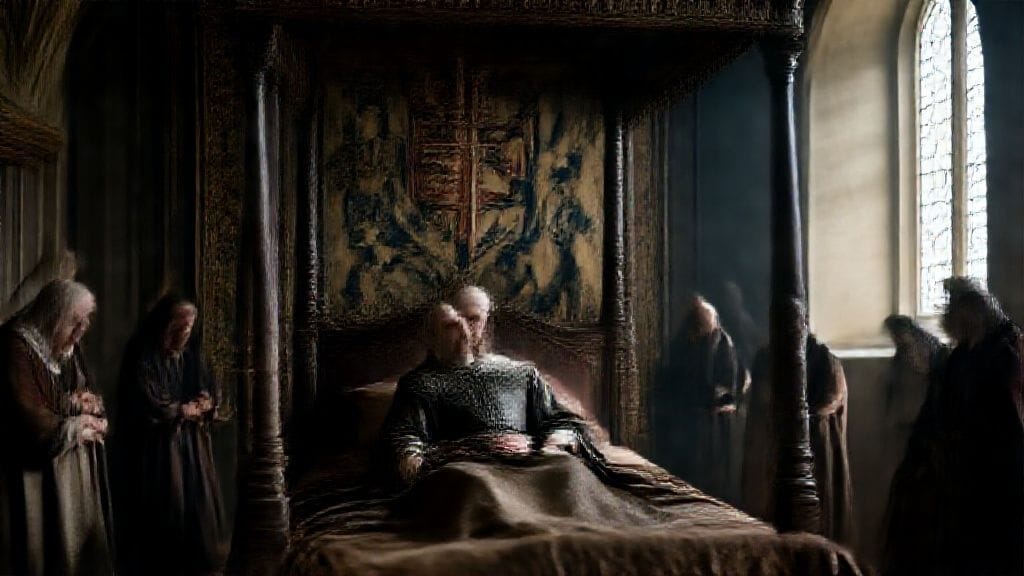
And then, in the summer of 1108, the end came. The exact circumstances of the death of Philip I of France are only sparsely recorded; the chroniclers, so eager to catalog his sins, offered few intimate details of his final hours. Yet from what we know of royal death rituals in this period, we can reconstruct the scene with reasonable plausibility.
Philip likely lay in a chamber within the castle at Melun, attended by clergy ready to administer the last rites. Given the earlier excommunications, the question of his spiritual standing at the moment of death has long intrigued historians. Evidence suggests that, by this time, he had reached at least a formal reconciliation with the Church, sufficient to allow him the sacraments. A priest would have heard his confession, offered absolution, and celebrated the anointing of the sick, preparing the king’s soul for departure from this world.
Outside the chamber, messengers waited nervously. The death of a king, even one partially eclipsed by his son, was a moment of acute danger. News had to be carried swiftly but carefully: to Louis, to bishops, to major lords whose loyalty could not be taken for granted. Within a few hours or days, the reality of Philip’s passing would spread along the roads leading from Melun to Paris, to Orléans, to the monasteries and courts that dotted the royal domain.
Inside, perhaps, Louis himself stood near the bed, listening to the labored breathing of a father with whom he had shared power but not always agreement. Chroniclers later emphasized the vigor and piety of the new king, but in that room on 29 July 1108, he would also have seen something else: the fragile humanity of the crown he now wore alone. The death of Philip I of France did not bring a burst of triumphal oratory. It brought, instead, the sober recognition that monarchy in this age was a thread drawn through the lives of fallible men, men whose failings were as much a part of their legacy as their achievements.
When Philip finally died, the kingdom did not shudder into chaos. No civil war erupted, no rival claimant surged forward to seize the diadem. This, in the end, may have been his most underrated accomplishment. By ensuring Louis’s prior coronation and sharing power in his last years, Philip allowed his own death to be a moment of continuity rather than collapse. The Capetian line, so precarious in the time of his birth, passed into the hands of a new generation without breaking.
Still, as news of the death of Philip I of France rippled outward, it carried with it the mixed judgments that had long surrounded his name. Some might have whispered that the king who chose love over law had at last answered to the highest Judge. Others, more pragmatic, noted that despite excommunication, scandals, and the rise of powerful neighbors, the Capetians remained on the throne. If the glory was limited, the survival was undeniable.
Funeral, Burial, and Memory: From Melun to Saint-Benoît-sur-Loire
Philip’s body did not remain in Melun. Following a pattern established by previous Capetian rulers, his remains were transported to a monastic church, a place where royal bones could rest beneath the chants of perpetual prayer. He was buried at the abbey of Saint-Benoît-sur-Loire, an important religious center located along the Loire River. This abbey, already associated with royal patronage and the cult of Saint Benedict, offered a setting where the king’s memory could be woven into the spiritual landscape of the realm.
The journey from Melun to Saint-Benoît-sur-Loire would have been both physical and symbolic. Monks, clergy, and perhaps selected nobles accompanied the procession. Villagers along the route might have paused in their summer labors to watch the passage of the royal bier. It was a reminder that, whatever one thought of Philip’s reign, a king was passing into history. The Capetian monarchy, for all its limitations, still carried a sacred aura; the death of Philip I of France was not merely a family event but a moment with religious and political resonance for the kingdom at large.
At the abbey, the funeral liturgy would have followed established forms: psalms intoned, readings proclaimed, a homily delivered that, one imagines, emphasized the need for prayer and mercy rather than public condemnation. Monastic chroniclers, even when harsh in their assessments, rarely used funerals as a stage for direct attack. Instead, they entrusted their sharper judgments to the parchments they would later fill with ink.
Saint-Benoît-sur-Loire thus became the keeper of Philip’s earthly remains, even as his spiritual legacy remained contested. Generations of monks would pray for his soul, chanting the Office of the Dead, remembering him among the list of royal benefactors. Yet the same monastic milieu also produced the narratives that portrayed him as weak, indulgent, and morally compromised. His tomb lay at the intersection of reverence and reproach.
Contested Legacies: How Chroniclers Judged Philip I
The harshest judges of Philip’s reign were often those who held the pen rather than the sword. Medieval chroniclers—monks, clerics, sometimes clerks attached to noble households—filtered the memory of kings through the lens of their own priorities and values. Philip’s scandalous marriage to Bertrade, his excommunication, and his perceived passivity in the face of powerful vassals made him an easy target for moralizing narratives.
Writers like Orderic Vitalis and Suger of Saint-Denis, though differing in perspective and purpose, both contributed to an image of Philip as a flawed monarch. Orderic, writing from the Anglo-Norman world, contrasted Philip unfavorably with rulers who combined martial prowess with at least outward respect for church discipline. Suger, who would later serve as abbot of Saint-Denis under Louis VI and Louis VII, focused more on the energy and reforms of Philip’s son, Louis, thereby implicitly casting Philip as a foil—a less impressive figure whose shortcomings highlighted his successor’s virtues.
One telling aspect of these accounts is their tendency to dwell on the king’s moral life more than on the broader structural constraints he faced. Few chroniclers bothered to note that the royal domain was small, that the resources available to Philip were dwarfed by those of some of his chief vassals, or that maintaining the mere existence of a Capetian monarchy amid such pressures was itself noteworthy. Medieval history-writing, steeped in moral theology, preferred stories of virtue and vice to analyses of fiscal capacity or administrative reach.
This imbalance means that when we revisit the death of Philip I of France through modern eyes, we must read the sources with caution. As the historian Ferdinand Lot once observed, medieval chronicles reveal as much about the spiritual anxieties of their authors as they do about the practical realities of kingship. Scholars like Georges Duby, in works such as “France in the Middle Ages,” have argued that Philip’s true significance lies not in battlefield glory but in the slow, often invisible consolidation of royal institutions that would bear fruit in later reigns.
Thus, while the chroniclers’ voices are indispensable, they are also partial. They invite us to imagine a king perpetually under moral indictment, but they do not force us to accept that as the final word. In their criticisms, we can glimpse an alternative narrative: a monarch who, in spite of his failings, kept the torch of Capetian legitimacy burning long enough for others to carry it forward.
From Weak King to Founding Figure: The Long-Term Impact of His Reign
When measured against later giants of French history—Philip II Augustus, Louis IX, even his own grandson Louis VII—Philip I can seem a modest, almost forgettable figure. He did not dramatically expand the territory of the crown, nor did he launch grand reforms that transformed the machinery of government. Yet history is not only shaped by those who break the mold; it is also shaped by those who preserve it against the storm.
One of Philip’s most important contributions lay in simple continuity. The Capetian system of hereditary kingship, bolstered by the practice of crowning heirs during their fathers’ lifetimes, survived his long and troubled reign. In an age when dynasties could vanish in a generation, that alone was a significant achievement. At the time of the death of Philip I of France, the idea that the throne naturally passed from father to son within the Capetian line had become more firmly rooted in the consciousness of the realm.
Philip also maintained and slowly strengthened the instruments of royal authority within the royal domain. He confirmed privileges, arbitrated disputes among nobles and clergy, and supported important religious houses, even amid his conflicts with church hierarchies. These acts, while individually modest, contributed over time to a sense that the king was the ultimate reference point for justice and legitimacy, at least within the core territories under direct Capetian control.
Furthermore, his reign overlapped with profound transformations in European society: the expansion of population, the growth of towns, the reform of the Church, and the emergence of new forms of religious life. By keeping the monarchy intact through these transitions, Philip made it possible for his successors to harness these changes. Louis VI would fight “robber barons” in the Île-de-France; Philip II Augustus would break the power of the Plantagenets; Louis IX would emerge as a model Christian ruler. None of that was predestined. It depended on the fragile thread of continuity that ran, however unglamorously, through Philip’s rule.
France After Philip: The Early Rule of Louis VI and the Shaping of Royal Power
With Philip’s passing in 1108, Louis VI stepped fully into the role he had already largely assumed. The new king confronted many of the same challenges that had plagued his father: turbulent vassals, limited resources, a Church both ally and critic. But Louis’s temperament and priorities differed in ways that altered the relationship between crown and nobility, particularly within the royal domain.
Louis VI earned his epithet “the Fat” later in life, but as a younger man he was robust and active, leading military expeditions against troublesome lords who preyed on peasants and travelers. Supported by able churchmen, notably Suger of Saint-Denis, he projected an image of the king as defender of order and justice. Under his rule, the monarchy began to assert more systematic control over castles, roads, and markets in the Île-de-France, laying further groundwork for a stronger centralized authority.
In doing so, Louis both built upon and reacted against his father’s legacy. The death of Philip I of France provided a convenient narrative break for chroniclers who wanted to contrast the “sinful” and “weak” old king with the energetic new one. Yet the institutions Louis wielded—the royal court, the chancery, the network of alliances with ecclesiastical centers—did not spring from nowhere. They were the inheritance of a dynasty that had, for more than a century, navigated the perilous waters of feudal politics.
Louis’s reign showed what could be done when a Capetian monarch combined personal vigor with the slowly accumulated resources of the crown. In that sense, Philip’s reign appears as a long, sometimes faltering prelude to a more assertive royal age. His death marked not only the end of a controversial life but the beginning of a new chapter in the slow rise of the French monarchy.
Love, Morality, and Power: Reassessing the Scandal at the Heart of His Life
Modern readers often fixate on the romance and scandal of Philip’s union with Bertrade d’Anjou, seeing in it a medieval echo of later royal love stories that challenged the constraints of court and Church. To his contemporaries, however, the issue was less romantic than theological and political. Marriage was a sacrament, indissoluble except under tightly defined circumstances, and the king’s example carried exceptional weight. When the sovereign himself seemed to trample that sacrament, anxieties about social and moral order intensified.
Yet it would be simplistic to reduce Philip’s motives to mere lust or caprice. Medieval kings, like their subjects, were capable of deep personal attachments that did not always align with dynastic calculations. Bertrade, far from being a passive figure, appears as a woman of intelligence and ambition, navigating the dangerous world of high politics in her own right. Their shared defiance of Church authority reflects not only personal desire but also the broader struggle between lay rulers and ecclesiastical reformers over who controlled the moral script of society.
When we return to the death of Philip I of France with this in mind, the outlines of a more complex portrait emerge. Here was a king who, in his private life, pushed against the bounds of what his age permitted, and who paid a political price for doing so. His story invites questions that resonate across centuries: How far may rulers follow their hearts without endangering their realm? To what extent should moral expectations constrain political power? And who has the authority to decide where that line lies?
Historians today, drawing on a wider range of evidence and more nuanced understandings of medieval culture, tend to see Philip and Bertrade not simply as villains in a clerical morality play, but as actors caught in the crosscurrents of transformation—participants in a struggle over the meaning of Christian kingship at a moment when both Church and monarchy were redefining themselves.
The Death of Philip I of France in Historiography and Popular Imagination
Over the centuries, the death of Philip I of France has seldom occupied center stage in popular narratives of the Middle Ages. Textbooks and general histories often mention him briefly, then hasten on to more dramatic figures and events. Yet within the specialized world of medieval historiography, his passing on 29 July 1108 marks an important milestone, separating the early, fragile Capetian monarchy from the more assertive phase that followed.
In nineteenth- and early twentieth-century scholarship, influenced by Romantic ideals and nationalistic readings of history, Philip was often overshadowed by more “heroic” or “saintly” kings. His reign, dominated by slow, incremental developments and personal scandal, did not lend itself to patriotic myth-making. However, as historians such as Marc Bloch and later Georges Duby shifted focus from great men to structures and mentalities, Philip’s role gained new interest. The very fact that he did not preside over dramatic conquests made him a useful case study in how medieval monarchies survived and adapted in the absence of spectacular victories.
Today, when scholars analyze the Capetian rise, they frequently emphasize the cumulative effect of seemingly unremarkable reigns like his. The death of Philip I of France has thus been reinterpreted less as the end of a failed kingship and more as a hinge between two modes of royal power: a modest, survival-oriented monarchy and a more ambitious, territorially expansive one. In academic works and university lectures, his story is used to illustrate the importance of continuity, institutional memory, and dynastic strategies in medieval politics.
Popular culture, for its part, has largely ignored Philip, preferring the drama of crusader kings, warrior queens, and saints. Yet the ingredients of a gripping narrative are all present: a young king under pressure from powerful neighbors, a forbidden love affair that provokes the wrath of the Church, a Europe convulsed by crusade, and a dynasty teetering between obscurity and greatness. It is only a matter of time, perhaps, before novelists and filmmakers discover in his life and death the raw material for a more nuanced and human portrayal of medieval kingship.
Conclusion
On that July day in 1108, as the candles burned low in Melun and the breath of an aging king grew shallower, no one could have known how the centuries would judge Philip I of France. His contemporaries, shaped by the concerns of their own age, saw in him a man who loved unwisely, who yielded too easily to his great vassals, who stood aside while others marched gloriously to Jerusalem. The chroniclers recorded his faults in ink that still speaks across the ages, ensuring that the scandal of Bertrade and the sting of excommunication would forever shadow the memory of his reign.
Yet when we look back from our own vantage point, the contours of his legacy shift. The death of Philip I of France did not plunge the kingdom into chaos; instead, it marked a carefully prepared transition to Louis VI, a ruler who would build on and transform the structures his father kept intact. The Capetian dynasty, fragile in its beginnings, emerged from his long reign not broken, but steadier, more deeply rooted in the consciousness of the realm. The royal domain, though modest, was more coherently governed; the idea of hereditary, sacral kingship more firmly entrenched.
Philip’s life, with all its contradictions, reminds us that history is often moved forward not only by dazzling conquerors or spotless saints, but also by flawed individuals who manage, despite their errors, to prevent collapse and preserve continuity. His story is a tapestry woven of love and law, sin and sacrament, weakness and endurance. In the quiet chamber at Melun where he died, the great dramas of his time—crusade, reform, feudal rivalry—converged in the figure of a man who had spent nearly fifty years trying to keep a precarious crown upon his head.
In the end, perhaps the most fitting measure of his importance is this: when the kingdom awoke the day after his death, the Capetians still ruled, and would continue to do so for centuries. From that simple fact flowed the later triumphs of French monarchy, the splendor and tragedy of its kings and queens, and, eventually, the very shape of European history. Philip I may not have carved his name in triumphal letters across the map, but he kept the line alive. Sometimes, in the long arc of the past, survival itself is a kind of victory.
FAQs
- Who was Philip I of France?
Philip I of France was a Capetian king who reigned from 1060 to 1108, one of the longest reigns of the Middle Ages. Crowned as a child and initially governed under a regency, he ruled a comparatively small royal domain centered on Paris and Orléans, navigating complex relationships with powerful vassals like the dukes of Normandy and the counts of Flanders. - When and where did Philip I of France die?
Philip I of France died on 29 July 1108 in the royal stronghold of Melun, a strategic town on the River Seine southeast of Paris. His death there marked the end of a nearly half-century reign and a carefully managed transition of power to his son, Louis VI. - Why was Philip I excommunicated?
Philip was excommunicated because he set aside his lawful wife, Bertha of Holland, and entered into a relationship—effectively a bigamous union—with Bertrade d’Anjou, who herself was already married. This violation of canon law outraged the reform-minded Church, leading Pope Urban II and French bishops to condemn and excommunicate the king multiple times. - Did Philip I participate in the First Crusade?
No, Philip I did not take part in the First Crusade. His excommunication and ongoing marital scandal undermined his position as a potential leader of a holy war. Instead, many of his powerful vassals and relatives, such as his brother Hugh of Vermandois and Raymond IV of Toulouse, joined the crusading armies that captured Jerusalem in 1099. - Who succeeded Philip I after his death?
Philip’s son, Louis VI, succeeded him as king of France. Louis had already been crowned as co-king during his father’s lifetime, which ensured a smooth succession when Philip died in 1108. Louis VI went on to strengthen royal authority within the royal domain and is often seen as the ruler who began transforming the Capetian monarchy into a more assertive power. - Where was Philip I of France buried?
Philip I was buried at the abbey of Saint-Benoît-sur-Loire, a significant monastic center on the Loire River. This abbey, associated with royal patronage and the cult of Saint Benedict, became the resting place for his remains and a spiritual focal point for prayers for his soul. - How do historians view Philip I’s reign today?
Modern historians tend to view Philip I’s reign as a period of crucial continuity rather than spectacular achievement. While medieval chroniclers emphasized his moral failings and political caution, contemporary scholarship highlights his role in preserving the Capetian dynasty, stabilizing the royal domain, and maintaining the institutions of kingship through a time of great social and religious change. - What was the political situation in France at the time of his death?
At the time of Philip’s death, France was still a patchwork of semi-independent principalities. The king’s direct authority extended mainly over the royal domain around Paris and Orléans, while powerful lords such as the dukes of Normandy and Aquitaine and the counts of Flanders and Anjou dominated their own regions. However, the Capetian dynasty was more secure than it had been a century earlier, and under Louis VI this foundation would be further strengthened. - How did his relationship with Bertrade d’Anjou affect his legacy?
Philip’s relationship with Bertrade d’Anjou deeply affected his legacy, leading to excommunication, strife with the Church, and enduring criticism in clerical chronicles. For centuries, this scandal overshadowed his political achievements, shaping an image of a king more driven by passion than by duty. Recent scholarship, however, places this relationship in the broader context of church reform, royal authority, and the complex interplay between love, law, and power in medieval society.
External Resource
Internal Link
Other Resources
- Encyclopaedia Britannica – general search for the exact subject
- Google Scholar – academic search for the exact subject
- Internet Archive – digital library search for the exact subject