Table of Contents
- A December Death in Rome: Setting the Scene in 872
- From Noble Childhood to the Threshold of the Papal Throne
- A Reluctant Pope in a Violent Century
- The Roman Stage: Streets, Factions, and Sacred Processions
- Kings, Emperors, and the Papal Chessboard
- The Human Sorrows of a Pope: Family, Loss, and Private Grief
- Defender of Rome: Adrian II and the Noble Clans
- The Eastern Question: Iconoclast Shadows and Byzantine Echoes
- A Pope Between Languages: The Slavic Liturgy Controversy
- Whispers of Decline: The Last Months of Adrian II
- 14 December 872: The Final Hours in the Lateran
- Rome Reacts: Mourning, Intrigue, and the Struggle for Succession
- Beyond the Tomb: How Adrian II Shaped the Papacy’s Future
- Memory, Chronicle, and Legend: How Historians See Adrian II
- Echoes in Stone: Traces of Adrian II in Medieval Rome
- A Century in Turmoil: The Long Shadow of the Ninth Century
- Conclusion
- FAQs
- External Resource
- Internal Link
Article Summary: On a cold December day in 872, the death of Pope Adrian II closed a turbulent chapter in Rome’s history, at once intimate and geopolitical. This article follows his journey from noble Roman child to reluctant pontiff, unfolding the tensions of a city riven by aristocratic factions, foreign armies, and spiritual disputes. It explores how the death of pope adrian ii coincided with the fragmentation of Charlemagne’s empire, a weakening papacy, and new missionary frontiers in the Slavic world. Through scenes of funeral rituals, whispered conspiracies, and sorrow behind palace walls, we see how his passing shaped the election of his successor and the future of the Church. The narrative also delves into his personal tragedies, including the loss of his wife and daughter, to show the human being behind the mitre. By reading the chronicles that record the death of pope adrian ii, we discover a pontiff caught between reform and survival, ideal and compromise. The article ultimately argues that the death of pope adrian ii did not simply end one life, but helped define what the medieval papacy would become. And as the Roman bells tolled that December, the city itself seemed to pause between past and future, wondering what would follow.
A December Death in Rome: Setting the Scene in 872
On 14 December 872, as the winter light faded early over Rome’s crumbling walls, the bells of the city began to toll in a slow, measured rhythm. In the Lateran Palace, seat of the bishops of Rome, courtiers and clerics moved with a tense, rehearsed urgency. A pope was dying. The death of Pope Adrian II, an event that might now appear as a footnote on a medieval timeline, felt very different to those who trod those cold stone corridors. For them, the ending of his life meant the reopening of a dangerous question: who would command the spiritual and political heart of Latin Christendom next?
Outside, the city wore its age like an old cloak. The ancient monuments of emperors—the Colosseum, the Forum, the shattered temples—stood as broken reminders of a past glory. The ninth-century Romans lived among ruins, scavenging marble, reusing columns, building churches inside the shells of pagan sites. Adrian II’s Rome was not the majestic capital of Augustus, but a beleaguered town hemmed in by threats: Saracen raiders along the coasts, feuding noble families within the walls, and distant kings claiming the title of emperor, but rarely the power to defend the city that crowned them.
In this setting, the death of Pope Adrian II took on a meaning that crossed the boundaries of the city. Messengers would soon carry the news northwards, across the Alps, to rulers who had once sought his blessing—and his legitimizing crown. To the east, in Constantinople, the Byzantine court would receive the report with a mixture of curiosity and calculation, aware that every change in Rome might shift the delicate balance between the two ancient sees of Christendom. Even further, across the Slavic lands of Central and Eastern Europe, where missionaries and local rulers argued over the language of the liturgy, the passing of this pope, who once favored the Slavic tongue, would echo in disputes that shaped new Christian cultures.
Yet behind the ceremonies and couriers, there was also a man in his seventies, frail and exhausted, whose life had been marked by unusual twists: a married cleric who became pope after the death of his wife and daughter; a noble Roman who resisted the papal throne for years, only to sit on it at a moment when the office was weaker and more vulnerable than it had been for generations. The death of Pope Adrian II, then, was not only the extinguishing of a powerful officeholder. It was the quiet close of a deeply human story, one in which the private sorrows of an aging man intertwined with the fate of institutions and empires.
Rome in 872 bore scars of recent crises. Papal elections in the ninth century often flirted with chaos—family militias, bribery, the shadow of royal interference. Adrian II’s pontificate had unfolded in the long aftershocks of Charlemagne’s empire, as his descendants struggled in fratricidal wars. In such an atmosphere, every papal death could ignite violence. Cardinals, Roman nobles, imperial envoys: all had their candidates in mind before Adrian’s last breath. It’s astonishing, isn’t it, how the stillness of a sickroom could coexist with currents of calculation flowing outside its doors?
The chronicles that allude to the death of Pope Adrian II are laconic, as medieval records so often are. One, the Liber Pontificalis in its later continuations, merely notes his passing and the succession of John VIII. But between those lines, historians discern the beating heart of a fragile institution facing its own mortality. To understand that winter day in 872, we must step back and trace the arc of Adrian’s life and of his times: from noble child of Rome to reluctant pontiff, from a city of ruins to a Europe in pieces, from coronation rites to the bedside of a dying pope whose decisions would outlive him.
From Noble Childhood to the Threshold of the Papal Throne
Adrian II was born around the beginning of the ninth century, likely into a distinguished Roman family, often described as noble and connected to the city’s aristocratic networks. Rome’s noble clans were not simply wealthy landowners; they were the social fabric out of which bishops, dukes, judges, and, in time, popes were woven. For young Adrian—then still bearing his baptismal name, which some sources suggest was also Adrian—the world of his childhood would have been a mixture of piety and politics, incense and dust.
The Rome of his youth was already far removed from the capital of the Caesars. The population had dwindled, perhaps to no more than 20,000–30,000 inhabitants. Much of the city lay abandoned; goats grazed among the shattered columns of the Forum. Yet the city’s spiritual importance had only grown. Pilgrims from across the Frankish kingdoms, from England, and from Iberia came to pray at the tombs of Peter and Paul. These processions, the liturgical year, and the rhythms of the curia shaped the formation of a young noble like Adrian. In the Lateran and in various titulus churches around the city, he would have heard Latin chants, legal debates, and whispered rumors of distant kings.
Adrian entered the clerical state early and rose steadily. His family prestige smoothed his path but did not guarantee the papacy; there were many noble sons in Rome, and the city’s factions could elevate or crush a candidate with brutal speed. What set Adrian apart seems to have been a combination of administrative competence and personal piety. He appears in records as a respected priest, possibly a cardinal-priest, long before he was ever mentioned as a contender for the papal throne.
More unusually, before fully embracing a clerical life bound to celibacy, Adrian married. This was not as extraordinary in the early medieval Church as it might seem today; local practices varied, and reforms imposing strict clerical celibacy were unevenly enforced. Yet Adrian’s marriage and fatherhood give his story an intimate texture lacking in the lives of many popes. He knew domestic happiness, the laughter of a child, the warmth of a shared home. That knowledge would make the tragedies that later struck him all the more searing.
On at least two separate occasions prior to 867, when a papal election took place, Adrian was proposed—or pressured—to take the papal chair, and he refused. The sources suggest that he declined the papal dignity during the pontificates of Sergius II and Leo IV, a rare gesture in an age when ambition often burned fiercely in the hearts of Roman clerics. His refusals have been interpreted in different ways. Some historians see in them a genuine reluctance, perhaps a desire to preserve his family life and spiritual integrity. Others read them as calculated caution: a sense that the papacy, in those specific moments, was too exposed, too constrained by external powers, to be worth the risk.
In either case, the pattern is striking. Adrian seemed to hover near the center of power, yet to hold back from seizing it. He lived through the pontificates of powerful predecessors such as Nicholas I, who took a firm hand in Carolingian dynastic and ecclesiastical disputes. He witnessed the growing entanglement of the papacy with the will of kings and emperors beyond the Alps. Over four decades, he learned how volatile the throne of Peter could be. All of this would weigh heavily when, in 867, he could no longer refuse.
A Reluctant Pope in a Violent Century
The year 867 brought with it a convergence of circumstances that made Adrian’s final refusal impossible. When Pope Nicholas I died, Rome needed a successor who could command both local respect and some measure of international credibility. The aristocratic families of the city—clans like the powerful counts of Tusculum—knew Adrian as one of their own, cautious and capable. The clergy knew him as a man of learning and stability. Under the pressure of these combined forces, he accepted what he had previously refused: the papal crown.
He was probably already well into his sixties, an advanced age in the ninth century, when the burden of the papacy fell on his shoulders. From the very beginning, there was a sense that Pope Adrian II was an interim figure: a respected elder who would provide continuity after the tempestuous, assertive reign of Nicholas I. Yet history has a way of thrusting even interim figures onto center stage.
His coronation unfolded in a city divided. The violence that had marked some earlier papal elections lingered in memory. Bands of armed men loyal to rival aristocratic groups shadowed the procession. As Adrian processed from the Lateran to St. Peter’s, he walked beneath the ancient arches and along streets narrowed by centuries of encroaching buildings. Citizens watched from windows or doorways. Some came to pray; others, to assess how this new pope might alter the balance of power in their endlessly negotiated city.
Adrian’s pontificate began under the long shadow of the Carolingian world’s disintegration. Since the death of Charlemagne (814) and then his son Louis the Pious (840), the empire had fractured into a patchwork of kingdoms. Treaties such as Verdun (843) and Mersen (870) attempted to divide lands among competing heirs, but they often sowed fresh conflicts instead. For the papacy, this meant a constant recalibration of alliances. Adrian inherited Nicholas I’s policy of involving the papacy in dynastic disputes and episcopal conflicts in the Frankish realms, but he lacked the same commanding presence and favorable circumstances.
At the same time, external threats pressed in. Saracen raiders had, in earlier decades, attacked the very outskirts of Rome and even sacked St. Peter’s itself. The memory of those humiliations remained vivid. Lombard princes in southern Italy vied for influence and territory, some looking to the papacy, others to Byzantium, others to the weakening Carolingians. Adrian’s short pontificate—only five years—was thus crowded with crises. Yet behind the diplomacy and letters, there remained the quiet personal drama of an aging man who had tried so hard to avoid the throne he now occupied.
To understand the death of Pope Adrian II, we must see his life as he likely saw it in those final years: the culmination of decades spent threading his way through a violent, uncertain century. Each judgment he rendered, each letter he sealed with his ring, was an attempt to keep together a world that was visibly coming apart.
The Roman Stage: Streets, Factions, and Sacred Processions
Rome in Adrian II’s time was less a unified city than a mosaic of fortified islands. Noble households, monasteries, and major churches formed nodes of power in a sea of decaying structures and vacant lots. The Tiber, prone to flooding, cut through this urban tapestry, forcing residents to adapt and rebuild. The papacy, for all its prestige, was only one power among many within the city’s walls.
The Lateran complex, where the popes resided, stood at the edge of the old city, near the ancient Aurelian walls. Its basilica, dedicated to Christ the Savior, was Rome’s cathedral, ranked above even St. Peter’s in ceremonial precedence. From there, on great feast days, the pope would lead processions through the city, a moving display of sacred authority. Crowds would line the streets; relics were borne aloft; chants resonated beneath weather-worn arches. These processions were not merely religious events; they were performative assertions of papal presence in a city that might otherwise slip from his grasp.
Yet behind the celebrations, the Lateran was also a fortress—physically and politically. Papal officials negotiated constantly with powerful Roman families who controlled key gates, towers, and bridges. One wrong step, one misjudged alliance, could turn pious ceremony into street fighting. The ninth century in Rome saw kidnappings, assaults on popes, and even the occasional assassination attempts. Adrian himself had known such brutality personally, in a devastating way that went beyond political calculation.
The city’s economy rested on agriculture from the surrounding patrimonia (papal estates), pilgrim traffic, and the delicate flow of subsidies and gifts from foreign rulers. When the Carolingian empire was strong, Rome could hope for military support and financial aid. When it faltered, so did Rome’s security. Adrian’s Rome thus oscillated between festive religious life and anxious watchfulness, between the rhythm of liturgy and the discord of faction.
In this world, the pope could not forget that his authority depended as much on perception as on law. Each public appearance, each procession, each ceremony of blessing or excommunication, had to be staged with care. The bells that would later toll for the death of Pope Adrian II also punctuated his daily attempts to hold the city together, to remind Romans that, whatever the weakness of distant emperors, the bishop of Rome remained the shepherd at home.
Kings, Emperors, and the Papal Chessboard
Beyond Rome’s tired walls, the wider political landscape was in flux. Adrian II’s pontificate intersected with the reigns of several Carolingian rulers, each claiming or contesting imperial authority. The papacy had, since the crowning of Charlemagne as emperor in 800, played an increasingly decisive role in legitimizing secular rulers. Yet the relationship was never simple. Popes needed protection; emperors needed sanctification.
Adrian came to the papal throne in the wake of intense conflicts between Nicholas I and Lothair II, king of Lotharingia, particularly over the king’s attempt to discard his lawful wife and marry his mistress. Nicholas had excommunicated Lothair and stood firm in defense of marriage law, earning a reputation for moral steel. When Lothair died childless in 869, questions over the distribution of his kingdom and the legitimacy of his heirs rippled across Europe. Adrian inherited this tangle of claims and resentments.
Simultaneously, the division of the Frankish lands between Louis the German and Charles the Bald raised the specter of renewed civil war. Both kings courted papal favor. Adrian, elderly and cautious, lacked both the appetite and the leverage for the kind of confrontational interventions Nicholas I had attempted. He tended instead toward compromise, seeking to preserve at least the formal acknowledgment of papal primacy without provoking open rebellion among bishops and kings.
One of the central episodes of Adrian’s pontificate was his involvement in imperial politics surrounding the death of Emperor Louis II (875), a pious and often effective ruler in Italy. Louis’s death without direct heirs created a scramble among his relatives. Adrian, already nearing the end of his life, found himself drawn into negotiations over who would wear the imperial crown. Ultimately, his successor John VIII would crown Charles the Bald as emperor; but the lines of loyalty, mistrust, and faction that shaped that decision were already being drawn during Adrian’s last years.
Each royal messenger arriving in Rome brought fresh demands, grievances, or flattery. Each papal letter that left the Lateran represented a move on a continent-spanning chessboard. The death of Pope Adrian II would disrupt this careful game, forcing kings to reassess their strategies. Some may have hoped his successor would be more pliable; others, more forceful. Adrian’s passing highlighted the degree to which, in the ninth century, the stability of Christian Europe often hinged on the frail body of an elderly cleric in a crumbling city.
The Human Sorrows of a Pope: Family, Loss, and Private Grief
Few details from Adrian II’s life pierce the veil of time as vividly as the tragedy that befell his family. Before his election as pope, Adrian had a wife and at least one daughter, a situation later church norms would forbid but which ninth-century Rome still tolerated in some clerical ranks. When he finally accepted the burden of the papacy in 867, his wife and daughter followed him into the orbit of papal power—a perilous zone in a violent age.
At some point during his pontificate, disaster struck. Sources relate that an ambitious Roman nobleman named Eleutherius, possibly a relative of a former pope, abducted and murdered Adrian’s wife and daughter. The full details are obscured by the brevity of medieval chroniclers, but the event is attested and has haunted every serious study of Adrian’s life. One can imagine the pope—already elderly, burdened by office he had tried to avoid—confronting not only the usual intrigues and wars but also the brutal annihilation of his closest kin.
This was more than a personal catastrophe; it was a revelation of the raw violence that simmered beneath Rome’s sacred surface. If the wife and daughter of a reigning pope could be seized and killed, what did that say about papal authority in the streets and alleys of the city? The Lateran’s walls, its guards, its rituals, had not been enough to protect them. Adrian the pope had failed Adrian the husband and father, at least in his own mind.
We do not have his words of grief, no letter in which he pours out his anguish. The papal registers from this period are fragmentary. But the silence itself speaks. Historians imagine him holding their memory in the quiet spaces between audiences, in the pauses of the liturgy, in the long nights when the flickering oil lamps cast more shadows than light. The death of Pope Adrian II, years later, cannot be understood without remembering that he had already died a kind of internal death when his family was taken from him.
This trauma may help explain his somewhat restrained political posture. A man who has seen such horror in his own home might be less enthusiastic about escalating conflicts that could spill more blood. It may also have deepened his concern for the moral life of clergy and laity alike, as he knew firsthand the destructiveness of unbridled ambition. In any case, the story of Eleutherius and the murdered women underscores that the papacy in the ninth century was not a secure ivory tower but a fragile perch above a city of daggers.
Defender of Rome: Adrian II and the Noble Clans
Pope Adrian II had to navigate the treacherous currents of Roman noble politics. Aristocratic families dominated the city, controlling fortifications, rural estates, and key positions in the Church. Papal elections were often bargains struck between these lineages, whose fortunes rose and fell with each new pontiff. Adrian, himself a noble Roman, might have seemed well placed to mediate among them, but his very origins also made him suspect in the eyes of rival houses.
Adrian’s policy toward these clans appears to have emphasized gradual assertion of papal jurisdiction over lands and revenues, rather than open confrontation. He sought to maintain the patrimonies of St. Peter—vast estates scattered across Italy and beyond—against encroachment. This involved both diplomatic correspondence and on-the-ground negotiations, sometimes backed by the threat of excommunication. Yet the pope could rarely deploy force in a decisive way; he relied on allies, on hired soldiers, and on the moral weight of his office.
The abduction and murder of his wife and daughter by Eleutherius, a man embedded in these same aristocratic networks, exposed the limits of Adrian’s control. Punishing the perpetrators without igniting a wider feud required tact and, likely, compromise. It also forced Adrian to confront the paradox at the heart of his role: he was the spiritual father of Rome but not its uncontested master.
Nevertheless, his efforts to defend papal interests in the city and surrounding territories laid groundwork for later popes who would gradually tighten their grip on Rome. Chroniclers hint that Adrian worked to restore certain church properties and rights, actions that often meant challenging noble usurpers. Even small victories—reclaiming a monastery, securing the income from a marketplace—sent a signal that the papacy would not simply yield to aristocratic predation.
In the context of his impending death, these struggles take on poignant resonance. The death of Pope Adrian II would open space for powerful families to reassert themselves in the next election, to recoup lands and influence they had lost. Every concession Adrian had wrung from them became a point of contention after he was gone. For the noble clans, the tolling bells on 14 December 872 were not only a summons to mourning; they were the signal that the game would begin anew.
The Eastern Question: Iconoclast Shadows and Byzantine Echoes
While Adrian’s mainstage challenges came from the fracturing Carolingian world and Roman aristocracy, the papacy in his era also had to reckon with the Christian East. The scars of the iconoclast controversy—Byzantium’s long, bitter dispute over the veneration of images—still marked relations between Rome and Constantinople. Although the final restoration of icons in the East had taken place in 843, well before Adrian’s pontificate, memories of Rome’s resistance to imperial iconoclast emperors remained in the background of papal-Byzantine diplomacy.
Adrian’s predecessor, Nicholas I, had engaged in sharp disputes with Patriarch Photius of Constantinople over questions of jurisdiction, doctrine, and ecclesiastical procedure. This so-called “Photian Schism” set Rome and Constantinople at odds and raised the specter of a deeper, more permanent schism. Adrian inherited this fraught situation and had to decide whether to escalate or de-escalate the conflict.
He chose a more conciliatory path, seeking to reopen channels of communication while maintaining the Roman see’s claims to primacy. Letters from his reign, preserved in part and cited by later writers, show a pope concerned with both doctrinal correctness and political prudence. Any healing of relations with the East had implications for Italy, too, since Byzantine influence still lingered in southern Italy and on the coasts.
The Eastern question also intersected with Adrian’s concerns in the Slavic world, where both Latin and Greek missionaries vied for influence. From Constantinople’s perspective, every papal move in Moravia, Bulgaria, or Dalmatia touched on the balance of power between the two great Christian centers. The death of Pope Adrian II thus reverberated in Byzantine corridors: a change of pope might bring a harder or softer line, a more aggressive or more flexible approach.
A later chronicler, writing from the vantage point of the twelfth century, remarks almost wistfully that “in those days the seas between Old Rome and New Rome bore more embassies than ships of war,” a reminder that dialogue never ceased, even when tempers flared. Adrian’s measured stance helped prevent the Photian dispute from exploding into an irreversible institutional schism during his lifetime. But his death left the question open, ready to be reshaped by his successors.
A Pope Between Languages: The Slavic Liturgy Controversy
One of the most remarkable features of Adrian II’s pontificate—and one that secured his memory far from Rome—was his involvement in the mission to the Slavs. The brothers Cyril and Methodius, Byzantine missionaries from Thessalonica, had brought Christianity to Great Moravia in the mid-ninth century, devising a Slavic alphabet and translating the liturgy into the vernacular. Their work confronted the usual assumption that Latin, Greek, and Hebrew were the only lawful liturgical languages.
By the time Adrian became pope, their mission had run into opposition from Frankish clergy, who insisted that Latin alone should be used in church services across the region. The clash was as much about jurisdiction as language: would the Slavic peoples fall under the influence of Eastern missionaries backed by Constantinople, or of Latin clergy supported by the Frankish hierarchy and Rome?
In a fascinating and, for its time, daring move, Adrian II decided to endorse the use of the Slavic language in the liturgy, albeit within certain constraints. He received Methodius in Rome, examined his translations, and approved them, allowing the Slavic tongue to serve as a vehicle for the Eucharist and the Gospel. This decision not only strengthened ties between Rome and the burgeoning Slavic churches but also signaled a willingness to step beyond rigid cultural boundaries.
Cyril died in Rome in 869, taking monastic vows under the name Constantine shortly before his death, and was buried in the Basilica of San Clemente. Adrian oversaw these events, merging the story of Slavic evangelization with the sacred geography of Rome itself. Methodius returned to the Slavic lands as a papally sanctioned archbishop, armed with Adrian’s approval.
Yet behind the celebrations of cultural accommodation, tensions simmered. Latin-rite Frankish clergy resented the papal backing of a rival. Over time, Methodius would face imprisonment and harassment. Still, Adrian’s intervention left an indelible mark. Later Slavic traditions would remember him as a pope who, at least briefly, championed their language. The death of Pope Adrian II thus carried a particular resonance east of the Alps: a patron had vanished, and with him, perhaps, some of the institutional protection for the Slavic liturgy.
In one later Slavic chronicle, the author notes that “the Roman pontiff, Adrian, received our fathers kindly and did not despise our speech, but blessed it.” Whether the exact wording is accurate or not, it captures the historical essence: Adrian’s papacy became a hinge between Latin universality and linguistic diversity, between a strictly monolingual Christendom and a more supple, missionary-minded Church.
Whispers of Decline: The Last Months of Adrian II
By 872, Adrian was well into his seventies, an old man by medieval standards. The strain of office, the griefs of his personal life, and the constant diplomatic juggling had taken their toll. The sources offer only glimpses of his final months—an occasional letter, a record of a council, a chronicle’s laconic note—but from these fragments, a picture of slow decline emerges.
In the Lateran, the routines of papal governance continued. Petitions arrived daily: appeals from bishops in the Frankish kingdoms, disputes over church property in Italy, requests for relics from faraway monasteries. Adrian’s secretaries drafted responses; legates were dispatched; notaries recorded decisions in registers of which only a portion survives. Yet those closest to the pope would have seen changes: longer pauses between audiences, more reliance on trusted advisers, a growing fatigue.
Rome itself sensed the pope’s ebbing strength. Noble families whose ambitions had been checked during his reign began to calculate afresh. Conversations in private halls turned to the question of succession: Which cardinal or prominent cleric might gather the most support? Could pressure be brought to bear on the electoral process? Would distant kings attempt to impose their own candidate?
The external political situation offered little comfort. The aftershocks of Emperor Louis II’s death were still playing out. The Slavic missions remained contested. Relations with Constantinople had not fully stabilized. Adrian must have known that his departure would leave many questions unresolved; yet he also knew, as every medieval pope did, that no one ever left the papal throne without unfinished business. The Church, like the world, remained perpetually in via, “on the way.”
Some scholars have speculated about the nature of Adrian’s final illness: perhaps a lingering decline of age, perhaps a specific ailment for which chroniclers had no precise medical language. Whatever the cause, by late autumn 872, his condition worsened. The papal household whispered the inevitable. Preparations, both spiritual and practical, began.
14 December 872: The Final Hours in the Lateran
On 14 December 872, winter had fully settled over Rome. In the Lateran Palace, the rooms near the pope’s private quarters were hushed. Servants padded softly along corridors; candles burned low and steady around a simple bed where the successor of Peter lay slipping in and out of consciousness.
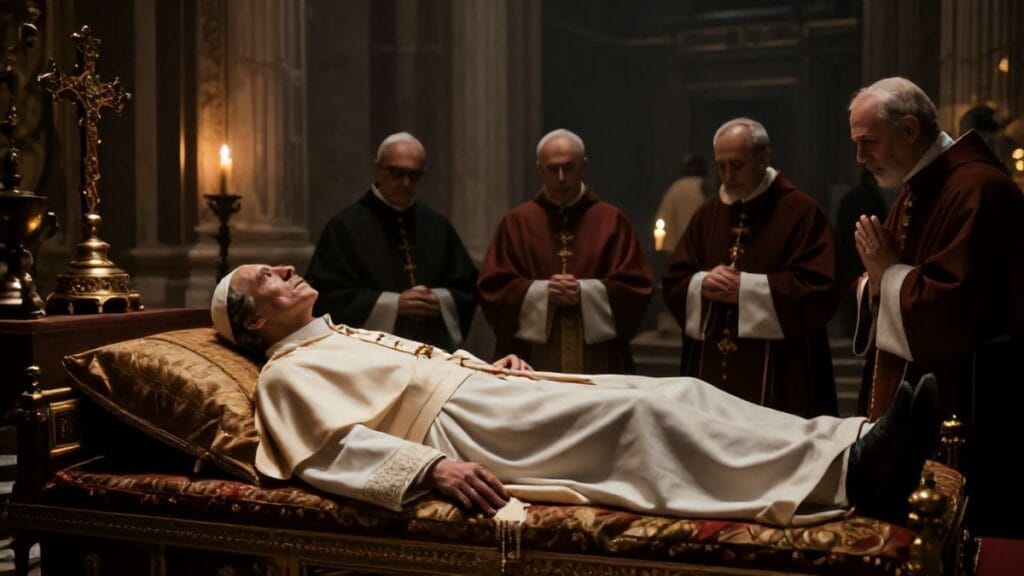
The death of Pope Adrian II, as it unfolded hour by hour, followed an ancient pattern of Christian departure. Priests and deacons gathered near his bedside, reciting the penitential psalms and the litanies of the saints. The papal physician—more a learned observer than a healer in the modern sense—could do little beyond offering comfort. Perhaps anointing oils had already been applied; perhaps Adrian, still lucid at moments, murmured final instructions, a last blessing, a whispered request for prayers.
Outside the room, in adjoining chambers, cardinals and senior clergy waited. Some prayed sincerely; others could not help thinking ahead to the coming conclave (though the formalized conclave would be a later development, the essential drama of election already loomed). Messengers stood ready to run to key churches, to summon the clergy of Rome, to inform certain noble houses. The moment of his passing would trigger not only grief but a legal and political process as defined in canon law as it was molded by custom.
When at last the pope’s breathing slowed and stopped, those present would have marked the time and recited the commendation of the soul, entrusting Adrian to the mercy of God. One of them—perhaps the archdeacon or a senior cardinal-priest—would have stepped forward to confirm his death. The fisherman’s ring, symbol of papal authority, would later be destroyed to prevent forgery. Word would move swiftly through the palace and then beyond its gates.
In church after church, bells began to toll, three slow notes repeated over and over, a sound that signaled to every Roman that the bishop of their city was dead. The death of Pope Adrian II, carried on the winter air, entered the homes of artisans and merchants, of widows and priests, of nobles and beggars. To some, he had been a distant figure, glimpsed only in processions. To others, a patron or judge. To a few, a man whose personal kindness or severity they had known firsthand.
That night, candles burned in many windows. In monasteries, the monks chanted the office of the dead. In aristocratic halls, the talk turned, perhaps too quickly, to politics. For the papal household, however, the first task was to tend to the body of the dead pontiff, preparing it for the elaborate funerary rites that would affirm, even in death, the dignity of his office.
Rome Reacts: Mourning, Intrigue, and the Struggle for Succession
The days following Adrian’s death unfolded with a rhythm that combined solemnity and scheming. His body, vested in papal garments, was placed on a bier within the Lateran basilica or another major church, where clergy and faithful could pass by, offering prayers. Thick incense smoked in the chilly air as psalms and chants echoed beneath the great arches. Candles surrounded the bier, their flames reflecting off the gold and silk of his vestments.
The funeral liturgy itself would have drawn a cross-section of Roman society. Bishops from nearby sees, abbots from prominent monasteries, representatives of noble families, and crowds of ordinary Romans all converged to witness the passing of their pope into eternity. The Mass for the Dead, with its somber readings and ancient chants, expressed the Church’s hope even as it acknowledged the reality of loss. “Requiem aeternam dona ei, Domine” — “Grant him eternal rest, O Lord” — rose again and again, a plea for mercy on a man who had himself mediated God’s mercy to others.
Yet behind the liturgical veil, another drama played out. With the papal throne vacant, the city became a hive of lobbying and quiet threat. Roman nobles met in private, weighing candidates. Some favored continuity, choosing men linked to Adrian’s policies. Others sought a break, a pope more willing to align with their interests or with a particular foreign ruler.
Letters later sent by Adrian’s successor, John VIII, suggest that the election that followed was not without tension. While the exact details of the conclave are murky, we know that John VIII emerged as the next bishop of Rome, taking office early in 873. The transition from Adrian to John marked not only a change of personality but also of style: John would prove more combative in defending papal interests against both Saracen incursions and internal corruption.
For contemporaries, the funeral rites and ensuing election confirmed a fundamental truth of medieval Christianity: popes die, but the papacy endures. The death of Pope Adrian II did not dissolve the institution he had led; rather, it served as another link in a chain that stretched back to Peter and forward into an uncertain future. Yet many must have felt a momentary instability, a sense that with each papal death, the world trembled slightly before settling once more.
Outside Rome, reactions varied. Some Frankish bishops, weary of papal intervention, may have hoped for a less assertive successor. Slavic Christians who had cherished Adrian’s support for their liturgy might have feared a reversal. Byzantine observers watched from afar, analyzing what this shift might mean for East–West relations. In every case, the news of Adrian’s passing forced others to recalculate, to adjust strategies that had taken his preferences and temperament into account.
Beyond the Tomb: How Adrian II Shaped the Papacy’s Future
Measured against giants like Gregory the Great or Innocent III, Adrian II may appear modest. His pontificate was relatively short, his personality less forceful than some predecessors, his era one of fragmentation rather than consolidation. Yet the quiet legacy of his decisions persisted, shaping the papacy’s trajectory in subtle but significant ways.
First, his stance on the Slavic liturgy established a precedent for cautious openness to vernaculars in missionary contexts. While Latin would remain the dominant liturgical language of the West for centuries, Adrian’s approval of Slavic worship under certain safeguards showed that the papacy could adapt its cultural expectations in the service of evangelization. Later debates about language in mission fields—from the Americas to Asia—would echo, in faint outline, the questions he faced.
Second, his attempts to steady relations with the Christian East helped prevent an immediate deepening of the Photian schism. By choosing dialogue over confrontation where possible, he preserved room for future rapprochement, even if later events would lead eventually to the more enduring schism of 1054. Adrian’s diplomacy demonstrated that the Roman see could combine doctrinal clarity with a certain flexibility in approach.
Third, on the internal front, his efforts to defend papal patrimonies and assert jurisdiction over Roman nobles contributed to the slow, halting consolidation of papal temporal power in central Italy. He did not complete this process; no single pope could. But by pushing back, case by case, against aristocratic encroachment, he kept alive the principle that the Church, not local clans, ultimately controlled key lands and institutions associated with St. Peter.
Lastly, his personal story—particularly the catastrophic loss of his family—introduced a deeply human dimension into the memory of the ninth-century papacy. Later chroniclers, while concise, did not omit this tragedy. It underscored that popes too were vulnerable, their lives intertwined with the violence and sorrow of their age. The death of Pope Adrian II, then, resonates not only as a political or ecclesiastical event, but as the closing of a life marked by both dignity and pain.
Memory, Chronicle, and Legend: How Historians See Adrian II
Our knowledge of Adrian II rests on a patchwork of sources: continuations of the Liber Pontificalis, Frankish annals, hagiographical texts linked to Cyril and Methodius, and later ecclesiastical historians who looked back on the ninth century with a mixture of curiosity and judgment. Each layer of testimony adds perspective but also distortion; historians must navigate between reverence, polemic, and silence.
One early modern historian, Cesare Baronio, in his monumental Annales Ecclesiastici, treated Adrian’s pontificate with brevity but respect, emphasizing his role in approving the Slavic liturgy and managing the Church amid political fractures. Baronio’s work, while shaped by Counter-Reformation concerns, preserved valuable references and helped cement Adrian’s image as a steady if unremarkable figure in troubled times.
More recent scholarship has approached Adrian with renewed interest, seeing in his reign a case study of how the papacy functioned when stripped of obvious worldly triumphs. The ninth century, often overshadowed by the age of Charlemagne before and the Gregorian reform after, offers a laboratory of institutional adaptation under pressure. In this light, Adrian’s modest but persistent efforts to maintain papal authority amid aristocratic violence and imperial weakness gain new significance.
Historians also pay close attention to the tale of Eleutherius and the murdered family, recognizing in it a rare window onto the personal costs of papal office. Some caution against over-romanticizing Adrian as a tragic hero, noting that our sources are too thin to support elaborate psychological portraits. Others argue that ignoring this event would flatten the very real human stakes behind institutional history.
Legend has not enveloped Adrian in the way it has some other popes; there are no widely circulated miracles or dramatic visions associated with his name. Instead, his memory survives in more sober form, anchored by the documentary record and by the gratitude of certain Slavic Christian traditions. The death of Pope Adrian II, in historical writing, thus becomes a point of reflection on the endurance of institutions through ordinary, even fragile, leaders.
Echoes in Stone: Traces of Adrian II in Medieval Rome
Walk through Rome today and the name of Adrian II does not leap out from monuments and grand inscriptions. Unlike some Renaissance popes who emblazoned their coats of arms on every new building, ninth-century pontiffs left subtler marks. Yet for those who know where to look, traces of his presence remain woven into the city’s fabric.
In the Basilica of San Clemente, layers of Christian history stack atop one another. It was here that St. Cyril (Constantine), co-apostle of the Slavs, was buried after his death in Rome. Adrian II’s role in receiving and honoring Cyril is remembered in liturgical commemorations and, in some accounts, in the decoration of the basilica. While later restorations have changed its appearance, the site still whispers of that moment when a pope from old Rome and missionaries from the Greek East forged a bond around a Slavic mission.
The Lateran itself, though repeatedly rebuilt and renovated, carries the memory of Adrian’s residence. Documents from his reign mention restorations and gifts to various Roman churches, acts that might have left physical traces in altars, mosaics, or reliquaries. Modern archaeologists and art historians sometimes link particular architectural or artistic elements to the ninth century, seeing in them the modest patronage of Adrian and his contemporaries.
Beyond specific sites, Adrian’s Rome lives in the city’s topography of processions and pilgrim routes. The paths he walked on feast days, the stations where he presided at Mass, the urban vistas he knew—many still exist in altered but recognizable form. Visitors to Rome who pass from the Lateran to the Colosseum, or from the Forum to St. Peter’s, unknowingly follow, in part, the footsteps of a pope whose death in 872 once plunged the city into mourning and uncertainty.
A Century in Turmoil: The Long Shadow of the Ninth Century
To fully grasp the significance of the death of Pope Adrian II, it helps to view it against the broader canvas of the ninth century—a century of endings and beginnings. The age opened with Charlemagne’s imperial coronation in 800, a moment of apparent restoration: the Western Empire reborn, the papacy aligned with a mighty secular protector. By the time Adrian died in 872, that dream had frayed. The Carolingian world was splintering; Viking and Saracen raids battered its frontiers; internal moral and doctrinal disputes sapped its unity.
The papacy, catching every tremor from this crumbling order, alternated between assertiveness and vulnerability. Strong popes like Nicholas I tried to shape events far beyond Italy, intervening in royal marriages and episcopal elections. Others, like Adrian, focused more on preserving core principles, keeping channels open, and managing local crises. The line between courage and caution was thin, and each pontiff had to walk it anew.
In this context, Adrian’s death marked not just the close of an individual life but a symbolic transition toward an even darker phase. The later ninth and early tenth centuries would see a period sometimes dubbed the “saeculum obscurum,” the “dark age” of the papacy, when Roman nobles more brazenly manipulated papal elections and the moral authority of the office suffered. Adrian II’s struggles against aristocratic violence, his partial successes and tragic failures, appear in retrospect as early battles in a longer war over the soul of the papacy.
Yet the century also planted seeds of renewal. Missionary ventures to the Slavs, theological debates that clarified doctrine, and the preservation and copying of texts in monastic scriptoria all contributed to an intellectual and spiritual resilience that would bear fruit later. Adrian’s supportive stance toward the Slavic missions belongs to this brighter thread, a sign that even amid political decay, the Church could expand its horizons.
When historians today pause at the date 14 December 872 and note the death of Pope Adrian II, they see in it more than a calendar entry. They see a moment when the hopes and fears of a tumultuous century converged on a single room in the Lateran, where an elderly Roman, born among ruins yet entrusted with a universal office, finally laid down a burden he had carried with more courage than fame.
Conclusion
The story of Adrian II unfolds as a quiet drama set against a noisy, fractured world. Born into a noble Roman family in a city of ruins, he rose through the clergy not as an ambitious schemer but as a cautious servant, twice refusing the papal throne before finally accepting it in old age. His pontificate, though brief, intersected with the disintegration of Charlemagne’s empire, the simmering tensions between Rome and Constantinople, the daring experiment of the Slavic liturgy, and the relentless pressures of Roman aristocratic politics.
At the center of these grand currents stood a man marked by intimate grief. The abduction and murder of his wife and daughter tore a wound that no office could heal, revealing the vulnerability of even the highest cleric in a violent century. Yet Adrian continued to govern, to write letters, to receive envoys, to bless and to admonish, carrying his personal sorrow into the public arena of the Church.
The death of Pope Adrian II on 14 December 872 brought these intertwined threads to a close. In the Lateran, as bells tolled and candles flickered, his soul was commended to God, while outside, nobles and clergy began maneuvering for the succession. His passing underscored the paradox of the medieval papacy: utterly dependent on the frail bodies and finite lives of individuals, yet somehow enduring beyond them, an institution that outlived each of its occupants.
Adrian’s legacy lies in choices that might seem modest on the surface: sanctioning the Slavic liturgy, tempering the tone of East–West controversies, resisting aristocratic encroachment where he could. Over time, these decisions helped shape a papacy that was both more universal in reach and more aware of its limits. The death of Pope Adrian II thus invites reflection on how historical change often comes not from spectacular revolutions but from the patient, imperfect labor of men and women whose names rarely dominate the headlines of their age.
Standing in Rome today, amid ruins older even than Adrian’s memories, one can almost hear the echo of those December bells, tolling for a pope few now recall. His life and death remind us that history’s grand narratives are built from human stories, fragile yet enduring, where private pain and public duty intersect in ways that still speak to us across the centuries.
FAQs
- Who was Pope Adrian II?
Pope Adrian II was a ninth-century bishop of Rome who reigned from 867 to 872. Born into a noble Roman family, he spent decades as a respected cleric before reluctantly accepting the papal throne in old age. His pontificate was marked by interactions with the fracturing Carolingian kingdoms, involvement in the missions to the Slavs, and efforts to preserve papal authority in a city dominated by powerful aristocratic clans. - When and how did Pope Adrian II die?
Pope Adrian II died in Rome on 14 December 872, most likely from natural causes related to age and declining health. Contemporary sources do not describe a violent end; instead, they present his death as a gradual weakening followed by the customary Christian rituals at his bedside. The death of Pope Adrian II triggered the immediate beginning of the papal election process that would lead to the accession of John VIII. - Why is the death of Pope Adrian II historically important?
The death of Pope Adrian II is significant because it occurred at a moment of intense political and ecclesiastical instability. His passing removed a relatively moderate, conciliatory figure from the papal throne just as the Carolingian empire was fragmenting and tensions between Rome and Constantinople remained unresolved. The transition to his successor shaped how the papacy would respond to external threats, internal corruption, and missionary opportunities in the later ninth century. - What role did Adrian II play in the Slavic missions?
Adrian II played a key role in supporting the mission of Saints Cyril and Methodius to the Slavic peoples. He received Methodius in Rome, approved the use of the Slavic language in the liturgy under certain conditions, and confirmed Methodius as an archbishop. This endorsement gave papal backing to vernacular worship in a major missionary field, influencing the development of Slavic Christian culture and demonstrating the papacy’s willingness to adapt in the service of evangelization. - What personal tragedies did Adrian II suffer during his life?
Adrian II experienced a profound personal tragedy when his wife and daughter were abducted and murdered by a Roman nobleman named Eleutherius during his pontificate. This event, recorded by medieval chroniclers, exposed the violent realities of Roman aristocratic politics and deeply affected the pope on a human level. It also highlighted the limited ability of the papacy to control powerful local families even within its own city. - How did Adrian II handle relations with the Byzantine Empire?
Adrian II inherited a tense situation created by the so-called Photian Schism, a dispute between Rome and Constantinople over ecclesiastical authority and doctrine. He chose a more conciliatory approach than his predecessor Nicholas I, seeking dialogue with the Byzantine court and patriarch while upholding Roman claims to primacy. His diplomacy helped prevent a complete rupture, maintaining a fragile but real connection between the two great centers of medieval Christianity. - Who succeeded Pope Adrian II?
Pope John VIII succeeded Adrian II, taking office in early 873 after an election shaped by Roman nobles and clergy. John VIII’s pontificate would be more assertive in some areas, especially in confronting Saracen raids and internal corruption, and he is often remembered as one of the last strong popes before the deeper crises of the tenth century. The policies and conditions inherited from Adrian influenced many of John’s challenges and responses. - How do historians today view Pope Adrian II?
Modern historians typically view Adrian II as a cautious, somewhat understated pope who nonetheless made important contributions in a difficult era. He is admired for his support of the Slavic missions and his attempts to balance firmness with diplomacy in dealing with kings and patriarchs. While not ranked among the most famous pontiffs, he is recognized as a significant figure in understanding how the papacy functioned during the troubled transition from Carolingian unity to medieval pluralism.
External Resource
Internal Link
Other Resources
- Encyclopaedia Britannica – general search for the exact subject
- Google Scholar – academic search for the exact subject
- Internet Archive – digital library search for the exact subject