Table of Contents
- A Summer of Tension in Rome, 1241
- The Making of a Combative Pope: Gregory IX Before the Tiara
- From Innocent III’s Legacy to a New Pontificate
- Gregory IX and the Empire: The Long War with Frederick II
- Crusades, Canon Law, and a Pope of Iron Will
- Rome Under Strain: Famine, Fear, and Political Siege
- The Final Months: An Aging Pontiff Against an Unyielding Emperor
- 22 August 1241: The Deathbed of Gregory IX
- Shock in the Holy City: Reactions in Rome and Beyond
- A Church Without a Pilot: The Delayed Conclave and Captive Cardinals
- Frederick II’s Calculations and the Political Vacuum
- The Long Shadow of Conflict: Gregory IX’s Legacy in Canon Law
- Saints, Scholars, and Inquisitors: Reform Movements After Gregory
- Memory and Myth: How Chroniclers Portrayed Gregory IX’s Death
- Echoes Across Centuries: Why the Death of Pope Gregory IX Still Matters
- Conclusion
- FAQs
- External Resource
- Internal Link
Article Summary: In late summer 1241, as Rome sweltered and armies maneuvered in central Italy, the death of Pope Gregory IX closed the life of one of the most combative pontiffs of the Middle Ages and plunged Christendom into uncertainty. This article traces his journey from a noble family in Anagni to the papal throne, then follows his fierce clashes with Emperor Frederick II, his role in crusading politics, and his codification of canon law. It reconstructs the tense atmosphere in Rome on the eve of the death of Pope Gregory IX, when famine, military pressure, and political intrigue converged. The narrative then lingers at his final hours, exploring not only what happened in the papal chambers, but how cardinals, Romans, and imperial envoys reacted as news spread. Moving outward in space and time, it examines the delayed papal election, imperial strategy, and the longer-term legal and institutional legacies shaped by the death of Pope Gregory IX. Along the way, it considers the memories preserved by chroniclers, the myths that grew around him, and later interpretive battles over his reputation. By the end, the article shows that the death of Pope Gregory IX was not a quiet ending confined to one Roman palace, but a pivotal moment in the struggle between papacy and empire that continued to define European politics for generations.
A Summer of Tension in Rome, 1241
Rome in August 1241 smelt of dust, sweat, and fear. The streets, already cramped and crooked, were choked by a heat that turned stone walls into slow-burning stoves. Market stalls sagged under shriveling vegetables, and the Tiber, sluggish and opaque, exhaled the sour odors of late summer. Above this weary city, on the Vatican hill and in the fortified palaces around the Lateran, another kind of pressure mounted—political, spiritual, and deeply personal. At the center of it all stood an old man with piercing eyes and an iron will: Pope Gregory IX.
By then, his name was known across Europe as one spoken either with devotion or with dread. To some he was the fearless guardian of the Church, the man who dared defy the self-proclaimed “Wonder of the World,” Emperor Frederick II. To others he was a stubborn, bellicose pontiff who turned the cross into a banner of his private vendetta. The death of Pope Gregory IX, when it came on 22 August 1241 in Rome, did not fall like a gentle dusk on a tranquil reign; it crashed like a stone into already turbulent waters.
Outside the city walls, imperial and papal forces had clashed repeatedly, their skirmishes leaving fields trampled and villages anxious. In the ports, rumors drifted among sailors and merchants: a papal council that never quite assembled, imperial fleets seizing cardinals at sea, the emperor tightening his grip on the kingdoms of Sicily and Germany. The papal states themselves had become a patchwork of loyalties, some towns flying the keys of Saint Peter, others the eagle of the Hohenstaufen dynasty. Gregory, old but unyielding, refused to give up the contest.
Within the Curia, cardinals and clerks navigated corridors of marble and fear. Everyone knew that the pope was failing. They could hear his coughs through half-closed doors, see how slowly he moved during public ceremonies, how heavily he leaned on his staff. Yet he continued to dictate letters, to receive envoys, to plot the next move against Frederick II. The death of Pope Gregory IX, when it finally occurred, would not only remove a man; it would rip away a pillar that held up the battered edifice of the papal cause.
But this was only the beginning of the story. To understand the magnitude of his passing, one must step back from that sweltering August and trace the path that led a cardinal from Anagni to the papal throne and, finally, to a death that reverberated from Rome to Palermo, from Paris to Jerusalem. That path winds through the high politics of the twelfth and thirteenth centuries—a world of crusades, legal revolutions, and the rising confidence of a Church determined to stand above emperors and kings.
The Making of a Combative Pope: Gregory IX Before the Tiara
Before he was Pope Gregory IX, he was Ugolino di Conti, a scion of a powerful noble family from the hill town of Anagni, southeast of Rome. Anagni, often a refuge for embattled popes, was steeped in the rhythms of ecclesiastical power. As a young man, Ugolino learned early that the papacy was not a serene monastery of peace but a battlefield draped in sacred vestments. The city’s streets, lined with stone houses belonging to cardinals and curial clerks, echoed with gossip about popes, emperors, and the eternal seesaw of power between them.
Ugolino studied in Paris and perhaps in Bologna, absorbing theology and, crucially, canon law. These were the disciplines that sustained reforming popes in their bid to structure Christendom as a spiritual commonwealth. At the University of Paris, he would have heard masters debating the nature of authority, grace, and the limits of royal power. In Bologna, students pored over Gratian’s Decretum, the foundational compilation of church law. Such environments trained him not only to argue but to think in juridical categories, to perceive political disputes as legal and moral contests. This legalistic mindset would mark his entire career and deeply influence the events surrounding the death of Pope Gregory IX.
By the closing years of the twelfth century, Ugolino was already a prominent cardinal. Created Cardinal-Deacon of Sant’Eustachio and later elevated to Cardinal-Bishop of Ostia, he accumulated experience as a papal diplomat and legate. He traveled on missions, mediated between quarrelling princes, and learned to speak with the authority of the pope even before he wore the tiara himself. Chroniclers depict him as a man of austere habits and penetrating intellect, more feared than loved, but respected even by his opponents.
In the circle of Pope Innocent III—perhaps the most influential medieval pope—Ugolino internalized a vision of papal supremacy so sweeping that it placed the pope at the apex of both spiritual and, in critical moments, temporal order. Innocent’s pontificate (1198–1216) was the measure against which later popes were judged. Ugolino watched his mentor depose kings, intervene in imperial elections, and launch crusades. Such lessons did not fade with time. When Ugolino finally became Gregory IX, he would echo and sometimes amplify Innocent’s vigorous assertion of papal rights, ensuring that when the death of Pope Gregory IX came, it would be mourned or celebrated as the passing of a man fashioned in that energetic mold.
Yet this future pope was not only a man of power. He cultivated friendships with emerging religious movements, particularly the Franciscans and Dominicans, whose blend of poverty and preaching impressed him. The young Francis of Assisi appealed directly to Ugolino’s heart. Years later, as pope, Gregory IX would canonize Francis and protect the mendicant orders, weaving them into the fabric of the Church’s power. It’s astonishing, isn’t it, that the same cardinal who appreciated radical poverty would later orchestrate war against a Christian emperor? But such were the complexities of thirteenth-century spirituality and politics.
From Innocent III’s Legacy to a New Pontificate
When Innocent III died in 1216, the papacy did not suddenly collapse into mediocrity. His immediate successors, Honorius III and then Gregory IX, were steeped in his outlook. They adhered to the idea that the pope possessed not only spiritual authority but, in effect, a supervisory role over kings and emperors. For Ugolino, this inheritance was both a burden and a promise.
Honorius III’s pontificate, calmer than Innocent’s, focused on the Fifth Crusade and managing the youthful Frederick II, who held the Sicilian crown and was elected king of the Romans. Ugolino, as cardinal, watched the delicate balancing act: on one side, the need for Frederick’s military support against Muslims in the eastern Mediterranean; on the other, fear that a powerful emperor ruling Sicily—the papacy’s southern neighbor—could surround and, eventually, strangle the Papal States.
In 1227, after Honorius died, the cardinals elected the now-elderly Ugolino as pope. The choice may have seemed one of continuity, a safe pair of hands. Yet what the cardinals gained in experience, they also acquired in stubbornness. Gregory IX entered office already formed—both theologically and politically. According to later testimony and the witness of his letters, he saw his role in stark terms: the pope was the vicar of Christ, charged with defending the liberty of the Church against all who would encroach upon it, even if that encroacher wore an imperial crown.
From the very beginning, his pontificate stirred controversy. Frederick II, bound by crusading vows, delayed and hesitated in fulfilling his pledge to sail east. Gregory, not inclined to accept excuses, excommunicated the emperor in 1227 when he set sail late and then turned back, citing illness. It was a dramatic move, signaling that Gregory IX would not shrink from using the Church’s most formidable spiritual weapon. This early clash foreshadowed everything that would follow, including the tense political climate surrounding the death of Pope Gregory IX more than a decade later.
Gregory’s Rome was a city of pageants and processions, where the pope’s presence infused urban life with ritual and power. When he emerged to bless the crowds, the roar of the people, the shimmer of vestments, and the tolling of bells formed a symphony of authority. Yet behind the celebrations, administrative burdens mounted. Gregory reorganized the Curia, oversaw countless legal cases, and continued to cultivate and discipline the new mendicant orders, especially the Franciscans, who were rapidly becoming the intellectual shock troops of the papacy.
Gregory IX and the Empire: The Long War with Frederick II
The story of Gregory IX cannot be told without his great rival, Emperor Frederick II. Born in Sicily, raised under papal guardianship, crowned king of the Romans and later Holy Roman Emperor, Frederick was a man who seemed to embody contradictions. He spoke multiple languages, patronized scholars, and maintained a glittering court in Palermo, where Latin, Greek, and Arabic learning mingled. To many Italian and German contemporaries, he truly appeared as stupor mundi, the “wonder of the world.”
Yet for Gregory IX, Frederick’s fascination lay less in his culture than in his potential for domination. The emperor’s control of Sicily and southern Italy meant that the Papal States were wedged precariously between imperial domains to the north and south. Gregory believed that unless firmly checked, Frederick would hem in the papacy, turning the successor of Peter into a glorified chaplain of imperial policy.
From their first serious conflict over the crusade, distrust deepened. Frederick eventually did go east on crusade (1228–1229), negotiating the return of Jerusalem through diplomacy rather than dramatic battlefield victories. While, on the surface, this might have seemed a triumph, Gregory denounced Frederick’s actions as illegitimate, since the emperor was still under excommunication. The pope even launched attacks on Frederick’s Italian territories while the emperor was absent. Their relationship became an escalating spiral of accusations, manifestos, and armed confrontation.
Letters flew across Europe, each side claiming righteousness. Gregory painted Frederick as a persecutor of the Church, even hinting at his impiety and supposed sympathies with Islam or philosophical skepticism. Frederick portrayed Gregory as a meddling priest interfering with secular autonomy. One contemporary chronicler, Matthew Paris of St Albans, preserved vivid imperial complaints as well as papal positions, giving later historians a window into this war of words and swords. In Paris’s chronicle, we can feel the personal animosity that added venom to what might otherwise have remained a cold institutional rivalry.
Throughout the 1230s, intermittent truces alternated with renewed hostilities. In 1239, Gregory excommunicated Frederick again, intensifying the conflict. Allies of the empire and partisans of the pope fought skirmishes from Lombardy to Apulia. Diplomats tried to patch things up, but neither man could truly concede. They had become antagonists in a drama that fused personal pride with structural conflict between regnum and sacerdotium—kingdom and priesthood.
This long war drained resources and blood, but it also hardened positions. The aging pope came to see Frederick as an existential threat to the liberty of the Church; Frederick, for his part, viewed Gregory as a reckless adversary willing to plunge Italy into chaos rather than loosen the papal grip on temporal power. Against this backdrop, the death of Pope Gregory IX would appear not only as the end of a papal life but as a turning point in this bitter struggle.
Crusades, Canon Law, and a Pope of Iron Will
Gregory IX’s energy did not focus solely on Frederick II. His pontificate unfolded at a time when crusading fervor still gripped the imagination of Western Christendom. Gregory promoted crusades not only to the Holy Land, but also to the Iberian Peninsula and even against perceived heretics within Europe. He authorized crusading campaigns against the Stedingers in northern Germany and against various dissident groups the Church branded as heretical. The cross, in his policies, became a versatile symbol: a sign of penitential warfare, of ecclesiastical unity, and of papal initiative.
At the same time, Gregory reshaped the legal foundation of the Church. In 1234, he promulgated a massive compilation of canon law known as the Decretales Gregorii IX, or simply the Gregorian Decretals. This work, assembled under the direction of the Dominican jurist Raymond of Penyafort, systematized papal decretals and earlier legislation, weaving them into an authoritative collection. The Decretales became the principal textbook in universities and ecclesiastical courts for centuries. Gregory thus inscribed his view of papal authority, church discipline, marriage law, and ecclesiastical procedure into the very fabric of Christian society.
This dual commitment—to militant crusading and rigorous canonical order—made Gregory a formidable pontiff. He did not envision a gentle Church retreating from the world, but a disciplined institution that could legislate, judge, and, when necessary, fight. This vision explains why he was one of the first popes to give systematic form to inquisitorial procedures against heresy, entrusting much of that work to the Dominicans. While the later medieval Inquisition would take different shapes in different regions, its early thirteenth-century roots are deeply entangled with Gregory’s determination to purify belief and strengthen the Church’s juridical reach.
The weight of such responsibilities bore heavily on an aging man. By the late 1230s, Gregory was in his eighth decade, far older than most medieval men ever became. Yet he continued to write, legislate, and, above all, struggle against Frederick II. When historians later reflected on the death of Pope Gregory IX, they noted that he died not as a retired sage but as a general still in the field—his decrees flying from his desk, his letters pressing bishops and princes to hold firm, right up until his final illness.
Rome Under Strain: Famine, Fear, and Political Siege
The Rome into which Gregory IX was elected had long been a turbulent city; the Rome in which he died was a cauldron. The urban commune—Rome’s civic government—oscillated between cooperation and hostility toward the papacy. Noble families such as the Orsini, Colonna, and Savelli wrestled for dominance, sometimes aligning with the pope, sometimes with external powers. Imperial agents stirred discontent when it suited Frederick II, encouraging Romans to assert civic liberties against what they portrayed as papal overreach.
By 1241, tension had reached new heights. The planned ecumenical council—summoned by Gregory to Rome to address the conflict with Frederick and other pressing issues—had provoked an imperial response of startling boldness. As ships carrying prelates and cardinals sailed toward Italy, an imperial fleet under Frederick’s command intercepted many of them near the island of Giglio, off Tuscany. The capture of these clerics, including key cardinals, sent shivers through the Curia. Rome felt besieged not only by armies but by the emperor’s control of the sea.
Within the city, supply lines were fragile. War disturbed trade, and rumors of shortages spread. While Rome did not descend into catastrophic famine, the fear of hunger hovered in the background. In hot, crowded neighborhoods, common people resented the taxes and levies used to fund papal military efforts. Urban unrest simmered, occasionally flaring into street violence. For all the grandeur of papal ceremonies, the Lateran and Vatican palaces were, in some respects, fortresses in hostile territory.
The pope’s health added to the city’s sense of precariousness. As Gregory’s condition worsened, factions began to calculate. Cardinals gauged which alliances might matter in the next conclave. Noble families considered how a papal vacancy could alter the balance of power. Imperial envoys waited, perhaps impatiently, for the moment when their master’s great adversary would finally be removed from the board. The death of Pope Gregory IX promised opportunity to some, danger to others.
In these final months, the atmosphere in Rome must have felt like the last act of a tragic drama, with everyone aware that the protagonist was about to fall. Yet behind the scenes, practical questions pressed urgently. How would the cardinals meet, given that some of their number were imprisoned by the emperor? Could a council ever be held under such conditions? Was the Church, in effect, under duress?
The Final Months: An Aging Pontiff Against an Unyielding Emperor
In the spring and summer of 1241, Gregory IX fought on two fronts: against Frederick II in the realm of arms and diplomacy, and against the relentless advance of age and illness within his own body. Contemporary sources do not describe his medical condition in technical detail, but the evidence suggests progressive weakness, perhaps aggravated by the stresses of office and the heat of a Roman summer. Reports speak of his failing strength, his increasingly rare public appearances, and the heavy burdens he still refused to lay aside.
Still, the pope would not relent. Even as his health declined, he issued bulls condemning the emperor’s actions, defending the seizure of clerical revenues for the war effort, and calling on allies to resist imperial pressure. He clung to his plan for a great council that would rally Christendom to the papal cause. When the imperial fleet seized many of the inbound prelates, Gregory responded with outrage, denouncing Frederick’s act as sacrilegious. His letters from this period bear the stamp of a mind still sharp, a will still adamant.
Within the Curia, some must have wondered whether the pope’s intransigence was wise. Was it prudent to continue a war that the Church seemed ill-equipped to win alone? Would it not be better to negotiate a lasting peace before death left the field open to imperial advantage? Yet Gregory’s experience had taught him that yielding ground to emperors only invited further encroachments. To him, the issue was not merely political but theological: the liberty of the Church was bound up with the honor of God. To compromise, he may have believed, would betray both.
His spiritual life in these last months, while less documented, can be imagined. Gregory was a man steeped in liturgy, in the daily rhythm of Mass, psalms, and canonical hours. Surrounded by chaplains and confessors, he would have been reminded continually of death, judgment, heaven, and hell—the four “last things” so central to medieval piety. Yet even as he prepared his soul, he did not abandon his temporal responsibilities. The death of Pope Gregory IX, when it came, would surprise no one; but it would still feel, to his followers, like the abrupt silencing of a voice that had never ceased thundering.
By July and early August, the strain was plain. Audiences grew shorter. The pope retired more frequently to his private apartments. Letters dispatched from the Curia bore the signatures of familiar secretaries, but their margins sometimes noted the pope’s incapacity to handle certain matters personally. And still the heat intensified, pressing down on the city like a lid over a boiling pot.
22 August 1241: The Deathbed of Gregory IX
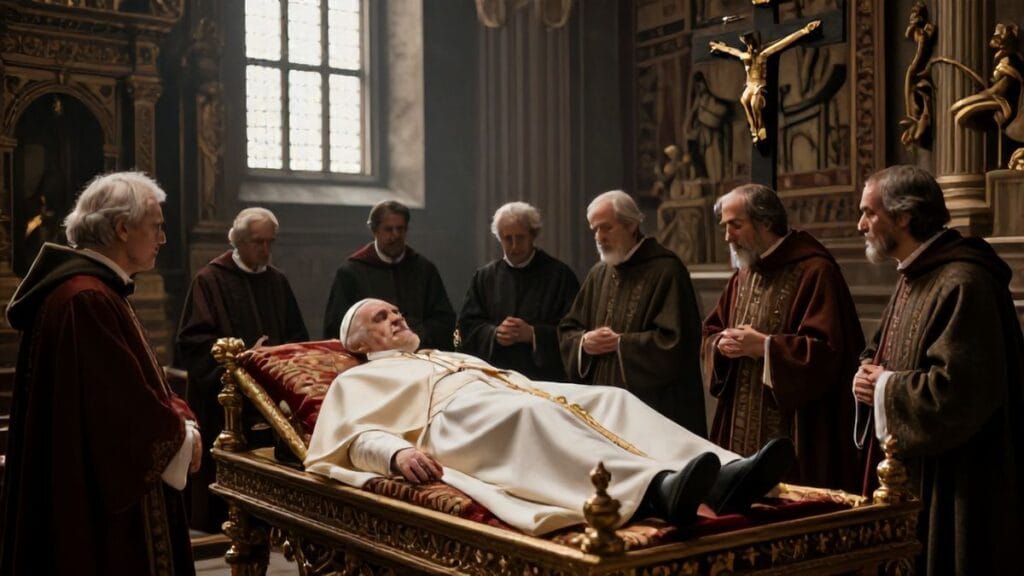
The exact details of that day in late August have faded with time, but the broad outlines are clear enough. On 22 August 1241, in Rome—likely within the precincts of the Lateran or a nearby palace—Pope Gregory IX finally succumbed to his illness. The scene, if we reconstruct it with the help of contemporary funerary customs and papal ceremonial, would have been intimate yet heavy with symbolism.
As his end approached, Gregory would have received the last sacraments: confession, anointing with holy oils, and the Eucharist, given as viaticum, bread for the journey from this world to the next. Cardinals, close advisors, and attendants likely gathered at his bedside. Some whispered prayers, others calculated silently what the coming vacancy would mean. Outside, the city buzzed with rumors that the pope was dying, just as distant camps and courts waited for confirmation.
The death of Pope Gregory IX was not an isolated family affair; it was an event of state and Church combined. As his breathing grew shallow, the weight of the papacy—its curses and blessings, its wars and councils, its laws and anathemas—seemed to hover in the room. To some bystanders, the pope might have appeared as a martyr for the Church’s liberty. To others, perhaps more cynical, he was an old man who had clung too long to confrontation, leaving behind a Church surrounded by enemies.
At the moment of death, rituals unfolded with practiced precision. A chamberlain or senior official verified the pope’s passing, sometimes in earlier ages by calling his baptismal name three times and striking the forehead gently with a small silver hammer. The Fisherman’s Ring and other symbols of office would be removed and later destroyed, signifying the end of his unique authority. Word would pass swiftly to the cardinals: the See of Peter was vacant.
Almost immediately, a different kind of work began. Curial offices sealed documents, archives were secured, and guards posted. The sede vacante—the period between two pontificates—was a vulnerable time, when enemies could exploit confusion. But Rome had done this many times before. Messengers rushed to inform distant powers. Among the first to be notified, one imagines, were imperial agents, who would carry the news to Frederick II, for whom the death of Pope Gregory IX represented both a relief and a fresh strategic puzzle.
Meanwhile, preparations for the funeral commenced. The pope’s body, vested in liturgical garments, would be laid out for viewing. Clergy chanted the Office of the Dead; incense swirled in thick clouds, battling the heavy summer air. For the Roman faithful, Gregory’s passing signaled both sorrow and uncertainty. However they had judged his policies, the pope’s death left a void at the heart of Christian society.
Shock in the Holy City: Reactions in Rome and Beyond
The news spread through Rome with the eerie speed that always attends public catastrophe. From the palaces of the cardinals to the lowest tenements near the Tiber, whispers became shouts: “The pope is dead.” Bells tolled, summoning clergy and laity alike to prayer, but they also sounded, in some ears, like alarms. Whenever a pope died, the city braced for unrest. Property disputes, pent-up grievances, and factional rivalries tended to erupt once the restraining hand of a pontiff vanished.
Yet behind the immediate mourning rituals, calculations began. Some Roman nobles saw an opportunity to assert the commune’s independence, perhaps to negotiate more favorable terms with a future pope. Others, tied to papal patronage, worried that their positions and revenues might evaporate depending on the new pontiff’s alliances. The atmosphere mixed grief with a chill of uncertainty.
Beyond Rome, reactions varied according to prior sympathies. In the papal-friendly communes of central Italy, bells rang in solemn lament, and clergy led processions praying for Gregory’s soul. They remembered him as a defender against imperial encroachment. In territories loyal to Frederick II or resentful of papal taxation, the response was more complex. Few Christians celebrated the death of a pope openly, but in whispered conversations at court or in private letters, some imperial partisans may have expressed relief that their formidable enemy was gone.
In monastic communities and cathedral chapters across Europe, the news stirred reflection. Chroniclers began to shape narratives even as tears were still wet. Some highlighted Gregory’s piety and devotion to reform; others dwelt on the destruction and excommunications that marked his conflict with the emperor. The death of Pope Gregory IX thus became, from the outset, a contested memory. How he would be remembered depended largely on which side of the papal-imperial divide one stood.
One can imagine a Franciscan friar, recalling with gratitude the pope who had canonized Francis and supported the friars, preaching a moving sermon about Gregory as a friend of the poor and champion of Gospel poverty. Meanwhile, a court poet in Palermo might compose verses hinting that the death represented divine judgment on a pope who had too readily taken up the sword. Memory, like politics, was a battlefield.
A Church Without a Pilot: The Delayed Conclave and Captive Cardinals
Ordinarily, the death of a pope would soon be followed by the gathering of cardinals to elect his successor. But 1241 was anything but ordinary. Many of the cardinals Gregory had summoned for the planned council had been captured by Frederick II’s forces at sea. Imprisoned in harsh conditions—some accounts say even in chains—they were in no position to participate promptly in a conclave. The Church, at a moment of acute crisis, found itself decapitated and partially gagged.
The remaining cardinals in Rome faced a grim dilemma. Should they attempt an election without their imprisoned colleagues, risking a schism if the imperial party or others refused to recognize the result? Or should they delay, allowing the emperor more time to consolidate his position while the papal throne remained empty? No option was free of danger. As the historian Joseph R. Strayer has observed in another context, medieval institutions often had to “improvise under pressure”; the papacy in 1241 was no exception.
After some hesitation, the Roman cardinals did convene, but under extremely trying circumstances. The city’s authorities, wary of unrest and eager to compel a rapid decision, reportedly placed the cardinals under a kind of forced enclosure, restricting their movements and, according to some reports, limiting their food. This early experiment in what would later become the formalized conclave procedure was far from serene. Fear of imperial interference and Roman volatility haunted the proceedings.
The result of these agonized deliberations was the election, in October 1241, of Cardinal Goffredo da Castiglione as Pope Celestine IV. Old and frail, Celestine reigned for little more than two weeks before dying himself, plunging the Church back into vacancy. The death of Pope Gregory IX had thus unleashed a storm that no one seemed able to calm. Only in 1243, after a prolonged interregnum and negotiations with Frederick II, would the cardinals manage to elect a more enduring successor, Innocent IV.
This long hiatus underscored the political significance of Gregory’s death. While he lived, he—however embattled—served as a rallying point for those opposed to imperial dominance. Once gone, factional struggles among the cardinals, pressure from Roman authorities, and Frederick’s manipulation of captive churchmen combined to weaken and delay the papacy’s response. In this sense, the death of Pope Gregory IX marked not just the end of one pontificate but the beginning of an institutional crisis.
Frederick II’s Calculations and the Political Vacuum
From his court, whether in Palermo, Foggia, or elsewhere in his sprawling domains, Frederick II awaited news from Rome with keen interest. The reports, when they came, must have pleased him: his great adversary was dead, the college of cardinals divided and partly in prison, the Roman populace restless. Yet the emperor was far too experienced to mistake opportunity for victory.
Frederick’s initial reactions balanced satisfaction with caution. He understood that an overly triumphant response could backfire, reinforcing the image of a persecutor of the Church. Instead, he could present himself as willing to negotiate with a new, more reasonable pope—even while quietly exploiting the weakness of the Papal States. The death of Pope Gregory IX allowed him to recast his public posture from embattled rebel to potential peacemaker, if only the new pontiff would acknowledge the legitimate rights of the empire.
Some sources suggest that Frederick, ever skilled at propaganda, circulated letters questioning whether Gregory’s intransigence had truly served the cause of Christendom. Had not the pope’s unyielding stance jeopardized crusading efforts? Had he not plunged Italy into needless war? Such arguments found receptive ears among some German princes and Italian moderates, weary of decades of conflict between papacy and empire.
At the same time, Frederick tightened his grip on his territories. The captivity of the cardinals offered leverage in future negotiations; the instability in Rome provided excuses to intervene under the guise of restoring order, should he choose to do so. But he needed to tread carefully. Too overt an incursion into central Italy could rally opposition anew. Thus, in the months following the death of Pope Gregory IX, imperial policy combined pressure and patience, waiting to see what kind of pope would emerge from the conclave struggles.
When Innocent IV finally ascended the papal throne in 1243, Frederick briefly believed he had found a more conciliatory pontiff. That hope would prove illusory: Innocent would eventually excommunicate and depose Frederick at the Council of Lyon. In retrospect, then, the death of Gregory did not end the papal-imperial conflict; it simply shifted its terms and protagonists. Yet for a time, it created a vacuum in which the emperor maneuvered deftly, showing how one man’s passing could alter the whole balance of medieval geopolitics.
The Long Shadow of Conflict: Gregory IX’s Legacy in Canon Law
While political battles raged in the years after 1241, Gregory IX’s most enduring legacy quietly continued its work in classrooms and courtrooms across Europe. The Decretales Gregorii IX, the great compilation of canon law issued under his authority, became the backbone of ecclesiastical jurisprudence. Long after the death of Pope Gregory IX, students in Paris, Bologna, and Oxford bent over its pages, memorizing its distinctions, arguing its cases, and applying its principles to disputes that Gregory himself could never have imagined.
The Decretals covered subjects ranging from the authority of popes and bishops to marriage, penance, church property, and legal procedure. By gathering and organizing earlier legislation, Gregory solidified the idea that the Church had a coherent, authoritative legal system, parallel to and sometimes challenging secular law. Bishops’ courts throughout Christendom received petitions citing chapters from the Decretals; litigants learned to frame their complaints in the language it provided.
Crucially, the collection reflected Gregory’s expansive view of papal authority. It positioned the pope as the ultimate court of appeal, capable of intervening in local disputes and even in secular affairs when moral or spiritual matters were at stake. This “papal monarchy” in law would shape later medieval and early modern struggles between Church and state. Thus, one could say that the death of Pope Gregory IX removed a particular man from the stage, but the legal architecture he built ensured that his influence endured in the background of European life for centuries.
Some modern historians, such as Brian Tierney, have traced how debates over papal and conciliar authority in later centuries depended on interpretations of texts solidified under Gregory. Ironically, the very legal tools he used to enforce central papal power could later be used by conciliarists and secular rulers to critique or limit that power. Law, once written, acquires a life of its own.
In parish life, too, Gregory’s juridical legacy left marks. Rules about marriage impediments, procedures for clerical discipline, and norms governing penance filtered down through episcopal statutes and pastoral manuals that drew on the Decretals. Ordinary Christians rarely knew Gregory’s name in this context, but they experienced the church discipline he helped craft in the confessional, at the altar rail, and in the everyday governance of their communities.
Saints, Scholars, and Inquisitors: Reform Movements After Gregory
Even as his legal work shaped the institutional Church, Gregory IX’s patronage of new religious movements and inquisitorial procedures influenced how later generations pursued holiness and orthodoxy. The Franciscans and Dominicans, whom he supported and regulated, became crucial actors in the decades after his death. Their preachers filled pulpits in cities and towns, their scholars taught at universities, and their inquisitors pursued heresy in ways that blended zeal, learning, and, at times, harshness.
It was Gregory who had canonized Francis of Assisi in 1228, only two years after the saint’s death. This swift recognition not only affirmed Francis’s personal sanctity but endorsed the broader mendicant ideal of apostolic poverty and itinerant preaching. In the later thirteenth century, Franciscan and Dominican thinkers would wrestle with questions of poverty, property, and authority under the shadow of papal expectations set in Gregory’s time. Some of the fiercest internal disputes within the Franciscan Order, especially about the meaning of absolute poverty, would play out before popes who inherited Gregory’s dual role as patron and disciplinarian.
Gregory had also empowered the Dominicans to serve as papal inquisitors, giving them a legal framework and mandate to investigate and punish heresy. After his death, the inquisitorial machinery expanded, particularly in regions like southern France and northern Italy. Procedures that Gregory’s bulls outlined—summoning suspects, gathering testimony, imposing penances—became standard practice. Later critics of the Inquisition, both medieval and modern, would look back uneasily at this development, seeing in it the dark side of the papal monarchy he championed.
Yet alongside these more repressive aspects, Gregory’s era also fostered a flowering of scholarship. The universities he relied upon for legal expertise continued to grow. The friars he supported cultivated theology, philosophy, and biblical exegesis at a high level. Figures such as Albert the Great and Thomas Aquinas, though active after Gregory’s time, flourished in an intellectual environment shaped by the institutional security and juridical order his pontificate helped to entrench. The death of Pope Gregory IX, therefore, did not mark the end of his contributions to Christian thought; it merely shifted the stage on which his institutional decisions played out.
In this mixture of sanctity and bureaucracy, zeal and coercion, we glimpse the ambivalent legacy of a pope who sought to reform and protect the Church by all the means at his disposal. Later saints, scholars, and churchmen worked within structures he had reinforced, sometimes extolling his memory, sometimes quietly struggling against the rigidities his centralization had introduced.
Memory and Myth: How Chroniclers Portrayed Gregory IX’s Death
History is not only what happens but also what people say happened. The death of Pope Gregory IX, like so many major events of the Middle Ages, quickly passed into the hands of chroniclers who shaped its meaning for future generations. Their accounts, though grounded in fact, carried the unmistakable imprint of their loyalties and fears.
In the Latin West, monastic chroniclers often wrote with a tone of pious sobriety. They recorded the date—22 August 1241—the location in Rome, and the bare details of his age and prior ecclesiastical career. Some praised him as a zealous defender of the faith who had resisted imperial arrogance. Others hinted that his severe measures against Frederick II had deepened divisions and caused suffering. Matthew Paris, in his Chronica Majora, though primarily concerned with English affairs, included vivid notices of papal-imperial conflicts, sometimes casting both pope and emperor in critical light. For Paris, the death of Gregory could appear less as a simple tragedy than as a milestone in an ongoing pattern of ecclesiastical overreach and secular ambition.
In imperial circles, including those influenced by Frederick’s own propagandists, more hostile portrayals emerged. Some writers accused Gregory of hypocrisy, claiming that a pope who preached peace had instead perpetuated war. Tales circulated—never fully substantiated—that Gregory’s harsh treatment of Frederick, his willingness to excommunicate and interdict, revealed a lust for power incompatible with Christian humility. In such narratives, the death of Pope Gregory IX might even be framed as divine retribution, a warning that no pope could wield spiritual weapons as instruments of political vendetta without consequence.
Later medieval and early modern historians revisited these chronicles, often using Gregory’s conflict with Frederick II as a lens through which to interpret broader questions about church and state. Protestant writers in the sixteenth century, for example, sometimes cited popes like Gregory as evidence of how far Rome had allegedly strayed from the simplicity of the early Church. Catholic historians, while acknowledging his severity, defended him as a necessary bulwark against imperial domination.
Modern scholarship has tended to offer a more nuanced view. Historians like I. S. Robinson and others have emphasized the structural nature of the papal-imperial conflict, noting that Gregory operated within a system that almost compelled confrontation. His personal will and temperament intensified the struggle, but he did not create the underlying tensions. From this perspective, the death of Pope Gregory IX appears less as the moral verdict on a single man and more as a significant juncture in a centuries-long contest over the shape of Christian society.
Echoes Across Centuries: Why the Death of Pope Gregory IX Still Matters
Why, after so many centuries, should we still care about an old man who died in Rome on a hot August day in 1241? What makes the death of Pope Gregory IX more than a footnote in the long list of pontifical obituaries? The answer lies in the cascading consequences of his pontificate and the vacuum his absence created.
First, Gregory’s intense confrontation with Frederick II helped crystallize the idea that the papacy could, and should, confront secular rulers when the Church’s liberties were at stake. Later popes would draw on his example, for better or worse, as they clashed with kings from Philip the Fair of France to Henry VIII of England. The rhetoric and legal arguments forged in Gregory’s battles did not vanish with him; they became part of the Church’s repertoire.
Second, the legal structures he sponsored shaped ecclesiastical governance for centuries. The Decretals codified and extended a vision of a centralized, legally ordered Church. Even in modern times, when canon law has undergone many revisions, echoes of Gregory’s legal project remain audible in the background. The death of Pope Gregory IX did not interrupt this legal tradition; it sealed it as part of his enduring legacy.
Third, Gregory’s relationship with the mendicant orders influenced the trajectory of Western spirituality. By recognizing and regulating movements like the Franciscans and Dominicans, he helped channel religious enthusiasm into forms compatible with institutional stability. The preachers, confessors, and theologians of these orders would leave deep marks on European culture, from art and literature to political thought.
Finally, his death at a moment of acute papal-imperial tension offers a case study in how institutional crises unfold. The papacy, deprived of a strong leader, floundered for a time, illustrating both the strength and fragility of medieval ecclesiastical structures. Elections delayed, cardinals imprisoned, cities restless—these features remind us that even venerable institutions depend on fallible human actors and can be shaken by the loss of a single, central figure.
When we look back on 22 August 1241, then, we see more than the end of an individual life. We glimpse the turning of a historical hinge, where one man’s passing altered the speed and direction of long-running conflicts over law, power, and faith. The death of Pope Gregory IX, in all its sorrow and controversy, thus remains a key episode in the larger drama of how the medieval Church sought to define its place in the world—and how the world, in turn, responded.
Conclusion
On that late summer day in 1241, as Rome baked under a relentless sun, the dying breaths of Pope Gregory IX carried away a lifetime of struggle, conviction, and controversy. His pontificate had been anything but tranquil. He had confronted emperors, launched and supported crusades, codified canon law, encouraged mendicant reformers, and constructed much of the legal and institutional scaffolding that would support the medieval Church for centuries. The death of Pope Gregory IX did not end these processes; rather, it allowed them to unfold without their original architect, shaped by successors who inherited both the tools he left and the problems he failed to resolve.
In the years immediately following his passing, the papacy endured a chaotic interregnum, the brief reign of Celestine IV, and the eventual election of Innocent IV, who would take up Gregory’s quarrel with Frederick II in his own way. Meanwhile, Gregory’s Decretals became the lawyers’ handbook of Christendom, and his policies toward the friars and inquisitors continued to bear fruit—sometimes sweet, sometimes bitter. Memory of him became a contested terrain, where admirers and detractors alike projected their hopes and fears about the Church’s role in the world.
Yet beyond the politics, there remains the human story: an aging nobleman from Anagni who carried Innocent III’s mantle, who believed with unshakable certainty that defending the liberty of the Church justified extraordinary measures. One may question his methods, lament the wars he waged, or criticize his use of spiritual sanctions as political weapons. But one cannot deny the scale of his impact. The death of Pope Gregory IX was, in a very real sense, the end of an era shaped by towering, combative popes who believed that the fate of Christian society rested, in part, on their shoulders.
To study his life and death is to peer into a world where law, faith, and power intertwined so tightly that they could scarcely be separated. It invites us to reflect on how institutions respond to crisis, how personal conviction intersects with structural necessity, and how the legacies of leaders outlive their bodies in the laws, narratives, and memories they leave behind. In that way, the old pope dying in Rome in 1241 still speaks to us, across the distance of centuries, about the enduring entanglements of conscience and authority.
FAQs
- Who was Pope Gregory IX before he became pope?
Pope Gregory IX was born Ugolino di Conti, from a noble family in Anagni near Rome. He studied theology and canon law, likely in Paris and Bologna, and rose through the ranks of the Church as a cardinal and papal legate. Closely associated with Pope Innocent III, he gained extensive diplomatic and administrative experience before his election to the papacy in 1227. - When and where did Pope Gregory IX die?
Pope Gregory IX died on 22 August 1241 in Rome, in the Papal States. He likely passed away in or near the Lateran Palace, surrounded by cardinals, clerics, and attendants who oversaw his final sacraments and the immediate rituals following a pope’s death. - Why was the death of Pope Gregory IX politically important?
The death of Pope Gregory IX was politically significant because it occurred at the height of his conflict with Emperor Frederick II. With many cardinals imprisoned by the emperor and Rome under pressure, Gregory’s death created a power vacuum. It delayed the election of a new pope, gave Frederick room to maneuver diplomatically, and exposed the vulnerability of the papal institution in times of leadership crisis. - What was Gregory IX’s main conflict with Emperor Frederick II about?
The core of their conflict was the balance of power between papacy and empire. Gregory IX feared that Frederick’s control of both the Holy Roman Empire and the Kingdom of Sicily would encircle and dominate the Papal States. Disputes over crusading vows, jurisdiction, and political authority escalated into excommunications, propaganda wars, and open fighting in Italy. - What is the significance of the Decretals of Gregory IX?
The Decretals of Gregory IX, promulgated in 1234, were a comprehensive collection of canon law that systematized earlier papal legislation and ecclesiastical norms. They became the core legal text for the Church, studied in universities and applied in church courts for centuries. This collection greatly strengthened the legal and institutional coherence of the medieval papacy. - How did the death of Pope Gregory IX affect the election of his successor?
Because several cardinals were captured by Frederick II’s forces while traveling to a planned council, the college of cardinals was incomplete and under pressure when Gregory died. Those in Rome faced confinement and political interference as they tried to hold an election. They eventually chose Celestine IV, who died within weeks, leading to a prolonged vacancy before Innocent IV was elected in 1243. - What role did Gregory IX play in the development of the Inquisition?
Gregory IX gave formal structure to inquisitorial procedures by issuing bulls that empowered specially appointed judges, often Dominicans, to investigate and prosecute heresy. He provided legal guidelines and papal backing for these efforts, laying important groundwork for what would become the medieval Inquisition in various regions of Europe. - How did Gregory IX interact with the Franciscan and Dominican orders?
Gregory IX was a key supporter and regulator of the new mendicant orders. He canonized Francis of Assisi, confirmed and clarified Franciscan and Dominican rules, and used their members as preachers, theologians, and papal agents. His support helped integrate these once-marginal movements into the mainstream life and governance of the Church. - Was Pope Gregory IX considered a saint?
No, Pope Gregory IX has not been canonized as a saint. While some contemporaries admired his piety and zeal, and later Catholic historians have respected his defense of papal authority, he did not receive formal recognition as a saint. His legacy remains that of a powerful and controversial reforming pope rather than a canonized holy figure. - How did contemporaries view the death of Pope Gregory IX?
Contemporaries viewed his death through the lens of their political and spiritual allegiances. Supporters of the papal cause saw it as the loss of a strong defender of the Church, while imperial partisans often interpreted it as an opportunity or even a sign of divine displeasure with his harsh policies. Chroniclers recorded the event in ways that reflected these divided perspectives.
External Resource
Internal Link
Other Resources
- Encyclopaedia Britannica – general search for the exact subject
- Google Scholar – academic search for the exact subject
- Internet Archive – digital library search for the exact subject