Table of Contents
- The Dawn of a Nation’s Resolve: Scotland on the Brink of Destiny
- The Tumultuous Reign of Robert the Bruce
- The Wars of Scottish Independence: A Landscape of Blood and Hope
- The Political Chessboard of Early 14th Century Britain
- The Papal Audience: Seeking Legitimacy Beyond Borders
- Arbroath Abbey: The Sanctuary of Sovereignty
- April 6, 1320: The Birth of the Declaration of Arbroath
- The Crafting of a Nation’s Voice: Authors and Architects of the Declaration
- The Text Unveiled: Language of Freedom and Ultimatum
- The Message to Pope John XXII: Between Diplomacy and Defiance
- The Cultural and Political Resonance Throughout Scotland
- English Authority Questioned: The Declaration as a Challenge
- The Impact on Scottish Nobility and Commoners Alike
- The Declaration’s Ripple Effect on European Diplomatic Circles
- From Manuscript to Myth: The Preservation and Legacy of the Declaration
- The Declaration of Arbroath in Modern Scottish Identity
- Parallels with Other Historic Declarations of Independence
- Historiographical Debates: Myth vs. Reality in the Arbroath Narrative
- The Symbolic Power of the Declaration in Contemporary Politics
- Reflections on Sovereignty: What Arbroath Means Today
- Conclusion: The Enduring Flame of Scottish Independence
- FAQs
- External Resource
- Internal Link
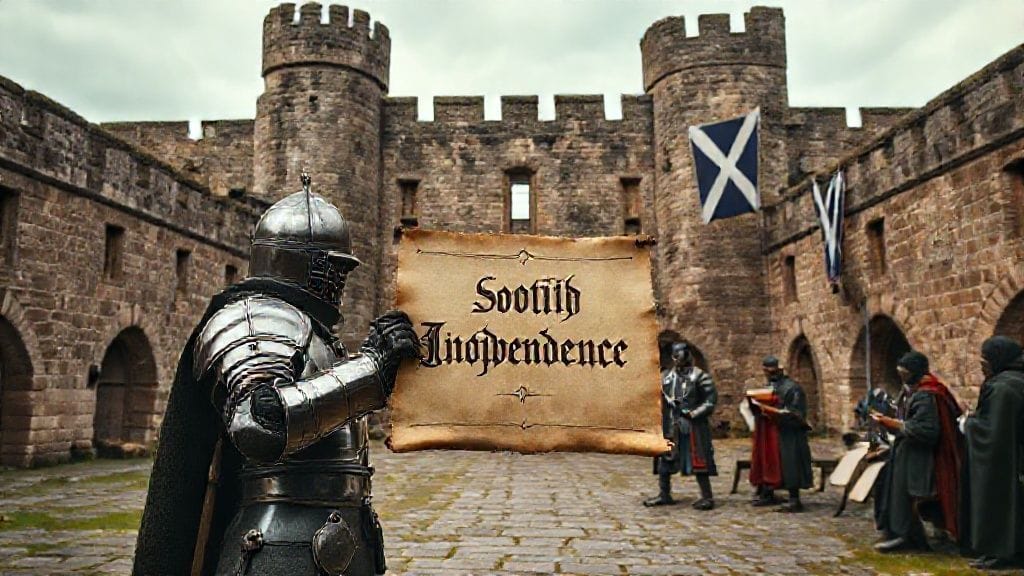
The cold April wind swept through the tranquil fields surrounding Arbroath Abbey, carrying with it the hopes and fears of a nation fighting to breathe free. It was the sixth day of April, 1320 — a day when the echoes of turmoil and bloodshed would crystallize into words, words that would declare the very soul of Scotland. Inside the venerable stone walls of Arbroath, nobles gathered, their faces somber yet resolute, their hearts bound by a singular cause: to proclaim Scotland’s right to independence before the eyes of history—and the wider Christian world.
This was no mere letter; it was a bold manifesto of nationhood, a declaration that would resonate for centuries. The Declaration of Arbroath is not just a document. It is the voice of a people, shouting against the tides of conquest and subjugation, claiming sovereignty as their immutable birthright.
The early 14th century was a time when the fate of Scotland hung by a fragile thread, stretched taut by relentless conflict and diplomatic maneuvering. The Wars of Scottish Independence had consumed the land for three decades, pitting the fiercely independent Scots against the formidable might of England. Robert the Bruce, crowned King of Scots in 1306 after a violent bid for the crown, had wrestled not only with English armies but with rival Scottish factions. His reign was marked by blood, betrayal, and an undying quest to unite the fractured kingdom.
Yet being king was not enough. For Robert Bruce and his comrades, what was required was the recognition of Scotland’s very existence — a sovereign nation acknowledged by the Pope, the highest authority in Christendom. Without papal recognition, their fight risked being dismissed as rebellion or mere insurrection. Thus, the Declaration of Arbroath became both a plea and a warning, staking Scotland’s claim on the universal stage.
The Wars of Independence had swept across the countryside, ravaging villages, castles, and the lives of common folk. Since 1296, English King Edward I aimed to absorb Scotland into his realm, wielding military strength and political cunning. Yet the Scots, led by figures like William Wallace and later Robert Bruce, fought tenaciously for their independence, motivated by a fierce love of their homeland and the idea of self-rule.
By 1320, the war had reached a grueling stalemate. Queen Isabella and the English court had little inclination to compromise. Scottish nobles, weary from years of strife, sought a different route—one that would bypass the battlefield in favor of diplomacy rooted in faith and law.
The political landscape of the British Isles was fragmented and volatile. England under Edward II faltered; his weak kingship alienated many, creating openings for Scottish assertiveness. Meanwhile, continental Europe was no less turbulent with papal politics deeply entangled in secular conflicts.
For Scotland, appealing to the Pope was a calculated risk. Pope John XXII, residing in Avignon far from Rome, wielded immense influence but often sided with powerful monarchs like Edward. Yet the Scots gambled on the Pope’s moral authority, hoping to counterbalance English claims and secure legal recognition of their independence.
Arbroath Abbey itself was a fitting venue—an ancient religious sanctuary steeped in symbolism and Scottish heritage. Founded in the 12th century by King William the Lion, it had long been a spiritual and political beacon. Here, the nobility would inscribe their united declaration, blending divine authority with earthly resolve.
The choice of Arbroath reflected a profound need to root the nation’s sovereignty in both religion and history—a message designed to resonate deeply with the Pope and the wider Christian world.
April 6, 1320, marked the culmination of months of deliberations, drafts, and anxious anticipation. Scottish earls and barons, channeling the collective will, ratified the Declaration—an unambiguous statement underscoring that Scotland’s monarchy and people would never submit to English overlordship.
The timing was crucial. The document needed to reach the papal court swiftly, urging the Pope to reject England’s interference and recognize Scotland’s independence as a divine and natural right.
Behind the declaration’s solemn prose were leading figures: Bernard of Kilwinning, the Abbot of Arbroath, is widely credited with drafting the text, working closely with King Robert and other Scottish lords. These men were more than politicians—they were historians and diplomats, weaving together history, theology, and politics into a powerful narrative.
Their eloquence and conviction transformed the document from a mere letter into a manifesto of liberty.
The text itself is a masterstroke of medieval rhetoric. It opens by affirming Scotland’s ancient Christian heritage, the king’s rightful accession, and the nation’s long-standing freedom. Its most stirring passage declares that if the sovereign fails to uphold Scotland’s independence, the people reserve the right to replace him—a revolutionary proto-democratic claim unprecedented for its time.
The document is defiant yet respectful, a delicate blend of assertion and supplication crafted to persuade and provoke simultaneously.
The Declaration’s primary recipient was Pope John XXII. It beseeched him to intervene in the conflict favoring Scotland, safeguard the Church’s true freedoms, and protect the rights of the Scottish people. It framed England’s claims as aggressive and unjust, positioning Scotland as a victim of foreign oppression worthy of papal protection.
The underlying message was clear: without acknowledgment from the Pope, Scotland’s struggle would remain illegitimate; with it, they could cement their sovereign status.
Back home, the Declaration galvanized Scottish society. Nobles found their cause legitimized beyond sword and shield; peasants and clanspeople embraced a renewed hope that their sacrifices would lead to recognized freedom. This collective identity forged in Arbroath has echoed through the centuries as a foundational moment of Scottish nationalism.
England’s ruling class bristled at the Declaration’s implications. To them, Scotland’s message was a direct threat, a formal contestation of Edward II’s rule and by extension English supremacy. The document intensified diplomatic tensions, hardening positions on both sides and extending the conflict’s shadow.
However, the Declaration also complicated the English narrative—making the Scottish cause harder to dismiss as mere rebellion.
The Declaration touched every stratum of Scottish life. It united diverse clans, nobles, clergy, and commoners under a banner of shared destiny. This unity was crucial for a nation still healing from decades of internecine strife and English invasions.
The document’s emphasis on popular consent, symbolized by the pledge of signatures from earls and barons, hinted at an emerging Scottish political consciousness beyond mere feudal loyalty.
Beyond Scotland and England, the European powers took note. The Declaration entered the diplomatic circles as a testament to Scotland’s resolve, a reminder that even small kingdoms wielded voices on the continent. It subtly challenged the medieval notions of sovereignty dominated by dynastic claims, emphasizing the people’s role in legitimizing kingship.
Thus, it foreshadowed later political philosophies centering popular consent.
Preservation of the manuscript was no small feat. Over centuries, the Declaration had survived wars, neglect, and political upheavals. Today, the original document is safeguarded at the National Archives of Scotland, celebrated as a national treasure. Its survival allows historians to trace the authentic voice of medieval Scotland, connecting past and present.
In modern Scotland, the Declaration of Arbroath occupies a revered place—not merely as a historical artifact but as a living symbol. It has been invoked in debates over independence movements, constitutional reform, and Scottish identity. Its message of freedom, justice, and self-determination resonates deeply with successive generations.
The Declaration’s resemblance to other seminal documents, such as the Magna Carta and later American Declaration of Independence, invites comparison. While distinct in context, all share a fundamental advocacy for rights, consent, and limits on sovereign power.
Yet, Arbroath’s unique fusion of medieval faith and proto-democratic ideas marks it as a singular precursor to modern notions of self-governance.
Historians have debated the Declaration’s immediate impact and its mythologization over time. While some argue its practical effect on ending English claims was limited, others emphasize its symbolic power in uniting Scottish nationalism. This tension between myth and reality enriches its enduring fascination.
In contemporary politics, the Declaration remains a potent symbol, invoked by independence proponents and cultural advocates alike. It serves not only as a historical document but as a beacon of Scotland’s enduring struggle for sovereignty and cultural survival within the United Kingdom and beyond.
Ultimately, the Declaration of Arbroath challenges us to reflect on sovereignty, identity, and the power of words in shaping nations. Its ancient ink still speaks to modern hearts, reminding us that freedom is born from courage and sustained by unity.
Conclusion
The Declaration of Arbroath is more than a medieval parchment—it is the heartbeat of Scots united in defiance and hope. In a turbulent era of conquest and chaos, it captured the profound yearning of a people to govern themselves, to live and die under their own laws and kingship. Its stirring affirmation that kings serve their people, and not the reverse, speaks across centuries, inspiring those who believe in liberty and justice.
As the winds sweep across the fields of Arbroath, we still hear the voices of those noble Scots, who dared to raise their pens as swords and write their freedom into history. Their declaration echoes as a timeless testament: sovereignty is a birthright, earned through sacrifice and protected by the collective will of the people.
FAQs
Q1: What led to the creation of the Declaration of Arbroath in 1320?
The ongoing Wars of Scottish Independence, especially under King Robert the Bruce’s reign, left Scotland in need of international recognition. The declaration was crafted to appeal to Pope John XXII, seeking to affirm Scotland’s sovereignty and request papal support against English claims.
Q2: Who were the key figures behind the Declaration of Arbroath?
While King Robert the Bruce was the monarch during the declaration, the text is believed to have been drafted by Bernard of Kilwinning, the Abbot of Arbroath, along with a council of Scottish nobles and clergy.
Q3: Why was the Pope addressed in the Declaration?
During the medieval period, the Pope held immense religious and political authority. Scots hoped papal recognition would legitimize their independence and pressure England to cease military and political claims over Scotland.
Q4: What makes the Declaration of Arbroath unique among medieval documents?
It contains one of the earliest articulations of the principle that a king’s legitimacy depends on serving his people and that the people have the right to depose a king who fails to uphold their freedom.
Q5: How did England respond to the Declaration of Arbroath?
England’s ruling class rejected the declaration’s claims, viewing it as a rebellion. The declaration intensified tensions but did not immediately end English claims on Scotland.
Q6: How is the Declaration remembered in Scotland today?
It is a cherished symbol of national pride and independence, often cited in political and cultural discussions about Scotland’s identity and autonomy.
Q7: Did the Declaration immediately secure Scotland’s independence?
No. It was part of a longer struggle, and full recognition came later, notably with the Treaty of Edinburgh-Northampton in 1328.
Q8: What is the historical significance of Arbroath Abbey in this context?
Arbroath Abbey was a spiritual and cultural center, making it a symbolic site to issue such a declaration. It underscored Scotland’s religious legitimacy alongside its political claims.