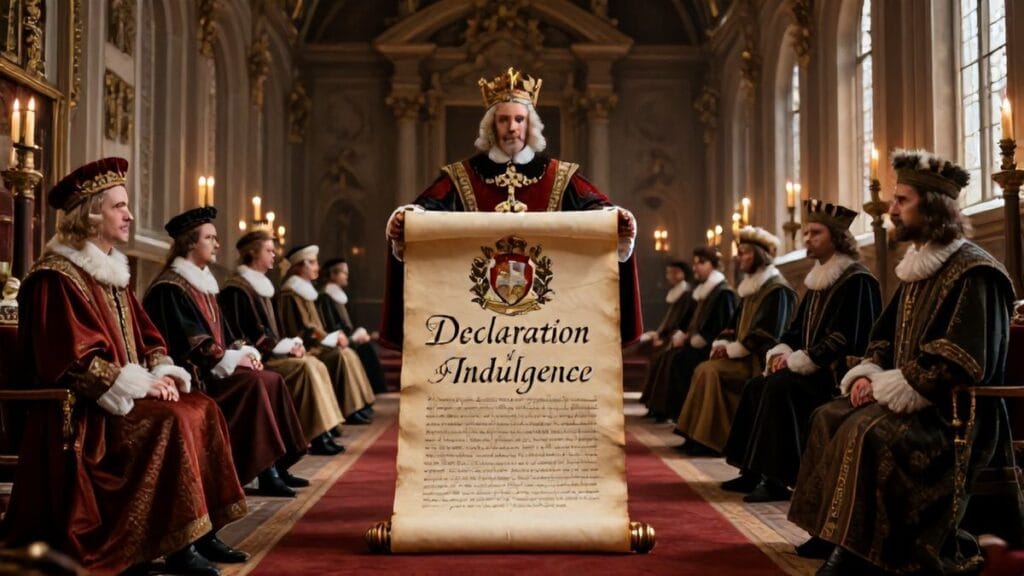
Table of Contents
- A Kingdom Holding Its Breath on the Eve of 1687
- James II: A Catholic King in a Protestant Realm
- From Restoration to Crisis: The Long Road to Indulgence
- Religious Lives in the Shadows Before 1687
- Drafting a Dangerous Idea: The Making of the Declaration
- 4 April 1687: The Declaration of Indulgence Is Proclaimed
- What the Declaration Actually Said: Clauses, Liberties, and Legal Shockwaves
- Hope and Suspicion: Catholics, Dissenters, and the First Reactions
- The Church of England Pushes Back: Pulpits, Pamphlets, and Private Fury
- Power, Parliaments, and Prerogative: A Constitutional Gambit
- From Paper to Parish: How the Declaration Reached Everyday Life
- The 1688 Reissue and the Crisis of Conscience
- The Seven Bishops and the Trial That Shook the Kingdom
- Whispers of Invasion: Dutch Diplomacy and the Road to Revolution
- The Fall of a Policy and the Fall of a King
- Winners, Losers, and the Afterlife of the Declaration
- Memory, Myth, and the Meaning of Toleration
- How Historians See the Declaration of Indulgence Today
- Conclusion
- FAQs
- External Resource
- Internal Link
Article Summary: In the spring of 1687, England’s political air crackled with anticipation as King James II issued his bold declaration of indulgence 1687, a royal decree that tried to suspend long-standing laws against Catholics and Protestant dissenters. This article traces the tangled story behind that moment: the fears, hopes, and ambitions that drove a Catholic monarch to confront a Protestant establishment. It immerses the reader in the crowded streets, hushed chapels, and anxious council chambers where the implications of the declaration were weighed and contested. We follow how the declaration of indulgence 1687 promised a new era of religious liberty while simultaneously threatening the constitutional balance of the kingdom. The narrative shows how bishops, ministers, merchants, soldiers, and ordinary believers reacted, some with euphoria, others with dread. It explores the explosive trial of the Seven Bishops and the convergence of domestic dissent with foreign intrigue. Ultimately, the story reveals how the declaration of indulgence 1687 helped precipitate the Glorious Revolution, reshaping ideas of monarchy, conscience, and law for generations. Along the way, the article reflects on how historians now debate whether it was a sincere step toward toleration or a calculated strategy to entrench royal and Catholic power.
A Kingdom Holding Its Breath on the Eve of 1687
In the dim, smoky light of a London tavern early in 1687, the talk was not of harvests or wars abroad, but of the king—and of religion. Merchants leaned over ale, whispering of rumors from Whitehall: that James II meant to do something no English king had dared in living memory. Ministers in black cloaks moved through muddy streets, their faces set with worry. Catholic priests, usually careful to step lightly and speak softly, now looked up with a strange mix of fear and expectation. The kingdom felt as though it had reached the edge of an unseen cliff.
England at that moment was a land of sermons and spies, of crowded parish churches and hidden chapels, of printed proclamations nailed to posts and secret manuscripts passed from hand to hand. Above it all loomed a still-new monarch, James II, a man whose private faith was now an open wound in the body of a Protestant nation. He had been crowned only in 1685, but already whispers of betrayal, tyranny, and popery were spreading like ink across a damp page.
Into this charged atmosphere would soon step the declaration of indulgence 1687, a document that sought to unmake decades of religious repression at a stroke. But this was not only about faith. It was about who ruled England: Parliament or king, law or royal will, the noisy conscience of the many or the silent determination of one. On the eve of its publication, nobody could fully foresee that this royal gamble would help bring down the very monarch who issued it.
Yet behind the rumors lay lived experience. For half a century, English men and women had learned to navigate religious danger like sailors along a rocky coast. Penal laws had barred Catholics from public office, and statutes like the Test Acts had forced anyone seeking employment under the Crown to receive Anglican communion. Protestant dissenters—Baptists, Presbyterians, Quakers, and others—had worshipped in fear of fines, prison, and humiliation. Once more, change was coming, and the sense of history turning on its axis could almost be felt in the chill April air.
James II: A Catholic King in a Protestant Realm
To understand the declaration of indulgence 1687, one must first understand its author. James II was no mere bureaucratic monarch signing papers pushed beneath his nose. He was a soldier, a man shaped by exile, battle, and conversion. Younger brother to Charles II, he had fled England during the Civil War and Interregnum, living abroad in Catholic lands where the Mass was celebrated openly. It was there, in the 1650s, that he converted decisively to Catholicism—a decision he would never renounce.
When the monarchy was restored in 1660, James returned home to a kingdom that had just tasted radical Puritan rule and wanted no more revolutions. For a time, his faith was a private scandal, a thing murmured about but not confronted too openly. Charles II, more flexible, more skeptical, and more inclined to compromise, protected his brother as best he could while navigating Parliament’s anxieties. But with the terrifying memory of the Gunpowder Plot in English minds and the specter of French Catholic absolutism across the Channel, the presence of a Catholic heir to the throne was like a smoldering ember in dry straw.
The Popish Plot hysteria of the late 1670s, largely fabricated but emotionally real, fanned hatred of Catholics and nearly destroyed James. He was forced into exile once more, his right to the throne bitterly contested in what became known as the Exclusion Crisis. Only the political skill and stubbornness of Charles II preserved the succession. When Charles died without legitimate heirs in 1685, James ascended as the first openly Catholic king of Protestant England since Mary Tudor.
James II saw himself as a restorer of royal authority and of justice toward his co-religionists. He had served bravely at sea, commanded armies, and knew the weight of command. The notion that Parliament or noisy crowds in London might dictate terms to the Crown offended his sense of order and divine hierarchy. Religion, to James, was not simply a private belief; it was a structure woven into monarchy, loyalty, and salvation itself. The king’s conscience was not to be bent by popular fear.
But the kingdom watched uneasily as he surrounded himself with Catholic advisers and officers. He appointed Catholics to positions in the army, bypassing the Test Acts. He allowed Catholic worship at court. He cultivated a close relationship with Louis XIV of France, whose persecution of French Protestants after the Revocation of the Edict of Nantes in 1685 cast a cruel shadow over any claim that Catholic power could coexist with Protestant liberty. James II may have sincerely believed in extending toleration to his Protestant dissenting subjects, but many suspected he aimed ultimately to remake England in the image of Catholic France.
From Restoration to Crisis: The Long Road to Indulgence
The declaration of indulgence 1687 did not spring from nowhere. It was the product of a half-century of bruising encounters between conscience and coercion. When Charles II returned to the throne in 1660, the restored monarchy faced a society exhausted by civil war and religious experimentation. The Church of England, which had been overthrown and replaced with a harsher Puritan regime, was brought back as the established church, its bishops restored to their sees, its liturgy enshrined in the Book of Common Prayer.
Yet beneath this outward restoration lay fractures. Many who had embraced forms of Puritanism—Presbyterians, Independents, Baptists, Quakers—could not in good conscience submit to the strict uniformity the restored Church required. The government responded with a set of harsh statutes remembered collectively as the Clarendon Code: the Corporation Act (1661), the Act of Uniformity (1662), the Conventicle Act (1664), and the Five Mile Act (1665). Together, they sought to force religious and political conformity, expelling thousands of ministers from their pulpits and making non-Anglican worship socially and legally dangerous.
Charles II himself oscillated between repression and a kind of cautious toleration. In 1672 he had issued his own Declaration of Indulgence, suspending penal laws against both Catholics and Protestant dissenters. But Parliament—fearful of Catholic influence and determined to guard its legislative powers—forced him to withdraw it in 1673 and accept the first Test Act instead. The lesson was clear: attempts by the Crown to unilaterally grant wide religious freedom would meet ferocious resistance from a Parliament that saw such moves as both religiously dangerous and constitutionally illegal.
By the time James came to the throne, the memory of that earlier experiment in indulgence had not faded. Many dissenters recalled it with a kind of bittersweet nostalgia: a brief window when their worship had been less risky. But the political class remembered something else—the specter of a king using prerogative power to override statutes passed by the nation’s representatives. The tension between the dream of toleration and the fear of arbitrary monarchy lay at the heart of the drama that would soon unfold.
Religious Lives in the Shadows Before 1687
Before the declaration of indulgence 1687 appeared, countless religious lives in England were lived at the margins of legality. Picture a small farmhouse in rural Devon, its shutters drawn tight on a Sunday evening. Inside, fifteen or twenty people sit crowded together as a dissenting minister, once an Anglican clergyman, now turned out of his parish, reads from the Bible. They know the risks: if informers learn of this “conventicle,” they may face fines they cannot afford, or worse, imprisonment.
In London’s twisting alleys, Quakers met in modest rooms, sitting in silence until someone felt moved to speak. Their refusal to swear oaths, their insistence on calling no man “master,” and their quiet defiance in the face of persecution had already filled gaols across the kingdom. Baptists baptized converts in rivers and streams, sometimes at dawn, sometimes under cover of night. Presbyterians clung to a more ordered, “reformed” worship, often wistfully recalling the brief moment during the Civil War when their model had seemed poised to become England’s norm.
For Catholics, the situation was in some ways worse. In law, they were subject to severe penalties: barred from public office, from Parliament, from the full benefits of citizenship. The memory of plots and rebellions associated with their faith meant that every rumor of Catholic organization was treated as a potential threat to the state. Priests celebrated Mass in secret chapels within private houses, disguised behind false walls or hidden above stable roofs. A Catholic gentleman might keep a chaplain under the guise of a “tutor” or “steward,” and families trained their children to say nothing that could betray the presence of a forbidden altar in an upstairs room.
Yet human beings, even under such constraints, find ways to negotiate. Many local magistrates preferred to turn a blind eye when possible. Informers were despised, and neighbors sometimes protected one another despite religious differences. In some market towns, an uneasy truce existed: Anglicans dominated public life, but dissenters were tolerated as long as they did not push their worship too openly. It was this precarious, improvised balance that James II’s sweeping declaration was about to disrupt.
Drafting a Dangerous Idea: The Making of the Declaration
Inside Whitehall Palace, far from muddy village roads and cramped meeting houses, James II and his advisers set to work on what would become the declaration of indulgence 1687. The king’s circle included prominent Catholics such as the Earl of Sunderland and Father Petre, a Jesuit whose presence near the levers of power horrified Protestant opinion. But James also courted some Protestant dissenters, sensing that their interest in religious liberty could be woven into his own broader aims.
Debate was intense, and not only about theology. The central question was constitutional: could the king, by virtue of his royal prerogative, suspend or dispense with laws passed by Parliament? James believed he could. He saw the penal laws and Test Acts not as sacred scripture but as human legislation that injured a significant portion of his subjects and fettered his freedom to appoint whomever he chose to office. To him, the king’s duty to secure justice and peace—even for religious minorities—gave him the right to loosen these legal knots.
Drafts of the declaration passed from hand to hand, ink corrected, phrases sharpened or softened. Some advisers urged caution: include only limited indulgence, they said, and couch it in the language of temporary necessity. Others, more radical, pressed James to seize the moment and permanently transform the religious landscape. The king leaned toward boldness. He was in his fifties, his reign already shadowed by suspicion, and he knew that history rarely offered second chances.
By early 1687, the text had taken shape. It did not only ease conditions for Catholics; it extended its protection to Protestant dissenters as well, suspending penal laws against them and allowing them to worship in licensed meeting places. This was calculated. James hoped to split the Protestant opposition by peeling dissenters away from the Anglican establishment, binding them to his throne by gratitude and interest. At the same time, he aimed to free Catholics from crippling restrictions and open a path for their more public role in English life.
Yet even among potential beneficiaries there was disquiet. Some dissenters feared that any liberty granted solely by royal will could be withdrawn just as easily—and that in accepting it, they might help weaken the very parliamentary safeguards that protected them from tyranny in other forms. The idea itself was dangerous, not simply because of what it offered, but because of how it proposed to offer it.
4 April 1687: The Declaration of Indulgence Is Proclaimed
On 4 April 1687, the declaration of indulgence 1687 was finally issued in England. It was printed on broad sheets, the royal arms emblazoned at the top, the language formal and resonant. Messengers carried it out from London along radial roads, to be read aloud in towns and cities, pinned to the walls of guildhalls, and posted at the doors of churches. News traveled even faster than the paper itself. By the time the proclamation reached some distant parishes, people were already arguing over what it must contain.
The scene in London when the text first became known was a blend of curiosity and unease. In coffeehouses, men read it aloud to assembled listeners while others leaned over shoulders, straining to catch every word. At court, courtiers nodded or frowned depending on their sympathies. Diplomatic envoys sent hurried dispatches home, trying to interpret what this meant for the European balance of power. A French observer might have smiled at England’s turmoil; a Dutch one saw growing opportunity.
One contemporary diarist, reflecting the tone of many observers, noted that the king had “resolved to set at liberty all manner of conscience, or so he saith, by his single word.” The phrasing captured both the scale of the act and the anxiety about its method. There was no parliamentary debate, no formal repeal of statutes, no careful legislative compromise. It was, in outward form, an act of royal grace—an indulgence extended by the monarch to his people, as though religion were a matter of royal favor rather than mutual covenant.
Still, for those long oppressed, the moment could feel like a sudden lifting of a weight. Imagine a Quaker woman, used to seeing her husband dragged before magistrates for attending meetings, now hearing that such gatherings would no longer be hunted down. Imagine a Catholic priest unfolding the printed sheet in a private chapel and daring to believe that perhaps, at last, he could serve his flock without constant fear of arrest. The words on the page did not erase hostility, but they altered the contours of risk.
But this was only the beginning. The real struggle would not be over the ink that dried on 4 April, but over the hearts, minds, and institutions that would either accept, bend, or break in response.
What the Declaration Actually Said: Clauses, Liberties, and Legal Shockwaves
The declaration of indulgence 1687 was not a vague gesture; it was a structured legal instrument whose details mattered. At its core, it did three major things. First, it suspended the execution of all penal laws concerning religious nonconformity, both for Catholics and for Protestant dissenters. Fines, imprisonment, and legal disabilities tied to worship practices were, in effect, placed on hold by royal command.
Second, the declaration granted liberty of conscience and public worship to Protestant dissenters, with conditions. They were required to register their meeting places, and their ministers had to seek licenses, but the very notion that “authorized” non-Anglican worship could take place in the open represented a revolution in the religious life of the kingdom. Chapels and meeting houses, once hidden or tolerated only by neglect, could now stand more visibly.
Third—and most controversially—it extended to Catholics the right to worship privately, and it removed some of the harshest legal barriers to their participation in civil and military life. While it did not fully abolish all anti-Catholic statutes, it asserted the king’s power to dispense with them in individual cases, and to suspend their enforcement more generally. This confirmed the worst fears of those who believed James sought to “papize” the state apparatus.
The language of the declaration emphasized the king’s prerogative. It stated that his Majesty judged it “conducive to the peace of the kingdom” and to the “security” of his reign that his subjects should not be persecuted for their consciences. Implicitly, it argued that the Crown alone had the breadth of view and sovereign authority to rise above partisan religious conflicts and impose a more generous settlement. To James, this was an act of wisdom and justice; to many of his subjects, it was an act of arbitrariness dressed in piety.
Legally, the shockwaves were profound. The statement that the king could “suspend” and “dispense with” laws, not merely in isolated cases but on a general basis, challenged a doctrine many MPs and lawyers held dear: that the monarch was bound to execute the statutes of the realm as enacted by Parliament. The jurist and politician Sir Edward Coke, long dead but still influential, had argued that such dispensing power was tightly limited. Now James seemed to be claiming a sweeping version of it. As the historian John Miller has observed, “the question was no longer only what men might believe, but who truly held sovereignty in England.”
Hope and Suspicion: Catholics, Dissenters, and the First Reactions
Reactions to the declaration of indulgence 1687 were anything but uniform. Among Catholics, there was mingled relief and apprehension. Some families brought out crucifixes that had long been hidden. Private chapels, once shrouded in secrecy, rang a little louder with the sound of prayer. Young men who might never have considered a public career now glimpsed the possibility of service in the army or at court. Yet older Catholics, seasoned by decades of persecution, warned caution. They knew how swiftly the political wind could change, how often promises had been made and betrayed.
Protestant dissenters were torn. Many Baptist and Congregationalist communities rejoiced in the new freedom to gather and preach more openly. Printed petitions of thanks were sent to the king by some dissenting ministers, acknowledging a debt of gratitude. For preachers who had spent years in fear or in gaol, this was no small thing. A sermon might now be preached with windows unshuttered, with children encouraged to invite neighbors without fear of informers lurking outside.
Yet behind the celebrations, a current of suspicion ran deep. Leading Presbyterians and other dissenting elites worried that aligning too closely with James II could isolate them from the broader Protestant nation. They remembered the role Parliament had played in defending liberties—political if not religious—during earlier confrontations with the Stuart monarchy. Some fretted that in supporting this royal indulgence, they might help James build an absolutist system that could later suppress them as easily as it now protected them.
Anglicans, particularly the clergy, reacted with alarm that ranged from quiet dismay to burning indignation. They had long seen themselves as the religious backbone of the English state, the “via media” between Catholic superstition and Puritan fanaticism. Now a Catholic king proposed to place all forms of Christian worship on something approaching equal legal footing, at least temporarily. To many bishops, this looked less like toleration and more like an attack on the privileged position of the national church.
In Parliament, or what remained of it in political memory, the anger was compounded by the question of method. The declaration was seen as a living demonstration that the king meant to rule without meaningful parliamentary consent. Some former MPs muttered that if such a use of prerogative went unchecked, no statute would be safe from royal suspension. “If laws be but cobwebs for the king to break,” one opponent reportedly remarked, “then we have a crown, but no constitution.”
The Church of England Pushes Back: Pulpits, Pamphlets, and Private Fury
The most organized and articulate opposition to the declaration of indulgence 1687 came from the Church of England. Bishops, deans, and parish clergy found their consciences and their careers caught in a tightening vise. They were, after all, royal servants who swore loyalty to the Crown, yet they were also guardians of a religious and legal order that the Crown now seemed bent on overturning by fiat.
From pulpits across the country, sermons began to circle warily around the topic. Some clergy cautioned obedience to the king “in all lawful things,” subtly signaling that not everything a monarch demanded was necessarily lawful. Others focused on the dangers of popery, drawing historical parallels with Mary I’s bloody persecutions a century earlier or with contemporary French oppression of Protestants. While public denunciations of the king’s policy were rare at first—too dangerous, too open—coded messages proliferated.
Behind closed doors, opposition was fiercer. Bishops exchanged letters filled with alarm. Archbishop William Sancroft, a cautious and devout man, struggled with the dilemma posed by a later royal order that the declaration be publicly read in every parish church. Could he, in good conscience, direct his clergy to proclaim as royal will something he believed to be legally invalid and religiously unwise? Around kitchen tables and in rectory parlors, lesser clergy debated whether loyalty to the Church, to the law, and to God might now require a sort of principled disobedience to the king.
Pamphleteers, operating at the risky edge of censorship, produced tracts attacking the idea of an unlimited suspending power. Some argued that even if liberty of conscience were a good in itself, it must be achieved through Parliament, not bestowed as a revocable grace of the Crown. The memory of the Civil War still warned against outright rebellion, but the spirit of resistance, especially in words, had been reborn. The printed page once again became a battlefield.
It is astonishing, isn’t it, how often ideals can collide rather than align? Many Anglicans believed in some measure of toleration, especially for moderate dissenters. Yet they recoiled at the way James proposed to grant it, and they were adamantly opposed to any step that might strengthen Catholic influence. In their eyes, the Church of England was not a mere political faction but the true spiritual anchor of the nation. To see its legal privileges threatened by a Catholic king’s sweeping decree felt like watching the ground itself shift under their feet.
Power, Parliaments, and Prerogative: A Constitutional Gambit
The declaration of indulgence 1687 thus sat at the intersection of religion and constitution. To many Protestant observers, James’s policy looked less like a sincere attempt to free consciences and more like a carefully calculated move to expand royal power. Whether that perception was entirely fair is still debated, but its impact at the time was undeniable.
James had already signaled his impatience with Parliament. Shortly after his accession, he used a compliant Parliament to confirm his revenues, then dismissed it when it showed signs of resisting his religious agenda. He did not summon another. In doing so, he effectively ruled without the body that, since the Elizabethan era, had shared at least some responsibility for the religious settlement of the realm. Now, by using his prerogative to suspend penal laws, he seemed to argue that he alone could set the terms of English religion.
Legal theorists and politicians clashed over the scope of prerogative. Supporters of James, many of them drawn from a new cadre of loyal officeholders and judges, upheld a broad view: that the king, as fountain of justice and mercy, could in emergencies or for the common good suspend troublesome statutes. Opponents countered with the notion of the “ancient constitution,” claiming that English kings had always been bound by the laws of the land and could not arbitrarily set them aside. They pointed to earlier charters and precedents to argue that what James proposed was not tradition but innovation—the kind of innovation that had sparked civil war in the previous generation.
This conflict was not merely abstract. Landed gentry, merchants, and urban elites feared what unrestrained monarchic power could do to their property, their contracts, and their political voice. Religious liberty granted by a monarch who might tomorrow revoke it was a fragile shield. As one pamphlet writer later summed up, “The question was not whether liberty was good, but whether liberty by prerogative was safe.” The stakes went beyond church doors; they reached into every corner of the relationship between ruler and ruled.
In trying to secure freedom for some through the royal prerogative, James may inadvertently have convinced many Englishmen that only a stronger Parliament could truly defend liberties—religious or otherwise. It was a paradox that would haunt the final years of his reign.
From Paper to Parish: How the Declaration Reached Everyday Life
Once the declaration of indulgence 1687 spread beyond London, it began to alter the rhythms of everyday life in quiet but unmistakable ways. In market towns, dissenting congregations emerged from the shadows. A bare room that had hosted secret worship might now acquire a signboard; a makeshift space might be publicized as a proper meeting-house. People who had grown used to whispering the time and place of gatherings could now announce them more freely, at least in theory.
Licensing procedures mattered. Dissenting ministers had to apply for formal recognition, and some hesitated to place their names on lists the government controlled. Others, seeing a historic opportunity, stepped forward. Local magistrates reacted unevenly: some diligently enforced the new rules, registering meeting places and ensuring that no violence erupted between Anglicans and dissenters. Others, hostile to the whole project, dragged their feet or tried quietly to intimidate those seeking licenses.
In the countryside, change was slower but no less real. A traveling preacher, previously forced to keep his gatherings small and mobile, might now linger in a village, holding service in a barn with the doors open rather than shut. Note that legal permission did not erase social hostility: neighbors could still mock or threaten; landlords could still pressure tenants to conform to the parish church. But the aura of automatic criminality that had blackened nonconformist worship dimmed.
Catholics felt a similar, if more cautious, transformation. In some areas, chapels once used only by gentry households began to admit a slightly wider circle. Priests moved with a bit less fear of sudden arrest. Rumors circulated of new Catholic schools and charities. Yet the hostility of the surrounding society meant that few dared to push their advantage far. A Catholic tailor or baker might attend Mass with more confidence, but he still risked losing customers if his faith became too public.
For Anglicans deeply attached to religious uniformity, these changes were jarring. Parish churches no longer enjoyed the same monopoly over religious life. Stories spread of people who had long dutifully attended Anglican services now wandering into dissenting meetings or Catholic chapels out of curiosity or conviction. For some, it felt as if the kingdom’s religious map was being redrawn village by village, town by town, in ways that no one could fully predict or control.
The 1688 Reissue and the Crisis of Conscience
James II was not finished. In April 1688 he reissued the declaration—often referred to as the second Declaration of Indulgence—and this time he went further by ordering that it be read aloud in every parish church on two consecutive Sundays. If the first declaration of indulgence 1687 had shaken the kingdom, the second, with its mandatory public proclamation, threatened to shatter the uneasy balance between king and church.
For many clergy, the order struck at the core of their identity. They were being commanded to stand before their congregations and read a political and legal document they regarded as both unconstitutional and injurious to the Church of England. It was not merely a matter of disagreeing with royal policy; it was a matter of conscience. Could they, as pastors responsible for souls, lend their voices to something they believed eroded both law and true religion?
Across the country, rectories and vicarages became sites of anguished debate. Some clergy, fearful of losing their livings or worse, resolved to comply outwardly while privately disapproving. Others, especially those with strong ties to the high-church tradition, leaned toward defiance. They believed that to acquiesce would be to betray not only their church but the ancient constitutional balance that had defined England since the Elizabethan Settlement.
The king, increasingly isolated and impatient, saw resistance as willful disobedience. He could not understand why those who called themselves loyal subjects balked at a measure he believed promoted peace. To James, the demand that his declaration be read in churches was not an act of tyranny but a reasonable expectation that his clergy, as officers of a national church, would support his vision for religious concord.
The stage was thus set for a confrontation that would galvanize opinion far beyond the clerical world. In resisting the reading of the declaration, a group of bishops would transform a religious policy dispute into a national cause célèbre.
The Seven Bishops and the Trial That Shook the Kingdom
In May 1688, seven bishops—including Archbishop Sancroft—presented a petition to James II respectfully asking to be excused from ordering the reading of the declaration in their dioceses. They argued that the declaration of indulgence 1687 (and its reissue) was founded on a dispensing power that had been “declared illegal” by Parliament in the past, and that their consciences could not support something they deemed unlawful. The petition was humble in tone but explosive in implication: leading figures of the established church were openly challenging the legality of the king’s action.
James reacted with fury. To him, the petition was seditious, an incitement to disobedience under the guise of conscience. He ordered the bishops arrested and charged with seditious libel. On 8 June 1688, they were taken to the Tower of London. Crowds lined the streets, some kneeling as the bishops passed, others shouting blessings and encouragement. The sight of these elderly, dignified churchmen—far from being rebels—treated as common criminals transformed them into symbols of principled resistance.
The subsequent trial at Westminster Hall gripped the nation. The prosecution argued that the bishops’ petition, though couched in gentle language, undermined royal authority and incited rebellion. The defense insisted that the bishops had merely exercised their right to petition the king and that their doubts about the legality of the dispensing power were reasonable and rooted in English constitutional tradition. Jurors, drawn from a society already uneasy about James’s policies, listened intently.
After long deliberations, the jury returned a verdict: not guilty. The news was met with an outpouring of jubilation. Bells rang, bonfires blazed, and crowds celebrated in London streets. For many, the acquittal represented more than a legal victory; it was a moral and political verdict on the king’s attempt to enforce his religious policy by overriding conscience and law. As one later commentator recalled, “the whole nation seemed to shout at once that law and liberty still lived.”
This dramatic episode did lethal damage to James II’s authority. By prosecuting respected church leaders and losing, he both alienated a crucial support base and exposed the fragility of his power. The declaration of indulgence 1687, intended to craft a new political alliance around toleration, had instead helped unite Anglicans and many dissenters in fear of royal overreach. Even abroad, observers took careful note. William of Orange, the Dutch stadtholder and James’s Protestant son-in-law, watched events with growing interest.
Whispers of Invasion: Dutch Diplomacy and the Road to Revolution
While James battled bishops at home, matters abroad were moving toward a climax. The Netherlands, governed in part by William of Orange, had long been wary of Louis XIV’s France and of any sign that England might become a Catholic ally of the French king. The declaration of indulgence 1687 and its reissue, alongside James’s broader Catholicizing measures, suggested to Dutch eyes that England was drifting into the orbit of French-style absolutism.
English exiles and opposition leaders began corresponding with William, hinting that significant segments of the English political and religious elite would welcome his intervention. At first, these were only whispers, colored by the hopes and fears of those who wrote them. But as news of the Seven Bishops’ trial and acquittal reached The Hague, the possibility of effective resistance to James in England began to seem more real. The legal and moral case against the king’s use of the suspending power was now backed by a verdict of an English jury.
The final spark came with the birth of James’s son, James Francis Edward, in June 1688. Until then, many had half-comforted themselves with the idea that the Catholic king’s rule would be a temporary anomaly, followed by the accession of his Protestant daughter Mary, married to William of Orange. A male Catholic heir changed that calculus. Now the prospect loomed of a lasting Catholic succession, supported by policies like the declaration of indulgence that elevated Catholic interests and royal power alike.
A group of English nobles and political leaders, later styled the “Immortal Seven,” sent William a formal invitation to intervene militarily in England to protect Protestantism and the laws of the realm. They cited, among other grievances, the king’s assault on the established church and his unconstitutional exertion of prerogative. William, who already viewed himself as a champion of international Protestantism, seized the opportunity. He framed his planned invasion not as a conquest but as a rescue mission: to secure a “free and lawful Parliament” and to restore proper constitutional order.
Thus a royal document issued in Whitehall to recalibrate domestic religion became one of the triggers for an international military expedition. Policy, conscience, and war were now tightly knotted. The delicate parchment of indulgence had, in effect, become a fuse.
The Fall of a Policy and the Fall of a King
In November 1688, William landed at Torbay with a substantial army. James attempted to rally his forces, but desertion and hesitation plagued his camp. Many of his officers and nobles, Protestant at heart and uneasy with the trajectory of his reign, defected or simply stayed neutral. The declaration of indulgence 1687, rather than binding new allies to him, had deepened distrust among core elements of the political nation.
As William advanced, James vacillated between negotiation and repression. At moments he considered rescinding some of his more controversial policies, including aspects of his religious program, but his concessions came too late and seemed too opportunistic. The memory of the Seven Bishops’ trial lingered: few now believed that his promises of moderation would be durable once danger had passed.
London’s mood shifted rapidly. Crowds that had once watched royal processions in sullen silence now cheered for William’s cause. City leaders negotiated quietly with Dutch representatives. In December, James, facing the collapse of his support and perhaps fearing a fate similar to that of his father, Charles I, attempted to flee. He was briefly intercepted, then eventually allowed to escape to France, where he would live out his days in exile under the protection of Louis XIV.
In the aftermath, the English political elite convened a Convention Parliament. They declared that James had “abdicated the government” and that the throne was therefore vacant. It was a legal fiction carefully crafted to avoid explicitly deposing a king while still justifying a transfer of power. William and Mary were offered the crown jointly, on condition that they accept a new constitutional settlement limiting royal prerogative and securing certain rights for Parliament and subjects alike.
Thus the declaration of indulgence 1687, intended to assert royal authority and reshape the religious landscape, had contributed to a broader crisis that ended in the curtailment of the very prerogative it relied upon. James’s use of suspending power for the sake of toleration helped convince many that such power was too dangerous to be left unbounded. The king lost not only his policy but his crown.
Winners, Losers, and the Afterlife of the Declaration
In the immediate wake of the Glorious Revolution, the declaration of indulgence 1687 was voided. The new regime under William and Mary rejected the idea that the monarch could unilaterally suspend laws. Yet the ambition behind the declaration—to provide broader religious toleration—did not disappear. Instead, it was channeled into a different constitutional form.
In 1689, Parliament passed the Toleration Act, granting limited freedom of worship to many Protestant dissenters. They were allowed to have their own meeting houses and ministers, provided they swore certain oaths of allegiance and supremacy and subscribed to most of the Thirty-Nine Articles, the doctrinal foundation of the Church of England. Quakers received some special provisions recognizing their scruples about oaths. Catholics and atheists, however, remained excluded from these protections, and the established church retained its privileged position.
In a bitter irony, many dissenters obtained under a parliamentary statute what they had first been offered under James’s royal declaration, though often in narrower form. Yet many preferred this new arrangement because it rested on law rather than on the precarious favor of a single monarch. What had been suspect in 1687—liberty by prerogative—became more acceptable when codified in statute. The principle that Parliament, not the Crown alone, should define the religious settlement of the realm had been affirmed.
Catholics, however, fared poorly. James II’s fall hardened anti-Catholic sentiment in many quarters. The very fact that the declaration of indulgence 1687 had benefited Catholics was used to discredit broad toleration as a “popish” scheme. Penal laws against Catholics remained in force, and in some respects were reinforced, in the following decades. For English Catholics, the period after the Glorious Revolution was one of continued, even intensified, marginalization—a sobering counterpoint to any triumphant narrative of liberty’s advance.
The Church of England emerged with its legal establishment intact but not unaltered. The experience of resisting James’s religious policies, especially through the stand of the Seven Bishops, had infused parts of the church with a stronger sense of its identity as guardian not only of doctrine but of constitutional principle. Yet internal divisions remained, as some clergy felt uneasy about the legitimacy of William and Mary’s rule and refused to swear the required oaths. These “nonjurors” became a small but symbolically important group, standing as a reminder that conscience could cut more than one way.
Memory, Myth, and the Meaning of Toleration
Over time, the declaration of indulgence 1687 took on a life in memory distinct from its brief existence in law. For some, it became a cautionary tale about the dangers of absolutism dressed in the robes of benevolence. For others, it was a tragically flawed but genuine attempt at religious pluralism ahead of its time. The complexity of its legacy lies in the way it wove together sincere commitments with strategic calculations.
In popular English Protestant memory, especially in the eighteenth and nineteenth centuries, James II was often depicted as a would-be tyrant seeking to subvert national liberty under the guise of toleration. Sermons on the anniversary of the Glorious Revolution sometimes mentioned the declaration as one of the king’s key offenses. It was portrayed as a piece of “popish craft,” aiming to lull Protestants into complacency while Catholic power grew. Such narratives simplified a far more tangled reality, but they were powerful.
Among some later dissenters, however, a more ambivalent memory persisted. They could not entirely condemn a policy that, for a fleeting moment, had opened doors to worship and witness that Parliament would only grudgingly unlock years later. The fact that their freedoms had once depended on a Catholic monarch’s decree complicated any neat story of pure Protestant heroism versus Catholic oppression. The moral landscape, in retrospect as in reality, was mottled with gray.
The declaration also invited broader reflection on what toleration meant. Was it merely the absence of punishment for private belief, or did it require positive legal recognition and protection for different forms of worship? Could a state church coexist with meaningful religious diversity, or did establishment inevitably create second-class citizens? The answers that emerged in the decades after 1688 were partial and imperfect, but the questions themselves were sharpened by the 1687 experiment.
Even today, the story resonates. Modern readers, accustomed to the language of rights and pluralism, can easily sympathize with the desire to end religious persecution. Yet they may also recognize the dangers when executive power expands in the name of noble goals. The declaration of indulgence 1687 sits at that uneasy crossroads: a document that both anticipated a more tolerant future and illuminated the perils of shortcutting constitutional safeguards to get there.
How Historians See the Declaration of Indulgence Today
Contemporary historians have moved far beyond the simple partisan narratives of earlier centuries when assessing the declaration of indulgence 1687. Instead of casting James II as a pure villain or a misunderstood saint of toleration, they tend to see him as a complex figure whose religious policy combined genuine conviction with political miscalculation.
Some scholars emphasize the sincerity of James’s commitment to ending penal laws. They point out that he consistently pursued greater freedom for Catholics, even when it alienated potential allies, and that he extended similar protections to Protestant dissenters in a way that went beyond what might have been purely tactical. From this perspective, the declaration was a bold, if constitutionally risky, step toward a more pluralistic religious order. The historian J. R. Jones, for example, has argued that James “was prepared to offer to dissenters more than many of his Protestant successors dared to concede,” though at a heavy political price.
Other historians focus on the constitutional dimension, criticizing James for his disregard of parliamentary authority and legal precedent. For them, the primary issue is not that he sought toleration but that he did so by claiming an expansive suspending power that threatened to unmake the rule of law. They argue that had James worked with a Parliament, even a reluctant one, to gradually ease restrictions, he might have achieved more lasting change without provoking revolution. In this reading, the declaration of indulgence 1687 was less a moment of enlightened progress than a catalyst for the reassertion of parliamentary supremacy.
There is also debate about the role the declaration played in the onset of the Glorious Revolution. Some see it as central: the spark that ignited the church’s resistance, led to the Seven Bishops’ trial, and signaled to William of Orange that England was ripe for intervention. Others treat it as one piece in a larger puzzle that included foreign policy, dynastic fears, economic concerns, and long-standing ideological divisions about monarchy. Either way, the declaration remains a key lens through which the tensions of late Stuart England come into focus.
What is perhaps most striking in modern scholarship is the refusal to simplify. The declaration of indulgence 1687 is neither celebrated unreservedly as the birth of English toleration nor dismissed entirely as a cynical ploy. Instead, it is understood as an episode in which high ideals and hard politics collided, producing outcomes that neither friends nor foes fully intended. In that sense, it offers a sobering reminder of how fraught the path toward greater freedom can be.
Conclusion
Standing at a distance of more than three centuries, one can see the declaration of indulgence 1687 as a hinge: a moment when England might have moved toward religious pluralism by royal decree, and instead moved toward constitutional monarchy and a more limited, Parliament-shaped toleration. The declaration’s story is not one of simple villains and heroes. A Catholic king sought to free consciences but did so in a way that alarmed those who feared for law and liberty. Protestant dissenters grasped at newly offered freedoms yet worried about the cost. The Church of England defended its status and principles, sometimes with courage, sometimes with a jealousy that left Catholics and others in the cold.
In the end, James II’s grand experiment failed. His use of prerogative deepened distrust, his alliance with Catholic interests intensified old fears, and his refusal to work patiently with Parliament undermined his own cause. The very document meant to reconcile religious division helped to unite his opponents, from bishops in rochet and chimere to Dutch generals across the sea. Out of the wreckage emerged a new settlement in which Parliament claimed the right to define both political and religious order, even as many forms of belief remained constrained.
Yet the declaration’s legacy lives on in the questions it forced to the surface. How can a state respect conscience without losing cohesion? Who should decide the boundaries of toleration: monarchs, assemblies, courts, or the shifting currents of public opinion? And what happens when the instruments used to secure liberty threaten other forms of freedom? The England of 1687 did not find final answers, but it illuminated the dilemmas that modern societies still wrestle with.
Perhaps that is why the declaration of indulgence 1687 still commands attention. It is a story about the interplay of faith and power, of lofty ideals and human frailty, of documents whose words reach far beyond the day they are signed. Its failure cleared the way for other, more durable forms of toleration, but it also stands as a reminder that the route to greater freedom is rarely straightforward—and that even well-meant shortcuts can alter history in unexpected ways.
FAQs
- What was the Declaration of Indulgence of 1687?
The Declaration of Indulgence of 1687 was a royal proclamation issued by King James II of England that suspended the enforcement of penal laws against both Catholics and Protestant dissenters. It granted a broad, though not absolute, liberty of conscience by allowing non-Anglican worship under certain conditions and asserted the king’s power to dispense with and suspend existing religious statutes without parliamentary approval. - Why did James II issue the declaration?
James II issued the declaration because he wanted to end legal discrimination against Catholics, including himself and his co-religionists, and hoped to secure a more stable, loyal base of support by extending similar freedoms to Protestant dissenters. He believed that royal prerogative gave him the authority to suspend religious laws and that broader toleration would strengthen his rule and reduce religious conflict, though many contemporaries saw it as a step toward absolutism. - How did the declaration affect Protestant dissenters?
The declaration allowed many Protestant dissenters—such as Baptists, Presbyterians, and Quakers—to worship more openly without facing fines, imprisonment, or other legal penalties. They could register meeting houses and obtain licenses for their ministers, which reduced the everyday risks of gathering for non-Anglican worship. However, some dissenters feared that accepting liberty granted solely by the king would weaken Parliament and leave them vulnerable if royal policy later changed. - Why did the Church of England oppose the declaration?
The Church of England opposed the declaration for both religious and constitutional reasons. Many Anglican leaders saw it as an attack on the established church’s privileged status and as a measure that favored Catholic interests. They also objected to the way James II used royal prerogative to suspend laws without Parliament, believing this undermined the ancient constitution of the realm. The order to have the declaration read in parish churches was especially offensive to many clergy, as it forced them to endorse a policy they judged unlawful. - What role did the declaration play in the Glorious Revolution?
The declaration contributed significantly to the tensions that led to the Glorious Revolution. Its use of suspending power alienated many political and religious elites, the order to read it in churches provoked the famous resistance of the Seven Bishops, and their subsequent trial and acquittal damaged James II’s authority. Combined with the birth of a Catholic heir and fears of lasting Catholic dominance, the declaration helped persuade English leaders to invite William of Orange to intervene, ultimately leading to James’s overthrow. - Did the declaration lead directly to lasting religious toleration?
No, the declaration itself was short-lived and was annulled after James II’s fall. However, it helped set the stage for the Toleration Act of 1689, passed by Parliament under William and Mary, which granted limited freedom of worship to many Protestant dissenters. That act provided a more durable, statutory basis for toleration, though it excluded Catholics and maintained the Church of England as the established church. In that sense, the declaration influenced the path toward toleration, even though its own provisions did not endure. - How did the declaration impact English Catholics in the long term?
In the short term, the declaration eased some restrictions on Catholics, allowing more open worship and access to certain offices. But its association with James II’s failed policies and eventual ouster hardened anti-Catholic sentiment in many circles. After the Glorious Revolution, penal laws against Catholics remained in force and in some respects were reinforced. As a result, English Catholics continued to face significant legal and social disabilities well into the eighteenth and nineteenth centuries. - What is the main constitutional significance of the declaration?
The main constitutional significance of the declaration lies in its assertion of a sweeping royal power to suspend and dispense with laws enacted by Parliament. The widespread opposition it provoked, and the subsequent settlement after the Glorious Revolution, helped to entrench the principle that the monarch could not unilaterally set aside statutes. This was later confirmed in documents like the Bill of Rights of 1689, which declared such suspending power illegal and bolstered parliamentary supremacy. - Was James II genuinely committed to toleration for all, or mainly to Catholic advantage?
Historians remain divided. Many agree that James II was sincerely committed to improving the condition of Catholics and believed in a broader liberty of conscience, at least for Christians. At the same time, his policies clearly favored Catholics in appointments and access to power, and he appeared willing to use toleration strategically to weaken the Church of England. Thus, his commitment to toleration was intertwined with a desire to secure Catholic interests and royal authority, making motives hard to separate cleanly. - How is the declaration of indulgence 1687 remembered today?
Today, the declaration is remembered as a pivotal but controversial step in the long, uneven development of religious freedom in Britain. It is often studied as an example of how a well-intentioned policy can be undermined by the means used to implement it, and as a key factor in the crisis that produced the Glorious Revolution. Rather than being seen simply as a villainous or heroic act, it is now interpreted as a complex episode where ideals of toleration, fears of absolutism, and competing visions of law and sovereignty all collided.
External Resource
Internal Link
Other Resources
- Encyclopaedia Britannica – general search for the exact subject
- Google Scholar – academic search for the exact subject
- Internet Archive – digital library search for the exact subject

