Table of Contents
- The Dawn of a Clash: Anatolia on the Brink
- Who Were the Paulicians? Origins and Beliefs
- The Byzantine Empire under Basil I: Power and Peril
- The Rise of the Paulician Threat
- Anatolia’s Turbulent Frontier: Geography and Strategy
- The Gathering Storm: Prelude to Bathys Ryax
- The Commander: Theophilos the Commander in Context
- The Battle Lines Drawn: Forces and Tactics
- The Clash at Bathys Ryax: An Unfolding Catastrophe
- Turning the Tide: Byzantine Strategy and Paulician Resistance
- The Fall of Chrysocheir: The Paulician Leader’s Last Stand
- Aftermath of Battle: The End of a Paulician Dream?
- The Impact on Byzantine Military Doctrine
- Repercussions in the Paulician Communities
- Bathys Ryax’s Place in Byzantine Memory
- Religious Ramifications and the Suppression of Heresy
- Geopolitical Ripples: Anatolia and the East
- The Paulician Legacy in Later Centuries
- Reflections on Power, Faith, and Rebellion
- Conclusion: Lessons from Bathys Ryax
The Dawn of a Clash: Anatolia on the Brink
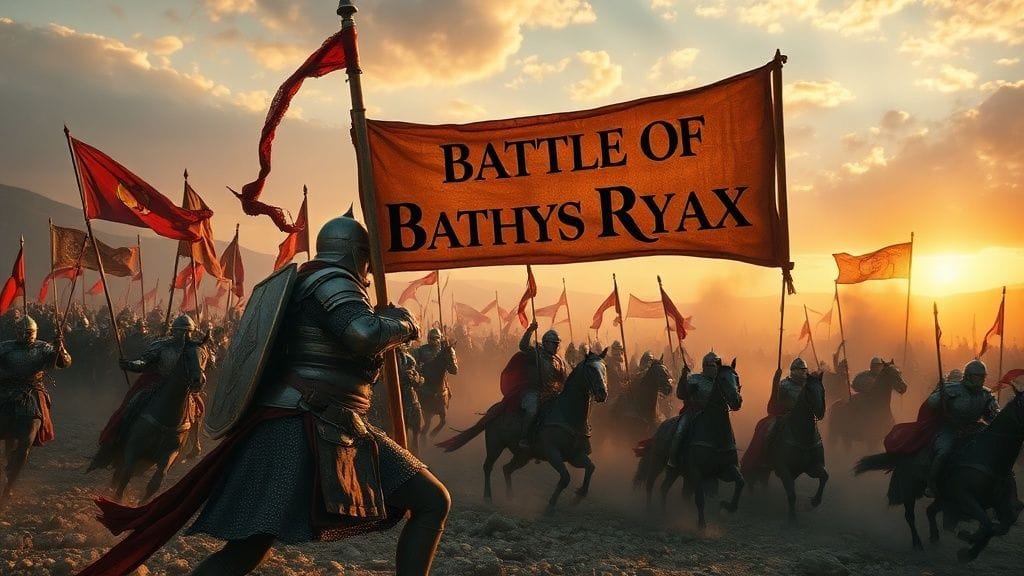
The sun burned low over the rugged hills of Anatolia in the summer of 872, casting elongated shadows over the rocky landscape where history was about to be violently rewritten. Dust rose in swirling eddies as two armies prepared for a fateful encounter that would resonate far beyond the vale of Bathys Ryax. Battle cries mingled with the clang of arms, and the air was thick with tension—neither side could predict the scale of the coming catastrophe. Yet, what made Bathys Ryax more than just another military engagement was the drama that enveloped it: a conflict not just of swords and strategy, but of ideology, faith, and survival.
To understand the weight of that day, one must first dive deep into the roots of the Paulician heresy, a widespread, defiant Christian sect whose beliefs clashed violently with the Byzantine Orthodoxy. Their defeat at Bathys Ryax was more than a military victory; it was a turning point in the empire’s turbulent efforts to unify, suppress dissent, and secure its eastern frontier.
Who Were the Paulicians? Origins and Beliefs
Few religious movements of the Middle Ages stirred as much fear and suspicion as the Paulicians. Emerging around the mid-7th century in the borderlands of Armenia and Eastern Anatolia, this sect adopted a blend of strict dualism reminiscent of earlier Gnostic traditions, a rigid rejection of the established Orthodox Church’s sacraments, and a radical call for spiritual purity.
The Paulicians believed in the cosmic struggle between good and evil, light and darkness, and vehemently rejected the worship of crosses, icons, and the material symbols of Byzantine Christianity. To the empire, they were heretics; to their followers, they were the true Christians, persecuted for their faith.
Their geography made the Paulicians particularly formidable. Nestled in the border provinces of the Byzantine Empire, often in rugged mountainous regions, they developed a semi-autonomous socio-military structure that made them both religiously distinct and politically defiant.
The Byzantine Empire under Basil I: Power and Peril
The backdrop to the battle at Bathys Ryax was the reign of Emperor Basil I, founder of the Macedonian dynasty, whose rule (867-886) sought to rejuvenate the empire after decades of internal strife and external incursions. Basil’s reign was marked by vigorous military campaigns, administrative reforms, and a broad Orthodox revival.
But the empire’s eastern borders were volatile. The presence of the Paulicians posed not only a religious affront but a tangible military threat. Their repeated raids undermined imperial authority, disrupted trade routes, and invited the suspicion that they might collude with Muslim emirates of the region.
Basil I understood that an effective solution would require a combined effort of military precision and ideological suppression. The confrontation at Bathys Ryax would become the crucible of that ambition.
The Rise of the Paulician Threat
By the mid-9th century, the Paulicians had grown from a persecuted sect into an organized, martial community. Under charismatic leaders like Chrysocheir, who succeeded the earlier Paulician ruler Karbeas, their raids became bolder and more frequent.
They carved out their own quasi-state centered around Tephrike (modern Divriği in Turkey), complete with its own military forces. Their tactical knowledge of the terrain combined with their zeal made them a particularly difficult enemy for Byzantine forces.
Each skirmish heightened tensions, and it was clear by 872 that a decisive confrontation was inevitable.
Anatolia’s Turbulent Frontier: Geography and Strategy
Anatolia’s physical geography shaped every battle fought on its soil. The densely forested hills, craggy mountains, and deep river valleys created natural fortresses and offered guerrilla advantages to localized forces like the Paulicians.
Bathys Ryax, whose name means “deep stream,” was a strategic crossroads. Control of this narrow valley meant dominance over the routes connecting the central Byzantine regions with the eastern frontier. The terrain compounded the complexity of moving troops and supplies, making any confrontational engagement particularly perilous.
The Byzantine commanders had to carefully anticipate the terrain advantages and the elusive tactics employed by their Paulician opponents.
The Gathering Storm: Prelude to Bathys Ryax
By the spring of 872, after months of raids by Paulician forces into imperial territory, Emperor Basil I authorized a major campaign to quash the threat once and for all. The Byzantine army assembled a sizeable force under the command of Theophilos the Commander, an experienced military leader known for his ruthlessness and tactical acumen.
The Paulicians, aware of the impending threat, rallied under Chrysocheir, determined to defend their territory and way of life at all costs.
What followed over the subsequent weeks was a tense game of maneuvers, ambushes, and probing attacks. Both sides sought the advantage, but it was clear that the final confrontation would erupt in the challenging terrain of Bathys Ryax.
The Commander: Theophilos the Commander in Context
Theophilos was no ordinary Byzantine general. Son of a family entrenched in military service, he was reputed for his iron discipline and sharp mind. His career was marked by victories against numerous foes and a deep understanding of Anatolia’s terrain and peoples.
Unlike some imperial commanders who favored brute force, Theophilos was methodical, leveraging detailed intelligence and combining infantry with cavalry maneuvers. His appointment to confront the Paulicians was both a testament to his standing and an acknowledgment of the gravity of the mission.
He understood that this battle was about more than defeating a rebellious faction—it was about restoring imperial authority in an empire fraying at the edges.
The Battle Lines Drawn: Forces and Tactics
On a humid morning in late summer 872, the Byzantine forces advanced cautiously into the valley of Bathys Ryax. The Paulicians, fewer in number but highly familiar with the terrain, took up defensive positions along steep ridges and narrow passes.
The Paulician forces were reputed to be excellent horsemen and archers, capable of swift raids and elusive counters. Byzantine troops, more heavily armored and better equipped, counted on formation discipline and superior numbers.
The battle plan of the Byzantines was simple yet risky: force the Paulicians out of their strongholds and prevent their escape through the box canyon.
The Clash at Bathys Ryax: An Unfolding Catastrophe
What began as a siege transformed quickly into a ferocious battle. Byzantine archers fired volleys into the forested embankments, while cavalry charges attempted to penetrate the Paulician lines.
For hours, the combat swayed back and forth. The Paulicians resisted fiercely, using the terrain to launch surprise counterattacks and harass the Byzantine flanks.
But the weight of numbers and the tactical patience of Theophilos gradually turned the tide. Byzantine soldiers pressed their advantage, sealing escape routes and isolating the Paulician forces. The valley echoed with the cries of the wounded and dying, the clash of steel, and the pounding of hooves.
Turning the Tide: Byzantine Strategy and Paulician Resistance
Despite their smaller numbers, the Paulicians demonstrated extraordinary resilience. Chrysocheir himself fought alongside his men, rallying them with impassioned cries and daring charges.
Yet the Byzantine coordination, combined with reinforcements ordered by Basil I, overwhelmed the rebels. The Byzantine forces systematically dismantled the Paulician defensive lines, forcing many into a desperate retreat into the surrounding hills.
As darkness fell, the battle concluded with a decisive Byzantine victory that would end the Paulician threat as a potent military force.
The Fall of Chrysocheir: The Paulician Leader’s Last Stand
Perhaps the most poignant moment of the battle was the demise of Chrysocheir. Pursued into the woods, he refused to surrender or flee. Contemporary chroniclers describe a fierce last stand against Byzantine forces, ending with his death by spear.
His fall symbolized the collapse of Paulician military ambitions and crushed the morale of their followers. The death of a leader so committed to his cause underscored the bitter human cost of this ideological conflict.
Aftermath of Battle: The End of a Paulician Dream?
The defeat at Bathys Ryax was catastrophic for the Paulicians. It shattered their eastern strongholds, forced many survivors into exile or hiding, and opened the door for Byzantine reconsolidation of the borderlands.
The imperial government enacted harsher measures against remaining Paulician cells, intensifying efforts at assimilation or eradication.
Yet, though broken, the Paulicians did not disappear completely. Remnants continued to survive, scattered but persistent, and their ideas influenced other religious movements in the centuries to come.
The Impact on Byzantine Military Doctrine
Bathys Ryax was a case study in integrating tactical adaptation with intelligence gathering. The battle reinforced the importance of leveraging terrain knowledge and combining forces adeptly.
The Byzantine military would incorporate lessons from this victory, refining their eastern campaigns and developing more mobile, flexible units capable of countering irregular, ideologically driven foes.
Theophilos's command became part of imperial military lore, inspiring subsequent generations of generals.
Repercussions in the Paulician Communities
For many Paulicians, the defeat deepened their sense of martyrdom and persecution. Communities fragmented, and the diaspora spread their beliefs across new territories.
Some groups migrated westward, while others slowly reconciled with the empire or fled under Muslim protection.
The cultural memory of Bathys Ryax endured as a story of resistance and tragedy, contributing to the complex mosaic of Anatolian religious diversity.
Bathys Ryax’s Place in Byzantine Memory
While not as famous as other battles of the era, Bathys Ryax was commemorated in official chronicles as a key victory against heresy and rebellion. It symbolized imperial resilience and the defense of Orthodox Christianity.
The battle helped define the Macedonian dynasty’s stature as champions of order, projecting power deep into Anatolia.
Still, this triumph rested on harsh realities—bloody conflict, religious intolerance, and the price of imperial consolidation.
Religious Ramifications and the Suppression of Heresy
The Byzantine church intensified its efforts to stamp out the Paulician “heresy” following Bathys Ryax. Trials, enforced conversions, and punitive measures increased, aiming to eradicate lingering dissent.
The empire’s religious unity was viewed as vital to political stability, making this victory as much spiritual as military.
Bathys Ryax thus marked a critical moment in the empire’s long struggle against internal religious fragmentation.
Geopolitical Ripples: Anatolia and the East
The Byzantine success at Bathys Ryax had matters beyond religion and borders. It stabilized a volatile frontier, enabling the empire to redirect resources to other threats, including Arab emirates to the south.
It also reinforced Byzantine influence over Anatolia, a crossroads of East and West, shaping the regional balance for decades.
Yet the constant tug-of-war over the region remained—a prelude to further upheavals to come.
The Paulician Legacy in Later Centuries
Though militarily crushed, the Paulicians left a lasting imprint. Their religious dissent echoed in later movements, including the Bogomils and Cathars.
Their history embodies themes of resistance, identity, and faith under siege, resonating long after their defeat amid the hills of Bathys Ryax.
Often overlooked, their story reminds us that empire is a tangled web of power, belief, and human tenacity.
Reflections on Power, Faith, and Rebellion
Bathys Ryax teaches profound lessons about the intersections of ideology and politics. The battle was not merely between armies but worldviews—a clash between orthodoxy and dissent, empire and autonomy.
It epitomizes the tragic complexity of enforcing unity through force and the deep human costs borne by believers on all sides.
This episode invites reflection on how history’s margins—outlaws, heretics, rebels—challenge dominant narratives and shape the contours of empires.
Conclusion: Lessons from Bathys Ryax
The defeat of the Paulicians at Bathys Ryax in 872 was more than a simple military victory; it was a decisive moment that reaffirmed Byzantine strength and religious conformity at the empire’s eastern fringes. It spoke to the empire’s desire to impose order but also revealed the fragility underlying imperial power.
This battle, fought in dusty Anatolian terrain under scorching skies, echoes through centuries as a reminder of faith’s power to inspire rebellion and empire’s resolve to suppress it.
Yet, in that crucible of swords and belief, humanity—its courage, convictions, and contradictions—shines through. Bathys Ryax compels us to look beyond dates and armies to the people, passions, and legacies bound up in history’s great turning points.
FAQs
Q1: Who were the Paulicians and why were they seen as a threat?
The Paulicians were a Christian sect with dualist beliefs rejecting Orthodox practices. Their military organization and repeated raids against Byzantine territories made them a both religious and military threat to the empire.
Q2: What was the significance of the battle at Bathys Ryax?
The battle marked the decisive defeat of the Paulician military forces, ending their quasi-state and allowing Byzantine reconquest of eastern borderlands.
Q3: Who commanded the Byzantine forces at Bathys Ryax?
Theophilos the Commander, an experienced general known for his strategic skill and leadership, led the Byzantine army.
Q4: What happened to Chrysocheir after the battle?
Chrysocheir was killed during his last stand in the battle, symbolizing the collapse of the Paulician military resistance.
Q5: How did the defeat at Bathys Ryax affect the Paulician religious movement?
While militarily crushed, Paulician beliefs persisted in scattered communities, influencing later Christian dissenting movements.
Q6: Did the battle change Byzantine military strategy?
Yes, it emphasized the importance of terrain, intelligence, and combined arms tactics in dealing with irregular and religiously motivated foes.
Q7: What were the wider geopolitical effects of the battle?
By securing the eastern frontier, the Byzantine Empire reinforced its regional dominance and was able to focus on threats elsewhere.
Q8: How is Bathys Ryax remembered in Byzantine history?
It is acknowledged as an important victory against heresy and rebellion, reinforcing imperial and religious unity during Basil I’s reign.

