Table of Contents
- A September Day at Westminster: The Stage of a Fallen King
- From Child King to Embattled Monarch: The Early Reign of Richard II
- Golden Dreams and Growing Resentment: The Cult of Kingship
- The Lords Appellant and the Shadow of Tyranny
- Revenge, Favorites, and the Road to Ruin
- The Return of Henry Bolingbroke: A Kingdom Trembles
- Capture in the North: Richard II at Flint Castle
- Procession of a Prisoner: The King Brought to London
- Negotiating a Fall: The Orchestrated Abdication
- 29 September 1399: The Formal Deposition at Westminster
- Voices in the Hall: Articles of Misrule and Accusation
- A Crown Handed On: Henry IV and the Birth of a New Dynasty
- The Fate of the Fallen King: Imprisonment and Death
- Echoes Through England: Political and Social Consequences
- Memory, Propaganda, and the Legend of Richard II
- The Deposition’s Long Shadow: Civil Wars and Broken Lineages
- How Historians See It: Tyrant, Tragic Hero, or Sacred King?
- Conclusion
- FAQs
- External Resource
- Internal Link
Article Summary: On 29 September 1399, within the vaulted spaces of Westminster, England, the deposition of Richard II reshaped the English crown and opened an age of uncertainty that would echo down the centuries. This article traces Richard’s journey from a child king on a fragile throne to a ruler whose extravagant vision of sacred monarchy clashed fatally with powerful nobles and a restless realm. It follows the political crises of his reign, the return of his cousin Henry Bolingbroke, and the carefully staged parliamentary drama that formally enacted the deposition of Richard II. Yet behind the formal language and ritualized gestures, we will see the human drama of fear, pride, betrayal, and loss. We explore how this single day at Westminster undermined the idea that a king’s authority was untouchable and set precedents for challenging royal power. The narrative also examines the social consequences, from common people whispering about the fall of their anointed monarch to magnates recalculating loyalties in a dangerous new order. Drawing on chronicles, later literature, and modern scholarship, the article reveals how the overthrow of Richard II helped shape the later Wars of the Roses and still haunts English political memory. By the end, the deposition of Richard II emerges not as an isolated coup, but as a pivotal moment in the long struggle between royal authority, noble ambition, and the rule of law.
A September Day at Westminster: The Stage of a Fallen King
On the morning of 29 September 1399, Westminster was a city within a city, its stone walls and abbey towers looming over the gray-brown Thames. Messengers had ridden through the dark hours to summon lords, clerics, and officials. The bells of the abbey tolled out across London, and within the great hall nearby, scribes sharpened their quills as if preparing to carve a verdict into the very memory of England. It was a day that would be remembered, a day when the ancient assumption that an anointed king was untouchable would be publicly, ritualistically broken. The deposition of Richard II was not a sudden blow, but the culmination of years of political tension, fear, and calculation. Yet in Westminster, it was compressed into the choreography of a single moment.
Witnesses described a charged atmosphere: the murmur of men in heavy wool and fur, the clink of spurs on stone, the rustle of parchment as legal formulas were prepared. Everyone knew what was at stake, though many pretended otherwise. A king who had once spoken of his own divinity, whose image had been gilded and painted in chapels, was now absent, a prisoner in his own realm. In his place stood Henry Bolingbroke—grave, controlled, his eyes scanning the hall—ready to step into the void. The deposition of Richard II was about more than one man losing his crown; it was about whether the crown itself might be taken by force of will, by parliamentary words, by the collective consent—or acquiescence—of the leading men of the kingdom.
Outside, London swarmed with rumor. Some said Richard had agreed to give up his throne; others whispered that he had been coerced, tricked, perhaps even threatened with death. Crowds strained to glimpse the great and powerful as they entered Westminster, trying to read their faces for clues. But the real drama unfolded in the candlelit hall, where written charges, sworn testimonies, and carefully rehearsed speeches assembled a legal fiction into something that looked like justice. The deposition of Richard II would be dressed in the robes of law and procedure, but no one could entirely silence the knowledge that this was, in essence, a revolution.
And yet, this revolution was strangely quiet. No armies clashed outside the walls; no barricades choked the streets. Instead, a king’s fate was sealed by words: accusations of misrule, confirmations of consent, proclamations that Richard had failed his realm and forfeited his right to rule. It is astonishing, isn’t it, to imagine that centuries of royal authority could be overturned not with a sword stroke but with the steady voices of clerks and peers? As the scribes’ ink dried, so too did the old certainty that kings reigned by God’s mysterious will alone. The story of how England reached this moment begins long before that September morning.
From Child King to Embattled Monarch: The Early Reign of Richard II
Richard II came to the throne as a boy of ten in 1377, the golden-haired grandson of Edward III, inheriting a kingdom exhausted by plague, long war, and political infighting. His father, Edward the Black Prince, had died the year before, leaving Richard as the direct heir. In these early years, the crown rested lightly on his head, its weight borne instead by a council of powerful uncles and magnates, including his formidable uncle John of Gaunt. The England he inherited was both proud and weary: proud of victories in France and a sense of national identity sharpened by conflict, but weary of war taxes, economic strain, and the recurrent specter of the Black Death.
Within a few years, the young king faced a crisis that would mark his character and his reign: the Peasants’ Revolt of 1381. England’s social tensions, sharpened by oppressive poll taxes and harsh labor laws, exploded into rebellion as thousands of peasants, artisans, and townsfolk marched on London. Richard, still barely in his teens, rode out to meet the rebels at Mile End and later at Smithfield. Chroniclers describe how he confronted them with a courage that astonished his elders, calling himself their “king and lord” and promising justice and reforms. His famous words—“Sirs, will you kill your king? I am your captain; follow me”—suggest a boy suddenly aware of the theatrical and symbolic power of monarchy.
Yet the aftermath of the revolt left scars. The promises of freedom and relief Richard made under duress were swiftly revoked; rebel leaders, including Wat Tyler, were killed; and the king presided over a season of harsh retribution. This early baptism in blood and betrayal seems to have shaped Richard’s view of kingship. He had seen a crowd capable of threatening royal authority itself, and he had survived by performing the role of sacral king, the one figure who could still command obedience. The deposition of Richard II, almost two decades later, would in some ways be the echo of that earlier confrontation between king and people, between fragile promises and harsh realities.
In his twenties, Richard began to emerge from the shadow of his elders, determined to rule in his own right. He enjoyed pageantry, ceremony, and artistic patronage, surrounding himself with a circle of favorites and courtly companions. He preferred diplomacy to war, seeking truces with France rather than new campaigns. To some contemporaries, this showed prudence; to others, it looked like weakness or even cowardice when compared to the militancy of his grandfather Edward III. The contrast between the warrior ideal of kingship and Richard’s more aesthetic, ceremonial approach would feed the growing discontent among certain nobles, particularly those who felt excluded from his inner circle or deprived of influence.
Yet in these apparently calmer years, the seeds of the deposition of Richard II were already being planted. His determination to define kingship on his own terms—exalted, almost sacred, and insulated from criticism—would collide with the expectations of a political elite raised on the idea that a king must listen, negotiate, and sometimes bend. Richard’s early reign, then, is not merely a prelude; it is the crucible in which his obsession with royal authority was forged.
Golden Dreams and Growing Resentment: The Cult of Kingship
As he matured, Richard II developed a vision of kingship that was unusually exalted, even by medieval standards. He favored richly embroidered robes of white and gold, commissioned lavish artistic works, and surrounded himself with symbols that emphasized the sacred quality of his rule. In the iconography of his court, he appeared as a Christ-like figure, calm and luminous, the earthly reflection of divine order. The famous Wilton Diptych, with its delicate portrayal of Richard kneeling before the Virgin and Child, captures something of this self-perception: a king chosen, cherished, and elevated above ordinary men.
This “cult of kingship” did not arise in a vacuum. Medieval Europe long held the belief that monarchs were anointed by God, set apart through coronation rituals and sacramental oil. But Richard took this further, insisting on elaborate ceremonial and strict court etiquette, and making it clear that criticism of the king was perilously close to blasphemy. He expected—and demanded—deference from even the greatest lords, sometimes enforcing his will with a chilling severity. The deposition of Richard II would later be justified, in part, by claiming that he had turned this sacral aura into a shield for tyranny.
To some, though, his court was a place of splendid refinement. He patronized poets such as Geoffrey Chaucer, cultivated a taste for French culture, and promoted younger courtiers whose loyalties were tied closely to his person rather than to ancient noble lineages. These men, often derided as “favorites” by their enemies, formed a protective circle around the king. They supported his efforts to centralize authority, reform royal finances, and negotiate peace on the continent. Yet in doing so, they elbowed aside older magnates who viewed themselves as the rightful partners—and sometimes guardians—of the crown.
The tension between this golden circle and the greater nobility steadily increased. Richard’s demand for unquestioning obedience clashed with the ethos of a political community that had, under previous kings, been accustomed to vigorous debate, occasional opposition, and even mild forms of resistance. In parliamentary sessions, murmurs of discontent began to coalesce into more organized opposition. Accusations of financial mismanagement, favoritism, and foreign influence layered upon older worries about the king’s temperament and judgment. The fragile balance between royal majesty and political cooperation was slowly, almost imperceptibly, tilting out of alignment.
Looking back from the vantage point of 1399, one can see how these years of ritual, spectacle, and courtly exclusiveness contributed to the eventual deposition of Richard II. Even some who admired his cultural refinement nervously noted his tendency toward vindictiveness and sudden reversals of favor. A king who cloaked himself in sacral imagery yet governed with personal passion and resentment was always courting disaster in a world where noble swords, and not merely sacred oils, decided who truly ruled.
The Lords Appellant and the Shadow of Tyranny
The first open rupture between Richard II and the political elite came in the late 1380s, with the emergence of a group of magnates known as the Lords Appellant. They were not minor figures. Among them stood Thomas of Woodstock, Duke of Gloucester—Richard’s own uncle—and Henry Bolingbroke, the very cousin who would one day lead the movement that toppled him. Joined by others, including the earls of Arundel and Warwick, they presented themselves as defenders of the realm against a circle of corrupt royal favorites who, they claimed, misled the king and endangered England’s stability.
The conflict escalated dramatically. In 1387, Richard assembled a small army of loyalists, but it was outmatched and defeated by forces allied to the Lords Appellant at Radcot Bridge. The king’s authority wavered, and in 1388 the “Merciless Parliament” convened. The very name hints at what followed. Under the guise of legal proceedings, several of Richard’s closest associates were condemned for treason and executed or exiled. The young king, humiliated and constrained, watched as his household was dismantled and his policies overturned. Chroniclers such as Thomas Walsingham paint a vivid picture of a monarch forced to endure the spectacle of his intimates put to death in the name of the common good.
These events left a deep mark on Richard’s psyche. They instilled in him a lasting hatred of certain nobles and a determination never again to be so vulnerable. When, in the early 1390s, he gradually reasserted control, he did so with a simmering sense of grievance. Pardon was offered, but true forgiveness was scarce. The king regained much of his authority and maneuvered some of the Lords Appellant back into a cautious reconciliation. Yet behind the outward smiles and ceremonies, older wounds festered. The path that led to the deposition of Richard II was paved with these unresolved enmities, their edges sharpened by memories of humiliation.
To his supporters, Richard’s return to power after the Merciless Parliament looked like the rightful restoration of royal dignity. To his critics, it raised fears that, having been schooled in submission, he would seek an absolute and vengeful monarchy. Both views contained slivers of truth. In the years that followed, the king’s rule grew more personal, more controlling, less tolerant of opposition. He never forgot that the Lords Appellant had once dared to question, and effectively override, his royal will. Their boldness would be remembered and, in time, repaid.
Revenge, Favorites, and the Road to Ruin
By the mid-1390s, Richard II seemed at the height of his power. He had outlived or politically neutralized many of his older opponents, and he surrounded himself once more with trusted counselors. In 1397, however, he moved from watchful unease to decisive—and ruthless—action. Under circumstances that still provoke debate among historians, he had Thomas of Woodstock, Duke of Gloucester, arrested and taken to Calais. There, in suspicious conditions, Gloucester died—almost certainly murdered. In the same year, the earls of Arundel and Warwick, both former Lords Appellant, were seized. Arundel was executed; Warwick was exiled.
The message was unambiguous. Richard was settling old scores, using the machinery of royal justice to exact revenge for the humiliations of a decade earlier. Parliament, increasingly pliant, endorsed much of this, confirming the king’s acts and retroactively legitimizing his crackdown. Some contemporaries were cowed into silence; others were quietly appalled. The deposition of Richard II later would cite these episodes as evidence of his cruelty and disregard for the norms that bound king and nobles together.
Richard’s behavior in these years grew more extravagant as well. He sought new forms of taxation and financial exactions, expanded his personal household, and cultivated a court culture that prioritized personal loyalty above all else. When he traveled, he did so in splendor; when he dispensed justice, it was often colored by memory and personal favor. Yet he could also present himself as a just and pious monarch, devoted to peace abroad and order at home. This duality—visionary and vindictive, sacral and ruthless—bewildered some observers and gave ammunition to his enemies.
Central to the road to ruin was his handling of Henry Bolingbroke, the son of John of Gaunt and one-time Lord Appellant. In 1398, a quarrel between Bolingbroke and another noble, Thomas Mowbray, Duke of Norfolk, led to a proposed trial by combat. Richard dramatically halted the duel at the last moment and instead banished both men: Bolingbroke for ten years, Norfolk for life. Then, in early 1399, John of Gaunt died. Richard seized his vast Lancastrian estates rather than allowing Bolingbroke, still in exile, to inherit them. It was a high-handed move, legally questionable and politically reckless, and it convinced many that the king now saw the property and privileges of even the greatest lords as subject to his whim.
This was the fatal miscalculation. By dispossessing Bolingbroke, Richard not only wronged a prominent prince of the blood; he also alarmed the broader nobility, who saw in this act the threat that they too might be stripped of their patrimony. The deposition of Richard II was not yet inevitable, but the path toward it had narrowed. A king who treated law as an instrument of personal power, who took what he would from friend and foe alike, might find that when trouble came, few would ride to his aid.
The Return of Henry Bolingbroke: A Kingdom Trembles
In the summer of 1399, while Richard II was in Ireland on a campaign to reassert control over the island, Henry Bolingbroke made his move. With a small force—some chroniclers speak of a few hundred men—he landed on the Yorkshire coast. His stated purpose, at least initially, was limited: to reclaim his rightful Lancastrian inheritance and seek redress for the wrongs done to him. But history often refuses to remain within the bounds of modest declarations. As Bolingbroke advanced south and west, powerful nobles began to rally to his banner. Among them was the influential Percy family of Northumberland, whose martial clout and regional authority gave weight to his enterprise.
The speed with which support coalesced around Bolingbroke is telling. It suggests that dissatisfaction with Richard’s rule ran deeper and wider than open opposition had revealed. Local gentry, uncertain of the future, watched carefully which way the wind was blowing. When they saw royal officials wavering and great lords joining Bolingbroke, many concluded that their own safety lay in aligning with the challenger rather than the absent king. The deposition of Richard II, still unspoken as a goal, began to seem like a real possibility in the minds of those who saw in Bolingbroke a strong, pragmatic alternative.
Meanwhile, Richard’s Irish campaign faltered. He had left England with a reputation for harshness, and he returned to find his authority eroding. Delays in communication compounded his troubles. By the time he landed in Wales, much of the kingdom had already slipped from his grasp. Some of his retainers deserted; others counselled negotiation. The king who had once proclaimed himself as inviolable, whose sacral image adorned religious paintings, now found his tangible power melting away, county by county, allegiance by allegiance.
The chronicles suggest scenes of almost tragic confusion: Richard moving from place to place, hoping to muster loyal forces, only to learn that this or that noble had gone over to Bolingbroke. The royal treasury was endangered; the machinery of government stuttered. In this chaos, the ideal of kingship that Richard cherished—elevated above petty bargaining, protected by divine sanction—collided with the brutal reality that authority depends, in the end, on men willing to fight for it. When they did not, the path toward the deposition of Richard II opened wide.
Capture in the North: Richard II at Flint Castle
The moment of capture came not amid a thunderous battle but in the windswept isolation of the northern marches. Fleeing from one stronghold to another, Richard II eventually took refuge at Flint Castle in North Wales, a brooding fortress perched above the sea. Its walls had endured storms and sieges before, but this time they could not shield the man within from the tides of politics. Henry Bolingbroke’s forces closed in, cutting off escape routes and tightening their grip on the surrounding countryside.
Accounts of the meeting between Richard and Bolingbroke at Flint, while varying in detail, agree on its essential drama. The king, once resplendent in royal finery, now appeared diminished—though still every inch aware of his sacred status. Bolingbroke, meanwhile, approached with a studied blend of deference and quiet authority. He knelt, addressed Richard as king, and professed loyalty, but also made plain that he had come to claim what was his: the Lancastrian estates and a voice in the governance of the realm. The political balance between them, however, had already shifted. Richard was a king in name, Bolingbroke the man with an army at his back.
Within the castle’s cold halls, negotiations unfolded. Richard was persuaded—or pressured—to accompany Bolingbroke back toward London. Promises were made that his dignity would be respected, that no harm would befall him. But the very fact that he traveled now as a sort of honored captive signaled the erosion of his sovereignty. The deposition of Richard II had not yet been formally conceived, but the captive king’s fate was increasingly being decided by those around him, not by his own will.
It is tempting to imagine Richard at Flint gazing out from the battlements, looking across the sea and the rugged Welsh landscape, sensing that his world was closing in. This was a man who believed deeply in the symbolism of the crown, in the mystical bond between monarch and kingdom. Now he found himself bargaining for terms of treatment, reliant on the good faith of a cousin he had once banished. The irony would not have been lost on him: the anointed king, reduced to negotiating from a position of helplessness with the very man whose inheritance he had seized.
Procession of a Prisoner: The King Brought to London
The journey from Flint to London was, in its own way, a grim inversion of a royal progress. Instead of traveling as a triumphant monarch receiving the homage of his subjects, Richard II rode as a guarded figure, his presence serving more to legitimize Bolingbroke’s cause than to assert his own authority. Towns and villages along the route turned out to see their king, but what they beheld was no longer the distant, radiant figure of coronation images. They saw a man in difficult circumstances, watched closely by armed escorts.
Rumors multiplied as the procession advanced. Some said Richard had agreed to abdicate; others insisted that Bolingbroke intended only to act as a reforming regent. Still others whispered that darker plans were afoot—that the king might meet an unfortunate “accident” in custody. In London itself, tension simmered. The city’s merchants and guilds, who had long fretted over royal fiscal demands and political instability, weighed their options carefully. Many chose to welcome Bolingbroke as a stabilizing force, while reserving judgment about Richard’s ultimate fate.
When the king finally entered the capital, chroniclers describe scenes of rude curiosity rather than universal mourning. The deposition of Richard II, though not yet declared, was being rehearsed in the minds of many Londoners as they watched the fallen monarch pass. Here was proof that even an anointed ruler could find himself at the mercy of political tides, that the mystical aura of kingship could be pierced by the very people whose consent and support gave it life.
Richard was lodged in the Tower of London, the fortress-palace whose thick walls had seen both royal ceremony and grim imprisonment. The symbolism could not be missed. Within those stone confines, the outlines of his fate became clearer. Advisors and clerics visited; documents were prepared; options were discussed. The Tower was both a prison and a waiting room for history, a place where the next act of the drama would be scripted.
Negotiating a Fall: The Orchestrated Abdication
In late September 1399, the pressure on Richard intensified. Bolingbroke, cautious yet ambitious, needed more than de facto control; he needed a legal and moral framework that would justify the transfer of power. An outright seizure of the crown without formality risked being branded as naked usurpation. What he and his allies required was a story to tell—a narrative in which Richard had, by his own misdeeds and free will, relinquished the throne. Thus began the process historians often describe as the “orchestrated abdication.”
Representatives of parliament and high clergy visited Richard in the Tower. They came armed with arguments, precedents, and perhaps implicit threats. The message was clear: the kingdom could no longer endure his rule; for the good of England, he must resign the crown. Different sources provide different versions of his response. Some suggest he wept; others that he alternated between resistance and resignation. A later report has him declaring that if he must lose his kingship, then at least Henry Bolingbroke, his cousin, should follow him, as if acknowledging the outcome while asserting his own role in determining it.
A formal document was drawn up, in which Richard purportedly renounced the crown and listed reasons for his unfitness to rule. These ranged from accusations of misgovernment to breaches of law and custom. Whether he signed this under genuine consent or overwhelming compulsion is a question that has long haunted scholars. In any case, the text became a crucial piece of the stagecraft that would culminate in the deposition of Richard II. It allowed Bolingbroke’s supporters to claim, with a straight face, that the king had abdicated and that parliament merely recognized the facts.
At the same time, an extensive list of charges was prepared, enumerating Richard’s alleged crimes: misuse of taxation, favoritism, unjust seizures of property, violations of established legal processes, and the persecution of noble opponents. These articles painted a portrait of a ruler who had strayed from the path of lawful kingship into tyranny. By the time Westminster Hall filled on 29 September, much of the narrative had already been written; the proceedings would simply give it a solemn, public face.
29 September 1399: The Formal Deposition at Westminster
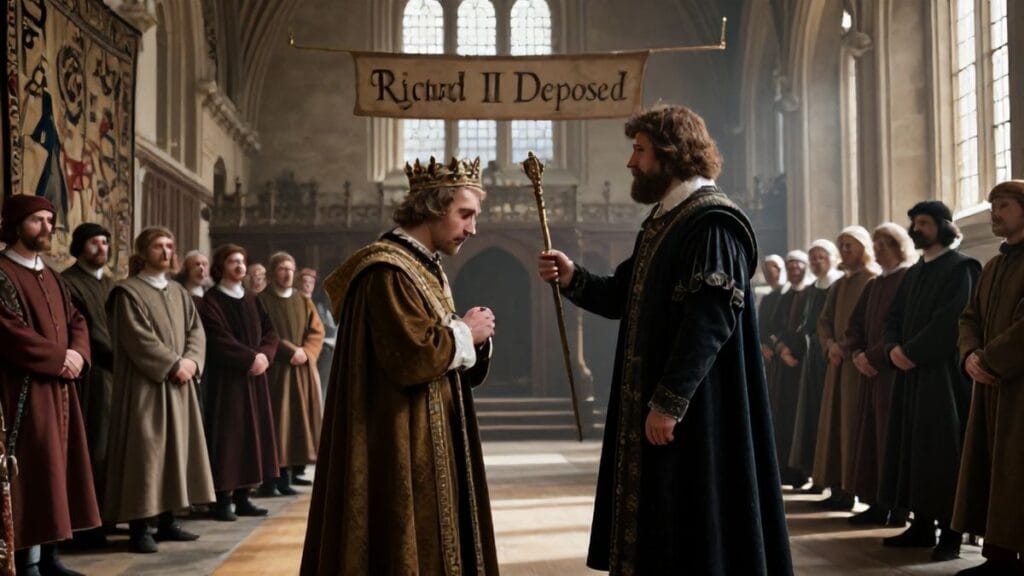
Westminster Hall on 29 September 1399 was a theater of power. Long tables were set; benches were arranged; great lords, bishops, abbots, and knights took their places beneath the soaring hammer-beam roof. The air was thick with expectation, and perhaps with a certain fear. Everyone knew that the events of this day—the formal deposition of Richard II—would set a precedent. If one anointed king could be unmade in such a fashion, what did that mean for the very nature of monarchy?
The proceedings opened with the reading of the supposed instrument of abdication. In it, Richard was made to confess that he had ruled unjustly, harmed the realm, and willingly surrendered the crown. The act of reading itself was laden with symbolism: the absent king’s own words, or at least words ascribed to him, being publicly proclaimed as the foundation for his downfall. Then came the articles of deposition, forty or more counts cataloguing his misrule. They spoke of unlawful arrests, vindictive prosecutions, financial extortions, and the manipulation of courts and parliaments. Here, in legal prose, his grand vision of sacral kingship was translated into a bill of indictment.
Witnesses later recalled that consent was sought from the assembled estates of the realm. Did they agree that Richard should no longer be king? Voices responded in the affirmative. It is impossible to know how many did so enthusiastically, how many in fear or calculation. Yet in that collective murmur of assent, the transformation was completed: the deposition of Richard II was no longer the act of one man or faction; it was, at least on paper, the decision of England’s political community. One chronicler describes how Henry, still outwardly deferential, was then invited to take up the burden of kingship, declaring that he claimed the throne by right of descent and by the will of God and the people.
What Richard himself felt that day we can only imagine; he was not present in the hall. But the ceremony was crafted to erase the distance between personal and institutional change. This was not, its architects insisted, a coup but a lawful correction of a failed kingship. The deposition of Richard II thus emerged as a strange hybrid: a revolutionary act cloaked in conservative language, a break with the past justified as a return to true principles of governance.
Voices in the Hall: Articles of Misrule and Accusation
The list of charges read against Richard II in Westminster Hall reveals not only the grievances of his enemies but also the expectations placed upon a medieval king. He was accused of squandering the royal revenues on unworthy favorites, of imposing harsh and irregular financial levies, of interfering with the independence of the courts, and of manipulating parliaments through intimidation and packed assemblies. He was said to have violated the oaths he swore at his coronation, trampling on the customary rights of both nobles and commoners.
These accusations painted a picture of a monarch who had turned personal vengeance into policy. The memory of Thomas of Woodstock’s mysterious death in Calais, the execution of Arundel, the exile of Warwick, and the dispossession of Bolingbroke all formed part of this narrative. Chroniclers sympathetic to the deposition, such as the author of the Westminster Chronicle, emphasized the king’s “unbridled will” and his determination to rule without counsel. Even those who did not favor Henry IV’s cause had to acknowledge that Richard’s actions made it easier for opponents to portray him as a tyrant. As one modern historian, Anthony Tuck, has observed, the case assembled against Richard was “both a legal fiction and a compilation of very real grievances.”
Yet within these lists there was also a measure of exaggeration and selective memory. Richard’s preference for peace with France, for instance, was framed as weakness rather than prudence. His attempts to assert royal prerogative were depicted as unprecedented when, in fact, earlier kings had also struggled to control their magnates. The deposition of Richard II thus stands at a crossroads of interpretation: was it a justified response to genuine abuses, or a carefully crafted propaganda campaign by a group of ambitious nobles who sought to mask their own power grab under the veil of public interest?
Whatever the balance of truth and distortion, the language of the articles is revealing. It roots the legitimacy of kingship not simply in divine anointing but in the king’s performance of certain duties: to uphold law, to protect property, to seek counsel, to promote justice. Richard, the charges declared, had failed so egregiously in these tasks that he had effectively abdicated his moral right to rule long before he surrendered the crown in writing. In this sense, the deposition of Richard II foreshadowed later constitutional struggles, suggesting that even in a monarchy, rulers could be held accountable to standards beyond their personal will.
A Crown Handed On: Henry IV and the Birth of a New Dynasty
With the formalities of deposition complete, Henry Bolingbroke stepped forward to claim the vacant throne. Styling himself Henry IV, he invoked both blood and necessity: he was, he argued, a rightful heir as a descendant of Henry III, and he had been called by the will of God and the people to rescue the realm from misrule. The careful phrasing sought to navigate a treacherous legal and moral landscape. To present himself simply as conqueror would be to invite condemnation and rebellion; to appear as a humble servant of the commonwealth bestowed a kind of moral legitimacy upon his ascent.
Ceremony followed swiftly. Henry was soon crowned in Westminster Abbey with the usual rites, anointed with holy oil, invested with the symbols of kingship. Yet the shadow of the deposition of Richard II hung over the glittering proceedings. Those present knew that, unlike previous accessions, this one had not followed the straightforward path of hereditary succession. Something had been broken, and it could not easily be repaired. A precedent now existed: if a king could be judged and removed by parliament and nobles, then might not future kings face the same fate if they displeased powerful factions?
Henry’s early reign was thus marked by a curious blend of confident assertion and anxious defensiveness. He had achieved his goal, yet he knew that his title, though consecrated by clerical blessing and parliamentary proclamation, rested on contested ground. Rebellions and plots would arise in the years to come, some invoking the memory of Richard II as a rallying point. Henry’s efforts to manage this legacy would shape not only his policies but also England’s political culture for generations.
Still, for many who had chafed under Richard’s rule, the new king offered hope. He promised respect for law, consultation with parliament, and a more measured use of royal power. Whether he fully delivered on these promises is another question, but in the immediate aftermath of 1399, a sense of having passed through a dangerous storm into calmer waters was palpable among Henry’s supporters. The crown had changed heads; the institution of monarchy endured, but altered, bearing the invisible mark of the deposition of Richard II.
The Fate of the Fallen King: Imprisonment and Death
Even after Henry IV’s coronation, one question loomed: what should be done with Richard II? As long as he lived, the deposed king remained a potential rallying point for discontented nobles, foreign powers, or popular movements. The English political imagination had long memories; tales of earlier usurpations and restorations circulated in chronicles and oral tradition. A living ex-king was both an embarrassment and a danger.
Initially, Richard was moved from the Tower of London to more remote locations, eventually ending up in Pontefract Castle in Yorkshire. The harshness of his captivity is contested, but he was certainly isolated and carefully guarded. There would be no dramatic public trial, no staged confession, no official execution. Instead, in early 1400, news spread that Richard II was dead. The circumstances remain murky. Some sources suggest that he was deliberately starved; others hint at more direct violence; a few propose suicide, though this seems less likely. The official line held that he died of “foul grief”—a phrase that left much unsaid.
His body was brought south, exhibited at St Paul’s Cathedral in London for identification, and then buried—first at King’s Langley and later, under Henry V, reinterred with royal honors in Westminster Abbey beside his first wife, Anne of Bohemia. These reburials were not mere acts of piety; they were political gestures, attempts to manage the memory of the deposed king. By granting him a noble resting place, Henry V in particular sought to close the wounds left by the deposition of Richard II, turning a controversial figure into a tragic, safely deceased ancestor.
Yet rumors persisted that Richard had somehow survived, that the body in the coffin was a substitute, that the rightful king waited in exile abroad. Such stories surfaced during later rebellions, used by enemies of the Lancastrian regime to cast doubt on its legitimacy. Whether believed or not, they testify to the difficulty of erasing so dramatic a figure from the collective consciousness. Richard might be dead, but the questions his fall raised—about monarchy, justice, and the limits of power—remained vibrantly alive.
Echoes Through England: Political and Social Consequences
The deposition of Richard II did not merely rearrange the names on royal charters; it reverberated through English politics and society in subtle and overt ways. For the political elite, it upended the hierarchy of obligation and loyalty. Magnates who had played a role in Richard’s downfall gained new influence, but they also acquired new vulnerabilities. They had demonstrated that a king could be made and unmade by collective action; they could not easily pretend, thereafter, that their own positions were beyond challenge.
Parliament emerged from the crisis with an enhanced, if still precarious, sense of its authority. Its consent had been publicly invoked to legitimize the deposition and Henry IV’s succession. This did not turn England overnight into a constitutional monarchy, but it did provide a powerful precedent for the idea that kings should rule “with the advice and assent” of the estates of the realm, and that their failure to do so might have dire consequences. Future debates over royal prerogative and parliamentary rights would look back, implicitly or explicitly, to 1399 as a reference point.
Among ordinary people, reactions varied. Some rejoiced at the fall of a king they blamed for high taxes, favoritism, or local injustices. Others were uneasy, sensing that the mystique of kingship had been damaged in ways that might make the world more unstable. When the man said to be an earthly reflection of divine authority could be deposed, what else might be called into question? Sermons and popular tales grappled with these uncertainties, sometimes casting Richard as a cautionary example of pride and tyranny, sometimes as a pitiable figure undone by fate and treacherous advisers.
Socially, the change of dynasty did not produce immediate revolution. The structures of landholding, law, and daily life persisted. Yet the deposition of Richard II contributed to a climate in which questions of legitimacy and obedience became more fluid. Local disputes over authority could now be narrated in terms borrowed from the national stage: Was a lord a just ruler or a petty tyrant? Did those below him have the right, in extremity, to resist? The language that had been used to justify removing a king could, in modified form, be applied elsewhere.
Memory, Propaganda, and the Legend of Richard II
In the years after 1399, the story of Richard II’s reign and fall was told and retold, each version serving the needs and anxieties of its time. Official chronicles under Henry IV naturally emphasized Richard’s alleged misdeeds and praised the new king as a savior of the realm. Poems and political tracts circulated that contrasted Richard’s supposed extravagance and cruelty with Henry’s supposed moderation and justice. Yet beneath the official narrative, alternative memories endured.
Some members of the gentry and clergy remembered Richard as a generous patron or a gracious presence at local ceremonies. In certain regions, particularly in the north and in parts of Wales, his image as a wronged king lingered. Tales arose—half-legend, half-hope—that he would one day return to reclaim his crown, echoing older European myths of the “sleeping king” who would rise in his people’s hour of need. These stories, though never dominant, contributed to periodic conspiracies and uprisings in the early 1400s.
Centuries later, Richard II’s legend would be reshaped yet again, most famously by William Shakespeare. In his play Richard II, the dramatist turned the deposition into a deeply moving meditation on identity, power, and the fragility of human greatness. Shakespeare’s Richard begins as a somewhat vain and capricious ruler, but in losing his crown he gains tragic self-awareness. “Not all the water in the rough rude sea / Can wash the balm off from an anointed king,” he declares, insisting on the indelible sacredness of his office even as it slips from his grasp. The play does not simply endorse or condemn the deposition of Richard II; instead, it invites audiences to feel its human cost and ethical ambiguity.
Modern historians, drawing on a wider array of sources, have offered more nuanced portraits. Some emphasize Richard’s genuine administrative initiatives and his preference for peace; others stress his increasing detachment from political realities and his reliance on intimidation. As historian Nigel Saul argues, Richard was “a ruler of considerable intelligence and imagination,” whose “conception of kingship outstripped the political structures of his time.” In this reading, the tragedy lies not only in his fall but in the mismatch between his ideals and the world he sought to govern.
The Deposition’s Long Shadow: Civil Wars and Broken Lineages
The significance of the deposition of Richard II did not end with his death or even with the consolidation of Henry IV’s reign. It cast a long shadow over the fifteenth century, contributing—directly and indirectly—to the dynastic conflicts known as the Wars of the Roses. The Lancastrian claim to the throne, founded on the ousting of a legitimate, anointed king, remained vulnerable to challenge. Rivals could, and did, argue that the line descending from another branch of the royal family—particularly the house of York—had a stronger hereditary claim.
When Henry IV’s son, Henry V, achieved dazzling military victories in France, he briefly seemed to erase the doubts about his dynasty’s origins. But his early death in 1422 and the minority of his son Henry VI reopened fundamental questions about legitimacy and competence. As political factions formed around competing royal uncles and cousins, the memory of 1399 reemerged as a dangerous precedent. If a king could be removed once for failure or perceived unfitness, why not again? When Henry VI’s mental illness and political weakness became manifest, some of his opponents cited the deposition of Richard II as an example of how England had previously dealt with a failing monarch.
In this way, the events at Westminster in 1399 helped normalize, to a degree, the idea that the crown might pass through extraordinary means. The result was not a stable constitutional mechanism for removing kings, but rather a climate in which coups, usurpations, and counter-usurpations became thinkable options in moments of crisis. The Wars of the Roses—from the accession of Edward IV to the brief reign of Henry VI’s restoration and the eventual rise of the Tudors under Henry VII—can be read as a prolonged struggle to resolve the tensions unleashed when Richard II was deposed.
By the time the Tudor dynasty firmly established itself, the memory of these earlier upheavals became both a cautionary tale and a tool of statecraft. Tudor propagandists emphasized the chaos of the preceding century to underscore the necessity of strong, centralized monarchy. Yet the knowledge that kings had been unmade before lingered, resurfacing in later centuries during the struggles that led to the execution of Charles I and the Glorious Revolution of 1688. At each of these turning points, historians and political thinkers looked back, explicitly or not, to the first great late-medieval experiment in removing a sovereign: the deposition of Richard II.
How Historians See It: Tyrant, Tragic Hero, or Sacred King?
Modern scholarship has circled around Richard II with a mixture of fascination and disagreement. Was he primarily a tyrant, whose deposition was a regrettable but necessary corrective? A tragic idealist, undone by the limitations of his age and his own character flaws? Or a sacred king whose removal tore at the spiritual fabric of medieval kingship? The answers vary according to which sources are emphasized and which interpretive lenses are applied.
Some historians, particularly those writing in the wake of nineteenth-century constitutionalism, tended to view Richard as a despot in the making. They focused on his revenge against the Lords Appellant, his financial exactions, and his manipulation of parliaments, seeing in the deposition of Richard II an early, almost proto-constitutional stand in defense of aristocratic liberties and the rule of law. In this view, Henry IV appears as a pragmatic reformer who, despite the blemish of usurpation, prevented worse abuses by removing an incipient autocrat.
Others, especially in the later twentieth and twenty-first centuries, have complicated this picture. They note that Richard inherited a war-torn, faction-ridden kingdom and that his efforts to assert strong royal authority had precedents in earlier reigns. They emphasize his artistic patronage, his administrative reforms, and his desire for peace as signs of a sophisticated, if sometimes impractical, ruler. For such scholars, the deposition of Richard II looks less like a heroic defense of liberty and more like a successful aristocratic rebellion, cloaked in the rhetoric of moral outrage.
Still other interpreters are drawn to Richard’s psychological and symbolic dimensions. They see in his insistence on sacral imagery and rigid hierarchy the struggles of a man who believed deeply in the divine nature of his office but lacked the political flexibility to maintain it. His story, in this reading, is a cautionary tale about the dangers of confusing theatrical majesty with genuine power. The more he wrapped himself in the imagery of inviolable kingship, the less able he became to adapt to changing circumstances and negotiate with those whose cooperation he needed.
Citation-rich studies, such as Nigel Saul’s Richard II (1997) or the essays collected in the volume Henry IV: The Establishment of the Regime, 1399–1406, underline how the deposition of Richard II remains a fertile field for debate. It stands at the intersection of politics, law, theology, and culture. To see Richard only as villain or victim is to miss the complexity of a reign in which genuine innovation and serious misjudgment were inextricably entwined.
Conclusion
On that September day in 1399, as voices in Westminster Hall assented to the removal of Richard II, few could have fully grasped the magnitude of what they were doing. They were not only ending one man’s reign; they were rewriting, almost unconsciously, the unwritten rules of English monarchy. The deposition of Richard II exposed the fragile underpinnings of royal authority, showing that it depended not only on divine sanction and ritual but on the consent—however grudging—of those powerful enough to support or resist it.
Richard’s life and downfall embody a series of paradoxes. He was both a visionary and a vengeful ruler, a patron of the arts who could be ruthless in politics, a man who believed passionately in the sacredness of his office yet sometimes wielded it with startling self-interest. His attempt to elevate kingship to almost untouchable heights ultimately made his fall all the more dramatic, and all the more instructive. In trying to lift the crown above politics, he drew politics more dangerously into its orbit.
The legacy of his deposition rippled through generations: in Henry IV’s uneasy kingship, in the dynastic bloodshed of the fifteenth century, in the political thought that gradually articulated limits on royal power. Centuries later, when Englishmen argued over the rights of parliament, the responsibilities of kings, and the grounds on which a ruler might be resisted or removed, they were, knowingly or not, walking paths first cut in 1399. The story of Richard II’s rise and fall remains compelling not only because of its human drama, but because it marks one of the moments when the medieval world’s assumptions about authority and obedience began, quietly but unmistakably, to shift.
FAQs
- What was the deposition of Richard II?
The deposition of Richard II was the formal removal of King Richard II of England from the throne on 29 September 1399 at Westminster. It involved the presentation of an alleged abdication document, the reading of numerous charges of misrule, and the public recognition of Henry Bolingbroke (Henry IV) as the new king. - Why was Richard II deposed?
Richard II was deposed because many powerful nobles and political figures believed he had abused his powers, pursued personal revenge against opponents, mishandled royal finances, and violated established legal and political customs. His seizure of Henry Bolingbroke’s inheritance and his harsh treatment of former opponents, like the Lords Appellant, convinced many that he posed a danger to the stability of the realm. - Who replaced Richard II on the throne?
Richard II was replaced by his cousin Henry Bolingbroke, who became King Henry IV. Henry justified his accession through a combination of hereditary claims and the argument that he had been called by the will of God and the estates of the realm to rescue England from misgovernment. - What happened to Richard II after his deposition?
After his deposition, Richard II was imprisoned in various locations, eventually held at Pontefract Castle in Yorkshire. In early 1400 he died under mysterious circumstances, commonly thought to have involved deliberate starvation. His body was displayed in London for identification and later buried, ultimately being reinterred with royal honors in Westminster Abbey. - How did the deposition of Richard II affect English politics?
The deposition had profound effects on English politics. It set a precedent for removing a king on the grounds of misrule, enhanced the perceived authority of parliament in questions of succession, and left the Lancastrian dynasty with a permanently contested claim. This instability contributed to later conflicts, including the Wars of the Roses. - Was the deposition of Richard II legal?
The legality of the deposition is debated. Henry IV and his supporters constructed a legal framework involving Richard’s alleged voluntary abdication and parliamentary approval, but critics argue that this was essentially a legal facade covering a successful coup. From a modern perspective, it combined genuine grievances with political opportunism. - How is Richard II portrayed in Shakespeare’s play?
In Shakespeare’s Richard II, the king is portrayed as a complex, poetic, and ultimately tragic figure. He begins as an imperious, somewhat careless ruler but gains profound self-awareness as he loses his crown. The play emphasizes the emotional and spiritual dimensions of his fall, turning the deposition into a meditation on identity, legitimacy, and the sacredness of kingship. - Did ordinary people support the deposition?
Evidence suggests a range of reactions. Some urban elites and local gentry welcomed Henry IV as a stabilizing force and resented Richard’s fiscal demands and favoritism. Others were unsettled by the breaking of the taboo against deposing an anointed king. Popular opinion was not uniform and could shift over time, especially as later rebellions invoked Richard’s memory. - How did the Church view the deposition of Richard II?
The higher clergy largely accepted the deposition, participating in the ceremonies that legitimated Henry IV. Officially, the Church emphasized the need for peace and order. However, the idea of unmaking a consecrated monarch raised difficult theological questions. Over time, many clerical writers justified the act by arguing that Richard had violated his coronation oaths and thus forfeited divine favor. - What long-term impact did the deposition have on the English monarchy?
In the long term, the deposition of Richard II undermined the notion of absolutely inviolable monarchy and contributed to a political culture in which kings were expected to govern in accordance with law, counsel, and the common good. While it did not create constitutional monarchy in the modern sense, it foreshadowed later struggles over royal power and parliamentary rights that would profoundly shape English and British history.
External Resource
Internal Link
Other Resources
- Encyclopaedia Britannica – general search for the exact subject
- Google Scholar – academic search for the exact subject
- Internet Archive – digital library search for the exact subject

