Table of Contents
- Alexandria on the Eve of Upheaval
- The Serapeum: A Temple Above a City
- Gods of Stone, Scrolls of Papyrus: Knowledge and Worship Intertwined
- From Tolerance to Tension: Christians and Pagans in Late Roman Alexandria
- Imperial Decrees and Holy Zeal: The Road to Confrontation
- The Riot of 391: Blood on the Steps of the Serapeum
- Besieged in the Sanctuary: The Last Pagan Stronghold
- Ambrose, Theodosius, and the Letters that Sealed a Temple’s Fate
- The Day the Colossus Fell: The Destruction Unleashed
- Fire, Rubble, and Relics: What Really Died at the Serapeum?
- From Temple to Church: Reclaiming Sacred Ground
- Alexandrian Lives Shattered and Remade
- The Library Question: Myth, Memory, and Misunderstanding
- Echoes Through the Centuries: Historians, Apologists, and Accusations
- The Serapeum in the Long Story of Religious Violence
- Archaeology Among the Ruins: Tracing a Lost Sanctuary
- Modern Reflections: Identity, Fanaticism, and Cultural Loss
- Conclusion
- FAQs
- External Resource
- Internal Link
Article Summary: In 391 CE, Alexandria witnessed one of antiquity’s most charged cultural confrontations: the destruction of the Serapeum, a temple that towered over the city both physically and symbolically. This article explores how a sanctuary dedicated to the god Serapis became the last bastion of pagan resistance in a world rapidly turning Christian. Moving through political decrees, street violence, and emotional testimonies, it recounts how imperial policy, local rivalry, and religious fervor converged to produce the destruction of the serapeum and to reshape Alexandria’s identity. We follow the lives of ordinary citizens, philosophers, monks, and soldiers to understand what was truly at stake when marble idols were shattered and altars overturned. Along the way, we unravel myths about burned libraries, interrogate ancient sources like Rufinus and Socrates Scholasticus, and weigh how much knowledge may have been lost. The narrative then traces the transformation of the sacred hill from a pagan sanctuary into a Christian symbol, and how that metamorphosis echoed in later persecutions and memories. Ultimately, the story shows that the destruction of the Serapeum was not just about broken stones, but about the collapse of an entire worldview. And even today, debates over the destruction of the Serapeum continue to mirror our own struggles over belief, tolerance, and the preservation—or erasure—of cultural heritage.
Alexandria on the Eve of Upheaval
On a humid evening in 391 CE, as the sun bled into the Mediterranean, Alexandria appeared, at first glance, as it had for centuries: a city of marble colonnades, crowded harbors, and a babel of languages rising like incense from its markets. Sailors from Cyprus shouted over the din of grain merchants; Jewish scholars argued fine points of law in shaded courtyards; Greek philosophers strolled beneath porticoes, their hands moving in arcs that traced invisible syllogisms in the air. Yet behind this familiar bustle, the city stood at a precipice. The destruction of the Serapeum had not yet occurred, but its possibility hung over Alexandria like a storm cloud, dense and electric, waiting to break.
Alexandria had always been a city of mixtures. Founded by Alexander the Great in 331 BCE, it had since grown into the intellectual heart of the Hellenistic world and then a jewel in the Roman crown. Here, the Nile’s fertile wealth met the shipping lanes of the eastern Mediterranean; here, Egyptian priests shared streets with Greek rhetoricians and Roman administrators. It was a place where identities overlapped like palimpsests, each new inscription half covering but never fully erasing what lay beneath.
By the late fourth century, however, another layer had been added with astonishing force: Christianity. What had begun as a persecuted minority faith now commanded the ear of emperors. Basilicas rose beside shrines of Isis; processions of monks wound past silent colossi of forgotten gods. And at the city’s southwestern height, looming over the dense urban fabric like a crown, the Serapeum still stood—massive, revered, and increasingly, to some, intolerable.
It is astonishing, isn’t it, how quickly a city’s spiritual map can change? Only decades earlier, the cult of Serapis, with its promise of healing, salvation, and cosmic order, had drawn worshipers from across the empire. Now, bishops denounced the same god as a demon, and Christian preachers urged their flocks to abandon the old sacrifices and smash the idols that had once guarded Alexandria’s fortunes. The destruction of the serapeum would crystallize these tensions into a single violent act, but for years beforehand, the city had been slowly, grindingly preparing for that moment.
As dusk settled, torches flickered along the Canopic Way. Somewhere in the city, a Christian widow taught her child to trace the sign of the cross; in another quarter, an aging priest of Serapis lit a lamp before the god’s statue, whispering prayers in Greek and Egyptian. Neither knew that, within a single year, the balance between their worlds would be irrevocably overturned.
The Serapeum: A Temple Above a City
To understand why the destruction of the Serapeum reverberated so deeply, one must first picture the temple itself. The Serapeum was not merely another sanctuary among Alexandria’s many shrines; it was, as ancient authors remarked with a mix of awe and envy, one of the marvels of the Roman world. Erected on a raised acropolis-like hill in the southwestern district called the Rhakotis, it towered over the city in both a literal and symbolic sense. Pilgrims climbing its monumental stairway would have felt the city fall away behind them, street noise replaced by the rhythmic thud of their own footsteps against stone.
Massive colonnades ringed a vast courtyard, their shafts of polished granite catching the sun like spears of red light. At the center rose the main sanctuary of Serapis, its doorways guarded by statues of lions and sphinxes—a quiet nod to the temple’s Egyptian roots. Within, in a space heavy with incense, stood the cult statue of Serapis himself: a majestic, bearded figure, part Greek Zeus, part Egyptian Osiris, crowned with a grain-measure (the modius) symbolizing destiny and abundance. His right hand may have held a scepter or a serpent; his left perhaps rested protectively upon the three-headed dog Cerberus, a sign of his dominion even over the underworld.
The Roman historian Ammianus Marcellinus, writing in the mid-fourth century, marveled at the Serapeum, ranking it with the Capitol in Rome and the temples of Jupiter at Baalbek as among the world’s greatest sanctuaries. That he felt compelled to place this Alexandrian temple in such exalted company tells us how its scale and splendor impressed contemporaries. The destruction of the serapeum was not, then, the toppling of a neglected provincial shrine; it was the deliberate defacement of a building that encapsulated the city’s sense of itself.
Surrounding the main temple were subsidiary chapels, libraries, lecture halls, and courtyards. The Serapeum was not isolated from Alexandria’s intellectual life—it was stitched into it. One could, in theory, perform a sacrifice to Serapis in the morning, consult a priest-physician about an illness at noon, and listen to a philosophical disputation on Plato by evening, all without leaving the temple precinct. It was, as much as any monument could be, a living representation of the fusion of Greek, Egyptian, and Roman cultures that Alexandria embodied.
From the city below, the temple’s silhouette cut an unforgettable profile against the sky. For centuries, travelers approaching Alexandria by sea would see, first, the distant flicker of the Pharos lighthouse and, then, as they drew closer, the hill of the Serapeum rising above the western quarter. It announced itself as a second beacon, not of navigation, but of spiritual and cultural authority. To bring such a monument to ruin would be to rewrite the skyline, and with it the mental map by which generations had come to know Alexandria.
Gods of Stone, Scrolls of Papyrus: Knowledge and Worship Intertwined
Religion in the ancient world was seldom confined to the purely “spiritual.” At the Serapeum, cult and knowledge interlocked so tightly that when the temple fell, many believed that an entire archive of learning fell with it. From the Ptolemaic period onward, temples in Egypt had served as repositories of books and centers of scholarly activity. While the famous Mouseion and the Great Library of Alexandria occupied the eastern part of the city, tradition held that an auxiliary, or “daughter,” library existed within or near the Serapeum.
Just how extensive this library was remains a matter of intense debate among historians. Ancient sources hint that when Julius Caesar’s forces set fire to the ships in Alexandria’s harbor in 48 BCE, the flames spread and destroyed warehouses containing papyrus scrolls destined for the Library. Later writers, eager to explain how the city’s intellectual life persisted, suggested that copies of many works were preserved at the Serapeum. By the Roman period, the complex certainly contained book collections used by grammarians, philosophers, and priests who studied both Greek philosophy and Egyptian sacred texts.
Imagine, then, a typical day in the second century. A Stoic tutor arrives leading a small knot of aristocratic boys, their wax tablets tucked under their arms. Passing beneath tall columns, they step into a cool corridor lined with niches. In each niche sit stacks of papyrus rolls, some labeled with red-inked titles: treatises of Aristotle, medical compendia in the tradition of Herophilus, hymns to Isis, astrological manuals calculating the fates. The young students, awestruck, are reminded that knowledge itself resides under the protection of Serapis.
In this world, theology and science were not separate compartments. The priests who tended Serapis might also be astronomers, recording the risings of stars; they might be healers prescribing herbal remedies; they might be scribes copying texts of Homer as eagerly as they preserved liturgies. The Serapeum was, in this sense, a crucible where the sacred and the scholarly mingled, each reinforcing the other’s authority. The destruction of the serapeum therefore threatened to break chains of transmission not only of cult practice but of accumulated learning.
To be sure, by 391 the intellectual center of gravity had already shifted. Christian theologians, Neoplatonist philosophers, and secular administrators maintained their own libraries and schools elsewhere in the city. But the symbolism remained powerful: if this temple of stone and papyrus could be torn down, then the old ways—religious, philosophical, and cultural—could, in theory, be effaced altogether. That prospect filled some with apocalyptic dread and others with almost ecstatic anticipation.
From Tolerance to Tension: Christians and Pagans in Late Roman Alexandria
For centuries, Alexandria had managed an uneasy but generally workable pluralism. Jews, Egyptians, Greeks, and various immigrant communities worshiped their own gods, kept their own customs, and quarreled only periodically. Under the early empire, Roman authorities usually cared less about which deities their subjects revered and more about whether taxes were paid and order maintained. But by the fourth century, the ground had shifted.
After Emperor Constantine’s conversion in the early 300s, Christianity enjoyed imperial favor, and by mid-century, it had become deeply embedded in urban life. In Alexandria, bishops wielded influence not only in spiritual matters but in civic ones. Churches multiplied; Christian schools flourished. At the same time, paganism did not vanish overnight. Temples still rang with chants; philosophers still invoked the gods of Olympus and Egypt in their metaphysical speculations. For decades, Christians and pagans shared the same streets, sometimes the same families, their lives braided together with a mixture of suspicion and familiarity.
The cracks began to widen as imperial legislation turned gradually from patronage of Christianity to active suppression of pagan practices. Theodosius I, ruling from 379, was especially zealous. A series of edicts issued between 379 and 391 chipped away at the public standing of the old cults: banning sacrifice, closing some temples, and prohibiting the consultation of oracles. Such measures did not always translate smoothly into provincial practice, but they sent a clear signal: the gods of the ancestors were no longer legitimate partners in Rome’s destiny.
In Alexandria, these laws intersected with fierce local rivalries. The city’s bishop, Theophilus, was a formidable and, by many accounts, combative figure. His relations with pagan elites were strained; so too were his dealings with other Christian groups, such as the followers of Origen. The Serapeum, as the city’s most prestigious pagan institution, became a kind of symbolic fortress in these factional struggles. For pagans, it represented continuity and dignity; for an ambitious bishop, it was an affront—an insolent reminder that Christianity did not yet command every sacred space.
Yet human lives do not align perfectly with ideological lines. There were pagans who admired Christian charity, Christians who secretly consulted astrologers or revered ancient statues as “mere art,” and ordinary Alexandrians who simply wanted to avoid trouble. A Christian shopkeeper might sell garlands to a pagan priest on festival days. A pagan philosopher might take Christian students eager to learn rhetoric. But as imperial bans hardened, such everyday accommodations grew fraught. When, at last, violence erupted on the steps of the Serapeum, it did so atop a bed of long-compacted resentments and fears.
Imperial Decrees and Holy Zeal: The Road to Confrontation
By the end of the 380s, the gap between imperial law and local practice in Alexandria was narrowing dangerously. In 380, Theodosius issued the Edict of Thessalonica, declaring Nicene Christianity the official religion of the empire. Over the next decade, new edicts condemned sacrifice as a form of treason and ordered that temples be closed or repurposed. Local governors were charged—at least on paper—with enforcing these measures, but many hesitated, knowing that sudden moves against beloved sanctuaries could trigger riots.
Bishop Theophilus, however, seems to have read the imperial mood with ruthless clarity. Sensing that the tide had turned irreversibly, he pushed beyond mere compliance toward active humiliation of the old religion. Ecclesiastical sources recount that he obtained permission to convert a small pagan temple—some say it was a Mithraeum—into a church. In the process, Christian workers uncovered grotesque cult images that they paraded through the streets, mocking them to the laughter of the Christian crowd.
For pagan devotees, this was salt in a wound. Statues that, in their eyes, housed the living presence of divinity were being dragged in dust and jeered at by upstarts. Theophilus’s message was unmistakable: the gods of Egypt and Greece were no longer to be feared or honored; they were to be ridiculed. The destruction of the serapeum was not yet in view, but the pattern was unmistakable. If even minor shrines could be despoiled with impunity, what sanctuary remained truly safe?
At the same time, ascetic monks from the deserts of Egypt poured into the city in increasing numbers. Hardened by lives of fasting and solitude, they regarded themselves as spiritual soldiers in a cosmic war. Temples, to their eyes, were not merely vestiges of an outdated culture; they were fortresses of demons. When given even a hint of ecclesiastical approval, they hurled themselves at shrines with unbridled fury, smashing statues and altars as acts of piety. Urban Christians, less inclined to such extremes, sometimes watched uneasily, but the rhetoric of the time left little room for compromise.
Thus, law, leadership, and popular fervor together created a tinderbox. A minor insult, a rash sermon, a misinterpreted gesture—any of these could ignite catastrophe. It did not take long for the spark to come.
The Riot of 391: Blood on the Steps of the Serapeum
The precise sequence of events that triggered the Serapeum crisis is reconstructed from fragmentary and biased sources, but the broad contours stand out with chilling clarity. According to the church historian Socrates Scholasticus, the initial clash began when Christians, emboldened by Theophilus’s campaigns against pagan shrines, turned their sights on the Serapeum’s lower precincts or associated structures. Some tried to seize or desecrate altars; others, we are told, mocked the rituals of the Serapis cult within earshot of its adherents.
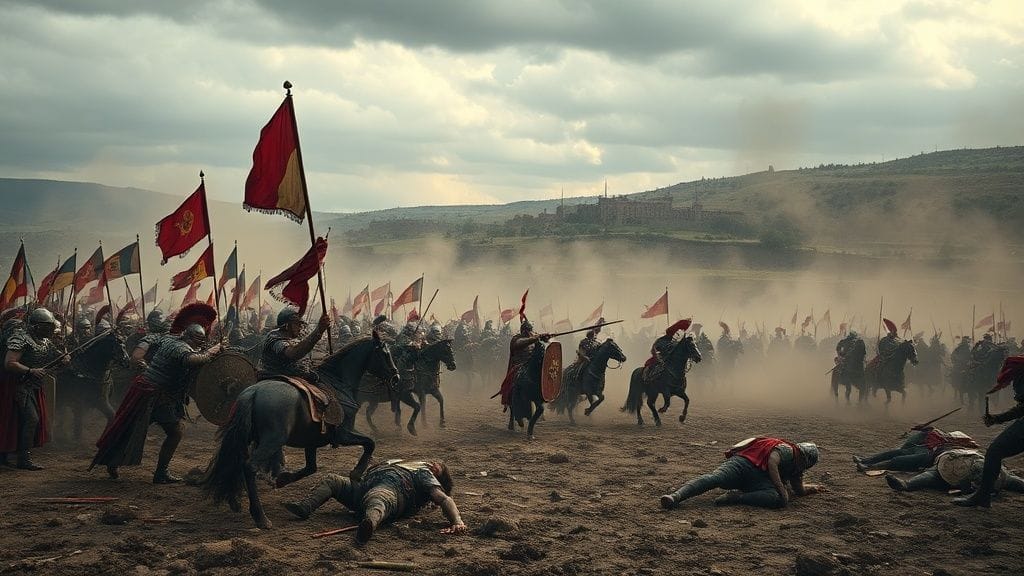
The response was swift and violent. Pagans, infuriated, armed themselves with whatever lay at hand—stones, staffs, tools—and drove their opponents back. Amid the chaos, several Christians were captured and dragged toward the temple. In the heat of rage, some of these captives were reportedly tortured and killed within the Serapeum complex itself. Rufinus of Aquileia, another ecclesiastical historian, describes Christians being sacrificed to the old gods in savage retribution, although such accounts likely exaggerate the ritual aspect to paint paganism in the darkest possible colors.
What is beyond dispute is that blood was spilled, and the Serapeum became a fortress. Pagans, along with sympathizers and perhaps even some curious onlookers swept up in the violence, barricaded themselves inside the temple complex. The steps that had once borne the feet of pilgrims now bristled with defenders hurling missiles at any who approached. From below, Christian crowds gathered, shouting curses and prayers; city officials hovered on the fringes, unsure how far to push for fear of triggering a massacre.
For those trapped within the Serapeum, the mood must have been a heady mixture of defiance and dread. The great colonnades that had once welcomed festivals and philosophical debate now served as bulwarks in a siege. Statues of the gods looked down unblinking upon makeshift barricades. Somewhere in the sanctum, the gigantic figure of Serapis loomed in semi-darkness, his stone serenity mocking the desperation of his devotees. Was the god listening? Would he intervene? Or had his power already fled before the relentless advance of the Christian cross?
Outside, rumors flew. Some claimed the pagans were stockpiling weapons and planning a broader assault on Christians. Others whispered that sacred treasures were being prepared for removal, spirited away to secret caches. The bishop’s supporters demanded firm action; moderates counseled negotiation. Each passing day tightened the knot of tension around the Serapeum, turning architecture into battlefield, faith into weapon.
Besieged in the Sanctuary: The Last Pagan Stronghold
As days stretched into weeks, the Serapeum became a microcosm of a dying religious order. Within its walls gathered an extraordinary cross-section of Alexandrian pagan society: elderly priests who had spent lifetimes tending altars; young men whose education had steeped them in Homer and Plato; artisans attached to the temple’s service; perhaps even a few wavering souls who, though already Christianized, found themselves drawn back to the sanctuary in the turmoil, unable to sever entirely the emotional bonds of childhood devotions.
The siege was more psychological than military. No Roman legions stormed the hill; instead, the temple’s defenders faced the slow suffocation of dwindling supplies and the gnawing realization that the imperial authorities were unlikely to rescue them. Every sound from the city below—the chanting of Christian processions, the tolling of bells, the occasional cheer—reminded them that they were now the minority, surrounded by a populace increasingly convinced that their gods were relics or, worse, demons.
Inside, arguments surely raged. Should they negotiate with the prefect? Surrender and throw themselves upon the mercy of the emperor? Or should they hold out as long as possible, transforming the Serapeum into a monument of resistance, an unforgettable last stand? Some may have imagined that their courage would shame the Christians or prompt Theodosius to intervene on behalf of order and tradition. Others, more realistic, knew that the flow of history had turned irrevocably against them.
In this tense interlude, the destruction of the serapeum existed only as a terrifying possibility, a whispered threat uttered by angry monks below and mulled in anxious silence by the besieged. Yet even in contemplating that possibility, they touched upon something deeper: what would it mean for their world if the very embodiment of their gods’ presence in Alexandria were smashed? Could philosophy survive without its sacred backdrop? Could cultural memory endure if its most visible monument fell?
At some point, envoys must have ventured between city officials and temple occupants, bearing proposals and counterproposals. But the real decision lay far away, in the imperial court, where a Christian emperor weighed the meaning of a single temple against the vision of a unified Christian empire.
Ambrose, Theodosius, and the Letters that Sealed a Temple’s Fate
Far to the west, in Milan, the bishop Ambrose held Theodosius’s conscience in a firm, if unofficial, grip. Ambrose had already proven his moral authority in dramatic fashion when, after the massacre at Thessalonica in 390, he demanded that the emperor perform public penance. Theodosius, humbled, complied. This set a precedent that the emperor, however powerful, was not above ecclesiastical rebuke.
When news of the Serapeum crisis reached the imperial court, it did not arrive as a neutral report of civic unrest. It came framed by Christian voices who described the pagans in the temple as murderers and rebels, and who presented the sanctuary itself as a nest of superstition prolonging the empire’s spiritual sickness. Ambrose wrote to Theodosius urging a firm, even ruthless, response. A temple in which Christians had been killed, he argued, could not remain standing as if nothing had happened.
Theodosius, for his part, had already outlawed sacrifices and closed many temples. But the Serapeum was different: its renown, history, and the sheer scale of its influence made any move against it a declaration with far-reaching consequences. Ultimately, the emperor decreed that those pagans sheltering in the Serapeum would be granted amnesty if they dispersed peacefully. However, the temple itself, along with any other remaining pagan sanctuaries in Alexandria that still functioned as centers of cult practice, was to be demolished.
It was, in effect, a death sentence passed from afar. The destruction of the serapeum had now been authorized at the highest level. When this decision reached Alexandria, the city prefect, local officials, and Bishop Theophilus each read in it something more than a simple administrative directive. For imperial representatives, it was an opportunity to demonstrate loyalty and restore order; for Theophilus, it was a divine mandate to complete what he saw as the purification of the city.
The besieged pagans were offered their lives, but at the cost of their temple. We do not know how this choice was presented, in what words, or whether some wept openly at the ultimatum. One imagines an old priest, hands trembling, running a calloused palm along a column’s cool surface for perhaps the last time. Could they bear to live in a city where the gods had been so publicly humiliated? Some may have harbored fantasies that, even with the decree, local resistance would prevent outright demolition. Those hopes, if they existed, were soon crushed.
The Day the Colossus Fell: The Destruction Unleashed
When the order was finally carried out, it unfolded with a strange, ritualistic intensity, as if the Christians felt compelled to reverse, step by step, the rites that had once sanctified the Serapeum. Accounts from Christian historians revel in the details. Rufinus relates, with undisguised satisfaction, how a bishop—likely Theophilus himself—ascended the sanctuary and, in full view of the gathered crowd, mocked the statue of Serapis before delivering the signal blow.
The great colossus, reputedly hollow and perhaps reinforced with wood, was attacked by soldiers, laborers, and zealots. Iron tools bit into stone; ropes were fixed; the statue swayed. Imagine the sound as it cracked and toppled, a shuddering roar that echoed off the colonnades and down into the city streets, mingled with the exultant cries of the onlookers. To Christians massed below, the fall of Serapis’ image signified the fall of the demon they believed had long enchanted Alexandria. To pagans watching from windows or distant alleyways, it must have felt like the sky itself tearing.
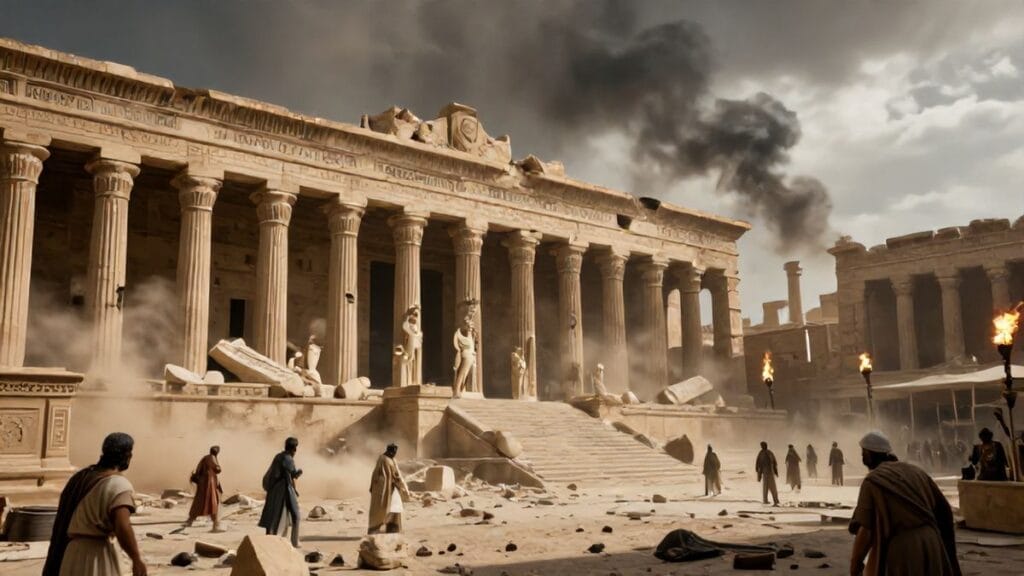
Once the central idol lay shattered, fury turned upon the rest of the temple. Columns were undermined and toppled; altars smashed; reliefs defaced. The very ground that had once been polished by processions was churned into mud and rubble. Monks, aflame with a sense of apocalyptic triumph, pried loose fragments of broken statues to be displayed as trophies or ground into dust. Some pieces of the Serapeum’s fine marbles were likely reused in churches, their pagan past half-forgotten beneath Christian mosaics.
Amid the chaos, certain objects were singled out for particular attention. Secret chambers were opened; subterranean passages explored. Theophilus is said to have paraded some of the temple’s sacra through the city, staging a procession of humiliation that inverted earlier celebrations of the god. In an act symbolic of total conquest, a cross was reportedly erected in the ruins, visible from far below. Where once incense had risen to Serapis, now Christian hymns pierced the dust-laden air.
The destruction of the serapeum was more than an episode of vandalism; it was a performance of power, carefully choreographed and deeply felt. Those who took part believed themselves actors in a cosmic drama: the triumph of Christ over the ancient gods. The rubble left behind was not a by-product; it was part of the message. A temple that for centuries had seemed immovable, eternal, was now reduced to shards. If this could fall, what else, they thought, could stand against the advancing kingdom of their God?
Fire, Rubble, and Relics: What Really Died at the Serapeum?
In the aftermath, dust settled slowly over the hill. Curiosity drew people to the site—Christians eager to witness the handiwork of divine justice, pagans mourning or secretly hoping to salvage small objects from the ruins. Among the most haunting questions that later generations asked was: what, exactly, perished in that wave of devastation? Did flames consume precious manuscripts, erasing forever works of philosophy, science, and poetry? Or had most of the Serapeum’s library already been dispersed, leaving only a symbolic husk to be trampled in 391?
Ancient sources are largely silent on the fate of books. Socrates Scholasticus, Rufinus, and Sozomen dwell on statues, altars, and rituals, not on scrolls. This omission has allowed imaginations to fill the gap. Some modern writers, eager for a dramatic narrative of lost wisdom, have portrayed the destruction of the serapeum as the final death-blow to the Great Library of Alexandria. Yet careful historians caution against such neat equations. The main library complex had likely suffered earlier, during Caesar’s campaigns, the civil wars of the third century, or the decree of Emperor Aurelian.
Still, it is hard to believe that no manuscripts were present in so vast and historically learned a sanctuary. Even if the Serapeum did not house a “second Great Library” in the romantic sense, it almost certainly contained collections of religious, philosophical, and scientific texts that had sustained its priestly and scholarly communities for generations. Racks of papyrus, stacks of codices, teaching materials used by grammarians—these may well have perished, whether in the heat of demolition, the neglect that followed, or the slow, damp decay of abandonment.
In that sense, the destruction of the serapeum represented a double loss. Concrete artifacts of culture—texts, inscriptions, artworks—vanished. But so too did the living community of interpretation that had animated them. A sacred story is carried not just by statues and scrolls but by rituals, conversations, and memories. Once the temple was desecrated, its priesthood scattered, its altars profaned, the chain of transmission was broken. A child born in Alexandria after 400 might grow up never having spoken with anyone who had sacrificed at the Serapeum, never having heard the chanted hymns to Serapis that once reverberated from its walls.
It is here that the event’s poignancy becomes almost unbearable. Civilizations do not end in a single day, but there are moments when the curtain falls abruptly on a particular stage. The destruction of the serapeum was one such moment, freezing in rubble the long, slow displacement of one religious worldview by another. The temple’s ruins were not merely evidence of physical ruin; they were a silence where once a thousand voices had mingled.
From Temple to Church: Reclaiming Sacred Ground
In late antiquity, no sacred space remained truly empty for long. Ruins invited reinterpretation; shattered altars beckoned to new cults. The hill that had borne the Serapeum was too prominent, too charged with meaning, to be left as a simple monument to absence. Christian sources tell us that within a relatively short time, a church was erected on or near the site of the former temple, its dedication transforming the hill’s spiritual orientation.
We do not know the exact architectural layout of this first church. It may have been a basilica, with a long nave flanked by colonnades and terminating in an apse where the altar stood. Some of the Serapeum’s granite columns quite possibly found second lives as supports for this Christian edifice, their capitals carved anew or simply recontextualized beneath frescoes depicting martyrs and apostles. In this way, physical continuity masked a radical shift in symbolism: the same stone that once framed sacrifices to Serapis now framed the Eucharist.
For Bishop Theophilus and his followers, this transformation was not an act of opportunism but the logical culmination of a spiritual battle. Christian polemicists loved to quote prophetic texts about idols falling and temples turning to dust. To convert the Serapeum’s hill into a Christian sanctuary was to write those prophecies onto the very skin of the city. Pilgrims arriving in Alexandria after 400 would no longer ascend to a statue of Serapis at the summit, but to a relic of a martyr or a gleaming cross. The landscape of devotion had been rewritten.
Yet traces of the older memory lingered. Some Alexandrians surely continued to refer to the district as “the Serapeum” long after the temple’s destruction, just as people in later centuries would speak of churches built “on the temple of such-and-such god.” Old names cling stubbornly to places, like ghosts. And in the hearts of those who had once counted the Serapeum as their spiritual home, the new church may have seemed less like a fulfillment than a desecration—a perpetual wound.
Still, over generations, new patterns of life settled around the site. Children who had never seen the towering statue of Serapis grew up knowing only Christian liturgy on the hill. Festivals changed their focus, processions their hymns. If someone pointed to a foundation stone and whispered that it had once supported pagan altars, the child might shrug, accepting the past as a curiosity rather than a live possibility. The very success of the Christian project was measured in how thoroughly this forgetting took hold.
Alexandrian Lives Shattered and Remade
To speak of the destruction of the serapeum only in terms of temples and laws is to miss its most intimate dimension: the way it carved through individual lives. Consider an elderly philosopher—call him Demetrios—who had taught for decades in porticoes adjoining the Serapeum. His lectures on Plato and Aristotle were interwoven with references to the gods, to the cosmic harmony upheld by Serapis and Isis. Students, some pagan, some nominally Christian, had sat at his feet, their wax tablets filling with flowing Greek script.
On the day he learns that the cult statue has been toppled, Demetrios walks, cane in hand, to the foot of the hill. From a distance, he sees smoke and dust. The gate he once passed through daily is crowded with triumphant Christians; access is barred. The hill that had framed his intellectual life is now barred to him, its meaning inverted. His philosophical system, once anchored in a sacral landscape, suddenly feels unmoored. He can still teach logic, still parse Homeric similes—but the underlying metaphysical picture has been publicly discredited, declared worthless or wicked by the new spiritual regime.
Or take a young Christian woman, Theodora, whose brother died in the initial riots on the Serapeum steps. For her, the temple’s destruction registers not as cultural loss but as moral vindication. Each blow that struck Serapis’ image felt like retribution. When a church rises on the site, she brings her children there, pointing with solemn pride: “Here, the idols fell. Here, Christ triumphed.” Her story, too, is real, and its emotional power must be acknowledged if we are to understand the era honestly.
In the city’s poorer districts, far from the hill, reactions were likely more ambivalent. An Egyptian laborer might have been glad for the work of hauling stones and repurposing masonry, indifferent to whether they came from temple or palace. A Jewish scribe, already accustomed to navigating between pagan and Christian majorities, may have watched events with wary detachment, sensing that Alexandria’s atmosphere was turning harsher toward any religious minority that did not fit neatly into the new orthodoxy.
The long-term consequences for social relations were profound. The fall of the Serapeum signaled to pagan elites that their public role was over. Some converted, sincerely or strategically; others retreated into private cults or philosophical circles stripped of overt ritual. Christian leaders, flush with victory, gained confidence in pressing against other perceived threats. It is no coincidence that, in the decades after 391, Alexandria would witness the violent death of the philosopher Hypatia and further eruptions of sectarian strife. The scripts of confrontation written at the Serapeum would be replayed, in new variations, again and again.
The Library Question: Myth, Memory, and Misunderstanding
Few historical events have attracted as much myth-making as the destruction of the Serapeum, especially regarding the fate of Alexandria’s libraries. Popular narratives often conflate multiple episodes of destruction into a single cataclysm: the burning of ships under Caesar, the damage under Aurelian, the alleged destruction under the Christian patriarchs, and the much later Arab conquest. In this tangle, 391 often emerges as the dramatic endpoint, the day when, supposedly, Christian mobs burned the last remnant of the Great Library to the ground.
Serious scholarship, however, urges caution. As the classicist Edward J. Watts and others have argued, the evidence for a vast library operating at the Serapeum in 391 is thin. What likely existed were smaller collections that served specific communities of scholars and priests. Their loss was real, but perhaps more akin to the closure of a significant research institute than the annihilation of a global archive. To say this does not minimize the event; rather, it replaces a romantic fantasy of a single “night of fire” with a more sobering picture of gradual erosion punctuated by violent ruptures.
Ancient authors themselves contributed to the confusion. Centuries later, the seventh-century bishop John of Nikiu would describe the destruction of pagan books by Christian zealots with explicit pride, celebrating the eradication of “impious writings.” Such accounts, read backward, color how we imagine the Serapeum’s fall. Conversely, Enlightenment thinkers like Edward Gibbon, hostile to organized religion, highlighted episodes of Christian violence against learning to support a broader narrative of “Decline and Fall.” In this historiographical tug-of-war, the destruction of the serapeum became a proxy for debates about faith and reason, superstition and enlightenment.
What emerges when we look closely is more complex—and more human. Some Christians in Alexandria valued classical learning deeply and sought to preserve and reinterpret it; others saw pagan literature as dangerous seduction. Some pagans fiercely defended their philosophical and ritual traditions; others may have recognized that Alexandria’s intellectual vitality could, in theory, survive under Christian auspices. The Serapeum, as both temple and scholarly site, stood at the intersection of these attitudes. Its fall signaled not so much the end of knowledge as a decisive shift in who controlled its institutions and framed its meanings.
Thus, while it is inaccurate to treat 391 as the single date on which “the Library of Alexandria” died, it is equally wrong to dismiss the event as trivial. The destruction of the serapeum visibly manifested the willingness of religious and political powers to sacrifice material culture—and perhaps bodies of knowledge—in the name of spiritual purity. That willingness would surface again in later centuries, under Christian, Muslim, and secular regimes alike. When we argue today about the removal of monuments or the fate of controversial archives, we unwittingly echo questions first posed on that Alexandrian hill.
Echoes Through the Centuries: Historians, Apologists, and Accusations
In the centuries that followed, the story of the Serapeum became a contested memory, reshaped by each generation to serve its own purposes. Church historians such as Socrates Scholasticus and Sozomen framed the destruction as a righteous act, a visible victory of the true faith over idolatry. They lingered over details that emphasized the impotence of the pagan gods—how the statue of Serapis failed to defend itself, how, once toppled, it proved to be, in their words, merely “stone and nothing more.”
Pagan voices, where they survive, are more muted, often couched in philosophical lament rather than fiery counter-accusation. The Neoplatonist Eunapius of Sardis, in his Lives of the Philosophers and Sophists, portrays the Christianization of the empire as a kind of intellectual and moral darkening, though he does not give a detailed account of the Serapeum itself. Later, in the fifth century, the murder of Hypatia—a pagan philosopher in Alexandria—would be remembered as emblematic of the hostility that had already destroyed the Serapeum, though the two events were separated by nearly a quarter century.
Modern scholars, armed with archaeology and critical methods, have tried to disentangle bias from fact. “We must remember,” one nineteenth-century historian wrote, “that our principal witnesses are not impartial chroniclers but partisans in a spiritual war.” This caution applies equally to medieval Christian chroniclers who boasted of idol-smashing and to early modern critics of Christianity who seized upon the Serapeum story as proof of clerical barbarism. Each selection of details, each omission, tells us as much about the historian’s own era as about 391.
Yet, for all the polemic, certain constants emerge: there was a riot; Christians were killed; pagans occupied the Serapeum; Theodosius decreed amnesty for the besieged and ordered the temple’s destruction; the great statue of Serapis was toppled and broken; a Christian church was erected on or near the site. Around these anchors, interpretation swirls. Was Theophilus a heroic reformer or a fanatic? Were the monks patriots of a new spiritual empire or agents of cultural vandalism? Was the average Alexandrian participant in the drama or its bewildered spectator?
These questions persist partly because they mirror dilemmas we still face: how to balance deeply held convictions with respect for inherited cultures; when, if ever, it is justified to eradicate symbols of the past deemed harmful or false. The destruction of the serapeum forces us to confront the turbulent intersection of faith, power, and memory—and to recognize that history rarely offers clean moral binaries.
The Serapeum in the Long Story of Religious Violence
The events of 391 did not occur in a vacuum. They belong to a broader pattern in human history, one in which religious and ideological commitments—often fused with political interests—have inspired people to tear down monuments, desecrate sanctuaries, and attempt to rewrite the sacred geography around them. When we survey millennia, the destruction of the serapeum stands alongside the smashing of idols by Hezekiah in the Hebrew Bible, the closure of pagan temples under Christian emperors elsewhere, the Protestant defacement of Catholic images during the Reformation, and the toppling of Buddha statues in our own times.
Such acts are rarely mere “vandalism” in the minds of their perpetrators. They are felt as purifications, as necessary surgeries on the body politic or the soul of a nation. At Alexandria, the Christians who felled Serapis’ statue believed they were liberating the city from demonic oppression. The fact that the idol was spectacularly large, integrated into an internationally renowned sanctuary, only heightened the sense of triumph. Destroying it meant, symbolically, destroying an entire spiritual order that had, in their theological vision, held humanity in bondage.
Conversely, for those attached to the old ways, such actions are experienced as existential threats, as attempts to erase not just beliefs but identities. Religion, after all, is woven into birth rituals, burial practices, family stories, songs, and daily habits. To see one’s temple desecrated is to feel that one’s ancestors are being dishonored, one’s future children cut off from a vital heritage. Little wonder that memories of loss—like those surrounding the Serapeum—persist centuries after the stones have fallen.
It is tempting to imagine that modernity has outgrown such zeal, that secularization and pluralism have inoculated us against similar escalations. Yet the last hundred years offer sobering counterexamples: cultural revolutions that smashed religious icons, nationalist movements that demolished minority shrines, extremist groups that attacked monuments deemed incompatible with their vision. The logic is eerily familiar: to build our new world, we must raze the old.
Remembering Alexandria’s trauma does not give us an easy blueprint for preventing future destruction. But it does offer perspective: the impulse to annihilate rival symbols is not confined to any one religion or ideology. It is a recurring human temptation, especially when fear and certainty combine. The Serapeum’s ruins whisper a warning: every civilization is capable of both preserving and erasing, venerating and violating. The choice lies not in our labels but in our actions.
Archaeology Among the Ruins: Tracing a Lost Sanctuary
Centuries after the Serapeum’s fall, its memory lingered in texts, but the precise contours of the temple complex faded from view. The Arab city that grew atop late antique Alexandria reconfigured streets and neighborhoods; earthquakes and subsidence altered the landscape. By the nineteenth century, European travelers and scholars, armed with classical references, began to scour Alexandria in search of physical traces.
Excavations near the area now known as Kom el-Dikka and elsewhere uncovered foundations, column drums, and fragments of statuary that began to sketch an outline of the lost sanctuary. One particularly evocative survivor is the so-called “Pompey’s Pillar,” a towering red-granite column rising more than twenty meters, crowned with a Corinthian capital. Despite its misleading medieval name—it has nothing to do with Pompey—it likely formed part of the Serapeum’s architectural ensemble, perhaps supporting a monumental porch or commemorative structure honoring Emperor Diocletian.
Standing before this solitary column today, surrounded by the bustle and dust of modern Alexandria, one can sense both the grandeur and the absence it signifies. It is a fragment, a vertical scar, pointing toward a vanished whole. Around it, archaeologists have uncovered remains of colonnades, courtyards, and underground galleries that may have belonged to the Serapeum’s subsidiary buildings. Pottery shards, inscriptions, and small statues help flesh out the picture, though many questions remain.
Archaeology, in this context, serves not only as a tool of reconstruction but as a form of quiet resistance against oblivion. Every measured trench, every carefully recorded foundation stone insists that the Serapeum was more than a moral example in ecclesiastical histories. It was a real place, with walls, thresholds, and worn steps where real feet once passed. Material evidence grounds and sometimes corrects textual narratives. Where Christian sources emphasize total destruction, the survival of architectural elements suggests reuse and adaptation, a more nuanced afterlife for the site than simple erasure.
At the same time, even the most meticulous excavation cannot fully restore what was lost. We can plot column bases on a plan, but we cannot hear the echo of chants beneath the colonnades; we can identify statues by their broken limbs, but we cannot summon the awe they inspired when whole. The work of the archaeologist and the work of the historian converge here, each aware of their limits. Together, they allow us to stand, imaginatively, amid the fallen stones and glimpse the temple’s past life—and the day of its undoing.
Modern Reflections: Identity, Fanaticism, and Cultural Loss
Today, when we speak of cultural heritage, we invoke ideals of preservation, diversity, and respect. International conventions protect monuments; museums debate the ethics of display and restitution. Yet the story of the Serapeum reminds us that attitudes toward the past have not always prioritized safeguarding. For Theophilus and his followers, the temple’s annihilation was not a crime but a triumph, a cleansing. To them, the survival of such a monument posed a greater danger than its destruction.
This mindset is not alien to our own age. Whenever societies are seized by revolutionary fervor—whether religious, political, or ideological—symbols of the old order become targets. Statues are toppled, books banned or burned, institutions purged. Sometimes, from the vantage of later generations, we judge these acts as necessary steps toward justice; at other times, we mourn them as irreversible losses. The destruction of the serapeum sits uneasily between these categories: a blow against a dominant cult that had, for centuries, intertwined power and piety, but also an assault on a rich and syncretic cultural legacy.
What, then, should we feel about that long-ago day in 391? Outrage at Christian zealotry? Relief that, in the end, some knowledge survived elsewhere? Sorrow for the pagans whose world collapsed? Perhaps the most honest response is a complicated mixture of empathy and unease. We can acknowledge the sincerity of Christian convictions while condemning the violence they sometimes inspired. We can appreciate that pagan religion was, by then, entwined with forms of social hierarchy and exclusion, without cheering its humiliation.
Most of all, the destruction of the serapeum invites introspection. Which monuments and memories do we now deem intolerable? How do we decide what to remove, repurpose, contextualize, or preserve? In one of his letters, Ambrose wrote to Theodosius that “the temples of the idols are not merely stones; they are the schools of errors.” Replace “idols” with whatever ideology one most fears today, and the sentiment remains recognizable. It is easy to see in others’ fanaticism a cautionary tale; harder to recognize similar impulses in ourselves.
Standing by the lone column that may once have adorned the Serapeum, a visitor in the twenty-first century confronts not only the ruins of a temple but the ruins of certainty. No side in the conflict of 391 emerges unambiguously virtuous or wholly villainous. Instead, we see human beings caught in a profound transition, clinging to or tearing down symbols that embodied their deepest hopes and fears. Their story, in all its complexity, is now part of ours. How we tell it—whether as a simple morality play or as a nuanced meditation on change and loss—reveals much about the kind of future we wish to build.
Conclusion
The destruction of the Serapeum in Alexandria in 391 was not an isolated episode of iconoclasm but the crystallization of a vast historical shift. High on its hill, the temple had long embodied the city’s hybrid identity: Greek and Egyptian, scholarly and devotional, imperial and local. Its fall marked the end of a world in which many gods coexisted in layered equilibrium and the emergence of a Christian order determined to assert exclusive truth. The ropes that pulled down Serapis’ statue tugged, symbolically, at the very fabric of Alexandria’s past.
Yet the story is not simply one of Christian aggression and pagan victimhood. It is also a tale of contested loyalties, of emperors balancing law and faith, of bishops grasping for influence, of ordinary citizens torn between ancestral rites and new promises of salvation. In the rubble of the Serapeum, we see both the severe confidence of a rising religion and the fragile resilience of a culture reconfiguring itself under pressure. Some knowledge, some traditions, and some lives were undoubtedly lost; others adapted, survived, and found new forms of expression.
Today, debates about religious tolerance, cultural heritage, and the fate of controversial monuments echo the anxieties that crackled through Alexandria more than sixteen centuries ago. Remembering the destruction of the serapeum does not give us easy answers, but it does sharpen the questions we ask. What do we owe to the past, especially when parts of it disturb or offend us? How do we honor the diversity of human experience without freezing injustice into stone? The ruins at Kom el-Dikka, the solitary column of “Pompey’s Pillar,” and the scattered testimonies of ancient writers all invite us to reflect, with humility, on the power we wield over memory itself.
In the end, no decree can fully silence a story as richly woven as that of the Serapeum. Its temple may be gone, but its legacy persists in arguments, in scholarship, in the moral imagination of our age. To walk among its traces is to stand at the crossroads of faith and reason, destruction and preservation, forgetting and remembrance—and to feel, faint but insistent, the pulse of a city that once believed its gods would stand forever.
FAQs
- What was the Serapeum of Alexandria?
The Serapeum was a monumental temple complex in Alexandria dedicated primarily to the god Serapis, a syncretic deity combining aspects of Greek and Egyptian religion. Built on a prominent hill in the southwestern quarter of the city, it served not only as a major cult center but also as a hub of learning, with associated libraries, lecture halls, and priestly schools that linked worship with scholarship. - When and why was the Serapeum destroyed?
The Serapeum was destroyed in 391 CE, during the reign of the Christian emperor Theodosius I. After violent clashes between pagans and Christians in Alexandria, pagans barricaded themselves inside the temple. Theodosius issued a decree granting amnesty to the besieged but ordering the destruction of the sanctuary itself, in line with broader imperial policies aimed at suppressing public pagan worship and consolidating Christian religious dominance. - Did the destruction of the Serapeum also destroy the Library of Alexandria?
There is no solid evidence that a large, centralized “Library of Alexandria” still existed in 391, nor that its main holdings were housed at the Serapeum. While the complex likely contained significant book collections used by priests and scholars, most historians believe the famous royal library had already suffered serious losses in earlier conflicts and political upheavals. The destruction of the Serapeum probably did eliminate some manuscripts, but it was not a single, definitive “end” to the Great Library in the dramatic way often imagined. - Who were the key figures involved in the Serapeum’s destruction?
The principal figures include Emperor Theodosius I, whose anti-pagan legislation set the legal framework; Bishop Theophilus of Alexandria, who played a leading role in attacking pagan sanctuaries and orchestrating the temple’s humiliation; and Bishop Ambrose of Milan, whose letters to Theodosius encouraged a firm stance against pagan “idolatry.” Local pagan priests, Alexandrian officials, and desert monks also played crucial roles on the ground. - How did the destruction of the Serapeum affect paganism in Alexandria?
The destruction dealt a severe symbolic and practical blow to paganism in the city. As Alexandria’s most prestigious pagan sanctuary, the Serapeum had anchored religious, social, and intellectual networks. Its fall signaled that the old cults no longer enjoyed imperial protection and drove many pagan elites either to convert, withdraw into private practice, or recast their traditions in more philosophical, less overtly cultic forms. Public pagan worship in Alexandria never recovered its former prominence. - What sources describe the destruction of the Serapeum?
Our main narrative sources are late antique Christian historians, including Rufinus of Aquileia, Socrates Scholasticus, and Sozomen, who wrote about the events from a Christian perspective and framed them as a triumph over idolatry. Later authors, such as John of Nikiu, also mention the destruction of pagan sanctuaries in Alexandria. Pagan accounts are sparse and indirect, which forces modern historians to read the existing texts critically and supplement them with archaeological evidence. - Is anything of the Serapeum still visible today?
Yes, though only in fragmentary form. The most conspicuous surviving element is the towering red-granite column misnamed “Pompey’s Pillar,” which likely formed part of the Serapeum’s monumental architecture. Excavations in the surrounding area have revealed foundations, colonnades, and other remains that archaeologists associate with the temple complex and its adjacent buildings. These ruins, along with inscriptions and statues, help reconstruct the layout and significance of the sanctuary. - How reliable are the accounts of Christian violence at the Serapeum?
The accounts we possess were written by Christian authors who had clear theological and political agendas. They tended to emphasize pagan cruelty toward Christians and to celebrate the destruction of idols. While there is no reason to doubt that violence occurred on both sides, the details—such as tales of human sacrifice inside the Serapeum—may be exaggerated or shaped by polemical aims. Historians therefore compare these narratives, analyze their rhetoric, and cross-check them against archaeological findings to arrive at a more balanced picture. - Did the fall of the Serapeum end religious pluralism in Alexandria?
It did not instantly extinguish all non-Christian religions, but it marked a major turning point in public religious life. After 391, pagan worship increasingly retreated from civic spaces and official ceremonies. Jewish communities remained, and various Christian groups contended among themselves, but the old polytheistic cults lost the visibility and prestige they had once enjoyed. Over the following decades, imperial policy and social pressures reinforced Christianity’s dominance, narrowing the scope of open religious pluralism. - Why does the destruction of the Serapeum still matter today?
The event endures as a powerful case study in how religious conviction, political authority, and cultural heritage can collide. It raises enduring questions about when, if ever, it is legitimate to destroy monuments associated with beliefs now seen as harmful, and what is lost—materially and morally—when we choose eradication over reinterpretation. In modern debates about heritage, iconoclasm, and identity, the story of the Serapeum offers a deep historical perspective on choices that remain painfully relevant.
External Resource
Internal Link
Other Resources
- Encyclopaedia Britannica – general search for the exact subject
- Google Scholar – academic search for the exact subject
- Internet Archive – digital library search for the exact subject