Table of Contents
- A Spring Morning in Westminster: The Day Everything Broke
- From Civil War to Commonwealth: The Road to a Troubled Parliament
- Pride’s Purge and the Birth of the Rump
- Governing a Broken Kingdom: The Rump’s Early Years
- Cromwell the Reluctant Statesman
- Money, Laws, and Religion: Why Patience Began to Snap
- A Parliament That Would Not End: The Growing Crisis of 1652–1653
- The Eve of Rupture: 19–20 April 1653
- “You Are No Parliament”: The Dramatic Scene Inside the House
- Shocked Silence in the Streets: How England Learned of the Fall
- Soldiers, Saints, and Schemers: Reactions Across the Nation
- Inventing a New Order: The Barebone’s Parliament Experiment
- From Protectorate to Restoration: The Long Echo of 1653
- The Human Cost: Lives Shaped and Broken by a Vanished Parliament
- How Historians Judge the Rump and Its Fall
- Myths, Legends, and Misremembered Words
- Why the Dissolution Still Matters to Modern Democracies
- Conclusion
- FAQs
- External Resource
- Internal Link
Article Summary: On 20 April 1653, the dissolution of the rump parliament shattered the fragile political experiment of England’s Commonwealth and set Oliver Cromwell on the path to quasi-monarchical power. This article traces the long and bloody road from civil war to that single explosive morning in Westminster, revealing how a Parliament born from army purges and revolutionary hopes slowly lost legitimacy in the eyes of soldiers, radicals, and ordinary people. It explores the motives behind Cromwell’s startling decision, the drama of soldiers entering the House of Commons, and the stunned reactions that rippled through London and the provinces. Across these pages, the dissolution of the rump parliament appears not as an isolated coup, but as the culmination of years of frustration over money, religion, and the meaning of victory in war. We follow the men and women who lived through these events: MPs clinging to their seats, veterans who felt betrayed, merchants anxious about stability, and preachers convinced that God was remaking England. The narrative then follows the experiments that replaced the Rump, from Barebone’s Parliament to the Protectorate, and finally to the Restoration that would undo so much of 1649’s revolution. Along the way, the article shows how the dissolution of the rump parliament became a powerful symbol in later struggles over sovereignty and military power. In the end, this dramatic episode speaks to enduring questions about who has the right to end a legislature, and what happens when revolutionaries turn on their own institutions.
A Spring Morning in Westminster: The Day Everything Broke
On the morning of 20 April 1653, the air over Westminster carried the chill of early spring, with a grey, uncertain light pooling over the Thames. Coaches rattled along the streets, apprentices hurried to their shops, and in the corridors of the House of Commons, men in plain black coats moved with a familiar purpose. For most of them, it was meant to be another day of debate and delay, of committees and clauses, as the Rump Parliament inched its way toward yet another settlement. Yet beneath the surface, tension crackled — invisible, but deadly. The dissolution of the rump parliament was only hours away, but no one in the chamber yet knew they were about to witness the violent ending of their own authority.
Outside, soldiers of the New Model Army stood watch more closely than usual. Musketeers in worn buff coats and iron caps leaned on their weapons, eyes following the comings and goings of MPs who believed, or told themselves, that they still governed the realm. Among the officers there were whispers: Cromwell was dissatisfied, the Council of Officers was impatient, the Parliament was on the brink of passing a bill that would secure its hold on power and close the door to further reform. In the taverns by Westminster Hall, Londoners muttered their own versions of the story — some claiming that the soldiers would shut the House that very day, others scoffing that the Rump would talk and talk until the crack of doom.
Oliver Cromwell himself moved through this morning with a growing weight on his conscience. He had once defended Parliament with ferocity, had shed blood and spent years in the field to keep its authority intact. But now, as he walked toward the House, surrounded by a handful of loyal officers, he believed that the institution he had bled for had betrayed its trust. The dissolution of the rump parliament, which for months had hovered as a threat and a rumor, was poised to become a sudden, irreversible act. “This is no longer God’s cause,” some men murmured about the Rump; for Cromwell, that judgment had begun to feel terrifyingly true.
As the MPs took their seats, the usual murmur rose and fell: papers shuffled, coughs echoed, and messengers moved along the benches. The Speaker’s chair, symbol of parliamentary dignity, loomed at the center like a carved wooden throne of reason and law. John Bradshaw, the judge who had presided over the trial of Charles I, was not there — his time in the spotlight was past — but the memory of the King’s execution still haunted the walls. Above the members’ heads, the high windows let in a pale light that seemed, to some who later remembered that day, like the last glow before a storm.
Inside the chamber, the order of business focused on a bill that, in dry legal language, would in practice determine the future of the Commonwealth. This bill would outline the terms under which the Parliament would eventually dissolve itself and transfer power to a newly elected body. Many outside the House believed that it instead aimed to perpetuate the Rump, to allow the sitting members to control the timing and shape of elections and to ensure that power remained in the hands of a narrow, self-protecting group. For months, army officers and radical pamphleteers had railed against this maneuvering. Now, the bill had reached a crucial stage.
What no one in that room fully grasped was that Cromwell, watching and waiting, had resolved that if the members advanced this bill, he would act. Not with another petition, nor with a stern speech, but with soldiers and steel. It is astonishing, isn’t it, to imagine how close the day might have come to being ordinary — a tedious step in a tedious legislative process — and how abruptly it veered toward drama. The dissolution of the rump parliament, when it came, would not be a polite legal formality. It would arrive as a man in plain clothes striding into the House with armed men at his back, shattering centuries of constitutional habit in a single, furious outburst.
But this was only the beginning. To understand why, on that specific day in April, Cromwell chose force over compromise, we must step back from the hushed chamber and the anxious corridors. We must trace the long, blood-spattered road from civil war to Commonwealth, from the ideal of a free Parliament to the bitter spectacle of its violent dismissal. Only then does the drama of that morning reveal its full meaning.
From Civil War to Commonwealth: The Road to a Troubled Parliament
The story of the dissolution of the rump parliament begins not with Cromwell’s outburst in 1653, but more than a decade earlier, when England first slid into open conflict between King and Parliament. In 1642, the country fractured under the weight of unresolved grievances: disputes over taxation, religion, royal prerogative, and the rights of subjects had built pressure for years. When Charles I raised his standard at Nottingham, calling loyal subjects to arms, he did more than trigger a civil war; he set in motion the destruction of the old constitutional order.
Parliament’s supporters — a coalition of gentry, merchants, artisans, and zealous Protestants — framed their struggle as a defense of ancient liberties. They insisted they were not rebelling against monarchy itself, but against the King’s unlawful acts. Yet as the fighting dragged on and casualties mounted, ideological positions hardened. Radical preachers began to speak of God’s special mission for England, of a reformation that must be completed not only in doctrine but in politics. Soldiers of the New Model Army, forged in the crucible of Naseby and Marston Moor, came to see themselves as instruments of divine providence.
By 1646, when the first civil war seemed to end with Parliament victorious and the King a prisoner, the question was no longer simply how to restrain a monarch. It was what kind of kingdom England would be. Should it remain a monarchy with carefully delineated powers? Should it become a more aristocratic or oligarchic state? Or could it, as some dared to imagine, become a commonwealth ruled without a king at all? The answers given by different factions within Parliament would soon tear the victors apart.
The second civil war of 1648, when royalist uprisings flared again and Scottish armies marched in support of Charles, deepened the chasm between the more conservative MPs and the radical army grandees. To Cromwell and many of his comrades, the renewed bloodshed proved that the King was “a man of blood,” unfit to be trusted with power again. Yet a substantial number of parliamentarians still clung to the idea of a negotiated settlement with the monarch, hoping to preserve both stability and tradition.
It was in this volatile environment that the New Model Army, camped outside London and seething with a mixture of religious fervor, political radicalism, and war-weariness, began to assert itself not merely as a fighting force but as a political actor. Petitions circulated through the ranks, calling for justice, reform, and a purging of corrupt or backsliding MPs. The Army’s leaders, including Cromwell and his son-in-law Henry Ireton, faced a dilemma: they feared both the King’s treachery and the social chaos threatened by the most radical voices among their own men.
The execution of Charles I in January 1649 was thus the culmination of a long chain of conflicts within the victorious side as much as between King and Parliament. As one 17th-century commentator later wrote, “The sword which had defended the Parliament was turned to cut the cord that bound it to the Crown.” With the King dead, the monarchy abolished, and the House of Lords dismissed, the stage was set for a revolutionary experiment: England would be governed by a single-chamber Parliament, claiming supreme authority in the name of the people. But the radical act that made this possible also poisoned the well of legitimacy from which that Parliament would have to drink.
For the new regime, the problem was stark. The very Parliament that now claimed to embody the people’s will had been weeded by force, reshaped by the Army, and cut off from centuries of constitutional practice. The seeds of the dissolution of the rump parliament were thus sown in the moment of its birth. A Parliament created through violence and exclusion would always be haunted by questions about its right to rule.
Pride’s Purge and the Birth of the Rump
The event that created the Rump Parliament — Pride’s Purge — stands as one of the most dramatic and chilling episodes in England’s political history. On 6 December 1648, as members of the Long Parliament walked toward the House of Commons, they found their path blocked not by crowds of petitioners, but by lines of soldiers. At their head was Colonel Thomas Pride, a former drayman turned officer, his name destined to become a byword for military intervention in politics.
Under orders from the Army leadership, Pride and his men stood at the door of the House with a list of names. As MPs approached, their loyalty was silently judged. Those deemed hostile to the Army’s objectives — especially anyone still inclined to negotiate with Charles I — were stopped, arrested, or turned away. About 140 members were excluded, with at least 45 imprisoned. The remainder, perhaps around 200 in theory but often fewer in practice, would become what contemporaries soon dubbed the “Rump”: the remnant of the Long Parliament left behind after the Army had sliced away its more moderate or royalist elements.
This moment was a constitutional earthquake. Never before had soldiers physically barred elected representatives from their chamber on such a scale. Even many who shared the Army’s frustrations with Parliament recoiled at the method. Yet Cromwell, who was away when the Purge began, accepted it on his return, famously remarking that “necessity hath no law.” In that phrase lay both the justification and the curse of the new regime. If necessity overrode legal forms, what would stop future “necessities” from overriding this Parliament in turn?
The Rump Parliament that emerged after the Purge was, on paper, the supreme authority in England. It would claim to represent the people, legislate in the King’s absence, and guide the Commonwealth through uncharted waters. In reality, its very existence depended upon the sufferance of the Army that had created it. The dissolution of the rump parliament in 1653 would later be carried out by the same armed force that had given it life. The circle, in a sense, was already closing.
Yet, in those early weeks of 1649, the Rump’s members did not see themselves simply as puppets. Many believed deeply in the parliamentary cause and in the opportunity before them. They moved swiftly on some matters: within days they established a High Court of Justice to try the King. The trial of Charles I in Westminster Hall was a chilling pageant of defiance against centuries of monarchy. When sentence of death was pronounced, the Rump Parliament, by its continued existence, endorsed a break with the past that would shock Europe.
The abolition of the monarchy followed, then the House of Lords. England would now be a “Commonwealth and Free State,” governed by representatives of the people in a single house. To radical voices in the Army and among London’s sectarian congregations, this seemed like the dawning of a new era. Pamphlets poured from the presses, praising the victory of the “good old cause” and promising further reformation in law, religion, and society.
But even then, a note of caution reverberated in the chamber. Many Rump MPs were conservative gentry, wary of excessive change and fearful that too rapid a reform might unleash social anarchy. They had fought, as they saw it, to restrain tyranny and secure property, not to overturn the entire social order. Over the next four years, this tension between conservative institution-builders and impatient revolutionaries would turn the Rump into a lightning rod for resentment, setting the stage for its eventual destruction. The very men who had survived Pride’s Purge would one day hear Cromwell’s furious words condemning them as “usurpers” of the nation’s trust.
Governing a Broken Kingdom: The Rump’s Early Years
Once the tumult of the King’s execution and the formal abolition of monarchy subsided, the Rump Parliament faced a sobering reality: it had to govern a country exhausted by war, scarred by division, and deeply uncertain about its future. The economy was disrupted, trade patterns were unstable, and many localities were still crawling with disbanded soldiers and unpaid garrisons. Royalist conspiracies simmered in the background, while in Ireland and Scotland, opposition hardened into armed resistance.
To survive, the new Commonwealth needed both legitimacy and money. Legitimacy proved elusive. Large parts of the population — perhaps a majority — still felt a deep attachment to the idea of kingship, even if they had come to despise particular policies of Charles I. Parish churches prayed, sometimes in hushed tones, for “the King” long after his death. Abroad, foreign powers viewed the regicide regime with cold suspicion. The Dutch, French, and Spanish courts all weighed whether to recognize a government that had killed its own monarch and boasted of having no king at all.
Money, meanwhile, was brutally simple. The wars had left the state deeply in debt. The Army and Navy were expensive to maintain, yet disbanding too many troops risked mutiny or disorder. The Rump resorted to heavy taxation and the confiscation and sale of royalist and church lands. This, in turn, bred resentment among those who saw their estates lost and their rents disrupted, and among small taxpayers who felt the burden of excise duties and assessments. In a bitter irony, a Parliament that had once denounced arbitrary royal taxation as tyranny now oversaw a fiscal regime just as intrusive.
In legislative terms, the Rump did achieve noteworthy reforms. It rationalized the legal system in modest ways, encouraged the use of English rather than Latin in some legal proceedings, and began to modernize aspects of commercial law. Religious policy veered toward a grudging toleration for a wide range of Protestant sects, though not for Catholics or radical antinomians. The Church of England as a state institution was effectively dismantled, replaced by a looser, more plural system.
Still, by 1650 the glow of revolution had dimmed. The Rump’s sessions were increasingly clogged with narrow bills, private interests, and procedural wrangling. Radical groups such as the Levellers accused Parliament of betraying the ideals for which the soldiers had fought. In their pamphlets and petitions, they demanded broader suffrage, regular elections, and equality before the law. The Rump replied with repression: Leveller agitators in the Army were arrested, mutinies crushed, and leaders like John Lilburne imprisoned or exiled.
Yet behind the celebrations of order restored, there was a growling unhappiness within the very Army that upheld the Commonwealth. Many officers had hoped for a sweeping reform of the legal and social order, not just a change of personnel at the top. As new campaigns opened in Ireland and Scotland, as the Navy sailed against the Dutch, and as taxes kept rising, the sense grew that Parliament was happy to rely on the sword but reluctant to share real power. Every year that passed without fresh elections deepened the suspicion that the Rump was becoming a self-perpetuating oligarchy.
Numbers can give this disappointment a sharp edge. The Long Parliament had first assembled in November 1640; by 1652 its core members had held their seats for nearly twelve years. In a political culture accustomed to more regular elections, this longevity looked less like stability and more like entrenchment. The dissolution of the rump parliament would ultimately be justified, at least by Cromwell and his supporters, as a necessary blow against this creeping perpetuity. But for the moment, the Rump carried on, fearful that to dissolve itself might open the door to royalist resurgence or popular radicalism.
Cromwell the Reluctant Statesman
Oliver Cromwell is often remembered in connection with the dissolution of the rump parliament as a harsh military ruler, striding into the Commons in fury. Yet the path that brought him to that moment is more complex, threaded with hesitation and a genuine, if sometimes tortured, concern for lawful authority. In the early 1650s, Cromwell was not simply England’s most famous general; he was a man torn between competing loyalties — to the Army that adored him, to the Parliament he had defended for years, and to the God he believed guided every event.
By temperament and conviction, Cromwell had never been a natural constitutional theorist. His letters from the war years reveal more about spiritual struggles and providential signs than about formal institutions. Still, experience had taught him the need for some stable framework of government. After the execution of Charles I, he had not rushed to sweep away Parliament. On the contrary, he repeatedly urged army radicals to show patience with the Rump, hoping that it would enact the long-promised reforms and then voluntarily dissolve to make way for a more representative body.
Yet as months turned into years, Cromwell’s patience thinned. He watched as MPs postponed decisions on electoral reform, on a new written constitution, and on the settlement of church affairs. He heard officers complain bitterly that Parliament was slow to pay the Army yet quick to criticize its political petitions. He saw that many in the Rump eyed the Army with barely concealed suspicion, fearing it as a rival center of power. Friendships strained; alliances frayed.
Cromwell’s own thinking evolved. He began to fear that the Rump, left to itself, would “perpetuate their own sitting,” as he later charged, clinging to office under the guise of necessity. At the same time, he recoiled from the wilder schemes of some Fifth Monarchists and radicals, who wanted to sweep away all existing institutions and replace them with a rule of the saints in anticipation of Christ’s imminent return. The dilemma was acute: how to create a government that was both godly and broadly acceptable, both strong enough to preserve order and humble enough to avoid outright tyranny.
Personal experiences sharpened his dissatisfaction. The brutal campaigns in Ireland (1649–1650) and Scotland (1650–1651) had convinced Cromwell that England’s future could not be secure while royalist forces remained uncrushed across the British Isles. Yet once military victory was achieved — especially after the Battle of Worcester in September 1651, which he called a “crowning mercy” — the question shifted from war to peace. How should the spoils be used? Who should reap the benefits of the sacrifice?
Cromwell’s growing disillusion with the Rump did not immediately translate into a plan to dissolve it by force. Even in 1652 and early 1653, he still hoped to coax Parliament into a grand act of self-denial, voluntarily ending its own existence and calling for new elections under fairer rules. But each time the idea surfaced, it bogged down in committee politics, personal anxieties, and disagreements over who should control the transitional process. The longer this dragged on, the harder it became for Cromwell to defend the Rump to his army colleagues, who saw their commander’s forbearance as increasingly misplaced.
By early 1653, Cromwell stood at a crossroads. If he continued to support the Rump, he risked alienating the Army and the religious radicals who formed his core base of support. If he turned against it, he would become something new in English history: a general using soldiers to forcibly shut down a sitting Parliament. The dissolution of the rump parliament would not just be a tactical maneuver; it would be a leap into a constitutional void. That he eventually took this leap reveals the depth of his despair about Parliament’s capacity to renew itself.
Money, Laws, and Religion: Why Patience Began to Snap
Why did the Rump become so unpopular among those who had once seen it as the hope of the Commonwealth? Part of the answer lies in the grinding, unglamorous pressures of government: taxation, legal confusion, and religious division. Over time, Parliament’s decisions — and its indecisions — alienated successive groups whose support it desperately needed.
Financially, the Commonwealth was in constant crisis. The wars in Ireland and Scotland, the maintenance of garrisons across three kingdoms, and the expansion of the Navy strained an already shallow treasury. The First Anglo-Dutch War, which broke out in 1652 over commercial and maritime rivalries, added a massive additional burden. To fund these efforts, the Rump imposed a range of taxes: monthly assessments, customs duties, and excise taxes on everyday goods. Merchants grumbled; country gentry fumed; small farmers and laborers simply felt squeezed. To many, the promise that Parliament would bring an end to arbitrary exactions rang hollow when the tax-gatherer knocked on the door yet again.
Legally, too, frustration grew. The English legal system, with its thicket of precedents, fees, and procedures, had long been a target of criticism. Many hoped that the revolutionary overthrow of monarchy would be followed by a rationalization of law: cheaper access to justice, simplification of archaic forms, and the curbing of corrupt practices. While the Rump did pass some reforms, they were piecemeal and cautious. Grand proposals for codifying or systematizing the law stalled in committee or met resistance from lawyers who stood to lose from sweeping change.
Religious policy was, if anything, even more combustible. The Rump’s general inclination was toward a limited toleration of Protestant sects so long as they did not threaten public order. Presbyterian structures, favored by many in the 1640s, were not fully entrenched; instead, a looser system of independent congregations arose. But this form of toleration fell short of the dreams of more radical groups, who wanted complete freedom from state interference in matters of conscience. At the same time, it alarmed many conservative Protestants and moderate Anglicans who feared that lack of uniformity would lead to chaos and heresy.
Into this tense environment stepped a chorus of critics. Preachers thundered against the sins of the nation and the failures of its rulers. Pamphleteers catalogued Parliament’s supposed corruptions: the granting of offices to friends, the dragging of feet on promised reforms, the pursuit of private interests under the cloak of public service. Some of these accusations were exaggerated, some were true, and many were impossible to untangle. What mattered politically was that they began to stick.
Within the Army, religious and political grievances fused. Soldiers who had risked their lives in what they believed was a holy cause now watched MPs debating salaries and statutes while the “good old cause” seemed to stagnate. Officers’ meetings, known as councils of war, sometimes turned into forums for airing complaints about Parliament’s failings. When the Rump showed signs of trying to curtail the Army’s political influence or delay its pay, trust eroded even further.
By 1652, the dissolution of the rump parliament had become a topic of increasingly open discussion in army circles. It was no longer unthinkable to imagine that the same force which had purged Parliament in 1648 might one day sweep it away entirely. Yet for all the grumbling, most officers still hesitated. Throwing out Parliament without a clear plan for what would replace it risked plunging the country into anarchy. What England needed, many concluded, was not simply an end to the current assembly but a comprehensive settlement — a “godly reformation” enshrined in a new constitutional structure.
A Parliament That Would Not End: The Growing Crisis of 1652–1653
The final eighteen months before the dissolution of the rump parliament form a tense, almost claustrophobic drama of proposals tabled, negotiations stalled, and trust steadily evaporating. Time and again, the idea of ending the Rump and holding new elections rose to the surface, only to sink back under waves of fear and suspicion.
By late 1652, the pressure for a settlement had become intense. England needed a stable, legitimate government to conclude peace with foreign powers, to reassure merchants and landowners, and to convince weary soldiers that their sacrifices would not be squandered. Within the Rump, some members understood this and were genuinely prepared to contemplate their own dissolution — provided they could shape the terms of what came next. They feared that a fully free election might return a majority hostile to the regicide and to the Commonwealth, threatening revenge and reversal.
At the same time, army leaders pushed for a broader, more representative body, one reflecting the “godly interest” in the nation. They wanted guarantees that the Army’s religious and political gains would not be undone. The two sides began to discuss frameworks for a transition: how many new members would be elected, under what qualifications, how long they would sit, and what safeguards would be put in place to protect the Commonwealth’s core principles.
These talks, however, became bogged down in detail. The Rump’s members, many of whom had clung to their seats through war, purges, and the execution of a king, were understandably loath to risk their lives and estates on the goodwill of a freshly elected House. The Army’s officers, meanwhile, grew suspicious that the Parliament intended to write the rules in such a way that the same narrow circle of men would retain control under a different name.
The crisis sharpened when the Rump began to advance a bill for a new representative and its own future dissolution. To outside observers, including many in the Army, this looked like a clever attempt to control the timing and shape of the transition — and to do so without proper consultation. Rumors spread that the bill would effectively perpetuate the existing members in power for a prolonged period, allowing them to hand-pick their successors. Whether these rumors were entirely fair or not, they inflamed already raw nerves.
Cromwell found himself drawn ever deeper into the impasse. He held long meetings with MPs, trying to persuade them to adopt a more generous framework for new elections. He met with officers, listening to their anger and their fears. These discussions produced draft plans and outlines, but no binding agreement. Meanwhile, the daily grind of governance continued, and with each delay, the Rump’s reputation among the Army’s rank and file sank further.
By early April 1653, the atmosphere was electric. Reports reached Cromwell that the Rump was pushing ahead with its own bill, ignoring or minimizing the Army’s concerns. On 19 April, a tense conference was held at Cromwell’s lodgings in Whitehall between parliamentary leaders and army officers. Accusations flew: of bad faith, of broken promises, of ambition masquerading as patriotism. When the meeting broke up without a clear resolution, many participants sensed that the balance had tipped. One observer later recalled that Cromwell left the room “with a cloud upon his spirit,” as if some internal line had been crossed.
That night, as candles flickered in the windows of London and prayers rose from pulpit and bedside, the pieces moved quietly into place. Orders were drafted for troops to be ready near Westminster. Officers whispered instructions to trusted captains. In the House of Commons, the bill that so worried the Army waited on the order paper, ready for further stages. In a sense, everyone knew that a climax was coming. But almost no one imagined just how sudden and physical it would be.
The Eve of Rupture: 19–20 April 1653
The night between 19 and 20 April 1653 hangs in the historical imagination like the stillness before a storm. London’s streets were not ablaze with revolt; there was no great mob surrounding Parliament, no royal army at the gates. Instead, the coming drama took shape in quiet rooms, in conversations behind closed doors, in the minds of a small circle of men who held in their hands the fate of a nation’s experiment in republican rule.
Cromwell’s mood that evening seems to have been one of strained, almost anguished resolve. If later accounts are to be believed, he paced, prayed, and argued with confidants about the righteousness of intervening directly in Parliament’s affairs. To some he had already hinted that he feared God’s wrath if he allowed the “corrupt” Rump to continue its course; to others he emphasized national necessity, the danger that a self-perpetuating assembly posed to liberty and stability. He knew that the dissolution of the rump parliament would be condemned by many as a coup, an act of military despotism. But he also believed that to do nothing would be a betrayal of the cause for which so many had bled.
Elsewhere in Whitehall and Westminster, other figures weighed their options. Parliamentary leaders counted votes, checked the progress of the controversial bill, and reassured one another that the Army, for all its bluster, would not dare openly overthrow the only legal authority in the land. They had endured Pride’s Purge and survived years of turbulence; surely they could outlast this latest wave of anxiety. If they could push the bill a little further, they thought, they might finally secure a constitutional framework that would protect the Commonwealth against both royalist restoration and army dominance.
Army officers, meanwhile, coiled for action. Orders went out for selected regiments to assemble quietly in the vicinity of Westminster the next morning. Trusted captains rehearsed what they would do if told to enter the House of Commons itself: how to post guards, how to avoid bloodshed, how to respond if MPs resisted physically. Few relished the idea of confronting the country’s elected representatives. Many were themselves politically engaged, literate men who understood that what they were about to do would echo across centuries.
In the city at large, life went on. Shopkeepers closed their shutters, watermen ferried late passengers across the Thames, and the bells of parish churches marked the evening hours. The average Londoner had no idea that the following day would witness a scene without precedent in English history — soldiers marching into Parliament to end its existence by force. And yet, if one had walked through certain taverns that night, one might have heard hints and rumors. England in 1653 was a small country in terms of political elites; secrets leaked along networks of kinship, trade, and shared cause.
Somewhere, in a study lined with law books and parliamentary records, an MP might have sat up late, re-reading the journals of past sessions, perhaps glancing at earlier struggles between Crown and Commons. The thought that Parliament itself could be the victim, not the check, of arbitrary power would have seemed strange indeed. But by the time dawn’s pale light crept over Westminster, that strangeness was about to become reality. The stage was set; the players had taken their positions. All that remained was for Cromwell to decide whether he would utter the words and give the signal that would transform tension into action.
“You Are No Parliament”: The Dramatic Scene Inside the House
The morning session of 20 April 1653 began with the usual ceremonial routine. Members took their seats, the Speaker, William Lenthall, assumed his chair, and the clerk prepared to read the order of business. The chamber was full enough to lend an air of weight to the proceedings, though as always, some benches were thinly occupied. The contentious bill on the future representative — and on the conditions under which the current Parliament would give way to it — was on the agenda. No one in that chamber expected that within hours, their authority would be smashed in a blaze of angry words.
Cromwell entered the House quietly at first, taking his accustomed seat among the members, not as a conqueror but as one MP among many. He wore plain clothing, the severe style that had become his hallmark: no plumes or gilded armor, no marks of royal pomp, only the gravity of a man who had shouldered too many campaigns. Those who watched him later recalled that he listened intently, head bowed at times, as speeches were made on the bill. For a while he remained still, as if giving Parliament one last chance to choose a different path.
But soon the drift of the debate became clear. The majority seemed inclined to push the bill onward, to secure, as Cromwell would interpret it, their own prolonged hold on power. Something in him snapped. Rising abruptly, he asked leave to speak — not an unusual request, but what followed would be anything but ordinary. At first, his speech followed familiar lines, touching on the need for godliness, for justice, for a settlement that reflected the sacrifices of the war. Then the tone sharpened.
He began to accuse the House of corruption, of self-interest, of neglecting the true welfare of the nation. Some members cried out in protest; others shifted uneasily. According to later accounts, Cromwell’s language grew more heated as he spoke, calling them “whoremasters” and “drunkards,” charges that, whether literally accurate or not, struck at their moral credibility. It is difficult to know exactly which phrases he used — reports differ, and some may be embellished — but all sources agree on the essence: he denounced the Rump as unfit to govern.
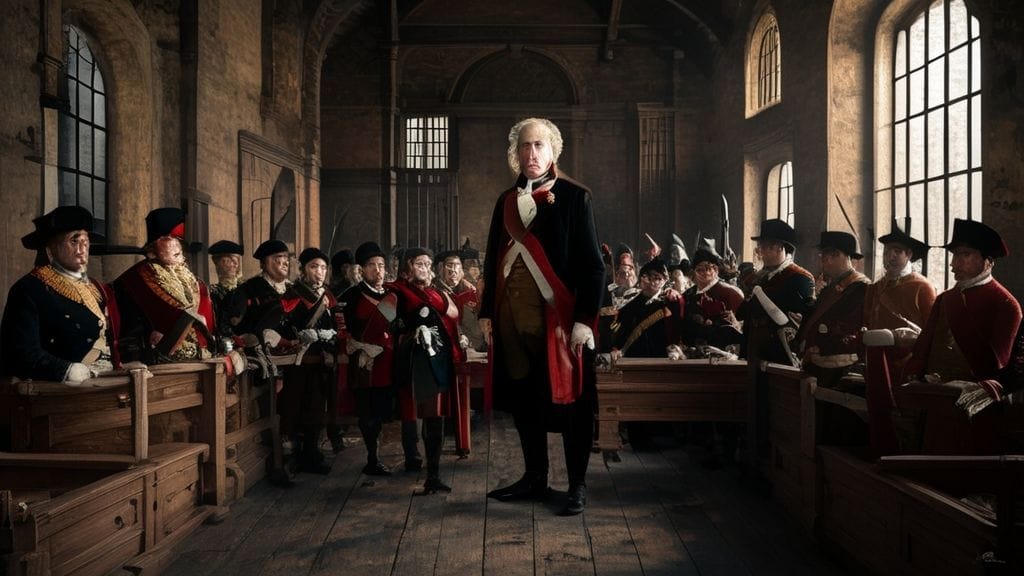
Then came the decisive moment. In a gesture loaded with symbolism, Cromwell is said to have stamped his feet, summoning the soldiers he had stationed nearby. Armed men entered the chamber, their boots sounding heavily on the wooden floor. The sight of musketeers within the sacred space of Parliament must have been shocking even to those who had endured Pride’s Purge five years earlier. This time, there was no pretense of merely excluding certain members; the very existence of the assembly was under assault.
Marching up to the Mace — the gilded staff that represented the authority of Parliament — Cromwell pointed and declared, “What shall we do with this bauble? Take it away.” The Mace, once revered, was seized and removed. The symbolism could not have been clearer: the emblem of parliamentary sovereignty was dismissed as a mere trinket, no longer commanding respect.
He then turned on the members personally, pointing to individuals and listing their alleged sins. “You are no Parliament,” he proclaimed, “I say you are no Parliament.” One by one, MPs were told to leave, shepherded out by soldiers, some protesting, some silent with stunned disbelief. The Speaker himself, William Lenthall, was ordered from his chair. Lenthall, who years earlier had faced down Charles I with the famous words, “I have neither eyes to see nor tongue to speak in this place but as the House is pleased to direct me,” now had nothing to say. The House was no longer pleased; it was being dissolved at sword point.
Within minutes, the chamber that had seen debates of epochal importance lay emptied of its elected occupants, occupied instead by troops. The dissolution of the rump parliament was no genteel signing of a legal instrument. It was an act of raw physical coercion, of a general using armed men to terminate the assembly in mid-session. Outside the doors, murmurs rippled through the corridors as news spread: “The General has broken the Parliament.” In that instant, the Commonwealth born in 1649 ceased to exist in the form that its architects had intended.
Later writers, both hostile and sympathetic to Cromwell, would return again and again to this scene. Some painted him as a tyrant, drunk on power, trampling the ancient liberties of England. Others cast him as a reluctant surgeon, forced to amputate a gangrenous limb to save the body politic. But whether one views it as necessary or disastrous, the moment itself retains a shocking clarity. In the heart of Westminster, the balance between sword and statute tilted decisively toward the former.
Shocked Silence in the Streets: How England Learned of the Fall
News in mid-17th-century London moved not by headlines and broadcasts, but along the arteries of rumor: taverns, markets, pulpits, and riverfronts. When word began to seep out that soldiers had entered the House of Commons and forced the MPs to disperse, the first reaction was not jubilant cheers nor immediate riots, but a kind of stunned, disbelieving silence. Many simply could not fathom what it meant that the Parliament — the very body that had gone to war against the King to defend its privileges — had itself been overthrown by force.
In the coffeehouses and alehouses around Westminster Hall, conversation turned quickly from trade and gossip to urgent questions. “Is it true? Did Cromwell truly dissolve the House?” Some insisted that it must be an exaggeration, that perhaps certain troublesome members had been removed, as in Pride’s Purge, but that Parliament itself remained. Others, more informed or more credulous, swore they had seen troops entering the building, had watched MPs being hustled out under the eyes of stern-faced officers.
The city’s printers, always attuned to political winds, began to ready their presses. Though official newsbooks would soon offer an authorized account, unofficial pamphlets circulated rapidly, carrying lurid or laudatory descriptions of the scene inside the House. One such account, later quoted by historians, contrasted the day to “the time when the King came thither in person,” suggesting that what Charles I had attempted and failed to do in 1642 — arresting members within the chamber — Cromwell had now done with success. The parallel was obvious and troubling.
Among the middling sort — merchants, artisans, shopkeepers — the reaction mixed anxiety with a wary pragmatism. On the one hand, political instability threatened trade, credit, and the enforcement of contracts. On the other, many had grown weary of the Rump’s endless debates and heavy taxes. If Cromwell’s bold stroke promised a more efficient government and a speedy settlement, some were prepared to give him the benefit of the doubt. Yet behind such calculations lurked an unspoken fear: if the Army could dismiss one Parliament, could it not dismiss any future assembly that displeased it?
In the parishes, clergy faced a delicate task. On the following Sunday, as congregations gathered under wooden beams and stone towers, some ministers cautiously alluded to the week’s events, casting them in providential terms. For godly preachers sympathetic to Cromwell, the dissolution of the rump parliament could be portrayed as a purging of corruption, a divine chastisement of hypocritical rulers. Others, more attached to old constitutional forms, spoke in more somber tones, lamenting that “the ancient bounds” had been broken, that the nation wandered without clear, legitimate guidance.
Outside London, news traveled more slowly, but its impact could be no less profound. County gentry, receiving letters or hearing travelers’ tales, tried to assess whether to support or resist whatever government would now emerge. Many had reluctantly accommodated themselves to the Commonwealth; now, they wondered whether yet another regime change would be demanded of them. For royalists in exile or internal hiding, the spectacle of Parliament’s humiliation offered a bitter satisfaction. If the regicide Parliament could be cast down by its own Army, perhaps the whole edifice of the Commonwealth would eventually crumble, clearing the way for a Stuart restoration.
Yet, for all the unease, there was no immediate counter-movement, no mass uprising in support of the Rump. The very fact that the Rump had never succeeded in winning deep popular affection or a clear sense of legitimacy now told against it. Few were willing to risk life and property to restore an assembly many saw as self-interested and ineffective. In that silence lay a grim verdict: the Rump had ruled, but it had not inspired.
Soldiers, Saints, and Schemers: Reactions Across the Nation
If the streets of London responded with wary quiet, within the Army and among religious radicals the news of the dissolution of the rump parliament stirred far more passionate reactions. For many officers and devout “saints,” Cromwell’s action confirmed what they had long suspected: that God was not finished reshaping England’s political order, and that the Rump had been an obstacle rather than an instrument of divine will.
In army camps, especially those where officers had been vocal critics of Parliament, the dismissal of the Rump was greeted with something approaching relief. The awkward tension of obeying civilian masters they no longer trusted had become a moral burden; now, that burden, at least temporarily, was lifted. Councils of officers discussed not whether the Parliament’s end was justified — most took that as a given — but what should replace it. Their visions varied: some wanted a more tightly controlled, godly assembly drawn from the most reliable elements; others favored a broader, more representative convention.
Among the Fifth Monarchists and other millenarian groups, Cromwell’s coup was interpreted through the lens of biblical prophecy. They saw in the overthrow of old institutions the birth pangs of the “fifth monarchy,” the kingdom of Christ that would follow four successive world empires as described in the Book of Daniel. To such minds, each toppled throne, each dissolved parliament, was a stage on the path to a divine order. Cromwell himself was sometimes credited, sometimes admonished, in their sermons and tracts as an instrument whom God might yet use — if only he stayed faithful to the radical course.
Yet enthusiasm was far from universal. Some officers and civilians, even those critical of the Rump, worried about the precedent being set. If no institution was safe from military intervention, how could long-term stability or trust be rebuilt? A few brave voices within the Commonwealth’s administrative machinery whispered concerns that England was drifting toward a form of rule “by the sword,” where the consent of the governed was overshadowed by coercion. In their letters and memoirs, one occasionally finds a note of melancholy: the sense that a cause begun in the name of parliamentary liberty had arrived at a destination where Parliament itself was dispensable.
Abroad, reactions were tinged with a mixture of alarm, curiosity, and opportunism. Foreign ambassadors in London sent hurried dispatches to their courts, trying to explain the latest upheaval in terms that made sense. The French and Dutch, already wary of the Commonwealth after the regicide, now had to reckon with the possibility that real power resided in the hands of a general, not a legislature. Diplomats asked themselves whether treaties signed with the Rump would still be honored, and whether Cromwell’s ascendency made England more or less dangerous as a rival on sea and land.
Back in the English countryside, ordinary people adapted as they always had to elite drama: by watching carefully and hedging their bets. Local justices continued to hold sessions, manor courts met, tithes were collected, marriages and baptisms recorded. The machinery of everyday governance did not grind to a halt because men in far-off Westminster had changed seats. But under the surface of continuity, rumors circulated about new oaths that might be required, new taxes that might be levied, new wars that might be fought under the direction of whatever regime Cromwell and his allies would now fashion.
Politics, religion, and personal interest intertwined in countless households. In one family, a veteran brother might hail Cromwell as the savior of the “good old cause,” while a more traditionalist father muttered that without King or true Parliament, the world had lost its proper order. In another, a merchant cousin might calculate whether the new power structure would favor his trade routes. The dissolution of the rump parliament was not just a constitutional maneuver in the abstract; it refracted through the full spectrum of human hopes, fears, and calculations.
Inventing a New Order: The Barebone’s Parliament Experiment
Having swept away the Rump, Cromwell and the Army were confronted with the question that haunts all revolutionaries: what next? It was one thing to end a failed or corrupt institution; it was quite another to design a replacement that could command obedience and respect. In the weeks following 20 April 1653, councils of officers and advisers debated furiously how best to fill the vacuum.
The solution they arrived at was both bold and, in retrospect, strangely fragile: a nominated assembly of “godly” men, drawn from across England, Wales, Scotland, and Ireland — selected not by open election, but by consultation among the Army, congregational churches, and trusted local figures. This convention, which would gather in July 1653, became known officially as the Nominated Assembly, but history would remember it as “Barebone’s Parliament,” after one of its more colorful members, Praise-God Barebone, a London leather-seller and zealous Puritan.
The idea behind this experiment was, in theory, to create a body purified of the self-interest and worldliness attributed to the Rump. Its members would be men of proven piety and “public spirit,” less bound by traditional notions of privilege and more open to radical reform. In a sense, it was an attempt to embody the “rule of the saints” in institutional form without fully embracing the most apocalyptic millenarian visions. Cromwell hoped that such an assembly would enact necessary reforms — in law, in church governance, in social policy — that older parliaments had avoided.
When Barebone’s Parliament met in July, its composition indeed reflected a different England from the one that had dominated the Long Parliament. Many members were of lesser gentry or even lower social status; some were tradesmen or professionals rather than great landowners. Their religious fervor was often intense. Debates quickly ranged far beyond mere fiscal and military concerns to questions of social morality, legal codification, and the godly reordering of everyday life.
At times, the assembly produced remarkably forward-looking proposals: for the reform of the Court of Chancery, for changes in marriage law, for more humane treatment of debtors. But it also moved toward measures that alarmed property owners and conservative elements: talk of abolishing tithes outright, suggestions of tampering with the rights of patrons in church livings, and a general suspicion of entrenched legal and economic privileges. The spectrum of opinion within the assembly itself was wide, and its more radical voices often drowned out moderating counsel.
Cromwell watched these developments with growing unease. He had hoped for a balance between godliness and practicality, between reform and stability. Instead, he saw signs that Barebone’s Parliament might alienate the landed interest whose support any lasting regime would require. Furthermore, the assembly’s legitimacy, already tenuous due to its nominated nature, would be fatally undermined if it was seen as an engine of social upheaval.
By December 1653, the experiment unraveled. A group of more moderate members, disheartened by the assembly’s direction and its internal divisions, orchestrated a self-dissolution: they gathered early one morning, voted to resign their authority back to Cromwell, and handed over their powers. Soldiers then quietly locked the doors. Once again, a nascent institution had been ended not through a regular electoral process, but through a mixture of internal resignation and military enforcement.
From the dissolution of the rump parliament to the rise and fall of Barebone’s Parliament, the pattern was becoming depressingly clear. Revolutionary leaders struggled to build a stable, broadly accepted structure of governance without reverting to old monarchical models or surrendering their hard-won gains. Each attempt to create a new order seemed to bear within it the seeds of its own undoing: either too conservative to satisfy the godly radicals, or too radical to reassure the propertied classes and the wider population.
From Protectorate to Restoration: The Long Echo of 1653
The collapse of Barebone’s Parliament in December 1653 paved the way for a more conventional — though still unprecedented — form of government: the Protectorate. Under the Instrument of Government, a written constitution drafted largely by army officers and lawyers, Oliver Cromwell was installed as Lord Protector of the Commonwealth of England, Scotland, and Ireland. In outward form, this looked startlingly like a monarchy in all but name: a single executive head, supported by a Council of State and required to summon regular parliaments.
The Instrument represented an attempt to reconcile several competing imperatives. It sought to institutionalize the gains of the Revolution — no return to royal absolutism, a secure place for Protestantism, a recognition of Parliament’s legislative role — while also providing the strong, singular leadership the Army believed necessary to maintain order at home and prestige abroad. Written constitutions were rare in European practice at the time; in this sense, the Protectorate was a daring experiment in modern statecraft.
Yet the shadow of the dissolution of the rump parliament fell heavily across the Protectorate years. Every time Cromwell summoned a new Parliament — in 1654, 1656, and beyond — the question loomed: would he tolerate resistance or opposition from the assembly, or would he again use soldiers to bend or break its will? In 1655, displeased with the intransigence of his first Protectorate Parliament, he dissolved it prematurely. The cycle of hope, friction, and dismissal repeated, convincing many contemporaries that no stable balance could be found between Parliament and the Army under Cromwell’s leadership.
Meanwhile, external and internal pressures mounted. The Protectorate fought wars with Spain, maintained a large standing army and navy, and tried to impose a system of regional major-generals to enforce moral discipline and security in the counties. These policies cost money and goodwill. While some measures — like the promotion of Protestant religious toleration for many sects — won praise among radicals, others alienated powerful elites who saw their local influence curtailed and their tax burdens increased.
When Cromwell died in September 1658, worn down by illness and the immense strain of governing, the question of succession brought the underlying fragility of the Protectorate into sharp relief. His son Richard, a less commanding figure, inherited the title of Lord Protector, but not the personal authority or military prestige that had buttressed his father’s rule. Parliament was recalled, factions proliferated, and the Army once more intervened, dissolving assemblies and rearranging power in a bewildering sequence of coups and counter-coups.
Amid this chaos, one idea slowly regained traction: the restoration of the monarchy. Men who had once cheered the fall of Charles I now reasoned that only a king, bound by negotiated terms and parliamentary controls, could provide the stability England so desperately needed. The memory of the Rump’s dissolution, and of subsequent failed experiments, underlined the dangers of poorly anchored republics. When General George Monck marched his forces from Scotland to London in 1660 and facilitated the calling of a new, freely elected Parliament, the road opened for Charles II to return.
The Restoration that followed did not simply wipe away the past decade. It consciously presented itself as a “healing and settling,” learning from the excesses and failures of both royalist and republican governments. Yet beneath the festive pageants that greeted Charles II, the lessons of 1649 and 1653 lingered. Future English parliaments would never entirely forget that one of their own bodies had been created by purge and dissolved by soldiers, or that another assembly had been closed by military power after veering too far into radical reform.
In this sense, the dissolution of the rump parliament cast a long shadow: it became a cautionary tale about the vulnerability of representative institutions when they lack broad legitimacy and when their relationship with armed forces is never clearly and firmly defined. That shadow would stretch far beyond the 17th century, shaping later debates about the proper bounds of executive and military power in constitutional states.
The Human Cost: Lives Shaped and Broken by a Vanished Parliament
Behind the grand narratives of constitutions and coups lie individual lives, altered or shattered by decisions taken in distant chambers. The dissolution of the rump parliament was no exception. For the MPs ejected from the House on that April day, the experience was personally humiliating and politically dangerous. Some retreated into private life, nursing grievances and writing memoirs that would later feed historians’ accounts. Others tried to remain active in local government or in professions like law and commerce, adapting to the new order as best they could.
A few paid a heavier price. Those most closely associated with the regicide of Charles I found themselves marked men once the political winds shifted. Though the immediate aftermath of the Rump’s fall did not bring wholesale purges or executions, the Restoration in 1660 would treat involvement with the 1649 High Court of Justice as a hanging offense. Some regicides fled abroad; others were hunted down, tried, and subjected to grisly deaths meant to display royal vengeance. The chain that linked Pride’s Purge, the Rump’s actions, and its dissolution ended for them on the scaffold.
Within the Army, the events of 1653 also left scars. Officers who had supported Cromwell’s move against the Rump did so in the belief that it would usher in a more just, godly government. When subsequent experiments faltered and the Protectorate struggled, some felt pangs of conscience. Had they, in removing Parliament by force, contributed to a cycle of instability that ultimately discredited the very cause they cherished? Memoirs and letters from the period sometimes hint at this inner conflict, a recognition that the sword, once drawn against a legislature, could not easily be sheathed again.
For ordinary soldiers, the political gyrations of the 1650s often translated into very concrete concerns: pay in arrears, uncertain prospects for land or pensions, and the ever-present risk of being ordered into new campaigns. Many had left farms, workshops, or apprenticeships to fight in the civil wars; a decade later, they found themselves still yoked to military life, now in the service of regimes that changed names and structures with unsettling frequency. Some veterans, disillusioned, drifted into vagrancy or petty crime, features of social distress that troubled local magistrates.
Outside the political and military spheres, the human consequences of the Rump’s rise and fall were equally real, if less immediately visible. The confiscations and land transfers it had overseen affected tenants and laborers who depended on estates for their livelihoods. Its religious policies shaped which ministers occupied pulpits, which doctrines resounded from Sunday to Sunday in parish churches and meetinghouses. When the Parliament vanished, its ordinances and statutes did not disappear overnight, but their authority was shaken, and the certainty of law — always fragile in a time of revolution — grew weaker still.
Consider, for instance, a provincial lawyer who had built a modest practice navigating the complex web of Commonwealth statutes. The abrupt dissolution of the rump parliament must have raised unsettling questions: Would the new regime honor contracts based on laws passed by the Rump? Would legal reforms painstakingly secured in recent years be maintained or reversed? Such practical anxieties, multiplied across thousands of professionals, merchants, and officials, contributed to a climate of insecurity that no formal constitution could fully dispel.
On a more intimate level, families divided by civil war and politics continued to reckon with the consequences. In some households, an uncle who had sat in the Rump now found his opinions quietly sidelined by younger relatives eager to embrace the Restoration. In others, a son who had cheered Cromwell’s bold act in 1653 later watched in dismay as the Protectorate faltered, bringing no clear resolution to England’s long trouble. History, for them, was not a neat sequence of events, but a lived experience of uncertainty, fear, and occasional hope.
How Historians Judge the Rump and Its Fall
Over the centuries, the dissolution of the rump parliament has drawn sharply divergent interpretations from historians, reflecting broader debates about revolution, legitimacy, and military power. As early as the late 17th century, royalist-leaning writers condemned Cromwell’s act as yet another proof of republican hypocrisy: a Parliament that claimed to fight tyranny had itself become tyrannical and then fallen victim to a tyrant in armor. For them, the lesson was simple: only a king, ruling in partnership with a properly constituted Parliament, could secure balanced government.
Whig historians of the 18th and 19th centuries, more sympathetic to parliamentary ideals, wrestled with the episode in subtler ways. Some saw the Rump as a necessary but transitional body, whose failure lay not so much in its ambitions as in its inability to gain broad support. The dissolution of the rump parliament then appeared as a tragic misstep by Cromwell, a deviation from the path of constitutional government into military rule. Others, focusing on the eventual emergence of stable parliamentary monarchy after 1688, treated the Rump’s fate as part of a messy learning process on the road to modern liberty.
In the 20th century, interpretations diversified further. Marxist historians tended to view the Rump as an instrument of the rising bourgeoisie, consolidating a revolution in property relations while hesitating to extend political rights more broadly. From this perspective, its dissolution reflected the contradictions of a “bourgeois revolution” that could overthrow feudal monarchy but feared genuine mass democracy. Cromwell’s intervention appeared as an attempt to manage these tensions from above, using the Army to clear away an outworn institution and pave the way for a new ruling configuration.
Revisionist scholars, meanwhile, pushed back against overly schematic narratives. They highlighted the practical constraints the Rump faced: fiscal crises, military threats, regional diversity, and deep cultural attachments to monarchy. Many argued that the Rump’s record was more mixed than its harshest critics allowed, pointing to its efforts at legal and administrative reform and its role in sustaining the Commonwealth during perilous years. The dissolution of the rump parliament, in this light, becomes as much a commentary on Cromwell’s impatience and evolving ambitions as on the Parliament’s inherent flaws.
One modern historian has remarked that “Cromwell killed the Rump not because it was doing nothing, but because it was doing too little of what he wanted and too much of what he feared.” That pithy summary captures the double-edged nature of Cromwell’s decision: he could no longer tolerate a Parliament that would not move fast enough toward the settlement he desired, yet by destroying it, he also removed a crucial — if imperfect — check on his own power.
Primary sources from the period, such as the diaries of politicians and the sermons of contemporary preachers, reveal the moral ambiguity many felt even at the time. One diarist recorded being “in doubt whether the Lord General be raised up to destroy or to perfect the work of Reformation.” Another, in a sermon published shortly after 1653, warned that “he who layeth violent hands upon a Parliament may find the same measure mete to him or his successors.” Such voices remind us that contemporaries, no less than modern historians, struggled to fit the events into a coherent moral and political narrative.
Myths, Legends, and Misremembered Words
Any event as dramatic as the dissolution of the rump parliament quickly attracts stories — some true, some embellished, some entirely invented. Over time, these anecdotes crystallize into a kind of folklore, shaping popular memory more powerfully than dry constitutional analysis. The scene of Cromwell striding into the House, calling the Mace a “bauble,” and ordering soldiers to clear the chamber has become iconic, but not all the details commonly repeated can be firmly documented.
The famous phrase “Take away that bauble!” appears in several later sources, but not in all contemporary accounts. It has the ring of authenticity — terse, contemptuous, perfectly capturing the military man’s disdain for ceremonial symbols. Yet it is possible that later writers sharpened Cromwell’s actual words into a more quotable form. Similarly, the exact epithets he hurled at MPs (“whoremasters,” “drunkards,” etc.) vary across reports, raising the question of whether some were added by hostile narrators eager to blacken his character.
Another myth concerns the supposed immediate, universal praise or condemnation of Cromwell’s act. In reality, as we have seen, reactions were mixed and often cautious. The tidy story that Cromwell swept away a universally hated, corrupt Parliament, cheered by all patriotic Englishmen, sits uneasily with evidence of widespread anxiety and ambivalence. On the other hand, the equally tidy story that he was instantly reviled as a tyrant ignores the substantial support he enjoyed among key military and religious constituencies.
Even the term “Rump Parliament” itself carried layers of meaning and mockery. “Rump” originally had connotations of leftovers, an inferior remnant after the prime parts had been removed. Satirical pamphlets and ballads drew on this imagery to lampoon the assembly as the worthless tail-end of the once-respected Long Parliament. Over time, the label stuck so thoroughly that the more neutral term “remainder” or “residual Parliament” vanished from common usage.
Historians, therefore, must tread carefully, separating what can be reasonably substantiated from what belongs more to legend. Yet legends matter, for they reveal how later generations wanted to see the past. The embellished story of Cromwell bursting in with righteous fury, scattering corrupt MPs like chaff, fed a 19th-century image of him as a stern, honest reformer. In contrast, royalist-tinged retellings emphasized the sheer arrogance of a soldier defying centuries of parliamentary tradition, foreshadowing the horrors of military dictatorship.
One enduring lesson from these myths is the way they compress complex political struggles into single, decisive moments. The dissolution of the rump parliament was not, in truth, a bolt from the blue; it was the climax of years of tension between Army and Parliament, of mounting frustration over unfulfilled promises and competing visions of godly government. To focus only on Cromwell’s footsteps echoing in the House on that April morning is to risk forgetting the long road that led there — and the long aftermath that followed.
Why the Dissolution Still Matters to Modern Democracies
Though it unfolded in a world of muskets, periwigs, and horse-drawn coaches, the dissolution of the rump parliament poses questions that resonate uncomfortably with modern democracies. At its heart lies a dilemma that has never really disappeared: what happens when a representative body loses the confidence of those who believe they fought or struggled to create it? Who, if anyone, has the right to end a legislature that seems unwilling to reform itself? And what role, if any, should armed forces play in resolving such crises?
In contemporary constitutional thought, the answer seems straightforward: parliaments and congresses are dissolved according to strict legal procedures, not at the whim of generals. Yet the 17th-century English experience reminds us that when political institutions lose legitimacy in the eyes of powerful groups — whether militaries, social movements, or economic elites — written rules alone may not be enough to prevent extra-constitutional interventions. Modern coups often justify themselves, just as Cromwell did, in the language of necessity, reform, and the people’s true interest.
Another enduring theme is the danger of self-perpetuating elites within representative bodies. The Rump, by clinging to office year after year without fresh elections, invited accusations of oligarchy and corruption. Today, debates about term limits, gerrymandering, and the influence of money on politics echo similar concerns: that those elected to represent the public may become more interested in preserving their own positions than in renewing democratic legitimacy.
At the same time, the aftermath of 1653 warns against simplistic faith in “clean sweeps.” The dissolution of the rump parliament did not automatically produce a better, more just government. Instead, it led to a succession of unstable experiments, culminating in a quasi-monarchical Protectorate and, ultimately, the Restoration of the very institution — monarchy — the revolution had sought to end. In this sense, the story illustrates how tearing down flawed structures without a widely supported plan for replacement can backfire, restoring older, perhaps even less accountable, forms of rule.
Finally, the episode invites reflection on the delicate relationship between civil authority and military power. The New Model Army was, in some ways, a precursor to modern standing armies: ideologically charged, professionally organized, and central to state power. Its interventions in politics, from Pride’s Purge to the Rump’s dissolution, underscored the peril of allowing armed forces to become arbiters of legitimacy. Modern democracies wrestle with this legacy: how to honor soldiers’ sacrifices and ensure civilian control without giving the military a veto over political outcomes.
When historians and citizens look back on the dissolution of the rump parliament, they do more than sift through a curious episode of 17th-century turmoil. They confront a mirror, however imperfect, of dilemmas that recur wherever representative institutions fall into disrepute and where some are tempted to believe that a decisive act of force can shortcut the slow, frustrating work of reform. It is a reminder that the health of a democracy depends not only on formal rules, but on a shared willingness to work within them — even when doing so feels maddeningly slow.
Conclusion
The dissolution of the rump parliament on 20 April 1653 was both a dramatic climax and a beginning — the visible crest of a long wave of conflict that had been building since the outbreak of civil war in 1642. Born out of Pride’s Purge, the Rump carried within it from the start a paradox: it claimed to represent the nation while resting on the bayonets of an Army that had reshaped it by force. For four turbulent years, it tried to govern a war-torn kingdom, balancing revolution and continuity, reform and caution, but never quite winning the trust or enthusiasm of the broad population or of the soldiers who had enabled its existence.
Oliver Cromwell’s decision to end that uneasy experiment in a single, explosive intervention arose from a tangle of motives: religious conviction, political frustration, concern for stability, and the temptations of personal authority. When he strode into the House of Commons and declared, “You are no Parliament,” he was not merely settling a policy dispute; he was declaring that the very source of civil legitimacy had failed. In that moment, the sword trumped the statute, and a path was opened that led through Barebone’s Parliament and the Protectorate to the eventual restoration of monarchy.
Yet to see only tragedy or only tyranny in these events is to miss their complexity. The Rump achieved genuine, if limited, reforms; its downfall was not the simple removal of a cartoonish villain. Cromwell, for his part, wrestled sincerely with questions of conscience and necessity, even as his choices deepened the very instability he sought to cure. The real lesson of 1653 lies less in taking sides than in recognizing how difficult it is to sustain revolutionary ideals within functioning institutions — and how swiftly force, once admitted as a political arbiter, can erode the foundations of representative government.
In the end, the dissolution of the rump parliament stands as a cautionary tale about the fragility of legitimacy, the perils of self-perpetuating elites, and the danger of relying on extraordinary means to correct ordinary political failings. It invites us to think hard about how parliaments gain and lose moral authority, how far generals should go in “saving” a country from its own institutions, and how easily necessary reforms can shade into open-ended rule by the strong. That these questions still feel urgent today is perhaps the clearest measure of how live the legacy of 20 April 1653 remains.
FAQs
- What was the Rump Parliament?
The Rump Parliament was the remnant of the Long Parliament that remained after Colonel Pride’s Purge in December 1648, when soldiers excluded or arrested MPs who favored negotiating with King Charles I. This reduced body went on to approve the trial and execution of the King, abolish the monarchy and the House of Lords, and govern England as a Commonwealth from 1649 to 1653. - Why did Oliver Cromwell dissolve the Rump Parliament?
Cromwell dissolved the Rump because he believed it had become self-serving, slow to enact necessary reforms, and unwilling to establish a new, more representative political settlement. He and many army officers feared that the Rump intended to perpetuate its own power through a carefully managed transition. Convinced that further delay endangered both the “godly cause” and national stability, Cromwell chose to intervene with military force. - How exactly did the dissolution of the Rump Parliament happen?
On 20 April 1653, Cromwell entered the House of Commons during a debate on a crucial bill concerning future governance. After listening for a time, he rose to denounce the members for corruption and failure. He then summoned soldiers into the chamber, ordered the ceremonial Mace removed, and commanded MPs and the Speaker to leave, declaring, “You are no Parliament.” The House was closed and its authority ended. - Was the dissolution legal?
By the constitutional standards of the time, the dissolution had no clear legal basis. The Rump had never passed a law granting Cromwell or the Army the right to dismiss it, and traditional royal prerogatives of dissolving Parliament no longer applied in the Commonwealth. Cromwell justified his action in terms of necessity, divine providence, and the people’s true interest, but in formal terms it was a military coup against a sitting legislature. - What replaced the Rump Parliament after its dissolution?
Immediately after the dissolution, Cromwell and the Army organized a nominated assembly of “godly” men known as the Nominated Assembly or Barebone’s Parliament, which met from July to December 1653. When that body collapsed, Cromwell became Lord Protector under the written Instrument of Government, inaugurating the Protectorate — a quasi-monarchical regime intended to balance strong executive power with periodic parliaments. - How did people at the time react to the dissolution?
Reactions were mixed. Many in the Army and among religious radicals welcomed the fall of a Parliament they saw as corrupt and obstructive. Others, including moderates and traditionalists, were alarmed that armed force had been used against the country’s representative institution. In the wider population there was more quiet anxiety than open protest; few were prepared to risk their lives to restore the unpopular Rump. - Did the dissolution of the Rump Parliament contribute to the later Restoration of the monarchy?
Indirectly, yes. By undermining the credibility of parliamentary government and entrenching the role of the Army in politics, the dissolution helped create an image of republican rule as unstable and militarized. The subsequent failures of Barebone’s Parliament and the Protectorate deepened this impression. When the opportunity for restoration arose in 1660, many English elites and commoners were ready to accept a constitutional monarchy as the least dangerous option. - How do historians today view Cromwell’s decision?
Historians are divided. Some see Cromwell’s action as a necessary, if harsh, step against an ineffectual and self-perpetuating body, arguing that without it the Commonwealth might have drifted into even deeper paralysis. Others regard it as a disastrous overreach that fatally damaged the prospects for a lasting republican settlement and entrenched military intervention in politics. Most agree that it was a turning point that revealed the unresolved contradictions of the English Revolution.
External Resource
Internal Link
Other Resources
- Encyclopaedia Britannica – general search for the exact subject
- Google Scholar – academic search for the exact subject
- Internet Archive – digital library search for the exact subject

