Table of Contents
- The Dawn of a City’s Sacred Landscape
- Jerusalem at the Crossroads of Empires and Faiths
- The Rise of the Umayyad Caliphate: A New Era
- Abd al-Malik ibn Marwan: The Visionary Patron
- The Purpose Behind the Dome: More Than a Monument
- Foundations Laid in Sand and Spirit: Architectural Inspirations
- A Race Against Time and Turmoil
- The Construction Process: Craftsmen, Materials, and Techniques
- The Dome’s Design: Symbolism Encased in Gold and Stone
- The Dome’s Sacred Site: The Significance of the “Noble Rock”
- Completion of the Dome of the Rock in 691–692: A Moment of Triumph
- The Dome as a Political Statement: Legitimacy and Power
- Religious and Cultural Implications in Early Islamic Jerusalem
- The Dome’s Enduring Legacy Through the Centuries
- The Dome of the Rock Today: A Living Monument
- Conclusion: The Dome's Subtle Voice Across Time
- FAQs About the Dome of the Rock
- External Resource
- Internal Link
1. The Dawn of a City’s Sacred Landscape
In the warm glow of a Middle Eastern sunset, Jerusalem’s skyline took on an ethereal shimmer. The golden dome, newly crowned atop the rugged, ancient stone platform, reflected the fading light as if capturing the very breath of heaven. It was the year 691–692, and an incredible transformation was reaching its pinnacle: the completion of the Dome of the Rock, a masterpiece that would forever entwine the earthly and divine, the political and religious, shaping one of the world’s most contested cities.
Imagine the scene: bustling markets within a city that had witnessed countless prophets and conquerors; the prayers of Jews, Christians, and recently ascendant Muslims interweaving in the air; and at the city's heart, a monumental structure rising not only in stone but in the spirit of a new empire. This was not simply a building. It was a statement — a beacon of faith and authority, a sanctuary, a symbol of a fledgling Islamic civilization staking its claim on Jerusalem’s sacred geography.
But how did this edifice come to be? What currents of faith, power, and artistry converged to birth this jewel of the ancient world? To understand the Dome of the Rock is to trace a story where faith meets empire, where faith is wielded as political might, and where architecture becomes a language of eternal dialogue.
2. Jerusalem at the Crossroads of Empires and Faiths
Jerusalem, a city saturated with layered histories, had long been a spiritual fulcrum for Judaism and Christianity. By the late 7th century, it found itself under new dominion — the Umayyad Caliphate, an Islamic Islamic dynasty forging an empire stretching from the Iberian Peninsula to the Indus River. Yet despite its political captivity, Jerusalem remained a mosaic of religious traditions.
The city was more than a prize; it was a symbol waiting to be molded. With Jewish hopes suppressed after centuries of hardship, and Christian communities holding on to their traditions amid changing rulers, the arrival of Islam introduced a new religious layer, one that connected to the Abrahamic legacy but with a distinct vision and imperial ambition.
The Omayyads, while conquerors, were also planners and builders. They sought to transform Jerusalem into a city reflecting their religious authority and political legitimacy. The Dome of the Rock was to become that symbol — a structure that would proclaim Islam’s sacred claim over the city, without erasing the past but rather reinterpreting it within a new framework.
3. The Rise of the Umayyad Caliphate: A New Era
Emerging after a period of internal strife and consolidation following the death of Prophet Muhammad in 632, the Umayyad dynasty established its rule in 661 under caliph Muawiya I. With Damascus as their capital, the Umayyads faced the challenge of legitimizing their rule over a diverse and sprawling realm. The need to unify their subjects under the banner of Islam was essential, and monumental architecture soon became a favored tool for expressing the Caliphate’s strength, piety, and permanence.
Abd al-Malik ibn Marwan’s ascendance to power in 685 ushered in a particularly visionary era. Conscious of both internal dissent and external threats, Abd al-Malik understood that political authority hinged not only on military might but on symbolic acts—especially those acknowledging the blossoming Islamic identity.
Jerusalem, with its sacred eminence in Islam as the site of Muhammad’s Night Journey (Isra and Mi’raj), offered the perfect stage. Here, a new Islamic landmark would rivet attention — a symbol of the Caliphate’s divine favor and temporal power. Hence, the inception of the Dome of the Rock.
4. Abd al-Malik ibn Marwan: The Visionary Patron
Abd al-Malik remains one of the most intriguing and influential figures in the early Islamic world. His reign (685–705) was marked by significant administrative reforms, currency standardization, and, crucially, monumental building projects.
It was more than vanity. Abd al-Malik sought to cement his legitimacy in a kingdom fractured by sectarian, tribal, and political fissures. The construction of a religious monument in Jerusalem was a masterstroke blending piety and power.
The Dome of the Rock would symbolize divine endorsement of Abd al-Malik’s rule, connecting the Caliphate to the sacred narrative of the prophets and the broader Abrahamic tradition. This vision required an architectural marvel capable of inspiring awe and devotion for centuries to come.
5. The Purpose Behind the Dome: More Than a Monument
The Dome of the Rock was not conceived simply as a mosque—although it functioned as a place of worship—but as a complex symbol. Centrally involved was the “Noble Rock,” a large stone believed by Muslims to be the site from which Prophet Muhammad ascended to heaven during the Isra and Mi’raj.
Its positioning and design communicated multiple messages. It was a testament to Islam’s spiritual depth and its connection to the prophetic past. At the same time, it visually and politically asserted the Umayyad Caliphate’s role as the rightful heir and guardian of Jerusalem’s sacred heritage.
In a region where religious rivalry was intense, the Dome aimed to assert an Islamic presence without overt conflict with Christian and Jewish claims—a delicate balancing act played out through sacred architecture.
6. Foundations Laid in Sand and Spirit: Architectural Inspirations
The architectural choice for the Dome of the Rock was groundbreaking yet reverent. The building borrowed elements from Byzantine structures, like the centrally planned rotunda and lavish mosaics, yet infused them with Islamic symbolism and theological intent.
The octagonal layout, the magnificent golden dome soaring 20 meters high, and the intricate mosaics echoed the grandeur of Roman and Byzantine religious architecture, signaling the Umayyads’ capability to rival—and surpass—the earlier empires.
This amalgamation was not accidental. It served as a visual dialogue between the new Islamic order and the world it had just inherited, presenting Islam as both a continuation and a transcendence of previous civilizations.
7. A Race Against Time and Turmoil
Constructing the Dome of the Rock was no small feat in an era marked by unrest and political volatility. The late 7th century was a period rife with rebellions and territorial disputes.
Despite these challenges, Abd al-Malik's administration pushed ahead. According to historic inscriptions inside the Dome, the construction was completed within a remarkably short span of approximately six years, between 691 and 692. This rapid pace underscored the monumental importance placed on this project.
The effort required mobilizing artisans, procuring rare materials from across the empire, and coordinating logistics amidst volatile times. This made the Dome not only a spiritual triumph but an administrative and organizational one.
8. The Construction Process: Craftsmen, Materials, and Techniques
The Dome of the Rock represents a remarkable feat of early Islamic art and engineering. Byzantine craftsmen—possibly from Constantinople or local skilled workers familiar with Byzantine techniques—were involved, bringing with them expertise in mosaic and dome construction.
Local stones formed the sturdy octagonal base, while the interior was decorated with exquisite mosaics depicting geometric patterns, vegetal motifs, and intricate arabesques—deliberately avoiding human figures to align with Islamic aniconism.
The wooden dome was initially covered with gold plate, later replaced and restored several times throughout history, giving the Dome its iconic glittering appearance. The decorative inscriptions, some of the earliest surviving Quranic texts used in architectural decoration, emphasized the theological message in an unprecedented manner.
9. The Dome’s Design: Symbolism Encased in Gold and Stone
Every part of the Dome carries layered meaning. The circle represents perfection, eternity, and the divine, while the octagon functions as a transitional shape between the earthly square and the heavenly circle—a metaphor bridging human and divine realms.
The golden dome, visible for miles around, elevates this message to the heavens. Inscribed Quranic verses upon the interior walls reinforce the unity of God and the prophetic mission of Muhammad, challenging contemporary Jewish and Christian narratives.
In many ways, the Dome is a hymn in stone and light to the ideals of a burgeoning religious civilization asserting its identity across an inherited sacred landscape.
10. The Dome’s Sacred Site: The Significance of the “Noble Rock”
Central to the structure is the Foundation Stone, or the Noble Rock, a massive slab of rock traditionally revered as the site of pivotal biblical and Qur’anic events.
Jews consider it the site where the world emerged, where Abraham prepared to sacrifice Isaac, and where the Holy of Holies once stood within the Jewish Temple. Muslims believe it to be the launch point for the Prophet Muhammad’s miraculous night journey to heaven.
By erecting the Dome over this spot, the Umayyads not only sanctified the rock in Islamic terms but positioned Islam as the ultimate heir of the Abrahamic covenant, staking spiritual and political claims intertwined in the very geography of Jerusalem.
11. Completion of the Dome of the Rock in 691–692: A Moment of Triumph
When it was finally completed in the early 690s, the Dome of the Rock stood as the most magnificent monument in Jerusalem. Contemporary accounts speak of its dazzling appearance, its gleaming dome shimmering under the sun, and its finely detailed mosaics shimmering within.
Its inauguration was more than a religious event: it was a ceremonial assertion of Islamic triumph and permanence, sending a clear message across the empire.
Pilgrims and residents alike marveled at the structure that symbolized not only divine proximity but also the political ascendancy of Abd al-Malik’s Caliphate.
12. The Dome as a Political Statement: Legitimacy and Power
Beyond its religious significance, the Dome of the Rock communicated a profound political message. Abd al-Malik used the monument to consolidate state power, offering a concrete symbol that legitimized his rule over Jerusalem and the broader Islamic realm.
At a time when the Umayyads faced internal dissent and external threats, this architectural statement functioned as a stabilizing icon. The inscriptions within assert orthodox Islamic monotheism and subtly criticize competing sects and faiths — a bold theological stance bolstered by the very stones of Jerusalem.
13. Religious and Cultural Implications in Early Islamic Jerusalem
The Dome of the Rock influenced Jerusalem's cultural landscape in profound ways. It became a pilgrimage site for Muslims and a symbol of Islamic identity, altering interfaith dynamics within the city.
It also marked the first major Islamic architectural project in a former Byzantine city, setting a precedent for future Umayyad, Abbasid, and later Islamic dynasties.
Interaction with local Christian and Jewish populations was complex — the Dome both asserted Islamic dominance and provided a space that did not directly confront existing religious traditions, an architectural embodiment of coexistence and competition.
14. The Dome’s Enduring Legacy Through the Centuries
Over the following centuries, the Dome of the Rock endured wars, conquests, and reconstruction. Crusaders converted it into a Christian church; subsequent Muslim rulers restored it fervently. Each era layered new meaning upon the monument, yet its core symbolism remained intact.
Its architecture inspired future Islamic buildings: from the great mosques of Cairo and Istanbul to the Mughal Empire’s palaces in India, the Dome’s artistic and spiritual legacy rippled far beyond Jerusalem.
In modern times, it is revered as one of Islam’s holiest sites, a symbol of religious identity, nationalism, and a flashpoint in an ongoing geopolitical struggle—testimony to its enduring power as a monument.
15. The Dome of the Rock Today: A Living Monument
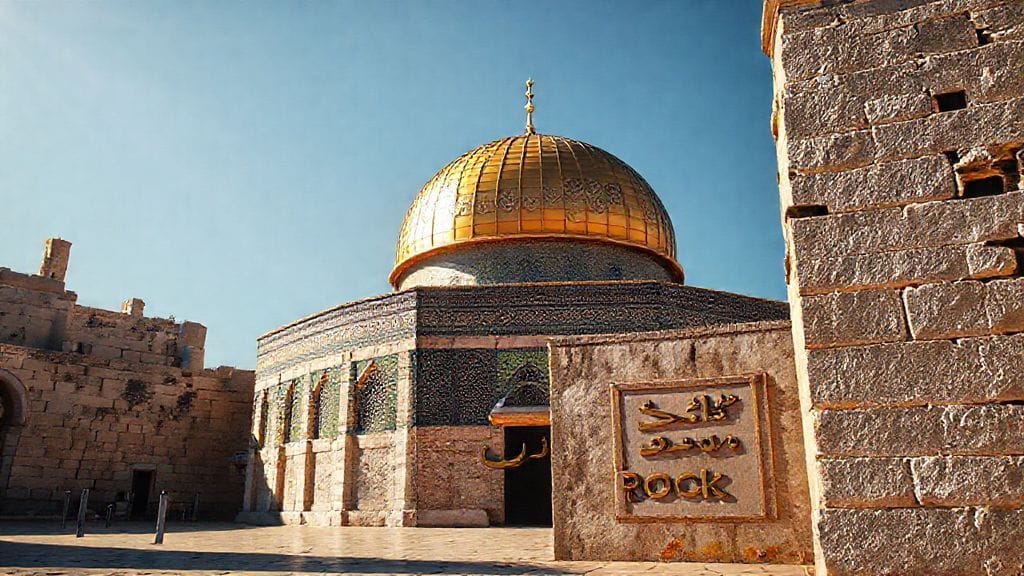
Today, the Dome of the Rock stands amidst the Old City of Jerusalem, its golden dome piercing the skyline like a beacon of history. Millions gaze upon it with reverence, curiosity, or political passion.
Its preservation challenges modern architects and stakeholders in light of political tensions, religious sensitivities, and tourism demands.
But beyond these concerns, the Dome remains a profound testament to humanity’s yearning to touch the divine, to inscribe meaning upon the earth, and to narrate stories of faith, power, and identity across millennia.
Conclusion
The completion of the Dome of the Rock between 691 and 692 was more than the construction of a religious monument; it marked the birth of a symbolic language where faith, architecture, and empire intertwined. From the vision of Abd al-Malik ibn Marwan to the hands of skilled craftsmen, this golden-domed marvel spoke volumes about the aspirations of an emerging Islamic civilization seeking to define itself in a city layered with spiritual significance.
Through wars, reconstructions, and reverence, the Dome has endured, a silent witness to the tumult and grandeur of centuries. It embodies not only the tangible heritage of Jerusalem but also the intangible threads of hope, conflict, and coexistence woven through history.
In gazing upon the Dome today, one doesn’t just see stone and gold — one sees the perennial human quest to understand the sacred, to wield power, and to leave a legacy that transcends time itself.
FAQs About the Dome of the Rock
Q1: Why was the Dome of the Rock built in Jerusalem?
A: The Dome was built to assert Islamic spiritual authority over Jerusalem, particularly over the sacred Foundation Stone believed to be the spot of Prophet Muhammad’s Night Journey, and to symbolize the Umayyad Caliphate’s political legitimacy.
Q2: Who was Abd al-Malik ibn Marwan and what was his role?
A: Abd al-Malik was the Umayyad Caliph who commissioned the Dome of the Rock as part of his broader efforts to consolidate Islamic rule and express religious unity through monumental architecture.
Q3: How does the Dome of the Rock differ from a mosque?
A: Although it has religious functions, the Dome is primarily a shrine or a commemorative monument built over the Noble Rock, rather than a congregational mosque designed primarily for communal prayer.
Q4: What architectural influences shaped the Dome?
A: Byzantine architecture heavily influenced the Dome, including the octagonal plan, the central dome, and mosaic decoration, signaling a dialogue with the conquered empire’s artistic traditions.
Q5: What is the significance of the Foundation Stone beneath the Dome?
A: It is a sacred rock revered in Judaism, Christianity, and Islam, associated with creation myths, prophetic events, and the prophet Muhammad’s ascension to heaven, making it a unique interfaith symbol.
Q6: How has the Dome of the Rock’s meaning evolved over time?
A: Originally a statement of Islamic sovereignty, its meaning has layered with religious reverence, political symbolism, and cultural identity, especially as Jerusalem’s control shifted through different empires and political forces.
Q7: Is the Dome of the Rock accessible to visitors today?
A: The site remains one of the most important religious landmarks, accessible to Muslims for worship, while restricted access zones and political sensitivities affect visitation by others.
Q8: How significant is the Dome of the Rock in contemporary discussions about Jerusalem?
A: It remains a potent symbol in the Israeli-Palestinian conflict and religious discourse, representing competing claims and faiths centered on Jerusalem’s sacred geography.

