Table of Contents
- A Kingdom on the Brink: England in 1085
- The Shadow of Conquest: From Harold to William
- Why Domesday? The Birth of a Royal Inquisition
- The Gathering Storm: Political and Economic Motivations
- The Role of King William the Conqueror: Power and Paranoia
- The Survey’s Logistics: Organizing the Greatest Census of its Time
- The Royal Commissioners: Faces Behind the Inquiry
- Local Landholders and the Burden of Truth
- The Anatomy of the Survey: What Was Measured and Recorded
- Tales from the Survey: Anecdotes from the Medieval Countryside
- Resistance, Compliance, and the Fear of the Last Judgment
- Compilation and Organization: The Making of the Domesday Book
- Unveiling Domesday: The Book as a Tool of Power
- Immediate Consequences: Governance, Taxation, and Control
- Medieval England Reborn: Societal and Economic Ripples
- The Domesday Book as a Historical Treasure Trove
- How Domesday Shaped English Identity and Law
- Myths and Legends: The Mystique Surrounding Domesday
- Comparing Domesday to Modern Censuses
- Legacy in the Medieval and Modern World
- The Domesday Survey in Popular Culture and Memory
1. A Kingdom on the Brink: England in 1085
At the heart of late 11th-century England, one could almost hear the restless murmur of a kingdom teetering on the edge of transformation — uncertain, unsettled, yet brimming with raw potential. The land bore the visible scars of war and conquest, but it was also on the cusp of unprecedented administrative overhaul. These were days when the realm’s fate was not only forged in the clash of swords but also written, painstakingly, in the scrolls and parchments of an extraordinary survey. The year was 1085; the place, Winchester, England. Here, King William the Conqueror commissioned what would become one of medieval history’s most ambitious endeavors — the Domesday Survey.
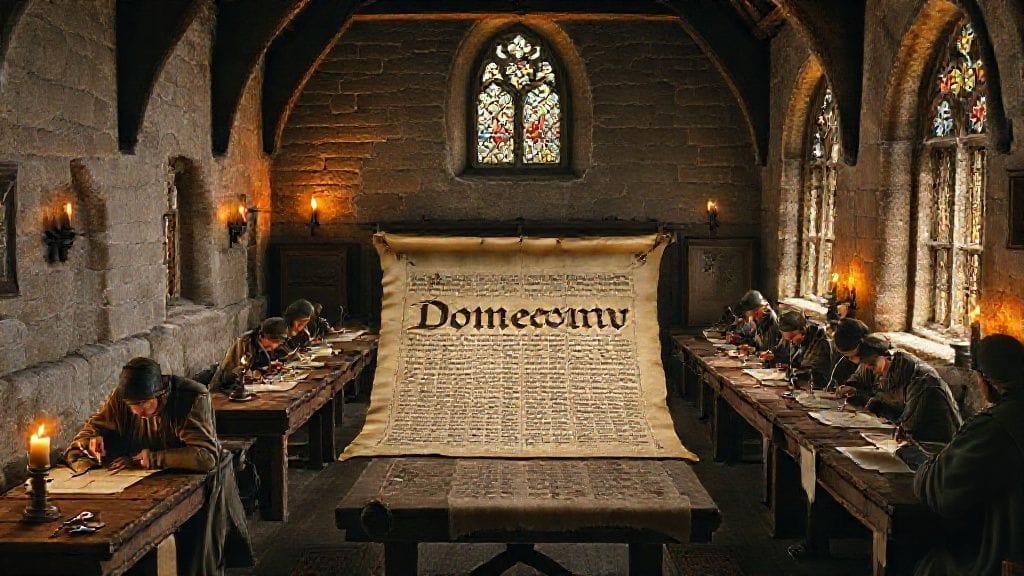
Amid a chilly autumn morning, courtiers, scribes, and royal envoys huddled in the stone halls of Winchester. The Crown’s command was clear: to know every shire, every manor, every farmstead and field, every cow and peddler — in order to wield and wield wisely the power that had been won in blood just two decades earlier. This was no mere census; it was the blueprint of conquest, administration, and legacy. Domesday, the Day of Judgment, had arrived not with thunder in the sky, but with the meticulous scratch of quills on parchment.
2. The Shadow of Conquest: From Harold to William
The Norman Conquest of 1066 remained fresh in the memories of all who dwelled in England. The Battle of Hastings had shattered the old Anglo-Saxon order; Harold Godwinson’s fatal arrow sealed the fate of an era. William of Normandy’s triumph was violent, breathtaking, and resolute. Yet victory on the battlefield was only the prologue to a century of complex integration, rebellion, and reform.
William was not merely a warrior king; he was a ruler determined to entrench his authority by reimagining the governance of the land. The centuries-old Anglo-Saxon systems of power, with their local lords and often informal customs, posed a challenge to Norman hegemony. In understanding the mechanisms of their new dominion, William sought certainty and order — a certainty that only information could provide.
3. Why Domesday? The Birth of a Royal Inquisition
The name “Domesday” itself conjures a grand, ominous weight — like a final judgment. It was not coined by the Normans but emerged in later centuries, inspired by the book’s absolute authority and unchallengeable verdict on land ownership and wealth. The Domesday Survey was, in essence, a royal inquisition, a comprehensive audit that allowed the Crown to peer into every corner of England’s feudal hierarchy.
The purpose was manifold: to assess taxable value, identify shifts in land tenure since 1066, and consolidate revenues essential to maintaining the Norman regime. But it was also a psychological tool. By cataloging the realm’s assets, William instilled a form of governance rooted in accountability that was new to England — a testament that the king’s authority was both omnipresent and uncompromising.
4. The Gathering Storm: Political and Economic Motivations
The mid-1080s were tense years for England’s rulers. Rebellions lingered in the north and west, fueled by discontented nobles and restless peasants. The cost of military campaigns and castle building strained the royal treasury. Moreover, England’s integration into William’s continental holdings meant complex politics and ongoing threats on multiple fronts.
It was in this climate that William’s council, possibly under the advice of Archbishop Lanfranc and other trusted barons, decreed the survey. The kingdom needed to be fiscally transparent, economically efficient, and politically stable. The Domesday Survey was the solution — a way to turn the sprawling patchwork of medieval landholdings and obligations into data, into leverage.
5. The Role of King William the Conqueror: Power and Paranoia
William’s personality loomed large over the survey. His reputation as a determined, sometimes ruthless monarch reflected a deep-seated need for control. Chroniclers describe him as suspicious, keenly aware of the precariousness of his regime in a land not yet fully conquered in hearts or minds.
Ordering the Domesday Survey was thus as much an act of political insurance as administration. To know was to dominate; ignorance bred rebellion, while knowledge secured obedience. William’s gaze was no longer that of a distant warlord but that of a sovereign omnipotent in overseeing his kingdom’s machinery.
6. The Survey’s Logistics: Organizing the Greatest Census of its Time
The logistical feat of the Domesday Survey is staggering when compared with the medieval context. Without modern communication or record-keeping technology, the Crown deployed commissioners to every shire, gap to gap, manor to manor. These men — likely abbots, sheriffs, knights, and experienced scribes — traveled across England to gather testimony and record detailed information.
Local juries, including peasants, villeins, and tenants, were convened to provide sworn statements. This reliance on local knowledge underscored the complexity of medieval society — it was both hierarchical and deeply communal. The sheer scale — encompassing roughly 13,000 settlements — is a testament to administrative ambition, resourcefulness, and the power of centralized authority.
7. The Royal Commissioners: Faces Behind the Inquiry
While many names remain lost to history, the royal commissioners personify the survey’s human aspect. These emissaries faced a delicate balance between royal duty and local negotiation. Some records suggest tension and even fear among the populace confronted with these inquisitors.
The commissioners’ skill lay not only in interrogation but in diplomacy — persuading reluctant villagers and landholders to divulge precise details, sometimes exposing contradictions or half-truths. In many ways, they were the Crown’s eyes and ears, navigating the patchwork of allegiance and resistance sewn across England’s countryside.
8. Local Landholders and the Burden of Truth
The survey placed unprecedented burdens on landowners and tenants alike. Those summoned to testify understood the significance: the accuracy of their declarations could mean the difference between maintaining their holdings or losing them to royal confiscation or rivals.
For many, the survey was a double-edged sword. It recorded their rights and properties but also codified royal oversight that could threaten their autonomy. Especially in a period when oral tradition had long shaped land tenure, the rigid documentation of Domesday introduced new legal and fiscal realities.
9. The Anatomy of the Survey: What Was Measured and Recorded
Each Domesday entry presents a microcosm of medieval life. The survey recorded who held the land in 1066 (before the conquest) and in 1085, the number of plough teams, men eligible to bear arms, mills, fisheries, meadows, woodlands, and livestock — even the presence of churches and the condition of buildings.
It was a holistic portrait, blending economic, military, and social elements. Through this, the document served not merely as a tax register but as a snapshot of England’s feudal fabric at a defining historical crossroads.
10. Tales from the Survey: Anecdotes from the Medieval Countryside
Beyond dry data, the Domesday Book hints at human stories. For example, a modest entry may reveal a local lord who lost land due to rebellion or a peasant whose holdings were swallowed by growing manorial estates. Some entries carry whispered evidence of hardship — “waste” lands reflecting the destruction of war, famine, or depopulation.
One anecdote describes the holdings of King Edward the Confessor, the last Anglo-Saxon king, contrasting with the Norman tenants-in-chief now controlling vast estates — a subtle reminder of a kingdom transformed yet haunted by its past.
11. Resistance, Compliance, and the Fear of the Last Judgment
Unease pervaded many communities as the survey progressed. Stories of resistance, whether passive or active, pepper historical accounts. Some landholders withheld information, while others tried to manipulate records. The name Domesday, though applied later, reflects the fear and finality associated with the survey, as if a divine judgment were being rendered upon the realm.
Nevertheless, the overwhelming majority complied. The reality of William’s power, backed by force and law, created a climate where evasion was risky and often futile.
12. Compilation and Organization: The Making of the Domesday Book
Once returned to Winchester, the assembled data required careful collation. Scribes painstakingly organized entries by county and tenancy. The end result was two large volumes — often called "Great Domesday" and "Little Domesday" — the former covering most of England, the latter covering areas in East Anglia.
The book’s format was systematic yet dense, a challenging document even for medieval eyes. But its precision and scope made it unparalleled as a tool for governance and history alike.
13. Unveiling Domesday: The Book as a Tool of Power
Domesday was not a public document; its distribution was limited to royal officials. Its value lay in enabling the Crown to assess and command, guiding taxation and adjudication of disputes. It became the foundation of Norman land law and a formidable symbol of kingly authority.
Ironically, whilst it imposed new constraints, it also preserved ancient rights and customs by firmly recording them — creating what today historians recognize as the most comprehensive snapshot of medieval England.
14. Immediate Consequences: Governance, Taxation, and Control
The practical impact was swift and profound. William used Domesday to calibrate taxation, ensuring the Crown's coffers could fund castles, armies, and administration. The survey helped quell disputes over land, anchoring Norman control in legal legitimacy.
Moreover, the detailed knowledge of landowners and resources tightened the government’s grip, curbing rebellion and encouraging loyalty through verified rights and obligations.
15. Medieval England Reborn: Societal and Economic Ripples
In the long term, Domesday reshaped the relationship between ruler and ruled. It incentivized better record-keeping and a culture of bureaucratic governance previously unknown in England. The feudal system was solidified, and a more stratified society emerged — yet one where property rights were increasingly documented and enforceable.
Economically, the data fostered more efficient land use and resource management, although it also entrenched social hierarchies that defined medieval England for generations.
16. The Domesday Book as a Historical Treasure Trove
For historians, Domesday is a priceless archive. It is both a mirror and window into the 11th century — revealing population estimates, land distribution, agricultural practices, and social structures.
Its data illuminates everything from economic conditions to settlement patterns, offering unparalleled insights into medieval life, warfare aftermath, and cultural transitions.
17. How Domesday Shaped English Identity and Law
The survey’s legacy extends beyond administration. It contributed to the foundations of English common law and notions of property ownership that resonate even today. By codifying rights and responsibilities, it helped forge early English national identity, blending Norman and Anglo-Saxon elements into a unified polity.
Its influence can be traced in legal traditions and the relentless English pursuit of governmental accountability.
18. Myths and Legends: The Mystique Surrounding Domesday
Over centuries, Domesday took on an almost mythical aura. Medieval chroniclers and later scholars alike viewed it as a divine or final reckoning — a biblical-like “day of judgment” for land and lineage.
This mystique persists in popular understanding, at times overshadowing the survey’s pragmatic origins but enriching its cultural resonance.
19. Comparing Domesday to Modern Censuses
Seen through a contemporary lens, Domesday was an astonishingly advanced survey. Modern censuses owe much to its pioneering spirit — standardizing data collection, employing verification through local testimony, and focusing on property as a basis for governance.
While methods and technology differ drastically, the underlying principle of gathering empirical data to inform policy remains the same.
20. Legacy in the Medieval and Modern World
Domesday’s impact blossomed across centuries. Its methodology inspired subsequent inquiries in England and beyond. British colonial administrators referenced its precedent in managing distant territories.
Today, its physical volumes reside safely in archives, treasured for their historical significance and their testament to human endeavor in governance.
21. The Domesday Survey in Popular Culture and Memory
From historical novels to documentaries, Domesday fascinates. It symbolizes order emerging from conquest, knowledge conquering uncertainty. It appears as a metaphor in literature and cinema for judgment, power, and the fragility of human claims to land.
Celebrations and exhibitions regularly rekindle public interest, affirming its place as a cultural as well as historical monument.
Conclusion
The Domesday Survey commissioned in 1085 stands as a monumental achievement of medieval statecraft — a testament not only to King William’s will but to the collective effort of thousands who lent their voices, knowledge, and labor to create a detailed portrait of an entire kingdom. It embodies a moment when conquest transitioned into governance, when knowledge was weaponized into power, and when the very fabric of English society was rethreaded with ink and parchment.
Beyond its administrative function, Domesday is a deeply human story — of ambition and fear, of authority and resistance, of legacy and memory. It reminds us that history is not just a collection of dates and facts, but the record of human choices, struggles, and dreams woven through time. In the cool halls of Winchester and the scattered villages it surveyed, the echoes of 1085 continue to resonate, inviting us to read and reflect on a kingdom that judged itself in the flickering light of quills and scrolls.
FAQs
1. What was the primary purpose of the Domesday Survey?
The survey aimed to catalog landholdings, resources, and taxable assets in England, allowing King William to strengthen royal control, assess taxes accurately, and resolve disputes over property.
2. How was the Domesday Survey conducted?
Royal commissioners traveled across England interviewing local juries composed of landholders and tenants, recording details about land ownership, resources, and values.
3. Why is the survey called "Domesday"?
The term "Domesday," meaning "Day of Judgment," was applied later because the survey’s verdict was final and binding, much like a divine judgment from which there was no appeal.
4. What kinds of information did the survey collect?
It recorded owners before and after the Norman Conquest, size of the townships, numbers of plough teams, livestock, mills, fisheries, and details relevant to taxation and military obligations.
5. How did the Domesday Survey affect English society?
It established a new, centralized authority and standardized land tenure documentation, shaping the feudal system and influencing English law and governance for centuries.
6. Who were the key figures behind the survey?
King William the Conqueror commissioned the survey, likely advised by key counselors such as Archbishop Lanfranc, but many royal commissioners and scribes carried out the work locally.
7. Is the Domesday Book still accessible today?
Yes, the volumes are preserved in England (notably at The National Archives, Kew), and have been extensively studied, translated, and digitized for research and public interest.
8. How does Domesday compare to modern censuses?
Despite medieval limitations, Domesday was a highly detailed and systematic record, setting early standards for data collection that underpin modern census practices.

