Table of Contents
- The Dawn of Rebellion: Madrid on May 2, 1808
- Spain on the Brink: The Tumultuous Context of Napoleonic Europe
- French Occupation: Seeds of Resentment
- The Spark Ignites: The Role of the Junta and the Popular Outcry
- The Streets Explode: The Uprising Unfolds in Madrid
- Figures of Defiance: Heroes and Martyrs of Dos de Mayo
- The French Response: Repression and Retribution
- The Broader Peninsular War: Spain’s Fight for Survival
- The Symbolism of Dos de Mayo: A Nation Awakens
- Artistic Memory: Goya’s Eternal Tribute
- Political Consequences: The Collapse of the Old Regime and the Rise of Resistance
- Societal Impact: From Rebellion to National Identity
- International Reverberations: The Uprising in the European Imagination
- Lessons in Insurrection: What Dos de Mayo Teaches Us Today
- Dos de Mayo in Modern Spain: Commemoration and Legacy
1. The Dawn of Rebellion: Madrid on May 2, 1808
It was a spring morning steeped in tension, the sun casting its uncertain light over the cramped streets of Madrid. As dawn broke, an uneasy crowd began to stir, whispers of discontent swirling through the city like a gathering storm. The air was thick with anxiety, anticipation, and fierce determination—the perfect alchemy for rebellion. On May 2, 1808, the people of Madrid would ignite an uprising that shook an empire and sparked a war echoed across Europe.
The quiet of the early day was shattered first by murmurs, then shouts. The uprising of Dos de Mayo was not a carefully orchestrated military coup but a spontaneous, fervent eruption of popular fury against the French occupation. It was ordinary citizens, shopkeepers, laborers, and students who became insurgents, stepping into the breach of history with nothing but their courage and a longing for freedom’s return.
2. Spain on the Brink: The Tumultuous Context of Napoleonic Europe
To grasp the seismic impact of the Dos de Mayo uprising, one must dive deep into the turbulent currents of early 19th-century Europe. The continent was a chessboard in the hands of Napoleon Bonaparte, whose imperial ambitions had swept away the old order with ruthless efficiency. Spain, once a proud empire, had been pulled into the vortex of this geopolitical upheaval.
In 1807, under the pretext of an alliance to invade Portugal, French troops entered Spain. The subsequent forced abdications of King Charles IV and his son Ferdinand VII, manipulated by the French, were a devastating blow. Napoleon installed his brother, Joseph Bonaparte, as king—an imposition that deeply wounded Spanish pride and ignited fury across all social strata.
Beneath the surface, Spain was a kingdom gripped by ideological contest—loyalists, liberals, clergy, and common folk each wrestled with loyalty and survival in an age when sovereignty itself was up for grabs.
3. French Occupation: Seeds of Resentment
French soldiers, though initially welcomed as allies by some, swiftly became the embodiment of foreign oppression. Their presence in Madrid disrupted the social fabric. The requisitioning of goods, harassment of locals, and disrespect toward Spanish customs fostered resentment.
One poignant detail: the French military paraded through the Plaza Mayor not just as conquerors but as a daily reminder that Spain’s autonomy was shredded. The simmering anger found an outlet in small acts of defiance—graffiti, secret meetings, and the clandestine spread of pamphlets. These were the tinder to the wildfire that would explode in May.
4. The Spark Ignites: The Role of the Junta and the Popular Outcry
What turned frustration into open revolt? The decisive moment came when rumors spread that French troops intended to remove members of the Spanish royal family from Madrid. This threat to national dignity and kinship relations became the last straw.
The local juntas—spontaneous governing councils—began to organize. Though initially fragmented, they symbolized the collective Spanish will to resist. Ordinary citizens, galvanised by these local authorities and inflamed by tales of insults and atrocities committed by French soldiers, took to the streets. The uprising wasn’t merely politically motivated; it was a raw emotional outpouring.
5. The Streets Explode: The Uprising Unfolds in Madrid
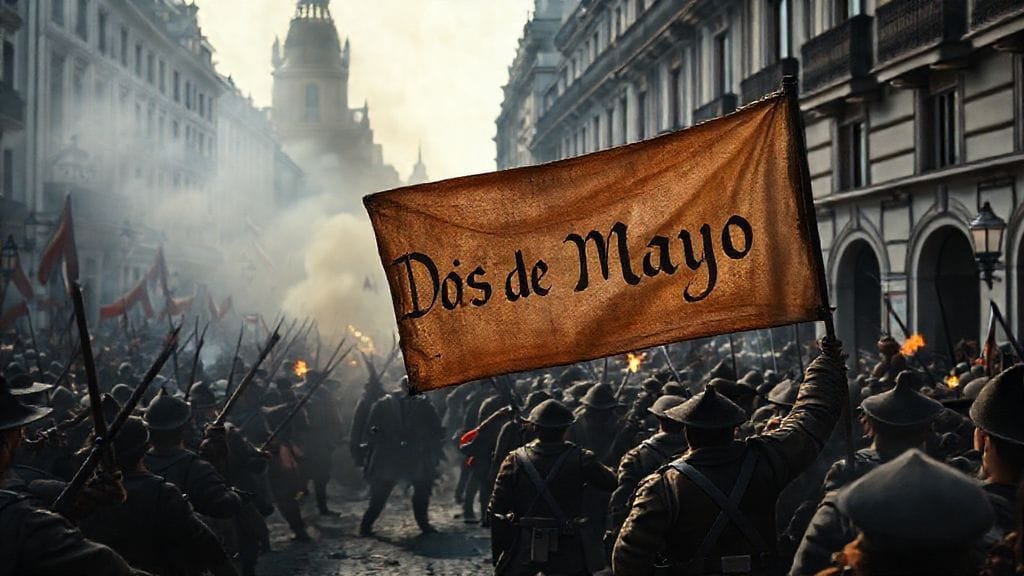
May 2nd was an eruption of chaos and bravery. The uprising began in the working-class neighborhoods of Madrid, where blacksmiths, artisans, and laborers closed ranks. They armed themselves as best they could—tool handles, knives, even kitchen utensils morphing into weapons of resistance.
The French forces, caught off-guard, met fierce resistance. Battles raged near the Puerta del Sol, Las Vistillas, and other iconic city landmarks. The sound of musket fire and cannon echoed amidst the cobblestones, while the streets became scenes of desperate hand-to-hand combat.
Though the French ultimately suppressed the revolt brutally, the event marked a violent rupture with the past. Civilians who fought alongside makeshift militias became living symbols of defiance, refusing to bow quietly.
6. Figures of Defiance: Heroes and Martyrs of Dos de Mayo
Among the tumultuous crowd stood individuals whose names would be etched in Spain’s collective memory. One such figure is Luis Daoíz, an artillery officer who led his troops in a valiant but doomed defense of critical positions. Daoíz’s death became a rallying symbol of sacrifice.
Similarly, Pedro Velarde, Daoíz’s comrade, displayed astonishing courage before falling in battle. Their last stand underscored the movement’s scarce resources but unyielding spirit. Beyond military figures, countless anonymous heroes—shopkeepers, women, students—played a critical role in sustaining the fight.
7. The French Response: Repression and Retribution
The uprising’s brutal suppression was swift and merciless. French forces executed hundreds of suspected insurgents in public squares, including El Dos de Mayo's infamous executions in the aftermath. The aim was clear: terrorize the population back into submission.
General Joachim Murat, Napoleon’s brother-in-law and commander in Spain, orchestrated a wave of reprisals. The trying of suspected rebels was summary, the punishments harsh. Yet, in the paradox of repression, Murat only fanned the flames of resistance across Spain.
8. The Broader Peninsular War: Spain’s Fight for Survival
The Dos de Mayo uprising was the opening chapter of the Peninsular War, a protracted and grueling conflict lasting six years. Spain’s initial burst of revolt inspired a nationwide resistance, punctuated by irregular guerrilla warfare that confounded the French armies.
British and Portuguese forces eventually allied with Spanish insurgents, turning the Iberian Peninsula into a crucial front against Napoleonic expansion. The war drained French resources and symbolized one of the first widespread popular resistances to Napoleon’s empire.
9. The Symbolism of Dos de Mayo: A Nation Awakens
Dos de Mayo quickly transcended its immediate context to become a potent symbol of national awakening. It demonstrated that ordinary people—regardless of class or standing—could rise against oppression and alter the course of history.
The uprising represented a breaking point, where loyalty to a foreign-installed monarchy became untenable. It ignited Spanish nationalism and helped forge a collective identity rooted in resistance, sacrifice, and hope.
10. Artistic Memory: Goya’s Eternal Tribute
No narrative of Dos de Mayo is complete without the genius of Francisco de Goya, whose paintings immortalized the event’s emotional intensity. His masterpiece, The Third of May 1808, captures the horror and heroism of the executions following the revolt.
Goya’s raw, unflinching portrayal reveals not only the tragedy but the dignity of the Spanish people confronting overwhelming violence. His art transformed history into a visceral experience, ensuring Dos de Mayo’s memory endured far beyond the battlefield.
11. Political Consequences: The Collapse of the Old Regime and the Rise of Resistance
The dos de Mayo uprising shook the foundations of Spain’s political order. It eroded the legitimacy of the Bonapartist regime and invigorated domestic political movements seeking constitutional reform.
The war’s upheavals eventually led to the 1812 Cádiz Constitution, one of the earliest liberal charters in Europe, signaling a shift towards modernity within Spain’s fractured society.
12. Societal Impact: From Rebellion to National Identity
The uprising also had profound social repercussions. The popular revolt blurred traditional class lines, uniting diverse sectors in a shared cause. It empowered burgeoning middle classes and commoners alike.
This collective struggle fostered a new Spanish identity defined by resilience and resistance—a narrative that would shape the nation’s self-conception for generations.
13. International Reverberations: The Uprising in the European Imagination
Europe watched with a mix of fear and admiration as Spain resisted Napoleon’s forces. Dos de Mayo inspired other suppressed peoples, signaling that popular revolt could challenge imperial might.
The conflict intensified diplomatic tensions and reshaped alliances, contributing to the eventual coalition that toppled Napoleon. The uprising’s echo resonated in the broader narrative of nationalist struggles across the continent.
14. Lessons in Insurrection: What Dos de Mayo Teaches Us Today
Looking back, Dos de Mayo offers timeless lessons about the power of collective courage against tyranny. It illustrates how the oppressed can reclaim agency even against vastly superior forces, and how cultural memory can sustain struggles beyond their immediate outcome.
The uprising reminds us that history is not only shaped by great generals or kings—but by the people in the streets, the anonymous multitude rising for dignity.
15. Dos de Mayo in Modern Spain: Commemoration and Legacy
Today, Dos de Mayo is a solemn public holiday in Madrid, remembered through ceremonies and cultural events that honor its martyrs and heroes. Monuments and museums preserve its stories, embedding the uprising in the city’s urban fabric.
The spirit of Dos de Mayo remains a touchstone for Spanish identity: a reminder that freedom was hard-won and vigilance eternal.
Conclusion
The uprising of Dos de Mayo 1808 stands as one of history’s vivid testaments to popular resistance—the raw, human will to defy subjugation when all seems lost. It was not a grandly engineered revolution, but a spontaneous flame kindled by ordinary people whose actions transcended themselves.
Though crushed in the moment, the rebellion energized a nation and reshaped Europe’s political landscape. It revealed the paradox of repression: in trying to extinguish the fire, the occupiers only set the forest ablaze.
The legacy of Dos de Mayo is not just the liberation of a people but the enduring power of hope and unity. As we reflect on this tumultuous day, we are reminded that history’s true protagonists are those who dare to rise—even against insurmountable odds.
FAQs
Q1: What caused the Dos de Mayo uprising in Madrid?
A1: The uprising was sparked by widespread resentment against French occupation following Napoleon’s forced abdication of the Spanish monarchs. The immediate trigger was the attempt to arrest members of the Spanish royal family and the imposition of Joseph Bonaparte as king, which ignited popular fury.
Q2: Who were the key figures in the Dos de Mayo uprising?
A2: Luis Daoíz and Pedro Velarde, two Spanish officers, became iconic heroes. They led the defense against French forces and died fighting, symbolizing the courage of the Spanish resistance.
Q3: How did the French respond to the uprising?
A3: The French brutally suppressed the revolt, executing hundreds in public and tightening military control. This repression paradoxically intensified resistance, fueling the wider Peninsular War.
Q4: What was the significance of Dos de Mayo in the Peninsular War?
A4: It marked the beginning of widespread armed resistance across Spain, leading to a six-year conflict involving guerrilla warfare and international alliances that eventually weakened Napoleon’s hold on Europe.
Q5: How did the uprising influence Spanish national identity?
A5: Dos de Mayo united Spaniards across classes into a shared narrative of resistance and sacrifice, fostering a modern sense of national pride bound to the struggle for freedom.
**Q6: Why is Francisco de Goya’s painting The Third of May 1808 so important?**
A6: Goya’s painting immortalizes the tragedy and heroism of the uprising’s aftermath, using art to convey the emotional depth and historical significance of the event, helping it resonate through generations.
Q7: How is Dos de Mayo remembered in Spain today?
A7: It is commemorated as a public holiday, with ceremonies, monuments, and public memory ensuring the uprising remains a symbol of Spain’s enduring spirit and fight for liberty.
Q8: What lessons does Dos de Mayo offer for contemporary society?
A8: It teaches the power of grassroots resistance, the importance of standing against oppression, and how collective memory shapes national identity and inspires future generations.