Table of Contents
- A Nation on the Brink: America Before the Dred Scott Decision
- From Enslavement to Lawsuit: The Early Life of Dred and Harriet Scott
- “Once Free, Always Free”: Missouri’s Legal Tradition and Its Collapse
- The Long Road Through the Missouri Courts
- Politics on a Knife’s Edge: Slavery, Congress, and the Union
- The Supreme Court Takes the Case: Behind the Marble Facade
- Inside the Chambers: Taney, His Colleagues, and a Divided Bench
- March 6, 1857: The Dred Scott Decision Is Announced
- “No Rights Which the White Man Was Bound to Respect”: The Words That Shocked a Nation
- Citizenship Denied: The Supreme Court Redraws the American Political Community
- The Missouri Compromise Struck Down and the Expansion of Slavery
- Northern Fury, Southern Triumph: The Immediate Political Firestorm
- Abraham Lincoln, Stephen Douglas, and the Shadow of Dred Scott
- Human Lives in the Balance: What the Ruling Meant for Black Americans
- From Courtroom to Battlefield: How Dred Scott Helped Ignite the Civil War
- The End of the Story for Dred and Harriet Scott
- Undoing the Damage: The Civil War Amendments and Legal Aftershocks
- Memory, Reckoning, and the Modern Legacy of the Dred Scott Decision
- Conclusion
- FAQs
- External Resource
- Internal Link
Article Summary: On March 6, 1857, in Washington, D.C., the United States Supreme Court issued the infamous dred scott decision, a ruling that denied Black people citizenship and intensified the nation’s slide toward civil war. This article traces the life of Dred and Harriet Scott, from their bondage in Missouri and journeys into free territory to their courageous decision to sue for freedom. It recreates the political backdrop of the 1850s, when the fragile balance between slave and free states was already cracking. The narrative enters the Supreme Court’s chambers, following Chief Justice Roger B. Taney and his colleagues as they fashioned a sweeping, pro-slavery judgment that struck down the Missouri Compromise. It then follows the explosive reaction across North and South, exploring how abolitionists, politicians like Abraham Lincoln, and everyday Americans responded. The article also examines the human cost for Black communities who saw their rights stripped away in writing. Finally, it looks at the long aftermath—from the Civil War Amendments to modern constitutional law—to explain why the dred scott decision remains one of the darkest yet most consequential moments in American legal history.
A Nation on the Brink: America Before the Dred Scott Decision
In the decade before 1857, the United States felt less like a single country and more like a fragile truce drawn on a map. Every river, territory line, and courthouse seemed to vibrate with the same question: would this vast republic be a nation of slavery, a nation without slavery, or something divided and unsustainable in between? The dred scott decision did not appear in a vacuum; it rose out of a nation already cracking along moral and political fault lines. To understand why one Supreme Court ruling could send shock waves from plantation fields to New England lecture halls, one must first step into the anxious, smoke-filled atmosphere of the 1850s.
The Missouri Compromise of 1820 had once offered a simple but uneasy formula—slavery would be allowed in some western lands and barred in others, drawing an imaginary latitude line across a continent. It was a legislative bandage over a wound that never healed. Each decade, as new territories clamored for admission to the Union, northerners and southerners counted slave states and free states like gamblers tallying chips. The Compromise of 1850, then the Kansas-Nebraska Act of 1854, tried to reset the board. “Popular sovereignty,” the idea that local white settlers would vote slavery up or down, turned the plains of Kansas into a battlefield. Newspapers carried reports of “Bleeding Kansas,” where men were shot, houses burned, and elections stolen in the name of either freedom or human bondage.
In Congress, tempers surged with similar ferocity. In 1856, Representative Preston Brooks of South Carolina strode into the Senate chamber and beat Senator Charles Sumner of Massachusetts nearly to death with a cane for denouncing slavery. A hush fell over the nation: if senators could be assaulted on the floor of the Capitol, how safe was the Union itself? Yet behind every insult, every fist fight, and every legislative compromise stood millions of enslaved people whose bodies and labor underwrote the American economy. Cotton exports powered southern fortunes and northern textile mills alike, while enslaved families lived under the constant threat of sale and separation.
Amid this turmoil, both pro-slavery and anti-slavery forces searched for tools that could cement their vision of the republic. Some pinned their hopes on Congress, others on violence in the territories, and a few looked to the federal courts. The Supreme Court, cloistered in its marble chambers in Washington, D.C., still had an aura of distance and authority. Many Americans did not yet think of it as an engine of social change. But as lawsuits involving enslaved people’s claims to freedom began to climb the judicial ladder, lawyers on both sides recognized that a single decision at the highest level could settle—or inflame—the slavery question for a generation.
It is in this tense, combustible America that we must place one enslaved man’s quiet but relentless struggle for freedom: Dred Scott, whose name would soon be spoken in every state in the Union.
From Enslavement to Lawsuit: The Early Life of Dred and Harriet Scott
Dred Scott did not set out to become a symbol. He was born into bondage, most likely around 1799 in Virginia, at a time when the new American republic was still an experiment and the institution of slavery seemed as permanent as the seasons. Little is known of his earliest years, a silence that speaks volumes about how little the nation cared to record the lives of the enslaved. Records show him eventually in St. Louis, Missouri, enslaved by the Blow family, and later sold to an army surgeon, Dr. John Emerson. In those transactions, Dred’s humanity was measured in dollars, his fate bound to the changing assignments of a white military officer.
That fate would soon carry him to places where the law, at least on paper, recognized his right to be free. Emerson took Scott first to Illinois, a state whose constitution forbade slavery, and then to Fort Snelling in the upper Mississippi region, in territory made free by the Missouri Compromise. For years, Scott lived and labored on soil that Congress and local law declared off-limits to slavery. It was here that he married Harriet Robinson, a young woman enslaved by a local army officer but later also owned by Emerson. Their marriage—remarkably, witnessed and formalized by a local justice of the peace—was one act of dignity in a system that often refused to acknowledge enslaved families at all.
To the Scotts, these years likely felt like a difficult routine marked by harsh work, military discipline, and the daily humiliations of enslavement. Yet legally, those years contained a powerful argument. In Missouri, a long-standing doctrine had held that enslaved people taken to free soil with their owners, and kept there for some time, could claim their liberty once brought back. This principle, often summed up as “once free, always free,” had been used by other enslaved plaintiffs to secure their emancipation in Missouri courts. Dred and Harriet, though likely illiterate, moved within a Black community that knew of such precedents and passed the knowledge along in whispers, stories, and cautious conversations.
When Dr. Emerson died, his widow inherited the Scotts and continued to hire them out for wages in St. Louis, pocketing the money. This was a common practice in urban slavery, where enslaved people could be “rented” like tools. It was also a moral affront: Dred and Harriet’s labor enriched a woman who lived hundreds of miles away and rarely, if ever, saw them. Friends, both Black and white, urged the couple to go to court. The Blow family, Dred’s former owners, sympathetic to his plight, helped arrange legal representation. Somewhere amid rented rooms in St. Louis, with their two daughters growing up in slavery, Dred and Harriet decided to gamble everything on the law.
In 1846, they filed suit in Missouri for their freedom. It was an audacious act. A Black man and woman, legally property, were asking white judges and juries in a slave state to declare them free. When we speak today of the dred scott decision, we often think only of the marble steps of the Supreme Court. But the story began in cramped local courtrooms, with simple words written on parchment: Dred Scott versus Irene Emerson.
“Once Free, Always Free”: Missouri’s Legal Tradition and Its Collapse
To modern eyes, it might seem extraordinary that enslaved people could sue their owners at all. Yet Missouri, like several other slave states, had a surprisingly long history of “freedom suits,” cases where enslaved plaintiffs claimed that some prior circumstance—residence in free territory, an illegal sale, or descent from a free ancestor—had made their bondage unlawful. Local statutes allowed enslaved people to sue as “poor persons,” granting them court-appointed counsel and permitting them to appear as plaintiffs, even though, paradoxically, the law also defined them as property.
For decades, Missouri courts had honored the doctrine that if an owner took an enslaved person into free territory, and there established residence, freedom followed. Judges sometimes moved by a sense of legal duty, sometimes by a flicker of conscience, had reasoned that the law of the free jurisdiction must be respected. When the enslaved person returned to Missouri, that freedom, once gained, could not be undone—a simple, powerful phrase: “once free, always free.”
By the time Dred and Harriet Scott brought their case, this doctrine had liberated dozens, perhaps hundreds, of people. It was an implicit recognition that slavery and freedom could not coexist without collision, and that when laws clashed, freedom ought to prevail. But the 1840s and 1850s were not ordinary years. The politics of slavery had grown more volatile. Southern planters, fearing any erosion of their power, watched northern abolitionism with mounting anger. In Missouri, pro-slavery sentiment hardened, and judges grew less willing to grant legal victories that might be interpreted as an insult to slaveholders or an endorsement of anti-slavery principles.
Dred and Harriet’s first trial in 1847 ended in a technical defeat; the court ruled against them because of a minor legal error involving testimony. But in 1850, at a new trial, a St. Louis jury heard evidence of their long residence in free territory and decided in their favor. For a brief, shining moment, the Scotts were legally free. They went home that night not as property but as persons under the law. It’s astonishing, isn’t it, to imagine such a transition hinging on the stroke of a pen and the word of a jury?
Yet this was only the beginning. Irene Emerson appealed, unwilling to lose what the law still termed “valuable property.” In 1852, the Missouri Supreme Court reversed the lower court’s ruling. In a stunning departure from its own precedents, the state’s highest judges abandoned “once free, always free.” They declared that Missouri was no longer bound to recognize the free laws of other jurisdictions if doing so might endanger its slaveholding society. The opinion was blunt: the times had changed, and so had the court’s stance.
In that reversal, the Scotts’ brief legal freedom vanished. They were once more enslaved. But something else happened, too. By discarding its own long-standing doctrine, Missouri opened the door for the case to move into the federal courts. What had begun as a local freedom suit would now become a constitutional showdown over the very nature of American citizenship and Congress’s power to restrict slavery. The Scotts’ personal quest for freedom was about to be welded, inexorably, to the fate of the Union.
The Long Road Through the Missouri Courts
The procedural path Dred and Harriet’s case followed was tortuous. After the Missouri Supreme Court’s reversal, the Scotts and their allies refused to give up. Technically, ownership of the Scotts had transferred from Irene Emerson—who had remarried—to her brother, John F.A. Sandford (the Supreme Court opinion would misspell his name as “Sanford”). Scott’s lawyers seized on the fact that Sandford resided in New York, while Scott was in Missouri. This created “diversity of citizenship,” a legal term that allowed the case to be heard in federal court.
Here the term “citizenship” took on a bitter irony: the jurisdictional doorway that opened to the federal courts depended on the alleged citizenship of the white defendant, not on the status of the Black plaintiff. Yet it gave Scott another chance. In 1854, the case came before the United States Circuit Court in Missouri. Once again, the basic question was whether Scott’s years in free Illinois and free federal territory had liberated him.
The jury in the federal trial ruled against Scott. The judge applied Missouri law as the state’s high court had redefined it—no longer honoring “once free, always free.” Still, the decision contained within it a path of appeal. Scott’s lawyers, encouraged by abolitionists and sympathetic politicians, petitioned the Supreme Court of the United States. The stakes were now vastly higher than one man’s freedom. Both sides understood that the justices could use the case to address burning national issues: Could a Black person of African descent be a “citizen” of the United States and sue in federal court? Did Congress have constitutional power to ban slavery in federal territories, as it had done with the Missouri Compromise?
To many southern politicians, the opportunity was irresistible. If the Court could declare that Congress had no power to bar slavery from the territories, then slaveholders could carry their human property into the West unchecked. The ruling would consecrate slavery as a national institution rather than a local option. For northern opponents of slavery, this was a nightmare, one they feared would transform the entire United States into a vast slave empire.
Thus, by the mid-1850s, the name “Dred Scott” began to appear in political speeches and newspaper editorials, long before the final ruling. The case was no longer obscured in court dockets; it had become a symbol around which both sides rallied. The dred scott decision, still unwritten, already haunted the country like a storm cloud on the horizon.
Politics on a Knife’s Edge: Slavery, Congress, and the Union
While Dred Scott’s case crept up the judicial ladder, the nation’s politics descended into open crisis. The old two-party system was crumbling. The Whig Party, once home to many moderate voices, splintered apart under the pressure of slavery. In its place emerged the Republican Party, founded in the mid-1850s on a platform that opposed the expansion of slavery into western territories. Its leaders, including a lanky Illinois lawyer named Abraham Lincoln, did not yet call for immediate nationwide abolition, but they insisted that slavery must be contained, set on a path to eventual extinction.
Southern politicians viewed this platform as a mortal threat. To them, slavery was not merely an economic system but the bedrock of their social order and political power. The admission of new free states, filled with voters hostile to slavery, would upset the delicate balance in the Senate. They feared becoming a permanent minority in a Union governed by those who denounced their way of life. The Kansas-Nebraska Act of 1854 had attempted to defuse the tension by letting settlers vote slavery up or down, but instead, it had inflamed it.
Violent clashes in Kansas, the brutal caning of Charles Sumner in the Senate, and the rise of abolitionist voices like Frederick Douglass and Harriet Beecher Stowe made compromise feel increasingly remote. Stowe’s novel “Uncle Tom’s Cabin,” published in 1852, had seized the nation’s imagination, depicting the horrors of slavery in vivid, sentimental detail. Southern critics accused her of unfair exaggeration; northern readers, while sometimes blinded by their own racial prejudices, found their consciences stirred. Douglass, in his speeches and writings, insisted that the Constitution could be interpreted as a freedom document if only the nation had the will.
Yet at the same time, President Franklin Pierce, and later James Buchanan, leaned toward conciliating the South. Buchanan, elected in 1856, hoped to quiet the slavery question by supporting a definitive Supreme Court ruling. Before he even took office, he corresponded with justices on the Court, asking about the likely outcome of the pending case. This improper contact hints at something larger: the dred scott decision was not simply a legal matter; it was intertwined with partisan strategy and presidential ambition.
The Court, ideally insulated from politics, was in fact steeped in them. Most of the justices were southern-born or southern-aligned Democrats. Many believed, as did much of the ruling white elite, that the long-term security of the Union required reassuring slaveholders that their property rights would be protected everywhere. If the Court could issue a sweeping judgment that resolved both the technical question of Scott’s suit and the broader constitutional disputes over slavery, perhaps, some hoped, the country might avert further violence.
Such hopes were tragically misplaced. The decision they would hand down in 1857 did not soothe; it seared. It did not close the debate; it blew it wide open.
The Supreme Court Takes the Case: Behind the Marble Facade
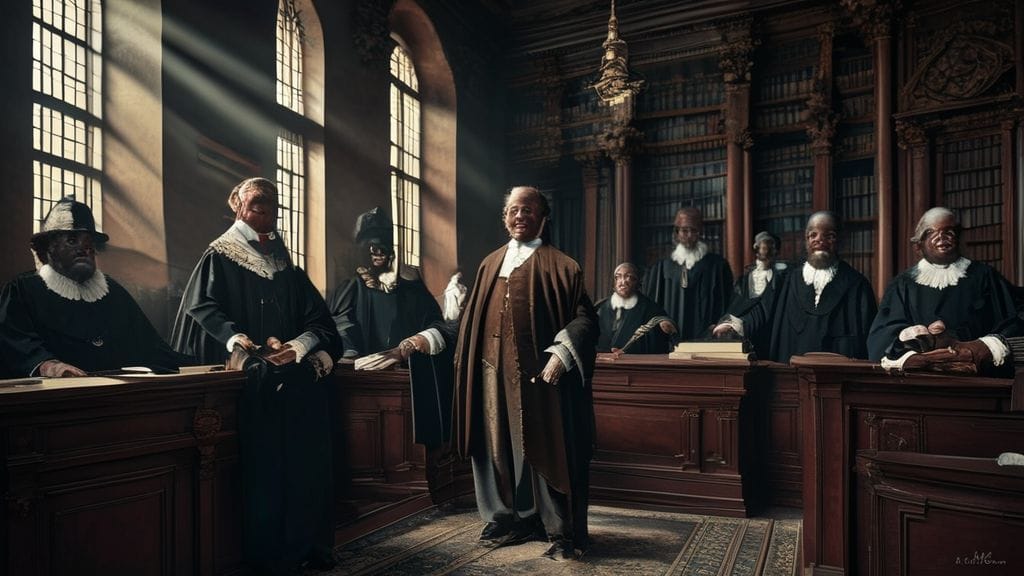
When the Supreme Court agreed to hear Scott v. Sandford, the case traveled from Missouri’s tense courtrooms to the solemn halls of the United States Capitol, where the Court still met at the time. The room was smaller than today’s grand, neoclassical building, but its significance was immense. There, beneath dark wood paneling and high windows, nine justices in black robes gathered to consider one enslaved man’s plea—and, through it, the fate of slavery in the territories.
Dred Scott himself was present in Washington at various stages, a quiet figure in a world of polished lawyers and powerful politicians. We can only imagine what he felt, walking the same streets as senators and cabinet members, knowing that his name would soon be on the lips of men who debated the fate of millions. Harriet remained in St. Louis, caring for their daughters, far from the abstractions of constitutional theory. For her, the case was about whether her children would live and die as property.
Scott’s legal team centered its argument on familiar ground: his long residence in free territory, under both Illinois law and the Missouri Compromise’s ban on slavery north of a certain line, had made him free. When he returned to Missouri, that freedom should have followed. The legal logic, rooted in decades of Missouri practice, was straightforward. But the lawyers also knew they were entering a minefield. The defense, representing Sandford and the broader interests of slaveholders, sought to make the case about two larger questions: whether any Black person of African descent could be a citizen under the federal Constitution, and whether Congress had any authority to outlaw slavery in federal territories.
The justices heard arguments in 1856 and initially seemed ready to decide the case on narrow procedural grounds. Yet behind closed doors, they quarreled over how far to go. Some wanted to avoid inflaming the slavery question any further. Others believed that this was precisely the moment to render a broad ruling that would settle the matter for good. Chief Justice Roger B. Taney, a Marylander and former slaveholder, would emerge as the architect of the most sweeping, and devastating, opinion the Court had ever issued.
Historians have pieced together the deliberations from letters and later recollections. Some justices initially drafted opinions that would have granted Scott his freedom under Missouri law, without reaching the bigger constitutional issues. But the political winds were blowing fiercely. Incoming President Buchanan, eager to see the Court resolve the controversy in a manner acceptable to the South, communicated privately with at least one justice. Taney and his allies concluded that a narrow ruling would simply postpone the crisis. They decided instead to answer every question the defense had raised—and more.
In choosing that path, the Court stepped out of its traditional reluctance to rule on issues it did not strictly need to decide. The dred scott decision would not only deny one man’s claim; it would redraw the boundaries of American citizenship and congressional power. It would turn the Court into a lightning rod in a way not seen before in the nation’s history.
Inside the Chambers: Taney, His Colleagues, and a Divided Bench
Roger B. Taney was in his eighties when he took up the pen to write the Court’s opinion. Frail in body but sharp in mind, he carried with him a long career in Democratic politics and a deep belief in states’ rights and property protections. To Taney, the Constitution was a compact made by and for white men, a shield for their interests rather than a promise of universal liberty. He saw the rising tide of northern anti-slavery sentiment as a threat to both the Union and the social order he cherished.
Among his colleagues, there were divisions, but southern and southern-leaning justices held the majority. Justices like John Catron and Peter Daniel urged a strong pro-slavery stance. A few, most notably Benjamin R. Curtis of Massachusetts, would ultimately dissent with powerful, carefully constructed arguments. The justices debated not only legal doctrines but also the likely reaction in the country. Could the Court afford to seem timid? Could it risk seeming radical?
Taney’s drafting process reveals his ambition. He would answer the question of Scott’s status by first declaring that people of African descent—whether enslaved or free—were not, and could not be, citizens of the United States within the meaning of the Constitution. He would then go further, striking at the heart of federal authority over slavery in the territories. The Missouri Compromise, which for nearly four decades had drawn a line between slave and free, would be declared unconstitutional. In the sweep of a pen, he planned to nationalize the security of slave property.
Justice Curtis, in contrast, painstakingly researched the status of free Black people at the time of the Founding. He found that in several of the original states, free Black men had voted and been treated as citizens, thereby qualifying as part of “the people” who ordained and established the Constitution. To Curtis, this history proved that Taney’s vision of an exclusively white political community was false. Curtis tried to persuade his colleagues that to deny this was to rewrite history for partisan ends. His questions cut to the core of the Court’s legitimacy: Could it simply declare that an entire class of people had never counted as part of the political nation when documented evidence said otherwise?
The debates grew heated. Some justices circulated drafts and counter-drafts. Taney dug in, his language growing more categorical and, in places, chilling. The majority rallied around him. A decision that might have been resolved on technical grounds was transformed into a manifesto on race, citizenship, and property. The dred scott decision was taking shape not as a cautious judicial opinion but as a sweeping pro-slavery proclamation from the highest tribunal in the land.
By early 1857, the drafts were complete. All that remained was to read the opinion from the bench and send it into a nation already struggling for breath.
March 6, 1857: The Dred Scott Decision Is Announced
On March 6, 1857, Washington, D.C., awoke to gray skies and winter chill. Two days earlier, James Buchanan had been inaugurated as president on the steps of the Capitol, invoking the hope that the Supreme Court would soon settle the great question of slavery in the territories. Now, in the Court’s chamber inside the Capitol building, citizens and reporters gathered to hear what the justices would pronounce in Dred Scott v. Sandford.
Dred Scott himself sat in the courtroom, a dark, quiet figure among the whispered conversations and rustling papers. He had spent more than a decade seeking freedom through the courts. His hair had grayed; his face, observers noted, bore the marks of age and hardship. Still, he was there to hear his fate. The man whose name would echo through history likely understood only fragments of the legal reasoning that would be spoken, but he knew that the decision would shape not only his life but that of his wife, Harriet, and their daughters.
Chief Justice Taney began to read. His voice, though aged, carried across the room. Hour after hour, he delivered the Court’s opinion. The crowd listened as he declared that the Court lacked jurisdiction because Dred Scott, as a Black man of African descent, could not be a citizen of the United States. Therefore, he had no right to sue in federal court at all. But Taney did not stop there. He pressed on, addressing questions that were, strictly speaking, unnecessary to decide the case.
Reporters scribbled furiously. Telegraph operators waited to transmit the news to distant cities. Outside, carriages creaked along muddy streets, and government clerks hurried about their business, unaware that inside the Court, the nation’s constitutional landscape was being radically redrawn. By the time Taney finished, the message was unmistakable: the Supreme Court had handed slavery’s defenders an enormous, if pyrrhic, victory.
The opinion spread quickly through Washington’s network of boardinghouses, saloons, and parlors. Politicians read early summaries with a mixture of delight, horror, or guarded satisfaction, depending on their region and party. Within days, newspapers across the country printed the decision in full or in part, their editorial pages roaring with approval or rage. The dred scott decision was no longer a legal abstraction; it was a front-page reality.
“No Rights Which the White Man Was Bound to Respect”: The Words That Shocked a Nation
Among the many passages in Taney’s opinion, one line burned itself into the nation’s memory. Writing of Black people of African descent, he declared that at the time of the Founding they were regarded as “beings of an inferior order, and altogether unfit to associate with the white race… and so far inferior, that they had no rights which the white man was bound to respect.” With these words, the Chief Justice did more than deny Dred Scott’s citizenship; he attempted to rationalize and cement a racial hierarchy as part of the Constitution’s very fabric.
To many white Americans in the South, the language confirmed what they had long argued—that the republic had been made by and for white men and that slavery’s existence was compatible with American ideals. Southern newspapers hailed the decision as a vindication. One editorial crowed that the Court had “written with the pen of history” and restored the proper understanding of the Constitution. Plantation owners took comfort in the notion that their property rights in human beings were now federally protected.
In the North, however, the reaction was explosive. Abolitionists seized upon Taney’s words as proof that the federal government had become an instrument of slave power. Frederick Douglass denounced the ruling in speeches that combined moral wrath with a fierce, almost prophetic hope. He insisted that no court, however high, could make injustice right. “My hopes were never brighter than now,” Douglass said, believing that the extremity of the decision would awaken the conscience of the nation.
Many white northerners who were not abolitionists, and who harbored their own prejudices, nonetheless bristled at the idea that Black people could never be citizens and that Congress lacked the power to limit slavery’s spread. The ruling, to them, seemed to erase the compromises that had held the Union together and to invite slavery to expand unchecked. Republican leaders warned that if slavery could not be barred from the territories, it might eventually reach every state. The dred scott decision, in their view, threatened to turn the entire nation into a slaveholding republic.
Even some moderates were appalled by Taney’s historical claims. They knew that free Black men had voted in several states at the time of the Constitution’s ratification. Taney’s sweeping pronouncement that Black people had “no rights which the white man was bound to respect” sounded less like legal analysis and more like racial dogma. The Court, which had wrapped itself in the language of history and original intent, was accused of rewriting both to serve a pro-slavery agenda.
The phrase became a rallying cry. It was repeated in pamphlets, sermons, and stump speeches, often with a tone of disbelief. Could this really be what American justice had come to? The question echoed from New York to Chicago, from Boston to small towns scattered across the northern landscape. In answering it, many Americans began to reconsider their allegiance to the Union as it was, and to imagine what it might have to become.
Citizenship Denied: The Supreme Court Redraws the American Political Community
At the core of the dred scott decision lay a radical redefinition of American citizenship. Taney declared that no person of African descent, whether enslaved or free, could be a citizen of the United States under the Constitution. This did more than bar Dred Scott from federal court. It sought to expel an entire population from membership in the political community.
In making this claim, Taney confronted a simple historical fact: in states like Massachusetts, New Hampshire, and New York at the time of the Founding, free Black men had voted and been treated as citizens. Justice Benjamin Curtis, in his dissent, painstakingly documented this reality. “At the time of the ratification of the Articles of Confederation,” he wrote, “all free native-born inhabitants of the States of New Hampshire, Massachusetts, New York, New Jersey, and North Carolina, though descended from African slaves, were not only citizens of those States, but such of them as had the other necessary qualifications possessed the franchise of electors.” Curtis’s words, drawn from state records and contemporary accounts, stood as a quiet but devastating refutation of Taney’s narrative.
Taney brushed such evidence aside. He insisted that even if some states had once granted limited rights to free Black people, the national Constitution did not, and could not, recognize them as part of “the people of the United States.” His vision was clear: citizenship was a racial category, reserved for whites alone. The decision, therefore, told millions of free Black Americans—men and women who paid taxes, worked, worshipped, raised families, and in some places voted—that in the eyes of the highest court, they were permanent outsiders.
The implications were chilling. If Black people were not and could never be citizens, what protections did they have under federal law? Could states bar them from entering, force them into labor, or subject them to special “Black codes” without violating the Constitution? White supremacists drew the obvious lesson: racial subordination was not merely tolerated; it was allegedly embedded in the nation’s founding document.
Black communities, already well aware of white hostility, responded with a mixture of fear and defiance. Church meetings turned into forums for political discussion. Ministers preached sermons that blended scripture with a call for resistance. Black newspapers, such as those edited by Douglass and others, urged their readers to see the decision not as the end, but as another stage in a long struggle. They pointed out that the Court’s interpretation could be changed—if not by the same men who sat on its bench, then by future justices, or by amendments to the Constitution itself.
Yet in 1857, such hopes still seemed distant. For the moment, the dred scott decision stood as the law of the land, casting a long shadow over every Black person in America, whether in chains or formally free.
The Missouri Compromise Struck Down and the Expansion of Slavery
If Taney’s ruling on citizenship shattered Black Americans’ legal status, his treatment of the Missouri Compromise shattered the delicate political geography of slavery and freedom. The Missouri Compromise had, since 1820, drawn a line across the western territories, prohibiting slavery north of latitude 36°30′ (except in Missouri itself). It was an attempt to keep a balance between slave and free states, a line that had been accepted—if grudgingly—by many southerners as the price of Union.
Taney declared this compromise unconstitutional. Congress, he argued, had no authority to exclude slave property from federal territories. Under his reasoning, the Fifth Amendment’s protection of property meant that slaveholders had a right to carry their human chattel into any territory owned by the United States. To bar them would be to deprive them of property without due process of law.
With this stroke, the Court effectively opened all federal territories to slavery. The West—Kansas, Nebraska, and lands yet to be organized—could no longer be legally closed to slaveholding. Popular sovereignty, the idea that white settlers could choose, was pushed aside by a stronger claim: the Constitution itself protected slave property wherever the United States flag flew. Abolitionists had long warned of a “Slave Power” conspiracy; now, many moderate northerners began to suspect they were right.
The practical consequences were immediate. In Kansas, where pro-slavery and anti-slavery settlers had already clashed violently, both sides took fresh stock of their positions. Pro-slavery advocates felt emboldened, believing that the Court’s decision strengthened their claim. Anti-slavery settlers feared that if federal law was on slavery’s side, they might ultimately be overwhelmed, not only by armed Missourians crossing the border to stuff ballot boxes, but by the weight of national authority.
In Congress, the ruling intensified sectional hostility. Republicans argued that if Congress could not bar slavery from the territories, then the entire premise of their party—preventing slavery’s expansion—was under assault. Some radical voices began to question whether allegiance to a Union so skewed toward slavery could be morally sustained. Southern politicians, in contrast, cited the decision as proof that the Constitution, properly understood, validated their rights. They pressed for new protections, including federal slave codes for the territories.
The dred scott decision thus transformed the territories into a battlefield not only of rifles and arson, but of constitutional theory. The Compromise line, once a rough stand-in for the nation’s attempt to manage its moral contradiction, had been erased. In its place was a stark vision: slavery could, in principle, go anywhere. Only state sovereignty—in free states—could keep it at bay, and even that seemed uncertain if the Court continued down this path.
Northern Fury, Southern Triumph: The Immediate Political Firestorm
The country’s reaction to the ruling followed familiar geographic lines, but with new intensity. In the Deep South, church bells rang and editorials proclaimed that the highest court had finally corrected decades of political meddling. Southern lawyers and planters extolled Taney as a guardian of the Constitution and property rights. They believed, at least for a brief moment, that the Court had given them a constitutional fortress within which slavery could endure unchallenged.
In the North, especially in states leaning toward the newly formed Republican Party, the mood was somber and angry. Newspaper headlines denounced the ruling as a betrayal of both history and justice. Legal scholars and politicians dissected the opinion, pointing out its inconsistencies and its disregard for established precedent. Some accused the Court of having transformed itself into a mere arm of the Democratic Party, subordinating reason to ideology.
Public meetings were held in town halls and churches. Resolutions were passed declaring that while the decision might bind the parties in the specific case, it could not bind the conscience of a free people. In Massachusetts, where anti-slavery sentiment ran strong, legislators discussed ways to shield their Black residents from the decision’s implications. Ministers delivered fiery sermons, comparing the Court to biblical tyrants and warning that a nation that enshrined injustice in its highest laws courted divine wrath.
Yet behind the anger lay a new clarity. Many northerners who had hoped that compromise could save the Union now saw how profoundly the federal government—executive, legislative, and judicial—had become entangled in protecting slavery. The dred scott decision seemed to show that slavery was no longer a regional institution tolerated for the sake of union; it was a national system demanding active defense. This realization radicalized many moderates, pushing them closer to the Republican Party and its commitment to halting slavery’s expansion.
Southern leaders, for their part, misread the moment. Flush with what they took to be a permanent victory, they assumed that northern dissent would fade and that the Court’s ruling would stand as a constitutional bulwark. They did not fully grasp how the decision would deepen northern suspicion and harden resistance. Within a few years, the very ruling they celebrated would be cited by northerners as evidence that remaining in a Union dominated by slave power was no longer acceptable.
Abraham Lincoln, Stephen Douglas, and the Shadow of Dred Scott
No one responded to the dred scott decision more shrewdly—or more consequentially—than Abraham Lincoln. At the time of the ruling, Lincoln was a relatively obscure Illinois lawyer and former one-term congressman, not yet the towering figure of American memory. But the decision jolted him back into the political arena. He saw in Taney’s opinion a grave danger: if its logic were carried forward, even free states might one day be forced to accept slavery within their borders.
In a speech at Springfield, Illinois, in June 1857, Lincoln dissected the ruling with the precision of a lawyer and the moral urgency of a citizen. He questioned the Court’s historical claims about Black citizenship and denounced the idea that the Founders had intended the Constitution to permanently enshrine racial hierarchy. While acknowledging that the decision was binding on the parties, he argued that it should not be accepted as the final word for all time. The people, through their political processes, could and must resist.
Lincoln’s great rival, Senator Stephen A. Douglas, took a very different tack. Douglas had championed popular sovereignty in the Kansas-Nebraska Act, arguing that local white settlers should decide the fate of slavery in each territory. The dred scott decision, by declaring that Congress could not bar slavery from the territories, threatened to undermine his doctrine. Yet Douglas publicly endorsed the ruling, insisting that citizens must respect the Court’s interpretation of the Constitution, even if they disliked it. He tried to square the circle by suggesting that, despite the Court’s opinion, local territories could still discourage slavery through “unfriendly legislation,” an argument that would later be known as the Freeport Doctrine.
The clash between Lincoln and Douglas came to a head in their famous debates during the 1858 Illinois Senate race. On outdoor stages across the state, before crowds that sometimes numbered in the thousands, the two men sparred over the meaning of the decision, the future of slavery, and the nature of American democracy. Lincoln pressed Douglas to explain how popular sovereignty could survive in the face of the Court’s ruling; Douglas struggled to hold together a coalition that included both northern moderates and southern-leaning Democrats.
In one debate, Lincoln warned that if the logic of the dred scott decision and the supporters of slavery prevailed, the nation might eventually see a Supreme Court ruling declaring that states had no power to exclude slavery at all. In that scenario, he told the crowd, the entire country would be open to human bondage. His words resonated deeply with listeners who feared that the decision was not an endpoint but a step along a path toward a fully national slave system.
Lincoln lost the Senate race, but his performance in the debates catapulted him to national prominence. When the Republican Party looked for a presidential candidate in 1860, many remembered the tall, intense lawyer who had stood on Illinois platforms warning that a “house divided against itself cannot stand.” The dred scott decision, once a legal case, had become a central theme in the oratory that would help bring Lincoln to the White House—and the nation to war.
Human Lives in the Balance: What the Ruling Meant for Black Americans
Beyond the grand constitutional issues, the dred scott decision had intimate, devastating consequences for Black people across the country. For the enslaved, the ruling was a grim reminder that the nation’s highest legal authority viewed them not as persons with rights but as property and as members of an allegedly inferior race. Any faint hope that federal institutions might someday offer relief was dimmed. If the Supreme Court could say that Black people had “no rights which the white man was bound to respect,” what protections remained?
For free Black communities in the North, the decision cast a pall over every aspect of life. Men who had voted in local elections, owned businesses, and sometimes even served in state militias were told, in effect, that they were not and could not be Americans in the constitutional sense. The psychological blow was immense. It suggested that no matter how hard they worked, no matter how deeply they rooted themselves in their communities, the legal and political nation would keep them forever at its margins.
In some states, racist politicians seized the opportunity to push for harsher laws. They proposed measures to restrict the movement, employment, or residence of free Black people, citing the Court’s decision as validation. In others, defenders of Black rights rallied to prevent such regressions, arguing that their states could still recognize Black citizenship at the state level, even if the federal government refused.
Black women, often overlooked in the political rhetoric of the time, shouldered a particular burden. They faced the overlapping oppressions of racism, sexism, and often poverty. Churchwomen organized meetings to respond to the decision, raising funds for anti-slavery efforts, supporting newspapers, and educating children in the hope that knowledge might someday arm them against injustice. Their names rarely appeared in the records, but their labor sustained the communities that resisted.
In the South, enslaved people heard fragments of news about the decision through grapevine networks that connected plantations and towns. They may not have grasped the full legal reasoning, but they understood that the nation’s highest court had sided with slavery’s masters. Yet even this did not extinguish resistance. Runaways still fled northward along the underground railroad; women and men still engaged in acts of quiet defiance, from working slowly to preserving forbidden cultural practices. The Court could shape law. It could not fully govern the human spirit.
Frederick Douglass, reflecting on the decision, captured this paradox. The ruling, he said, was “an open, glaring, and scandalous tissue of lies,” but its very extremity revealed the moral bankruptcy of slavery’s defenders. As one historian later observed, “By attempting to settle the slavery question in slavery’s favor, the Court unsettled the nation more profoundly than any judicial body had ever done” (a sentiment echoed in the work of scholars like Don E. Fehrenbacher in “The Dred Scott Case”). The gap between law and justice had rarely been so wide—or so visible.
From Courtroom to Battlefield: How Dred Scott Helped Ignite the Civil War
The dred scott decision did not cause the Civil War by itself, but it poured fuel on a fire already raging. By 1857, sectional tensions were high; by 1861, they had erupted into open conflict. The ruling shaped this trajectory in several crucial ways.
First, it discredited the idea that the Supreme Court could serve as a neutral arbiter of the slavery question. Many northerners who had once trusted in institutions to manage the conflict now saw the Court as captured by slaveholding interests. If the judicial branch could not be relied upon to mediate fairly, then political and, ultimately, military solutions seemed the only options left.
Second, the decision polarized the political landscape. It strengthened the Republican Party in the North, as more voters responded to its warnings about the Slave Power’s grip on federal institutions. In the 1860 presidential election, Republicans ran on a platform that explicitly rejected the implications of the ruling, pledging to prevent the spread of slavery into the territories. Southern leaders interpreted this platform—and Lincoln’s eventual victory—as a direct threat not only to slavery’s expansion but to its long-term survival.
Third, the ruling intensified southern fears and expectations. Having celebrated the decision as a great triumph, southern politicians expected the North to comply. When northern states resisted by passing laws aimed at protecting their Black residents and by refusing to enforce pro-slavery measures enthusiastically, southern leaders felt betrayed. They began to speak more openly of secession, arguing that the North would never truly respect their rights under the Constitution.
When Lincoln was elected in 1860 without carrying a single southern state, many in the South decided that the compact of the Union had been broken. Several states seceded before Lincoln even took office. In their declarations of secession, they cited the perceived hostility of northern states to slavery and their defiance of federal authority. While they did not always mention the dred scott decision by name, its shadow hung over their grievances: here was the proof, they believed, that the federal Constitution recognized their right to own slaves, and here were northern states refusing to accept that “settled” law.
Within weeks of Lincoln’s inauguration, Confederate forces fired on Fort Sumter. The war that followed would claim hundreds of thousands of lives and reshape the nation. It is a grim irony that a decision intended by Taney and others to preserve the Union and protect slavery helped instead to tear the Union apart and, ultimately, destroy slavery. The Court had tried to write finality into the Constitution; history refused to cooperate.
The End of the Story for Dred and Harriet Scott
Amid the vast political consequences of the dred scott decision, it is easy to lose sight of the man and woman whose names are at its center. What became of Dred and Harriet after the Court ruled against them?
In an unexpected twist, their personal story took a merciful turn. Following the Supreme Court’s ruling, ownership of the Scotts technically remained with the family of their original St. Louis owners, the Blows, who had long since expressed sympathy for Dred’s quest. In May 1857, not long after the decision, Taylor Blow, a member of that family, formally purchased Dred and his family from Irene Emerson’s brother. Almost immediately, he executed papers of manumission, legally freeing them.
After more than a decade of legal struggle and a lifetime in bondage, Dred and Harriet Scott were finally free—not by the grace of the Supreme Court, but by the decision of a former owner moved by conscience. They settled in St. Louis, where Dred took work as a porter in a hotel. Visitors sometimes recognized him, the man whose case had shaken the Union. Accounts describe him as quiet and dignified, carrying himself with a certain gravity born of experience.
Their freedom was bittersweet. Dred’s health was failing. In September 1858, just over a year after his emancipation, he died, likely of tuberculosis. He was buried in St. Louis. Harriet lived on, working and caring for their children, carrying the memory of a struggle that had spanned courtrooms and continents. History would remember his name far more often than hers, but their fight had always been a joint endeavor—a husband and wife determined to secure liberty for themselves and their daughters.
In the decades that followed, local communities in St. Louis occasionally recalled the Scotts’ courage. Their grave sites were tended, their story retold. Yet for a long time, the broader national narrative treated them mainly as symbols in a constitutional drama rather than as people with dreams, sorrows, and modest joys. Only later would historians and the public more fully reckon with the humanity of those whose names appear in case captions and law books.
The contrast between the Court’s harsh, dehumanizing language and the quiet, ordinary labor of the freed Dred Scott working as a porter is striking. In a sense, his life after emancipation was what he had long sought: the chance to live as a free man, earning wages, moving about without a master’s permission, raising his family as best he could. The law had denied him that right for years. When it finally came, it was through personal action, not judicial grace.
Undoing the Damage: The Civil War Amendments and Legal Aftershocks
The Civil War shattered the world that had produced the dred scott decision. As Union armies marched through the South, enslaved people seized opportunities to flee to Union lines, turning the conflict into a war for freedom as well as for union. By 1863, Lincoln’s Emancipation Proclamation declared enslaved people in rebellious states to be free, a wartime measure that anticipated a more permanent constitutional change.
That change came in the form of the Civil War Amendments, ratified between 1865 and 1870. The Thirteenth Amendment abolished slavery and involuntary servitude, “except as a punishment for crime.” With one sentence, it overturned the fundamental assumption of the dred scott decision that human beings could be held as property under federal protection. The Fourteenth Amendment went further, directly repudiating Taney’s vision of citizenship. Its first sentence declared, “All persons born or naturalized in the United States, and subject to the jurisdiction thereof, are citizens of the United States and of the State wherein they reside.” In doing so, it overturned the notion that race could bar a person from national citizenship.
The Amendment also guaranteed “equal protection of the laws” and “due process” to all persons, planting constitutional seeds that future generations would cultivate in battles against segregation, disenfranchisement, and discrimination. The Fifteenth Amendment sought to protect Black men’s right to vote, aiming to integrate them fully into the political community that Dred Scott had been told he could never join.
In a formal legal sense, then, the dred scott decision was nullified by these amendments. The doctrine that Black people could not be citizens was dead. The idea that Congress lacked authority to shape the legal status of slavery in the territories was rendered moot by slavery’s abolition. Yet legal texts do not erase legacies overnight. The attitude that had informed Taney’s opinion—the belief in white supremacy and the comfort with using law to enforce racial hierarchy—survived the war. It resurfaced in Black Codes, Jim Crow laws, and Supreme Court decisions like Plessy v. Ferguson (1896), which upheld racial segregation.
Nevertheless, the Fourteenth Amendment provided a powerful tool for those who would fight back. In the twentieth century, civil rights lawyers invoked its guarantees to challenge segregation, discriminatory voting rules, and unequal schooling. When the Supreme Court decided Brown v. Board of Education in 1954, striking down racial segregation in public schools, the justices were, in a sense, writing an answer to the dred scott decision across a gap of nearly a century. Where Taney had used the Court’s authority to enshrine racial exclusion, the Warren Court used it to inch closer to racial equality.
Modern justices have not forgotten the earlier ruling. In various opinions, they and legal scholars have cited Dred Scott as a cautionary tale about the dangers of reading personal ideology into the Constitution, of overreaching beyond what a case requires, and of allowing prejudice to masquerade as historical fact. One might say that the shadow of 1857 still falls across the bench whenever the Court takes up a case involving rights, personhood, and membership in the American political community.
Memory, Reckoning, and the Modern Legacy of the Dred Scott Decision
Today, the dred scott decision is almost universally condemned. Law students encounter it early in their studies, often in constitutional law courses, as an example of how profoundly the Supreme Court can err. Historians analyze it to understand how law, politics, and race intertwine. Activists and educators invoke it when explaining why legal victories alone cannot guarantee justice, and why vigilance against the misuse of judicial power is always necessary.
In Washington, D.C., and St. Louis, memorials, markers, and educational programs now tell the story of Dred and Harriet Scott not merely as litigants but as human beings. Descendants of the Scotts have participated in public events to remember their ancestors’ courage. In 2007, on the 150th anniversary of the decision, ceremonies and symposia across the country reflected on its legacy. Some justices of the modern Supreme Court have publicly acknowledged the case as among the Court’s gravest mistakes.
Yet memory is complex. For many Black Americans, the dred scott decision is not just a remote historical episode; it is part of a lineage of legal betrayals that includes Plessy, the refusal to protect Black voting rights during Reconstruction, and more recent rulings that they view as eroding hard-won gains. To them, the case is a reminder that the law can be harnessed to service oppression as easily as liberation. Its language about rights that white men are “bound to respect” echoes, in modern form, whenever marginalized groups are told—explicitly or implicitly—that their claims to full belonging are excessive or unwelcome.
At the same time, the decision’s repudiation through constitutional amendment and later jurisprudence testifies to another truth: that law is not static. It can be challenged, overturned, rewritten. A nation can look back at its highest court and say, “Here, you were wrong.” That act of collective judgment is itself powerful. It tells later generations that they are not bound to accept injustice just because it once marched under the banner of legality.
Contemporary debates over immigration, voting rights, criminal justice, and the status of marginalized groups sometimes echo the themes of 1857. Who belongs? Who is a member of “the people” the Constitution protects? What rights must society, and its law, be “bound to respect”? When legal arguments invoke history and tradition to limit rights, critics often recall how Taney misused history to justify exclusion. As one scholar observed, the case stands as “a permanent monument to the capacity of law to betray its own proclaimed ideals.”
There is a certain tragic symmetry in how the dred scott decision has entered American consciousness. It is both a warning and, indirectly, a spur to progress. By laying bare the extremes to which racial prejudice could be clothed in constitutional language, it forced later generations to confront that prejudice more directly. In doing so, it shaped not only the trajectory of the nineteenth century but the evolving meaning of citizenship, equality, and justice down to our own time.
Conclusion
The story of the dred scott decision begins with an enslaved man and woman who wanted something simple and profound: to live as free human beings with their children. From their decision to sue in a Missouri court, events spiraled outward into one of the most consequential and tragic Supreme Court rulings in American history. In March 1857, in Washington, D.C., the Court attempted to settle the slavery question by denying Black people citizenship, strengthening slaveholders’ rights, and striking down the Missouri Compromise. Instead of resolving conflict, the justices deepened it, pushing the nation closer to civil war.
We have traced how that ruling grew from the soil of a deeply divided republic, how it drew on and distorted history, and how its cold, categorical language—insisting that Black people had “no rights which the white man was bound to respect”—echoed through North and South. We have seen its immediate harm to Black Americans and its longer-term role in galvanizing political resistance, from Lincoln’s rise to the formation of the Republican Party’s anti-slavery platform. We have followed Dred and Harriet beyond the courtroom to their final years in hard-won freedom, and we have watched as the Civil War Amendments formally overturned what the Court had done.
Yet the decision’s legacy is more than a legal artifact reversed by later text. It stands as a stark reminder that courts are not immune to the prejudices and power struggles of their era, and that phrases like “history” and “original intent” can be wielded to oppress as well as to liberate. Its very notoriety has given later generations a moral compass of sorts: when law is used to narrow the circle of those deemed worthy of rights, citizens can look back to 1857 and see where such reasoning leads.
Remembering the dred scott decision, then, is not only an exercise in historical knowledge but an act of civic responsibility. It calls on us to honor the courage of Dred and Harriet Scott, to recognize the millions whose lives were shaped by the institutions that betrayed them, and to measure our own era’s laws and judgments against a simple standard: do they expand the rights we are bound to respect in one another, or do they deny them? The answer to that question will define, as surely as any court opinion, the kind of nation we choose to be.
FAQs
- What was the Dred Scott Decision?
The Dred Scott Decision was an 1857 ruling by the United States Supreme Court in the case Dred Scott v. Sandford. The Court held that people of African descent, whether enslaved or free, could not be citizens of the United States, and that Congress lacked the power to prohibit slavery in federal territories, effectively striking down the Missouri Compromise. - Who was Dred Scott?
Dred Scott was an enslaved man born around 1799 who spent years living with his owner in free states and territories. With the support of allies, he sued for his freedom in Missouri courts, arguing that his residence on free soil had made him free, eventually carrying his case all the way to the Supreme Court. - Why did the Supreme Court say Black people could not be citizens?
Chief Justice Roger B. Taney’s majority opinion claimed that at the time of the Founding, people of African descent were considered an “inferior order” and were not intended to be part of the political community that created the Constitution. This assertion ignored historical evidence that free Black men had voted and been treated as citizens in several original states, a point emphasized in Justice Benjamin Curtis’s dissent. - How did the Dred Scott Decision affect the spread of slavery?
By declaring the Missouri Compromise unconstitutional and ruling that Congress could not bar slavery from federal territories, the decision effectively opened all U.S. territories to slaveholders. It transformed the West into potential slave country and fueled fears in the North that slavery might spread nationwide. - Did Dred and Harriet Scott ever gain their freedom?
Yes. After the Supreme Court decision, Dred and his family were purchased by Taylor Blow, a member of the family that had once owned him in Missouri. Blow then emancipated them, and the Scotts became legally free in 1857. Dred died the following year in St. Louis; Harriet lived several more years as a free woman. - How was the Dred Scott Decision overturned?
The decision was effectively overturned by the Civil War Amendments. The Thirteenth Amendment abolished slavery, and the Fourteenth Amendment declared that all persons born or naturalized in the United States are citizens, directly rejecting Taney’s view that Black people could not be citizens. These amendments erased the key legal principles of the ruling. - Why is the Dred Scott Decision considered one of the worst Supreme Court rulings?
It is widely condemned because it entrenched racial hierarchy, denied citizenship to an entire class of people, expanded protections for slavery, and misrepresented historical facts to justify its conclusions. It also helped push the country toward civil war. Many scholars and justices cite it as a prime example of how prejudice and politics can corrupt constitutional interpretation. - What impact did the decision have on Abraham Lincoln and the Republican Party?
The ruling galvanized Lincoln and other Republicans, who used it to illustrate the dangers of allowing slavery to dominate national institutions. Lincoln’s speeches criticizing the decision and warning that its logic could nationalize slavery helped raise his profile, contributing to his eventual election as president in 1860 on an anti-slavery-expansion platform. - Did all the justices agree with the Dred Scott ruling?
No. Two justices, most notably Benjamin R. Curtis, dissented. Curtis argued that free Black people had been recognized as citizens in several founding-era states and that the Court’s sweeping denial of their citizenship was historically and legally incorrect. His dissent has often been praised by later scholars as a more accurate reading of history. - What lessons does the Dred Scott Decision offer today?
The case serves as a warning that courts can be deeply influenced by the prejudices and power structures of their time. It shows how appeals to “history” and “original intent” can be distorted to deny rights rather than protect them. Modern debates about citizenship, equality, and the scope of constitutional rights are often informed by the memory of how disastrously the Court once went astray in Dred Scott.
External Resource
Internal Link
Other Resources
- Encyclopaedia Britannica – general search for the exact subject
- Google Scholar – academic search for the exact subject
- Internet Archive – digital library search for the exact subject