Table of Contents
- A City Before the Storm: Ephesus at the Edge of an Era
- Rome’s Glittering Gateway to Asia Minor
- Fault Lines Beneath Marble: The Seismic World of the Eastern Mediterranean
- Tremors in an Age of Crisis: The Third Century Unravels
- The Day the Earth Groaned: Reconstructing the Earthquake of 262
- Shattered Temples and Fallen Libraries: Physical Destruction in Ephesus
- Survivors, Panic, and Piety: Human Responses to Catastrophe
- From Rumor to Opportunity: How the Goths Learned of a Wounded Coast
- Sails on the Horizon: The Gothic Fleet Approaches Asia Minor
- The Gothic Raid on Ephesus: Nightfall over the Temple of Artemis
- Fire, Plunder, and Captives: Inside the Assault on a Broken City
- Rome’s Absent Shield: Military and Political Failure in 262
- Faith under Siege: Pagan Shrines, Christian Communities, and Sacred Loss
- Economic Ruptures: Trade, Wealth, and the Long Shadow of Destruction
- From Marble Splendor to Fading Memory: The Slow Decline of Ephesus
- Chronicles, Inscriptions, and Ruins: How We Know What Happened
- Echoes through the Centuries: Interpreting Disaster and Invasion
- Conclusion
- FAQs
- External Resource
- Internal Link
Article Summary: In the year 262, the prosperous Roman city of Ephesus, on the coast of Asia Minor, was struck by a devastating earthquake and soon after by a brutal Gothic raid, transforming one of the empire’s brightest jewels into a landscape of ruins. This article explores how the earthquake and gothic raid Ephesus endured were not isolated accidents, but part of a wider third-century crisis that exposed the fissures in Roman power, faith, and society. Through a blend of narrative reconstruction and historical analysis, it follows the city’s trajectory from cosmopolitan hub to wounded survivor, tracing the shockwaves that rippled through politics, trade, and religion. It examines how the physical destruction of temples, theaters, and markets reshaped the city’s identity, while the terror of foreign invaders shattered the illusion of Roman invincibility. Eyewitness hints, later chronicles, and archaeological traces are woven together to illuminate both the drama of the events and the quieter suffering that followed. The earthquake and gothic raid Ephesus experienced became a symbol of imperial vulnerability, remembered by later generations as a warning carved into stone and memory. At the same time, the disaster opened new paths for local elites, religious communities, and imperial reformers to reimagine what survival under Rome meant. Ultimately, the intertwined catastrophe of earthquake and gothic raid Ephesus faced in 262 reveals how a single year of calamity could redirect the fate of a city and echo through centuries of Mediterranean history.
A City Before the Storm: Ephesus at the Edge of an Era
On the western shore of Asia Minor, where the Cayster River meandered toward the Aegean Sea, Ephesus lay glittering in the Mediterranean light. By the middle of the third century, the city’s colonnaded avenues, towering façades, and crowded markets made it one of the most dazzling spectacles of the Roman East. Travelers arriving by sea first glimpsed the curved marble front of the harbor, then the rising tiers of houses and public buildings clinging to the slopes of the surrounding hills. It seemed a city at the height of its power. Yet beneath the polished stone and imported luxuries, invisible tensions were accumulating—both in Roman politics and in the restless earth that slumbered below.
The story of the earthquake and Gothic raid Ephesus suffered in 262 cannot be understood without first stepping into this world before the rupture. Ephesus was not a remote outpost or forgotten provincial town; it was a vital artery in the body of empire. As capital of the Roman province of Asia, it hosted governors, tax officials, and envoys from across the Mediterranean. Its streets echoed with Greek, Latin, Syriac, and a dozen other tongues, spoken by merchants and pilgrims who had come to worship at the famed Temple of Artemis or to seek fortune in the city’s bustling bazaars. In the amphitheater—one of the largest in the Roman world—crowds roared at performances, debates, or imperial proclamations.
Yet this apparent stability was misleading. The third century was an age of accelerating instability across the Roman world, and Ephesus, for all its magnificence, was not immune. Political assassinations in distant Rome, frontier wars on the Danube and Euphrates, and outbreaks of plague had already begun to gnaw at the confidence of citizens who once believed the empire unshakable. In the taverns around the harbor, sailors traded rumors of new barbarian raids and of emperors rising and falling in rapid succession. Meanwhile, tensions simmered between traditional pagan cults and small but growing Christian communities, both of which interpreted misfortune through their own theologies of divine favor and wrath.
And below it all, literally beneath the foundations of temples and bathhouses, lay another danger: shifting tectonic plates along the fault systems that scarred Asia Minor. People of the time knew nothing of plate tectonics, but they were intimately familiar with the shudder of the ground and the sudden cracking of walls. Ephesus had felt earthquakes before; inscriptions and repairs attested to past tremors. Yet as 262 approached, no omen, prophecy, or engineer’s report could fully prepare the city for the scale of the catastrophe that was coming, nor for the way that human violence would so swiftly follow upon the heels of natural devastation.
Rome’s Glittering Gateway to Asia Minor
Ephesus’ importance was rooted in geography as much as in marble and myth. Situated near the western terminus of overland routes that connected the Anatolian plateau and the eastern provinces with the Aegean, it functioned as a hinge between continents. Grain from the interior, textiles from Syria, spices from beyond the eastern frontiers, and raw materials mined in Asia Minor all flowed through its warehouses. From Ephesus, ships carried these goods to Italy, Greece, and North Africa, turning the city into a key node in the complex trade networks that nourished Roman prosperity.
Politically, Ephesus enjoyed the status of a provincial capital, often serving as a base for imperial officials tasked with administering justice, collecting taxes, and maintaining order. The city hosted elaborate festivals and games in honor of the emperors, blending the local cult of Artemis with the imperial cult that proclaimed the Caesar as a quasi-divine guarantor of stability. Processions snaked through the streets, passing by statues of emperors who had likely never set foot there, but whose images loomed over civic space.
The urban fabric itself was a testament to centuries of investment. The famed Temple of Artemis—though repeatedly damaged and rebuilt over the centuries—remained one of the architectural marvels of the ancient world, surrounded by colonnades and subsidiary shrines. The Library of Celsus, with its ornate façade and niches for scrolls, symbolized the city’s intellectual life and its embrace of Greek paideia, the culture of education and rhetoric. Bath complexes offered not only hygiene but also venues for social interaction and business negotiations, while the broad Curetes Street, flanked by statues and monuments, provided a ceremonial axis connecting the harbor with the heart of the city.
Yet behind these public glories lay social hierarchies and tensions. The wealthy elite—landowners, merchants, and officeholders—sponsored building projects in exchange for honorific inscriptions and positions in the city’s governing council. Freedmen and artisans filled the middle strata, running workshops and small businesses. At the bottom, slaves labored in households, fields, and docks. In a city so deeply tied to trade, fluctuations in commerce could ripple quickly through these layers. When the wider empire faltered, Ephesus felt the shock, even before the literal earthquake arrived.
Fault Lines Beneath Marble: The Seismic World of the Eastern Mediterranean
The eastern Mediterranean has always been a landscape shaped, and reshaped, by earthquakes. Ancient observers, from Greek philosophers to Roman naturalists like Pliny the Elder, struggled to explain why the earth should suddenly shiver, why buildings should crumble without warning. Some blamed trapped winds beneath the ground, others the anger of gods disturbed in their subterranean realms. Whatever the theories, the people of Asia Minor lived with the knowledge—often passed down through local stories—that their cities stood on uneasy ground.
Modern geology has mapped the complex network of fault lines that run through western Anatolia, where the Anatolian plate grinds and twists under the pressure of neighboring tectonic plates. Ephesus lay within this seismically active zone, on or near faults that periodically released energy in violent jolts. Archaeological layers reveal multiple episodes of destruction and reconstruction across centuries, testifying to a repeated pattern: prosperity, sudden ruin, then rebuilding—sometimes with grander stones, sometimes with more modest repairs as resources dwindled.
Roman authorities were not entirely passive in the face of seismic risk. After major earthquakes in cities like Smyrna or Nicomedia, emperors sometimes issued decrees granting tax relief or sending funds for rebuilding. Inscriptions proudly recorded imperial generosity, presenting disaster recovery as proof of Roman care for its subjects. But this system depended on a strong central government with the resources and will to act. By 262, the empire’s capacity to respond had been badly eroded by decades of war, plague, and political chaos.
Local builders, too, adapted their techniques over time. Reinforced walls, wooden tie-beams, and flexible mortars were among the strategies used to make structures more resilient. Yet monumental architecture—vast theaters, towering colonnades, and heavy stone roofs—remained fundamentally vulnerable. When the earth moved, it was these symbols of civic pride that often suffered most dramatically, their collapse serving as a public, visible sign of communal misfortune. In the case of the earthquake and Gothic raid Ephesus would endure in 262, the damage to such monuments amplified the psychological blow of the disaster, transforming not only the physical landscape but the city’s sense of itself.
Tremors in an Age of Crisis: The Third Century Unravels
The year 262 fell in the midst of what modern historians call the “Crisis of the Third Century,” a period roughly spanning 235 to 284 in which the Roman Empire seemed to hover constantly on the brink of disintegration. Emperors rose and fell with dizzying speed, often killed by their own troops or rivals. Frontier defenses buckled under the pressure of renewed Persian aggression in the East and of Germanic and Gothic incursions along the Rhine and Danube. Economic strain, debased currency, and the lingering effects of epidemic disease all contributed to a pervasive sense of instability.
For people living in cities like Ephesus, these distant upheavals translated into fluctuating tax burdens, disruptions in trade routes, and waves of refugees moving across the provinces. The empire’s militarized frontiers were increasingly porous. Groups like the Goths—who had originally been confined to regions north of the Black Sea—learned, through both conflict and commerce, the weaknesses and riches of their Roman neighbors. Raids, once sporadic, became more coordinated and ambitious, sometimes even involving naval operations that projected barbarian power deep into the Aegean and eastern Mediterranean.
In this context, the earthquake and Gothic raid Ephesus experienced were not random coincidences but events that collided with a preexisting atmosphere of anxiety. When the ground shook in Asia Minor, it did so in an empire already rattled by internal divisions and external pressure. When Gothic ships sailed south into warmer waters, they encountered coastal communities whose defenses, both material and psychological, had been worn thin by years of imperial neglect.
Religiously too, this was an age of contestation and transformation. Traditional civic cults, centered on temples like that of Artemis at Ephesus, remained powerful but no longer unchallenged. Mystery religions and oriental cults offered alternative paths to the divine, while Christianity, still officially illegal but increasingly widespread, attracted adherents in urban centers. Disaster—whether earthquake or invasion—provided fertile ground for rival interpretations. Some pagans might see calamity as proof that the gods were offended by impiety or neglect of their shrines. Some Christians might interpret the same events as warnings or as signs of an approaching end of days. In 262, these competing narratives would collide in the rubble of Ephesus’ broken monuments.
The Day the Earth Groaned: Reconstructing the Earthquake of 262
No ancient reporter stood in the forum of Ephesus with a stylus and wax tablet to describe the earthquake in real time. Our knowledge is fragmentary, gleaned from later sources and from the mute testimony of stones. Yet by piecing together chronicle entries, architectural damage patterns, and layers of destruction, historians have attempted to imagine what that day—or sequence of days—might have been like.
A key reference comes from the fourth-century historian Eusebius of Caesarea, who in his Chronicle notes that around this time, in the reign of the emperor Gallienus, “many cities of Asia and Achaia were overthrown by an earthquake.” Later writers, such as the fifth-century chronicler Jerome, echo this information. Though their accounts are brief, combined with archaeological evidence they strongly suggest that Ephesus was among those cities—possibly one of the worst affected. As one modern scholar has observed, “the concurrence of literary testimony and large-scale structural collapse at Ephesus points to a major seismic event in the mid-260s” (to paraphrase a representative academic position).
Imagine, then, a late summer or autumn day in 262. The harbor is crowded, the markets full. Without warning, a deep rumble rolls through the ground, like distant thunder trapped beneath the city. At first, perhaps, people pause, uncertain. Then the shaking intensifies. Columns sway, masonry groans, tiles cascade from roofs. In a few terrible moments, façades crack open, statues topple, and entire sections of walls collapse. Inside houses, lamps fall and shatter, igniting small fires that add smoke to the choking dust.
In the great theater, where thousands might have gathered for events, the tiered seating becomes a death trap as stones tumble down and panicked crowds surge toward exits. At the Temple of Artemis, parts of the vast colonnade shift and fracture. The sacred precinct, long a symbol of permanence, suddenly reveals its vulnerability. Water lines break; fountains sputter and die. In the lower parts of the city, the ground may buckle or liquefy, swallowing roads or tilting buildings at strange angles.
Aftershocks follow, each one reigniting fear. Survivors cluster in open spaces—plazas, fields outside the city walls—too terrified to re-enter their homes. Dust hangs in the air for days, mingling with the smell of crushed stone, splintered wood, and the bodies of those trapped beneath the rubble. The noise of hammers and shouted names replaces the everyday soundscape, as people dig for loved ones, sometimes finding them alive, more often not.
The earthquake and Gothic raid Ephesus suffered have often been discussed together, but in this first phase, the city was wrestling “only” with nature’s fury. Yet already the disaster was eroding Ephesus’ capacity to defend itself. Walls were cracked, arsenals damaged, and officers killed or preoccupied with rescue. The city’s morale was shattered. When word spread across the sea that rich coastal cities lay wounded and exposed, the stage was set for the second act of the tragedy.
Shattered Temples and Fallen Libraries: Physical Destruction in Ephesus
The physical scars of the 262 earthquake are still visible in the archaeological record of Ephesus, though centuries of rebuilding and later occupation have blurred the lines between one catastrophe and another. Nonetheless, patterns of collapse and hasty repair tell a compelling story. Columns that once stood perfectly vertical now lean at odd angles; some Corinthian capitals lie broken in the streets where they fell. In certain buildings, archaeologists have found layers of crushed masonry and domestic debris sandwiched between earlier and later floors, suggesting a sudden, widespread destruction followed by reconstruction on top of the ruins.
Public monuments, those most beloved by later tourists and modern photographs, appear to have suffered particularly. The Library of Celsus, though ultimately restored in later centuries, shows evidence of structural damage consistent with seismic forces. The massive theater, carved into the hillside, retained its general form but required significant repairs. Lesser-known structures—warehouses along the harbor, smaller shrines, and residential quarters—likely fared even worse, their humble materials offering little resistance to the violent shaking.
Religious sites bore the brunt not only of physical but also symbolic loss. The Temple of Artemis had already endured fires and episodes of destruction in previous centuries, each time rising again as a statement of Ephesian resilience and divine favor. In 262, the earthquake seems to have damaged the precinct once more, cracking foundations and columns. While it is debated how extensive the harm was, the psychological impact would have been profound. If even Artemis’ sanctuary could be shaken to its core, what safety remained?
In the residential districts, the destruction was more intimate. Collapsed ceilings crushed sleeping children; masonry walls crumbled onto cooking fires, burying meals and cooks alike. Household shrines, where families honored their ancestors and household gods, were shattered, their figurines and offerings scattered among the debris. The earthquake and Gothic raid Ephesus experienced are sometimes reduced to macro-level discussions of imperial politics and urban decline, but for thousands of ordinary people, the disasters began at the level of broken doorways and silent courtyards.
Survivors, Panic, and Piety: Human Responses to Catastrophe
In the immediate aftermath, survival took precedence over everything else. Those who escaped serious injury searched for water, shelter, and food. Traditional social hierarchies were both maintained and disrupted: elites could draw upon stored wealth, country villas, or patronage networks to secure supplies, but they too were trapped in a city whose infrastructure had suddenly faltered. Slaves and poor laborers, already vulnerable, faced even harsher conditions as employment evaporated and hunger loomed.
Religious interpretations of the earthquake proliferated. Priests of Artemis and other cults likely organized processions and sacrifices, seeking to appease deities they believed had been angered or to interpret the quake as a divine message. Oracles might have been consulted; omens scrutinized. Some may have pointed to moral failings—neglect of proper rituals, impiety of the youth, or the growing presence of “strange” religions—as reasons for the calamity.
Christian communities, though still a minority, were almost certainly present in Ephesus, a city with an important place in early Christian tradition. For them, the earthquake could be woven into an apocalyptic narrative: a sign of the world’s instability and the coming judgment of God. Later Christian writers often interpreted disasters in such terms, and it is reasonable to imagine that local believers saw in the toppled idols and shattered temples a kind of vindication of their faith. But this did not spare them from grief. Christians, like their pagan neighbors, lost homes, families, and meeting places in the destruction.
Acts of solidarity and cruelty likely coexisted. Neighbors helped dig each other out of the rubble; strangers shared water; temporary shelters sprang up in public spaces. At the same time, looting of abandoned houses and shops occurred, as always in the confusion of large-scale crises. Old grudges might have been settled under the cover of chaos. Rumors stirred fear: whispers of further quakes, of divine punishment yet to come, of bandits in the countryside.
As days turned into weeks, the initial shock hardened into a grim routine. People began to clear streets, prop up damaged buildings, and rebuild what they could. Appeals for imperial assistance may have been sent, though whether they reached a stable central authority able to respond is doubtful. The city remained wealthy in reputation, but in reality it had been badly handicapped. It was at this moment of half-recovery, when watchfulness had slackened but full defenses had not been restored, that another, very different kind of disaster approached from the sea.
From Rumor to Opportunity: How the Goths Learned of a Wounded Coast
The Goths of the third century were not a single, unified nation in the modern sense, but a loose collection of related groups inhabiting regions north of the Black Sea and along the lower Danube. They had long interacted with the Roman world through trade, warfare, and diplomacy. By the 250s and 260s, some Gothic leaders had begun to exploit the empire’s internal turmoil, launching raids deep into Roman territory. These operations were more than mere border skirmishes; they were coordinated expeditions seeking plunder, prestige, and captives.
How exactly word reached Gothic chiefs that the rich coastal cities of Asia Minor lay vulnerable after earthquakes remains a matter of speculation, but the mechanisms are easy to imagine. Traders, prisoners of war, defecting soldiers, and even Roman deserters all moved between worlds, carrying information as they went. Rumors of collapsed walls and panicked populations would have been discussed in Black Sea ports and along riverfront encampments. In an environment where intelligence meant the difference between a successful raid and disaster, such news would not have gone unnoticed.
Moreover, by the early 260s, the Goths had acquired or commandeered ships, either building their own or seizing Roman vessels. Previous raids along the Black Sea coast and into the Aegean had demonstrated that the Mediterranean was no longer a Roman lake beyond barbarian reach. The combination of maritime capability and fresh intelligence about weakened cities created a deadly synergy. The earthquake and Gothic raid Ephesus suffered thus existed in a single strategic timeline: one event opening the door, the other stepping through it.
For Gothic warbands, a wounded Ephesus represented an irresistible target. Here was a city famed for its wealth and sanctuaries, with warehouses full of goods and a long tradition of civic rivalries that might complicate local defense. If the harbor facilities had been damaged by the quake, organization of naval patrols would have been even more difficult. The Goths did not need a detailed map; they needed only the knowledge that the usual Roman order along this stretch of coast had been broken.
Sails on the Horizon: The Gothic Fleet Approaches Asia Minor
Sometime after the earthquake—scholars debate whether months or a shorter interval—the people of Ephesus and neighboring cities began to hear reports of strange ships on the horizon. Stories filtered in from fishermen, coastal watch posts, and survivors of earlier raids: dark-hulled vessels, crammed with warriors, sailing not under Roman flags but under the banners or symbols of northern tribes. For those who understood the implications, it must have felt like a nightmare materializing atop an already grim reality.
The Gothic fleet, most likely a motley assembly of ships of various origins, would have hugged the coast, probing for weak points, raiding smaller settlements along the way. Each success brought more plunder, provisions, and possibly more ships, seized from Roman harbors. With each victory, confidence grew. The sea, once primarily a conduit for trade and imperial power, now became a corridor of threat, with Gothic prows cutting through waters that had never before seen such invaders on this scale.
As the ships drew closer to the shores of Asia Minor, local defenses were tested. Some towns may have managed to repel the raiders or buy them off with tribute; others were sacked and set aflame. The imperial navy, stretched thin and plagued by political instability, proved unable to mount a decisive response. Provincial governors, already dealing with earthquake relief and internal unrest, lacked the resources to mount a coordinated coastal defense.
When at last the fleet steered toward the Ephesian coast, any remaining illusions of safety must have crumbled. Residents who had rebuilt makeshift homes after the earthquake now watched the sea with a new, more immediate fear. The combination of recent trauma and the visible approach of a foreign threat produced a deep psychological dislocation. The earthquake and Gothic raid Ephesus confronted were merging into a single, terrible experience: the sense that the world itself, both natural and political, had turned hostile.
The Gothic Raid on Ephesus: Nightfall over the Temple of Artemis
The raid itself is only briefly mentioned in surviving texts, but its outlines are stark. Later sources, including the chronicler Jordanes, writing in the sixth century, recall with a kind of grim awe that the Goths “laid waste many cities of Asia” and that among their most shocking acts was the plundering of the Temple of Artemis at Ephesus. Though Jordanes wrote long after the events and through the lens of his own Gothic identity, his testimony dovetails with earlier indications that 262 was a year of compounded disaster for the city.
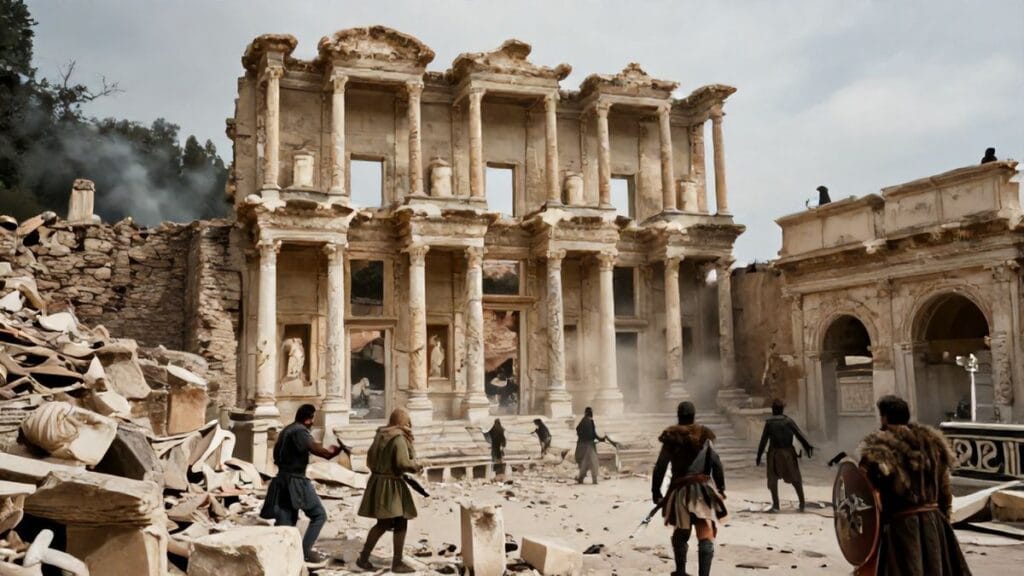
One can imagine the scene as dusk fell over the harbor. Gothic ships, having anchored just beyond the reach of any remaining shore defenses, sent small boats rushing toward the beaches. Warriors disembarked, some wearing mail or leather armor, others only tunics, but all armed with swords, spears, and an iron determination to seize what they could. The city’s defenders—reduced in number and morale by the earthquake—scrambled to assemble a line of resistance. A few Roman soldiers, local militia, and perhaps even armed slaves might have taken up positions along key streets and at gates.
But the advantage lay with the attackers. They were numerous, mobile, and unburdened by the need to protect civilians. Moving quickly, they forced or bypassed the harbor defenses, fanning out into the lower city. What followed was a savage, chaotic struggle amid half-ruined buildings. Nightfall only heightened the confusion. Flames from torches and burning houses cast flickering light on shattered columns and fallen statues, turning Ephesus’ familiar landmarks into ghostly silhouettes.
Some accounts suggest that the Temple of Artemis was set on fire during the raid, although whether the entire complex burned or only parts of it is uncertain. Even limited damage to such a revered sanctuary was enough to resonate across the Roman world. To pagans, the idea that northern barbarians could desecrate one of the most famous temples of the Hellenistic and Roman eras was an affront almost beyond comprehension, a sign that the old protective order was failing. To later Christian commentators, the event could be interpreted more ambiguously, even triumphantly, as a sign of the impotence of pagan gods whose houses could be plundered and burned.
Within the city, the distinction between sacred and profane spaces meant little to the raiders. Warehouses and mansions were broken into; whatever could be carried away was seized. Art objects, coin hoards, jewelry, and even marble fixtures were pried loose. Those inhabitants who resisted were cut down. Others were taken captive, destined to be sold as slaves or ransomed. The earthquake and Gothic raid Ephesus endured thus converged in a terrifying spectacle: tremor-shaken buildings now streaked with soot and blood, their ruins echoing with screams and foreign voices.
Fire, Plunder, and Captives: Inside the Assault on a Broken City
In the tight streets below the main avenues, the raid took the form of house-to-house terror. Families who had survived the quake now faced a different trial. Doors were battered down; household goods rifled through; the meager treasures of the poor—tools, clothing, simple ornaments—were stolen or destroyed. Women and children were especially vulnerable, either killed in the chaos or dragged away in chains. For the Goths, captives were as valuable as gold, providing labor, ransom, and a visible demonstration of victory back home.
In some quarters, pockets of resistance likely formed. A group of young men might barricade a narrow alley with overturned carts and rubble, pelting attackers with stones or javelins. For a brief time, they might hold the invaders at bay, the higher ground and familiarity with the terrain giving them a local advantage. But against a determined, numerically superior force, such heroism could only delay the inevitable. Once the defenders were overwhelmed, retribution was swift and brutal.
Fires, whether set deliberately or sparked accidentally in the rush of battle, began to spread. In an already damaged city, flames found many paths: through cracked walls, open roofs, and fallen beams. Smoke clouded the air, obscuring friend and foe alike. Somewhere in the city, priests may have attempted a last, desperate ritual; Christians may have huddled together in prayer. But on that night, human agency—whether pious or profane—was largely powerless. The structures that had defined Ephesian identity for centuries were being unmade in hours.
By dawn, the raiders had largely achieved their aims. Loaded with valuables and herding captives, they began to withdraw toward their ships, perhaps leaving small fires smoldering and a shocked, stunned population behind them. Some Ephesian defenders might have trailed them at a distance, powerless to do more than witness the departure. The sea, so recently a source of trade and connection, now carried away neighbors and treasures into an uncertain northern darkness.
In the raw silence after the raid, the full scope of the catastrophe began to emerge. Buildings that had survived the earthquake were now gutted by fire or smashed by human hands. Temples were desecrated, their treasuries emptied. The social fabric was torn: prominent families murdered or scattered, slaves and employers alike missing. The earthquake and Gothic raid Ephesus endured had not simply added injuries together; they had multiplied them, turning a proud metropolis into a deeply traumatized community.
Rome’s Absent Shield: Military and Political Failure in 262
The dual calamity of Ephesus exposed a painful truth: Rome’s protective shield was no longer reliable along all its frontiers and coasts. The empire that had once prided itself on bringing “peace” to the Mediterranean world now struggled to defend even its most prestigious provinces. The reasons were complex. Legions were stretched thin, deployed against threats on multiple fronts. Emperors spent more time securing their own thrones than coordinating comprehensive defense strategies. Provincial governors, rotated frequently and often more interested in personal enrichment than long-term stability, lacked both the incentive and the tools to prepare for low-probability, high-impact events like an earthquake followed by a barbarian naval raid.
In theory, coastal defense systems existed. Watchtowers, small garrisons, and fleets based in key ports were meant to deter or at least detect enemy incursions. But the earthquake had likely damaged these installations, and years of neglect may already have eroded their effectiveness. The Gothic use of captured ships and their willingness to sail beyond traditional raiding grounds introduced a new strategic dynamic that Rome had been slow to anticipate. It is astonishing, isn’t it, how quickly centuries-old assumptions about security can crumble in the face of adaptive, opportunistic enemies?
Politically, the embarrassment was severe. News of the sack of cities in Asia, especially of the famed Temple of Artemis, would have traveled swiftly through the imperial grapevine: letters, official reports, and rumor alike. For an emperor trying to project strength amidst the third-century crisis, such reports were a gift to rivals and critics. They undermined the narrative of imperial invincibility that the Roman state had carefully cultivated through monuments, coinage, and ritual.
Some remedial measures may have followed. Later in the century, emperors such as Claudius II Gothicus and Aurelian would launch significant campaigns against Gothic groups, seeking to reassert Roman dominance and to avenge earlier humiliations. But these reactions, however vigorous, could not erase the memory of 262. The earthquake and Gothic raid Ephesus suffered became part of a broader pattern demonstrating that the empire’s reach could be matched, and occasionally outmatched, by its adversaries.
Faith under Siege: Pagan Shrines, Christian Communities, and Sacred Loss
The destruction and desecration of sacred spaces, especially the Temple of Artemis, had profound religious implications. For centuries, Artemis’ sanctuary had been not only a local cult center but also an international symbol of divine presence in the city. Pilgrims from across the Mediterranean came to Ephesus to honor the goddess, making offerings and seeking her favor. The temple’s treasury functioned as a kind of sacred bank, storing wealth under divine protection. When that sanctuary was damaged and plundered by foreigners, it sent a shudder through the religious imagination of the ancient world.
Pagan intellectuals and priests struggled to interpret the event. Some might have argued that the disaster was a punishment for moral and ritual lapses: perhaps the city had allowed impious practices, neglected sacrifices, or tolerated subversive cults. Others might have framed it as part of a mysterious divine plan beyond human comprehension. The earthquake and Gothic raid Ephesus endured forced them to confront the uncomfortable possibility that the gods’ favor was not guaranteed, or at least not unconditionally manifested in worldly security.
Christian communities interpreted the same events through different lenses. For them, the fall of a great pagan temple could be seen as confirmation of scriptural warnings that idols were powerless. Later Christian authors occasionally pointed to the destruction of pagan sanctuaries as signs of the advance of the true faith, though in 262 such interpretations would have been complicated by the suffering of Christian individuals caught in the same calamity. Still, the narrative possibilities were powerful: Artemis’ house could burn, but the “church,” as a spiritual community, could endure even persecution and disaster.
In the years following 262, the balance between pagan and Christian presence in Ephesus and the wider region would gradually shift. The trauma of the earthquake and raid may have subtly accelerated this process. Religious institutions that could promise meaning, consolation, and a sense of cosmic order in the face of catastrophe gained appeal. In time, the once-dominant pagan cults of Ephesus would fade, replaced by churches and monasteries that interpreted the city’s ruined temples as relics of a superseded past.
Economic Ruptures: Trade, Wealth, and the Long Shadow of Destruction
Economically, the combined shock of natural and human disaster was immense. Ephesus’ prosperity depended on stable trade routes, functioning infrastructure, and confidence—confidence of merchants that their goods would reach market, of shipowners that their vessels would not be seized, of investors that their capital was secure. The earthquake disrupted the city’s physical infrastructure: warehouses collapsed, harbor installations cracked, and roads were obstructed. The Gothic raid compounded this by deliberately targeting wealth stores and shipping.
Merchants who had once seen Ephesus as a safe and profitable hub now had to weigh new risks. Some may have diverted their trade to other cities—Smyrna, Pergamon, or more distant ports—seen as less damaged or better defended. The flow of customs revenues, a key source of income for both local authorities and the imperial government, declined. Artisans lost patrons; builders found work in repair and reconstruction but often in a context of scarcity rather than expansion.
The city’s elite families, who had invested in urban beautification projects partly as a means of displaying status, now faced hard choices. With their own wealth diminished by plunder and destruction, they could no longer fund monumental construction on the same scale. Instead, restorations often took the form of patchwork repairs, reusing materials scavenged from ruined buildings. Architectural historians speak of a visible shift, in the later third and fourth centuries, from grand, integrative projects to more modest, piecemeal adaptations. The earthquake and Gothic raid Ephesus endured thus contributed to a physical and economic transition, from a city building upward in marble to one increasingly cannibalizing its own past.
Rural hinterlands were also affected. Farms that supplied the urban markets lost customers or faced difficulties transporting produce. Slaves and free laborers taken in the raid left gaps in the agricultural workforce. Taxation, always a concern under Roman rule, became even more burdensome as imperial authorities sought to extract revenue from a shrinking base. Some rural communities may have retreated into greater self-sufficiency, reducing their integration into the wider market economy, a trend that would become more pronounced in later centuries.
From Marble Splendor to Fading Memory: The Slow Decline of Ephesus
The disasters of 262 did not, by themselves, destroy Ephesus as a functioning city. Life went on. People rebuilt homes, repaired streets, and continued to trade, worship, and argue. In subsequent centuries, Ephesus would even experience periods of renewed importance, particularly as a center of Christian activity. Yet the earthquake and Gothic raid Ephesus endured marked an inflection point—a moment when the trajectory of the city bent subtly downward.
Over time, a combination of factors accelerated the decline. The harbor, already challenged by silting from the Cayster River, became increasingly shallow and difficult to maintain. Without regular and expensive dredging, ships could no longer approach as easily, undermining the city’s economic lifeblood. Political shifts in the empire redirected investment and administrative attention to other centers. Later invasions, internal conflicts, and natural disasters added new layers of damage and disruption.
Archaeological excavation reveals this gradual fading. Some once-grand public spaces were abandoned or repurposed, their paving stones stripped for use in new, smaller structures. Statues fell and were not re-erected; inscriptions crumbled unread. Residential areas shifted; some neighborhoods shrank or disappeared. Churches rose where temples had stood, sometimes incorporating the older stonework into new sacred architectures, physically embodying the passage from one era to another.
By the Byzantine period, Ephesus had become a quieter, less cosmopolitan town, overshadowed by other regional centers. Later still, it would be nearly forgotten, its ruins half-buried, its harbor receded far from the sea. Travelers in the early modern era marveled at the scattered remnants of columns and theater seating, barely guessing the layered history of quakes and raids that lay beneath. The memory of the specific earthquake and Gothic raid Ephesus had endured eroded, like the inscriptions on its stones, but traces survived in chronicles and local legends, awaiting rediscovery by modern scholars.
Chronicles, Inscriptions, and Ruins: How We Know What Happened
Reconstructing the events of 262 is a complex exercise in historical detective work. As mentioned earlier, key literary witnesses include Eusebius and later chroniclers who reported widespread earthquakes in Asia and Achaia around this time. Jordanes, in his Getica, provides a Gothic-centered narrative of raids that reached deep into the Roman East and targeted cities like Ephesus. These texts are terse, biased, and separated from the events they describe by decades or centuries. Yet they provide essential anchors for our understanding.
Inscriptions found in Ephesus and other cities occasionally mention rebuilding projects “after the earthquake,” though dating them precisely to 262 requires correlation with stylistic and contextual clues. One might imagine a dedicatory inscription along the lines of, “In the consulship of… this portico was restored by the generosity of… after the ruinous trembling of the earth,” a typical Roman formula linking civic benefaction to disaster recovery. Such epigraphic fragments, combined with coin hoards ending in the 260s and architectural damage patterns, strengthen the case that a major seismic event struck the region in that decade.
Archaeology adds a quieter but crucial voice. Layers of destruction—collapsed roofs, crushed pottery, sudden breaks in occupation—suggest a moment of violent disruption. Evidence of fire atop earthquake damage can indicate plundering or later accidents during reconstruction. In some cases, skeletons found under rubble offer poignant, direct testimony to individual fates. While we must be cautious about attributing every collapsed wall to a specific quake or raid, the convergence of multiple types of evidence around the mid-third century gives historians reasonable confidence in linking them to the earthquake and Gothic raid Ephesus experienced.
Modern scholarship, drawing on seismology, comparative studies of other ancient disasters, and critical readings of sources, has refined our picture. Debates remain: Was the earthquake of 262 a single catastrophic event or part of a cluster of quakes in the region? How extensive was the Gothic damage relative to the seismic destruction? What role did local politics play in shaping the city’s response? Nonetheless, a broad consensus has emerged that 262 was a turning point, even if the exact details will never be known with absolute certainty.
Echoes through the Centuries: Interpreting Disaster and Invasion
The intertwined story of the earthquake and Gothic raid Ephesus endured raises enduring questions about how societies experience and remember catastrophe. Ancient observers tended to frame such events morally or theologically. Modern readers, versed in seismology and social science, may emphasize structural vulnerabilities, political failures, and the randomness of natural hazards. Yet across the divide of centuries, certain themes resonate: the fragility of human achievements, the speed with which fortunes can reverse, and the intertwining of natural and human violence.
Historians like Ramsay MacMullen and more recent scholars of Roman decline have pointed to episodes like that of 262 as evidence that the Roman Empire’s famed resilience had limits. It was not that a single earthquake or raid could topple an empire, but that repeated shocks, applied to a system already stressed, could cumulatively erode capacity and confidence. When earthquake and invasion strike together—as they did in Ephesus—their effects are not merely additive. Physical destruction undermines defense; panic facilitates plunder; economic loss hampers reconstruction. The city becomes caught in a web of cascading consequences.
At the local level, memory of such disasters can shape identity. Later Ephesian communities, pagan and Christian alike, would have told stories of “the time when the earth shook and the barbarians came.” These tales, embroidered in retelling, might attribute heroic last stands to certain families, miracles to particular saints or deities, and cowardice or betrayal to rivals. Over time, the specifics blur, but the emotional core remains: a sense of having been tested, wounded, and, in some measure, changed.
For modern visitors walking among the ruins of Ephesus, it is easy to focus on the visible remains—the theater, the library façade, the fragments of temples—and to imagine them only in their pristine, sunlit grandeur. Yet to truly understand the city’s past, one must also picture the moments when those same stones shook, cracked, and burned. The year 262 was one such moment, when nature and human ambition collided in a way that left marks not just on buildings, but on the deep texture of Mediterranean history.
Conclusion
The catastrophe that struck Ephesus in 262 was not a simple story of a city destroyed and abandoned. It was, instead, a layered narrative of a proud metropolis shaken by an earthquake, then ravaged by a Gothic raid, yet still determined to endure. These events unfolded against the backdrop of the third-century crisis, when the Roman Empire’s political, military, and economic foundations were already trembling. The earthquake exposed the fragility of even the grandest monuments; the raid revealed the limits of imperial protection and the daring of new barbarian powers on land and sea.
In the aftermath, Ephesus rebuilt but was never quite the same. Its temples and theaters bore the scars of 262; its citizens carried memories of terror and loss. Trade routes shifted, religious landscapes evolved, and political priorities changed. Over centuries, the city’s significance waned, its harbor silted up, and its ruins fell silent. Yet the echoes of that year remained, preserved in chronicles, inscriptions, and the very pattern of broken stones archaeologists still uncover.
To study the earthquake and Gothic raid Ephesus endured is to confront broader themes that transcend antiquity: how societies absorb multiple shocks, how natural disasters can be exploited by human opportunism, and how memories of trauma are woven into cultural identity. It reminds us that even the most seemingly stable civilizations live under the twin shadows of earth and sword, of tectonic forces and human ambition. Ephesus, once a beacon of Roman-Asian splendor, became a case study in vulnerability and resilience, its fate a cautionary tale etched into the long saga of the Mediterranean world.
FAQs
- What exactly happened in Ephesus in the year 262?
In 262, Ephesus was struck by a powerful earthquake that caused widespread structural damage and loss of life. While the city was still struggling to recover, a Gothic naval expedition raided the coast of Asia Minor, attacking and plundering Ephesus, including its famed Temple of Artemis. The combination of natural disaster and human assault created a deep and lasting crisis for the city. - How do historians know that an earthquake and a Gothic raid occurred around the same time?
Historians rely on a mix of written sources, inscriptions, and archaeological evidence. Late antique chroniclers such as Eusebius and Jerome mention severe earthquakes in Asia around this period, while writers like Jordanes recall Gothic raids that reached Ephesus and its temple. Archaeological layers of sudden destruction, structural collapse, and repair work dated to the mid-third century support the conclusion that both an earthquake and a major raid struck the city in close succession. - Was the Temple of Artemis completely destroyed in 262?
The evidence suggests serious damage and desecration, but not necessarily total obliteration in a single event. Literary sources emphasize that the Goths plundered and possibly burned parts of the sanctuary, and the earthquake likely contributed to structural problems. However, the temple complex had already undergone multiple rebuildings in earlier centuries, and its final decline was gradual, influenced by later earthquakes, changing religious practices, and economic decline. - Did the disasters of 262 cause the final fall of Ephesus?
No, Ephesus continued to be inhabited and even important for centuries after 262, especially as a Christian center. However, the earthquake and raid significantly weakened its infrastructure, economy, and prestige. Combined with later problems—such as harbor silting, political shifts, and additional conflicts—these events contributed to a long-term trajectory of decline, rather than a single, sudden collapse. - How did the people of Ephesus interpret the earthquake and raid?
Contemporaries would have interpreted the disasters primarily in religious and moral terms. Pagan priests might have seen them as signs of divine anger or warnings, while Christians could understand them as part of a broader pattern of worldly instability and divine judgment. At the same time, many people responded in practical ways—rescuing survivors, rebuilding structures, and adapting to new economic and social realities—regardless of theological explanations. - What impact did these events have on the wider Roman Empire?
The disasters at Ephesus exposed Rome’s weakening ability to protect its cities and key religious sites, undermining confidence in imperial power. They also highlighted new forms of barbarian threat, including seaborne raids deep into the eastern Mediterranean. While the empire survived the third-century crisis, episodes like the earthquake and Gothic raid at Ephesus showed how vulnerable even core provinces had become. - Is it possible to visit the remains of the buildings damaged in 262 today?
Yes, modern visitors to the archaeological site of Ephesus in western Turkey can see many structures that bear traces of ancient earthquakes and later rebuilding. The great theater, the Library of Celsus, streets, houses, and the area associated with the Temple of Artemis all show layered histories of construction, damage, and repair. While it is not always possible to attribute specific cracks or collapses to the 262 events, the overall urban landscape preserves the memory of repeated catastrophes and recoveries.
External Resource
Internal Link
Other Resources
- Encyclopaedia Britannica – general search for the exact subject
- Google Scholar – academic search for the exact subject
- Internet Archive – digital library search for the exact subject