Table of Contents
- The Echo of Discontent: Morning of June 17, 1953
- From Workers’ Strikes to Nationwide Uprising
- The Soviet Grip on East Germany: Context and Constraints
- The Political Landscape of Postwar East Germany
- Stalin’s Shadow: Soviet Control and the Formation of the GDR
- The People’s Republic: Promises and Repression
- Economic Hardship and Rising Frustrations
- The Spark Ignites: What Triggered the June 17 Uprising?
- Spreading Flames: How Protests Swept Across East Germany
- Berlin on Fire: The Heartbeat of the Uprising
- Voices of Defiance: Workers, Students, and Citizens Unite
- The Soviet Response: Tanks, Troops, and the Iron Fist
- The Fall of the Insurrection: Brutality and Betrayal
- Human Stories: Courage and Tragedy Behind the Headlines
- Propaganda Wars: East and West Interpretations of the Uprising
- Aftermath: Repression and Reform in the GDR
- The Uprising’s Role in Cold War Dynamics
- Memory and Legacy: June 17 in German and Global Consciousness
- The Commemoration in West Germany: A National Holiday
- The Long Shadow: How 1953 Shaped East German Resistance
- Echoes in History: June 17 and the Road to the Fall of the Berlin Wall
- Historians’ Perspectives: Debates and Reappraisals
- Conclusion: The Courage That Refused to be Silenced
- FAQs: Understanding the East German Uprising of 1953
- External Resource
- Internal Link
The Echo of Discontent: Morning of June 17, 1953
Berlin awoke that day cloaked in an unusual tension—an uneasy stillness that belied the immediate storm brewing within its streets. The sun filtered weakly through a gray, oppressive sky, as if the weather itself mourned what was about to unfold. The cigarette vendors and tram drivers noticed it first: a restlessness in the air, a trembling edge to the voices that whispered promises of revolt. June 17, 1953, was not just another day in East Berlin, the capital of the fledgling German Democratic Republic (GDR); it was the day when the shackles of repression momentarily cracked, and the long-simmering discontent of a nation exploded into a roar that echoed far beyond the city’s borders.
This uprising was to become one of the first significant popular challenges to Soviet domination in Eastern Europe, a poignant reminder that beneath concrete facades and ideological slogans, human hopes and grievances simmered fiercely. It was a day when workers defied orders, when the streets became battlegrounds, and when ordinary citizens dared to dream of freedom. But the uprising was also met with brutal force and political cynicism, a harsh lesson in the costs of resistance within the Cold War crucible.
From Workers’ Strikes to Nationwide Uprising
The unrest began not as a political revolt but as a labor strike: East German construction workers, frustrated by impossibly increased quotas and plummeting living standards, stepped away from their tasks. What started as a cry against economic injustice rippled quickly into a nationwide movement calling for political reform and an end to Soviet control. By midday, the workers’ calls reverberated through factories, offices, and homes—demands escalated, slogans grew louder, and the streets filled with tens of thousands of people.
The uprising was spontaneous yet charged with a deep sense of collective purpose. Voices raised in unison shouted for better wages, democratic rights, and a genuine government that served the people rather than the Kremlin’s dictates. The walls of East Berlin, draped with Soviet and GDR banners, became silent witnesses to this defiant chorus echoing throughout June 17.
The Soviet Grip on East Germany: Context and Constraints
To grasp the magnitude of the uprising, one must understand the iron grip the Soviet Union held over East Germany after World War II. The GDR was a satellite, a buffer zone in the Soviet security strategy, birthed from rubble and ideological imposition alike. The Red Army’s occupation in 1945 had swiftly given way to the establishment of a socialist state grounded in Marxist-Leninist principles but marked more by coercion than consent.
This control was exercised not only through military presence but through intimate mechanisms of surveillance, propaganda, and political repression. The Socialist Unity Party (SED), stormtroopers of the regime, ensured conformity through Stasi operatives lurking in the shadows and purges against dissenters. Lives and liberties were subordinate to the survival of a Soviet-aligned order imposed upon a still-devastated population seeking normalcy.
The Political Landscape of Postwar East Germany
The GDR was proclaimed in October 1949, following the formal creation of the Federal Republic of Germany in the West. From its inception, East Germany was a paradox — an industrial power attempting rapid socialist transformation but facing the scars of war, economic chaos, and mass displacement. The SED claimed the mantle of progress and justice, yet its policies often deepened misery.
Politically, the system was a single-party dictatorship masquerading as a people’s democracy—elections were controlled, voices dissenting silenced, and opposition driven underground. This autocratic rigidity bred disillusionment, particularly among those who had hoped that socialism would bring social equity and national recovery.
Stalin’s Shadow: Soviet Control and the Formation of the GDR
Joseph Stalin’s influence remained omnipresent in shaping the destiny of East Germany. The GDR was not simply a German state; it was a Stalinist creation, tailored to Soviet needs and ideological purity. The imposition of collectivization, centralized planning, and political purges echoed transformations across the Soviet Bloc.
Stalin’s death in March 1953 had created a momentary fissure in Soviet policy, but Moscow’s fundamental expectation remained clear: East Germany was to remain an unyielding outpost. The June 17 uprising occurred in this precarious period, revealing both the fragility of Soviet authority and the pent-up pressure that had been simmering beneath.
The People’s Republic: Promises and Repression
The early 1950s in East Germany were years of contradiction—grandiose promises of workers' paradises clashed with realities of food shortages, housing crises, censorship, and police brutality. The price of obeying the SED’s ambitious economic plans was often unbearable.
Efforts to increase industrial output included raising work quotas dramatically without corresponding wage increases, a policy that directly contributed to the unrest of June 17. The average East German worker found themselves squeezed between state demands and personal survival, inspiring anger and a longing for change.
Economic Hardship and Rising Frustrations
By 1953, the economic pulse of East Germany was under severe strain. Inflation eroded purchasing power; rationing persisted; and the black market thrived amid shortages of basic goods. The government’s five-year plan, echoing Soviet industrial aims, demanded more while offering less.
Workers, especially in construction and heavy industry, faced unrealistic productivity targets. Their discontent was compounded by a loss of personal freedoms and a pervasive sense of being pawns in a grand ideological game that overlooked their humanity. As historian Mary Fulbrook notes, “The East German workers were living in a state that demanded sacrifice yet denied dignity.”
The Spark Ignites: What Triggered the June 17 Uprising?
The immediate trigger came on June 16, 1953, when construction workers in East Berlin walked off their jobs, protesting a 10 percent increase in work quotas that effectively reduced their wages. This small act of defiance ignited a wider movement.
By June 17, the protests swelled into full-scale demonstrations. Calls for better working conditions quickly morphed into demands for free elections, the resignation of the SED government, and the withdrawal of Soviet troops. What had started as a labor dispute now challenged the very legitimacy of the regime.
Spreading Flames: How Protests Swept Across East Germany
The uprising was not confined to Berlin; it rippled through more than 700 localities. Factories, schools, and public squares became arenas of resistance. Strikes occurred in Leipzig, Dresden, Halle, and other industrial centers as workers rejected the party line.
This breadth reflected deep nationwide dissatisfaction. People from all walks of life—blue-collar workers, intellectuals, students—joined the chorus for change. It was as if the entire nation had reached a breaking point.
Berlin on Fire: The Heartbeat of the Uprising
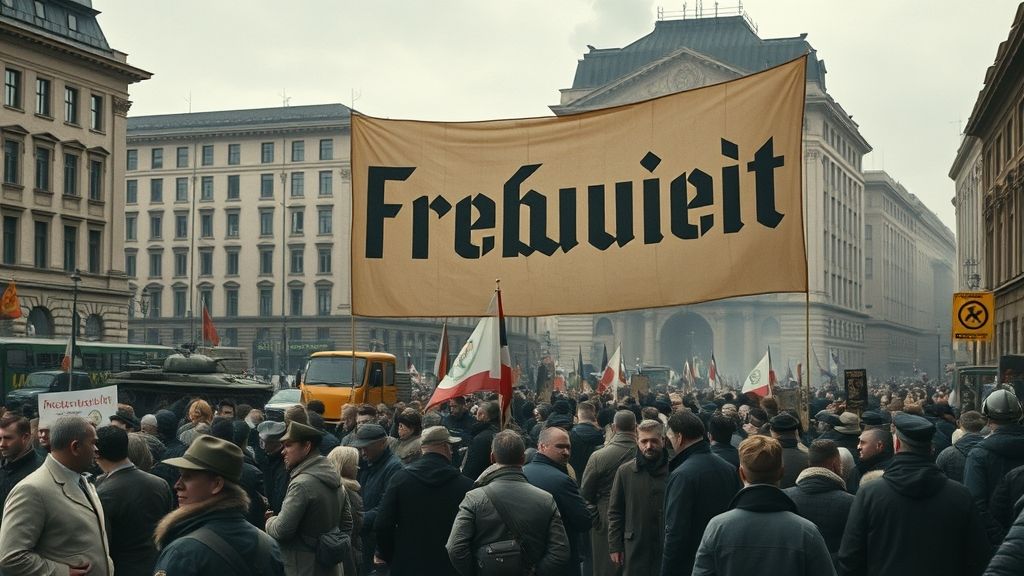
In East Berlin, the capital, crowds marched toward the government headquarters, shouting “Freedom!” and “Down with the dictatorship!” The atmosphere was charged with both hope and peril.
Barricades appeared; slogans were spray-painted on walls; state offices were stormed. The streets were alive with a raw, dangerous vitality. Yet behind the scene, Soviet forces were already mobilizing. It was a moment poised on a knife’s edge.
Voices of Defiance: Workers, Students, and Citizens Unite
Witness testimonies reveal a mosaic of individual bravery and desperation. A factory worker, Erich, recalled, “We had lived quietly in fear. That day, we shouted not just for our wages but for our dignity.” Students, often marginalized, saw in the uprising an awakening of political consciousness.
Women also played critical roles—organizing, communicating, caring for the injured—pointing to a communal resistance that transcended gender and class.
The Soviet Response: Tanks, Troops, and the Iron Fist
Within hours, Soviet troops and tanks flooded East Berlin. The message was unequivocal: the party and its Soviet overseers would tolerate no challenge. Thousands were arrested; hundreds injured and several killed.
The repression was swift and merciless. The uprising was crushed with an iron fist, the Soviet leadership unwilling to appear weak, and the GDR government desperate to reassert its authority. In the eyes of the regime, the rebellion was a betrayal, a “fascist-instigated counterrevolution.” But the truth was far more complex.
The Fall of the Insurrection: Brutality and Betrayal
By the evening of June 17, armed resistance was suppressed. The street protests, once filled with hope, had ceded to fear and despair. Many activists were imprisoned, tortured, or forcibly exiled.
Despite the violence, the uprising planted a seed of long-term resistance. While publicly silenced, the spirit of June 17 lived on in the hearts of East Germans, a persistent reminder that the regime’s legitimacy was contested.
Human Stories: Courage and Tragedy Behind the Headlines
The uprising’s human dimension is often overshadowed by political analysis. Families torn apart, workers shot down while carrying makeshift banners, mothers who wept openly in fear and rage—the individual stories give flesh to historical facts.
One poignant anecdote tells of a young mother, Anna, who shielded a wounded protester from Soviet soldiers, her bravery risking everything. These human moments underscore that history’s grand currents flow through the lives of ordinary people.
Propaganda Wars: East and West Interpretations of the Uprising
The Cold War amplified the symbolic importance of June 17. Western media heralded the revolt as a spontaneous cry for freedom, using it propaganda against Soviet tyranny. West Germany declared June 17 a national holiday, the “Day of German Unity,” commemorating resistance to communism.
Conversely, the East German government and Soviet press demonized the uprising as a capitalist-instigated sabotage, attempting to erase its legitimacy. This battle over narrative turned June 17 into a fracture line between two Germanies and two worlds.
Aftermath: Repression and Reform in the GDR
In the uprising’s wake, the GDR regime implemented both repression and cautious reforms. Work quotas were slightly relaxed, and Stalin’s death enabled some softening under East German leader Walter Ulbricht.
Nonetheless, surveillance intensified, and political freedoms remained tightly controlled. The message was clear: dissent might be tolerated cautiously, but the regime retained ultimate power.
The Uprising’s Role in Cold War Dynamics
The East German uprising strained Soviet-American relations and impacted policies in both blocs. It revealed cracks in Soviet control, inspiring other movements in Eastern Europe, such as Poland’s 1956 Poznań protests and Hungary’s 1956 revolution.
For Washington, the uprising was exploited as evidence of the failures of communism, bolstering anti-Soviet rhetoric. For Moscow, it necessitated heightened vigilance and repression across its satellites.
Memory and Legacy: June 17 in German and Global Consciousness
The meaning of June 17 evolved over decades. In West Germany, it was a symbol of resistance to communism and a call for German unity. In East Germany, the event was taboo, erased from official memory until reunification.
After 1990, both Germanys’ perspectives converged, recognizing June 17 as a testament to human courage and the complex struggle for freedom under dictatorship.
The Commemoration in West Germany: A National Holiday
From 1954 until reunification in 1990, June 17 was celebrated in West Germany as a public holiday, the “Day of German Unity,” a tribute to those who resisted tyranny. It became a ritual of remembrance and a political statement against the East German regime.
This observance connected citizens to a shared national identity rooted in democratic ideals, though it also highlighted the division of the nation.
The Long Shadow: How 1953 Shaped East German Resistance
Though violently suppressed, the uprising shaped future opposition movements within the GDR. It inspired underground networks, dissenting intellectuals, and workers’ protests in the decades that followed.
The memory of June 17 became a beacon for those who sought to challenge the regime, culminating eventually in the peaceful revolutions of 1989.
Echoes in History: June 17 and the Road to the Fall of the Berlin Wall
The uprising foreshadowed the eventual collapse of the East German state. It showed that Soviet dominance was not invincible and that Germans behind the Iron Curtain harbored deep yearnings for freedom.
Over 35 years later, the spirit born in June 1953 contributed quietly—but powerfully—to the wave of change that brought down the Berlin Wall and reunited Germany.
Historians’ Perspectives: Debates and Reappraisals
Scholars continue to examine the uprising to unpack its causes, scope, and significance. Was it primarily a workers’ strike or a proto-political revolution? How spontaneous was it, and what role did Western propaganda truly play?
These debates enrich our understanding but also remind us that history is lived experience, layered and complex.
Conclusion: The Courage That Refused to be Silenced
The East German Uprising of June 17, 1953, remains a profound chapter of resistance against oppression. It was a day when courage overwhelmed fear, when ordinary people demanded dignity amid hardship, and when the relentless machinery of tyranny was momentarily unsettled.
Though crushed in blood and steel, the uprising’s legacy lives on as a testament to the human spirit’s refusal to remain silent in the face of injustice. It reminds us why freedom, once glimpsed, can never be forgotten—and why history is shaped not only by power but by the dreams of those who dare to defy it.
FAQs
Q1: What were the main causes of the East German Uprising of 1953?
The uprising was largely triggered by increased work quotas imposed on construction workers without fair compensation, amid widespread economic hardship and political repression in the GDR. Dissatisfaction with Soviet control and lack of political freedoms fueled broader protests.
Q2: Who were the key actors involved in the uprising?
Workers, especially from construction and manufacturing sectors, formed the core of the uprising, alongside students and ordinary citizens. The Soviet military and the East German SED government were the regime’s enforcers tasked with quelling the revolt.
Q3: How did the Soviet Union respond to the uprising?
The Soviet leadership sent troops and tanks to suppress the protests brutally within hours. Thousands were arrested, many injured or killed, and the movement was portrayed as a fascist conspiracy.
Q4: What were the consequences of the uprising for the GDR?
The regime tightened repression but also made minor concessions, such as relaxing work quotas. The event deepened divisions in German society and influenced future resistance movements, while straining East-West relations.
Q5: How was the uprising remembered differently in East and West Germany?
West Germany commemorated June 17 as a national holiday symbolizing resistance and unity. East Germany suppressed memories of the event, portraying it negatively until after reunification when a more balanced view emerged.
Q6: What is the legacy of the June 17 uprising today?
It stands as an early manifestation of resistance against Soviet dominance in Eastern Europe, a symbol of human courage and yearning for freedom. It shaped political consciousness in East Germany and contributed historically toward eventual reunification.
Q7: Did the uprising have any influence on other Eastern Bloc countries?
Yes, the uprising inspired and foreshadowed subsequent revolts and protests in other Soviet satellite states, such as Poland and Hungary, underscoring the fragility of communist control.
Q8: Where can I learn more about the East German Uprising of 1953?
A thorough overview is available on Wikipedia’s dedicated page, offering detailed accounts and further readings.