Table of Contents
- A Winter Edict in Constantinople: Setting the Stage in 435
- From Tolerance to Intolerance: The Long Road to Religious Legislation
- Christian Empire, Pagan Cities: The Fourth Century Transformation
- From Theodosius I to Theodosius II: A Dynasty of Laws
- Drafting the Edict Against Pagan Sacrifices in the Imperial Palace
- What the Edict Actually Said: Words Meant to End a World
- Bishops, Bureaucrats, and Informers: Enforcing the New Order
- Temples in Twilight: How Sacred Landscapes Were Transformed
- Pagan Lives Upended: Priests, Philosophers, and Ordinary Worshippers
- Resistance, Evasion, and Silent Persistence of the Old Gods
- The Western Mirror: Comparing East and West in the War on Sacrifice
- Law as Theater: Public Rituals of Christian Triumph
- Voices from the Margins: Jews, Heretics, and the Pagan “Other”
- Memory, Martyrdom, and the Creation of a Christian Past
- Did the Edict Work? Measuring the Impact on Late Antique Society
- From Roman Law to Medieval Christendom: The Edict’s Long Shadow
- Reassessing the Edict: Historians, Debates, and New Perspectives
- Conclusion
- FAQs
- External Resource
- Internal Link
Article Summary: On 4 November 435, in the marble heart of Constantinople, an imperial edict against pagan sacrifices was issued that tried to close the final chapter of Rome’s ancient religious world. This article traces the path from earlier imperial toleration to the harsh Christianizing legislation that culminated in that decree, showing how law, belief, and politics wove together. It explores the theological anxieties that shaped the edict against pagan sacrifices, and the very human lives—priests, philosophers, city dwellers—caught beneath its language. Moving chronologically, it follows the edict from the chancery where it was drafted, through the streets and temples where it was enforced, and into the rural sanctuaries where worship stubbornly persisted. Along the way, the narrative examines how the edict against pagan sacrifices reshaped sacred spaces, refashioned imperial authority, and helped legitimate Christian rule. It also considers the limits of law, revealing tensions between imperial intentions and local realities, where sacrifices sometimes continued behind closed doors. Finally, the article reflects on the long afterlife of the edict against pagan sacrifices, from medieval canon law to modern historical debates, inviting us to see it not as a single moment but as part of a slow, contested death of the old gods.
A Winter Edict in Constantinople: Setting the Stage in 435
On an early November day in the year 435, the air over Constantinople would have carried the bite of the approaching winter. The great avenues of the city, its colonnades and forums, were already filling with the restless movement of imperial officials, clerics, and petitioners drawn toward the palace district that loomed over the Bosporus. Within that intricate complex of chambers, courtyards, and audience halls, scribes bent over wax tablets and sheets of parchment. Somewhere in this maze, a text was being polished into its final, severe form: an imperial edict against pagan sacrifices, to be issued in the name of the eastern emperor Theodosius II on 4 November, and dispatched across the provinces of the Eastern Roman Empire.
This was not the first law to strike at traditional cults. For decades, emperors had attacked sacrifice and temple worship, piece by piece. But this edict had the air of finality. It was meant not simply to restrict, but to extinguish the last legal embers of public pagan worship. It threatened property, status, and perhaps even life, and it did so with the full solemnity of the imperial voice, expressed in the carefully crafted Latin of the law codes. And yet, beyond the palace walls, the world it targeted was not quite dead. In the countryside of Asia Minor, in the valleys of Greece and Syria, in the shadow of mountain shrines and rural altars, smoke from animal offerings still sometimes rose toward the sky.
To understand why this November edict carried such weight, you have to imagine the city that produced it. Constantinople in 435 was a Christian capital, crowned with great churches, above all the Church of Holy Wisdom, and ringed by mighty walls that would protect it for a thousand years. Its emperor, Theodosius II, wore his piety like a second crown, surrounding himself with bishops, monks, and theological advisors. His court was a world where the interpretation of scripture mattered as much as the movements of armies, and where the boundaries of orthodoxy and heresy were mapped as carefully as the frontiers of the empire itself.
But beneath this Christian surface lay a city and an empire that still bore the deep imprint of older religious habits. Some senators came from families that had, only a few decades earlier, proudly sponsored temples and pagan festivals. Legal formulas still echoed with invocations that once called on Jupiter and Mars. The very concept of imperial power had grown up in an environment where sacrifice—public, bloody, visible sacrifice—was the ritual language through which ruler and gods communicated. To write an edict against pagan sacrifices in such a world was to reach into the foundations of Roman identity and attempt to rewrite them.
Inside the imperial chancery, a small group of legal specialists and high officials would have argued over phrases. Should they criminalize mere attendance at temples, or just the act of sacrifice? How harshly should they treat those who persisted? Which officers, which governors, would be responsible for enforcing the provisions? The text that emerged blended drama and bureaucracy; it sought to sound both absolute and manageable. And when the emperor affixed his authority to it, this law joined the stream of constitutions that would later be gathered in the Theodosian Code, a monument of Christian imperial legislation.
Yet behind the solemn language lay a more fragile thread: fear. The fear that, despite nearly half a century of Christian rule, the old gods were not yet defeated; the fear that the empire’s suffering—its wars, its famines, its internal tensions—might somehow be blamed on lingering pagan practices; the fear that social order itself might be weakened by religious plurality. It is within this tangle of anxiety and ambition that the 435 edict against pagan sacrifices must be placed. It was, at once, an assertion of confidence in Christian triumph and a confession that victory was not yet complete.
From Tolerance to Intolerance: The Long Road to Religious Legislation
A century before Theodosius II’s decree, it would have been almost inconceivable for a Roman emperor to outlaw sacrifice. Sacrifice was Roman religion. It was the beating heart of the relationship between human and divine. When an emperor assumed power, he sacrificed. When legions marched to war, they sacrificed. When cities marked their festivals, they sacrificed. Cows, sheep, pigs, incense, and wine—these were the currency of favor in a world where gods were thought to respond to carefully calibrated ritual.
In the early fourth century, even as Christianity rapidly expanded, emperors remained officially pagan, though many experimented with forms of monotheism or solar worship. Constantine the Great, who would become the first Christian emperor, was himself steeped in this sacrificial culture. After his vision of the cross and his victory over Maxentius in 312, Constantine began to favor Christians vigorously. Yet he did not initially attempt to eradicate pagan rites. His early legislation is cautious. He banned certain private magic rituals, restricted some forms of divination, and granted privileges to Christian clergy; but he also restored some pagan temples and continued to use pagan imagery on coins for years.
The pivot from this ambiguous coexistence to outright hostility toward sacrifice was gradual and uneven. It reflected not only theological conviction, but also shifting understandings of the proper relationship between empire, law, and truth. As Christian bishops learned to speak the language of imperial power, they urged emperors to use their authority to “correct” religion. In their eyes, sacrifices to the old gods were not simply erroneous, they were demonic acts that polluted the community. Augustine of Hippo would later write of the “sacrifices of pagans” as offerings to evil spirits. Such a view made toleration morally dangerous.
Emperors, meanwhile, discovered that religious legislation could be a powerful political tool. By favoring Christians, they secured the loyalty of an increasingly influential constituency: bishops who controlled local networks of charity and authority, and congregations whose identity now intertwined with imperial fortunes. Laws against sacrifice became a way to perform Christian identity at the highest level of power. But even in the late fourth century, these laws often went unenforced, especially in rural areas. Governors did not necessarily share the zeal of bishops; local elites might protect long-standing cults; and the sheer size of the empire blunted any attempt at perfect control.
It is astonishing, isn’t it, how quickly what was once central can become criminal? By the time Theodosius I (r. 379–395) came to the throne, an arch of legislation had already begun to bend toward intolerance. The edict against pagan sacrifices issued in 435 stood at the far end of that arc, but it began long earlier—in courtroom debates, in sermons calling for the destruction of idols, in city councils deciding whether to maintain or abandon traditional festivals. With each generation, the legal screws tightened a little more, and the idea that sacrifice was not merely outdated but illegal sank deeper into imperial policy.
Christian Empire, Pagan Cities: The Fourth Century Transformation
The fourth century was a time of religious double vision. Walk down the streets of Antioch or Alexandria in the 360s, and you might see processions for Christian martyrs and, only a few days later, pagan festivals honoring gods whose images were centuries old. The same families could harbor Christians and pagans under one roof. In the imperial court of Constantius II, bishops debated the nature of Christ while courtiers still whispered omens and consulted astrologers in private. The empire seemed to hesitate between two ages.
The conversion of Constantine and his successors did not wipe the slate clean. It layered Christian practices onto an existing urban and ritual landscape that remained stubbornly pagan in many respects. Temples continued to dominate city skylines. Oracles were still consulted. The Olympic Games and other civic festivals, though increasingly controversial, were not immediately abolished. For a generation, the empire was de facto religiously plural, even if de jure Christianity enjoyed growing preference.
The emperor Julian’s brief pagan “restoration” (361–363) dramatized this tension. A nephew of Constantine, Julian abandoned Christianity and tried to revive a philosophically refined paganism anchored in sacrifice and ritual. He reopened temples, restored priesthoods, and sponsored sacrifices with theatrical enthusiasm. His short reign revealed how much traditional religion could still be mobilized if imperial will aligned with it. But his death in battle in 363, and the subsequent return to Christian emperors, also made clear that the momentum of history had shifted. From then on, paganism would never again have an emperor openly championing its cause.
Yet in the decades after Julian, the empire remained far from uniformly Christian in practice. In the countryside, known to later Christian authors as the realm of the pagani—the “villagers” or “rustics,” from which the word “pagan” derives—old cults flourished for longer. Rural temples were social and economic centers as well as religious ones. They managed land, sponsored feasts, and provided a sense of communal continuity. A sudden abolition of sacrifice would have been experienced not simply as a theological shift but as a violent disruption of social life.
Urban elites, too, were divided. Some aristocratic families in Rome and the East clung to their ancestral cults, seeing in them a badge of cultural superiority. They patronized schools of Neoplatonic philosophy that regarded sacrifice as a symbolic means of uniting the soul with the divine. Others converted to Christianity but carried over old patterns of patronage, now applied to churches and monasteries instead of temples. The lines were not always clear; there were “crypto-pagans” in Christian guise and “crypto-Christians” in supposedly pagan households.
Against this backdrop, laws against sacrifice in the fourth century functioned as probes, testing how far imperial power could reach into the religious habits of the population. Some decrees targeted divination and private rituals; others claimed to close temples or restrict sacrificial feasts. But their effect varied dramatically from place to place. The world that would one day receive the 435 edict against pagan sacrifices was still forming itself, unevenly, in these earlier decades of coexistence, conflict, and compromise.
From Theodosius I to Theodosius II: A Dynasty of Laws
The story of the 435 edict cannot be told without the shadow of Theodosius I, often called “Theodosius the Great.” Reigning from 379 to 395, he is remembered in Christian tradition as the emperor who definitively bound the empire to Nicene Christianity. In 380, his Edict of Thessalonica declared Nicene belief the official faith of the empire. Over the next decade and a half, he and his co-emperors issued a series of laws that attacked pagan sacrifice more aggressively than ever before.
One famous law of 391, preserved in the Theodosian Code, commanded the closing of temples and banned sacrifices and visits to shrines. Another outlawed the performance of traditional cults even in private homes. These measures were often couched in the language of “superstition” (superstitio) versus “true religion” (religio), terms that allowed emperors to praise Christianity while marginalizing older practices as irrational or dangerous. Theodosius I also permitted, and sometimes encouraged, bishops and monks to take direct action against temples—actions that occasionally spilled into outright mob violence, like the destruction of the Serapeum in Alexandria.
Yet the implementation of these laws was inconsistent. After Theodosius I’s death, his sons Arcadius (in the East) and Honorius (in the West) inherited not only an empire but also a legal project. They reaffirmed bans on sacrifice, reinforced penalties, and issued new edicts against pagan practices. But they confronted the same problem their father had: distance. A law promulgated in Constantinople could take months to reach distant provinces. Even when it arrived, a governor might quietly ignore it if it threatened social peace, or if he himself was lukewarm in his beliefs.
By the time Theodosius II ascended to the eastern throne as a child in 408, a tradition of anti-pagan lawmaking was several decades old. Under the regency of his elder sister, Pulcheria—renowned for her austerity and devotion—this trend intensified. Pulcheria championed the building of churches, the veneration of relics, and the eradication of what she saw as lingering pagan errors. The court’s theologians linked imperial prosperity to religious purity: if idols were still honored anywhere in the empire, they argued, God’s favor might be withdrawn.
Theodosius II’s reign thus became a laboratory of Christian legislation. His government oversaw the compilation of the Theodosian Code, officially published in 438, which gathered together imperial constitutions from 312 onward. It is no accident that the period leading up to that codification saw renewed energy in drafting laws that would look, in retrospect, like the capstone to a Christianizing project. Among these, the edict against pagan sacrifices issued in Constantinople on 4 November 435 stands out. It crystallized decades of legal language into a final imperial statement: sacrifice, the act that once defined Roman piety, was now to be treated as a crime.
In the Code, the laws against sacrifice appear almost liturgical in their repetition. They ban, reiterate, clarify, and threaten. They reveal emperors impatient with evasions, determined to close loopholes, and aware that the people they governed were skilled at adapting old rites to new circumstances. The 435 edict was both a product of this dynasty of laws and a contribution to it. Its authors knew they were writing in a tradition; they also hoped, perhaps naively, that this time the words would make the difference their predecessors had not yet achieved.
Drafting the Edict Against Pagan Sacrifices in the Imperial Palace
Picture the scene inside the imperial palace in Constantinople in the autumn of 435. The political agenda was crowded. There were frontier problems to manage, disputes with the Western court, and delicate theological controversies simmering in the wake of the Council of Ephesus of 431. And yet, amid these issues, the imperial cabinet found time to focus on pagan sacrifice—an indication of how symbolically important this matter remained, even when actual pagan communities were shrinking.
The procedure for drafting a law was by now standardized. A need was identified—sometimes by a petition from a bishop or local community, sometimes by an internal assessment that existing laws were being flouted. Legal experts, often from senatorial backgrounds and trained in classical rhetoric, composed a text in Latin, the traditional language of legislation, even though Greek had long since become dominant in the East. The draft would then be reviewed by high-ranking officials: the magister officiorum, the prefects, the quaestor of the sacred palace, each ensuring that the language fit existing legal frameworks.
In the case of the edict against pagan sacrifices, we can imagine churchmen hovering in the background, if not seated directly at the table. Bishops in cities like Constantinople, Antioch, and Alexandria routinely pressed the court for stronger measures against pagans, Jews, and heretics alike. Some may have provided horror stories of sacrifices performed “in secret,” of temples left standing as scandalous relics of demon-worship. They would have framed the issue in spiritual terms: God demanded the cleansing of the empire; the emperor, as God’s chosen instrument, must obey.
The drafters, however, had to translate these fervent appeals into the precise grammar of Roman law. They needed to specify offenses, outline penalties, assign responsibilities. Should property used for sacrifices be confiscated? Should temple lands be transferred to the imperial fisc or to the churches? Where would the fines go? What would happen to city magistrates who turned a blind eye? Every such detail was both a moral choice and an administrative calculation.
One can almost hear the nuance in the phrasing as they honed the edict. Vague commands had failed before; people could always claim ignorance or interpret the law generously. The 435 edict therefore emphasized clarity. It repeated, insisted, and underlined: no sacrifices, no visits to temples for cult purposes, no offerings at altars tucked away in private estates. To ensure compliance, it harnessed not only governors and soldiers but also informers. Those who reported violations might gain rewards; those who concealed them risked sharing in the punishment.
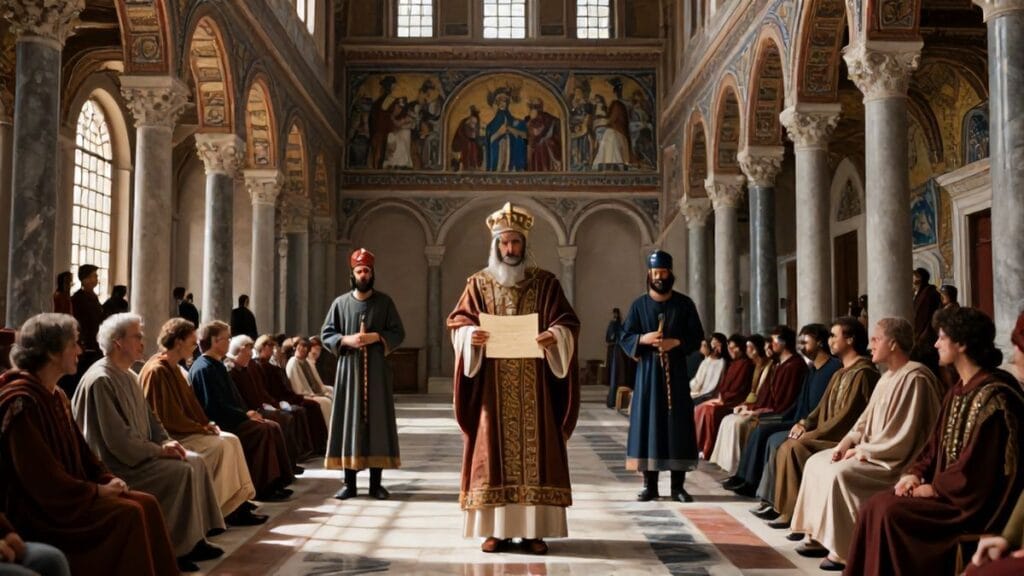
When the text was finally approved, it would have been presented to Theodosius II, likely in a formal audience. The emperor’s role in such matters was part ritual, part real. He might ask questions, propose minor alterations, or simply sign, trusting his advisors. Whatever the case, once his authority was attached, the law became more than a document. It became an imperial pronouncement with a date, a sender, and an intended circle of recipients. The edict against pagan sacrifices left the palace bearing the stamp of 4 November 435—a moment when the political and spiritual ambitions of a Christian court crystallized into words bound for the farthest corners of the empire.
What the Edict Actually Said: Words Meant to End a World
The text of the 435 edict, preserved in the Theodosian Code, is terse yet loaded with meaning. It opens with a statement that leaves no room for doubt: pagan sacrifices are forbidden, not only in public, but also in private, and not only in cities, but in every place under imperial authority. Sacrificial animals, incense, libations—any form of offering to the traditional gods—are placed under a legal ban. The law targets not just the act of killing a victim on an altar, but the broader ritual ecosystem that sustained sacrifice.
Property plays a central role in the edict. Temples that remain standing are to be closed definitively. Their lands and revenues, if not already confiscated in earlier rounds of legislation, are threatened once more with seizure. The edict declares that anyone who dares to perform or sponsor a sacrifice risks losing not only the animals and materials involved but also their estates. For members of the upper classes, whose identity rested on landed wealth, this was a serious threat. The law sought to make patronage of pagan rites not simply impious, but irrational, even suicidal.
Penalties are spelled out with judicial precision. Local magistrates and provincial governors are warned that negligence will be punished. If sacrifices take place under their watch, they cannot plead ignorance. The edict places responsibility squarely on the shoulders of those who, in the old Roman tradition, had once organized and presided over civic ceremonies. Now, instead of presiding at altars, they are ordered to tear them down. In a cruel irony, the guardians of public cults become its legal executioners.
The language, while legalistic, is also polemical. Pagan rites are described as “superstitious” and “profane.” No emperor of the high empire would have recognized his own religious world in these adjectives. But by the fifth century, the rhetorical framework of Christian polemic had thoroughly infiltrated law. To sacrifice was to consort with demons, to invite divine wrath, to insult the true God. A practice once considered the cornerstone of civic virtue is now portrayed as a public crime that endangers the moral health of the community.
What the edict does not say is just as revealing. It does not name specific gods; Zeus, Athena, Apollo, and the countless local deities remain, in the text, an unnamed “other.” It does not describe the beauty or complexity of the rituals it bans; there is no acknowledgment that these rites had given structure and meaning to lives for centuries. The law writes over the emotional texture of ancient religion with the flat terms of legal prohibition. In doing so, it attempts to erase not just actions, but memory itself.
And yet, the very need to reassert the ban, decades after earlier laws had already attacked sacrifice, suggests that the edict is both an end and a concession. Sacrifice must still be happening somewhere, or at least be feared as a possibility, for the court to bother. The edict against pagan sacrifices reads, in this light, as a last, forceful push—a declaration that the imperial state will tolerate no more exceptions, no more half-measures, no more rituals performed under the guise of “harmless customs.” It is words wielded as a hammer, intended to break the last supporting beams of an ancient religious house.
Bishops, Bureaucrats, and Informers: Enforcing the New Order
A law, even a severe one, is only as effective as the people who enforce it. In the fifth-century Eastern Roman Empire, that meant entrusting the edict to a chain of actors whose interests did not always align. At the top were provincial governors, appointed by the emperor, responsible for maintaining public order, collecting taxes, and implementing imperial commands. Below them, city magistrates and councils handled local administration. Threaded throughout were bishops and clergy, whose moral authority could rival or surpass that of secular officials, and a shadowy world of informers ready to profit from others’ transgressions.
For bishops, the edict against pagan sacrifices was a powerful tool. Many had spent years campaigning, preaching, and sometimes agitating for stricter measures against pagan rites. Now they could appeal directly to a recent, sharp-edged law, citing its language from the pulpit or in letters to governors. In their sermons, they might remind congregations that the emperor himself had spoken, that God’s will matched imperial policy, and that to persist in sacrifices was to rebel at once against heaven and against the earthly ruler.
Bureaucrats, however, had to weigh zeal against stability. A governor who launched an aggressive campaign to root out sacrifices might win praise from bishops and from the court, but also risk sparking unrest among rural populations still attached to their local cults. Confiscating temple lands could bring in revenue, but it could also disrupt delicate economic networks. Some governors undoubtedly enforced the edict with energy; others probably filed it away, to be cited when convenient and ignored when not.
Informers played an ambiguous role in this system. Late Roman law often encouraged citizens to report violations, promising rewards or a share in confiscated property. The edict encouraged denunciation of those who persisted in pagan sacrifice. For some, this was a religious act: to expose idol-worship was to defend the faith. For others, it was a chance to settle old grudges or to profit from a neighbor’s misfortune. The line between pious zeal and opportunistic betrayal blurred easily.
Imagine a small town in inland Asia Minor. The local bishop, newly emboldened, announces that any knowledge of sacrifices must be reported to him or to the authorities. A landowner with a private shrine on his estate faces a dilemma. A few years earlier, he might have continued his rites discreetly, trusting in the indifference of distant officials. Now, a disgruntled tenant or a rival might expose him, costing him his land. The social fabric tightens and frays at once, as fear and suspicion creep into relationships once governed by patronage and reciprocity.
In some regions, bishops took matters almost literally into their own hands. Church histories tell of clerics leading processions to tear down rural shrines, to topple statues, to “purify” sacred groves. These accounts are, of course, stylized and triumphant, but they reflect a real alliance between spiritual and secular power. One late antique bishop boasted that, “by the laws of pious emperors and by the zeal of the faithful,” the altars of demons had been overturned. His words could stand as an epitaph for the world that the 435 edict sought to bury.
Temples in Twilight: How Sacred Landscapes Were Transformed
Before the fourth century, temples were among the most visible symbols of Roman presence across the Mediterranean. They crowned acropolises, dominated marketplaces, and stood at crossroads where travelers paused to pray. Each was a microcosm of art, ritual, and memory: columns carved in local styles, statues of gods and heroes, altars darkened by centuries of smoke. To outlaw sacrifice was to render these buildings mute. The twilight of the temples was at once a legal, architectural, and emotional process.
When the edict against pagan sacrifices was read in cities and towns after 435, local authorities would have looked up at these monuments with a new sense of obligation. Closing a temple was not always as dramatic as demolishing it. In some places, doors were simply sealed, access was restricted, and altars left unused. In others, statues were removed, altars smashed, and sacred objects confiscated by the imperial treasury or transferred to churches. The transformation could be swift and violent, or slow and almost invisible, depending on the local balance of forces.
Some temples found second lives. The Roman genius for practical adaptation survived into Christian times. A grand temple might be converted into a church: its cella turned into a nave, its columns now framing Christian altars. This was not only a matter of convenience; it was a deliberate sign of triumph, a visible proclamation that Christ had taken the place of the old gods. In other cases, temples became civic buildings, storehouses, even quarries for stone. Stripped of cult, they were reabsorbed into the fabric of everyday life.
But there were also sites where change came more slowly. Rural sanctuaries, off the main roads, could fade into semi-obscurity. Their priests—if they still had them—aged without successors. Peasants might still leave tokens or light lamps, reimagining the acts as mere customs, divorced from “sacrifice” in the strict sense that the law banned. In such places, the sacred landscape decayed into memory. Ivy crawled over walls once crowned with offerings; altars became landmarks for shepherds.
The emotional impact of this transformation is hard to quantify, but glimpses appear in the writings of pagan intellectuals. The Neoplatonist philosopher Eunapius, writing earlier in the fifth century, spoke bitterly of temples “deserted and desolate,” their priests scattered, their rites forbidden. For him, the prohibition of sacrifice was not just religious persecution; it was an attack on culture itself, on the beauty of ceremonies that connected humans with the divine. Though Eunapius did not live to see the 435 edict, his laments anticipate its consequences.
For Christians, by contrast, the twilight of the temples was described in tones of victory. Church historians like Socrates Scholasticus and Theodoret recounted the closing and destruction of pagan shrines as episodes of divine justice. One could almost say that the edict against pagan sacrifices supplied the script for these narratives: the law demanded the end of sacrifice, and the stories of temple downfall provided the proof that this end had been achieved. Between the ruins and the rhetoric, a new sacred landscape emerged—one in which churches, martyrs’ shrines, and monasteries replaced temples as the primary coordinates of holiness.
Pagan Lives Upended: Priests, Philosophers, and Ordinary Worshippers
Behind every law lies a vast constellation of ordinary lives. The edict of 435 did not simply rearrange stones; it disrupted vocations, silenced chants, and altered the rhythms of festivals that had punctuated the year for generations. To appreciate its human cost and complexity, we must look past the marble and into the stories of those who served and frequented the old cults.
Start with the priests. A pagan priesthood was not always a full-time profession. In many cities, it was a civic honor, held for a year or a term, involving financial contributions to festivals and sacrifices. In others, it resembled a family business, passed down within clans that had served a particular deity for centuries. These men—and occasionally women—stood at the center of rituals. With the edict against pagan sacrifices, their core duties became illegal. Some converted to Christianity, perhaps sincerely, perhaps as a pragmatic adaptation. Others retreated into philosophical circles, recasting their religious knowledge as abstract wisdom, hiding their devotion to the gods behind allegory.
Philosophers of the Neoplatonic tradition experienced the change as a direct blow. For thinkers like Proclus in Athens, who lived during the very years when Theodosius II reigned, sacrifices were part of a complex ritual theology. Offerings were a way of harmonizing the soul with the cosmic order. Proclus is said to have performed secret rites at night, fearing imperial scrutiny. Under the shadow of laws like the 435 edict, the philosophical defense of sacrifice became both an intellectual and a clandestine act. The classroom and the hidden altar became two sides of the same attempt to keep an ancient vision of the universe alive.
Ordinary worshippers faced simpler but no less painful choices. A mother who had always brought her child to a temple on a particular feast day now had to decide: obey the law and stay home, or quietly continue the custom, hoping not to be noticed. A farmer who relied on rituals for the blessing of his fields found himself told that prayers should now be offered in church, not at the shrine of the local deity. Old stories about the god who had protected the town in a past famine or war were still told around hearths, but now in an undertone, almost apologetically.
Some, no doubt, moved readily into Christian practice. For them, the end of sacrifice might have felt like a natural evolution rather than a rupture. After all, Christian liturgy itself retained echoes of sacrificial imagery—the language of offering, the centrality of the Eucharist as a memorial of Christ’s self-sacrifice. It could, for some converts, function as a continuity in new form. Others, especially in mixed households, may have oscillated between rites, hedging their bets in a spiritually plural world where law ran faster than belief.
There must have been anger as well. We do not possess the diaries of rural priests suddenly stripped of their functions, nor the testimonies of artisans whose livelihoods depended on crafting cult statues, incense, or sacrificial instruments. But we can infer their existence from the traces we do have: from the polemics of Christian preachers against “stubborn pagans,” from the occasional episodes of unrest associated with temple closings, from the indignant tone of pagan writers who accused Christians of cultural vandalism. These voices remind us that the edict against pagan sacrifices did not land on a blank slate. It collided with lives already in motion, redirecting them in ways that were as intimate as they were irrevocable.
Resistance, Evasion, and Silent Persistence of the Old Gods
No law, however forceful, can fully control the hidden corners of human behavior. The 435 edict was designed to eradicate sacrifice, but it also generated new forms of resistance and evasion. Some were overt and dramatic; others were subtle, almost imperceptible, quietly braiding old practices into new patterns of life.
In cities, direct defiance of the law was risky. To sacrifice openly in a temple after 435 would have been a provocative act, inviting punishment. Yet urban settings offered other kinds of cover. Private houses, especially among the elite, could conceal shrines in side rooms or courtyards. A dinner gathering might include a discreet libation to household gods, framed as a mere “custom,” not a sacrifice in the sense banned by law. Family rituals honoring ancestors blurred the line between pagan and Christian practice, especially when fewer outsiders were present to judge.
In rural areas, where surveillance was weaker, resistance could take a slightly bolder form. Archaeological evidence from some regions suggests that small altars and local sanctuaries remained in use well into the late fifth and sixth centuries. Christian hagiographies, ironically, preserve many such examples; they tell stories of saints confronting villagers who still “sacrifice at altars” or hold feasts for pagan deities. These texts, written to celebrate Christian victories, inadvertently testify to pagan persistence long after the edict against pagan sacrifices claimed to have ended it.
Evasion also operated through reinterpretation. An offering of first fruits, once designed for a temple god, might be redirected to a church or to the poor, recast as Christian charity while retaining much of its old ritual structure. Festivals once associated with particular deities could be re-labeled as commemorations of saints, their dates preserved while their ostensible meaning changed. This kind of syncretic adaptation did not necessarily represent conscious resistance, but it did allow elements of the old religious calendar to survive beneath a Christian veneer.
Philosophers and literary men developed a different strategy: allegory. They argued that sacrifices and myths had never been meant literally; they were symbols of deeper truths about the soul and the cosmos. In this reading, one could continue to honor the gods in a more interior, intellectual way, without bloody offerings. The law’s focus on physical sacrifice left this mental cult harder to touch. But the imperial and ecclesiastical authorities were not fooled; they often conflated philosophical paganism and sacrificial practice in their condemnations, sensing that both nourished the same rival vision of the divine.
Perhaps the most poignant form of persistence was memory. Even when sacrifices ceased, the stories of the gods, the recollection of past festivals, the emotional attachments to temples and sacred spaces lingered. Elderly men and women might tell children about processions they had once joined, about miracles attributed to deities now officially denounced as demons. In these narratives, the old gods did not entirely die; they retreated into the half-light of remembrance, inhabiting a world that the law could not fully penetrate.
The Western Mirror: Comparing East and West in the War on Sacrifice
The edict of 435 emerged from the Eastern court in Constantinople, but it echoed and was echoed by developments in the Western half of the empire. While East and West were politically distinct by this time, sharing only a loose partnership, they often mirrored each other in religious policy, each watching the other’s experiments with law and enforcement.
In the West, the suppression of pagan sacrifices had a slightly different trajectory. Rome itself was a more heavily pagan city for longer, its senatorial class famously attached to old rites. The conflict over the Altar of Victory in the Roman Senate under emperors Valentinian II and Theodosius I epitomized the tension: pagan senators demanded the restoration of a symbolic altar in the Senate House; Christian leaders like Ambrose of Milan opposed it fiercely. Ultimately, the Christian side prevailed, and sacrifices in Rome’s traditional calendar were sharply curtailed.
Western emperors issued their own laws against sacrifices. A series of decrees in the 380s and 390s banned sacrifices, closed temples, and threatened penalties similar to those in the East. Yet the sack of Rome by Alaric in 410, the weakening of central authority, and the fragmentation of the Western Empire under barbarian kings complicated enforcement. In some regions, especially where Germanic rulers remained Arian Christians or even pagans, eastern-style rigor was difficult to replicate.
Nonetheless, the legal ideals converged. The very inclusion of anti-sacrificial laws in the Theodosian Code, a joint project intended for use in both East and West, signaled a shared commitment to eradicating traditional cults. The 435 edict against pagan sacrifices thus belongs to a larger, empire-wide endeavor. Its language would have resonated with Western jurists, even if they struggled to apply it in territories slipping from imperial grasp.
Historians have noted that, ironically, pagan practices may have lingered longer in some Western rural areas than in the more tightly administered Eastern provinces. The weakening of the Western state could mean fewer resources for strict enforcement. In Gaul, Spain, and parts of Italy, there are hints in later sources of rustic ceremonies and seasonal rites that bore the marks of pre-Christian sacrifice well into the sixth and seventh centuries, now increasingly framed by Christian authors as “pagan survivals.”
The East, by contrast, with its stronger bureaucracy centered in Constantinople, could sustain waves of legislative pressure over decades. The edict of 435 was one such wave, adding to a long series. The Western mirror thus returns a complex image: on paper, both halves of the empire were united in their war on sacrifice; in practice, regional dynamics, political instability, and the sheer diversity of local cultures produced very different religious landscapes on the ground.
Law as Theater: Public Rituals of Christian Triumph
Imperial laws were not just administrative tools; they were performances. When a new edict arrived in a city, it was often read aloud in public, sometimes in the forum or near the main church. The text of the edict against pagan sacrifices would have been proclaimed in such settings, turning legal prose into a kind of civic liturgy. The crowd might include Christian clergy, city officials, ordinary townspeople, and perhaps a handful of uneasy pagans listening in silence.
This moment of proclamation mattered. It staged the emperor’s piety in front of his subjects. Anyone listening could sense that a boundary had been drawn: on one side, the Christian empire, allied with God; on the other, the lingering darkness of idol-worship, condemned and outlawed. The reading of the edict thus became part of a broader theater of Christian triumph, joining other public rituals such as processions with relics, the dedication of churches on former temple sites, and the celebration of imperial feast days with Christian liturgy.
Christian preachers eagerly incorporated such laws into their rhetorical repertoire. A homily on the futility of idols might segue into praise for the emperor who had “just now” issued another law against pagan sacrifices. The text of the edict, or at least its gist, would be paraphrased from the pulpit, braided together with biblical verses condemning idolatry. Law and scripture mutually reinforced each other, shaping perceptions of what was normal, acceptable, and expected in public religious life.
At the same time, the performance was not merely verbal. The enforcement actions that followed—closing a local temple, demolishing an altar, removing a cult statue—were often staged as spectacles. Crowds might gather to watch statues toppled or burned, to see sacred objects carted away. For Christians, these acts could be celebrated as exorcisms of civic space; for pagans, they were humiliations, sometimes borne in fearful silence, sometimes resisted with futile protests.
One late antique writer describes how an imperial official, armed with laws against sacrifice, entered a city and ordered the destruction of its main temple. The townspeople, he says, “watched as their ancient god was dragged out and smashed, and some wept, but dared not resist.” Whether or not this particular account is exaggerated, it captures the theatricality of the process. The law did not operate in the shadows; it sought to mark the urban landscape with visible signs of change, to make Christian supremacy impossible to ignore.
Seen in this light, the 435 edict was part of a choreography that fused text, voice, and action. The scroll unrolled in the governor’s hand, the voice of the herald ringing across a square, the clatter of hammers on stone as altars fell—all these were scenes in an imperial drama whose message was unambiguous: the age of sacrifice was over, and anyone who clung to it did so under threat of punishment not only from God, but from the emperor himself.
Voices from the Margins: Jews, Heretics, and the Pagan “Other”
The edict of 435 targeted pagan sacrifices specifically, but it did so within a broader landscape of religious difference. Jews, various Christian “heretics,” and other minorities all occupied precarious positions in the late Roman order. Laws against sacrifice intersected with, and sometimes blurred into, measures against these other groups, creating a complex map of inclusion and exclusion.
Jews held a unique status. They were recognized as adherents of an ancient, scripturally grounded monotheism, and imperial policy oscillated between protection and restriction. While Jewish sacrificial worship in the Jerusalem Temple had long since ended with the temple’s destruction in 70 CE, other aspects of Jewish ritual—circumcision, dietary laws, Sabbath observance—continued to mark them off sharply from Christians and pagans alike. The ban on sacrifice thus did not directly affect Jewish cult, but it contributed to a world in which animal offerings were increasingly associated, in Christian minds, with “superstition” and backwardness. Jewish communities, wary of being conflated with pagans, sometimes emphasized their distance from the kind of idolatrous rites the edict condemned.
Christian “heretics”—Arians, Nestorians, and other groups—posed a different challenge. They shared the Christian rejection of pagan sacrifice, but their interpretations of Christ’s nature or the Trinity deviated from Nicene orthodoxy. The same emperors who outlawed sacrifices also issued fiercely worded edicts against these theological rivals, confiscating their churches and exiling their leaders. From their perspective, the imperial use of law to enforce orthodoxy was part of the same authoritarian pattern that underpinned anti-pagan measures. Some may even have compared their plight to that of pagans, both victims of a state that sought to dictate belief.
Paganism itself became a loaded category. It was not merely a description of non-Christian religion; it was a polemical label used to mark people as culturally and morally suspect. To accuse someone of sacrificing, or even of sympathizing with those who did, could damage reputations. Political enemies might be branded “pagans” as a way of undermining their standing at court. The edict against pagan sacrifices thus nourished a broader culture of suspicion, in which religious accusations became weapons in social and political struggles.
We hear few direct voices from the marginalized themselves. Most of our sources are Christian: bishops, historians, jurists. Yet even in their writings, the cracks show. Some late antique authors complain that “many people still keep pagan customs in secret,” or that “certain powerful men protect idolaters.” Such remarks betray the persistence of alternative religious loyalties. They also suggest that imperial authority, while formidable, could not compel hearts with the same ease as it commanded bodies.
In this world, identity was rarely simple. A city councilor might attend church services to demonstrate loyalty to the emperor, while privately clinging to family traditions that skirted the edges of the law. A Jewish merchant might navigate between Christian clients and pagan suppliers, careful not to be drawn into rituals that might taint his standing. An Arian bishop, deposed and exiled, might reflect bitterly on how the machinery of state that once persecuted pagans now turned with equal force against those deemed “heretical.” The 435 edict, though narrowly focused on sacrifice, thus participated in a larger imperial project of categorizing, managing, and sometimes crushing religious difference.
Memory, Martyrdom, and the Creation of a Christian Past
One of the most enduring effects of laws like the 435 edict was not simply their immediate impact, but the stories they enabled Christians to tell about themselves. As pagan worship faded from public life, Christian writers began to craft a narrative in which the victory over sacrifice appeared both inevitable and divinely guided. The memory of martyrs, the destruction of temples, and the promulgation of laws against pagan sacrifices all merged in a grand tale of triumph.
Martyrs occupied a central role in this story. Christians who had died under earlier persecutions were portrayed as having suffered at the hands of pagan emperors who demanded sacrifices to the gods. With the conversion of the empire and the issuing of anti-sacrificial laws, their deaths took on a new meaning. They had, it was said, paved the way for the empire’s purification. The very places where martyrs had been killed were now adorned with churches and shrines. In homilies, preachers sometimes contrasted the blood of martyrs with the blood of animals once poured out on pagan altars, insisting that only the former had true redemptive power.
Temples themselves became props in a Christian memory-theater. When a temple was converted into a church, Christian writers often embellished the event, describing miraculous signs that accompanied the change: idols crumbling at the touch of a cross, demons shrieking as they fled their former dwellings. These stories, even when exaggerated, served to reinforce the idea that the end of sacrifice was not merely a legal matter, but a spiritual battle in which Christ had conquered the demons behind the old gods.
Imperial laws fit neatly into this scheme. The edict against pagan sacrifices issued on 4 November 435 could be presented as the culmination of God’s plan. In one oft-quoted line, a fifth-century bishop proclaimed that “the rulers of the earth now serve the King of Heaven,” citing recent edicts as proof. Law thus became a kind of scripture in its own right, read and interpreted as evidence of divine favor. The memory of pagan sacrifice was reduced to a foil, a dark background against which the splendor of Christian orthodoxy shone more brightly.
This process of memory-making had another consequence: it flattened the complexity of the past. Nuances—the coexistence of pagans and Christians in the same families, the ambiguous attitudes of early Christian emperors, the syncretic blending of rites—tended to be erased. In their place arose a cleaner narrative: once there was idolatry and sacrifice, then Christ came, and finally the pious emperors, through laws such as the 435 edict, swept away the last traces of error. This powerful story would shape medieval and even modern perceptions of the “fall of paganism,” often obscuring the slower, more uneven reality.
Yet counter-memories persisted, especially among learned pagans and, later, among humanists who looked back wistfully to the classical world. They saw in the banning of sacrifice not a noble victory, but a cultural loss. The historian Zosimus, writing in the early sixth century, famously argued that Rome’s decline began when emperors neglected the traditional rites that had once secured divine favor. For him, the laws against sacrifice were symptoms of a fatal break with ancestral wisdom. In his melancholy account, the edict against pagan sacrifices and its kin were not chapters in a story of salvation, but milestones on the road to ruin.
Did the Edict Work? Measuring the Impact on Late Antique Society
Evaluating the effectiveness of the 435 edict is challenging. On paper, it was uncompromising: sacrifices forbidden everywhere, temples closed, penalties severe. But societies are not ruled by paper alone. To ask “Did it work?” is to ask how far imperial law could actually reshape religious practice across a vast and varied empire.
In urban centers, particularly those with strong Christian leadership, the edict seems to have accelerated trends already underway. By the mid-fifth century, public pagan festivals were rare in major eastern cities. Christian churches dominated the most symbolic urban spaces. Pagan intellectual circles survived in a few places—Athens, perhaps Gaza, certain Syrian cities—but they did so under increasing scrutiny. The edict gave bishops and governors additional justification to suppress any overt sacrificial rites that might linger.
The countryside is harder to read. Archaeological evidence suggests a patchwork. In some regions of Asia Minor, Syria, and the Balkans, temples show signs of abandonment or Christianization by the fifth century. Elsewhere, small sanctuaries appear to have remained active into the sixth century, as indicated by votive offerings and modifications to buildings. Christian sources complaining of ongoing “pagan sacrifices” in rural areas decades after 435 likewise hint that the edict did not instantly wipe the practice away. Instead, it contributed to a climate in which pagan rites gradually retreated, becoming more localized, more discreet, and more vulnerable with each generation.
One way to measure impact is through silence. By the late fifth and early sixth centuries, explicit references to sacrifice in legal texts and Christian polemics become less frequent. Laws shift their focus more toward heresy and internal church disputes. This could mean that pagan sacrifice had largely ceased to be a widespread problem, or at least that it no longer loomed as the primary religious concern of the state. The edict against pagan sacrifices, and its predecessors, may thus have achieved their ultimate goal not by instant eradication, but by slowly starving traditional cults of public legitimacy, resources, and institutional support.
Yet even in success, there were costs. The legal suppression of sacrifice narrowed the spectrum of acceptable religious expression. It stifled forms of local autonomy and creativity that had once flourished around temples and festivals. It also helped entrench a model of empire in which uniformity of worship was seen as essential to stability. This model would be inherited by medieval Christian polities and, in different ways, by later confessional states of both Christian and Islamic worlds.
For individuals, the impact varied from liberation to loss. Christians who had felt marginalized or threatened in a predominantly pagan world now saw their faith honored by the highest powers. Pagans who had once taken pride in their rituals now felt themselves increasingly out of step with the times, pressured to conform or to retreat into inward, often precarious dissent. To say that the edict “worked” is thus to recognize that it helped tip the balance decisively toward a Christian society—but also to admit that it did so through an exercise of coercive power whose ethical implications have continued to trouble observers ever since.
From Roman Law to Medieval Christendom: The Edict’s Long Shadow
The edict of 435 did not vanish with the fall of the Western Empire or the transformations of the Eastern Empire into what we call Byzantium. Instead, it became part of the enduring legal and cultural legacy of Christian imperialism. As the Theodosian Code influenced later collections of law, and as church councils and canonists borrowed its language and assumptions, the principles embodied in the edict against pagan sacrifices traveled far beyond their original context.
In the East, Justinian’s sixth-century legal reforms drew on earlier anti-pagan legislation, reaffirming the illegality of sacrifice and extending restrictions on non-Christian worship. Justinian’s famous Corpus Juris Civilis incorporates the assumption that the state has both the right and the duty to regulate religious practice in accordance with Christian truth. Sacrifice, now firmly associated with idolatry, appears as an egregious violation of that duty.
As Roman law filtered into medieval Europe, whether through direct transmission in the Byzantine East or through revivals in the Latin West, its treatment of paganism influenced how new rulers thought about religious dissent. Early medieval kings who converted to Christianity often faced subjects who still practiced local cults involving sacrifices of animals, and sometimes even humans, at sacred groves, springs, or stones. Missionaries and bishops, armed with both scripture and the prestige of Roman precedent, urged them to emulate the pious emperors by banning such rites.
Medieval church councils repeatedly condemned “pagan sacrifices” (sacrificia pagana), sometimes echoing the language of late antique Roman laws. Even when the specific content of the 435 edict was not known, its spirit survived: the conviction that sacrificial offerings to any being other than the Christian God were not merely religious errors, but crimes against God and society, deserving of legal sanction. This conviction underpinned campaigns against Norse, Slavic, and Baltic pagan practices, as well as against some heterodox Christian groups accused of quasi-pagan ritual.
In the longer run, the edict’s shadow can be seen in the development of European attitudes toward “idolatry” in the colonial period. When early modern missionaries and explorers encountered indigenous religions in the Americas, Africa, and Asia, they often interpreted animal sacrifices and offerings through a lens shaped, however indirectly, by late Roman precedents. The ancient logic—sacrifice to false gods is demonic and must be eradicated—resurfaced in new theaters, now backed by the power of expanding European states.
Of course, contexts changed, and laws evolved. But the basic pattern—using state authority to suppress sacrificial cults in the name of monotheistic truth—bears a family resemblance across centuries. In that sense, the 4 November 435 edict issued in Constantinople can be seen as a turning point with long afterlives, a moment when the Roman Empire helped define an enduring Christian approach to the sacrificial “other.”
Reassessing the Edict: Historians, Debates, and New Perspectives
Modern historians have approached the edict of 435 and its companion laws from multiple angles, debating their motives, effects, and meanings. For much of the nineteenth and early twentieth centuries, scholars tended to accept the narratives of late antique Christian writers at face value, seeing the ban on sacrifices as a straightforward victory of monotheism over superstition. Paganism was portrayed as moribund, its suppression almost inevitable once Christianity gained imperial favor.
Later research has complicated this picture. Archaeologists have shown that pagan cults persisted in some areas long after they supposedly vanished. Social historians have emphasized the diversity of local experiences, arguing that the impact of laws like the edict against pagan sacrifices varied widely depending on region, class, and urban versus rural settings. Legal historians have pointed out that the mere existence of repeated anti-pagan laws suggests not inevitable victory, but ongoing struggle.
There is also debate about motivations. Were emperors primarily driven by genuine religious conviction, or by political calculation? Some scholars stress the personal piety of rulers like Theodosius II and the influence of devout women at court, such as Pulcheria. Others highlight how suppressing pagan elites helped consolidate power, weaken alternative centers of authority, and channel resources toward Christian institutions that, in turn, supported the regime. The truth likely lies in a combination: sincere belief and strategic governance were not mutually exclusive in the minds of late antique rulers.
Recent work has also paid attention to the voices of pagans themselves, as far as they can be recovered. Authors like Libanius, Eunapius, and Zosimus have been reread not simply as nostalgic reactionaries, but as witnesses to a profound cultural rupture. Their lamentations over banned sacrifices and ruined temples are now seen as important testimony to the emotional cost of religious change, even if their accounts are partial and polemical.
Additionally, scholars influenced by anthropology and comparative religion have reconsidered the meaning of sacrifice itself. Rather than viewing sacrificial rites as crude superstition, they examine their social, symbolic, and psychological functions. From this perspective, the banning of sacrifice appears not only as a theological move, but as a reconfiguration of how communities negotiate relationships with the sacred, the communal meal, and the boundaries between human and divine. The Christian Eucharist, with its sacrificial language but bloodless form, is interpreted as both a continuation and a radical transformation of older sacrificial logics.
Finally, there is ongoing reflection on the ethics of religious coercion. The edict against pagan sacrifices raises questions still urgent today: To what extent should states regulate religious practices deemed harmful or erroneous? When does the protection of a perceived truth become oppression? By revisiting the events of 435 with critical distance, historians invite us to see in them not only an episode in the past, but a mirror for contemporary debates about pluralism, tolerance, and the limits of state power in matters of conscience.
Conclusion
On that November day in 435, when the edict against pagan sacrifices left the palace in Constantinople, its authors could hardly have foreseen the many worlds their words would touch. They acted in a particular moment, facing what they perceived as a lingering threat from an ancient religious order they believed incompatible with Christian truth. Their law was meant to be decisive, to close a chapter. In reality, it marked a turning point in a much longer, messier process: the gradual unmaking of a sacrificial civilization and the emergence of a different religious landscape in its place.
The edict crystallized decades of shifting policies, theological debates, and social tensions. It gave bishops a sharper tool, put new pressures on governors, and forced priests, philosophers, and ordinary believers to make choices they might otherwise have deferred. Its impact varied from city to countryside, from province to province, but its message was constant: the public and legal space of the empire would no longer accommodate sacrifices to the old gods.
At the same time, the story of the edict’s implementation and afterlife reminds us of the limits of power. Resistance, evasion, and quiet persistence dogged every attempt at total religious uniformity. Temples fell into ruin not overnight, but over generations; beliefs and memories survived long after rituals ceased. The law did help reshape practice, yet it could not fully dictate the inner landscape of faith and attachment.
In the centuries that followed, the principles embodied in the edict seeped into the foundations of medieval Christendom and beyond, influencing how later societies confronted religious “others” and especially sacrificial cults. Historians today, armed with new evidence and critical tools, look back on 435 not as a simple victory of light over darkness, but as a complex episode in the history of power, belief, and human lives caught between worlds. The smoke that rose from pagan altars may have faded, but the questions raised by the attempt to extinguish it—about coercion and conviction, about memory and identity—still hang in the air, challenging us to think carefully about the costs of enforcing religious truth by law.
FAQs
- What was the edict issued against pagan sacrifices in 435?
The edict issued on 4 November 435 in Constantinople was an imperial law of the Eastern Roman Empire, under Theodosius II, that categorically banned pagan sacrifices throughout the empire. It forbade both public and private sacrificial rites, ordered the closing of remaining temples, and imposed severe penalties—such as confiscation of property—on those who continued to perform or support traditional pagan cults. - Why did the Roman authorities want to stop pagan sacrifices?
By the fifth century, the imperial court and most of the governing elite were committed Christians who saw pagan sacrifices as offerings to false gods or demons, and therefore as spiritually dangerous to the empire as a whole. The suppression of sacrifice also served political purposes: it weakened traditional pagan elites, reinforced the alliance between emperors and bishops, and helped present the empire as a unified Christian commonwealth under divine favor. - Did the edict against pagan sacrifices immediately end pagan worship?
No, it did not end pagan worship overnight. While the edict accelerated the decline of public sacrifices in many cities and gave authorities a powerful legal basis for closing temples, pagan practices continued in various forms, especially in rural areas and private settings. Over time, however, the law contributed to a climate in which traditional cults lost resources, visibility, and legitimacy, leading to their gradual disappearance. - How was the edict enforced across such a large empire?
Enforcement relied on provincial governors, local magistrates, and increasingly on bishops and clergy who monitored religious life in their communities. Informers were encouraged to report violations, sometimes receiving a share of confiscated property. However, enforcement was uneven; some officials were zealous, others indifferent or cautious, especially where strict application of the law might provoke unrest. - What happened to pagan temples after the edict?
The fate of temples varied. Some were simply closed and abandoned, falling into ruin over time. Others were converted into churches or civic buildings, their architecture repurposed for new uses. In certain areas, particularly rural or remote ones, small sanctuaries continued in semi-clandestine use for some time, despite the law. Overall, the edict hastened the transformation of the sacred landscape from one dominated by temples to one marked primarily by churches and monasteries. - How do historians today view the edict against pagan sacrifices?
Historians now see the edict not as a single, decisive blow that instantly destroyed paganism, but as part of a long series of laws and social changes that gradually reshaped religious life. They emphasize regional diversity, the persistence of pagan practices, and the complex motives—both religious and political—behind such legislation. Many also reflect critically on the degree of coercion involved and its implications for understanding religious intolerance in late antiquity and beyond.
External Resource
Internal Link
Other Resources
- Encyclopaedia Britannica – general search for the exact subject
- Google Scholar – academic search for the exact subject
- Internet Archive – digital library search for the exact subject