Table of Contents
- A Kingdom at War with Itself: France on the Eve of 1598
- From Devout Protestant to King of France: The Long Road of Henry of Navarre
- Blood in the Streets: Massacres, Sieges, and the Trauma of the Wars of Religion
- “Paris Is Well Worth a Mass”: Conversion, Pragmatism, and a Fragile Crown
- A City by the Loire: Why the Edict of Nantes Was Signed in Nantes
- Inside the Edict: Clauses, Compromises, and Careful Silences
- The Day the Edict of Nantes Was Signed: April 13, 1598
- Tears, Prayers, and Suspicions: First Reactions Across the Kingdom
- Living the Edict: Everyday Life Under a Royal Promise of Toleration
- Faith on the Margins: The Catholic League, Rome, and International Repercussions
- Cities of Refuge: Strongholds, Safe Havens, and the Geography of Protection
- Families, Consciences, and Silent Conversions: The Edict’s Human Face
- Wealth, Trade, and Knowledge: How the Edict Shaped the French Economy
- From Richelieu to Louis XIV: A Century of Uneasy Coexistence
- The Slow Strangling of Toleration and the Revocation of 1685
- Memory of a Broken Promise: The Edict in French and European Imagination
- Conclusion
- FAQs
- External Resource
- Internal Link
Article Summary: In April 1598, after decades of civil war and religious bloodshed, the edict of nantes signed by King Henry IV in the port city of Nantes attempted to provide France with something it had not known for a generation: peace with differences. This article traces the path to that moment, from the early Wars of Religion and the horrific St. Bartholomew’s Day massacre to Henry of Navarre’s contested conversion and fragile accession to the throne. It explores why little Nantes became the stage for one of Europe’s boldest experiments in religious coexistence, examining the clauses of the edict, its loopholes, and its funding of fortified Protestant strongholds. Through vivid portraits of soldiers, merchants, mothers, and ministers, the narrative shows how the law transformed daily life, while never fully calming fears. The edict’s international reverberations, from Rome to London and Amsterdam, reveal a Europe watching France test the dangerous idea that more than one faith could be officially tolerated. Yet behind the promises of protection lay political calculations that later monarchs would slowly undo, ending with Louis XIV’s brutal revocation in 1685. By following the legacy and memory of the Edict of Nantes across centuries, the article uncovers how a royal decree became a symbol: at once of fragile compromise, betrayed hopes, and the early struggle for what we now call religious freedom.
A Kingdom at War with Itself: France on the Eve of 1598
On the morning of April 13, 1598, when the edict of nantes signed its way into the legal fabric of France, the parchment that Henry IV was about to seal carried a weight far beyond ink and words. For more than three decades, the kingdom had been devouring itself in the name of God. Villages lay in ruins, fields untended, churches burned or stripped, and families torn apart not only by armies but by the dividing line of faith. By the late sixteenth century, the very idea of “France” had begun to fray: was it a Catholic realm consecrated to the Virgin, as tradition insisted, or a land in which a Protestant minority might claim a legal right to exist?
To understand why the edict of nantes signed that day in a Loire port was so revolutionary, one must step back into the chaos of the French Wars of Religion. Between 1562 and 1598, the kingdom endured eight distinct wars, layered with fragile truces that collapsed almost as soon as they were signed. Each conflict was a bitter tangle of theology and politics. On one side stood the Catholic majority, increasingly mobilized by the militant Catholic League and backed by Spain and Rome; on the other, the Huguenots—French Calvinists—supported at various moments by Protestant England, German princes, and the Dutch Republic.
By the 1590s, the scars of these conflicts were everywhere. In some regions, towns had changed hands so many times that older inhabitants remembered three or four different sieges. Parish records show years with sharp declines in baptisms and marriages, hinting at famine and flight. Tax registers are patchy, revealing both administrative collapse and a simple reality: many taxpayers had died or vanished. France was not merely a battlefield; it was a wounded body struggling to survive repeated blows.
Yet the wars were not a continuous blaze. They flared and smoldered, punctuated by uneasy truces that tried, and failed, to create a framework for coexistence. Earlier edicts had attempted toleration in cramped, temporary forms. The Edict of Amboise in 1563, for instance, allowed limited Protestant worship for nobles and in certain towns, but only as a stopgap. Each such text represented a reluctant admission that neither side could easily annihilate the other. And each was soon undermined by mutual suspicion, local violence, and political intrigue.
By the time Henry of Navarre claimed the French throne as Henry IV, the kingdom he aspired to rule resembled a patchwork of armed camps more than a unified monarchy. A Catholic Paris refused to accept him, provincial governors acted like warlords, and the great noble houses—Guise, Bourbon, Montmorency—pursued their own factions and feuds behind the language of confession. It is astonishing, isn’t it, that out of such disorder would emerge a text that tried to rewrite the rules of belonging in the kingdom.
France in 1598 was also a European crossroads. The Spanish Habsburg Empire, committed to defending Catholic orthodoxy, pressed along France’s borders and meddled in its politics, recognizing rival claimants and financing the Catholic League. England under Elizabeth I, while wary of a strong France, nonetheless preferred a Protestant-leaning neighbor to a Spanish satellite. The Dutch Republic, locked in its own struggle with Spain, watched closely, knowing that French instability could spell both opportunity and danger. When the edict of nantes signed into law the limited rights of a Protestant minority, the reverberations would be felt from Rome to London.
From Devout Protestant to King of France: The Long Road of Henry of Navarre
At the center of this storm stood a man who seemed, in his own way, to embody contradiction: Henry of Navarre. Born in 1553 in the mountain kingdom of Navarre, straddling the Pyrenees, Henry was raised in the Reformed religion by a fiercely Protestant mother, Jeanne d’Albret. As a boy he listened to Calvinist preachers denounce Catholic “idolatry” and praise the simplicity of the Gospel. He was meant to be a champion of the Huguenot cause, not the monarch who would reconcile France under a Catholic crown.
His youth was steeped in war. As a teenager, Henry rode with Protestant armies, slept in tents, and learned the craft of survival in a country tearing itself apart. He forged bonds with Huguenot captains who would later hold key fortified towns granted in the edict of nantes signed decades later, men for whom loyalty to the “Béarnais”—as Henry was known—was inseparable from their faith. In taverns and encampments, around smoky fires, he listened to stories of massacres and betrayals, and he saw firsthand what religious hatred could do to a village, a family, a child.
Yet Henry was also a prince of the blood, a Bourbon, and destiny had placed him close to the line of succession for the French throne. The Valois dynasty that ruled France in the mid-sixteenth century was withering away. A series of weak kings—Francis II, Charles IX, and Henry III—left no surviving sons. Civil war gnawed at their authority. By the late 1580s, as the Valois line approached extinction, Henry of Navarre, a Protestant, emerged as the legitimate heir under the rules of Salic law.
For many French Catholics, this was unthinkable. The kingdom prided itself on being “the eldest daughter of the Church,” a nation wrapped in Marian devotion. A Protestant king seemed to them a betrayal of centuries of sacred history. The militant Catholic League, led by the powerful Guise family, vowed to prevent such a sacrilege. Streets of major cities filled with shouts of “Rather a king from the earth than a heretic from heaven!” Henry found his claim resisted not just by political rivals but by a religious imagination that saw him as a kind of walking blasphemy.
The crisis deepened in 1589 when King Henry III, assassinated by a fanatical monk, breathed his last. With his death, the legal path was clear: Henry of Navarre became Henry IV of France. But the crown he inherited was more theory than reality. Paris barred its gates to him, crying loyalty to the Catholic League. In some provinces, governors refused his commands. The Spanish king Philip II poured money and troops into France to prevent a Protestant from securing the throne. Henry’s kingdom lay, in many ways, ahead of him rather than beneath his feet.
So when the edict of nantes signed in 1598, it was concluding a journey that Henry had begun years earlier—not only across battlefields, but across worlds of belief. To unite France, he would need to navigate not just politics but conscience, and to decide what kind of king he was prepared to be: a confessional champion or a pragmatic peacemaker.
Blood in the Streets: Massacres, Sieges, and the Trauma of the Wars of Religion
Behind the elegant legal phrases of the later edict lay a darker landscape, etched in blood. To grasp what made a law of toleration both necessary and fragile, one must look at the memories that haunted the French in 1598—memories of neighbors killing neighbors in the name of God.
The date that loomed largest in Protestant memory was August 24, 1572: St. Bartholomew’s Day. That night in Paris, as bells rang in the darkness, bands of armed men, many wearing white armbands, surged through the streets, hunting down Huguenots. Windows were shattered, doors battered open, and bedrooms invaded. Admiral Gaspard de Coligny, the towering political and military leader of the Protestants, was thrown from his window, his body mutilated. The Seine ran thick with corpses. Over the following weeks, the violence spread to dozens of cities across France. Modern historians estimate that perhaps 5,000 to 10,000 Protestants were killed; some contemporary witnesses claimed even more.
For the Huguenots, this massacre was a searing revelation: the king’s word could not be trusted, Catholic neighbors could become executioners overnight, and there was, perhaps, no safe place left in the kingdom. Mothers taught their children the names of the slain as martyrs of the true Church. Pastors preached from texts like Psalm 79—“O God, the nations have come into your inheritance; they have defiled your holy temple; they have laid Jerusalem in ruins”—and applied them to France. It was this wounded, suspicious community that would, a generation later, scrutinize every line of the edict of nantes signed by Henry IV, wary of another trap.
Catholics, too, carried their own scars. They remembered the desecration of churches, the smashing of statues, the stripping of altars, and the defiant songs of psalms shouted in the streets. They told stories of priests driven from their parishes, of the Mass interrupted by armed Protestants, of holy relics thrown into the mud. In regions where Huguenots briefly held power, Catholics could be fined, banished, or, in some cases, killed. To those who knelt before images of the Virgin, the Reformation could look like a wave of sacrilege and rebellion.
Sieges compounded this trauma. Towns like La Rochelle, Montpellier, and Nîmes became symbols of stubborn Protestant resistance. In the siege of La Rochelle (1572–1573), royal Catholic forces tried to starve the Huguenot stronghold into submission. Within its walls, hunger gnawed at the inhabitants; outside, disease and attrition claimed soldiers. None of this disappeared from memory. Later, when the edict granted “places of surety” to Protestants—fortified towns they could garrison at the king’s expense—it did so in a country where people vividly recalled what such strongholds could mean for civil war.
Villages and small towns suffered most. There, local quarrels easily took on confessional colors. A disputed field, a contested inheritance, a broken engagement—such tensions, already present in any community, could suddenly be reframed as a struggle between “Papists” and “Heretics.” A drunken insult in a tavern became grounds for a brawl that might end with bodies in a ditch. When Henry IV considered how to craft the text that would become the edict of nantes signed in 1598, he knew he was not dealing with abstract theology alone. He was addressing wounds that ran down to the level of village gossip and family feuds.
One Catholic chronicler, Pierre de L’Estoile, who kept detailed journals of these years in Paris, wrote of his city as if it were a patient suffering from a chronic illness, flaring up into fever and delirium. “We have grown accustomed to the sound of the tocsin as others are to the bells of vespers,” he observed bitterly. It was into this sickened body that Henry IV hoped to inject the medicine of a legal peace, knowing full well that medicine could be refused, spat out, or only half-swallowed.
“Paris Is Well Worth a Mass”: Conversion, Pragmatism, and a Fragile Crown
The turning point came in 1593, in a moment that would define Henry IV’s reputation for centuries. After years of campaigning, he had won several crucial battles, but Paris, the symbolic heart of the kingdom, remained closed to him. The Catholic League ruled the streets; Spanish gold and Spanish soldiers buttressed its resistance. For many Parisians, the thought of a Protestant king sitting in the Louvre was intolerable. Henry could continue to fight, risking endless war and perhaps eventual ruin, or he could take a step that would shock many of his Protestant allies: convert to Catholicism.
The phrase later attributed to him—“Paris vaut bien une messe,” “Paris is well worth a Mass”—captures the mixture of cynicism and realism that colored his decision. Whether he actually spoke those words we cannot be certain, but the sentiment fits the man and the moment. In July 1593, Henry publicly abjured Protestantism and embraced the Catholic faith in the church of Saint-Denis, the burial site of French kings. He attended Mass, received the sacraments, and offered himself to his former enemies as a reconciled son of the Church.
Reactions were fierce and divided. Many Huguenots felt abandoned. They had fought beside Henry for years, enduring hardship in the belief that their prince shared their faith and would secure a Protestant-friendly kingdom. Now, some whispered, he had sold his conscience for a crown. Catholic hardliners, on the other hand, doubted the sincerity of his conversion. They suspected it was a political masquerade, his heart still secretly attached to Reformed doctrine. Rome hesitated for years before fully recognizing him.
Yet Henry’s conversion, however calculated, began to soften resistance. The League fractured; some nobles made peace with the new king. In 1594, Henry entered Paris, not as a conqueror, but as a reconciled monarch. Crowds lined the streets, some cheering, some watching warily. He rode beneath banners proclaiming loyalty to “Henry the Great,” even while many in the capital still muttered that the man on the horse had once denied the Mass.
Ironically, it was this Catholic king, shaped by a Protestant childhood and scarred by religious war, who would soon give legal recognition to the very minority he had just left. His conversion did not erase his past; it equipped him to understand, perhaps better than any previous monarch, the fears of both sides. When the edict of nantes signed in 1598, it was the work of a man who knew what it meant to switch confessions, to have kin on both sides of the religious divide, and to live with enemies as neighbors.
Henry’s pragmatism also extended beyond religion. He needed to rebuild royal finances, restore trade, and reassert monarchical authority. Consistent warfare had drained the treasury and left provincial governors dangerously independent. Peace was not just a pious goal; it was a fiscal necessity. If the Protestant strongholds could be pacified with guarantees rather than suppressed by force, the crown might begin to balance its books and repair roads, canals, and fortifications. The edict, therefore, was both a moral project and a budgetary strategy.
A City by the Loire: Why the Edict of Nantes Was Signed in Nantes
Why, then, did this epoch-making document bear the name of Nantes rather than Paris? The capital, after all, was the traditional stage for royal gestures of national significance. Yet when the edict of nantes signed its way into history, it did so in a city perched on the Loire estuary, closer to the Atlantic winds than to the echo of Parisian organ music.
Nantes in the late sixteenth century was a bustling port, a commercial hub tying the French interior to the oceans beyond. Its merchants traded in salt, wine, grain, and textiles, sending barges up the Loire and ships out toward the Bay of Biscay. The city had seen its share of religious tension, but it was not the incendiary powder keg that Paris had become. Politically, it was significant but not dominant—a place where the king might negotiate without constantly feeling the breath of radical factions on his neck.
In the late 1590s, Henry IV was moving through western France to consolidate his authority and resolve conflicts in provinces long unsettled by war. His royal court, less a fixed institution than a traveling government, set up residence at various points along the Loire. Nantes, with its sturdy castle of the Dukes of Brittany and its access to the sea, offered both security and a symbolic reminder of the monarchy’s integration of once-separate realms. Here Brittany’s old ducal power had been absorbed into the French crown; perhaps, Henry may have thought, here religious discord could be similarly tamed.
The choice of Nantes also had a practical dimension. Western France housed important Protestant communities and strategic towns. By signing the edict there, Henry could immediately begin applying its clauses to contested areas nearby, putting his promises of protection and amnesty into action where soldiers still bristled at the gates. The very geography of the edict’s birth—far from Rome, beyond Spain’s direct reach, yet attached to the lifeblood of French commerce—mirrored its ambition: a specifically French solution to a French catastrophe.
Residents of Nantes in April 1598 would have seen unusual sights: royal secretaries hurrying through narrow streets with bundles of documents; Huguenot envoys arriving by river, boots still muddy from the road; Catholic councillors in black robes disappearing into dim chambers for tense discussions that stretched long into the night. In taverns near the docks, sailors and merchants speculated on what this new “edit du roi” might mean—lower taxes, fewer soldiers quartered in their homes, or perhaps just another promise soon broken.
When at last the edict of nantes signed under Henry’s authority, sealed with the royal wax, the city lent its name to a document that sought to redirect the current of French history, much as the Loire waters shifted direction with the tides.
Inside the Edict: Clauses, Compromises, and Careful Silences
The Edict of Nantes was not a sweeping declaration of religious liberty in the modern sense. It did not proclaim that all consciences were free or that belief was a private matter beyond the reach of the state. Instead, it was a thick bundle of articles—nearly a hundred clauses—painstakingly crafted to balance, limit, and define the space in which Protestants might legally breathe.
At its heart, the edict confirmed Catholicism as the official religion of the kingdom. There would be no ambiguity on that point. Catholic worship was to be reestablished everywhere it had been interrupted; churches seized by Protestants were often to be restored to the Catholic clergy. Public life, from royal ceremonies to municipal processions, would remain draped in Catholic ritual. For many Catholics, this reaffirmation was essential: it told them that France had not become a confessional free-for-all.
Yet within this Catholic framework, the edict granted Huguenots a remarkable set of protections. It allowed them to practice their faith in specified places: certain towns, suburbs, and noble estates where they were already established. In some regions, they could even build new churches. The text distinguished carefully between royal cities, where Protestant worship might be restricted, and other locations where it would be allowed more freely. This geographical specificity gave the edict a cartographic character: it drew an invisible map of toleration across the kingdom, with pockets of officially sanctioned Protestant life amid a Catholic landscape.
Perhaps the most striking concession was the provision of “places de sûreté” or places of surety. Around one hundred fortified towns were granted to the Huguenots for a renewable period, to be garrisoned at the king’s expense, as a guarantee of their safety. These strongholds—among them La Rochelle, Montauban, and Saumur—were miniature bastions of Protestant security. The idea was extraordinary by the standards of royal sovereignty: the king acknowledged that a portion of his subjects did not yet trust his promises enough to lay down arms, so he effectively rented out royal protection in stone and cannon.
Beyond worship and fortresses, the edict addressed civil rights. Huguenots were to be admitted to public offices and universities; they could serve as magistrates, officers, and municipal councillors. Mixed chambers of justice were established in certain parlements, with both Catholic and Protestant judges. In theory, at least, a Huguenot could appeal to the law on relatively equal footing with a Catholic neighbor. “We wish,” Henry declared, “that they be maintained and kept in their goods, lives, and liberties, as our other subjects.”
Yet the edict also contained careful silences and subtle limitations. Protestant worship was forbidden in Paris and a few other key cities, bowing to Catholic sensitivities. Huguenots could not proselytize openly; Catholic subjects were not granted symmetrical freedoms in Protestant strongholds. The edict avoided endorsing Protestantism as a legitimate alternative truth; instead, it treated it as a tolerated deviation, a reality too entrenched to be crushed, but not embraced.
Modern historians often see the edict as a masterpiece of political balancing. It did not seek to reconcile doctrines, only to manage coexistence. One scholar, Janine Garrisson, aptly described it as “a law of peace, not of love.” It created legal habits—not shared beliefs. And those habits, once established, would gradually shape French expectations about what the king owed to his subjects.
The Day the Edict of Nantes Was Signed: April 13, 1598
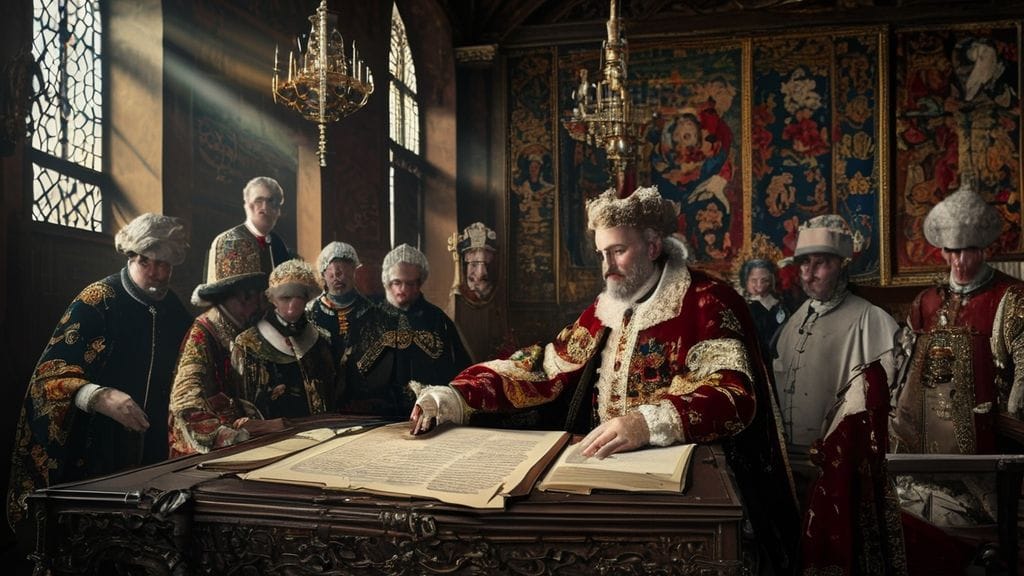
The act itself—the moment when the edict of nantes signed into being—was both ceremonial and bureaucratic. But within its constrained ritual, something quietly extraordinary unfolded. On April 13, 1598, Henry IV, now a Catholic king with a Protestant past, put his signature to a document that officially recognized that not all his subjects prayed as he did—and that this difference, while regrettable in the eyes of many contemporaries, would be endured under law.
We can imagine the scene: in a chamber of the Château des Ducs de Bretagne in Nantes, lit by narrow windows and candles sputtering in iron sconces, royal secretaries laid out the final clean copy of the text. Courtiers and councillors murmured in corners, some anxious, some relieved. Representatives of the Protestant communities had already pressed their case, negotiating not only general principles but specific towns, rights, and safeguards. Catholic clerics had likewise argued for boundaries, ensuring that the edict did not turn France into a confessional patchwork without hierarchy.
Henry, familiar with the sword more than the quill, leaned over the parchment, the scent of ink and wax mingling with the faint odor of damp stone. Signing an edict was no novelty for a king, but this document touched the very nerve of royal identity. Was he king only of Catholics, or king of all Frenchmen, whatever pew they occupied? By putting his name to the text, Henry made a choice that would define his reign and outlive his dynasty.
When the last flourish of his signature dried, the edict was not yet law everywhere. It still needed to be registered by the kingdom’s sovereign courts, the parlements, including the notoriously resistant Parlement of Paris. But symbolically, the deed was done. A king had bound himself publicly to protect a minority he could easily have continued to persecute. Whatever his inner calculations, he had turned personal pragmatism into state policy.
Word of the signing spread along the river and across country roads. Messengers carried copies toward Paris, Bordeaux, Toulouse, and beyond. In Protestant strongholds, church bells rang cautiously. In some Catholic towns, there was muttering in taverns and sulking in sacristies. The edict of nantes signed in Nantes would now have to be lived everywhere else, and that, as many suspected, would be the real test.
Tears, Prayers, and Suspicions: First Reactions Across the Kingdom
The first reactions to the edict were as varied as France itself. For some Huguenots, the news arrived like a hesitant sunrise after a long, cold night. In a village near Montauban, a Calvinist pastor reportedly read aloud the main clauses to his congregation, his voice breaking as he reached the promise that their children could inherit property without discrimination, that their marriages would be recognized, that no one could be forced to change religion by threats of violence. Old men who had survived the massacres of the 1570s wept quietly, unsure whether to believe that this time, the king meant it.
Yet joy was tempered by fear. Many remembered how previous edicts had been revoked or ignored. They knew that a royal promise on paper might not stop a mob with pikes on a dark night. Some asked: What if Henry dies? What if another king, less sympathetic, sits on the throne? The edict of nantes signed by Henry IV was, after all, the word of a particular monarch, not a timeless constitution. Trust in the Bourbon king mixed uneasily with deep mistrust of Catholic institutions that had long persecuted them.
Among Catholics, reactions ranged from relief to outrage. Moderates, exhausted by war, accepted the edict as a bitter but necessary compromise. They argued in sermons and pamphlets that peace itself was a Christian good and that God might prefer a united, penitent kingdom with a tolerated heretical minority to a divided realm drowning in blood. More militant Catholics, especially those close to the former Catholic League, saw the edict as a surrender. To them, it meant that error would not only be tolerated but funded and protected by the very king who should have eradicated it.
The Parlement of Paris, a bastion of legal conservatism and Catholic sentiment, resisted registering the edict. For months, debates raged in its chambers. Magistrates fretted over whether the edict contradicted earlier royal declarations of Catholic exclusivity. They worried that it set a dangerous precedent: if a king could grant rights to heretics, could he not in future undermine the Church in other ways? Only under strong pressure from Henry did the Parlement finally register the edict in January 1599, nearly a year after it had been signed in Nantes.
Internationally, reactions were similarly mixed. Protestant powers such as England and the Dutch Republic welcomed the edict as a sign that France would not fall into the hands of Spain and Rome. It meant that a significant Protestant presence would remain within a major European kingdom, potentially an ally or at least a counterweight to Catholic hegemony. The papacy, on the other hand, viewed the edict with deep unease. While relieved that Henry had converted, Rome was troubled by the explicit protection of heretics. Diplomatic correspondence reveals an awkward balance: the pope could praise the king for his return to the faith while quietly pressing French bishops to limit the edict’s implementation.
Living the Edict: Everyday Life Under a Royal Promise of Toleration
Once the edict of nantes signed and registered, its true meaning unfolded not in royal councils but in the daily lives of ordinary people. A law, after all, is only as real as the habits it creates and the conflicts it can mediate. In the early seventeenth century, hundreds of French towns and villages began the delicate work of learning how to live with neighbors who prayed differently but shared wells, markets, and, sometimes, bloodlines.
Consider a small town in the Languedoc where Protestants made up perhaps a third of the population. Before the edict, a Protestant funeral might be quickly carried out at dawn, under threat of interruption by a hostile crowd. With the edict, such ceremonies gained a fragile legitimacy. Huguenot psalms could be sung more openly, though still in designated spaces. Catholic processions on feast days, once occasions for triumphalist displays, now passed by Protestant houses whose shutters might be half-closed in wary compromise rather than slammed shut in fear.
Mixed families, in particular, found themselves navigating new possibilities. A Catholic father and Protestant mother might now register their children without clerical disputes over legitimacy, though questions of baptism and religious upbringing remained thorny. The edict did not solve all such dilemmas, but it gave families a legal framework within which to negotiate, appealing to courts when necessary rather than to fists or clandestine threats.
In cities with significant Protestant minorities, like Rouen or Bordeaux, the edict transformed professional life. Huguenot lawyers, once excluded from certain posts, began to appear in municipal councils. Protestant merchants, secure in their property rights, invested in ships and warehouses. Catholic artisans, meanwhile, sometimes resented what they saw as Huguenot economic success. Under the surface of tolerated worship, economic rivalries simmered, occasionally erupting into local clashes that tested the resilience of the royal law.
Church buildings themselves became symbols of negotiated space. In some towns, Catholics and Protestants disputed ownership of a single church, leading the edict’s commissioners to painstakingly assign it to one confession while authorizing the other to build or use a different site. In at least one case, a town clock had to be moved from a steeple to a neutral tower so that both communities could mark time without argument over which bells spoke for the city.
Royal commissioners, traveling the kingdom to enforce the edict, acted as both judges and mediators. Their reports reveal the micro-conflicts that the grand law had to manage: quarrels over burial grounds; fights about the right to ring bells; complaints that a Protestant sermon could be heard from a Catholic street. The edict had created new rights, but it also created new frontiers—audible, visible, and emotional—where those rights rubbed against ancient customs.
Yet, slowly, a kind of habit of coexistence emerged. Children grew up knowing that “the others” were not distant abstractions but classmates, competitors, sometimes even friends. The memory of the earlier wars, while still vivid for older generations, began to fade at the edges for those born after 1598. The edict’s greatest achievement may have been precisely this: it bought time, years and decades in which people could get used to one another’s existence.
Faith on the Margins: The Catholic League, Rome, and International Repercussions
Even as the edict of nantes signed a truce within French borders, it resonated uneasily in the wider Catholic world. Spain, Rome, and the Habsburg Netherlands had all invested heavily, financially and ideologically, in the hope of a fully Catholic France. For them, Henry’s concessions to heretics were a disappointment, if not a betrayal.
Spain, ruled by the devout and intransigent Philip II until his death in 1598, had backed the Catholic League for years with subsidies and troops. A Protestant-friendly or even just religiously mixed France was a strategic nightmare: it threatened Spain’s lines of communication to the Low Countries and offered potential support to the rebellious Dutch. The edict meant that the Huguenots, far from being crushed, would remain a permanent factor in French politics. Spanish diplomats now had to reckon with a France less likely to align fully with Catholic Habsburg interests.
In Rome, theologians and cardinals pored over reports of the edict. Some argued that, in practice, the Church had long tolerated some coexistence where it lacked the means to suppress heresy entirely. Others, more rigid, saw in the edict a dangerous accommodation that might inspire similar claims in other realms. If the “eldest daughter of the Church” could live with a legal Protestant minority, what might that suggest to Catholics in the German Empire or Poland-Lithuania, where confessional pluralism was already a contentious reality?
Protestant powers, by contrast, received the news with cautious optimism. England’s Queen Elizabeth I understood the edict as both a religious and a geopolitical gain. A France at peace, not beholden to Spain, could help balance Catholic power in Europe. The Dutch Republic, entangled in its own struggle for independence, took comfort in the idea that French Huguenots would continue to exist as a community whose fortunes were tied, in complex ways, to the broader Reformed world.
Within France, remnants of the Catholic League smoldered. Hardline clergy preached against the edict from some pulpits, warning that tolerating heresy invited divine punishment. In a few regions, local officials tried to drag their feet in implementing its provisions. Henry’s government responded with a mix of firmness and flexibility, replacing recalcitrant magistrates in some cases and negotiating concessions in others. The edict, as a living instrument, required constant political tending.
Cities of Refuge: Strongholds, Safe Havens, and the Geography of Protection
One of the most striking aspects of the edict was its creation of a network of Protestant “places of surety”—fortified towns under Huguenot control, subsidized by the crown. These were more than military outposts; they were psychological anchors, symbols that the king’s word had tangible walls and cannons behind it.
La Rochelle, perched on the Atlantic coast, was perhaps the most famous of these strongholds. Within its walls, Protestant worship dominated; its harbor opened onto Protestant allies abroad. For Huguenots facing harassment in the countryside, the thought that La Rochelle existed—that there was a citadel where their faith was the norm and their safety backed by royal funds—offered comfort. Other towns, such as Montauban, Saumur, and Nîmes, played similar roles on a smaller scale, each weaving itself into Huguenot imagination as a potential last refuge.
The geography of these strongholds altered the mental map of France. The kingdom was no longer simply a Catholic expanse with scattered heretical enclaves. Instead, it included recognized zones where a different religious order prevailed, under the umbrella of a single crown. For some Catholics, this seemed like the fragmentation of the realm. For many Protestants, it was the only realistic way to believe in the edict of nantes signed by a king who was, after all, officially Catholic.
Living in a place of surety came with responsibilities. Local leaders had to maintain defenses, ensure garrisons were disciplined, and negotiate with royal officials over funding and jurisdiction. The edict stipulated that these towns were not to become independent republics. Their loyalty to the king was expected, their autonomy closely watched. Yet their very existence gave Huguenot politics a dual center: loyalty to the crown on one side, commitment to their fortified communities on the other.
This arrangement could never be entirely stable. It left open the question of what would happen when the terms expired or when the crown felt strong enough to demand their dismantling. The seeds of future conflict were embedded in the clauses of protection that, for the moment, kept civil war at bay.
Families, Consciences, and Silent Conversions: The Edict’s Human Face
Beyond councils and citadels, the edict reshaped something more intimate: the terrain of conscience within families and individuals. In a society where religion permeated birth, marriage, and death, the possibility of open yet unequal toleration forced countless personal choices and compromises.
Mixed families lived at the sharp edge of this new reality. A Protestant woman married to a Catholic man might, under pressure from in-laws or parish priests, attend Mass while secretly holding Reformed beliefs. Their children might be raised in one confession publicly and another in whispered lessons at home. The edict did not legislate the soul; it only regulated external worship and civil status. Within the walls of a home, hidden acts of piety or dissent unfolded in a silent theater beyond the reach of royal commissioners.
Some conversions—both to Catholicism and to Protestantism—were sincere, born of reflection, marriage ties, or personal encounters with preachers. Others were clearly strategic. To access certain offices, or to avoid local harassment, a Protestant might “return” to the Catholic Church, attending Mass just enough to be seen, while privately remaining unconvinced. Conversely, a Catholic artisan in a strongly Protestant town might adopt Reformed practices to secure business and social standing. The edict created a public framework; individuals learned to live within and around it, sometimes wearing masks.
Children growing up after 1598 inhabited a world where difference was at once normalized and stigmatized. A child in a Protestant family knew that the king allowed their worship but also that the majority considered them in error. Catholics, for their part, were taught that Huguenots were misled but not to be slaughtered. The sharp binary between neighbor and enemy, so brutally enforced in the massacres of the previous generation, softened into a complicated blend of suspicion, tolerance, curiosity, and, at times, affection.
Clergy played a crucial role in shaping how communities interpreted the edict. Some Catholic priests, weary of bloodshed, urged their flocks to see Huguenots as misguided siblings rather than demonic foes. Others remained implacable, denouncing the edict from the pulpit even as they grudgingly complied with its terms. Protestant pastors walked their own tightrope, preaching fidelity to Reformed doctrine while counseling restraint and obedience to the king.
In all this, the edict of nantes signed by Henry IV served as both shield and boundary. It protected consciences from the most brutal forms of coercion, yet it also reminded everyone, especially Protestants, of their minority status. They were tolerated, not embraced; protected, but not equal in prestige to the Catholic majority.
Wealth, Trade, and Knowledge: How the Edict Shaped the French Economy
The political and religious dimensions of the edict are obvious, but its economic impact was equally profound. War is bad for business; civil war, fought across multiple regions over decades, is catastrophic. By 1598, France’s roads, bridges, and granaries had suffered from neglect and destruction. Trade had withered in places where armies passed through too often. The edict, by promising internal peace, opened the door to a remarkable period of recovery and growth.
Protestant communities, in particular, brought substantial commercial and artisanal dynamism. Huguenots were overrepresented in certain trades—textiles, printing, banking, and long-distance commerce. When the edict of nantes signed into law an assurance of property rights and legal recourse, it encouraged these merchants and artisans to invest at home rather than seek security abroad. Workshops expanded, new trading ventures launched, and partnerships formed that crossed confessional lines as profit motives gently nudged prejudice aside.
Cities like Lyon, Bordeaux, and La Rochelle benefitted from this renewed confidence. Protestant and Catholic merchants negotiated grain shipments, wine exports, and textile imports that bound France more tightly into Atlantic and Mediterranean networks. The kingdom’s tax revenues, crucial for Henry IV’s ambitious plans to improve infrastructure and stabilize royal finances, recovered accordingly. His famous minister, the Duke of Sully, worked hand in hand with the king to rebuild roads, encourage agriculture, and reduce debt—a program that would have been impossible without the relative calm the edict provided.
The world of ideas also flourished. Protestant academies, legalized and protected by the edict, became centers of learning. In towns like Saumur and Montauban, students studied theology, languages, and philosophy under Reformed professors, sometimes corresponding with scholars in Geneva, Basel, and Leiden. Catholic universities, meanwhile, continued to produce jurists, physicians, and theologians. The coexistence of these institutions fostered an environment of intellectual competition and cross-fertilization, even if each tradition guarded its orthodoxy.
Printing presses in both communities benefitted from the greater security. Religious polemics did not vanish—if anything, the flow of pamphlets remained steady—but they now appeared alongside works of history, science, and literature. A France no longer paralyzed by constant warfare could afford to debate, write, and experiment.
From Richelieu to Louis XIV: A Century of Uneasy Coexistence
The edict of nantes signed by Henry IV did not freeze French religious life in amber. Over the following decades, as political circumstances shifted, so too did the interpretation and enforcement of its clauses. Two towering figures—Cardinal Richelieu in the early seventeenth century and Louis XIV later in the century—would reshape the edict’s legacy in very different ways.
After Henry IV’s assassination in 1610, France entered a period of regency and factional strife. His young son, Louis XIII, eventually came under the guidance of Armand Jean du Plessis, better known as Cardinal Richelieu. A brilliant, cold-eyed statesman, Richelieu was less interested in theological debates than in consolidating royal power. For him, the edict was acceptable only so long as it did not threaten the unity of the state.
Richelieu’s main grievance was with the Protestant places of surety, which he saw as “a state within the state.” During the 1620s, he led campaigns against rebellious Huguenot strongholds, culminating in the famous siege of La Rochelle (1627–1628). This time, the city could not hold out indefinitely. Starved and battered, it surrendered. In the subsequent peace, Huguenots lost their fortified places and political assemblies, though the core religious freedoms of the edict were, on paper, maintained. The message was clear: Protestants could keep their faith but not their semi-autonomous enclaves.
For several decades thereafter, France experienced a tense but functional coexistence. Huguenots worshipped, studied, and traded under the edict’s protections, while the monarchy tolerated them as long as they posed no political challenge. In some regions, local authorities respected the spirit of the edict; in others, they limited it through restrictive interpretations. The balance held, precariously, because France faced other pressing concerns: wars against the Habsburgs, internal revolts like the Fronde, and the challenges of state-building.
All of this changed under Louis XIV, the Sun King, who came to embody an ideal of absolute, Catholic monarchy. For Louis, unity was not just a political necessity but a theological virtue. He gradually came to see the very existence of a Protestant minority as a blemish on his otherwise glittering kingdom. Over the course of his long reign, he and his ministers chipped away at the edict’s guarantees, using a mixture of legal attrition, financial incentives, and brute force.
The Slow Strangling of Toleration and the Revocation of 1685
The edict of nantes signed in 1598 had offered Huguenots a place in France; by the 1680s, that place was shrinking to a narrow ledge. Louis XIV pursued a strategy that historians have described as “administrative persecution.” Instead of immediately revoking the edict, he encouraged bishops and intendants to interpret its clauses in the most restrictive way possible.
Protestant schools were closed or forced to accept Catholic oversight. Huguenot churches in towns where their numbers had declined were demolished on the grounds that they no longer served a “significant” community. Conversions to Catholicism were rewarded with pensions and tax relief; Protestant worship was harassed by intrusive inspections. The infamous “dragonnades” began: royal soldiers quartered in Protestant homes were encouraged to make life so miserable that families would “voluntarily” convert.
Under such pressure, many Huguenots wavered. Some outwardly embraced Catholicism while secretly meeting in clandestine assemblies. Others clung defiantly to their faith, seeing in their suffering a continuation of the martyrdom narratives that had defined earlier generations. The edict, once a shield, became a tattered document invoked in vain by pastors dragged before hostile magistrates.
In 1685, Louis XIV took the final step. With the Edict of Fontainebleau, he formally revoked the Edict of Nantes. Protestant worship was banned; churches were destroyed; pastors were ordered to leave the kingdom within two weeks, while laypeople were forbidden to emigrate. In practice, thousands of Huguenots fled anyway, slipping across borders into the Dutch Republic, England, Brandenburg-Prussia, and even the English colonies in North America and South Africa.
France lost an estimated 150,000 to 200,000 of its most industrious and educated subjects. Skilled craftsmen, merchants, and scholars carried their knowledge abroad, enriching rival economies and deepening the sense that France’s golden monarchy rested on a grave injustice. One contemporary Protestant lamented, “Our king has broken the promise of Henry the Great, and with it, the hearts of his faithful subjects.” The dream of legal coexistence embedded in the edict of nantes signed almost a century earlier lay in ruins.
Yet even in exile, the memory of the edict endured. Huguenot refugees in London, Amsterdam, and Berlin evoked it in sermons and pamphlets as a symbol of lost rights and a broken covenant between ruler and ruled. In their narrative, Henry IV became the good king of tolerance, Louis XIV the tyrant of uniformity. That contrast would influence how later generations, especially in the Enlightenment, judged the two monarchs and the very concept of religious freedom.
Memory of a Broken Promise: The Edict in French and European Imagination
Long after its clauses ceased to be enforced, the Edict of Nantes lived on as a story that Europeans told about themselves. In the age of Voltaire and the Encyclopédie, when philosophers probed the foundations of tolerance and the rights of conscience, the edict became a reference point—a flawed but pioneering attempt to manage pluralism.
Voltaire, in his searing account of religious intolerance, often cited the wars of religion and their atrocities as evidence of the dangers of fanaticism. For him, the edict symbolized a moment when reason and moderation briefly triumphed over zeal, even if later undone. He famously wrote of the Huguenot sufferer Jean Calas in the eighteenth century to denounce judicial persecution, implicitly contrasting such injustices with the more generous spirit of Henry IV’s policy.
In the nineteenth century, as France grappled with its own identity amid revolutions and restorations, the Edict of Nantes was rediscovered in new ways. Liberal historians celebrated it as a precursor to modern secularism; Catholic ultraconservatives condemned it as the original sin that had opened the door to religious relativism and the erosion of Church authority. Literature and painting romanticized Henry IV as the jovial, peace-loving monarch who cared more for the peasants’ “chicken in the pot” than for confessional rigidity.
Modern scholars, working with parish records, notarial archives, and diplomatic correspondence, have painted a more nuanced picture. They emphasize that the edict was both groundbreaking and limited: it protected a specific minority but did not articulate a universal principle of religious liberty. It was grounded in the logic of royal authority and reason of state rather than in a theory of human rights. Yet precisely because of this, it offers a window into how early modern states learned to live with diversity when forced to by circumstance.
In contemporary France, where laïcité—strict secularism—structures public life, the Edict of Nantes is sometimes invoked as a distant ancestor, an early experiment in managing faith in a shared civic space. Commemorations in Nantes and elsewhere mark its anniversaries; museums display facsimiles of the original text. The very fact that the edict of nantes signed more than four centuries ago still belongs to public debate shows how deeply the question it tried to answer—how can people who disagree profoundly about ultimate truths share a political community?—remains with us.
Conclusion
When Henry IV took up his pen in Nantes in April 1598, he could not know how long his edict would endure or how future centuries would judge it. He knew only that his kingdom was tired of war, that his Protestant former comrades would not dissolve into thin air, and that his Catholic majority would not accept their faith being treated as merely one option among many. Between these constraints, he carved out a law of coexistence, neither heroic nor trivial, that allowed France to breathe.
The edict of nantes signed that day did not reconcile doctrines or erase prejudice. It did something more modest and, in its own way, more radical: it acknowledged that political unity need not rest on religious uniformity, at least not absolutely and not immediately. It created protected spaces where a minority could worship, work, and raise families without constant fear of slaughter. It reshaped the geography of the kingdom, the habits of its courts, and the imaginations of its children.
Its eventual revocation in 1685 stands as a grim reminder that progress is not linear. Rights gained can be lost; promises made can be broken. Yet the revocation could not erase the memory of nearly a century of relative coexistence, nor the example it provided to thinkers and reformers elsewhere. In that sense, the Edict of Nantes continues to live onward—not as an ideal model, but as an early, imperfect attempt to answer a question that still haunts divided societies today.
Looking back, we see in the edict not just a royal signature on parchment, but the faint outline of a future in which pluralism is managed not by the sword but by law. Its story, born from France’s darkest religious conflicts, invites us to consider how much courage and compromise are required simply to let others be.
FAQs
- What was the Edict of Nantes?
The Edict of Nantes was a royal decree issued by King Henry IV of France in April 1598 in the city of Nantes. It ended the French Wars of Religion by granting substantial, though limited, rights of worship, civil status, and protection to the Protestant minority known as Huguenots, while affirming Catholicism as the official religion of the kingdom. - Why was the Edict of Nantes significant?
It was one of the first major attempts in Europe to legally organize religious coexistence within a single state. By allowing a minority faith to exist under royal protection, the edict challenged the prevailing assumption that political unity required religious uniformity and set a precedent for later ideas of toleration. - Why was it signed in Nantes and not in Paris?
Nantes was a strategic port city in western France where Henry IV was then consolidating his authority. It offered a relatively neutral and secure environment compared to Paris, which remained deeply polarized after years of conflict and was dominated by memories of the Catholic League’s power. - What rights did Huguenots receive under the edict?
Huguenots were allowed to practice their religion in specific towns and regions, hold public office, attend universities, and access the courts on more equal terms. They were also granted a network of fortified “places of surety,” garrisoned at royal expense, as a guarantee of their safety for a limited period. - Did the Edict of Nantes create full religious freedom?
No. It affirmed Catholicism as the state religion and treated Protestantism as a tolerated exception rather than an equal faith. Worship was geographically restricted, and many public civic and ceremonial spaces remained exclusively Catholic. The edict was a practical compromise rather than a declaration of modern religious liberty. - How long did the Edict of Nantes remain in force?
The edict’s core provisions were applied, with varying rigor, from 1598 until 1685. Under Cardinal Richelieu, Huguenots lost their fortified strongholds but kept basic religious rights. Under Louis XIV, those rights were gradually eroded until the edict was formally revoked by the Edict of Fontainebleau in 1685. - What happened after its revocation?
After the revocation, Protestant worship was banned, churches were destroyed, and pastors were expelled from France. Many Huguenot laypeople fled illegally to Protestant countries, taking their skills and capital with them. Those who remained often practiced their faith in secret, forming the so‑called “Church of the Desert.” - How did the Edict of Nantes influence later ideas of tolerance?
Philosophers and political thinkers of the Enlightenment looked back on the edict as an early, if incomplete, example of religious toleration. Its history—both its achievements and its revocation—fed debates about the rights of conscience, the limits of state power over belief, and the dangers of confessional absolutism.
External Resource
Internal Link
Other Resources
- Encyclopaedia Britannica – general search for the exact subject
- Google Scholar – academic search for the exact subject
- Internet Archive – digital library search for the exact subject

