Table of Contents
- A Winter in Thessalonica: The Day an Empire Chose a Faith
- From Persecuted Sect to Imperial Partner: Christianity Before 380
- Three Emperors, One Empire in Crisis
- The City by the Sea: Thessalonica on the Eve of the Edict
- February 27, 380: The Text and Spirit of the Edict of Thessalonica
- Defining “The True Faith”: Creed, Bishops, and Imperial Authority
- Arians, Pagans, and Jews: The Others in a Newly Catholic Empire
- From Policy to Practice: Laws, Courts, and the Making of Orthodox Rome
- The Bishop, the Emperor, and the Crowd: Human Stories Behind the Decree
- City Streets and Country Shrines: How Everyday Life Changed
- Theodosius and Ambrose: Conscience, Power, and Public Penance
- The Long War Against Paganism: Temples, Philosophers, and Memory
- Doctrinal Battles After Victory: Councils, Heresies, and New Divisions
- East and West: How the Edict Shaped Two Future Christian Worlds
- Law, Violence, and Tolerance: Moral Questions Around the Edict
- Echoes Through the Middle Ages: State Religion as a European Pattern
- Modern Reflections: Religious Freedom in the Shadow of 380
- Conclusion
- FAQs
- External Resource
- Internal Link
Article Summary: On February 27, 380, in the bustling port city of Thessalonica, a brief legal text quietly redirected the spiritual course of Europe and the Mediterranean: the edict of thessalonica 380. Issued by the emperors Theodosius I, Gratian, and Valentinian II, it declared Nicene Christianity the only legitimate faith for Roman citizens and bound religious identity to civic loyalty. This article traces the long road from persecuted Christian minority to triumphant state religion, exploring the political calculations, theological disputes, and human dramas that converged on that February day. It follows the edict through courtrooms, city streets, and remote villages, showing how law slowly reshaped daily life, from closed temples to contested churches. The narrative also uncovers the resistance of Arians, pagans, and Jews, who suddenly found themselves reclassified as outsiders in their own empire. Across the centuries, the consequences of the edict of thessalonica 380 helped to define medieval Christendom, inspire later confessional states, and provoke modern debates about religious liberty. By revisiting its context and legacy, we can understand both the attraction and the danger of trying to legislate spiritual unity. In the end, the story of the edict is as much about human fear and hope as it is about doctrine and power.
A Winter in Thessalonica: The Day an Empire Chose a Faith
The winter air in Thessalonica carried the salty breath of the Aegean and the murmurs of an empire on edge. The year was 380, and in the imperial residence of this prosperous Macedonian port, clerks hunched over wax tablets and parchment, preparing a text that would outlive their names, their city, and the empire itself. Outside, merchants argued in a cacophony of Greek and Latin, sailors shouted across quays lined with ships, and smoke rose from shrines and churches that still stood almost side by side. Yet behind those ordinary sounds, something was shifting.
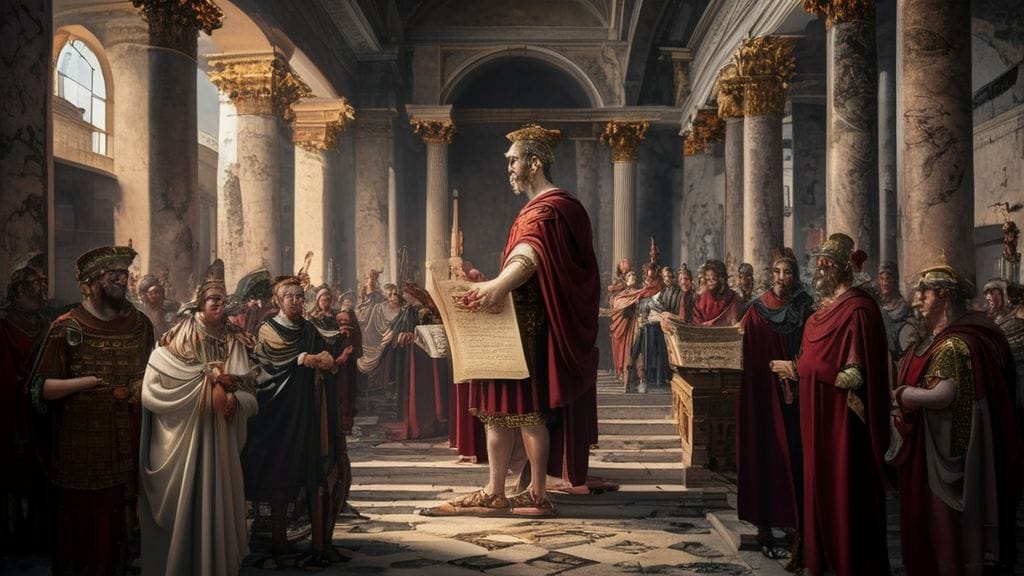
On February 27, three emperors put their names to a decision that seemed, at first glance, only another imperial ordinance. Yet this decision—the edict of thessalonica 380—did what no earlier decree had dared to do so bluntly: it declared that the Roman Empire, once the vast home of gods, cults, and philosophical sects, would now recognize a single, specific form of Christianity as the faith of its people. Not just Christianity in general, but the creed of those who followed the teaching “transmitted to the Romans by the divine Apostle Peter” and professed by the bishops of Rome and Alexandria.
The document is short, barely a paragraph in the Theodosian Code, written in legal Latin that lacks the drama of battle speeches or prophetic visions. There were no trumpets receiving the text, no mass ceremony announcing it from balconies. Yet its implications were enormous. With a few sentences, belief became a matter of law, orthodoxy a matter of imperial preference, and dissent—whether Arian, pagan, or any other shade of difference—a potential crime against the state.
This was not the first time a Roman emperor had intervened in religious affairs. Constantine, half a century earlier, had favored Christianity and summoned bishops to councils. His successors had wavered between different theological camps. But the edict of thessalonica 380 marked a turning point: it did not merely protect Christians; it made one Christian creed the measure of loyalty. The line between citizen and heretic was now written into law.
And yet, behind this legal clarity, life remained messy and human. Bishops maneuvered for influence. Soldiers wondered whether their gods still watched. Families divided over doctrine. In crowded tenements, the fine points of the Nicene Creed meant little to the woman selling bread or the sailor nursing a bad back. For them, what would matter were the steady ripple effects of this cold February decision: which festivals survived, which buildings were closed, which words it became dangerous to say aloud.
To understand why the edict was issued and what it did to the Roman world, we have to step back—to persecutions and visions, to court intrigues and whispered theological quarrels—and then walk forward again, through the centuries that echoed with its logic. The edict of thessalonica 380 was both an answer to chaos and the beginning of a new kind of tension. It is astonishing, isn’t it, that a few lines drafted in a provincial palace could still shape our conversations about faith and freedom more than 1,600 years later?
From Persecuted Sect to Imperial Partner: Christianity Before 380
Two and a half centuries before the edict, Christians were more likely to be found in prisons than in palaces. To many Romans of the second and third centuries, Christianity seemed a strange, obstinate movement—denying the old gods, refusing public sacrifices, meeting at odd hours to share secret meals. At best, they were odd; at worst, they were seen as a danger to social order. Sporadic persecutions erupted when emperors demanded religious conformity as a test of loyalty.
Under emperors like Decius and Diocletian, Christians were pushed to the margins with brutal efficiency. Edicts required them to sacrifice to the gods or face confiscation of property, exile, or death. The empire imagined unity as religious sameness. The idea that the same state would one day pass an edict like that of Thessalonica, not to suppress Christianity but to enforce it, would have sounded like fantasy.
The reversal began with Constantine. His victory at the Milvian Bridge in 312, famously associated with a vision of a cross in the sky and the words “In this sign you will conquer,” changed the balance of power between empire and church. The Edict of Milan in 313 legalized Christianity and promised religious tolerance throughout the empire. Church buildings rose on prominent hills; bishops stepped into imperial courtrooms as mediators and advisors.
Yet this newfound legitimacy brought new tensions. If Christians were no longer hunted, they were still deeply divided among themselves. By the mid-fourth century, the struggle over how to understand the relationship between God the Father and Christ the Son had spiraled into a full-blown political and theological war. The Council of Nicaea in 325 declared the Son to be “of one substance” (homoousios) with the Father, condemning the teachings of Arius, who saw the Son as a created being—less than the Father, though exalted above all creation.
Imperial sponsorship did not end the quarrel; it sharpened it. Arian and Nicene factions lobbied emperors, organized councils, and exiled one another in turn, while ordinary believers navigated a shifting landscape of terminology and authority. At times, emperors openly supported Arian-leaning bishops. The church that Constantine had favored became, in the words of historian Ramsay MacMullen, “a field of battle with the weapons of theology.”
By the time Theodosius I emerged as a key figure in the East, Christianity had moved from persecuted fringe to institutional muscle, but it was a muscle twitching in conflicting directions. Paganism was still strong, especially in the aristocratic circles of Rome and the countryside. Christianity itself was splintered. Could an empire already harried by external enemies and internal usurpers afford such spiritual fragmentation? The answer, for Theodosius, would eventually be no. The edict of thessalonica 380 must be seen as the culmination of this long, uneven climb from marginalization to dominance, and as a desperate attempt to close the fractures that Christian success had opened within the faith itself.
Three Emperors, One Empire in Crisis
The Roman Empire in 380 was a wounded giant. The days when a single Augustus ruled serenely from Rome were long gone. Instead, the empire was divided among co-emperors who cooperated uneasily across vast distances. In 380, three names carried imperial authority: Gratian in the West, Valentinian II as a young colleague, and Theodosius I in the East.
Gratian, ruling from the western provinces, had already taken bold steps against traditional Roman religion, refusing the title of Pontifex Maximus—chief priest of the old cults—and removing the Altar of Victory from the Senate house in Rome. He surrounded himself with Christian advisors and distanced imperial identity from pagan ritual. Yet his position was fragile, threatened by military challenges and the enduring influence of pagan aristocrats.
Valentinian II, still a boy, was a pawn in the power game, his court dominated by his mother Justina. She would later support Arian clergy, drawing sharp rebukes from Nicene bishops such as Ambrose of Milan. The West, then, was not simply “Christian”; it was a battleground between competing Christianities, with old cults still murmuring beneath the surface.
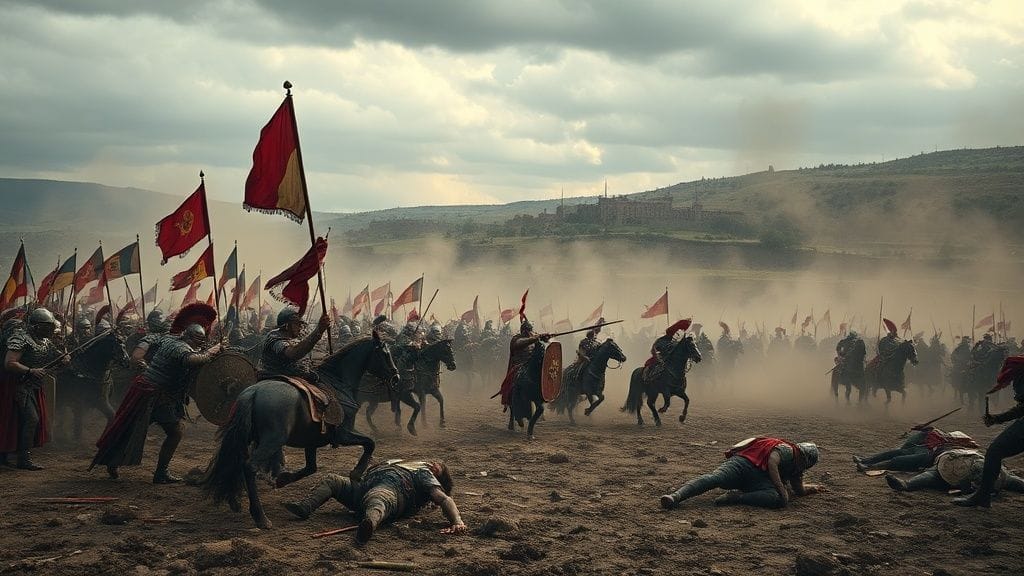
In the East, Theodosius I had risen in the aftermath of crisis. The catastrophic defeat of the Roman army by the Goths at Adrianople in 378 had shaken imperial confidence. Emperor Valens died on the battlefield; large swathes of imperial territory fell under the de facto control of Gothic groups. Theodosius, of Spanish origin, was elevated to the throne in this context of emergency. He needed loyalty—from the army, from the cities, and from heaven.
Chaos was not limited to borders and battlefields; it seeped into churches and town squares. In Constantinople, the capital of the East, Arian bishops had long held sway, and Nicene Christianity was a weak, harassed minority. Theodosius arrived with a personal commitment to Nicene faith, shaped by his family and advisors. But conviction alone did not explain his actions. In a world where divine favor was understood as a shield against defeat and disaster, a divided church looked like a spiritual liability.
Three emperors thus faced a map marked with fractures: military vulnerabilities, rival generals, stubborn pagan senators, and bitterly feuding bishops. A unified religious policy—tied to a particular, carefully defined creed—offered a way to present a single imperial identity across regions. The edict of thessalonica 380 was not issued from abstract theological curiosity; it emerged from this tangle of fear, belief, and calculation. Its sharp language drew strength from the weakness of the world it sought to reorder.
The City by the Sea: Thessalonica on the Eve of the Edict
Why Thessalonica? The city, today known as Thessaloniki in northern Greece, was already a vital node in the imperial network long before Theodosius chose it as a temporary capital. Perched along the Via Egnatia, the great Roman road linking the Adriatic to the Aegean, Thessalonica married land and sea routes, serving as a funnel for troops, grain, and information between East and West.
By the late fourth century, its streets reflected the religious complexity of the empire. Inscriptions and archaeological remains show a vibrant mix: altars to traditional gods, traces of imperial cult, synagogues of established Jewish communities, and churches serving growing Christian congregations. Civic life revolved around the forum, baths, theaters, and circuses—spaces where religious and social identities rubbed shoulders daily.
When Theodosius made Thessalonica his residence in 380, it was partly for strategic reasons. The Balkans were restless; Gothic federates and local populations had to be managed, and the city’s fortified harbor and walls made it a secure headquarters. But proximity also mattered. From Thessalonica, the emperor could reach both the Latin West and the Greek East, symbolizing his role as a bridge between parallel halves of the empire.
In the neighborhoods near the palace, bishops’ houses stood within walking distance of imperial offices. Messengers moved between them carrying letters, drafts of decrees, and reports of unrest. Scribes, many of them Christians themselves by this period, etched the emperor’s will into legal form. While we lack a detailed eyewitness account of the day itself, we can imagine the atmosphere: the quiet concentration in the notaries’ rooms, the murmur of debates about phrasing, the ever-present awareness that this was not just an internal church decision but a statement to the entire Roman world.
Thessalonica would later be stained by another imperial act of violence—the infamous massacre of its citizens by Theodosius’ troops in 390 after a riot, for which Bishop Ambrose of Milan demanded public penance. That tragic episode, often cited in medieval sources, hangs like a shadow over any mention of the city and this emperor. It reminds us that decrees and piety coexisted with brutality. The same power that signed the edict of thessalonica 380 could also unleash soldiers on unarmed crowds.
Yet on that February day in 380, Thessalonica was above all a stage. In its mosaicked halls and bustling streets, an unprecedented fusion of spiritual and legal authority took shape. Rome had long claimed the right to tell its subjects what to do. Now it was claiming the right to tell them, in fine detail, what to believe about the nature of God.
February 27, 380: The Text and Spirit of the Edict of Thessalonica
The edict itself survives in the Theodosian Code (16.1.2), a fifth-century compilation of laws that preserved this earlier decision. Its language is strikingly direct. Addressed to the population of Constantinople but quickly understood as empire-wide in significance, it begins with a sweeping claim:
“It is Our desire that all the various nations which are subject to Our Clemency and Moderation should continue to profess that religion which was delivered to the Romans by the divine Apostle Peter…”
From the very first line, the emperors—Theodosius, Gratian, and Valentinian II—make their intention unmistakable. Religion is no longer a private choice or a local tradition; it is a matter of imperial “desire” directed at “all the various nations” under Roman rule. The edict ties religious profession to submission to imperial clemency, fusing spiritual and political obedience.
The text then defines the content of this required religion: belief in “the single deity of the Father, the Son, and the Holy Spirit under the concept of equal majesty and of the Holy Trinity.” This is pure Nicene orthodoxy, sharpened into law. It recognizes as true Christians only those who align with the faith “which the Apostle Peter transmitted to the Romans” and which is professed by the bishops of Rome and Alexandria—then Damasus and Peter, respectively.
Those who agree are to be called “Catholic Christians.” Those who refuse are branded as “demented and insane” (dementes vesanosque), language that jars modern readers for its stark contempt. They are threatened with punishment not only from God but from the emperor himself. While the edict does not specify the precise penalties, it clearly anticipates both spiritual and temporal consequences.
Several things stand out in this short but potent legal act. First, its scope: it assumes that religious uniformity is both desirable and enforceable across a multicultural empire. Second, its precision: it does not simply endorse Christianity; it endorses one interpretation of Christian doctrine. Third, its tone: it delegitimizes opponents by attacking their sanity, not merely their arguments.
This is where the edict of thessalonica 380 differs fundamentally from the earlier Edict of Milan of 313. Milan promised freedom of worship; Thessalonica demands a specific kind of worship. Milan was about toleration; Thessalonica about orthodoxy. The latter does not immediately outlaw all other forms of belief, but it places them in a legally inferior, morally suspect category.
Behind the legal Latin, we can hear the voice of an anxious regime. To an empire beset by invasions and internal power struggles, theology could no longer be left to the whims of bishops and local synods. The emperor, as guardian of cosmic order, had to declare where divine truth lay. Whether Theodosius personally reworked the phrasing or simply approved a draft from his advisors, his signature bound the fortunes of the empire to the fate of one confessional formula.
But this was only the beginning. A law is not magic. It must be interpreted, enforced, adapted. The edict of thessalonica 380 would live many lives—in courtroom exchanges, in sermons thundered from pulpits, in whispered fears of persecution. Its blunt distinctions would be sharpened and reinterpreted by generations who turned its brief text into a long tradition of state-backed orthodoxy.
Defining “The True Faith”: Creed, Bishops, and Imperial Authority
At the heart of the edict lies an audacious claim: the emperors not only endorse a particular creed but identify it with the faith of Peter, the apostle, and therefore with Christianity’s true origin. In one stroke, they entwine imperial power, apostolic tradition, and specific episcopal authorities in Rome and Alexandria.
This was not a neutral choice of cities. Rome, though no longer the political capital, remained the symbolic heart of empire and home to a prestigious Christian community that traced its roots to Peter and Paul. Alexandria, on the other hand, was a powerhouse of theological debate and monastic fervor, a city where Christian intellectual culture and urban politics overlapped dangerously. The bishops of these two sees—Damasus in Rome and Peter in Alexandria—were both staunchly Nicene and strong supporters of Theodosius’ religious policies.
By naming them explicitly, the edict effectively sidelines other centers of Christian authority, especially those associated with Arian or semi-Arian positions. It was a statement not only of doctrine but of ecclesiastical geopolitics. The empire was choosing its bishops as carefully as its gods.
This partnership between emperor and bishop would become one of the defining features of late antiquity. Church councils, which had once been gatherings of ecclesiastical leaders, were now convened under imperial authority, their decrees backed—when convenient—by the threat of the imperial sword. The Council of Constantinople in 381, often seen as the practical implementation of the edict’s theology, reaffirmed Nicene orthodoxy and condemned Arianism anew, this time with the momentum of imperial law behind it.
And yet, this alliance was never without tension. Bishops might welcome imperial support when it served their doctrinal position, but they could also resist imperial interference when it threatened their autonomy. The story of Theodosius and Ambrose of Milan, which would unfold dramatically a decade after the edict, shows how a bishop could confront even a “Catholic” emperor on moral grounds.
Still, on paper, the edict of thessalonica 380 treated orthodoxy as a settled matter. God, Peter, bishops, and emperor all supposedly spoke with one voice. In reality, the ink had barely dried before debates continued in churches, monasteries, and homes. Even the precise meaning of Nicene terminology—how to understand “substance” and “person” in the Trinity—remained contested in theological schools.
The edict did not end debate; it drew a legal line inside it. On one side of the line stood those whose arguments were considered within the bounds of permitted controversy. On the other, those labeled heretics, subject to crackdowns that could include exile, loss of property, or exclusion from public office. In doing so, it inaugurated a new era in which theological nuance could carry juridical consequences.
Arians, Pagans, and Jews: The Others in a Newly Catholic Empire
For those who did not fit the edict’s definition of “Catholic Christian,” the world changed, sometimes slowly, sometimes abruptly. The most immediate targets were Arian Christians, who had enjoyed imperial favor under earlier rulers and still held key sees, especially in the East. In Constantinople, for instance, the Arian bishop Demophilus had ministered to a large flock. Theodosius soon required him to accept the Nicene faith or vacate his church. Demophilus chose exile; Nicene clergy took his place, and the city’s primary churches shifted hands.
Such transfers were not mere administrative changes. They meant that congregations who had worshiped under one theology suddenly found their buildings claimed by another. Some accepted the change, others drifted away to improvised meeting places or quietly blended in. In the countryside, Arian communities persisted for years, especially among Gothic groups outside the formal Roman legal system. But within the legal boundaries of the empire, Arianism was marked as deviance.
Paganism—the complex web of traditional cults, temples, and civic rituals—faced a more gradual erosion. The edict of thessalonica 380 did not outright ban pagan worship, but it signaled that the imperial wind was now blowing decisively in another direction. Within a decade, further laws would restrict sacrifices, close some temples, and withdraw state funding from ancient rites. Public office increasingly became tied to Christian allegiance, turning pagan aristocrats into anachronistic figures in a Christianizing bureaucracy.
For Jews, the situation was more ambiguous. Judaism was an ancient, recognized religion in the empire, with legal protections that Christianity had only recently acquired. Theodosius’ legislation sometimes defended synagogues from mob violence, even punishing Christian monks who attacked them. At the same time, the religious prestige of Christianity and the drive for uniformity put Jewish communities under growing pressure, socially if not always legally.
The language of the edict—distinguishing “Catholic Christians” from all others, who were declared “demented and insane”—did not distinguish clearly between Arian, pagan, Jewish, or other dissenters. All, in different ways, were pushed to the margins of civic virtue. To be a full participant in the imperial project now strongly implied being a Nicene Christian.
Yet behind these broad categories were individual stories of fear, compromise, and defiance. A pagan philosopher in Athens might continue to teach Plato in relative peace, while a small-town priest watched his cult statue removed from its temple. A Jewish merchant in Antioch might find Christian processions louder and more confident each year. An Arian soldier might weigh the cost of outward conformity against the dictates of conscience.
The edict of thessalonica 380 did not erase diversity overnight, but it reframed it. Difference was no longer simply a fact of life; it was a problem to be managed, a threat to the unity the emperors now claimed to guard. The psychological shift was as important as the legal one. The empire, long proud of its pantheon, had begun to see religious variety less as wealth and more as fracture.
From Policy to Practice: Laws, Courts, and the Making of Orthodox Rome
A law, even one as emphatic as the Thessalonican edict, must travel from imperial scriptoria to provincial courtrooms, from parchment to human behavior. This journey was uneven and full of compromise. Provincial governors, judges, and military commanders interpreted imperial religious policy through the lenses of local realities, personal beliefs, and political calculations.
The Theodosian Code, compiled in 438, lets us glimpse how the principles of the edict expanded into a wider web of legislation. Over the next decades, laws were issued that:
– Forbade heretics from holding assemblies.
– Stripped them of certain civil rights, like the ability to leave inheritances to their congregations.
– Restricted or banned public pagan sacrifices.
– Protected Catholic churches while sometimes tolerating, sometimes restricting, synagogues.
Enforcement varied dramatically. In cities with strong Nicene bishops and supportive governors, heretical or pagan practices might be actively suppressed, temples closed, and clergy harassed. Elsewhere, officials turned a blind eye, either out of sympathy or to avoid provoking unrest. In some regions of the East, for example, Arian and “semi-Arian” groups lingered in influence well into the fifth century.
Court cases reveal the human friction behind these laws. In one region, a pagan landowner might complain about unauthorized destruction of his rural shrine; in another, a Christian bishop might petition the emperor to intervene against local magistrates who still sympathized with old cults. Each petition, each rescript, added a new layer to the lived reality of the edict’s ideals.
Even within the church, disputes arose about how far to push the legal advantages granted by the state. Some bishops urged clemency and persuasion, fearing that coerced conversions produced shallow faith. Others, emboldened by imperial backing, pressed for more aggressive measures against “error.” The historian Sozomen records episodes where temples were converted into churches or dismantled, often with the tacit or explicit support of Christian crowds.
The edict of thessalonica 380 thus evolved into more than a single moment in 380; it became a legal and cultural precedent. Whenever later emperors considered new religious policies—against Donatists in North Africa, against “pagans” in Italy, against Nestorians or Monophysites in the East—they did so in a world where Theodosius had already declared that defining and enforcing orthodoxy was part of an emperor’s job.
It is here that we see the birth of a distinctively late Roman and medieval assumption: that there should be “one empire, one faith,” and that divergence from that faith is not just a spiritual mistake but a civic danger. The courts, once arbiters of property and crime, became, at times, theaters of doctrinal enforcement.
The Bishop, the Emperor, and the Crowd: Human Stories Behind the Decree
Behind the abstract categories—“emperor,” “bishop,” “heretic”—stood men and women whose lives were transformed by the new religious order. The edict framed the stage; they acted upon it, sometimes in harmony, often in tension.
Take, for instance, Gregory of Nazianzus, the eloquent Nicene theologian who became bishop of Constantinople in the wake of Theodosius’ policies. When he arrived in the capital, Nicene Christians were still a persecuted minority. He preached in a small house-church called the Anastasia, facing hostility from Arian mobs and even physical attacks. The edict and Theodosius’ subsequent actions suddenly reversed his fortunes. A council confirmed him as bishop; Arian clergy were expelled from the city’s main churches. Gregory, once besieged, now stood as the favored preacher of a triumphant orthodoxy.
Yet Gregory was deeply uneasy about the politicization of faith. In his orations, he lamented the way theological disputes had become occasions for shouting matches in the marketplace, where “every corner of the city,” as he put it, “is filled with people who are arguing about incomprehensible questions.” The same legal backing that protected his creed also fueled an argumentative, sometimes violent religious culture he found distasteful.
Or consider a more humble figure: an Arian deacon attached to a church in Constantinople. For years, he has served his congregation faithfully, baptizing infants, visiting the sick, leading prayers under his bishop’s guidance. With the implementation of the edict of thessalonica 380 and Theodosius’ expulsion of Arian clergy, he must choose: accept Nicene doctrine and remain in ministry, or refuse and risk exile or marginalization. Perhaps he convinces himself that words are flexible, that “substance” and “person” can be interpreted in ways that preserve his earlier convictions. Perhaps he cannot.
In village churches, the story plays out differently. There, the arrival of a new bishop or the replacement of a local priest might be the only visible sign of change. The peasants who bring their grain to be blessed, their children to be baptized, may scarcely grasp the high-level doctrinal shifts. Yet over time, homilies emphasize the Triune God in Nicene terms; feast days honoring martyrs persecuted by pagan emperors become more prominent; stories of “heretics” begin to creep into sermons as cautionary tales.
Urban crowds were active participants in this transformation. In Alexandria, Antioch, and other cities, supporters of rival bishops sometimes clashed in the streets. Allegiances were not purely theological; they were also ethnic, social, and personal. An imperial edict could appoint a bishop; it could not instantly generate affection. The line between pious demonstration and political riot was thin.
Through these lives, we see how the edict of thessalonica 380 was not merely an elite text but a catalyst for countless small decisions: to conform or resist, to argue or remain silent, to stay put or flee. The empire’s legal voice echoed in the conscience of individuals, who had to reconcile imperial definitions of truth with their own memories, loyalties, and hopes.
City Streets and Country Shrines: How Everyday Life Changed
For the average inhabitant of the Roman world, the age of Theodosius brought neither instant revelation nor immediate persecution. Change arrived in textures, not in proclamations. It crept into the rhythm of days, the soundscape of cities, the calendar of festivals.
In the cities, the most obvious signs were architectural. Temples that had once dominated the skyline began to fall silent. Some were closed by order of local authorities; others simply declined as funding dried up and worshipers drifted to churches. In some cases, temples were converted into churches, their columns and courtyards repurposed for Christian liturgy. Imagine a citizen of Antioch walking past a sanctuary that for generations had hosted sacrifices to Apollo, now hearing psalms sung where once hymns to the sun god rang out.
Processions changed too. Where once statues of gods were paraded during civic festivals, now relics of martyrs and icons of Christ and the saints moved through the streets, accompanied by chants and incense. The boundaries between religious and civic ceremonies blurred. To attend public life increasingly meant to inhabit a Christian symbolic universe, even if one’s private beliefs lagged behind.
The calendar shifted as Christian feasts—Easter, Christmas, saints’ days—became public holidays, filling the space of older pagan celebrations. Market closures, legal suspensions, and local fairs adapted to these new rhythms. A government clerk, once accustomed to closing his office for a festival of Jupiter, now found his schedule coordinated instead with the Paschal cycle.
In the countryside, where imperial edicts often traveled more slowly, old practices endured longer. Rural shrines, sacred groves, and small altars remained in use, sometimes discreetly, sometimes openly. Christian bishops and monks saw these as stubborn holdouts of “pagan superstition.” Stories multiplied of zealous monks roaming the countryside, toppling idols and burning shrines, sometimes with local support, sometimes provoking resistance.
A famous later example—often cited in both ancient and modern accounts—is the destruction of the Serapeum in Alexandria, a grand temple to the god Serapis, in the 390s. Although slightly after the edict of thessalonica 380, it illustrates the trajectory the edict helped set: imperial policy aligned with Christian zeal could result in spectacular symbolic acts, erasing monuments of the old faith. The historian Socrates Scholasticus describes Christian crowds, backed by Theodosius’ authority, dismantling the temple’s statue and turning the building’s ruins into a visible trophy of Christian victory.
Food, oaths, and family rituals also changed. Christians refused to swear by the old gods in legal contexts, preferring to swear by God and Christ. Meals that had once been woven into sacrificial cults were reinterpreted or abandoned. Children grew up learning Bible stories instead of myths of Hercules and Venus.
Yet behind all this, continuities persisted. The sun still rose; taxes were still collected; diseases still ravaged. For many, the shift from a pagan-Christian mixed empire to a predominantly Christian one was experienced as a slow realignment of symbols rather than a rupture of daily survival. The edict formed the legal backbone of this process, but its flesh and blood were the small accommodations and adjustments of countless ordinary lives.
Theodosius and Ambrose: Conscience, Power, and Public Penance
One of the most famous stories connected to Theodosius, though occurring a decade after the edict, reveals the complex dance between imperial authority and ecclesiastical conscience that the new religious order made possible.
In 390, Thessalonica itself became the scene of a massacre. After a popular charioteer was imprisoned for alleged sexual misconduct, the city erupted in protest. Theodosius, reportedly furious at the killing of imperial officials during the unrest, ordered a savage reprisal. Soldiers surrounded the circus where citizens had gathered for games and slaughtered thousands indiscriminately. Ancient sources give varying numbers, but all agree it was a bloodbath.
News of the massacre reached Ambrose, the powerful bishop of Milan and a key supporter of Nicene orthodoxy. Ambrose had applauded the edict of thessalonica 380 and Theodosius’ efforts to enforce Catholic Christianity. Yet he now faced a moral dilemma: could he continue to treat the emperor as a Christian in good standing after such a crime?
In a remarkable letter, preserved by Ambrose’s biographers, the bishop informed Theodosius that he could not offer him the Eucharist until he performed public penance. The emperor, the most powerful man in the Christian world, was told he must kneel in church as a sinner among others, his purple robes offering no shield before God’s judgment.
After initial anger, Theodosius submitted. In a highly theatrical scene, he reportedly laid aside his imperial insignia, prostrated himself, and begged forgiveness in the cathedral at Milan. Whether every detail of this narrative is strictly factual has been debated by modern scholars, but its impact on later memory is unquestionable. It became a model of how a bishop, armed with the moral authority of the faith recognized in the edict, could confront and even humble an emperor.
This episode reveals a tension built into the regime created after 380. The edict of thessalonica 380 had elevated Nicene Christianity to a position of unprecedented legal and social power. Bishops became key allies of the imperial project. Yet their very prestige and moral capital also gave them leverage to question imperial conduct in the name of the same faith the emperor claimed to defend.
Ambrose’s stance did not overturn the basic alliance of throne and altar, but it set a precedent: rulers were not above the moral law their own policies promoted. In later centuries, medieval popes and bishops would look back to this moment as evidence that spiritual authority, at least in some cases, could stand over kings and emperors. The seeds of those later conflicts between church and state lay, indirectly, in the same soil that nurtured the edict of Thessalonica.
The Long War Against Paganism: Temples, Philosophers, and Memory
Although the edict focused on Christian orthodoxy, its long-term impact on the pagan heritage of the empire was profound. Traditional cults did not vanish in a single generation, but they found themselves increasingly cornered, discredited, and symbolically delegitimized.
Imperial laws in the decades after 380 targeted sacrifices with particular severity. Sacrificial rituals were the heart of pagan worship, linking human communities to their gods through shared meals and offerings. By criminalizing sacrifice, the state struck at the core of the old religious system. While private veneration of household gods or philosophical theism might survive, the public, communal dimension of pagan religion became vulnerable.
Yet not all pagans were the same. Urban aristocrats in Rome maintained a refined, philosophical paganism, blending devotion to the old gods with a sense of civic duty and cultural superiority. The famous senator Symmachus, in his plea to restore the Altar of Victory to the Senate house, argued not from fanaticism but from tradition: Rome’s greatness, he claimed, had grown under the protection of these gods; to abandon them was to cut the thread of history. Ambrose replied that Christ had now taken their place, and that truth, not antiquity, must guide policy. The controversy over that altar, though technically distinct from the edict of thessalonica 380, was infused with its spirit: the state now had one favored religious language, and all others were negotiable at best.
In the philosophical schools of Athens and Alexandria, pagan teachers continued to instruct students in Plato, Aristotle, and the Stoics. Some, like the Neoplatonists, wove complex metaphysical systems that could be read as bridges—or barriers—between Christian and pagan thought. The fate of Hypatia of Alexandria, a pagan philosopher and mathematician murdered by a Christian mob in 415, illustrates the volatile mix of intellectual rivalry, civic tension, and religious zeal that marked the end of the ancient pagan world.
Over time, temples were not just abandoned; they were reimagined. Christian writers turned them into symbols of error, darkness, and demonic deception. Stories circulated of idols that fell and shattered at the sign of the cross, of oracles that fell silent when Christ’s name was invoked. The physical landscape of the empire was slowly retold as a moral landscape, where every ruin of a temple testified to the impotence of the old gods.
Yet the memory of pagan antiquity did not die. It survived in literature, art, and education. Christian scholars read Virgil and Cicero, adorned churches with classical motifs, and adopted Roman legal and administrative vocabulary. There was, in effect, a cultural conversion of the past: the same empire that had enforced the edict of thessalonica 380 also curated and baptized large parts of its pagan heritage, setting the stage for the Christianized classicism of the Middle Ages and the Renaissance.
Doctrinal Battles After Victory: Councils, Heresies, and New Divisions
One might imagine that once Nicene Christianity was declared the official faith, doctrinal peace would follow. The reality was the opposite. Victory brought not tranquility but new lines of fracture, as debates shifted from the Trinity to the nature of Christ, the roles of grace and free will, and the proper relationship between church and empire.
The Council of Constantinople in 381, convened by Theodosius, reaffirmed and expanded Nicene teaching, especially regarding the Holy Spirit. It condemned not only Arians but also other groups deemed heretical, such as the Macedonians (who denied the full divinity of the Spirit) and various radical sects. This council, often cited in the same breath as Nicaea, became part of what later generations called the “Niceno-Constantinopolitan Creed,” the backbone of Christian orthodoxy in both East and West.
But new controversies soon emerged. In the East, disputes over how to speak of Christ’s humanity and divinity led to the Nestorian and Monophysite controversies, spawning rival churches and bitter schisms. In the West, questions of sin, grace, and human freedom animated the debates between Augustine of Hippo and Pelagian thinkers. Each of these disputes unfolded in a post-380 world, where “orthodoxy” was not just a matter of argument but could be backed by imperial edicts.
Augustine, who lived from 354 to 430, is a particularly important figure here. He had seen Christianity go from tolerated to dominant, and he wrestled deeply with the question of whether and how the state could rightly use force in religious matters. In his writings against the Donatists—a rigorist Christian group in North Africa—Augustine first opposed, then gradually accepted coercive measures to bring heretics back into the church, citing Luke’s “Compel them to come in” (Luke 14:23). The shadow of the edict of thessalonica 380 can be felt behind his reasoning: once the empire and the true faith were linked, could the state simply tolerate schism within its own church?
The eastern emperors of the fifth and sixth centuries convened multiple councils—Ephesus (431), Chalcedon (451), and others—to settle Christological disputes. Each time, imperial force hovered in the background: bishops were exiled, sees were reassigned, and rival confessions were stamped “heretical” with legal consequences. The logic inaugurated in 380—that the emperor had the duty to define and enforce a single orthodoxy—now played out across new theological battlegrounds.
The irony is sharp: the edict that was meant to secure unity ended up making each new doctrinal disagreement a potential matter of state crisis. When belief is law, disagreement is treasonous. Councils became not just spiritual assemblies but high-stakes political arenas. The human longing for a faith that transcends politics had, in a very real sense, been woven into the very fabric of imperial politics itself.
East and West: How the Edict Shaped Two Future Christian Worlds
Over the centuries, the Roman Empire would split not just administratively but culturally and religiously into what we now call the Byzantine East and the Latin West. The memory and logic of the edict of thessalonica 380 fed into both halves, but with distinct nuances.
In the East, where the empire endured for another thousand years in Constantinople, the ideal of symphonia—a harmonious cooperation between emperor and church—became a guiding image. The emperor was seen as God’s representative on earth, guardian of orthodoxy, and promoter of the church’s mission. The edict’s assertion that emperors could and should define the creed resonated strongly in this setting. Even when emperors erred doctrinally, as in certain iconoclast periods, the basic assumption that they played a central role in religious life remained intact.
In the West, the story unfolded differently. The collapse of imperial authority in the fifth century left bishops, especially the bishop of Rome, as some of the few stable institutional figures. The memory of Theodosius and his edict lingered, but now the papacy gradually claimed for itself the right to define orthodoxy independently of secular rulers. When Charlemagne was crowned “Emperor of the Romans” in 800, the ideal of a Christian empire returned, but in a changed form: the emperor was now more clearly distinct from the papal authority that crowned him.
Medieval canon lawyers and theologians re-read the edict of thessalonica 380 through their own lenses. Some saw it as the model of a Christian ruler’s duty to suppress heresy and protect the church. Others used it to argue that since emperors had historically recognized specific creeds, they were bound to respect the church’s doctrinal definitions. In either case, the notion that the state bore responsibility for religious truth persisted.
By the time of the Great Schism between East and West in 1054, both sides shared a common heritage that traced back, in part, to Theodosius’ decision, even as they accused one another of distorting that heritage. The Byzantine basileus and the Latin kings may have disagreed over the filioque clause or papal primacy, but they agreed on something the ancient pagans would have found incomprehensible: that a realm should have one true faith enforced by law.
Thus, the edict of thessalonica 380 helped shape two Christian civilizations that would, in their own ways, carry its assumptions into the Crusades, the Inquisition, and the confessional states of early modern Europe. Its legacy was not uniform, but everywhere it contributed to the instinct that spiritual and political unity should be twins, not strangers.
Law, Violence, and Tolerance: Moral Questions Around the Edict
As modern readers, we cannot approach the edict without moral unease. How should we judge a law that, for all its pious language, laid the groundwork for centuries of religious coercion? Can we separate its sincere desire for unity from its harsh treatment of dissent?
On one hand, it is important to inhabit the mindset of the fourth century. To Theodosius and his contemporaries, religion was not a private preference but the axis around which the universe turned. If God was one and Christ was the only Savior, then error was not merely mistaken—it was dangerous. Heresy and paganism threatened not only souls but the safety of the empire, since divine wrath might punish a realm that tolerated false worship.
Moreover, the empire already had a long tradition of regulating religion. Emperors had earlier suppressed foreign cults they deemed subversive, controlled the priesthood of the imperial cult, and intervened in the affairs of mystery religions. In that context, the edict of thessalonica 380 looked less like a radical innovation and more like a transfer of that regulatory instinct onto a new religious landscape.
Yet the cost of this logic was high. By fusing spiritual and political loyalty, the edict made it difficult to imagine a society where profound religious differences could coexist as citizens’ protected rights. Over time, the same reasoning that justified the marginalization of Arians and pagans would be used to defend the persecution of Jews, Muslims, and even dissenting Christians in later European history.
Some ancient voices sensed this danger. The historian Ammianus Marcellinus, though not directly commenting on the edict itself, lamented the rise of religious intolerance in the later empire, noting how “no wild beasts are as hostile to men as Christians are to one another.” His words, bitter but revealing, capture the paradox of a religion of love turned inward upon itself with legal force.
Modern discussions of religious freedom often implicitly react against this legacy. The Enlightenment critique of confessional states, the experiments with toleration in early modern Holland and England, and the eventual codification of religious liberty in documents like the U.S. First Amendment all unfold in a world historically shaped by the idea, first clearly articulated in 380, that the state should choose a single true religion.
To reflect on the edict today is thus to confront a deep question: can a society hold strong religious convictions and still grant robust legal room to dissent? Or is the temptation to enforce belief by law too strong once the state adopts any creed as its own? Theodosius answered that question one way; many modern societies answer it differently. But the distance between those answers is not as wide as we might like to think. The debate he helped ignite is far from over.
Echoes Through the Middle Ages: State Religion as a European Pattern
As Europe transitioned from late antiquity into the medieval period, the pattern set in 380 hardened into habit. Kingdoms that rose from the ruins of the Western Empire—Franks, Visigoths, Lombards—were often defined not only by their kings and laws but by their official confession.
The Visigothic kingdom in Spain offers a telling example. Originally Arian, its rulers found themselves increasingly out of step with the Nicene Catholic majority in their realm. In 589, at the Third Council of Toledo, King Reccared converted to Catholicism, dragging his realm’s religious identity with him. The memory of earlier imperial policies, including the edict of thessalonica 380, loomed over this conversion: a king was expected to choose a faith for his people, and unity of confession was seen as a pillar of stability.
Throughout the Middle Ages, councils convened by kings and emperors issued canons against heresy, Jews, and later Muslims, building on the precedent that rulers had a duty to protect true religion. The Spanish councils of Toledo, the Carolingian synods under Charlemagne and Louis the Pious, and the Fourth Lateran Council in 1215 all illustrate this intertwining of spiritual and temporal authority.
The Inquisition, born in the twelfth and thirteenth centuries to combat Cathar and Waldensian movements, operated on that same underlying assumption. Heresy was not just a theological error; it was a crime against the social body. The edict’s logic—that to deviate from the legally defined creed was to stand outside the communal norm—echoed in the cells and trials of inquisitorial courts.
Even when reform movements arose, such as the Gregorian Reform in the eleventh century or later the Protestant Reformation, they did not initially question the basic idea of a state-supported, enforced religious truth. Instead, they disputed who should define that truth—the pope, a council, a prince, or the people. Lutheran and Calvinist territories became, in their own ways, confessional states, using the power of rulers to suppress rival doctrines.
Thus, the edict of thessalonica 380 resonates not only in Catholic monarchies but also in Protestant realms. It helped to establish a European Christian political imagination in which religion and citizenship were deeply entangled. The path to modern religious pluralism would have to cut through, and partly reweave, this long, inherited fabric.
Modern Reflections: Religious Freedom in the Shadow of 380
Today, in many parts of the world, the idea that the state should declare one true religion and penalize dissent feels instinctively wrong. Constitutional guarantees of religious freedom, international human rights norms, and a philosophical emphasis on individual conscience stand at odds with the spirit of the edict of thessalonica 380. And yet, the world is not uniformly secular or pluralist. Some states still endorse official religions; others blend national identity with particular confessions.
Modern historians and theologians look back at 380 from different angles. Some Christian thinkers view Theodosius’ decision as a necessary, if flawed, step in history—a moment when truth gained protection against the chaos of competing cults and philosophies. Others see it as the tragic beginning of “Constantinian” Christianity, in which the church traded its prophetic voice for imperial favors.
The Second Vatican Council (1962–1965), in its declaration Dignitatis Humanae, explicitly affirmed religious freedom as a right rooted in human dignity, a remarkable development for a church that had once benefited from and defended confessional states. While not directly repudiating the edict, it implicitly moved away from the idea that the state should coercively impose religious orthodoxy. This shift shows how even institutions shaped by Theodosius’ legacy can, over time, reassess it.
Secular thinkers, too, grapple with the implications of the old alliance of throne and altar. Some argue that the history of the edict and its aftermath demonstrates the dangers of any strong religious influence on law. Others warn that attempts to banish religion entirely from public life risk ignoring deep human needs and identities, potentially provoking backlash.
In pluralistic democracies, the challenge is to find a balance: to allow robust religious convictions to be expressed in the public sphere, without letting any one creed gain the legal monopoly that Nicene Christianity enjoyed after 380. Debates over blasphemy laws, religious symbols in public spaces, state funding of religious schools, and conscientious objection all echo, in a distant and transformed way, the ancient question: what is the right relationship between truth and power?
The edict of thessalonica 380 thus remains more than a dusty artifact. It is a mirror, held across time, in which we can see both the continuity and change in our attempts to live together amid deep differences. Its world is not ours, but the temptation it embodies—to solve spiritual conflict with legal command—still whispers in our ears.
Conclusion
On a winter’s day in 380, in a city that now lies within the borders of modern Greece, three emperors signed a brief text that tried to bring heaven and earth into alignment. The edict of thessalonica 380 declared that one creed, the Nicene faith as professed by specific bishops, was to be the religion of “all the various nations” under Roman rule. It sought unity in an age of fragmentation, certainty in a time of theological and political turmoil.
In doing so, it redefined what it meant to belong to the empire. Citizenship and orthodoxy became entangled; law and belief intertwined. The consequences were immense: the gradual suppression of pagan cults, the marginalization of heretical Christians, the elevation of bishops as imperial partners—and, sometimes, imperial critics. The edict gave birth to a long tradition of confessional states, where rulers saw themselves as guardians of religious truth and where dissent could be punished as treason.
Yet the story is not one of simple oppression. The same world that produced the edict also saw bishops confront emperors, monasteries shelter dissenters, and thinkers like Augustine wrestle with the ethics of coercion. Over centuries, Christian communities themselves came to question the wisdom of using state power to enforce belief, opening paths toward later ideas of religious freedom.
The edict’s legacy is thus paradoxical. It helped to shape a civilization rich in art, thought, and institutions, yet it also contributed to episodes of violence and exclusion carried out in the name of truth. To remember Thessalonica in 380 is to confront both the grandeur and the danger of merging the sword and the spirit. Our own age, still negotiating the fraught boundary between faith and law, can learn from that distant winter: that while convictions may guide our lives, the choice to enforce them by decree carries a weight that echoes through centuries.
FAQs
- What was the Edict of Thessalonica?
The Edict of Thessalonica was an imperial decree issued on February 27, 380, by the Roman emperors Theodosius I, Gratian, and Valentinian II. It declared Nicene Christianity—specifically the faith professed by the bishops of Rome and Alexandria—to be the official religion of the Roman Empire, requiring subjects to adhere to this creed and branding others as heretics. - Why was the edict of thessalonica 380 historically significant?
It marked the first time a Roman law explicitly made a particular form of Christianity the state religion, moving beyond the toleration granted by the Edict of Milan in 313. This shift laid the foundation for centuries of close alliance between church and state in Europe and helped establish the model of confessional states that defined much of medieval and early modern history. - Did the edict immediately end paganism and other religions in the empire?
No, the edict did not instantly eradicate paganism, Arianism, or Judaism. Pagan temples and non-Nicene Christian communities continued to exist for decades, especially in rural areas and among certain groups. However, the edict created a legal and ideological framework that increasingly marginalized these traditions and justified later laws restricting their public expression. - How did the edict affect everyday people in the Roman Empire?
For ordinary people, change was gradual. They saw it in the transformation of urban spaces, the conversion or closure of temples, the growing prominence of churches and Christian festivals, and the expectations placed on public officials to be Nicene Christians. Over time, public life became more thoroughly Christian in symbolism and practice, even if private beliefs sometimes lagged behind. - What role did Theodosius I personally play in enforcing the decree?
Theodosius I was a committed supporter of Nicene Christianity and followed the edict with concrete actions, such as expelling Arian bishops from major cities and convening the Council of Constantinople in 381 to reaffirm Nicene doctrine. His subsequent laws further restricted heretical and pagan practices, making him a key architect of the Christian imperial order. - How is the edict viewed by modern historians and theologians?
Opinions vary. Some see it as a necessary consolidation of orthodoxy in a divided empire; others regard it as the beginning of an unhealthy fusion of church and state that compromised the church’s prophetic voice and fueled religious persecution. Many modern Christian theologians, especially since the twentieth century, have moved toward affirming religious freedom and distancing themselves from the coercive implications of the edict. - Is there a direct connection between the edict and modern ideas of religious freedom?
Indirectly, yes. The long history of confessional states that followed the edict, with their conflicts and persecutions, eventually provoked philosophical and political movements advocating toleration and freedom of conscience. Modern concepts of religious liberty emerged partly as a response against the kind of state-enforced orthodoxy exemplified by the edict of thessalonica 380.
External Resource
Internal Link
Other Resources
- Encyclopaedia Britannica – general search for the exact subject
- Google Scholar – academic search for the exact subject
- Internet Archive – digital library search for the exact subject