Table of Contents
- On an April Morning in England, 1785
- Britain Before the Loom: A World of Hand and Shuttle
- The Making of an Unlikely Inventor
- A Dinner Conversation that Changed the World
- From Sketch to Steel: Conceiving the Power Loom
- April 4, 1785: The Patent is Filed
- First Threads: Trials, Errors, and Mechanical Misery
- Inside the Machine: How Cartwright’s Loom Worked
- Met with Suspicion: Weavers, Mill Owners, and the Public React
- Fire in the Mills: Riots, Frames, and Broken Windows
- From Curiosity to Cornerstone: Imitation and Improvement
- Lives Unraveled: Families, Children, and the Factory Bell
- Empire Woven by Steam: Cotton, Colonies, and Capital
- A Legacy of Ruin and Reward for Edmund Cartwright
- Global Reverberations: From Lancashire to the World
- Historians Debate the Loom’s True Cost
- What Remains of a Revolution in Wood and Iron
- Conclusion
- FAQs
- External Resource
- Internal Link
Article Summary: This article follows the dramatic story of the Edmund Cartwright power loom, from its patenting in England on April 4, 1785, to its far-reaching consequences for workers, industry, and empire. It begins with the quiet urgency of an April morning when a country clergyman stepped into history by filing a patent that would help transform the textile trade. From there, the narrative explores the pre-industrial world of hand weavers, the unlikely path that led Cartwright to invention, and the heated debates that his machine unleashed. Along the way, readers encounter factory riots, family tragedies, and astonishing fortunes built upon steam and spinning cotton. The Edmund Cartwright power loom is examined both as a feat of ingenious engineering and as a catalyst of social upheaval. The article then widens its lens to consider global repercussions, linking the loom to slavery, imperial expansion, and the rise of capitalism. Finally, it weighs the long shadow of the Edmund Cartwright power loom in historical memory, asking whether its promise of progress justified the human cost it imposed. Throughout, the story interlaces narrative and analysis to help readers feel the texture of a world caught in the teeth of a new machine.
On an April Morning in England, 1785
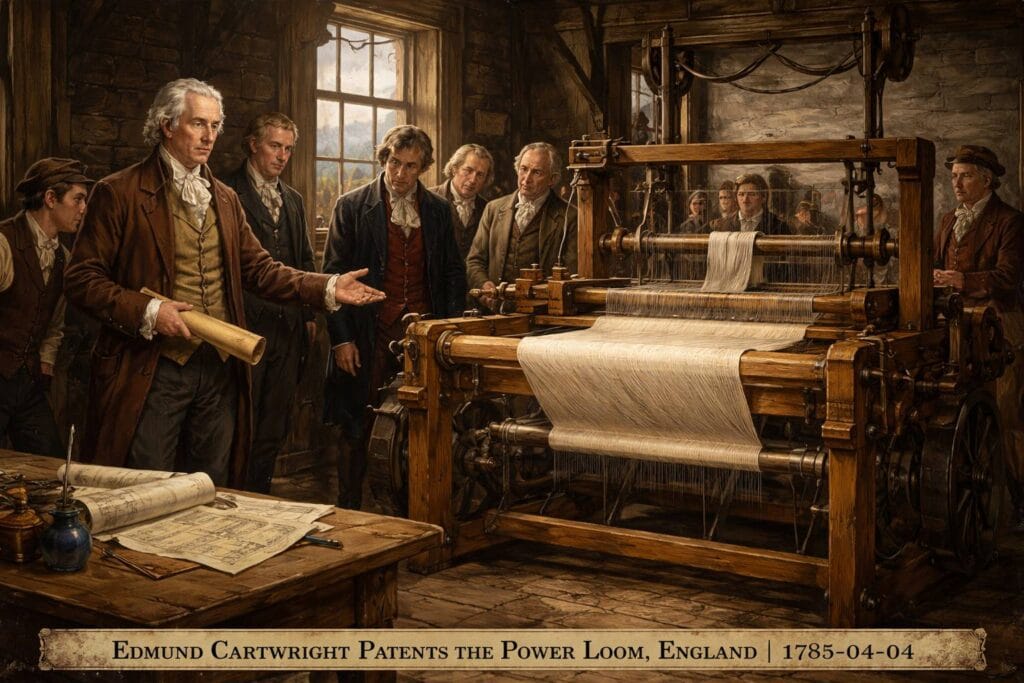
On April 4, 1785, in an England already humming with the early sounds of the Industrial Revolution, a country clergyman walked into the world of patents. His name was Edmund Cartwright, and the device he sought to protect with legal ink and parchment was a strange, skeletal contraption of wood, iron, gears, and belts. It would soon be known, simply and fatefully, as the Edmund Cartwright power loom. The day itself passed quietly; no crowds gathered, no newspapers announced a revolution. The London streets carried on with their usual rhythm—horses’ hooves on cobblestones, hawkers calling out their wares, river barges sliding down the Thames. Yet behind that ordinariness, something epochal was beginning.
When Cartwright’s documents were submitted to the patent office, they described a machine few people could fully imagine. It promised to do, under the steady push of mechanical power, what generations of skilled hands had done in the dim light of cottage windows and cramped workshops. To weave cloth—once the slow art of the loom bench, the rhythm of the shuttle and the treadle—might now become the business of engines, pistons, and continuous motion. The Edmund Cartwright power loom was not the first whisper of mechanization in textiles; by 1785, the spinning jenny, water frame, and spinning mule had already reshaped the spinning of thread. Yet weaving had remained stubbornly bound to human limbs, to the intimate movements of weavers who knew every creak of their looms.
That was precisely what was about to change. The paperwork filed that day was dry and technical, but the reality it foreshadowed was anything but. Hidden inside its terse diagrams lay conflicts not yet ignited: the anger of displaced artisans, the grim discipline of factory life, the roar of future riots. Account books would be rewritten, fortunes would be made, and old communities would unravel. It is astonishing, isn’t it, that such upheaval can begin in the scratch of a pen on paper?
Cartwright himself could hardly grasp all that the agreement would unleash. A man educated in Latin and scripture, steeped more in sermons than in steam, he was entering a realm dominated by hard-nosed mill owners and daring mechanics. Yet, as he signed and sealed the patent, he locked his name onto the very machinery of an age. The Edmund Cartwright power loom would not only bear his name but also carry forward his own mixture of naivety, ambition, and persistence into hundreds of noisy factories and thousands of human stories.
But this was only the beginning. To understand what changed on that April morning, we must first understand what existed before—what Britain looked and felt like when the shuttle still flew at the command of calloused hands and weary feet.
Britain Before the Loom: A World of Hand and Shuttle
Before the Edmund Cartwright power loom emerged from sketches and speculation, weaving was a craft embedded deeply in the routines of everyday life. In the mid-eighteenth century, Britain’s textile industry was vast but scattered, stretching from the moors of Yorkshire to the valleys of Lancashire, and into the cramped quarters of London’s weaving districts. Cloth, especially wool and increasingly cotton, was Britain’s lifeblood, but the heart that pumped that lifeblood came from dispersed cottages and small workshops, not towering factories.
The domestic system—sometimes called the “putting-out” system—organized production through a network of merchants and families. A merchant in a market town such as Leeds or Manchester would supply raw yarn to rural weavers, who worked in their own homes or tiny outbuildings. A handloom often dominated a room, its wooden frame looming beside a narrow bed, a hearth, and a small table. Children wound bobbins or helped with simple tasks; wives and husbands shared the work according to the household’s needs. The clack of the shuttle, the squeak of the reeds, the thump of the beater formed the soundtrack of countless evenings.
Speed was determined by the human body. A skilled handloom weaver might produce a few yards of cloth a day, depending on the fabric’s complexity and width. They took pride in their rhythm and finesse. Some had inherited the craft, learning from fathers or uncles. Others had drifted into it when land became scarce or rents rose. In the weaving villages, social life was woven tightly around shared labor: gossip across hedgerows, beer after a market day, and the small but vital independence of working for oneself, even if money was often short.
Yet beneath this image of autonomy, pressures were mounting. Earlier inventions had already quickened the pace of thread production. James Hargreaves’s spinning jenny (c. 1764), Richard Arkwright’s water frame (1769), and Samuel Crompton’s spinning mule (1779) transformed the front end of the textile process. Yarn became more abundant and cheaper. That may sound a blessing, but for weavers it was a warning. When spinning was the bottleneck, weavers could command decent wages. When yarn flooded the market, cloth had to be made faster and cheaper—or weavers risked being undercut, their bargaining power eroded.
Meanwhile, Britain’s imperial expansion brought in rivers of cotton, grown largely by enslaved labor in the West Indies and the American South. The empire demanded finished cloth as much as it supplied raw fiber. Towns like Manchester began to swell, their streets slick with the trade in cloth, their warehouses stacked with bales. The pressure to mechanize every stage—from spinning to weaving—grew with each ship that docked.
Political thinkers and social critics sensed a transformation coming. Some, like Adam Smith in The Wealth of Nations (1776), praised the division of labor and the promise of increased productivity. Others saw darker possibilities: swelling slums, exploited children, the erosion of old ways. But in 1785, the power loom was still evening talk at dinners, a speculative idea rather than a finished device. The loom remained, fundamentally, a wooden frame animated by foot and hand. That was the world Edmund Cartwright was poised to disrupt.
The Making of an Unlikely Inventor
Edmund Cartwright did not look like the archetypal industrial pioneer. Born in 1743 in Nottinghamshire into a respectable, moderately prosperous family, he was a man of letters long before he ever set eyes on the guts of a machine. Educated at Oxford, he took holy orders and became a clergyman, serving as a rector. His daily life revolved around sermons, pastoral visits, and the rhythms of the Church of England. If one had met him in the 1770s, nothing in his appearance or occupation would have suggested that the name “Edmund Cartwright power loom” would one day echo through mill towns and economics textbooks alike.
Cartwright was, however, curious. He moved in circles where ideas were traded almost as avidly as commodities—dinners where industrialists, landowners, and intellectuals debated the nature of progress and the future of trade. England in these years vibrated with invention: James Watt was perfecting the separate condenser for the steam engine; Boulton & Watt were building engines for mines and mills; tinkerers and mechanics across the Midlands experimented with ways to harness water and steam.
Though Cartwright lacked formal training in engineering or mechanics, he was no stranger to experimentation. He wrote poetry, dabbled in agriculture, and kept up with scientific discussions of the day. The Enlightenment spirit—which treated nature and society alike as puzzles to be solved by reason and experiment—touched even rural rectories. In his letters, we catch glimpses of a restless mind, not quite content to remain within the neat boundaries of parish life.
He was also, crucially, the brother of more worldly men. His siblings included John Cartwright, a naval officer and political reformer known for his radical views on parliamentary representation, and Major Thomas Cartwright, involved in estate management and commercial ventures. Through them, Edmund had one foot in the genteel world of the educated clergy and another in the practical affairs of business and reform. Such a position could spark ambition—and perhaps a desire to leave a mark that sermons alone could not provide.
By the early 1780s, rumors about mechanized weaving had begun to circulate. Handloom weavers felt the unease; entrepreneurs felt the opportunity. When Cartwright first heard of these notions, he reportedly reacted with skepticism bordering on disbelief. How could a machine, he wondered, possibly replicate the subtle, coordinated actions of a skilled weaver’s limbs? Skepticism, in his case, became the seed of obsession. If others claimed it could be done, perhaps he should examine it for himself.
Thus the clergyman-inventor was born—not through methodical training in a workshop, but through the charged atmosphere of an age intoxicated with innovation, and a personality predisposed to ask, “Why not?”
A Dinner Conversation that Changed the World
Every revolution has its whispered beginnings, its unremarkable moments in which the future sits casually at the table. For Edmund Cartwright’s journey toward the power loom, that moment came, by his own later account, in a dinner conversation. In the early 1780s, while visiting Matlock in Derbyshire—a spa town where polite society came to take the waters and exchange ideas—Cartwright found himself in the company of men who spoke excitedly of new devices transforming industry.
Among the topics was the prospect of a weaving machine. Cartwright listened as one gentleman confidently declared that such a device was not merely theoretical; mechanics in the north were attempting to make it real. The idea, as Cartwright recalled, struck him as implausible. Weaving, he argued, required too many simultaneous movements, too much coordination of hand and foot, eye and judgment. How could mere wood and iron reproduce that living choreography?
The reply he received is said to have been simple yet piercing: “If that is so, Mr. Cartwright, why could you not try to invent such a machine yourself?” The room likely filled with laughter, talk shifted to other matters, and glasses were refilled. But in Cartwright’s mind, the gauntlet had been thrown. He later recounted this episode with a mix of amusement and gravity, understanding that this offhand challenge had opened a door he could not easily close.
After that dinner, thoughts of mechanical weaving would not leave him. He began, with the stubbornness of an outsider, to imagine how the fundamental actions of weaving—shedding, picking, beating—could be translated into mechanical motions. Seasoned engineers might have approached the question with knowledge of existing prototypes or the limitations of materials. Cartwright, unburdened by such practical constraints, took the problem as an intellectual puzzle. It’s astonishing, isn’t it, how ignorance sometimes proves fertile soil for audacity?
This was not yet the Edmund Cartwright power loom of history, but its ghost had entered his mind. He read, he sketched, he questioned weavers and mechanics. The clergyman was crossing an invisible boundary, stepping from contemplation into invention. What compelled him? Partly, no doubt, the challenge; partly the promise of profit in a booming industry; partly the ubiquitous eighteenth-century faith in improvement, the belief that human ingenuity could and should perfect the tools of labor.
By the mid-1780s, those scattered thoughts began to coalesce into rough designs. The man who had once doubted the very possibility of a power-driven loom was now determined to build one. And so he began the precarious journey from idea to apparatus.
From Sketch to Steel: Conceiving the Power Loom
Translating imagination into mechanism is always a messy process, more trial and error than flash of genius. For Cartwright, designing his loom meant dissecting the weaver’s craft into discrete mechanical actions. When one sits at a handloom, the work feels fluid and continuous; but to a determined observer, it breaks down into repeated motions: lifting and lowering warp threads, propelling the shuttle, tightening the newly placed weft, winding the cloth.
The first step was shedding: separating the vertical warp threads into two layers to create a “shed” through which the shuttle could pass. Traditionally, this was done by the weaver’s feet pressing treadles connected to harnesses (healds). Cartwright imagined cams and levers that could raise and lower these harnesses automatically, timed to a rotating shaft. Next came picking: driving the shuttle from one side of the loom to the other, carrying the horizontal weft thread. Here, he envisioned mechanical pickers, activated by the same rotating power, to fling the shuttle rhythmically back and forth.
Then came beating up—the moment when the newly inserted weft thread is pushed firmly against the cloth edge by the reed attached to a swinging batten. Could that swing, too, be yoked to the turning of shafts and gears? Could the whole dance of the loom be synchronized like the movements of a clock? Cartwright’s rough sketches began to populate with cranks, eccentrics, pulleys, and connecting rods, all aimed at recreating the intimate practice of weaving with unwavering, mechanical regularity.
Power itself was another question. This would be no hand-operated contraption. Cartwright’s mind turned, as so many did in those years, to the new masters of motion: waterwheels and steam engines. If a loom could be linked to a rotating main shaft driven by water or steam, then the repetitive labor of the weaver’s limbs might be replaced with steadier, tireless power. Dozens, perhaps hundreds, of looms could then be driven from a single source, all clattering together in one building—a factor that would eventually redraw the map of British towns and villages.
Of course, inventing on paper is easier than building in wood and iron. Cartwright worked with local craftsmen to turn his concepts into rough models. Misalignments, weak joints, and mistimed motions plagued his earliest attempts. Threads tangled, shuttles jammed, parts shook themselves loose under strain. The machine had to be strong enough to run continuously, yet precise enough not to tear the delicate warp threads it handled. Failure, dismay, and tinkering became his daily companions.
Yet each failure refined his understanding. By 1785, he believed he had something coherent enough to warrant legal protection. The device was crude, but the principle was in place: a loom powered not by muscle, but by an external source, translating rotary motion into the sequential operations of weaving. The Edmund Cartwright power loom, as it would later be known, was still a fragile newborn, but now it needed a name, a number, and the authority of the state behind it. Cartwright turned toward London and the patent office, ready to stake his claim.
April 4, 1785: The Patent is Filed
On that April day in 1785, when Edmund Cartwright’s patent application was recorded, the event attracted no particular fanfare. Yet the language inscribed there—itself dry, almost lifeless—outlined a machine that would alter the pace and nature of textile production. Cartwright described “a certain new invented machine for weaving,” intended to perform the functions of a traditional loom under the drive of mechanical power. The document attempted, as patents must, to stake out not merely a specific design but a broad conceptual territory: the idea of power-driven weaving itself.
Patenting in late eighteenth-century Britain was an expensive and often convoluted process. It required legal counsel, careful drafting, and payments that could amount to several hundred pounds, a sum beyond the reach of many artisans and small inventors. Cartwright, with his social connections and clerical income, could just manage it. His decision to proceed suggests that he imagined not a minor improvement but a device capable of earning back its cost through substantial commercial success.
In the quiet rooms where the paperwork was processed, clerks logged his claim among many others—patents for agricultural implements, chemical processes, and mechanical gadgets that never would see widespread use. No chorus sang for one more parchment rolled and stored. Yet this particular filing laid legal groundwork for future conflicts. If others attempted to build power looms, would they infringe his rights? If mill owners adopted similar machines, would they owe royalties to a country clergyman?
At that moment, though, economic battles lay in the future. What mattered immediately was that the Edmund Cartwright power loom now existed, at least in the eyes of the law. Cartwright himself still had immense work ahead to transform his claimed invention into a reliable, commercially viable machine. Still, the patent conferred a peculiar kind of confidence—the sense that he had, in principle, captured something new and valuable.
Word of his patent trickled slowly through the industrial districts. Some weavers heard rumors and scoffed; others felt an uneasy chill. Mechanized spinning had already wounded their bargaining position. If weaving, too, were mechanized, what place would be left for their hard-won skills? Among forward-looking entrepreneurs, the reaction was more cautious curiosity. Could this clergyman’s contraption deliver what he promised? Or would it join the long list of failed, half-baked schemes?
Answers would require real machines, not legal abstractions. In the years following the patent, Cartwright would pour his money and hopes into building and running mills equipped with his power looms. The story of the Edmund Cartwright power loom was shifting from diagrams and legal scribbles to the hot, oil-scented spaces of early factories.
First Threads: Trials, Errors, and Mechanical Misery
Securing a patent was one thing; making the loom work in practice was another ordeal entirely. Cartwright, undeterred, set about constructing full-sized versions of his machine. In 1787 he established a factory at Doncaster and later at Grimshaw’s mill in Manchester, determined not only to build the looms but to operate them as part of a functioning textile business. He had moved from the speculative role of inventor to the perilous world of industrial entrepreneur.
The early results were mixed at best. The Edmund Cartwright power loom, in its first incarnations, was clumsy and temperamental. Threads snapped under inconsistent tensions. The timing of the shuttle, shedding, and beating-up did not always align, causing faults in the cloth or catastrophic tangles. Observers sometimes saw more stoppages than smooth weaving. A single loose pin or misaligned cam could halt the entire process. Skilled weavers watching from the sidelines had reason to smirk; the machine, for all its ingenuity, seemed a fragile imitation of their practiced hands.
Moreover, the environment of early mills added to the difficulty. Power transmission from waterwheels or steam engines came through long line shafts, belts, and gear trains. Vibrations shook the floors; moisture warped wooden frames. Lubricants stained both machinery and fabric. Adjusting one loom meant disrupting others in the same line. Cartwright’s designs, though conceptually coherent, had to contend with a rough-and-tumble reality that plans on paper rarely reveal.
Financial strain followed mechanical frustration. Building mills, purchasing engines, and hiring workers consumed capital at an alarming rate. The cloth produced by his early looms struggled to compete, in both quality and cost, with the work of experienced handloom weavers. Some merchants balked at buying machine-woven fabrics, fearing that customers would distrust them. In an age when reputation mattered deeply, the slightest flaw in texture or pattern could damage sales.
Yet the basic logic behind the Edmund Cartwright power loom remained compelling: once perfected, a machine powered by water or steam could, in principle, outpace even the most gifted weaver. Cartwright persisted in tinkering, strengthening frames, refining motions, and adjusting mechanisms. He introduced components like automatic warp let-off and cloth take-up, striving to make the loom more continuous and less dependent on constant human correction.
Still, in the 1780s and early 1790s, his enterprises leaned more toward failure than triumph. Losses mounted. Partners lost faith. Cartwright, for all his intellectual drive, discovered that the business of cloth and machinery was unforgiving. He would eventually be forced to shut down his own mills and sell off equipment at a loss. The inventor seemed defeated. And yet, paradoxically, his work was only just beginning to change the world, because others had been watching—and learning.
Inside the Machine: How Cartwright’s Loom Worked
To understand why the Edmund Cartwright power loom proved so fateful, it helps to peer inside its mechanical logic. Imagine standing beside one of his later looms, a tall frame of timber and iron, belts turning overhead, shafts spinning. The noise is sharp and rhythmic—a series of clacks, thumps, and whirrs that resolve into a strange, relentless music. Every sound corresponds to a movement that a handloom weaver once made alone.
At the core lay a main driving shaft, powered from outside the loom by either a waterwheel or a steam engine. This rotating shaft served as the heartbeat of the machine. Attached to it were cams and cranks timed so that each revolution triggered a sequence of motions. First, levers linked to the healds raised and lowered sets of warp threads, creating the shed. Then, at precisely the right moment, the picking mechanism hurled the shuttle through the shed, trailing the weft thread. Immediately afterward, an arm swung the batten forward, pushing the new weft tight against the growing edge of cloth. Meanwhile, separate mechanisms gradually unwound more warp from the beam and wound the finished cloth onto a roller.
The genius—and challenge—of the design lay in synchronization. If the shed opened too late or closed too soon, the shuttle would strike threads and cause breakages. If the beat of the reed lagged or jumped ahead, the cloth density would vary, creating weak spots or irregular patterns. Cartwright’s power loom used a series of linked motions to ensure that these steps occurred with unvarying regularity. Once set in motion, and properly adjusted, the loom needed only minimal human oversight: attention to broken threads, adjustments in tension, replacement of shuttles, and changes in pattern.
Early versions often struggled with these requirements. Components wore down quickly; lubricants congealed; adjustments drifted. But the conceptual foundation—of a loom driven by a steady, external power source and organized around a central shaft—became the template that others would refine. By the early nineteenth century, improved versions of the Cartwright-style power loom could produce cloth several times faster than a handloom weaver, especially for simple, plain weaves.
This increase in speed mattered immensely. If a handloom weaver toiled for ten to twelve hours to produce a certain length of cloth, a power loom might, under optimal conditions, double or triple that output with one semi-skilled minder supervising multiple machines. Multiplying this productivity across dozens or hundreds of looms in a single factory transformed not just individual lives but entire economies. The Edmund Cartwright power loom thus represented more than a clever piece of engineering; it embodied a new relationship between human beings and machines, one in which people increasingly served as attendants to mechanical systems rather than masters of their own tools.
This shift would soon reverberate far beyond Cartwright’s own workshops, as other inventors and industrialists seized upon his concept and made it ruthlessly efficient.
Met with Suspicion: Weavers, Mill Owners, and the Public React
As the idea of the Edmund Cartwright power loom spread, reactions diverged sharply depending on where one stood in the social fabric. For handloom weavers, who still formed a large and politically conscious class, the loom appeared as a looming threat. Many had already observed how mechanized spinning had crowded spinners out of the domestic system, forcing them into factories or into poverty. Now they faced the possibility that weaving—their own last bastion of skilled, relatively autonomous labor—might also be pulled into the jaws of mechanization.
Letters, pamphlets, and conversations from the period record their anxiety. Some dismissed the machine as a passing folly, pointing to its early breakdowns and the inferior quality of its cloth. Others read the signs more grimly. They understood that capital had patience: even if the first Edmund Cartwright power loom stumbled, improved versions would emerge. Worse, the loom seemed to disrespect the dignity of their craft, reducing years of training to the mere feeding and watching of iron and wood.
Mill owners and entrepreneurs, in contrast, viewed the situation through the cold lens of costs and profits. While cautious about investing in unproven technology, many sensed the potential. A loom that could be operated by less skilled, and therefore cheaper, labor promised to break the power of weavers to demand higher wages during periods of high demand. Mechanization also allowed tighter control over production schedules and quality. Cloth could be produced in-house, from raw fiber to finished fabric, under a single roof—a dream for capitalists concerned about supply chain uncertainties.
The broader public was caught between fascination and unease. Newspapers occasionally reported on new machines, praising British ingenuity and the nation’s growing industrial might. Pamphleteers linked such advances to national prosperity and military strength, particularly during the long wars against Revolutionary and Napoleonic France. Yet, reports of distress among artisans also circulated: tales of weavers forced to sell their looms, of families whose incomes had shrunk by half in a decade.
One contemporary observer, quoted later by historians, remarked that “the weaver who once held a place of some consideration in the parish now finds himself humbled to a level with the poorest laborer.” The power loom, though not the sole culprit, became a symbol of this reversal. Its whirring frames seemed to embody the impersonal, relentless forces that were sweeping away the old world.
Still, in the late 1780s and early 1790s, the power loom remained relatively rare, more an ominous rumor than an everyday reality. That would change in the early nineteenth century, when improved designs spread and political tensions reached a boiling point, sometimes literally in the flames of burning mills.
Fire in the Mills: Riots, Frames, and Broken Windows
The Industrial Revolution was never a silent, peaceful transition; it was noisy, contested, and often violent. As power looms based on Cartwright’s principles began to appear in greater numbers during the early decades of the nineteenth century, resistance took on a physical, sometimes ferocious form. Workers who saw their livelihoods disappearing before their eyes lashed out at the machines they believed were destroying them.
Even before the widespread adoption of the Edmund Cartwright power loom, stockingers and framework knitters had attacked machines in the Midlands in the 1770s and 1780s. By the 1810s, a broader movement known as Luddism erupted across industrial districts. Named—perhaps apocryphally—after a figure called Ned Ludd, these rioters targeted frames, looms, and other devices that threatened skilled trades. In Yorkshire and Lancashire, power looms were among their most hated symbols.
In 1812, one of the most notorious incidents occurred at Westhoughton Mill near Bolton, where a crowd of workers set fire to a factory equipped with power looms. Flames licked the sky; wooden frames cracked and collapsed; iron warped in the heat. For the rioters, this was not mere vandalism but a desperate assertion of their right to subsistence. Yet the British state responded with severity. Troops were deployed; leaders were arrested, tried, and in several cases executed or transported. Machine breaking was framed not as understandable protest but as seditious rebellion.
Cartwright himself, by then a more marginal figure in the textile business, watched these developments from a distance. The Edmund Cartwright power loom had helped set the machinery of change in motion, but the conflict had moved beyond any individual. Factory owners now defended their investments with both private guards and the backing of government power. Magistrates read the Riot Act; soldiers stood sentry at mill gates. Broken windows and shattered frames became the visible scars of an invisible war over the meaning of progress.
The Luddites ultimately failed to halt the advance of mechanization; their story is often told as a tragic, perhaps futile resistance to inevitability. Yet their struggle reveals how deeply the new machines disturbed the social order. They knew that the power loom was not just a tool; it was, in historian E. P. Thompson’s phrase, an instrument in a “moral economy” being reshaped in favor of capital. As looms multiplied, the sound of their furious clatter drowned out, one by one, the quieter beat of the handloom in the cottage.
From Curiosity to Cornerstone: Imitation and Improvement
The long-term significance of the Edmund Cartwright power loom lies less in Cartwright’s own factories, which failed, than in the ideas others extracted from his designs. Once his patents expired—or were selectively ignored—engineers and mill owners freely adapted, refined, and combined his concepts with their own innovations. The result was an evolutionary leap in loom technology.
In the early nineteenth century, inventors such as William Horrocks and later Kenworthy and Bullough introduced significant modifications. They strengthened frames, improved let-off and take-up mechanisms, and refined the picking system to reduce shuttle breakages. By the 1820s and 1830s, power looms had become more reliable and faster, with some capable of more than 100 picks (shuttle passes) per minute. Factories in Lancashire, Yorkshire, and Scotland began to install them in growing numbers.
Statistics from these decades chart the transformation. In 1803, there were perhaps a few hundred power looms in all of Britain. By the mid-1820s, that number had risen into the thousands. By 1835, it is estimated that over 100,000 power looms were in operation in the UK, many of them in cotton mills around Manchester, Oldham, and Blackburn. Each of these machines traced its ancestry, in part, back to the conceptual framework laid down by Cartwright. Even when designs differed significantly in detail, the basic principle—a loom driven by continuous power, with coordinated mechanical motions performing the weaver’s tasks—remained Cartwright’s enduring contribution.
As power looms became fixtures of factory life, their presence reshaped the organization of labor. One worker could now supervise several looms, perhaps four or six, watching for broken threads, replacing shuttles, and clearing faults. The focus shifted from individual craft skill to the ability to manage machines efficiently. Training periods shortened; children and young women, often cheaper to hire, filled the ranks of loom minders. Production volumes soared, and unit costs dropped.
The transformation did not go unnoticed abroad. Continental Europe, following Britain’s lead, began to adopt power looms, sometimes smuggling designs or luring British mechanics to share their knowledge despite laws against industrial emigration. In the United States, New England textile mills integrated power looms into vertically organized factories, creating the famous “Lowell system” that employed young women from rural areas. In each place, the shadow of the Edmund Cartwright power loom loomed large, even if his name was seldom mentioned on the factory floor.
In this way, Cartwright’s invention followed a path common to many epoch-making technologies: born in one mind and first nurtured in a few obscure workshops, it became, through collective adaptation and improvement, a cornerstone of an entire industrial civilization.
Lives Unraveled: Families, Children, and the Factory Bell
To measure the impact of the Edmund Cartwright power loom solely in yards of cloth or percentage increases in productivity would be to miss its deepest consequences. The loom did not merely change how fabric was made; it changed how men, women, and children lived, worked, and imagined their futures. The domestic system, with all its hardships, offered a degree of control over one’s time. Weaving families could work late into the night during busy periods and ease off when demand slackened, adjusting labor to the cycles of the household and the seasons.
Factory life under the rule of the power loom shattered that flexibility. Work shifted to the clock and the bell. Looms, driven by expensive engines, could not be idled lightly; they had to run for long, regular hours to justify their costs. Workers were required to appear at set times—dawn to dusk, often six days a week. Fines punished late arrivals; dismissal awaited those who could not maintain pace. Meals were snatched in brief breaks; personal needs had to fit around the machine’s demands.
Children, too, were drawn into this new regime. Small, nimble fingers proved useful for tying broken threads and cleaning tight spaces. In some mills, children as young as eight—or even younger, despite later laws—worked grueling shifts. Accounts from factory inspectors and reformers in the 1830s and 1840s describe pale faces, stunted growth, and exhaustion. One parliamentary report, looking back on earlier decades, noted that “the incessant din of the machinery and the confinement before it seem alike unfriendly to the health and the mind of the young.”
For handloom weavers displaced or undercut by the power loom, the transition was often brutal. Many clung to their craft as long as possible, accepting falling wages. By the 1830s, some weavers earned less than half of what their predecessors had earned in the 1790s, despite working longer hours. The poet and weaver Samuel Bamford, in his memoirs, recalled the “gradual but certain decay” of his class, as pawnshops filled with looms and shuttles, and cottages emptied of their traditional tools.
Yet not all was unrelieved misery. For some, especially those with little land or prior skill, factory work offered a steady, if low, wage where none had existed. Young women in particular sometimes welcomed the independence of earning their own money, even within harsh conditions. Towns grew; shops, schools, and chapels multiplied. Still, even these modest gains were threaded through with dependence on employers and vulnerability to slumps in demand.
The human story of the Edmund Cartwright power loom is thus one of profound ambivalence. It brought more cloth to more people at lower prices, contributing to a world in which ordinary citizens could afford multiple changes of clothing and where textiles helped define new fashions and identities. But the cost was paid in disrupted communities, exhausted bodies, and a new sense of being at the mercy of forces—markets, machines, masters—that individuals could scarcely influence.
Empire Woven by Steam: Cotton, Colonies, and Capital
The reach of the power loom extended far beyond the walls of British mills. It tugged at threads that ran across oceans, binding together enslaved workers on distant plantations, merchants in port cities, mill hands in northern England, and consumers at home and abroad. The explosion of machine weaving intensified Britain’s hunger for raw cotton, much of which came, by the early nineteenth century, from the American South, cultivated by enslaved African Americans under brutal conditions.
Mechanization had made cotton cloth one of the cheapest and most ubiquitous manufactured goods. British calicoes and muslins flooded markets in Europe, Africa, and Asia. In India, where handloom weaving had a long and sophisticated history, British imports—powered by machines inspired by the Edmund Cartwright power loom—undermined local producers. Traditional weavers, once thriving under Mughal and early colonial regimes, found themselves unable to compete with the low prices of factory-made cloth churned out by mills in Lancashire.
Thus, the power loom became one of the tools by which Britain consolidated its imperial dominance. Cheap industrial textiles, combined with naval power and political influence, allowed British merchants to capture markets and reshape economic structures in colonized regions. Handicraft industries that had supported communities for generations crumbled under the weight of imported goods. The story of deindustrialization in parts of India in the nineteenth century cannot be told without acknowledging the role of British textile machinery, including the descendants of Cartwright’s loom.
At home, the profits from global textile trade fueled further industrial investment. Bankers and mill owners in Manchester and Liverpool built fortunes from the triangular flows of cotton, cloth, and capital. Fancy townhouses, public buildings, and philanthropic institutions in these cities stood, in a sense, on foundations of woven cotton. The pulsing engines that drove rows of power looms translated the invisible labor of enslaved people and colonial subjects into tangible wealth for metropolitan elites.
Political debates gradually caught up with these realities. Abolitionists in Britain, campaigning against the Atlantic slave trade and slavery itself, sometimes pointed to the uncomfortable links between industrial prosperity and human bondage. Yet the mills kept spinning, the looms kept clattering. Even after Britain abolished slavery in its own colonies in 1833, the appetite for slave-grown cotton from the American South continued until the U.S. Civil War disrupted supplies.
In this way, the Edmund Cartwright power loom played an indirect but significant role in knitting together an industrial-capitalist world system. Its mechanical arms drew in fibers from distant fields and flung out cloth to global markets, embedding British power in the very fabric of everyday life across continents.
A Legacy of Ruin and Reward for Edmund Cartwright
What, meanwhile, became of the man whose name is forever linked to the power loom? Edmund Cartwright’s personal fate was a study in the cruel ironies of invention. Despite setting in motion a technological shift that enriched countless mill owners and merchants, Cartwright himself never became truly wealthy from his loom. His early mills lost money; his lack of business acumen and the immaturity of the technology meant that by the time power looms were widely adopted, others had captured most of the benefits.
In the late 1790s and early 1800s, Cartwright retreated somewhat from direct industrial ventures. He continued to invent—turning his attention to wool-combing machines and agricultural improvements—but his financial position remained precarious. Only later did the British state acknowledge his contributions in a tangible way. In 1809, after lobbying by influential supporters who recognized how central his ideas had been to the mechanization of weaving, Parliament granted him a lump sum of £10,000 as a form of reward or compensation. It was a substantial amount, but still small compared to the vast profits that rows upon rows of power looms would generate in the following decades.
Cartwright’s later years were marked by a mixture of quiet satisfaction and lingering disappointment. He knew that the Edmund Cartwright power loom had been the foundation upon which others built, and he took some pride in that fact. Yet he also witnessed the upheavals his invention had helped unleash: the crowded factory towns, the harsh regimes of labor, the protests and riots. Whether he grappled deeply with the moral dimensions of these changes is harder to say. Surviving letters suggest he remained, above all, a man convinced of the virtues of improvement and progress.
He died in 1823, just as the power loom was entering its golden age in British factories. In that sense, he lived long enough to see his mechanical child grow into a formidable adult, though not long enough to witness its global diffusion. Historians later would disagree about how much credit he deserved. Some nineteenth-century writers, eager for heroic narratives of progress, hailed him as the great benefactor of the weaving trade. Twentieth-century scholars, more skeptical, stressed the collaborative, cumulative nature of technological change and the role of anonymous mechanics whose names never appeared on patents.
Yet regardless of how we apportion individual credit, the fact remains that the phrase “Edmund Cartwright power loom” marks a distinct turning point in industrial history. His life story, with its mix of aspiration, innovation, misfortune, and partial recognition, mirrors the broader ambiguities of the age he helped shape.
Global Reverberations: From Lancashire to the World
By the mid-nineteenth century, the principles embodied in the Edmund Cartwright power loom had traveled far beyond Britain’s shores. In New England, the mills of Lowell and Lawrence ran rows of power looms driven by waterwheels and, increasingly, steam. These factories became showcases of American industrialism, their brick walls and towering chimneys celebrated in promotional literature and criticized in reformist tracts that described exhausting workdays and boardinghouse regimens imposed on young female operatives.
On the European continent, nations such as Belgium, France, and Prussia raced to emulate British successes, sometimes with government support. Colonial administrators in places like India debated how to integrate or suppress indigenous weaving traditions in the face of imported machinery. The spread of the power loom thus intersected with political projects as diverse as nation-building, colonial control, and social reform.
Technological diffusion was not simply a matter of copying blueprints. Local conditions—available power sources, labor supplies, capital markets, transportation networks—shaped how and where power looms took root. In some regions, hand weaving persisted alongside machine weaving, serving niche markets or producing specialized fabrics. In others, the looming presence of factories decimated handloom communities. The global story of power weaving is therefore one of uneven and contested change, not smooth universal adoption.
Still, by the late nineteenth century, the logic inaugurated by the Edmund Cartwright power loom—substituting mechanical power and standardized machine motions for skilled manual labor—had spread into many sectors beyond textiles. Printing, metalworking, and even aspects of agriculture underwent similar transformations. The loom stands, in this sense, as both a particular machine and a metaphor for industrialization itself: a device that weaves together raw materials, energy, and human effort into a continuous flow of products, at once enriching and unsettling societies.
Travelers who visited industrial centers in those years often described their impressions in vivid terms. Some, like the French writer Alexis de Tocqueville visiting Manchester, saw in the factories the very “workshop of the world,” both awe-inspiring and nightmarish. Others, including early labor organizers and socialists, interpreted the rows of clattering looms as evidence that wealth had outpaced justice. A later historian would write that in many such towns “the air itself seemed to vibrate with the ceaseless motion of production.” That vibration began, in part, with the irregular, tentative beat of Cartwright’s first machines.
Historians Debate the Loom’s True Cost
In the centuries since Cartwright walked into the patent office, historians have argued fiercely about what the power loom meant for ordinary people. Did it, on balance, improve or degrade their lives? The answer depends on where one looks, and at what timescale. On the one hand, the explosion of machine-made cloth contributed to long-term rises in material living standards. Clothing became more plentiful and affordable; comfort and hygiene improved for broad segments of the population. Over generations, industrialization supported urban infrastructure, public education, and, eventually, political reforms that expanded the franchise and labor protections.
On the other hand, the transition was anything but smooth or benign. E. P. Thompson, in his influential work The Making of the English Working Class, portrayed early industrialization as a period of intense exploitation and “class struggle without end,” in which technologies like the power loom served as tools of capitalist discipline rather than neutral engines of progress. Other scholars, such as economic historians who focus on wage and price data, have highlighted the eventual upward trends in incomes, though even they acknowledge that handloom weavers in particular suffered catastrophic declines in earnings during key decades.
We must also confront the ethical dimension of the global system that the Edmund Cartwright power loom helped strengthen. Cheap factory cloth sustained and was sustained by forms of unfree labor abroad—from enslaved people on cotton plantations to coerced and underpaid workers in colonized territories. The loom’s whirring in Manchester, as one historian put it, “echoed faintly but inexorably in the fields of Mississippi and the villages of Bengal.”
Yet it would be too simple to condemn or to celebrate. The power loom was, in many ways, an expression of human ingenuity, a brilliant solution to a technical challenge. Its moral weight derives not only from its design but from the social arrangements into which it was placed. In a different world—one with strong protections for workers, equitable access to education, and less coercive global relations—the same technology might have written a different story.
Still, we do not live in that hypothetical world, and the actual history of the Edmund Cartwright power loom obliges us to grapple with the entanglement of invention, power, and inequality. As today’s societies wrestle with new waves of automation and artificial intelligence, historians frequently invoke the loom as a cautionary tale. When machines change the structure of work, who bears the cost, and who reaps the rewards? Cartwright’s story, far from a dusty episode, remains urgently relevant.
What Remains of a Revolution in Wood and Iron
Today, in museums and heritage sites across Britain and beyond, restored power looms sometimes stand silent beneath high ceilings, their once-ferocious clatter replaced by explanatory placards. Occasionally, curators will set one in motion for a demonstration. Visitors cover their ears, startled by the volume; children watch shuttles streak back and forth, marveling at the automatic choreography. These preserved machines are often descendants of later improvements, more refined than Cartwright’s own clumsy prototypes. Yet they carry the same essential idea, the same mechanical grammar that the Edmund Cartwright power loom first articulated.
Outside these curated spaces, little remains of the thousands of original looms that once filled mills. Many were dismantled, scrapped, their metals melted down as technology advanced. Electric looms, computerized systems, and globalized supply chains have long since surpassed the capacities of nineteenth-century machines. And yet, if you trace back the genealogy of modern textile manufacturing, you still find, somewhere near the root, the hand of a Nottinghamshire clergyman who dared to imagine that weaving could be done by a machine.
The true remnants of his revolution, though, are less material than social and conceptual. We live in a world that takes for granted the notion that complex manual tasks can and will be automated, that human judgment can be encoded into mechanical or digital sequences. The very word “loom” now appears in contexts far removed from cloth: data “weaves” through networks; algorithms “spin” and “thread” information. The metaphor reveals how deeply the logic of mechanization has seeped into our language and thought.
In small towns that once depended on handloom weaving, plaques and local histories recall the loss as much as the innovation. Oral traditions and family stories speak of great-grandparents who left the loom bench for the factory, or who refused and fell into poverty. The long echo of the Edmund Cartwright power loom thus persists not just in engineering textbooks but in the memory of communities and in the moral arguments we still have about work, technology, and justice.
Yet behind the celebrations of progress and the laments for what was destroyed, one simple, stubborn fact endures: on April 4, 1785, a person with no special mechanical training walked into a patent office and claimed to have reimagined one of humanity’s oldest crafts. From that unassuming act flowed a cascade of changes that none of his contemporaries could fully foresee. The threads he set in motion are still, in many ways, being woven into our lives.
Conclusion
The story of the Edmund Cartwright power loom is a story of contrasts and entanglements. It begins with a solitary clergyman, challenged during a casual dinner to consider whether weaving might be mechanized, and leads to roaring factories, blackened skies, and a world economy increasingly bound together by machine-made cloth. It demonstrates how a single inventive leap, filed as a patent on an ordinary April day in 1785, can, through the hands of countless others, reshape work, family life, and global power.
We have followed the loom from Cartwright’s sketches to his struggling mills, from the skepticism of handloom weavers to the excitement of entrepreneurs, from the smashing of frames by desperate rioters to the seamless operations of later, refined machines. Along the way, we have seen how the loom’s clatter mixed with the cries of children in factories, with the rustle of cheap cotton dresses, with the distant rustle of cotton plants in enslaved workers’ fields. The Edmund Cartwright power loom exemplifies the double-edged nature of industrial technology: it brought undeniable material benefits, yet it also enforced new forms of dependence, inequality, and loss.
Historians still debate how to weigh its legacy, but perhaps the most honest answer is that the loom wove together progress and pain in patterns we are still trying to read. Its significance lies not just in its mechanical ingenuity, but in the questions it forces us to ask about who controls technology, who gains, and who pays the price. As today’s societies confront new machines that threaten to displace workers and reorder economies, the echoes of Cartwright’s loom sound with renewed urgency. To listen carefully to that echo is to recognize that our own choices—about regulation, fairness, and human dignity—will determine whether our age’s inventions become instruments of shared prosperity or of deepening divide.
FAQs
- Who was Edmund Cartwright?
Edmund Cartwright (1743–1823) was an English clergyman and inventor best known for creating the first practicable power loom for weaving. Although he lacked formal engineering training, he patented his mechanized loom in 1785 and continued to refine textile machinery and agricultural implements over his lifetime. - What is the Edmund Cartwright power loom?
The Edmund Cartwright power loom was an early mechanized weaving machine that used external power—initially water and later steam—to drive the motions traditionally performed by a handloom weaver. It automated key processes such as raising and lowering warp threads, propelling the shuttle, and beating the weft into place, greatly increasing the potential speed and scale of cloth production. - Why is the 1785 patent date important?
On April 4, 1785, Cartwright’s patent for his weaving machine was officially recorded, marking one of the earliest legal recognitions of a power-driven loom. This date symbolizes a turning point in the mechanization of textiles, as it laid the conceptual and legal foundation for subsequent generations of power looms that would transform the industry. - Did Cartwright become rich from his invention?
No, Cartwright did not become truly wealthy from his power loom. His own mills were financially unsuccessful, and he faced significant technical and commercial challenges. Only later did the British Parliament award him £10,000 in recognition of his contributions, a sum modest compared to the huge profits his ideas enabled for later industrialists. - How did the power loom affect handloom weavers?
The spread of power looms dramatically undercut the position of handloom weavers. As factories produced cloth more cheaply and in greater quantities, many handloom workers saw their wages fall and their employment opportunities shrink. This led to severe hardship in weaving communities and contributed to episodes of unrest, including Luddite attacks on machinery in the early nineteenth century. - Was Cartwright’s loom the first mechanized loom in history?
Cartwright’s was not the first attempt at mechanizing weaving, but it was among the earliest to be systematically designed and patented as a power-driven loom in Britain. Earlier centuries had seen various mechanical aids to weaving, and around the same era other inventors were experimenting with similar concepts. Cartwright’s work, however, provided a key conceptual template that later inventors refined. - How did the power loom influence the Industrial Revolution?
The power loom accelerated the shift from dispersed, home-based textile production to concentrated factory systems. By increasing output and reducing the need for skilled labor in weaving, it reinforced industrial capitalism, encouraged urbanization, and deepened Britain’s dependence on global supplies of raw cotton. It became one of the core technologies that defined the Industrial Revolution’s second wave. - What were the global consequences of the power loom?
Globally, power looms helped Britain dominate textile markets, often at the expense of traditional weaving industries in places like India. They also intensified demand for raw cotton, much of which was produced by enslaved labor in the Americas. In this way, the technology contributed to patterns of colonial exploitation, economic dependency, and eventual deindustrialization in some regions.
External Resource
Internal Link
Other Resources
- Encyclopaedia Britannica – general search for the exact subject
- Google Scholar – academic search for the exact subject
- Internet Archive – digital library search for the exact subject