Table of Contents
- A Wind from the Channel: Setting the Stage at Dover, August 1270
- A Prince Shaped by War: Edward’s Violent Youth in a Fractured England
- From Civil War to Holy War: The Road from Evesham to the East
- Christendom in Crisis: The Lost Legacy of the Earlier Crusades
- Allies, Rivals, and Reluctant Partners: The Politics Behind the Ninth Crusade
- Raising the Cross: Financing and Recruiting Edward’s Small but Fierce Army
- Prayers, Tears, and Trumpets: The Departure from Dover
- Across a Troubled Continent: Edward’s Journey through France and Italy
- Storms at Sea and Delays on Land: The Long Road to the Holy Land
- Arriving at Acre: A Fading Crusader Outpost on the Edge of Defeat
- A Lion Among Ruins: Edward’s Campaigns in the Shadow of Baybars
- Knives in the Shadow: The Assassination Attempt That Nearly Ended a Dynasty
- Homeward Bound: News from Wales, a Dead King, and an Unfinished Crusade
- From Crusader to Conqueror: How the Ninth Crusade Shaped Edward I’s Kingship
- Echoes in the Holy Land: Local Memories and Long-Term Consequences
- Myth, Memory, and Propaganda: The Making of “Edward Longshanks the Crusader”
- The Ninth Crusade in the Shadow of the End: Last Flicker of a Fading Dream
- Conclusion
- FAQs
- External Resource
- Internal Link
Article Summary: This article follows the dramatic arc of Edward I’s departure from Dover in August 1270 and the campaign later known as the edward i ninth crusade, the final major crusading expedition to the Holy Land. It plunges into the turbulent world that shaped Edward: baronial revolts at home, the fading memory of earlier crusades, and a Christendom too divided to save its last outposts in the East. Moving from the misty cliffs of Dover to the exhausted port of Acre, the story traces his small but determined army, its struggles against the Mamluk sultan Baybars, and the desperate diplomacy that replaced grand conquest. The narrative explores the assassination attempt that almost killed Edward, the abrupt recall home after Henry III’s death, and the quiet, uneasy truce that ended his venture. Beyond the battlefield, the article probes how the edward i ninth crusade shaped Edward’s later rule in England, Wales, and Scotland, giving him both prestige and a more ruthless political style. It also examines the human cost on soldiers, civilians, and merchants caught between collapsing crusader states and expanding Islamic empires. Throughout, the article questions the legacy of the edward i ninth crusade: was it a heroic last stand, a doomed anachronism, or a political performance for a prince about to become one of England’s most formidable kings?
A Wind from the Channel: Setting the Stage at Dover, August 1270
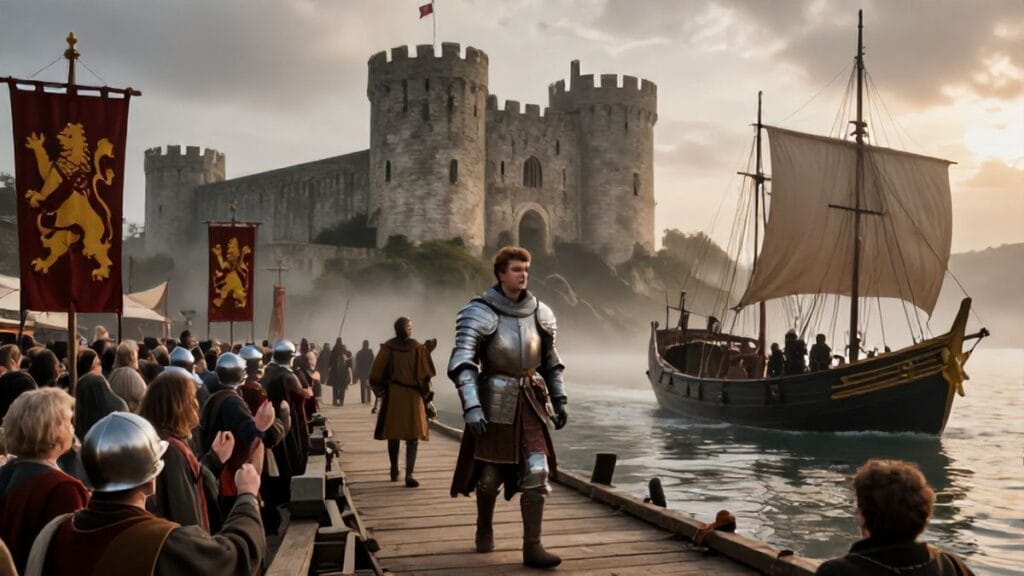
The wind that rolled in from the English Channel that August of 1270 was sharp, salted, and heavy with the smell of tar and wet rope. It rattled the banners nailed to the tall masts in Dover’s crowded harbor, tugging at cloth embroidered with crosses, lions, and the personal devices of knights who believed they were about to step into sacred history. Men shouted in Norman French and English, in Latin and the rough dialects of the shires. Horses snorted nervously as they were coaxed onto creaking ships. Priests muttered blessings. Women clutched children, weeping silently, their eyes fixed on the shore, as if by staring hard enough they might fix that moment in time and keep their husbands from ever truly departing.
Near the waterline, surrounded by a close ring of household knights, stood the tall, angular figure who was the center of all this motion: Edward, the twenty‑something heir to the English throne. Later chroniclers would remember him as Edward I, the hammer of the Scots, the conqueror of Wales, the lawgiver. But today, he was simply the prince who had taken the cross, about to depart on the journey that would burnish his reputation as a crusader. The edward i ninth crusade was still just an uncertain expedition, its scale modest, its hopes large, its future unknowable. The air around him shimmered with the overlapping noise of merchants bargaining, carpenters hammering, and clergy chanting, while the gray cliffs of Dover rose like a vast, silent amphitheater behind it all.
This was not the triumphant march of an invincible army. Edward’s force was small, closer to a hardened retinue than a massive host, perhaps no more than a thousand fighting men if we count the knights, mounted sergeants, and infantry who would eventually sail under his banner. There were no endless lines of camp-followers stretching across the horizon, no apocalyptic preachers whipping crowds into hysteria. Instead, there was a controlled, almost businesslike energy. England had only recently emerged from civil war. The treasury was strained. The great lords were wary of committing their resources far from home. Yet, for all its modest size, the expedition carried a weight that was far greater than the number of its ships. It carried the remains of a dream that had begun two centuries earlier at Clermont, when Pope Urban II had called the first crusade.
Edward’s gaze, if we trust the imaginative reconstructions of later historians, likely drifted out toward the horizon where the sea and sky blurred into a single muted band of gray-blue. Somewhere beyond that line, past the coasts of France and Italy, beyond the fingers of Cyprus and the shattered harbors of the eastern Mediterranean, lay Acre—the last truly significant Christian stronghold in the Holy Land. And beyond Acre, in turn, lay the inland hills and plains where Saladin’s heirs and the Mamluk sultans had spent decades eroding Latin Christian power, stone by stone, fortress by fortress. To many in Christendom, those places still glowed with half-mythical light: Golgotha, the Holy Sepulchre, the streets where Christ was said to have walked. To a prince raised in war, they were also a battlefield promised and long-awaited.
There was drama here, of course, and ceremony. Bishops in heavy robes raised their hands to bless the departing fleet. A papal legate might have been present, representing the distant but insistent will of Rome. Relics were displayed, kissed, and lifted toward the sky as if to catch the wind itself. Yet behind all the ritual lay a long chain of political calculations, debts, compromises, and unfulfilled vows that stretched back years. The edward i ninth crusade did not spring fully formed from a single vow at an altar; it was the culmination of Edward’s turbulent youth in a kingdom that had nearly torn itself apart.
On the quay, the air was raw with human smells and emotion. A boy clung to his father’s belt, refusing to let go until a squire gently pried his fingers loose. A knight laughed too loudly, his voice pitched with nervousness he would never admit. A noblewoman, her veil snapping in the wind, stood rigid and pale, lips barely moving in silent prayer. In this swirl of grief, piety, and ambition, Edward’s own thoughts are lost to us. The chronicles tell us what he did, whom he met, how many ships he hired. They do not tell us with certainty what fears churned in his chest as he stepped onto the gangplank of the ship that would carry him away from Dover’s shore.
But this was only the beginning. To understand why this departure mattered, and how the edward i ninth crusade became both a final echo of the crusading age and a rehearsal for Edward’s brutal, efficient kingship, we must step back into the years that formed him: a childhood of royal privilege, a youth of rebellion and battle, and a Europe reeling from the failures of earlier crusades.
A Prince Shaped by War: Edward’s Violent Youth in a Fractured England
Edward Plantagenet entered the world in 1239 already entangled in the webs of power, expectation, and resentment that defined thirteenth-century England. His father, King Henry III, was pious, cultured, and, in the eyes of many of his subjects, disastrously inept at governance. Henry dreamed of building cathedrals and recapturing the Angevin glory of his father, King John, and grandfather, Henry II. Instead he piled up debts, leaned heavily on foreign favorites, and clashed repeatedly with his barons over taxation and royal authority.
Edward grew up watching these struggles unfold. He saw the growing anger of English nobles who chafed under the weight of royal demands and the influence of Henry’s Lusignan relatives. He learned that loyalty at court could be purchased and betrayed with equal speed. In his adolescence he witnessed the rise of Simon de Montfort, the charismatic, French-born earl who became first his ally, then his rival, and finally his enemy in a civil war that would leave fields soaked with English blood.
By the early 1260s, England teetered on the edge of collapse. The Provisions of Oxford, a baronial attempt to bind the king to a council and curb his abuses, had led to years of tension. Edward, initially wavering between factions, eventually emerged as a fierce champion of royal rights. He was tall, commanding, restless—a man whose physical presence impressed even those who hated him. Chroniclers describe him as long-limbed and intense, with a temper that could flare into cruelty. War was not an abstraction to him; it was a proving ground. He had fought in Wales and Gascony, testing his skill and ruthlessness.
The crisis exploded in 1264–65 into what historians now call the Second Barons’ War. At the Battle of Lewes in May 1264, Edward led a brilliant but ultimately disastrous cavalry charge that initially scattered the London militia but left the royal army fatally disorganized. His father and uncle were captured, and the realm fell into the hands of Simon de Montfort, who briefly ruled in the king’s name. Edward himself was taken prisoner, his political future seemingly shattered.
Yet captivity sharpened him. Within a year he had escaped, rallied royalist forces, and hunted de Montfort down. At Evesham in August 1265, Edward marshaled a disciplined force of knights and infantry, luring de Montfort into a trap. “Then began a slaughter grim and great,” wrote one chronicler, capturing the carnage that followed. De Montfort was killed and dismembered, his body hacked apart in a spasm of vengeance. Edward’s victory was decisive but stained with brutality; some saw it as divine justice, others as a chilling glimpse into the prince’s nature.
These experiences shaped the man who would depart from Dover five years later. They gave him a fierce belief in the sanctity of royal power, a deep suspicion of noble factions, and a habit of using force decisively when needed. They also honed his logistical sense: he had learned how to move men, secure supplies, and negotiate alliances in the heat of civil war. When, in the wake of Evesham, Edward renewed and formalized his crusading vow, it was no longer the romantic gesture of a sheltered prince. It was the calculated decision of a hardened commander who saw in the edward i ninth crusade both a spiritual duty and a chance to strengthen his prestige at home and abroad.
For Henry III, still smarting from humiliation and reliant on his formidable son for stability, Edward’s crusading ambition was a double-edged sword. On one hand, it promised to align the English crown with the great pan-European movement of holy war, earning papal favor and honor among Christian princes. On the other, it meant that the kingdom’s most capable military leader would vanish across the sea at a time when Wales simmered with resistance and Scotland watched England with wary eyes. The king vacillated, then relented. The cross was sewn onto Edward’s cloak. Money began to be raised. Slowly, the idea of the journey east solidified from vow into plan.
From Civil War to Holy War: The Road from Evesham to the East
The years between the Battle of Evesham and Edward’s embarkation at Dover were a blur of mopping up resistance, consolidating royal authority, and negotiating the messy business of peace. The baronial cause did not evaporate overnight; pockets of opposition held out in the Marches and in fortified towns, and the bitterness of civil war ran deep. Edward had to move carefully, balancing punishment with reconciliation, lest the kingdom splinter again. This balancing act taught him an essential lesson he would carry to the Holy Land: sometimes an oath, a treaty, or a symbolic gesture could secure more lasting victory than another round of bloodshed.
At the same time, larger currents beyond England’s shores were shaping his path. News from the East was grim. Antioch had fallen to the Mamluks in 1268, a shattering blow to the already fragile crusader states. The once-imposing chain of Christian holdings that had stretched along the Levantine coast was now reduced to a few vulnerable enclaves. The pope and his legates spoke urgently of the need for yet another great crusade, a new wave of warriors to shore up the last positions before they too were swept away.
Edward’s vow, made as early as 1263 and renewed after Evesham, placed him within this wider narrative. But his crusade was never going to be a vast, all-consuming enterprise like the First or Third Crusades. Europe had changed. The enthusiasm of the twelfth century had cooled; the disasters of the Second Crusade, the bitter memories of the Fourth’s sack of Constantinople, and the shame of the failed Fifth and Seventh had all left their scars. Monarchs were more cautious, treasuries more carefully guarded, aristocrats more skeptical of promises of spiritual reward that could so easily end in death and debt.
Yet there were still men, especially among the nobility of England and France, who felt the pull of Jerusalem. Crusading had become a marker of status, a badge of honor to be displayed in heraldry and remembered by descendants. For Edward, the edward i ninth crusade offered a chance to step onto a stage once graced by Richard the Lionheart, his own great-uncle. The comparisons were inescapable. Richard’s exploits in the Third Crusade had become legend: his battles with Saladin, his daring marches, his near-miss attempts at Jerusalem. To march east under the cross was to walk deliberately into the shadow of that legend—and, perhaps, to reshape it.
Meanwhile, another crusading figure strode across the European stage: Louis IX of France, later canonized as Saint Louis. Louis had already led one disastrous crusade to Egypt in the 1240s, captured at Mansourah and ransomed at great cost. Yet his piety remained unshaken. In 1267, at a great assembly in Paris, Louis once again took the cross, calling upon nobles from across Christendom to join him. Edward answered that call. The French king, older, saintly, and world-renowned, would be the moral center of this new crusading effort. Edward, fiery and younger, would be one of its military arms.
The plan, such as it existed in the minds of planners in Rome and Paris, was grand: an international crusade to strike at the Muslim world, perhaps through Egypt or Tunis, to weaken its power and eventually restore Christian control in the Holy Land. In reality, as preparations wore on, the seams showed. Funding was patchy, recruitment uneven, and political rivalries ever-present. Still, the machinery of crusade was set in motion. Preachers crisscrossed Europe. Indulgences were proclaimed. Special taxes were levied. Ships were hired in Italian ports, and supply contracts were drawn up in terse Latin.
In England, Edward worked relentlessly. He visited shrines, confirmed his vow publicly, and cultivated the image of a prince humbly submitting to God’s will. Yet behind this spiritual theater lay hard negotiation. He had to coax money from an already tense political nation, negotiate with the papacy over the sharing of crusading taxes, and secure truces with troublesome neighbors to ensure that his absence did not invite invasion. It is astonishing, isn’t it, to imagine the thin line of security England rested upon when its crown prince prepared to vanish into distant wars, hoping that treaties and fear would hold his enemies at bay?
By the summer of 1270, after delays and compromises, the moment of departure could no longer be postponed. Louis IX had already set out from France, aiming first at Tunis in North Africa, where he hoped to strike at Muslim power and perhaps bring the local ruler into the Christian fold. Edward would follow, his smaller English contingent joining the wider French-led campaign. The fate of his crusade, and indeed of the entire enterprise, now hinged on winds, weather, disease, and the unpredictable course of human events.
Christendom in Crisis: The Lost Legacy of the Earlier Crusades
To grasp why Edward’s departure from Dover carried such weight, one must see the edward i ninth crusade not as an isolated adventure but as the last tired surge of a movement nearly two centuries old. The earlier crusades had changed the world: they had brought European knights into contact with Byzantine politics and Islamic scholarship, opened new trade routes, and intensified religious hatreds. They had also normalized a strange phenomenon: armed pilgrimage, in which the sword became an instrument of devotion.
In the blaze of the First Crusade, the capture of Jerusalem in 1099 had seemed to confirm God’s favor. Chroniclers exulted in gore: enemies cut down, streets running with blood, visions of divine signs in the sky. Over the following decades, crusader states were carved out along the eastern Mediterranean shore—Edessa, Antioch, Tripoli, and the Kingdom of Jerusalem itself. Castles like Krak des Chevaliers and Belvoir rose, built with European stonecraft but adapted to Levantine realities. Merchants from Venice, Genoa, and Pisa grew rich on the trade that flowed through these ports, shipping spices, silk, and sugar back to Europe.
But what had once looked like a permanent extension of Latin Christendom was, by Edward’s time, visibly crumbling. Muslim powers had regrouped, unified at times under leaders like Nur al-Din and Saladin, and chipped away at crusader holdings. The fall of Jerusalem to Saladin in 1187 had shocked Europe into sending the Third Crusade. Richard the Lionheart, Philip Augustus of France, and Frederick Barbarossa all marched east. Barbarossa drowned in a river. Philip quarreled and returned home. Richard fought fiercely—winning at Arsuf, negotiating access for Christian pilgrims, but failing to retake Jerusalem.
Subsequent crusades only deepened the sense of futility. The Fourth Crusade (1202–04), diverted by politics and Venetian manipulation, ended not in Jerusalem but in the sack of Constantinople, a Christian city looted by Christian soldiers. The Fifth and Seventh crusades, focused on Egypt, revealed the logistical and strategic difficulties of attacking such a powerful, populous region. Louis IX had left thousands dead in the Nile Delta and in prisons, his own authority bruised, his saintly aura barely surviving the humiliation.
By the mid-thirteenth century, a kind of crusading fatigue had set in. The rhetoric of papal bulls remained fiery—promising remission of sins, eternal glory, and the defense of the Holy Sepulchre—but the practicalities were grim. Wars were expensive. Many nobles remembered relatives who had left and never returned, or who had come home maimed and debt-ridden. Merchants had learned that trade with the Muslim world could be more profitable than war against it. Italian city-states, torn between piety and profit, supplied ships and loans but often hedged their bets, dealing with both Crusaders and Muslims.
Moreover, the papacy had increasingly turned the language of crusade inward, authorizing campaigns against heretics in Languedoc, political enemies in Italy, and even, at times, Christian rulers who defied Rome. This dilution of the crusading ideal made some knights wary. Was a crusade to Tunis or against a Christian heretic in southern France truly equivalent to marching to Jerusalem?
In this world of diminished hopes and divided loyalties, Edward’s vow stood out. He was not an aging king desperate to cleanse his conscience like Louis IX. He was a young, vigorous prince with a long future ahead of him. His participation symbolized, to many, a possible renewal of true crusading spirit—a bridge between the glorious legends of the past and a present in need of heroes. Yet at the very moment he stepped aboard at Dover, the edward i ninth crusade was already hemmed in by the constraints of its age: too small, too late, and facing an enemy more unified and experienced than in the days of the First Crusade.
Allies, Rivals, and Reluctant Partners: The Politics Behind the Ninth Crusade
Crusades were never purely spiritual enterprises; they were coalitions of kings, nobles, and city-states with their own agendas and mutual suspicions. Edward’s journey east was deeply entangled in the politics of his relationships with France, the papacy, and the great Italian maritime republics. To watch the ships being loaded in Dover without understanding this diplomatic undercurrent would be like hearing the roar of a crowd without knowing the rules of the game they had come to see.
Edward’s alliance with Louis IX was at once genuine and uneasy. The English and French royal houses had been rivals for generations, locked in a struggle over territories in what is now western France: Normandy, Anjou, Aquitaine. Henry III had lost much of his ancestral holdings; Edward had fought hard in Gascony to defend what remained. Despite this, crusade rhetoric demanded unity. Under the cross, kings and princes were to set aside their quarrels for the sake of Christ’s tomb.
And so Edward and Louis became, for a time, comrades in a shared holy cause. But their positions were unequal. Louis was already king, older and widely revered. Edward was a prince from a kingdom with a more fragile internal stability. His contingent would be smaller. His voice, in the councils of crusade, would not carry the same weight. Historians like Jonathan Riley-Smith have emphasized how these hierarchical dynamics often shaped strategic debates more than abstract ideals of Christian brotherhood.
The papacy, for its part, looked on Edward with a mixture of hope and calculation. A strong English prince on crusade might bolster papal authority and demonstrate that Rome could still mobilize the secular powers of Europe. At the same time, the Curia was careful not to lean too hard on England’s already strained finances; dead kings and bankrupt crowns did little to advance papal interests. Negotiations over crusade taxes and the granting of “tenths” (a fraction of clerical income) became long, delicate dances, where promises of spiritual reward were matched against blunt fiscal realities.
Then there were the Italians—Venice and Genoa in particular—whose ships and sailors would be essential to carrying Edward and his men across the Mediterranean. These city-states were mercantile powers first, crusading powers second. They sold transport, supplies, and naval escort to whoever could pay, whether Christian princes or Muslim rulers. Their harbors hummed with multilingual deal-making. When Edward’s agents negotiated shipping in places like Venice, they were stepping into markets where the Holy Land was less a sacred destination than a lucrative trade corridor.
Amid all this, the leaders of the remaining crusader states watched the preparations from afar with a desperate, pragmatic eye. The lords of Acre, Tyre, and the scattered strongholds of the Latin East knew that any Western reinforcements, however small, could tip the balance in local conflicts. They sent envoys, letters, and pleas for help, describing in harrowing detail the pressure they faced from the Mamluks under Sultan Baybars. The image of a besieged remnant of Christendom, clinging to a few coastal cities, haunted sermons in England and France—and haunted Edward, too, as he prepared to leave.
Thus, when he finally stood on the deck of his ship in Dover harbor, the prince was not just a lone pilgrim. He was a node in a complex network of expectations and bargains: ally of Saint Louis, son of a vulnerable king, client of a calculating papacy, customer of hard-headed Italian merchants, hoped-for savior of desperate Levantine lords. The edward i ninth crusade would have to navigate all these currents at once, even as its sails filled with the uncertain wind of late medieval fortune.
Raising the Cross: Financing and Recruiting Edward’s Small but Fierce Army
Before the first anchor was raised, Edward had to accomplish a task every crusading leader dreaded: finding enough money and men. Crusading indulgences might promise eternal salvation, but ship captains demanded payment in coin, not piety. Smiths wanted silver for the swords they forged; farmers expected compensation when their sons marched off to war instead of tending fields.
In England, the years after the civil war were not a time of abundance. Fields had been burned, debts piled up, and the scars of conflict still marred the countryside. Yet the idea of the cross retained its grip on the imagination of the knightly class. Edward’s recruitment drew heavily from the nobility and their retinues—men who saw in the edward i ninth crusade an opportunity for both spiritual redemption and worldly glory.
Names like Edmund of Lancaster (Edward’s brother), John de Vescy, and Robert Burnell appear in charters and chronicles linked to the expedition. Some were Edward’s close allies from the barons’ war, tested in English campaigns. Others were younger men eager to establish their reputations. They came with squires, clerks, grooms, and servants, forming tight-knit household units that would fight, eat, and camp together across continents.
Financing this force required a patchwork of strategies. Edward borrowed heavily, pledging lands and future revenues as security. He extracted contributions from religious houses and wealthier towns. Special levies, sometimes justified explicitly as crusade taxes, were imposed on clergy and laity alike. The papacy authorized certain taxes on church income, in return for promises that a portion would be directed to the expedition.
Despite all this, the funds were never enough to create an army on the scale of the First or Third Crusades. Historians estimate that Edward’s force, when fully assembled in the East, may have consisted of a few hundred knights and a similar number of mounted sergeants and infantry. It was, in medieval terms, a strike force rather than a grand host. This compact size, however, also had advantages: it could move more quickly, forage more efficiently, and respond flexibly to shifting circumstances in the fragile cities of the Levant.
The prince also had to wrestle with more intimate questions: who would guard his interests at home? His wife, Eleanor of Castile, famously accompanied him on the crusade, an unusual but not unprecedented choice. Their partnership, both political and personal, had been forged through years of shared journeys and negotiations—especially in Gascony, her family’s homeland. Her decision to travel added another layer of risk; if disaster struck in the East, England could lose both its heir and his consort in a single blow.
For the ordinary men who followed Edward, motivations varied. Some no doubt were inspired by sermons promising remission of sins, by fear of hell and hope of heaven. Others were lured by the possibility of plunder or advantageous marriages in the East. Many, perhaps most, simply followed their lords out of feudal obligation or personal loyalty. They packed what they could: a cloak, a knife, perhaps a cherished token from home. They said goodbye to families with no certainty they would ever return.
It is in these small details—the hurried wedding before departure, the hastily drafted will naming heirs, the whispered confession in a cold village church—that the human cost of the edward i ninth crusade becomes visible. The chronicles record Edward’s title and his victories; they do not name the foot soldier who left a pregnant wife behind in Kent, or the archer from Yorkshire who had never seen the sea before standing on the pebbled beach at Dover. Yet it was their sweat and blood that would propel the prince’s ambitions across the water.
Prayers, Tears, and Trumpets: The Departure from Dover
By the time late summer 1270 rolled over Dover, the preparations had reached their crescendo. The harbor thrummed like a living organism, its wooden piers and anchored ships bound together by ropes, oaths, and expectations. Coastal towns had long grown used to the sight of fleets coming and going—fishing boats, merchant cogs, royal dispatch vessels. But this felt different. This was the departure of the heir to the throne, wearing the cross, bound not to war in Wales or Gascony but to lands that to most English eyes existed only in sermons and stories.
We can imagine the final day before the fleet sailed. Edward, mounted on a tall warhorse, rode through the narrow streets leading down to the harbor. Dover Castle loomed above, its stone walls a reminder of England’s own history of conquest, from the Norman invasion of 1066 onward. Banners fluttered from windows, and crowds pressed close, craning for a glimpse of the prince. Some shouted blessings; others watched in silence, their faces pinched by worry.
On the waterfront, ships bobbed at anchor: stout transports with broad hulls to carry horses and men, sleeker vessels for scouting and escort. The hulls gleamed with fresh pitch. Ramps had been laid for the difficult business of loading warhorses—a nerve-wracking process for man and beast alike. Carpenters hurried to reinforce stalls below decks, ensuring that the valuable animals would not break legs in heavy seas.
Clergy moved among the ranks, sprinkling holy water, touching relics to foreheads. The air filled with the cadences of Latin prayers: Deus, qui corda fidelium… Each knight knelt in turn to receive a blessing, helmet cradled in his hands, before rising and stepping onto the gangplank. For a moment, each man became a solitary figure framed between land and sea, the last point of contact between the life he knew and the unknown horizon yawning before him.
Edward himself likely participated in a solemn mass, perhaps in the castle’s chapel or a nearby church, before the final descent to the harbor. Chronicles like those of Walter of Guisborough later noted his piety and attendance at devotions on campaign. We do not have a verbatim transcript of the sermon preached that day, but its themes are easy to guess: the righteousness of the cause, the glory of martyrs, the suffering of Christians in the East. The fall of Antioch, the threat to Acre, the desecration of holy places—all would have been invoked as spurs to courage.
Yet behind the ringing rhetoric lay raw, personal partings. A father embraced a son who had insisted on joining despite still being barely bearded. A wife handed her husband a small cross to wear under his armor, hidden from view but close to the skin. A younger brother, too young to go, promised to keep watch over the family lands. Tears were not unmanly in such moments; crusade chroniclers occasionally mention men weeping openly when leaving home, even as they steeled themselves for battle.
At last, with prayers said and cargo loaded, there was nothing left but to go. Trumpets blared. Orders were shouted. Sailors hauled on ropes, and the canvas bellied out, catching the wind. One by one, the ships drew away from the piers, their prows cutting through the green-gray water. On shore, hands waved, then grew still as the distance widened. The white cliffs, so familiar and solid, began to shrink behind the departing fleet.
From Edward’s vantage point on deck, the shoreline would have unfolded like a moving fresco: the castle, the town, the thronged harbor, then the open coast. Somewhere in that receding landscape lay the roads to London and Westminster, to the court where his aging father struggled to keep control. He could not know that within a few years he would return not as prince but as king, his father dead and the realm’s burdens resting heavily on his shoulders. For now, the task before him was singular: to reach the eastern Mediterranean, to join whatever remained of Louis IX’s enterprise, and to bring what aid he could to the faltering outposts of the Holy Land.
Across a Troubled Continent: Edward’s Journey through France and Italy
The voyage from Dover to the continent was short by comparison with what followed, but it symbolized a threshold. Within days, Edward’s ships made landfall—likely at Wissant or a similar French port—before the army continued overland. What began as a sea journey became a long, complicated trek through the political patchwork of medieval Europe, weaving its way through territories where every border crossing could demand negotiations, tolls, and displays of respect.
In France, Edward moved through a kingdom that was at once ally and rival. The memory of conflicts over Normandy and Aquitaine lingered, even as the crusading vow temporarily overrode them. Edward paid due homage where required, met with French lords, and stayed in monasteries and castles that had hosted earlier crusaders. At some point along this route, he would have heard rumors about Louis IX’s campaign—rumors that soon hardened into dire news.
Louis had chosen a controversial target: Tunis, in North Africa, rather than heading directly to the Levant. His hope, partly spiritual, partly strategic, was that by converting or subduing the ruler of Tunis, he could create a new Christian base in the western Mediterranean to pressure Egypt and support future attacks on the Holy Land. But the expedition had been plagued by heat, disease, and supply problems almost from the moment it landed. By August 1270, even as Edward left Dover, Louis fell ill with dysentery in the sweltering camp outside Tunis. On August 25, he died, reportedly lying on a bed of ashes in an imitation of Christ’s humility.
When word of Louis’s death reached Edward—likely as he moved south through France—it must have struck like a hammer blow. The spiritual and political figurehead of the crusade was gone. The French host, wracked by disease and demoralized, soon reached a negotiated settlement with the ruler of Tunis and prepared to withdraw. The grand, coordinated enterprise that had been so carefully preached from pulpits across Europe was unraveling before Edward even set foot in the eastern Mediterranean.
Yet he did not turn back. If anything, the death of Louis and the winding down of the Tunis campaign shifted Edward’s focus more sharply toward the Levant. His contingent would no longer be merely a supporting wing in a vast French-led crusade; it would become, in effect, its own expedition—a compact, mobile force heading directly for the threatened cities of the Holy Land. In this sense, the edward i ninth crusade took on its distinctive shape not in Dover or in Jerusalem, but on the roads of France, in the echo of funeral bells rung for a dead French king.
From France, Edward’s route bent toward Italy. The Italian peninsula was a patchwork of city-states, papal territories, and imperial holdings, all knitted together by trade routes and ecclesiastical networks. Genoa and Venice, ever hungry for maritime contracts, vied for the business of transporting crusaders. Edward’s party would have passed through landscapes dotted with monasteries, where monks copied not only Bibles but also medical and scientific texts, many of them translated from Arabic—a quiet reminder of the cultural exchanges that crusading both hindered and, paradoxically, fostered.
In these cities, Edward negotiated shipping, borrowed yet more money, and tried to recruit additional fighters. His entourage likely grew and shrank as opportunistic knights joined and others, disappointed or exhausted, peeled off. The prince’s charisma and status were assets, but the underlying reality remained: Europe’s appetite for large-scale crusade had waned. He would sail east with what he had, not with the tens of thousands dreamed of in papal encyclicals.
As autumn turned to winter and then into another year, the itinerary stretched on. It is one of the ironies of medieval crusading that the journeys meant to save faraway holy places often spent more time tangled in the roads, ports, and markets of Europe than in the battlefields of the East. Edward’s crusade was no exception. Still, each step, each negotiation, brought him closer to the crumbling edge of Latin Christendom—closer to Acre, and to the confrontation with the man whose name was spoken in the Levant with a mix of dread and grudging respect: Sultan Baybars.
Storms at Sea and Delays on Land: The Long Road to the Holy Land
From the Italian ports, likely including Sicily or southern harbors such as Brindisi, Edward’s force finally turned its face fully toward the East. The Mediterranean, so often portrayed in modern imagination as a placid blue expanse, could be treacherous in the thirteenth century. Ships were vulnerable to storms, piracy, and the simple wear and strain of long voyages overloaded with men, animals, and supplies.
The fleet’s route probably included a stop in Sicily, where the lingering effects of the so-called “Sicilian Vespers” and the island’s contested rulership created a tense backdrop. Then Cyprus, by then a key staging ground for crusader activity, would have loomed as the last safe harbor before the contested coast of the Levant. There, the prince might have consulted with experienced veterans of eastern warfare, men who had spent years in the uneasy peace and sporadic skirmishing that defined life in the dwindling crusader states.
Delays dogged the journey. Weather could force ships into port for days or weeks. Illness swept through cramped holds, preying on those weakened by unfamiliar food and stress. Horses, so crucial to the heavy cavalry that formed the core of Edward’s fighting strength, were particularly vulnerable. Even a small loss of mounts could cripple the expedition’s tactical options upon arrival.
But this was still a world where the movement of a royal prince attracted attention, and where the prestige of crusade could open doors. Merchants on Cyprus were willing to sell grain, dried fish, and arms at a profit. Local rulers on friendly islands extended hospitality, eager to be seen aiding a cause that still carried spiritual cachet. Priests and friars, hearing of the English prince’s approach, came to offer counsel and to ask favor for their own houses and causes.
It was during this phase—this oscillation between forward motion and frustrating halt—that the edward i ninth crusade may have begun to shift in Edward’s own mind. No longer the supporting flank of a grand French-centered campaign, his expedition increasingly resembled a surgical intervention into a conflict that had, for years, been fought by exhausted local forces with minimal European reinforcement. He would arrive not as a conqueror laying out an empire, but as the commander of a compact, elite strike force whose actions would be measured in skirmishes and negotiations as much as in pitched battles.
In the intervals of calm at sea, the prince’s ship became a floating world. Knights cleaned armor and sharpened blades on deck while sailors went about their work. Priests heard confessions in cramped corners below, whispering absolution over men who knew that a sudden storm could send them to the bottom in a night. Eleanor of Castile, if the later romanticized stories of her presence are accurate, walked the deck in the cool of evening, speaking softly with her husband and his captains, her very presence a reminder of the dynastic stakes bound up in the voyage.
At last, after months on the move, the low line of the Levantine coast would have appeared on the horizon. The outlines of towers and walls slowly resolved into the battered profile of Acre, the de facto capital of what remained of the Kingdom of Jerusalem. For Edward, this was the moment when dream and reality collided: the Holy Land, so long invoked in prayers and diplomacy, was no longer a vision but a place—a hot, dusty, embattled place, very much alive and very much in danger.
Arriving at Acre: A Fading Crusader Outpost on the Edge of Defeat
When Edward stepped ashore at Acre in 1271, he entered a city that had outlived empires and now stood trapped between decay and defiance. The harbor was crowded with ships from Genoa, Venice, Pisa, and beyond, their masts clustered like a forest of bare winter trees. Warehouses, markets, and quays bustled with merchants speaking languages from across the Mediterranean—Italian, Provençal, Arabic, Greek, Armenian. It was a place of cosmopolitan trade and grim war, sacred relics and sordid deals.
Acre had become the beating heart of the crusader states after the loss of Jerusalem. Here, the High Court of the kingdom met; here, treaties were negotiated; here, refugees from fallen cities crowded into narrow streets, each new influx of displaced families adding another layer of desperation. The city’s walls and towers were formidable, rebuilt and strengthened after earlier sieges, but no one could mistake them for impregnable. The Mamluk sultan Baybars had already demonstrated, at Antioch and elsewhere, that he possessed both the patience and the artillery to reduce even the mightiest fortresses.
As Edward processed through the city, accompanied by a modest but conspicuous escort of English knights, he would have seen both the material and moral exhaustion of his new allies. The local barons were veterans of endless skirmishes and sieges, their lands shrunken to narrow coastal strips and isolated strongholds inland. The military orders—the Templars, Hospitallers, and Teutonic Knights—still maintained powerful fortresses, but their resources were stretched thin. Many of the men who met Edward’s gaze that day had lost friends, brothers, and sons in campaigns that had yielded, at best, temporary reprieves.
Yet there was also hope in his arrival. A royal prince, bearing the prestige and potential resources of England, symbolically reversed the pattern of neglect the Levant had suffered for decades. Messengers hurried to and from his quarters, as local lords and representatives of the military orders sought to gauge his intentions. Would he commit to a long-term defense of the Holy Land? Would more forces follow? Or was this to be a brief, symbolic gesture—a bright flare in a long night?
The political situation was tangled. The titular king of Jerusalem, Hugh III of Lusignan (also king of Cyprus), had to balance the interests of powerful barons, the Italian city-states, and the orders. Factional rivalries ran deep, sometimes cutting across religious lines: Genoa and Venice, for example, might back different claimants or policies based on trade interests rather than purely spiritual concerns. Edward had to maneuver within this maze, cautious not to alienate potential allies even as he pursued his own goals.
The religious atmosphere was equally complex. Latin churches, Greek Orthodox chapels, Armenian monasteries, and even mosques coexisted in uneasy proximity, reflecting centuries of conquest and reconquest. Pilgrims still came—some daring enough to venture inland under escort to visit shrines. But the flow was a trickle compared to the torrent of earlier decades. Fear hung over the city like a physical weight. Every rumor of Baybars moving north, every report of a new Mamluk army assembling in Egypt, sent a tremor through Acre’s streets.
Into this world walked Edward and his companions, their banners fresh and bright, their armor relatively new compared to the battered gear of local knights. It must have been, for a fleeting moment, a spectacle that rekindled old visions: a prince of the West answering the call, like Richard before him. Yet behind the cheers and formal welcomes were hard questions. Edward’s contingent was small. No great armies marched in his wake. Could anything he did truly change the course of events, or was his crusade fated from the outset to be an episode—a brave but ultimately marginal chapter in the long story of failure?
A Lion Among Ruins: Edward’s Campaigns in the Shadow of Baybars
Once settled in Acre, Edward moved quickly to transform presence into action. His aim, as far as can be reconstructed from the terse narrative of Latin and Arabic chroniclers, was to break the suffocating pressure Baybars exerted on the remaining crusader territories. He could not hope to defeat the Mamluk sultan in open battle with the forces at his disposal. What he could do, however, was launch sharp, targeted strikes to disrupt enemy plans, embolden local allies, and perhaps draw in support from the Mongols in the north.
One of Edward’s earliest operations was a raid toward Qaqun, a fortified point inland. With his mounted knights and lighter cavalry, he struck quickly at surrounding territories, burning crops and villages that supplied Mamluk garrisons. It was a tactic drawn from the rough school of frontier warfare he had studied in Wales and practiced in Gascony: hit hard, hit fast, then withdraw before superior forces could converge. In the short term, such raids inflicted pain and sent messages. In the long term, their strategic value depended on whether they were part of a sustained, coordinated effort—a condition the edward i ninth crusade, with its limited manpower, struggled to meet.
Still, within Acre and the neighboring strongholds, Edward’s vigor impressed many. Chroniclers sympathetic to him emphasized his personal courage, riding in the front rank, encouraging his men with words and example. Muslim sources, though hostile, did not dismiss him. The famous Mamluk chronicler Ibn al-Furat, for instance, noted these English-led raids as notable disturbances—more irritating than fatal, but not to be ignored. Baybars, who had spent years honing his state’s military machine, recognized that even small Western forces could become dangerous if they coordinated with regional enemies of the Mamluks.
This possibility led Edward into a realm of diplomacy that feels, in retrospect, like a glimmer of a very different kind of crusade—one fought with letters and envoys as much as with lances. He opened channels to the Mongol Ilkhanate in Persia, whose rulers, though not Christian, were bitter foes of the Mamluks. The dream, shared by some in both East and West, was of a grand alliance: Mongol armies sweeping down from the northeast while crusader forces struck from the coast, crushing Baybars between them.
Such visions were intoxicating, but the reality stubbornly refused to cooperate. The Mongols had their own agendas and internal conflicts. While they launched occasional campaigns that did indeed put pressure on Mamluk frontiers, sustained coordination with Edward proved elusive. Language barriers, distance, and mutual suspicions all played a role. Moreover, many in Christendom still remembered the ravages of earlier Mongol invasions; to treat them as full allies rather than as potential scourges of God stretched some clerical imaginations too far.
Meanwhile, Baybars responded to Edward’s presence with a mix of caution and contempt. He did not rush into a major battle that might risk his hard-won advantages. Instead, he tightened the noose around remaining crusader positions elsewhere, taking or threatening smaller castles, testing for weakness. At times, he explored diplomacy, sending envoys with offers of truces that might isolate Edward and peel away local allies. The sultan understood that the West’s will to sustain prolonged campaigns was thin. If he could outlast the enthusiasm of this English prince, time itself would finish the work he had begun.
On a human level, the months of campaigning were grueling. Heat, unfamiliar diseases, and the ceaseless strain of frontier watch took their toll on Edward’s men. Skirmishes flared unexpectedly. Scouts vanished along dusty roads. Even in victory, there was little to celebrate beyond another narrow reprieve. Yet in these harsh conditions, the prince continued to build the martial reputation that would later fuel his authority back in Britain. To his companions, he appeared as a lion among ruins—a reminder of what Western Christendom had once been able to bring to bear in the East, and a poignant symbol of how far its reach had shrunk.
Knives in the Shadow: The Assassination Attempt That Nearly Ended a Dynasty
If the military actions of the edward i ninth crusade were limited in scope, one event in Acre gave the expedition a drama that captured imaginations for generations: the attempted assassination of Edward himself. The outlines of the story are reasonably clear, though embellished over time. In June 1272, during a period of uneasy truce talks, a man gained admission to Edward’s quarters claiming to be a messenger—or, in some versions, a convert seeking baptism. Once inside, he drew a concealed dagger and lunged at the prince.
The attacker’s identity remains debated. Some Christian sources suggested he was an agent of Baybars, part of a plot by the sultan to remove a troublesome foe without the uncertainties of open battle. Muslim chroniclers are more circumspect or silent on this point, though Baybars was known for using a mix of diplomacy and clandestine action against his enemies. Whatever the precise chain of command, the knife that flashed toward Edward’s body was real, and its impact was immediate.
The assassin’s blade struck, wounding Edward—accounts differ on whether in the arm, the hip, or near the ribs. Some versions claim the dagger was poisoned. In the ensuing struggle, the tall, physically powerful prince managed to overpower and kill his attacker, but not before suffering a serious injury. Blood flowed. The chamber erupted in chaos as attendants rushed in, unsure whether more assailants might follow.
What happened next has become the subject of both hagiographic legend and scholarly scrutiny. A later, romanticized tradition—made famous in Victorian histories and popular retellings—insists that Eleanor of Castile, upon discovering that the wound was poisoned, sucked the venom from her husband’s flesh, risking her own life to save his. Modern historians are skeptical; the story, like many medieval anecdotes exalting queens’ devotion, fits too neatly into chivalric ideals to be taken at face value. More likely, surgeons and physicians—drawing on both European and, indirectly, Islamic medical knowledge—tended the wound with cauterization, poultices, and painstaking care.
For weeks, perhaps months, Edward’s survival was in doubt. Fever surged. The wound festered. In an age when even minor infections could be lethal, an injury inflicted by a dirty blade in a hot climate was a severe threat. Prayers were offered in Acre and, later, in England when the news finally traveled home. The possible consequences were enormous. Had Edward died in Acre in 1272, England would have faced a succession crisis just a few years after the trauma of civil war. The future conquest of Wales, the wars in Scotland, the legal reforms associated with Edward’s reign—all might have unfolded very differently, or not at all.
The near-disaster also underlined the fragility of the crusading endeavor. Here was a prince whose presence had been heralded as a sign of renewed Western commitment, felled not on a glorious battlefield before thousands, but in a private chamber by a single determined man with a hidden knife. The contrast between the grand rhetoric of Pope and preacher and the grubby reality of assassination attempts could not have been starker.
When Edward finally began to recover, his outlook—already hardened by years of conflict—must have sharpened further. Trust became an even more precious and scarce commodity. He had seen, at close range, how quickly a campaign could be derailed by treachery. The lessons he took from that bed in Acre would later echo in his dealings with rebellious Welsh princes and Scottish kings, where mercy was often overshadowed by calculated severity.
Homeward Bound: News from Wales, a Dead King, and an Unfinished Crusade
While Edward lay recovering in Acre, events in Europe moved inexorably forward. The flow of information was slow, but not static. Letters, messengers, and merchants carried rumors and facts across the Mediterranean. It was through this web of communication that news eventually reached the prince which would transform his status and with it the meaning of his crusade.
In November 1272, Henry III of England died. The weary king, whose long reign had seen both architectural splendor and political disaster, passed away in Westminster, far from the holy places his son struggled to defend. By traditional standards, the death of a king during a crusade might have been expected to cause panic, coups, or at least frantic scrambles for power. Yet England, still bruised from the barons’ war but now more accustomed to Edward’s de facto leadership, reacted with a surprising degree of calm.
The royal council, guided by men like Robert Burnell, moved quickly to assert Edward’s succession. He was proclaimed king in his absence—an unusual but not unprecedented step—on the assumption that he would eventually return to assume the crown formally. The realm would be governed in his name until then. In a sense, this continuity was the greatest testament to Edward’s earlier efforts to stabilize England after civil war: the administration did not collapse when its prince went abroad, nor when its king died.
For Edward, the news must have struck like a thunderclap across the dusty courtyards of Acre. He was now not just a crusader prince, but a king. With this elevation came heavy responsibilities. Wales remained restless; the northern lords, never fully tamed, needed watching; Scotland’s politics were always a potential threat on the horizon. The longer he remained in the East, the greater the risk that old wounds at home would reopen.
Yet departure was not instantaneous. Edward had to weigh the honor of his vow and the expectations of his Levantine allies against his duty to England. Ultimately, pragmatism and necessity prevailed. After negotiating a truce with Baybars—one that brought, for a time, a fragile respite to the beleaguered coastal cities—he prepared to leave the Holy Land. The fighting he had done, the raids he had led, and the alliances he had pursued had not reversed the tide of Mamluk expansion. But they had helped to hold back that tide, however briefly, buying a few more years of precarious survival for Acre and its sister strongholds.
As he boarded ship once more, this time heading west, Edward carried with him both the scars and the stories of the edward i ninth crusade. He left behind friends and allies who would continue, without him, the grim watch on the frontiers. Within less than two decades, in 1291, Acre would finally fall to the Mamluks, its walls smashed, its defenders killed or scattered. The last significant Latin hold on the mainland Levant was erased. From the vantage point of that eventual catastrophe, Edward’s efforts could be read as tragically insufficient. From the vantage point of 1272, they were still remembered with gratitude by those who had fought beside him.
The return journey retraced, in reverse, the zigzagging path Edward had taken east. He stopped in Sicily and France, meeting with rulers who now treated him as a monarch in his own right. In Gascony, his hereditary possession, he paused long enough to reassert his authority and to soothe local tensions. Each encounter on the road home helped to reshape his image: no longer just the crusader prince, he was now the king who had shed blood for Christ in the East and who would, his supporters claimed, bring that same energy to the governance of his own lands.
From Crusader to Conqueror: How the Ninth Crusade Shaped Edward I’s Kingship
When Edward finally landed back in England—probably in 1274, after a prolonged return and a period in Gascony—he stepped ashore not as the same man who had sailed from Dover four years earlier. The experiences of the edward i ninth crusade had fused with those of the barons’ war to create a ruler of unusual resolve and clarity of purpose. In the years that followed, as he embarked on the conquest of Wales, the assertion of overlordship in Scotland, and a program of legal and administrative reform, the imprint of his crusading years can be read between the lines of his actions.
One of the clearest continuities lies in his approach to military organization and logistics. On crusade, Edward had commanded a relatively small, elite force in a hostile environment, far from reliable supply lines. He had learned to value mobility, tight discipline, and fortified bases. In Wales, beginning in the late 1270s, he deployed these lessons ruthlessly. His ring of stone castles—Caernarfon, Conwy, Harlech, and others—functioned like the coastal fortresses of the Levant, anchoring English rule in contested terrain. The combination of rapid campaigning and strategic fortification bore the unmistakable mark of a man trained in the harsh school of frontier war.
Crusade had also reinforced Edward’s sense of kingship as a quasi-sacred vocation. To take the cross was to present oneself as a leader chosen, at least in part, by God to defend Christendom. Although he never again embarked on a major foreign crusade, Edward kept this aura of divinely sanctioned authority close. He wrapped his Welsh and Scottish campaigns in the language of order, justice, and Christian duty—even when they involved harsh repression, mass deportations, and the crushing of local elites. The same man who had negotiated truces with Baybars without scruple later demanded unconditional submissions from Welsh princes like Llywelyn ap Gruffudd, whom he treated simultaneously as a rebellious vassal and as an almost heretical threat to the unity of his realm.
On a more personal level, the assassination attempt in Acre had likely deepened his suspicion of rivals and plotters. In England, he moved vigorously against those he saw as threats to royal authority, whether magnates hoarding private armies or towns pushing against the boundaries of their charters. His legal reforms—embodied in statutes like Westminster and Gloucester—strengthened royal courts and sought to curb abuses by lesser lords. To modern eyes, these measures can seem almost bureaucratic, but behind them sat a king for whom disorder was not an abstract political problem but a lived experience of blades in the dark.
Crusading prestige, too, played a political role. In coronation ceremonies and courtly display, Edward’s status as a man who had fought in the Holy Land was emphasized. Chroniclers and poets folded his eastern adventures into narratives of royal heroism. Just as earlier kings had traded on the memory of Richard’s wars against Saladin, so Edward’s supporters subtly contrasted his concrete experience with the more inward-looking piety of some continental rulers. He was a king who had seen the world, spoken with popes, kings, and Eastern lords, and survived trials that would have killed lesser men.
Yet his crusading years left more ambiguous legacies as well. Exposure to the multiethnic, multireligious society of Acre did not soften Edward into a cosmopolitan tolerant ruler. If anything, his later reign was marked by pragmatic but often harsh policies toward religious minorities, most notoriously the expulsion of Jews from England in 1290. Historians debate whether his time in the East influenced these attitudes directly or whether they grew more from domestic pressures. Still, it is hard to ignore the contrast between the patched-together coexistence he observed in Acre and the rigid, exclusionary ideals he would later enforce at home.
In sum, the edward i ninth crusade did not define Edward’s kingship, but it sharpened and colored it. It provided the crucible in which his ideas of authority, war, and piety were tested and confirmed. The king who returned from the East carried, in his mind and on his body, the marks of that journey. England, Wales, and Scotland would all feel the consequences.
Echoes in the Holy Land: Local Memories and Long-Term Consequences
From the perspective of the Levant, Edward’s crusade was one episode in a long, grinding story that did not end with his departure. In Acre and the surrounding settlements, people remembered him as one of several Western princes who had come, fought, negotiated, and left again, each leaving behind a slightly altered balance of power and a trail of personal memories.
For the local Christian populations—Latin, Greek, Armenian, Syriac—the arrival of the English prince had been both a morale boost and a reminder of Western inconsistency. They had seen earlier waves of crusaders march through, sometimes staying to settle, sometimes merely passing on. Edward’s raids may have temporarily eased Mamluk pressure on certain routes or fortresses, allowing more secure access to markets or pilgrimage sites. The truce he helped negotiate with Baybars brought a few years of relatively less intense warfare, during which merchants could trade and farmers plant with slightly reduced fear.
Yet the structural realities did not change. The Mamluk Sultanate remained the ascendant power, with larger armies, more unified leadership, and a stronger economic base than the fragmented crusader states. Latin lords still bickered amongst themselves; Italian city-states still prioritized trade concessions over unified defense. After Edward’s withdrawal, Baybars and his successors resumed their campaigns, chipping away at remaining Christian positions and sometimes turning against former Muslim allies as well. The fall of Acre in 1291, described in agonizing detail by eyewitnesses like the Templar of Tyre, was the inevitable culmination of forces that no single expedition could reverse.
Muslim chroniclers, when they mentioned Edward at all, slotted him into their own narrative frames. To them, he was another ifrangi noble—courageous perhaps, dangerous in limited ways, but ultimately part of a declining phenomenon. Their attention remained more focused on the strategies and virtues of their own rulers: the justice and ruthlessness of Baybars, the logistical feats of Mamluk armies, the diplomatic balancing acts required to manage both internal factions and external threats like the Mongols. In this sense, the edward i ninth crusade appears almost as a footnote in Arabic histories: worth mentioning, but not central.
For Jewish and Muslim communities living under crusader rule, Edward’s sojourn brought mixed experiences. Some faced heightened tensions as crusader zeal flared; others benefited indirectly from the temporary stabilization of front lines, which made trade and travel safer. Any relief was short-lived. As power shifted and walls fell in the subsequent decades, many of these communities would be uprooted, expelled, or killed—not in a single cataclysm, but in a series of waves that blurred into one another in local memory.
Perhaps the most poignant long-term consequence of Edward’s crusade in the region was this: it helped to preserve, for a little longer, the idea that Western Christendom still cared enough to send its princes to the East. That idea sustained, however briefly, the willingness of Levantine Christians to look west for help. When Acre finally fell and no new princes came, the shock was not merely military; it was existential. A door that had long swung, however erratically, between Europe and the Levant slammed shut. Edward’s expedition, seen in this light, was among the last times that door creaked open before closing for centuries.
Myth, Memory, and Propaganda: The Making of “Edward Longshanks the Crusader”
In the decades and centuries following Edward’s death in 1307, the story of his crusade was told, retold, and reshaped to suit changing tastes and political needs. Medieval chroniclers, some writing under royal patronage, emphasized the piety and bravery of their subject, smoothing over the more ambiguous aspects of his time in the East. Later antiquarians and romantic historians added their own flourishes, culminating in the Victorian fascination with crusading chivalry.
Central to this mythmaking was the image of Edward as a physically imposing warrior-king. His nickname, “Longshanks,” evoked his tall stature and rangy limbs. Tales of his feats in battle—smiting foes at Evesham, leading charges in Wales, standing firm against the assassin in Acre—blended into a composite portrait that took on the sheen of legend. The edward i ninth crusade became, in such narratives, proof of his knightly virtue: proof that he had tested himself on the most sacred stage of all, the theater of holy war.
Popular retellings seized especially on the story of Eleanor sucking poison from his wound. Whether factual or not, it fit perfectly into the romantic ideal of conjugal devotion and noble suffering. Painters depicted the scene; Victorian schoolbooks repeated it with little skepticism. In these versions, both Edward and Eleanor were elevated above the messy realities of politics and war, their marriage transformed into a symbolic union of courage and loyalty that, conveniently, reflected the moral values of the storytellers’ own age.
At the same time, Edward’s crusade was sometimes contrasted, favorably or unfavorably, with those of other kings. Admirers pointed to his willingness to risk his life abroad as evidence of a truly Christian monarch, more engaged than some of his successors who preferred to stay in Europe. Critics, particularly in later periods when crusading itself came under moral scrutiny, might cast the expedition as a youthful folly—an early sign of the aggressive temperament that would later ravage Wales and Scotland.
Modern scholarship has tried to cut through these layers of myth. Historians such as Christopher Tyerman and Jonathan Phillips have reassessed the scale and impact of the Ninth Crusade, pointing out its modest dimensions and its essentially defensive character. Rather than seeing Edward as a would-be conqueror of Jerusalem, they situate him within the narrower aims of late crusading: shoring up remaining strongholds, conducting raids to delay enemy advances, and engaging in complex diplomacy with both Muslim rulers and the Mongols. In this light, the edward i ninth crusade appears less as a grand moral drama and more as a pragmatic, limited intervention in a conflict whose outcome was already heavily weighted against the crusaders.
Yet myth and memory are not so easily swept aside. In popular imagination, scope and consequence often yield to symbolism. The image of an English king riding under the cross, leaving from Dover’s gray harbor and arriving in sun-baked Acre, still has the power to fascinate. It condenses centuries of anxiety, aspiration, and violence into a few vivid scenes: the crowded quay, the storm-tossed ship, the clash of arms under alien stars. Even when historians whisper that the reality was smaller, messier, and more compromised, the echoes of older narratives continue to ring.
The Ninth Crusade in the Shadow of the End: Last Flicker of a Fading Dream
Standing back from the vivid details—the salt wind at Dover, the press of bodies in Acre’s streets, the hiss of a blade in a darkened chamber—we are left with a broader question: what did the edward i ninth crusade mean in the long history of crusading? Was it a final, noble attempt to rescue a doomed project, or simply a delayed aftershock of earlier, greater ventures?
In many ways, the Ninth Crusade epitomizes the contradictions of late medieval holy war. Its leader was personally brave and politically astute, yet constrained by limited resources and shifting alliances. Its spiritual rhetoric remained high, invoking the same themes of liberation and salvation heard since 1095, yet its actual operations were largely reactive and tactical: raids, truces, diplomatic feelers to unlikely partners. Its arrival briefly galvanized defenders in the East, but could not reverse centuries of demographic and military trends that favored the region’s Muslim powers.
The crusade’s timing also mattered. By the 1270s, crusading energy was increasingly being channeled into other theaters: against heretics, against political foes of the papacy, against Iberian Muslims in the context of the Reconquista. The Holy Land had lost its exclusive claim on the West’s militant devotion. When Acre fell in 1291, there were laments and calls for renewal, but no major expedition on the scale of earlier centuries ever materialized. The age of large, pan-European crusades to the Levant was over.
Edward’s expedition thus occupies a liminal space: not grand enough to be transformative, not trivial enough to be forgotten. Its very modesty highlights how far ideals had drifted from reality. Knights still dreamed of Jerusalem; kings still posed as defenders of the cross; preachers still thundered about sacred duty. Yet when the time came to translate words into fleets and armies, what emerged was a force measured in hundreds rather than tens of thousands, acting more as a fire brigade than as a conquering host.
And yet, it would be a mistake to view the Ninth Crusade as meaningless simply because it failed to save the crusader states. History is composed as much of these “almosts” and “not quites” as it is of decisive victories. The expedition shaped the careers and imaginations of those who participated. It influenced, as we have seen, the kingship of Edward I and the destinies of England, Wales, and Scotland. It left marks in Arabic and Latin chronicles, in the memories of port cities from Dover to Acre, and in the built environment of castles and churches endowed by veterans on their return.
Moreover, it serves as a lens through which we can examine the wider forces at play in the late thirteenth century: the rise of centralized monarchies, the hardening of religious boundaries, the growing entanglement of commerce and war. Through the story of one prince sailing from one harbor, we glimpse a world in transition—a Christendom moving, however slowly and unwillingly, away from the era when armed pilgrimage to the Levant was the ultimate expression of piety and power.
As the last significant crusade to the Holy Land led by a reigning or soon-to-be-reigning king, the edward i ninth crusade stands at the twilight of a project that had once promised nothing less than the remaking of the world. Its limited successes and ultimate futility do not diminish the intensity with which its participants felt they were part of something vast and sacred. Instead, they remind us that historical actors rarely see the ends of the stories they inhabit. Edward and his companions did not know they were among the last; they only knew they were late, and that they had come anyway.
Conclusion
Edward’s departure from Dover in August 1270 began as a moment thick with ceremony and hope: a tall prince riding down to the sea, a small but determined army at his back, the promise of holy war on his lips. What followed, stretched across years and continents, was a campaign that revealed the stark gap between the exalted language of crusade and the realities of late thirteenth-century power. The edward i ninth crusade never threatened to retake Jerusalem; it could not roll back the Mamluk tide. Yet within its constrained scope it mattered—stiffening the resistance of Acre, forcing Baybars to adjust his plans, and etching deep lines into the character of the man who would become one of England’s most formidable and controversial kings.
In the Holy Land, Edward’s presence left behind a memory of fleeting respite, a burst of foreign energy in a long siege that would, in the end, overwhelm the last crusader strongholds. In England and its neighbors, the crusade’s legacy was more lasting: a ruler seasoned in distant wars, hardened by assassination attempts, and skilled in the arts of both negotiation and ruthless suppression. The same Edward who once knelt in Acre’s churches later presided over the conquest of Wales, the subjugation of Scottish kings, and the expulsion of Jews, wielding a conception of kingship that blended crusading sanctity with uncompromising statecraft.
As mythmakers turned his eastern journey into legend—embroidering it with tales of poisoned daggers and a queen’s loving heroism—the more prosaic record preserved by chronicles reminds us of another truth: that history often pivots on episodes that feel, at the time, improvised and uncertain. The edward i ninth crusade was precisely such an episode, its routes dictated by winds and rumors, its aims repeatedly revised in the face of disease, death, and shifting alliances. To follow it from Dover’s gray cliffs to Acre’s crumbling walls is to watch the crusading movement itself in miniature, moving from confident ambition to beleaguered defense, from sweeping visions to narrow calculations.
In the end, the story of Edward I and his last crusade stands not as a tale of triumphant conquest, but as a study in persistence amid decline. It shows us a young man forged in civil war, seeking salvation and glory abroad, only to discover that even the holiest of causes must bow to the hard mathematics of men, money, and time. And it leaves us, centuries later, with the image of a fleet slipping away from Dover’s harbor—sails billowing, trumpets sounding, families weeping on the shore—heading toward a Holy Land that would soon slip, irrevocably, from Western hands.
FAQs
- What was the Ninth Crusade, and why is Edward I associated with it?
The Ninth Crusade was a late thirteenth-century crusading expedition to the Holy Land, centered primarily on Edward of England’s campaign in 1271–72. Although Louis IX’s Tunis expedition is sometimes linked to it, modern historians usually associate the term mainly with Edward’s operations from Acre against the Mamluk sultan Baybars. Edward I is its most prominent leader, and his involvement gives the edward i ninth crusade its enduring place in English and crusading history. - How large was Edward I’s army during the Ninth Crusade?
Edward’s force was relatively small compared to earlier crusading armies. Estimates vary, but most scholars suggest he commanded a few hundred knights along with several hundred mounted sergeants and infantry, totaling perhaps around a thousand fighting men. This made his expedition more of an elite strike force than a massive invading host. - Did Edward I try to recapture Jerusalem?
No, Edward never mounted a serious attempt to retake Jerusalem. By the 1270s, the balance of power in the region made such a goal unrealistic for a force of his size. Instead, he focused on raids, limited campaigns, and diplomacy aimed at relieving pressure on the remaining crusader strongholds, particularly Acre, and at forging alliances against the Mamluks. - Was Edward I really attacked by an assassin in the Holy Land?
Yes, contemporary sources agree that Edward was attacked and wounded in Acre in 1272 by a man admitted to his quarters, often described as an agent of Sultan Baybars. The details—especially claims about a poisoned dagger and Queen Eleanor sucking out the poison—were embellished in later retellings, but the core event of a serious assassination attempt is well-attested. - What impact did the Ninth Crusade have on the crusader states?
The immediate impact was limited but not negligible. Edward’s raids and his role in negotiating a truce with Baybars gave the crusader states a few more years of relative breathing space. However, these efforts could not reverse long-term trends favoring the Mamluks, and the key city of Acre ultimately fell in 1291, ending significant Latin Christian rule on the mainland Levant. - How did Edward I’s crusading experience influence his later rule in Britain?
The crusade reinforced Edward’s belief in strong, centralized royal authority and honed his skills in logistics and frontier warfare. These lessons shaped his campaigns in Wales and Scotland and informed his legal and administrative reforms in England. His status as a crusader king also enhanced his prestige, which he used to justify assertive and sometimes brutal policies at home. - Why do historians consider the Ninth Crusade the last major crusade to the Holy Land?
After Edward’s expedition, no comparable campaign led by a major Western monarch reached the Levant. Later crusading efforts focused more on other theaters—like Iberia or internal European conflicts—or remained unrealized plans. The fall of Acre in 1291 effectively closed the chapter on large-scale, trans-Mediterranean crusades aimed at defending or recapturing the Holy Land.
External Resource
Internal Link
Other Resources
- Encyclopaedia Britannica – general search for the exact subject
- Google Scholar – academic search for the exact subject
- Internet Archive – digital library search for the exact subject

