Table of Contents
- A Historic Handshake beneath the Washington Sun
- The Shadows of War: A Prelude to Peace
- The Long Road to Camp David
- An Unlikely Meeting Place: The United States as Mediator
- The Architects of Peace: Begin, Sadat, and Carter
- Camp David Accord: Days of Hard Negotiations
- The Role of Diplomacy and Determination
- March 26, 1979: Signing the Peace Treaty
- The Content of Peace: Terms and Guarantees
- Reactions across the Region: Acceptance and Resistance
- The Price of Peace: Political Turmoil within Egypt
- Israel’s Strategic Gain and Regional Doubts
- The Cold War Context and Global Stakes
- The Peace Treaty’s Impact on Arab-Israeli Relations
- Egypt’s Isolation and Later Reintegration in the Arab World
- Economic and Military Consequences for Both Nations
- The Treaty’s Legacy: A Blueprint and a Warning
- Human Stories Behind the Headlines
- The Treaty in the Lens of History and Memory
- Contemporary Reflections: Peace in a Turbulent Region
- Conclusion: The Fragile Triumph of Courage
- FAQs: Unpacking the Egypt-Israel Peace Treaty
- External Resource: Deepening Knowledge
- Internal Link: Journey through History Sphere
1. A Historic Handshake beneath the Washington Sun
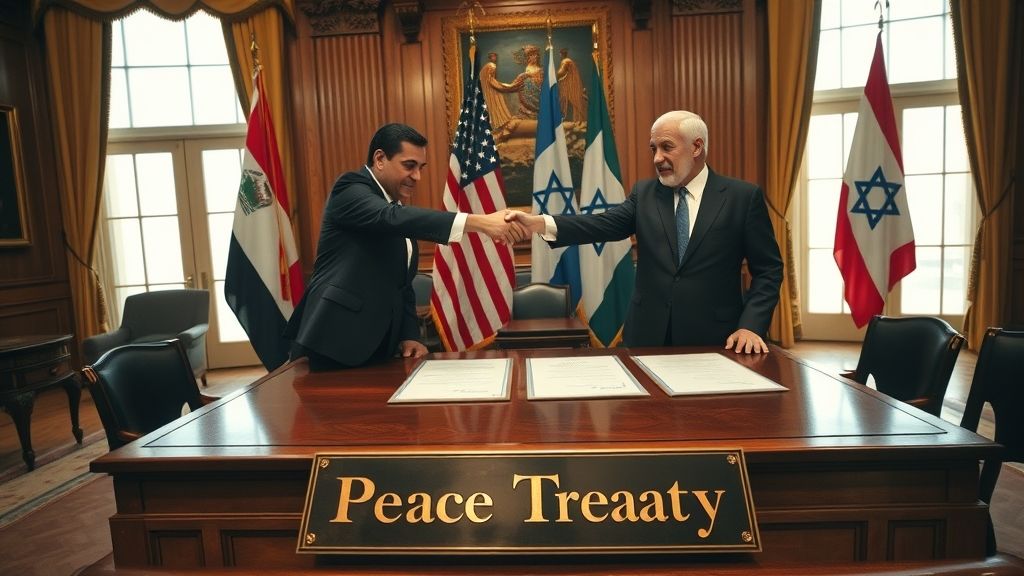
The day was bright, clear, and carried with it the weight of history. On March 26, 1979, beneath the careful eyes of international observers and in the heart of Washington, D.C., Egyptian President Anwar Sadat and Israeli Prime Minister Menachem Begin shifted the course of the modern Middle East with a handshake — signed, sealed, and delivered through the Egypt–Israel Peace Treaty. It was a moment heavy with symbolism. Decades of animosity, wars, and suspicion gave way to the fragile hope of peace. President Jimmy Carter, the architect and facilitator of this unprecedented accord, watched as the leaders extended their hands with a mixture of solemn duty and tentative optimism.
One could not help but feel the profound emotion simmering beneath the formalities—a testament to human courage in the face of entrenched conflict. Yet, this handshake was not simply the closing of paperwork, but the opening of a new, uncertain chapter for two nations long defined by enmity.
2. The Shadows of War: A Prelude to Peace
The Egypt–Israel relationship forged itself over decades of bloodshed, fear, and rivalry. The Six-Day War in 1967 had seen Israel deliver a crushing blow to Arab forces, substantially redrawing territorial lines and deepening the wounds in a region already marked by colonial fractures and nationalist struggles. Egypt, under Gamal Abdel Nasser, had been a central figure in the confrontation — a champion of Arab nationalism and resistance. Yet the humiliation of '67 only intensified Arab hostility towards Israel.
Then came the Yom Kippur War in 1973, a surprise attack by Egypt and Syria on Israeli territories during the holiest day in the Jewish calendar. Though tactically Israel would hold its ground and later regain lost lands, the war shocked Israel into acknowledging the need for a political solution. For Egypt, it marked a reclamation of dignity and a strategic opportunity. Both sides were caught in a gruelling cycle of violence, where each military engagement only reinforced enmity rather than resolution.
By the mid-1970s, international actors grew increasingly concerned. The Cold War undercurrents complicated the situation further, as the Soviet Union backed many Arab regimes, while the United States aligned firmly with Israel. The region was a chessboard — and the stakes could not have been higher.
3. The Long Road to Camp David
Peace was once considered a distant dream, dismissed as impossible amid endless dialogues that bore little fruit. Yet, beneath the surface, a clandestine dialogue had begun. Anwar Sadat shocked the Arab world in 1977 by becoming the first Arab leader to visit Jerusalem, signaling a daring new approach to the conflict. His speech at the Knesset was both conciliatory and bold, invoking shared history and the possibility of coexistence.
This act put the stage for formally mediated peace talks. Both sides recognized the desperate need for a solution, but deep mistrust shadowed every move. The United States, led by President Carter, saw an opportunity neither to be wasted nor underestimated.
4. An Unlikely Meeting Place: The United States as Mediator
Washington, D.C., is not a city often associated with ancient rivalries or desert struggles, but in the late 1970s, it became the improbable theater for the Middle East's most consequential peace negotiations. The U.S. held a delicate position — balancing its geopolitical goals, the loyalty of allies, and the desire to stabilize a volatile region.
President Jimmy Carter’s personal commitment went beyond the usual diplomacy. He invited Sadat and Begin to Camp David, the presidential retreat nestled in Maryland’s Appalachian Mountains, away from the prying eyes of the media and tensions of Washington. It was a calculated move — the isolation and intimacy would force confrontation and conversation, breaking down barriers of suspicion.
5. The Architects of Peace: Begin, Sadat, and Carter
The personality clashes were as significant as political positions. Menachem Begin, a former Irgun commander and staunch nationalist, had long viewed Arab states as enemies to be defeated. Anwar Sadat, charismatic and resolute, was a pragmatist willing to break taboos. Jimmy Carter, moralistic and deeply invested, acted as both referee and confidant.
Together, the three would embark on a two-week marathon of debate, despair, assurance, and delicate compromise. They were bound by a shared understanding that the alternative to peace was endless conflict — but each carried his own vision and red lines.
6. Camp David Accord: Days of Hard Negotiations
The Camp David negotiations from September 5 to 17, 1978, were marked by tense confrontations, unexpected breakthroughs, and hours of sleepless debate. Sadat insisted on full Israeli withdrawal from Sinai territory, while Begin grappled with security assurances and recognition of Israel’s right to exist.
The United States played an essential role, with Carter intervening personally to bridge gaps. When progress stalled, Carter would meet separately with each leader to coax concessions. “Peace,” Carter remarked later, “is not a natural condition in politics—it is created by relentless human courage.”
Against frequent skepticism, the Camp David Accords culminated in two frameworks: one setting the principles for peace between Egypt and Israel, the other offering a vision for Palestinian autonomy in the West Bank and Gaza — the latter less successful but ground-breaking nonetheless.
7. The Role of Diplomacy and Determination
The accords embodied the triumph of diplomacy where arms had failed. More than the formal document, it was a testament to the power of dialogue, patience, and personal tenacity. The leaders confronted historical wounds, nationalist pride, and domestic opposition — yet chose negotiation over arms.
It is important to grasp the human cost beneath this achievement. Dictating terms was easy compared to persuading populations and political elites back home. Both Sadat and Begin faced opposition from camps that viewed peace as betrayal or capitulation.
8. March 26, 1979: Signing the Peace Treaty
Following months of implementation talks and adjustments, the formal peace treaty was signed on March 26, 1979, in the East Room of the White House. The ceremony was grand yet heavy with caveats — a show of hope built on fragile foundations.
Jimmy Carter opened the event with words of solemn promise: “Let this peace be a beacon to the world.” When Sadat and Begin signed, cameras clicked, and reporters clamored — but the weight of years and the realization of the unknown future silenced the celebratory notes beneath the applause.
The treaty marked the first peace agreement between Israel and an Arab state, officially ending a state of war that had lasted since Israel’s creation in 1948.
9. The Content of Peace: Terms and Guarantees
The treaty's terms were meticulously crafted:
- Complete Israeli withdrawal from the Sinai Peninsula, returned to Egypt in stages.
- Recognition of each state's sovereignty and mutual diplomatic relations.
- Establishing normalized relations including the exchange of ambassadors.
- Cooperation on economic and cultural levels.
- Security arrangements preventing the use of Sinai for aggression.
- Framework mechanisms to resolve future disputes peacefully.
These details reflected staggering compromises, especially on territory and security—issues that had previously stymied all peace efforts.
10. Reactions across the Region: Acceptance and Resistance
The treaty sent shockwaves throughout the Arab world. While officially many Arab states declared support for peace, beneath the surface lay rage and resentment. Egypt’s leadership took the brunt of criticism.
The Arab League expelled Egypt in 1979, underscoring the intense regional backlash. Many believed Sadat had crossed an unforgivable line, breaking Arab solidarity with his unilateral peace deal. Palestinian groups saw the treaty as a betrayal of their cause.
Meanwhile, Israel celebrated peace with its largest neighbor but remained wary of other threats looming to its north and east.
11. The Price of Peace: Political Turmoil within Egypt
Sadat’s bold gamble came at a staggering personal and political cost. Many Egyptians viewed the treaty as capitulation, and his government cracked down on dissent.
Tragically, in 1981, Anwar Sadat was assassinated during a military parade by Islamist militants—an act directly tied to his role in the peace process and the domestic enemies it created.
His death highlighted the deep divisions within Egyptian society and the perilous path peace demanded.
12. Israel’s Strategic Gain and Regional Doubts
For Israel, the treaty guaranteed security on its southern border, a critical strategic victory allowing it to redirect military resources elsewhere.
However, many Israelis were skeptical, doubting if peace with Egypt could mean true reconciliation with the rest of the Arab world or resolve Palestinian issues.
Still, the treaty cemented Israel’s legitimacy on the international stage in a way no singular military victory had done.
13. The Cold War Context and Global Stakes
The treaty’s timing was no accident in the midst of Cold War rivalry. U.S. rapprochement with Egypt signaled a shift, pulling Egypt away from Soviet influence. This realignment altered alliances and regional power balances, embedding the Middle East deeper into East-West rivalries.
By fostering peace, the U.S. hoped to secure a reliable regional partner in Egypt, stabilizing the volatile frontiers of global superpower competition.
14. The Peace Treaty’s Impact on Arab-Israeli Relations
The treaty set a precedent, demonstrating that long-standing conflict could be resolved through diplomacy—yet it also underscored the stubbornness of other disputes.
While other Arab states remained hostile, the treaty opened channels for subsequent peace negotiations, influencing later deals such as the Oslo Accords.
It shifted the narrative from perpetual war toward cautious, if uneasy, coexistence.
15. Egypt’s Isolation and Later Reintegration in the Arab World
Post-treaty, Egypt suffered a decade of diplomatic isolation, cut off from pan-Arab institutions and allies. The costs were economic, political, and symbolic.
However, the 1990s saw Egypt slowly regain its position, particularly after the Gulf War when Egypt supported the coalition against Iraq.
The painful years of isolation contrasted with the historic benefits of peace, illustrating the complexities of regional politics.
16. Economic and Military Consequences for Both Nations
The treaty entailed substantial U.S. military and economic aid packages to both Egypt and Israel—a tool to maintain the peace bargain.
The Sinai demilitarization reduced potential flashpoints, while infrastructure investments transformed the desert region into economically viable territory.
Both countries invested in new security strategies, yet vigilance remained the norm.
17. The Treaty’s Legacy: A Blueprint and a Warning
The Egypt–Israel Peace Treaty stands as a dual symbol: a blueprint for conflict resolution and a warning of the difficulties peace entails.
It proves that leaders can transcend hatred but also that peace requires sustained effort, compromise, and courage amid enormous pressures.
Subsequent failures and ongoing conflicts remind us that peace treaties are beginnings, not ends.
18. Human Stories Behind the Headlines
Beyond political rhetoric were personal sacrifices. Soldiers returning home from Sinai, families living in once-contested areas, citizens wary of the unknown—all carried the emotional weight of a transformed reality.
Sadat’s boldness, Begin’s pragmatism, and Carter’s tenacity rested on millions of lives hoping for stability.
These human dimensions bring a textured understanding to what might otherwise seem distant geopolitics.
19. The Treaty in the Lens of History and Memory
Forty-five years on, historians weigh the treaty’s achievements against its challenges. It is commemorated as a major milestone in the pursuit of peace, yet also as a catalyst for regional estrangement.
Memorials to Sadat and Begin, careful education on the accords, and cinematic portrayals have preserved the event’s legacy, entwining it deeply in collective memory.
20. Contemporary Reflections: Peace in a Turbulent Region
Today, the Egypt–Israel Peace Treaty remains a cornerstone in Middle Eastern diplomacy.
Despite intermittent tensions, the treaty has held firm—a fragile peace that has allowed both nations to navigate decades of regional upheaval.
It prompts essential questions: how to deepen peace, how to address other conflicts, and what lessons remain for future leaders.
Conclusion
The signing of the Egypt–Israel Peace Treaty on March 26, 1979, encapsulates both the triumphs and challenges of peace-making in a world scarred by conflict. It was a moment born from courage, fraught with risk, and sustained by the unyielding will of visionary leaders. Yet peace is never a destination, but a continuous journey requiring resilience, understanding, and hope.
This treaty stands as a testament to humanity’s capacity to choose dialogue over destruction, compassion over conquest. Its legacy is a reminder that even the most entrenched enemies can find common ground when history demands vision and leaders dare to reach beyond their borders—and beyond themselves.
FAQs
Q1: What were the main causes that led to the Egypt–Israel Peace Treaty?
A1: The treaty grew out of decades of conflict, notably the wars of 1948, 1967, and 1973, which entrenched hostility. Sadat’s historic 1977 visit to Jerusalem and the international desire to stabilize the region, supported by U.S. mediation, set the stage for peace.
Q2: Who were the key figures behind the peace treaty?
A2: Egyptian President Anwar Sadat, Israeli Prime Minister Menachem Begin, and U.S. President Jimmy Carter were central. Their personalities, courage, and diplomatic skills were pivotal in overcoming deep-seated mistrust.
Q3: What were the main terms of the treaty?
A3: Israel agreed to withdraw from the Sinai Peninsula; both nations recognized each other’s sovereignty; diplomatic relations were established; and security arrangements ensured the demilitarization of Sinai.
Q4: How was the treaty received in the Arab world?
A4: The treaty was met with widespread condemnation by Arab states, leading to Egypt’s expulsion from the Arab League. Many Arab countries viewed it as a betrayal of the Palestinian cause and Arab unity.
Q5: What were the domestic consequences for Egypt?
A5: Sadat faced harsh opposition, including assassination in 1981 by Islamist militants opposed to the peace treaty. Egypt experienced diplomatic isolation and internal divisions resulting from the agreement.
Q6: Did the treaty bring lasting peace between Egypt and Israel?
A6: Yes, it ended a state of war and established a durable peace, making Egypt the first Arab country to officially recognize Israel. Despite tensions, the treaty remains in effect.
Q7: How did the treaty impact global politics during the Cold War?
A7: The treaty shifted alliances, diminishing Soviet influence in Egypt and strengthening U.S. presence in the region. It helped reduce superpower tensions locally, but complicated relationships in some Arab states.
Q8: What lessons does the Egypt–Israel Peace Treaty provide for future peace efforts?
A8: It illustrates that peace requires bold leadership, compromise, and international support. However, it also shows the importance of addressing broader regional issues and public sentiment to sustain peace.