Table of Contents
- The Dawn of a Fateful Day: June 24, 1839
- Setting the Stage: Egypt and the Ottoman Empire in the Early 19th Century
- Mehmed Ali Pasha’s Ambitions: From Viceroy to Sovereign
- The Geopolitical Chessboard: European Powers Eye the Ottoman Decline
- Military Innovations and Reforms in Egypt
- The Road to Nezib: Tensions, Mobilization, and Strategy
- The Ottoman Army: Strengths, Weaknesses, and Leadership
- The Battlefield at Nezib: Terrain, Weather, and Tactics
- The Clash of Forces: Hour by Hour on June 24
- Ibrahim Pasha’s Command: Genius, Discipline, and Determination
- The Ottoman Collapse: Chaos, Retreat, and Surrender
- Capturing the Ottoman Fleet: A Symbolic and Strategic Coup
- Immediate Aftermath: Shockwaves Through Istanbul and Cairo
- The European Powers’ Reaction: Balancing Act or Imperial Interests?
- The Treaty of London (1840): A Forced Peace and Its Ramifications
- The Legacy of Nezib: Shaping Egyptian Nationalism and Ottoman Reform
- Personal Stories from the Battlefield: Soldiers, Commanders, and Civilians
- The Battle in Historical Memory: Narratives and National Myths
- Nezib in the Broader Context of Middle Eastern History
- Conclusion: A Battle That Echoed Beyond the Battlefield
- FAQs About the Egyptian Victory at Nezib
- External Resources
- Internal Links
The June sun scorched the plains near the small town of Nezib, nestled in southeastern Anatolia, where two empires faced each other in a decisive confrontation. The air was tense with the mingled smells of gunpowder, sweat, and the dry dust kicked up by thousands of marching feet. For months, the Ottoman Empire and its rebellious Egyptian vassal had been edging toward open conflict, but few could have predicted how swiftly the day’s events would unfold. By nightfall of June 24, 1839, the Egyptian army under the seasoned Ibrahim Pasha had shattered the Ottoman forces, altering the political map of the Eastern Mediterranean forever.
The Battle of Nezib was not merely a clash of arms but a dramatic assertion of modernizing ambitions, personal rivalries, and competing visions of empire. To understand this pivotal moment, one must peer beneath the battle’s smoke, into the corridors of power where empires struggled not only for survival but for identity.
Setting the Stage: Egypt and the Ottoman Empire in the Early 19th Century
The year 1839 found the Ottoman Empire in a state of pronounced fragility. Once a sprawling polity dominating vast swaths of Europe, Asia, and Africa, it was now beleaguered by internal dissent, nationalist uprisings, and external pressures. At the same time, Egypt, technically an Ottoman province but in practice a semi-autonomous realm under the ambitious viceroy Mehmed Ali Pasha, was rising rapidly in power and prestige.
Mehmed Ali, an Albanian Ottoman commander turned ruler, had carved out a formidable state machinery in Egypt. Through ruthless reforms, military modernization, and territorial expansion, he challenged the very foundations of Ottoman authority. His successes in conquering the Levant and exerting influence over Arabia only deepened anxieties in Constantinople.
But this was more than a mere power struggle between ruler and vassal. It was a story steeped in the conflicting currents of modernity and tradition, nationalism, and imperial legacy. The Ottomans wished to preserve a crumbling unity; Egypt sought recognition as a sovereign force, a regional power in its own right.
Mehmed Ali Pasha’s Ambitions: From Viceroy to Sovereign
Mehmed Ali’s rise was remarkable: originally an Ottoman soldier who gained control of Egypt amidst the Napoleonic withdrawal in 1801, he transformed the province into a military-industrial powerhouse. His vision went beyond mere survival; he sought to establish a dynasty that would sit independently at the regional table.
The reforms Mehmed Ali undertook were sweeping. He introduced conscription, reformed agriculture, established workshops and factories, and built a modern army trained by European advisers. His son, Ibrahim Pasha, was the instrument of war, commanding Egypt’s forces with discipline and tactical brilliance.
However, Mehmed Ali’s ambitions collided directly with Ottoman sovereignty when he invaded Syria and Anatolia, aiming, in effect, to carve out a wider dominion. The Battle of Nezib would become a test not only of armies but of imperial fate.
The Geopolitical Chessboard: European Powers Eye the Ottoman Decline
Europe’s great powers, notably Britain, France, Austria, and Russia, watched the Ottoman crisis with hawkish eyes. Each had conflicting interests: Britain sought to safeguard routes to India and control of the Mediterranean; France supported Mehmed Ali partly as a counterbalance; Russia desired Ottoman weakness for territorial expansion; Austria feared nationalist contagions.
The Eastern Question—the fate of the Ottoman territories—was the central diplomatic puzzle of the era. The Battle of Nezib, therefore, was not just a regional conflict but a piece on a much larger imperial chessboard.
Military Innovations and Reforms in Egypt
The Egyptian army’s strength at Nezib derived from decades of modernization. Inspired by European models and led by foreign advisors, Egypt combined disciplined infantry armed with modern rifles and artillery with cavalry and logistics that outmatched their Ottoman counterparts.
These reforms represented a break from traditional Ottoman military structures dominated by Janissaries and feudal levies. The efficiency, training, and morale of Egyptian troops were palpable on the battlefield.
The Road to Nezib: Tensions, Mobilization, and Strategy
As Ottoman forces retreated eastward in response to Egyptian advances, the armies converged near the town of Nezib (modern-day Nizip, Turkey). Both commanders understood the stakes.
Ibrahim Pasha seized the strategic initiative, choosing ground that maximized his artillery and infantry strengths. His forces numbered about 35,000, while the Ottoman army, led by the young Abdülmecid Pasha, had a larger but less cohesive contingent of approximately 50,000 men.
Both sides suffered from internal divisions, supply issues, and the psychological toll of protracted conflict.
The Ottoman Army: Strengths, Weaknesses, and Leadership
The Ottoman army in 1839 was a patchwork of newly reformed units and traditional troops still loyal to outdated methods. The empire’s leadership was struggling to integrate European military reforms while managing ethnic and religious diversity across its ranks.
Abdülmecid Pasha, although earnest, lacked the military prowess and authority of his Egyptian opponent. Morale was fragile and command structures often confused, setting the stage for disaster.
The Battlefield at Nezib: Terrain, Weather, and Tactics
The plain near the Orontes River provided open ground conducive to artillery bombardment and maneuver warfare. The midday sun blazed relentlessly, exacerbating fatigue.
Ibrahim Pasha deployed his forces in a formation that encircled the Ottoman lines, using massed artillery to disrupt enemy formations. His cavalry was poised to exploit breaches, while the infantry held firm in well-drilled ranks.
The Ottomans took a defensive posture but were ill-prepared for the ferocity of the Egyptian assault.
The Clash of Forces: Hour by Hour on June 24
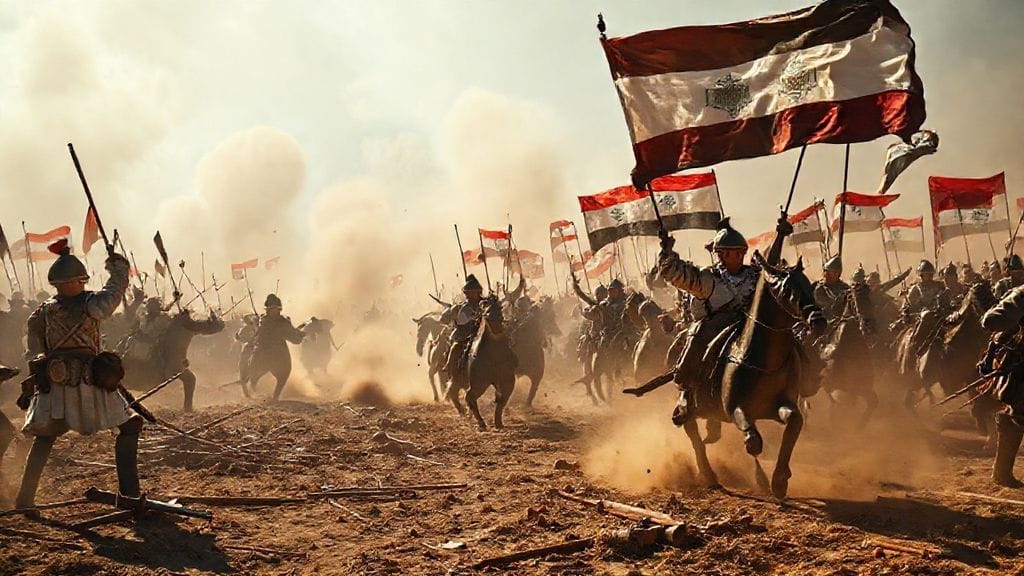
At dawn, the battle commenced with an exchange of artillery fire that shattered the morning silence. The Egyptians advanced methodically, keeping tight formations, their guns cutting down Ottoman columns.
By midday, Egyptian infantry had breached Ottoman flanks. The Ottomans attempted counterattacks, but confusion and lack of coordination under fire eroded their resolve.
As the afternoon progressed, the Ottoman army unraveled. Retreat turned to rout. Thousands of Ottoman soldiers fled across the Orontes, seeking safety in nearby towns.
Ibrahim Pasha’s Command: Genius, Discipline, and Determination
Ibrahim’s leadership was decisive. He combined strict discipline with bold tactics, motivating his troops toward a cohesive victory. His ability to exploit Ottoman weaknesses without overextending evidenced a keen strategic mind.
Witnesses recalled his calm demeanor under fire, and numerous letters praised his organizational skill—a leader in every sense.
The Ottoman Collapse: Chaos, Retreat, and Surrender
By dusk, the Ottoman forces had lost nearly half their men as casualties or prisoners. Abdülmecid Pasha fled the field, and command quickly disintegrated.
War correspondents of the time described scenes of mass confusion, abandoned artillery, and desperate fugitives.
The defeat was catastrophic, signaling not only a military loss but a blow to imperial prestige.
Capturing the Ottoman Fleet: A Symbolic and Strategic Coup
Shortly after the battle, the Egyptian forces took control of the Ottoman fleet anchored at the port of Acre. This naval seizure was as astonishing as the land victory; it demonstrated Egypt’s newfound dominance.
Possession of the fleet threatened Ottoman control of the eastern Mediterranean and underscored the empire’s vulnerability.
Immediate Aftermath: Shockwaves Through Istanbul and Cairo
News of the defeat plunged the Ottoman capital into anxiety. Sultan Abdulmejid I faced immense pressure to negotiate peace.
Conversely, in Cairo, celebrations mingled with anxious calculations about European reactions. Mehmed Ali sensed opportunity but understood the limits imposed by external diplomacy.
The European Powers’ Reaction: Balancing Act or Imperial Interests?
Despite initial admiration for Egyptian military prowess, European powers grew concerned that Mehmed Ali’s success might destabilize the region or upset the balance of power.
Combined diplomatic pressure, threats of intervention, and the shifting alliances led to the 1840 Treaty of London, forcing Egypt to relinquish much of its conquests, though Mehmed Ali retained hereditary rule over Egypt.
The Treaty of London (1840): A Forced Peace and Its Ramifications
The treaty was a double-edged sword: it preserved Ottoman sovereignty over Syria and Anatolia, but marked a tacit recognition of Egyptian semi-independence.
Mehmed Ali’s dream of outright sovereignty was curtailed, yet his state remained stronger and more autonomous than before.
The Legacy of Nezib: Shaping Egyptian Nationalism and Ottoman Reform
The battle signaled a turning point in Egyptian self-perception and Ottoman attempts at reform.
It exposed weaknesses in imperial military organization, encouraging Ottoman rulers to accelerate their Tanzimat reforms.
Simultaneously, Egyptian pride in military accomplishment sowed seeds of nationalism that would echo into the 20th century.
Personal Stories from the Battlefield: Soldiers, Commanders, and Civilians
Among the tens of thousands, human stories vividly illustrate the conflict’s complexity. Letters from Ottoman conscripts recount confusion and fear. Egyptian veterans spoke of relentless discipline tempered by camaraderie.
Local villagers between the lines endured disruption, famine, and the uncertain mercy of armies in flux.
The Battle in Historical Memory: Narratives and National Myths
In Egypt, Nezib became a symbol of resistance—proof that local initiative could confront imperial decline. Ottoman historiography framed it as a painful but instructive failure.
Nationalists in both Turkey and Egypt would revisit Nezib as a site of identity and lessons, each side interpreting the victory or defeat through their own lens.
Nezib in the Broader Context of Middle Eastern History
The battle underscored the fragility of empire and foreshadowed sweeping transformations. It was part of the long decline of Ottoman dominance intersecting with emerging nationalisms and European intervention.
The ripples of Nezib extended beyond borders, influencing regional politics well into the colonial and post-colonial era.
Conclusion
The Battle of Nezib stands as a vivid testament to an empire’s twilight and another’s ascent. It encapsulates the clash of old and new, tradition and innovation, loyalty and ambition. Though Mehmed Ali’s Egypt would eventually bend before European pressure, the resounding victory at Nezib illuminated a crucial truth: in the shifting sands of 19th-century empires, power was no longer guaranteed by birthright alone, but by vision, reform, and the will to fight.
The echoes of that hot June day resonate today, in the stories that nations tell themselves and in the geographies shaped by the struggles of the past. Nezib was more than a battle. It was a moment where history sped forward, unstoppable, and unforgettable.
FAQs About the Egyptian Victory at Nezib
Q1: Why was the Battle of Nezib fought?
The battle arose from Mehmed Ali’s ambitions to expand his rule beyond Egypt, directly challenging the Ottoman Empire’s authority over Syria and Anatolia.
Q2: Who were the main leaders in the battle?
Ibrahim Pasha led the Egyptian forces, while the Ottoman army was commanded by Abdülmecid Pasha.
Q3: What military innovations gave the Egyptians an advantage?
Egypt had modernized its army with European training, disciplined infantry, artillery superiority, and better logistics compared to the Ottoman forces.
Q4: How did the European powers respond to the Egyptian victory?
They feared regional instability and Mehmed Ali’s increasing power, leading to diplomatic intervention that resulted in the 1840 Treaty of London.
Q5: What were the immediate consequences of the battle?
A major Ottoman military defeat, the capture of the Ottoman fleet by Egypt, and heightened diplomatic tensions pushing toward negotiated peace.
Q6: How did the battle influence Ottoman reforms?
It exposed the empire’s military weaknesses, prompting acceleration of the Tanzimat reforms aimed at modernizing administration and army.
Q7: Is the battle remembered differently in Egypt and Turkey?
Yes; Egyptians often celebrate Nezib as a symbol of national strength, while Turkish narratives portray it as a sobering defeat with significant lessons.
Q8: What is the long-term historical significance of Nezib?
It marked critical shifts in imperial relations, foreshadowing the decline of Ottoman control and the rise of localized power centers in the Middle East.