Table of Contents
- The Calm Before the Storm: Beijing on the Eve of Invasion
- Seeds of Discontent: The Boxer Rebellion’s Origins
- A Nation in Turmoil: Qing Dynasty’s Struggles and Foreign Intrusion
- The Rise of the Boxers: Nationalism and Violent Resentment
- The Siege of the Legations: Innocence Encircled in a Foreign Quarter
- Global Powers Mobilize: Formation of the Eight-Nation Alliance
- Strategic Planning: The Road to Beijing
- The March to the Capital: An International Military Collaboration
- August 14, 1900: The Capture of Beijing Begins
- Urban Combat in the Forbidden City’s Shadow
- The Fall of the Legation Quarter: Relief and Devastation
- The Role of Key Figures: From Generals to Emissaries
- Civilian Suffering and the Price of Urban Siege Warfare
- Immediate Aftermath: Political Tremors and the Boxer Protocol
- The Legacy of the Invasion: China's Shock and the West’s Assertiveness
- Cultural Narratives: Recounting the Siege in Chinese Memory
- The Shadow of Imperialism: Global Repercussions and Lessons
- Long-Term Effects on Sino-International Relations
- The Military Lessons: Coalition Warfare at the Turn of the Century
- Reflections on Intervention: Humanitarianism or Exploitation?
- The Boxer Rebellion and Beijing’s Modern Identity
- Commemorations and Historiography: Revisiting the 1900 Invasion
- Echoes in Contemporary Geopolitics: Resonance of the Past
- Conclusion: The End of an Era and the Dawn of Modern China
- FAQs: The Eight-Nation Alliance and the 1900 Beijing Capture
- External Resource
- Internal Link
The Calm Before the Storm: Beijing on the Eve of Invasion
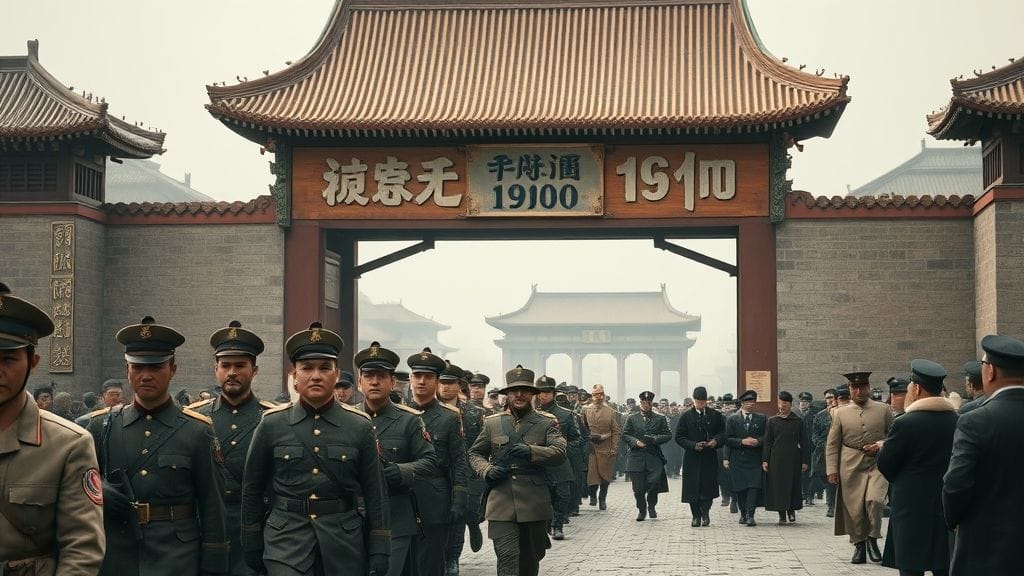
August 1900—Beijing, the imperial heart of the Qing Empire, bustled with a paradoxical mixture of ancient grandeur and mounting tension. The heat hung heavy in the air, carrying with it an unease deeper than the sweltering summer. Streets thronged by peasants, soldiers, foreign diplomats, and merchants seemed ordinary at first glance. The Forbidden City rose majestically against a graying sky, a sanctum of imperial power untouched for centuries. But beneath this veneer of order, the city simmered with volatile fears. The Boxer uprising had grown deadly, diplomatic quarters were under siege, and the world’s eyes fixated on this Asian capital poised on the brink of catastrophe.
Time seemed to slow on that humid morning as the distant thunder of foreign artillery echoed ever closer. The arrival of the Eight-Nation Alliance—a coalition of global powers united by fear, ambition, and the desire to stamp their mark on China’s fate—would forever change Beijing’s history and reverberate through the next century.
Seeds of Discontent: The Boxer Rebellion’s Origins
To comprehend the capture of Beijing by the Eight-Nation Alliance, one must unravel the tangled roots of the Boxer Rebellion, a nationalist uprising fueled by desperation and xenophobic fervor. The 1890s had left China battered: the Qing Dynasty, aged and weakening, faced unprecedented external pressures. Humiliations piled up—the Sino-Japanese War of 1894-1895, the carve-up of China by Western imperial powers, and the unending presence of missionaries and merchants prizing opium sales over cultural sensitivity.
Disparate groups of disenfranchised peasants and martial artists coalesced into the “Righteous and Harmonious Fists,” derogatorily called “Boxers” by foreigners, due to their practice of martial rituals believed to grant invulnerability. Their crusade was violently anti-foreign and anti-Christian, violent outbursts directed at both missionaries and Chinese Christians, symbols of the invasive West.
It was a tinderbox waiting for a spark—and the spark came as the Boxers marched towards Beijing, intent on purging foreign influences and questioning the very foundation of Qing governance.
A Nation in Turmoil: Qing Dynasty’s Struggles and Foreign Intrusion
Meanwhile, the Qing court stood divided. Empress Dowager Cixi, the de facto ruler, oscillated between suppressing the Boxers and harnessing them as a weapon against foreign powers. This ambivalence reflected a broader schism within China, torn between reformists seeking modernization and conservatives clinging to Confucian traditions. The government’s indecision granted the Boxers greater boldness.
Foreign legations, embassies of Britain, France, Germany, Russia, Japan, the United States, and others, perched vulnerably in Beijing’s Legation Quarter—an island of Western law within Chinese imperial soil. Their presence, while intended as a safeguard for nationals and commercial interests, was a daily provocation to the simmering nationalist fury outside their walls.
The Rise of the Boxers: Nationalism and Violent Resentment
Across northern China, the Boxers swelled in numbers. Their message was savage: drive out the "foreign devils" and restore China's purity under Han and Manchu traditions. Their forces laid siege to towns, slaughtering missionaries and converts with brutal efficiency. Rumors flourished that Boxer rituals conferred supernatural protection against bullets, emboldening their courage.
In July 1900, the Boxers neared Beijing, their numbers swelling to tens of thousands. Qing military units wavered, some siding secretly with the rebels, further paralyzing any effective defense.
The Siege of the Legations: Innocence Encircled in a Foreign Quarter
The Legation Quarter of Beijing, a maze of diplomatic buildings, homes, and embassies, became the focal point of this conflict. Around 900 Western civilians and troops, along with several hundred Chinese Christians, found themselves besieged by Boxer forces and Qing troops loyal to them.
For 55 harrowing days, these defenders endured cut-off supplies, constant bombardment, and the fear of massacre. Letters sent in desperation made their way to foreign capitals, igniting international outrage and demanding intervention.
Global Powers Mobilize: Formation of the Eight-Nation Alliance
The siege was an undeniable provocation that plunged the imperialist powers into action. Britain, Russia, Japan, Germany, France, the United States, Italy, and Austria-Hungary coalesced into the Eight-Nation Alliance. This rare coalition was borne not of friendship but of mutual interest: the protection of nationals and the preservation of unequal treaties forcing China open to foreign trade and influence.
Each nation dispatched troops across perilous terrains. What followed was an immense logistical and military effort—one of the earliest examples of multinational coalition warfare in the modern age.
Strategic Planning: The Road to Beijing
Coordinating an assault on a fortified capital thousands of miles from home presented immense challenges. The alliance commanders met in places as diverse as Tianjin and Shanghai, debating strategies that balanced speed and caution.
The main objective was to reach Beijing's Legation Quarter and break the siege. But the city was heavily fortified, and the Boxers and Qing troops had prepared for defense. Diplomats warned of possible massacres should the foreign armies fail to act swiftly.
The March to the Capital: An International Military Collaboration
By mid-July, the allied forces began their advance from their respective positions. Soldiers ranged from British Gurkhas and Indian sepoys, Russian Cossacks and Siberian infantry, Japanese Samurai-descended troops, to disciplined European battalions and American Marines.
Despite differences in language, discipline, and culture, they formed an uneasy alliance. The march was grueling: summer heat, logistical bottlenecks, and constant skirmishes with Boxer fighters.
Yet their resolve was unbroken; behind them, a tide of international media coverage and public pressure demanded success.
August 14, 1900: The Capture of Beijing Begins
On the morning of August 14, the combined assault commenced. Allied artillery blasted city barricades as infantry prepared to storm the walls. The air, thick with smoke and dust, was punctuated by the ear-splitting roar of cannons and rifle fire.
The defenders, both Qing troops and Boxers, fought fiercely, aware that the city's fall meant a crucial blow to their cause. But the alliance’s superior firepower and tactical coordination began to tilt the balance.
Urban Combat in the Forbidden City’s Shadow
Fighting in Beijing’s narrow streets was brutal and chaotic. Allied troops cleared blocks, breached gates, and engaged in fierce street-to-street combat. The Forbidden City, the centuries-old imperial palace, loomed above like an inscrutable witness to the unfolding turmoil.
Though largely spared direct fighting by imperial decree, surrounding districts suffered greatly—houses burned, civilians caught in crossfire, and cries of suffering echoed alongside gunfire.
The Fall of the Legation Quarter: Relief and Devastation
After days of fierce struggle, the Legation Quarter was finally relieved. The terrified defenders emerged, faces gaunt, spirits bruised but alive. The siege was broken, but at a terrible cost.
Yet the victory was hollow and bittersweet. The intervening days revealed atrocities on all sides—Boxer fighters had slaughtered civilians and missionaries, while allied troops engaged in retaliation and looting. The scars on Beijing’s physical and social fabric would take decades to heal.
The Role of Key Figures: From Generals to Emissaries
The capture involved military leaders like British General Alfred Gaselee, Japanese General Yamaguchi Motoomi, and American General Adna Chaffee. Their decisions and coordination under pressure shaped the campaign.
On the Qing side, Prince Duan championed the Boxers, while others like the Guangxu Emperor remained sidelined. Diplomats like British Minister Claude MacDonald played critical roles negotiating under fire.
Their personal stories reveal the complexity of an event often reduced to a simple narrative of East versus West.
Civilian Suffering and the Price of Urban Siege Warfare
Amid the battle lines, ordinary Beijing residents endured terror and devastation. Families fled, churches and homes burned, marketplaces transformed into battlegrounds.
The invasion exposed the human cost of imperial rivalry—foreign soldiers entered as liberators for some and oppressors for others. Reports detail harrowing accounts of women and children caught in indiscriminate violence.
Immediate Aftermath: Political Tremors and the Boxer Protocol
With Beijing captured, the Eight-Nation Alliance forced the Qing government to sign the Boxer Protocol in September 1901, imposing heavy reparations and executing officials linked to the uprising.
China's sovereignty was further compromised. Foreign troops stationed in Beijing for years, resenting a government perceived as weak and complicit. The humiliation fueled nationalist resentment and inspired future reforms and revolutions.
The Legacy of the Invasion: China's Shock and the West’s Assertiveness
The events of 1900 marked a turning point. For the West, the crushing of the Boxer Rebellion reinforced their dominance in China and justified imperialistic policies cloaked in ideals of civilization and order.
For China, it underscored vulnerabilities and the urgent need to modernize. The era of unequal treaties and foreign occupation would eventually culminate in the fall of the Qing Dynasty less than a decade later.
Cultural Narratives: Recounting the Siege in Chinese Memory
Chinese historical memory is shaped both by the humiliation of foreign intervention and the complex legacy of the Boxers. Popular stories paint the rebels as both tragic patriots and misguided zealots.
Poetry, literature, and oral histories carried forward the trauma and valor, while official accounts vacillated between condemnation and cautious reverence.
The Shadow of Imperialism: Global Repercussions and Lessons
The intervention exposed the darker face of imperialism that would characterize much of the twentieth century—the entitlement to impose power through force far from home, the cynical disregard for local sovereignties, and the contradictions of humanitarian rhetoric.
It prompted critiques within Western societies, sparking debates on morality and the price of empire.
Long-Term Effects on Sino-International Relations
The invasion intensified foreign presence in China, but also seeded resistance. It catalyzed movements that would reshape China’s political landscape—constitutional reforms, revolutionary movements culminating in 1911, and long-term suspicion of foreign intentions.
Diplomatically, it also marked a rare moment of coordination among eight often competing powers, influencing how future coalitions formed.
The Military Lessons: Coalition Warfare at the Turn of the Century
The multinational operation remains a study in early coalition warfare, highlighting challenges of command, communication, and cultural differences that resonate even today in military alliances.
It tested emerging doctrines of urban warfare and power projection in distant theaters, shaping military thought in participating countries.
Reflections on Intervention: Humanitarianism or Exploitation?
Was the Eight-Nation Alliance driven by altruism to save lives or imperial greed cloaked in moral pretext? Historians continue debating motivations, underscored by testimonies of genuine rescue and terrible abuses alike.
This duality reflects perennial dilemmas about foreign intervention still relevant in modern geopolitics.
The Boxer Rebellion and Beijing’s Modern Identity
Beijing’s transformation from imperial capital to modern metropolis retains the imprint of 1900. Monuments, plaques, and museums commemorate the rebellion and the siege, offering lessons on resilience and reconciliation.
The city’s layers of history intertwine—dynastic power, foreign intrusion, revolution, and renewal.
Commemorations and Historiography: Revisiting the 1900 Invasion
Over the decades, scholars from China and abroad have re-examined the rebellion and invasion. New archival evidence, memoirs, and archaeological work enrich understanding beyond stereotyped narratives.
Annual commemorations reflect national pride and historical reflection, fostering dialogue about identity and sovereignty.
Echoes in Contemporary Geopolitics: Resonance of the Past
The memory of the Boxer Rebellion preservation and foreign capture informs China’s contemporary policies regarding sovereignty and foreign relations. Sensitivities over interference, territorial integrity, and cultural pride find roots in the trauma of 1900.
It remains a potent symbol against foreign domination and a reminder of the complexities of cross-cultural encounters.
Conclusion: The End of an Era and the Dawn of Modern China
The capture of Beijing on August 14, 1900, by the Eight-Nation Alliance was no mere military episode; it was a crucible of clash—between tradition and modernity, empire and nationalism, East and West.
It marked the twilight of imperial China and set the stage for a tumultuous century of revolutions, reforms, and regrowth. Its lessons resonate in the enduring struggle for dignity and self-determination.
From the smoke-wreathed streets of that August day to the vibrant capital of today, the story of the siege is at once a tragedy and a testament—a reminder that history's upheavals shape not just nations, but the hearts of their people.
FAQs
Q1: What triggered the Boxer Rebellion, and how did it lead to the siege of Beijing?
The Boxer Rebellion stemmed from widespread anti-foreign resentment and desperation caused by economic hardship, foreign imperialism, and Christian missionary activities. The Boxers’ march on Beijing sought to expel foreigners, culminating in their siege of the Legation Quarter where foreign nationals resided.
Q2: Who were the members of the Eight-Nation Alliance, and why did they intervene?
The alliance consisted of Britain, Russia, Japan, Germany, France, the United States, Italy, and Austria-Hungary. They intervened primarily to protect their citizens and interests trapped inside Beijing, to suppress the uprising, and to maintain their spheres of influence in China.
Q3: What was the significance of the Boxer Protocol?
Signed in 1901, the Boxer Protocol ended the rebellion but imposed harsh penalties on China, including large indemnities, execution of officials, foreign military stationing, and further erosion of sovereignty, deepening China’s status as a semi-colony.
Q4: How was the siege of the Legation Quarter conducted, and how were civilians affected?
The siege lasted 55 days with desperate fighting, shortages, and mounting fears among civilians. Those trapped suffered shortages and constant threat, while many outside faced brutal violence from Boxers and Qing forces.
Q5: How is the Boxer Rebellion remembered in China today?
It is viewed with mixed sentiments: as a symbol of anti-imperialist resistance and tragic patriotism, and a lesson on the dangers of extremism. Commemorations highlight both suffering and resilience.
Q6: What were the longer-term effects of the Eight-Nation Alliance’s capture of Beijing?
It deepened foreign control but also galvanized reformist and revolutionary movements in China, ultimately contributing to the Qing dynasty's downfall and modern China’s birth.
Q7: Did the intervention reflect humanitarian motives or imperial exploitation?
The motives were complex—a blend of genuine concern for foreign nationals and opportunistic imperial interests exploiting the crisis to expand influence.
Q8: What military lessons arose from this multinational campaign?
The campaign illustrated challenges of coalition warfare—logistics, coordination, cultural differences—and showcased early examples of urban combat tactics relevant to later conflicts.