Table of Contents
- A Quiet Day in Rome Before an Unexpected Choice
- Rome in 236 CE: Empire, Anxiety, and a Persecuted Church
- The Shadow of Martyrs and the Empty Chair of Peter
- Who Was Fabian Before History Remembered His Name?
- The Gathering of Bishops and People in a City on Edge
- The Dove Descends: Legend, Symbol, and the Election of Pope Fabian
- From Farmer to Bishop of Rome: The Weight of Sudden Authority
- Reorganizing a Scattered Church: Fabian’s Administrative Genius
- Politics, Emperors, and the Thin Line of Tolerance
- Catacombs, Martyrs, and the Cult of Memory
- Doctrinal Tensions and the Seeds of Future Schisms
- Everyday Roman Christians Under Fabian’s Pastoral Care
- Storm Clouds: From Philip the Arab to Decius the Persecutor
- Pope Fabian’s Final Trial and Martyrdom
- How the Story Was Told: Legend, Liturgy, and Memory
- The Election of Fabian and the Development of the Papacy
- Echoes Through the Centuries: Art, Scholarship, and Debate
- Reconstructing January 10, 236: A Historian’s View
- Conclusion
- FAQs
- External Resource
- Internal Link
Article Summary: On a seemingly ordinary winter day in 236 CE, the Christian community of Rome gathered to choose a new bishop and witnessed an event that would echo through legend: the election of pope Fabian. From the humblest of backgrounds, Fabian arrived as an obscure layman and left that gathering as leader of one of the most vulnerable yet resilient communities in the empire. This article retraces the tense historical context of third-century Rome, the persecutions that shaped Christian memory, and the surprising story that a descending dove somehow sealed his election. It explores how the election of pope Fabian transformed not only his own life but also the inner workings of the Roman Church, from its administration and catacombs to its relations with emperors and heresies. Yet behind the miracle story lie complex political realities, social anxieties, and a community trying to organize itself in the shadow of imperial suspicion. By weaving narrative and analysis, we follow Fabian from farmer to martyr, from anonymity to canonization, and examine how later generations retold and reshaped his story. Ultimately, the election of pope Fabian becomes a window into the slow, fragile emergence of the papacy as an institution of enduring power and memory.
A Quiet Day in Rome Before an Unexpected Choice
Rome woke under a low, colorless January sky. The year was 236, though no one on the streets spoke in those numbers; they reckoned time by the names of consuls, by imperial years, by the slow rhythm of harvests and taxes. It was just another winter morning in the capital of the empire, crowded with the creak of carts and the bark of vendors, with slaves fetching water and soldiers clattering along the paving stones. Yet somewhere beneath the surface noise, in courtyards and tenement stairwells, a quieter movement unfolded. Men and women, many of them poor, some of them household slaves, a few of them citizens of rank, walked with deliberate discretion toward one particular gathering place. They were members of the Christian community of Rome, and on this day they were to take part—directly or indirectly—in what later generations would remember as the election of pope Fabian.
To those outside that fragile circle, the event hardly seemed worth noticing. The empire did not yet recognize the bishop of Rome as a figure of global consequence. He was, from the state’s perspective, at best the representative of a stubborn, marginal, often troublesome religious minority. But inside the community, the seat once associated with Peter, now vacant after the death of Bishop Anterus, carried almost unbearable weight. It meant continuity with the apostles, guidance in crisis, and an organizer in times when persecution might erupt without warning. The Christians who moved through the alleyways that morning bore scars of memory: stories of Nero’s cruelty, of Decian rumors beginning to stir, of friends dismissed from jobs or disowned by families because of their faith.
No one expected what would happen that day. The names circulating among the faithful were those of respected presbyters and deacons, men who had already proven themselves in preaching, discipline, and diplomacy. Fabian, a stocky provincial landowner of middle years, probably walked into that assembly with the untroubled anonymity of someone who comes merely to pray and to watch decisions being made by others. Yet before the sun would set, that anonymity would vanish. Through a sequence of events that later writers would cast in the language of miracle, the election of pope Fabian would become one of the most striking stories of leadership by surprise in Christian antiquity.
This was only the beginning. The quiet of the morning, the ordinary sounds of Rome’s streets, masked a turning point. The man who would be chosen on this day would oversee the systematization of the Roman Church, deepen its care for martyrs and their graves, and hold the community together at the edge of an approaching storm. Long before later ages would speak of “popes” with the weighty implication of universal jurisdiction, this modest, almost accidental election offered a glimpse of what the office of bishop of Rome might yet become.
Rome in 236 CE: Empire, Anxiety, and a Persecuted Church
To understand the drama of that January day, we have to step back into the world of 236 CE, when the Roman Empire was beginning to shudder under pressures that would, over the next decades, grow into full-blown crisis. The so‑called “Third-Century Crisis” had not yet received its name, but its early tremors could be felt. Emperors were made and unmade by army intrigue. Frontier wars flared along the Rhine and the Danube; in the east, the revived power of the Sasanian Persians threatened imperial pride and territory. Around Rome itself, the urban plebs navigated food shortages, taxation, and the unpredictable moods of imperial authority.
Religion, in this environment, was both glue and fault line. Public cults to Jupiter, Mars, and the divine person of the emperor intertwined with civic identity; sacrifices and processions were woven into the calendar. To reject those traditional practices was, in the eyes of many Romans, to reject the solidarities that bound the empire together. Christians, with their refusal to offer incense to the emperor’s image, appeared to some neighbors as saboteurs of the gods’ favor. They met, often in the houses of wealthier converts, sometimes in rented halls, increasingly in semi‑formal buildings whose discreet furnishings hinted at permanent worship. They practiced rituals—baptism, Eucharist, anointing—that puzzled outsiders, and shared letters and gospels that told of a crucified criminal as “Lord.”
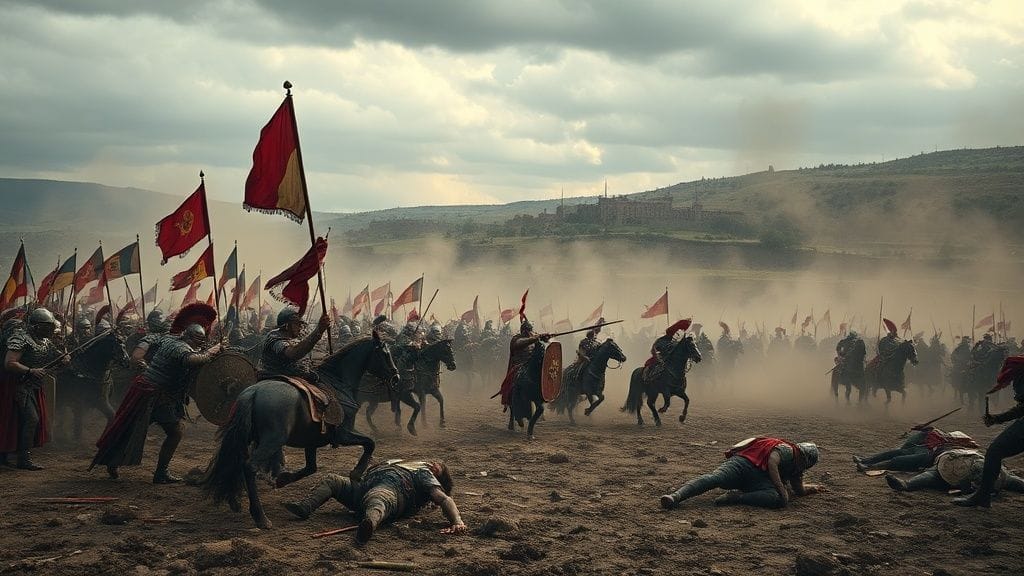
By 236, Christians had already endured waves of persecution, both localized and empire‑wide. Nero’s brutal scapegoating after the Great Fire, the martyrdoms under Domitian and Trajan, the sporadic crackdowns of later emperors—all these episodes lived on in the community’s memory, told and retold in whispered gatherings and in the Acts of Martyrs. Imperial policy was inconsistent: some emperors ignored them, others pursued them. A cautious tolerance might prevail one decade and evaporate the next. Under Emperor Maximinus Thrax, who had come to power in 235, hostility sharpened. He distrusted the clergy, especially those suspected of sympathies with his predecessors, and local officials knew that zeal against subversive groups could win them favor.
Yet Christians were not merely victims. They formed associations that cared for widows, orphans, and the poor, distributing alms collected weekly. They buried their dead with reverence and sometimes with a defiant generosity of space and decoration. In Rome, the community had grown large enough to require careful organization. It spanned different neighborhoods, social classes, and even languages—Latin, Greek, and others heard in the port of Ostia. To hold such a diverse, embattled body together required leadership: bishops, presbyters, deacons, and an array of unofficial elders and patrons. The vacancy at the top left the community vulnerable, especially at a time when imperial authority was unstable.
In that context, the election of pope Fabian was not a quaint ecclesiastical formality but an urgent political and spiritual necessity. Whoever stepped into that role would have to face not only the inner disputes of doctrine and discipline but also the prickly realities of an empire that might at any moment decide that Christians were, once again, enemies of the gods and therefore enemies of the state.
The Shadow of Martyrs and the Empty Chair of Peter
The death of Bishop Anterus left what Christians in Rome would have sensed as far more than an administrative vacancy. The bishop’s seat—symbolically linked to the apostle Peter—was now empty, and with it the focal point for teaching, liturgy, and external negotiation. To later ages, that chair would become the throne of the pope; in 236, it was still a simpler but already powerful symbol of continuity. In a community that prized unbroken succession from the apostles, the list of names—Linus, Anacletus, Clement, and onward—was not a mere roster of officeholders. It was a chain, a lifeline reaching back to Christ himself.
Equally powerful was the Church’s relationship with its martyrs. The graves of those who had died rather than renounce their faith were scattered in and around Rome: in the catacombs along the Via Appia, the Via Salaria, and other roads leading out of the city. Christians visited these resting places on anniversaries, celebrated liturgies “ad corpus” near the tombs, and copied stories of courageous deaths that circulated from community to community. The memory of martyrs functioned both as warning and inspiration. Their heroism offered models for how to face interrogations, torture, and execution. Their deaths also reminded the living that faithfulness could carry a lethal price.
Under previous bishops, including Pontian and Anterus, the Church of Rome had begun to organize this cult of memory more formally. Lists of martyrs were kept, burial sites were catalogued, and funds were set aside for the construction and maintenance of underground galleries. These lists were more than paperwork; they were acts of defiance against oblivion, insisting that those whom the state had tried to erase would be remembered by name. When Anterus died—likely after a very brief episcopate—his own burial needed arranging. The community performed the rites, but the question lingered: who would now guide into the future this complex, emotionally charged relationship with the dead?
That is the world into which Fabian walked on the day of the election. The empty chair of Peter seemed to stare at everyone in the room, a mute demand for decision. The stories of martyrs hovered in the air like unseen witnesses. The people who had gathered were not choosing a mere supervisor; they were designating a successor to a heritage of suffering and hope. No one imagined that the choice would fall upon a stranger to the city’s inner clerical circles. Fewer still could have foreseen that later Christian writers, such as Eusebius of Caesarea, would one day recount this day as a turning point marked by a sign from heaven.
Who Was Fabian Before History Remembered His Name?
Before his election, Fabian was, in historical terms, almost invisible. This obscurity is itself telling. He was not a famous teacher, not a celebrated martyr, not a known troublemaker in the imperial records. Most likely, he came from the Italian countryside—later sources suggest he was a layman of some means, perhaps a small landowner or farmer. He would have known the rhythm of sowing and harvest, the stubbornness of the soil, the anxieties of weather. It is entirely plausible that he had come to Rome partly on business and partly drawn by the gravitational pull of the capital’s Christian community, stronger and more organized than those of many provincial towns.
Fabian’s faith, though unrecorded in detail, can be inferred from the very fact of his presence at the election. To attend such a gathering was to affiliate openly with a suspect group. Imperial policy might be inconsistent, but surveillance was real, informers existed, and the possibility of sudden crackdown was never far away. One does not risk such visibility for a faith held lightly. Whether Fabian had already served in some local capacity where he came from—perhaps as an elder or organizer—is a matter of speculation. But he must have been known, at least to a few, as a man of seriousness and piety. Ordinary holiness, in the Christian imagination, often carries greater long‑term weight than momentary brilliance.
Imagine, then, Fabian entering the assembly hall or courtyard where the election would take place. He is likely dressed plainly, perhaps marked by calloused hands and the weathered face of someone used to outdoor labor. The eyes of the community are not on him. They rest instead on the presbyters whose doctrinal debates and pastoral visits have made them familiar figures. Fabian, in all probability, expects to cast his support for one of these men and then to return to relative obscurity, enriched perhaps by a sense of having participated in a solemn decision. Fate, or providence as Christians would say, had other plans.
Historically, such sudden ascents from obscurity are rare but powerful. They challenge assumptions about who is “qualified” to lead. They reconfigure networks of influence. When later writers narrated the election of pope Fabian, they emphasized precisely this contrast between his humble status and the dignity suddenly thrust upon him. The shock of that contrast would anchor the legend that followed: a dove, symbol of the Holy Spirit, descending and resting upon the head of an unknown layman as if to say, in visible sign, “this is the one.” Whether one reads this as literal miracle, theological embellishment, or a powerful communal memory shaped by faith, it conveys the community’s conviction that something extraordinary had happened to an ordinary man.
The Gathering of Bishops and People in a City on Edge
The exact location of the election is lost to us, but the setting can be plausibly reconstructed. The Christian community of Rome in 236 did not yet occupy the great basilicas that would later dominate its landscape. Instead, its principal gathering places were likely large houses adapted for worship—domus ecclesiae—and perhaps a few modest halls with simple furnishings: wooden chairs or benches, an altar table, lamps burning smoky oil. Light filtered in from small courtyards; the air carried the mixed scents of wax, incense, and crowded bodies.
The process of choosing a bishop in this period was not standardized in the later canonical sense, but there were recognizable patterns. Local clergy, neighboring bishops, and representatives of the laity all played roles. The community’s tradition insisted that the bishop should emerge not as the imposition of a distant authority but as someone whose faith and character were known and affirmed by the people he would lead. It is striking that, centuries later, canonists would look back to such early elections as models of “consent of the faithful,” even as real procedures changed under different pressures.
On that morning or early afternoon, those present would have been filled with a mix of solemnity and tension. News and rumors from beyond Rome’s walls no doubt circulated in low voices: skirmishes in distant provinces, changes of governors, whispers of imperial decrees. Within the community, there were also unresolved theological questions: how strictly to treat those who had lapsed under past persecutions; how to relate to communities that had diverged on issues like the nature of Christ or the validity of certain baptisms. The man chosen as bishop would need not only courage but also patience and a certain political dexterity.
Presbyters and deacons perhaps stood or sat at the front, their faces turned toward the assembly. A few visiting bishops from nearby regions might have been present to lend authority and continuity; Roman tradition later treasured such collegiality. Men and women, free and slave, gathered behind them. Some carried infants. Others bore scars—physical, emotional—from past confrontations with the authorities. Old men who remembered Trajan’s policy of limited tolerance might have looked anxiously toward their grandchildren, unsure what the future would hold.
Within this charged atmosphere, names were spoken aloud. Voices expressed support, doubts, hopes. Prayers were recited. Perhaps a passage from the Gospels was read—Jesus choosing the Twelve, or Peter confessing Christ at Caesarea Philippi. The symbolism would not have been lost on anyone. And somewhere, in a corner or at the edge of the crowd, Fabian listened. It is astonishing, isn’t it, to imagine that his mind might have wandered, as any ordinary person’s would, toward personal concerns: the state of his farm, the health of his family, the logistics of his journey home. None of those concerns would vanish, but by the end of that day, they would be overshadowed by a responsibility that still seems almost impossible: to shepherd the largest Christian community in the world’s greatest city under the gaze of a potentially hostile empire.
The Dove Descends: Legend, Symbol, and the Election of Pope Fabian
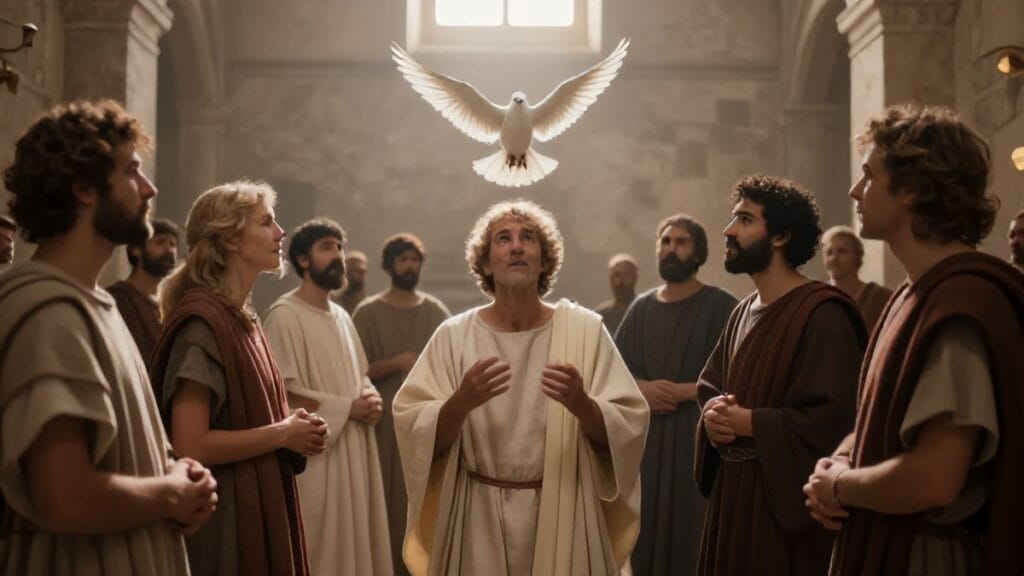
And then, according to the oldest account we possess, something happened that no one had planned. The Church historian Eusebius of Caesarea, writing in the early fourth century, preserves the story in his Ecclesiastical History. He tells us that as the Christians were gathered, uncertain whom to choose, a dove suddenly flew into the assembly and settled upon the head of Fabian. The crowd, struck with awe, interpreted this as a sign of the Holy Spirit, echoing the Gospel account of the Spirit descending like a dove upon Jesus at his baptism. The reaction, Eusebius says, was unanimous: the people cried out that Fabian was worthy, and he was at once seized and placed upon the episcopal seat. Thus, the election of pope Fabian was sealed not by intricate political maneuvering but, in the memory of the community, by a visible intervention from heaven.
Even a modern, critical historian must pause before this narrative. On the one hand, we recognize in it the familiar motifs of hagiography: divine signs, sudden reversals of fortune, the elevation of the humble. On the other hand, the story is not without a certain plausibility as communal memory. A bird entering an open courtyard or hall in Rome would not have been rare. For a crowd primed by biblical imagery, such a moment could easily crystallize into a powerful symbol: the unknown layman marked by the dove becomes, in an instant, “the chosen one.” Was the bird’s landing pure coincidence, seized upon by a community longing for a clear sign? Or did later recollection, shaped by devotion, embellish a more prosaic process of acclamation?
Scholars debate these questions. Some argue that the dove story suggests that Fabian already enjoyed a reputation for sanctity or leadership in some circle, and that the image of the dove simply dramatized a choice that many present were prepared to make. Others propose that the story served to sanctify an otherwise surprising election, offering a legitimizing myth to later generations who might have wondered how such a relatively unknown figure obtained such a high office. Whether literally accurate or not, the account captured something essential about how early Christians wanted to understand their leaders: chosen, not merely by human preference, but by divine guidance manifest in community experience.
Whatever we make of the details, the story’s impact is undeniable. It fixed the election of pope Fabian in the Christian imagination as a moment of extraordinary clarity in a confused time. The emphasis on lay participation—Fabian as an ordinary believer suddenly lifted by communal acclamation—also speaks to an early ecclesiology in which the people of God, not just a clerical elite, played an active role. In that sense, the dove story is less about ornithology than about theology. It proclaims that the Spirit may speak through the unexpected, and that leadership can emerge not only from the center but also from the margins.
Yet behind the celebrations and the exhilaration of that moment, Fabian himself must have felt something very different: a dizzying vertigo. To be shouted into office by a crowd convinced that heaven had spoken is a heavy burden for any conscience. In that instant, his life was no longer his own. The hall, the faces, the sound of voices chanting his name—these sensations would stay with him as he stepped forward to accept an office he had never sought.
From Farmer to Bishop of Rome: The Weight of Sudden Authority
The transition from layman to bishop in the ancient Church involved more than a new title. It required a cascade of rituals—ordination to the diaconate and presbyterate, then consecration as bishop—all of which, in Fabian’s case, would have been carried out rapidly to formalize what the community had already recognized. The placing of hands upon his head, the prayers invoking the Holy Spirit, the kiss of peace shared with fellow clergy: these gestures inscribed his new identity upon his body and soul. Another man, on the same morning, might have awakened thinking of weather and work; now Fabian had to think in terms of doctrine, discipline, and survival itself.
Sudden authority can be intoxicating, but it can also be terrifying. Fabian would have found himself immediately surrounded by advisers offering guidance, by clergy seeking direction, by petitioners requesting help or intervention. Cases of discipline—quarrels between members, disputes over property donated to the Church, accusations of immorality or false teaching—would land on his table. So would the delicate matter of finances: managing alms collections, supporting clergy, maintaining burial grounds, and possibly even assisting distant communities suffering from famine or persecution.
Beyond these practicalities loomed the question of imperial relations. Maximinus Thrax, the reigning emperor, had little love for a Church he associated with his predecessor, Alexander Severus, who had shown Christians some measure of tolerance. To be bishop of Rome meant being the visible face of that suspect community in the very city where the emperor’s authority was most concentrated. It required a tactful balance between avoiding unnecessary provocation and refusing to betray the faith. Fabian had to learn, quickly, how to be both shepherd and diplomat.
It is easy, centuries later, to view the election of pope Fabian as a tidy chapter in the papal lists: a name, a date, a series of accomplishments. Lived from within, however, it must have felt like stepping onto a shifting deck in a rising storm. Many who greeted his election with joy might soon bring him their resentments and disappointments. Every decision—to appoint a certain presbyter, to censure a wayward deacon, to fund a particular construction project—would alienate someone. To keep this diverse, sometimes fractious community together without the backing of any earthly sword required a kind of authority that could not depend on coercion alone. It had to rest on trust, on perceived holiness, and on a reputation for justice.
We have only sparse records of Fabian’s inner life, but the external traces of his nearly fourteen‑year episcopate suggest that he shouldered his unexpected office with steady determination. Rather than being paralyzed by the drama of his election, he took up the work that awaited him with a farmer’s practical sense: fields must be tilled, seeds sown, weeds pulled, season after season, whether or not the weather cooperates.
Reorganizing a Scattered Church: Fabian’s Administrative Genius
Among later Christian chroniclers, Fabian gained a reputation not only for sanctity but for administrative talent. According to the Liber Pontificalis—a collection of papal biographies compiled centuries later but drawing on older traditions—he divided the city of Rome into distinct regions and appointed seven deacons to oversee them. This was not a purely bureaucratic measure. It responded to the concrete realities of a growing, geographically dispersed Christian population in a sprawling urban center.
The deacons’ responsibilities included the distribution of charity, the supervision of local worship spaces, and the identification of needs among the poor, sick, and vulnerable. By assigning clear territories and roles, Fabian helped ensure that aid did not simply flow to the most visible or vocal, but reached the hidden corners where suffering was greatest. The election of pope Fabian, then, did not merely introduce a new figurehead; it initiated a phase of structural consolidation that made the Roman Church more resilient.
Fabian is also credited with the systematic care of the catacombs and the relics of martyrs. Under his leadership, inscriptions were recorded, burial networks expanded, and the memory of the dead woven more tightly into the life of the living community. This administrative care was deeply theological. In honoring the bodies of martyrs, the Church affirmed its belief in the resurrection of the flesh and in the continuity between the earthly and heavenly communities. It also claimed, against the empire’s power to kill, that death did not have the final word.
Some traditions attribute to Fabian the sending of missionaries or representatives to various regions, including Gaul, to strengthen distant churches and maintain unity. While details are hazy, it is clear that during his episcopate Rome’s sense of responsibility toward other Christian communities grew. The seeds of what later centuries would call Roman primacy—the idea that the bishop of Rome held a special role among bishops—were being sown not through grand proclamations but through patient, often invisible, administrative support, correspondence, and mediation.
It is important to see, in these developments, not a cold bureaucracy but a form of pastoral care. Fabian’s reorganization brought the Church closer to its people at a time when scattered, loosely connected groups might easily have withered under pressure. By strengthening local structures, he gave the faithful points of reference and refuge in moments of fear. His work underscores a historical truth often overlooked: that the survival of ideas frequently depends on well-managed institutions. The election of pope Fabian, remembered for its miraculous dove, also marked the rise of a quiet, practical genius for organization that would help carry Christianity through the trials to come.
Politics, Emperors, and the Thin Line of Tolerance
No bishop of Rome in the third century could afford to ignore imperial politics. During Fabian’s tenure, the empire saw rapid changes of ruler: Maximinus Thrax, Gordian I and II, Pupienus and Balbinus, Gordian III, Philip the Arab, and the ominous rise of Decius. Each change altered the political weather in which Christians had to live. Some emperors were indifferent to this peculiar sect; others viewed it as a threat to traditional piety and civic order.
Fabian’s early years as bishop likely coincided with suspicion from Maximinus, who resented any group associated with his predecessor. Evidence suggests that Christian leaders suffered targeted harassment during this period; some sources even speak of bishops being sent into exile. Fabian had to maneuver carefully, perhaps keeping a lower profile, focusing on internal organization rather than public controversies that might draw the emperor’s ire. His very survival through these early years hints at a capacity for discretion without capitulation.
The accession of Philip the Arab around 244 brought a different mood. Some later Christian writers, perhaps exaggerating or misreading the situation, claimed that Philip was himself sympathetic to Christianity, even a believer. While firm evidence for this is lacking, it is plausible that his regime was comparatively tolerant. If so, Fabian would have enjoyed a brief window in which to strengthen the Church without the constant fear of an imminent crackdown. The development of burial grounds, the reorganization of charity, and the nurturing of ties with other churches may all have flourished in this relative calm.
But such calm was deceptive. The empire’s deeper crises—economic strain, military reversals, social fragmentation—did not disappear. Many citizens, steeped in the traditional religions, interpreted misfortune as a sign that the gods were displeased. In that worldview, stubborn refusal by Christians to participate in public sacrifices seemed reckless at best, treasonous at worst. A public official could easily exploit such sentiments, directing popular anger away from imperial mismanagement and toward a conveniently distinct minority. Fabian, watching these currents, must have sensed that tolerance was fragile, always liable to collapse under pressure.
When Decius seized power in 249, he brought with him a program for restoring the old Roman virtues and pieties. His famous edict required all inhabitants of the empire to perform a sacrifice to the gods and to the emperor’s image, documented by a certificate called a libellus. Christians faced a stark choice: comply and betray their faith, or refuse and face punishment, even death. Fabian did not live long into Decius’s reign, but his final months unfolded against the dread of this policy. The thin line of tolerance had snapped, and the bishop of Rome, who had once been chosen amid cries of joy under a descending dove, now walked under the shadow of state-sanctioned persecution.
Catacombs, Martyrs, and the Cult of Memory
Among Fabian’s most enduring legacies was his deepening of the Church’s relationship with its martyrs and the places where their bodies rested. The catacombs of Rome, far from being the secret labyrinths of modern imagination, were carefully structured burial complexes along the city’s outskirts. They included galleries, chapels, and loculi—shelf-like tombs carved into the walls. In these dim corridors, generations of Christians found both sorrow and consolation. They buried their dead, celebrated Eucharist on quiet anniversaries, and prayed in the presence of bones they believed already participated in the hope of resurrection.
Fabian, drawing on earlier efforts, is said to have appointed deacons or other officials specifically to oversee the catacombs. This meant recording names, preserving inscriptions, and ensuring respectful maintenance. In some cases, it may have involved expanding the complexes, cutting new tunnels or chambers to accommodate the growing Christian population. Such work required not only piety but also financial resources, careful coordination, and, at times, discreet negotiation with landowners and local authorities.
In honoring the martyrs, Fabian’s administration strengthened a powerful narrative framework: that the Church, though outwardly weak, was inwardly victorious. Martyrs were not merely victims; they were athletes of faith, crowned in heaven. Their graves became places where the present community could touch its own future, where fear of persecution might be transfigured into courageous hope. The stories of their interrogations, tortures, and steadfast confessions circulated alongside the Gospels, creating a shared memory that bound disparate Christian groups together.
This cult of memory had political implications as well. In a society that often tried to erase rebels and undesirables from official record—damnatio memoriae, the condemnation of memory—Christians insisted on remembering exactly those whom the state wanted forgotten. In this sense, the election of pope Fabian and his subsequent policies asserted a quiet but potent resistance: the community would not let its dead be swallowed by oblivion. Instead, it would write their names into stone and into liturgical calendars, sanctifying the very suffering that imperial brutality had intended as a deterrent.
Centuries later, archaeologists would uncover inscriptions bearing Fabian’s own name in the catacombs, confirming that he practiced what he preached: he too would join the martyrs in the earth beneath Rome, his story woven into the same tapestry of memory he had labored to preserve.
Doctrinal Tensions and the Seeds of Future Schisms
While persecution and administration demanded urgent attention, Fabian’s years as bishop also unfolded amid ongoing theological debates. The third century was a time of fluid, sometimes experimental, Christology and ecclesial identity. Questions that would later be hammered out at great councils—Nicaea, Constantinople, and beyond—were already emerging in local disputes and regional controversies.
One set of tensions involved how strictly to treat those who had lapsed under persecution. Should Christians who had sacrificed to pagan gods under pressure be permanently excluded from communion? Could they be readmitted after a period of penance? Opinions varied. Rigorists argued that apostasy was an unforgivable betrayal; more lenient voices insisted on the Church’s calling to forgive, while still honoring the martyrs’ cost. Although the most famous iteration of this controversy would erupt later, during the Novatianist schism after Fabian’s death, the seeds were present during his episcopate. His administrative structures—lists, regional deacons, organized penance—would become tools in these unfolding debates.
Other doctrinal issues concerned the nature of Christ and the relationship between Father, Son, and Holy Spirit. Various teachings, some influenced by philosophical currents, circulated through the empire. Rome, as a hub of communication, received letters and visitors bringing both orthodox and heterodox ideas. The bishop of Rome was expected to respond, sometimes by condemning teachings, other times by seeking compromise or clarification. Fabian’s specific positions are poorly documented, but his correspondence with other churches, hinted at in later sources, suggests he played a role in maintaining doctrinal cohesion.
These theological tensions were not abstract scholastic games; they touched ordinary believers’ understanding of who God was and what salvation meant. They also influenced power dynamics. If one bishop labeled another a heretic, that judgment could fracture communities, reorganize alliances, and alter flows of money and support. Thus, when we say that the election of pope Fabian helped shape the development of the papacy, we must include this dimension: his role as referee, however limited by surviving documentation, in the doctrinal disputes of his time.
Later historians, parsing thin evidence, sometimes disagree on how strong Roman authority already was in these doctrinal matters. But even if Fabian did not yet wield the sweeping jurisdiction claimed by later popes, his office functioned as a reference point. Churches wrote to Rome, and Rome responded. This pattern, simple though it may seem, laid crucial groundwork for future centuries of debate over who, in the end, had the last word on contested questions of faith.
Everyday Roman Christians Under Fabian’s Pastoral Care
Behind the public dramas of imperial edicts and theological disputes lay the quieter, constant rhythm of Christian daily life in Rome. Fabian’s pastoral governance touched these lives in ways both subtle and profound. In crowded insulae—multi-story apartment buildings susceptible to fire and collapse—Christian families carved out corners for prayer. They taught their children to cross themselves before meals, to memorize fragments of psalms and gospel stories, to whisper the name of Christ even as their neighbors invoked Jupiter or Mithras.
For many, baptism under Fabian’s episcopate marked a radical turning point. The catechumenate—period of preparation for baptism—could last months or even years, involving instruction, moral reform, and public rites of exorcism and renunciation. To emerge from the baptismal water was to join a community that might one day cost one’s life. Yet it also meant belonging to a new family, one that cared for widows and orphans, buried the poor with honor, and offered a sense of meaning in an uncertain world.
The deacons Fabian appointed in various regions of the city served as visible faces of this care. They visited the sick, bringing food and simple remedies, and sometimes offered to take the place of parents at legal hearings or negotiations. Christian artisans, laborers, and merchants formed networks of mutual support that transcended ethnic and class divisions more rigidly observed outside the Church. In a city marked by slavery, some households saw the startling sight of masters and slaves receiving the same bread and wine at the same table, hearing the same words of forgiveness.
Fabian himself, though burdened with administrative tasks, would have presided at major liturgies: Easter, the feast days of prominent martyrs, perhaps special gatherings in times of crisis. His homilies—lost to us—would have addressed not abstract theology alone but the concrete fears of his flock: the sick child, the looming tax bill, the rumor of an anti-Christian edict. Leadership, in such a context, meant staying close enough to the ground to hear the anxieties that rarely reached imperial ears.
In this sense, the election of pope Fabian was not only a moment of high symbolic drama but the beginning of innumerable small acts of care. The structures he built and the tone he set shaped how countless obscure Christians—a weaver in Trastevere, a dockworker in Ostia, a servant girl in a senator’s household—experienced their faith. They will never be named in any chronicle, but their lives, sustained by this pastoral ecosystem, carried Christianity forward under conditions that might otherwise have crushed it.
Storm Clouds: From Philip the Arab to Decius the Persecutor
As Fabian’s episcopate advanced, the political horizon darkened. Philip the Arab’s relatively mild rule, whether or not he was privately sympathetic to Christians, could not stem the empire’s deeper unraveling. Military defeats, economic turmoil, and regional revolts accumulated. In many Roman minds, these disasters could not be separated from perceived religious decline. Voices calling for a return to ancestral piety grew louder. The stage was being set for a leader who would make religious conformity a tool of imperial restoration.
That leader emerged in the person of Decius. Rising from the military ranks, he cast himself as a restorer of Rome’s ancient virtues and institutions. His program was not merely nostalgic rhetoric; it would express itself in policy, and one of its most infamous instruments was the edict of sacrifice. By requiring all inhabitants to offer ritual homage to the gods and the emperor’s genius, Decius sought to re-weave what he saw as frayed bonds between religion and state. Christians, who refused to sacrifice on principle, became the sharpest test case of his campaign.
News of Decius’s intentions likely reached Fabian in fragmentary, alarming form. Letters from other communities, travelers reporting new demands from local magistrates, rumors of arrests or interrogations—these bits of information would have combined into a grim picture. Fabian knew the stories of past persecutions; he had curated the memory of martyrs. Now he faced the prospect that such stories might soon be written again, this time with his own name among them.
The atmosphere in Rome must have grown tense. Some Christians, remembering temporary calms under previous emperors, may have hoped that Decius’s zeal would be short-lived or that enforcement of his edict would be uneven. Others, more attuned to the ideological fervor of his rhetoric, expected the worst. Fabian’s role in these months would have been to hold the community together, to discourage both panic and compromise, and to prepare hearts for the possibility of suffering. The dove that had once descended at his election now cast a different shadow: the Spirit that chose him might be leading him not only to govern but to die.
Pope Fabian’s Final Trial and Martyrdom
The details of Fabian’s final days are sparse but eloquent. Both Eusebius and the Depositio Episcoporum—an early Roman calendar of bishops’ burials—attest that he died during the persecution of Decius, on January 20, 250. Later tradition honors him explicitly as a martyr. Though we lack a full transcript of his trial or execution, we can reconstruct the outline with some plausibility.
Summoned before imperial or local authorities, Fabian would have been ordered, like all subjects, to perform sacrifice for the safety of the emperor and the prosperity of the empire. For most Romans, this was a simple civic ritual, a small offering of incense or a bit of meat at a public altar, accompanied by prescribed prayers. For Christians, taught that “you shall have no other gods before me,” it was an intolerable compromise, a symbolic betrayal of exclusive loyalty to Christ. As bishop of Rome, Fabian’s decision carried a double weight: his example would either embolden or unsettle countless others.
We can imagine the interrogation: the official’s tone alternating between impatience and incredulity that a man of such responsibility would cling to what he saw as superstition. Offers of leniency, threats of punishment, perhaps even appeals to patriotism: “Do you not love Rome? Do you wish the gods to abandon us?” Fabian, by all accounts, refused. His previous work among the martyrs’ graves had taught him that fidelity sometimes ends in the arena or the execution yard. Now his turn had come.
Whether he was beheaded, as some later iconography suggests, or died in prison is uncertain. What is clear is that his body was recovered and buried in the catacombs of Callixtus on the Via Appia, in the very earth where he had honored so many martyrs before him. An inscription, discovered by archaeologists centuries later, bears his name and the Greek word “episkopos”—bishop—etched into the plaster of his burial chamber. It is a simple epitaph for a life that spanned anonymity, miraculous election, intense labor, and violent end.
The election of pope Fabian, then, cannot be told as a triumphal story alone. It began in a moment of communal exhilaration under the sign of a descending dove and ended in the silence of a tomb carved underground, sealed against the world’s noise. Yet to the Christians who preserved his memory, this trajectory was not a failure. It was a pattern: the cross before the resurrection, suffering before glory. Fabian joined the long line of those whose blood, in Tertullian’s famous phrase, would be “seed of the Church.”
How the Story Was Told: Legend, Liturgy, and Memory
In the centuries after Fabian’s death, his story passed through the hands of chroniclers, hagiographers, liturgists, and artists. Each retelling shaped, and was shaped by, the needs of its time. Eusebius, writing within living memory of the persecutions, used Fabian’s election and martyrdom to illustrate the continuity of episcopal succession under adversity. The Liber Pontificalis later embellished details of his administrative achievements, enhancing the sense of an orderly, purposeful papal history guiding the Church through turmoil.
Liturgical calendars fixed his feast day, allowing communities far from Rome to remember him annually with prayers and readings. Sermons on his day drew out lessons of humble elevation, faithful governance, and courageous death. The image of the dove became a favorite motif in visual art, appearing in mosaics, frescoes, and illuminated manuscripts depicting the election of pope Fabian as a scene of serene, almost theatrical clarity: the startled crowd, the calm bishop-to-be, the bird hovering above as if frozen in perpetual descent.
As the medieval papacy grew in political and spiritual power, stories like Fabian’s performed an important function. They reminded both clergy and laity that the office, however exalted, had once been borne by men who risked their lives rather than burn a pinch of incense to the emperor. In an age when popes might command armies or negotiate with kings, the memory of a farmer-turned-martyr undercut any temptation to see the papal throne purely in terms of worldly prestige. Legend, in this case, became a form of moral pressure.
Modern historians, returning to these sources with critical tools, have sometimes stripped away what they see as pious accretions. Yet even the most skeptical scholarship rarely dismisses the core elements: Fabian’s unexpected election, his significant administrative activity, his martyrdom under Decius. The persistence of these motifs across centuries and genres speaks to a durable historical memory. Like all memories, it has been edited, framed, and occasionally romanticized. But it also reflects a community’s effort to make sense of its past, to read God’s providence in the twists of human history.
The Election of Fabian and the Development of the Papacy
From a long-term perspective, the election of pope Fabian offers a snapshot of the papacy in its formative stages: authoritative yet vulnerable, symbolically central yet institutionally modest. Compared to later popes who would crown emperors, issue sweeping decrees, and preside over vast bureaucracies, Fabian governed a community numerically small, legally precarious, yet increasingly organized.
His election by acclamation, dramatized by the dove story, highlights an early model of papal legitimacy grounded in the consent of local clergy and people, interpreted through a theological lens of divine choice. Over time, as the Church grew and political entanglements multiplied, papal elections would become more complex, confined eventually to the College of Cardinals and shaped by factors far beyond Rome’s Christian neighborhoods. Remembering Fabian’s election forces us to reckon with this evolution: from a community event to a highly regulated, often secretive process.
At the same time, Fabian’s emphasis on administration, charity, and the cult of martyrs contributed to the papacy’s growing sense of itself as guardian not only of doctrine but of Christian social order. By organizing deacons regionally, he modeled a way for the bishop of Rome to be present throughout the city without being physically everywhere. This distributed presence would later expand to include not just deacons but a vast array of clergy, religious orders, and lay organizations acting in the pope’s name.
His engagement, however limited, in doctrinal and inter-church issues also signaled Rome’s emerging role as arbiter and center of unity. When later popes invoked the authority of their predecessors, they did not skip over the third century. Fabian’s name, inscribed in catacombs and calendars, stood among the witnesses to a tradition of Roman leadership forged in adversity.
Thus, the election of pope Fabian is not an isolated anecdote but a thread in a larger tapestry. It shows how charisma and structure, miracle and management, martyrdom and memory, interwove to shape an institution that would far outlast the empire that once persecuted it. To stand in the catacombs today and trace, with one’s fingers, the faded letters of his name is to touch an early node in the long, tangled history of the papacy.
Echoes Through the Centuries: Art, Scholarship, and Debate
Over time, Fabian’s story has generated not only devotional literature but also scholarly debate and artistic interpretation. In Renaissance frescoes, he sometimes appears as a dignified figure in papal vestments, the dove hovering above him amid swirling clouds, set against a backdrop of idealized Roman architecture. These images reflect their makers’ own understandings of papal dignity, projecting backwards a level of ceremony and splendor unknown in Fabian’s day.
Historians, by contrast, have sought to peel away anachronism. Works of modern ecclesiastical history, drawing on archaeology, epigraphy, and critical analysis of texts like Eusebius and the Liber Pontificalis, attempt to reconstruct Fabian’s world in its own terms. They ask how the structures he developed compare with those of other urban churches, how his martyrdom fits within broader patterns of Decian persecution, and how his memory shaped later canon law concerning papal elections and succession. In one influential modern study, a historian remarks that Fabian “stands at the hinge of the Roman episcopate’s development from charismatic leadership to institutional office,” capturing in a single phrase the dual nature of his legacy.
The dove story, in particular, continues to provoke discussion. Some theologians read it as an archetype of the Spirit’s freedom to overturn human expectations, linking it with other biblical and historical episodes in which unlikely figures are chosen for great tasks. Others, more cautious, treat it as a poetic condensation of a collective discernment process: a way of saying that the community experienced Fabian’s election as inspired, even if the literal details elude verification. Art often sides with the former view, scholarship with the latter, but both keep the story alive.
In contemporary discussions about authority and participation in the Church, Fabian’s election sometimes resurfaces as a point of comparison. Advocates for greater lay involvement in ecclesial decision-making invoke early precedents of acclamation, while defenders of more centralized procedures emphasize the need for stability and protection from political meddling. The historical Fabian is not responsible for these arguments, but his story offers both sides a rich, ambiguous symbol: a layman elevated by popular acclamation and remembered as a saintly bishop whose authority proved itself in service and martyrdom.
Reconstructing January 10, 236: A Historian’s View
Returning, finally, to the specific date—January 10, 236—we stand at the intersection of narrative imagination and critical restraint. The sources do not give us an hour-by-hour log of Fabian’s election. They preserve, instead, a handful of bare facts (a succession, a martyrdom, an inscription) and one luminous legend: the dove. To reconstruct that day is to weave together what we know of Roman urban life, early Christian practice, and the psychology of communities under pressure.
We can say with reasonable confidence that the assembly included clergy and laity, that it took place in a modest but significant worship space, and that it produced a decision broadly accepted by the community. We can also say that those present were not characters in a clean, linear drama but individuals carrying their own fears, hopes, and internal conflicts. Some may have been skeptical of Fabian at first, wondering how an unknown could bear such responsibility. Others might have embraced him precisely because he did not belong to any established faction. If a bird flew overhead and, in that charged moment, landed on his head, we can imagine the collective intake of breath, the sense of stunned recognition: sign or coincidence, it felt right.
A historian’s task is not to flatten this complexity into either a cynical dismissal or uncritical credulity. It is to honor the testimony of the past, like that preserved by Eusebius, while acknowledging the layers of interpretation that inevitably accrue around remembered events. The election of pope Fabian, whatever exact form it took, clearly left a deep impression on those who came after. That very intensity of memory tells us that the community experienced it as more than routine. Something about that sudden, perhaps unwelcome, elevation of an ordinary man spoke to their understanding of how God worked in history.
Standing back, we can see the outlines: a winter day in Rome; a persecuted, hopeful community; an empty episcopal seat; a gathering filled with tension and prayer; an unsought candidate marked, in the minds of many, by a sign from above; a life of intense labor concluded in martyrdom; and a name carved into stone beneath the city that had both nurtured and opposed him. In that sequence, the election of pope Fabian becomes not just an episode in ecclesiastical chronology, but a vivid case study in how leadership, faith, and institution co‑emerge amid the shifting tides of empire.
Conclusion
The story that began with a quiet Roman morning and an obscure provincial visitor ends in the cool darkness of the catacombs, where Pope Fabian’s name still whispers from ancient plaster. The election of pope Fabian, sealed in memory by the flight of a dove and the roar of a crowd’s acclamation, rose from the intersection of human need and religious imagination. A community battered by past persecutions and anxious about future ones needed a leader; in Fabian, they found not a celebrated theologian or powerful aristocrat, but a man whose very ordinariness made his elevation feel like a work of the Spirit. His subsequent years as bishop reveal how that inspiration took institutional form: the reorganization of deacons, the careful tending of martyrs’ graves, the strengthening of ties with other churches. Through these quiet labors, he helped transform a vulnerable sect into a more cohesive and enduring body.
Yet his career also reminds us that no structure, however well built, is immune to the tremors of history. The same empire that tolerated or ignored Christians for stretches of his episcopate turned violently against them under Decius, demanding public acts of worship he could not perform in good conscience. Fabian’s refusal, and his resulting death, completed the arc of his story: from chosen by the people and, as they believed, by God, to witness before the powers of the world that another kingdom held his ultimate loyalty. In the centuries that followed, artists, liturgists, and scholars would return again and again to this arc, finding in it a template for leadership grounded in humility, service, and the willingness to suffer.
Viewed across nearly two millennia, Fabian’s life may seem small beside the sweeping dramas of emperors and wars. But the endurance of his memory, inscribed in stone and story, indicates a different metric of significance. The election of pope Fabian helped shape not only the local Christian community of his day, but the very idea of what the bishop of Rome could be: at once organizer and mystic sign, administrator and martyr. To revisit his story today is to be reminded that institutions owe their longevity not only to laws and offices, but to the lived courage of individuals who, when history unexpectedly calls their name, step forward and say yes.
FAQs
- Was Fabian really a layman when he was chosen as bishop of Rome?
According to the earliest and most influential accounts, including that of Eusebius of Caesarea, Fabian was not part of the established Roman clergy when he came to the election assembly. The story emphasizes his status as an ordinary believer, underscoring that his elevation came as a surprise to everyone present, which is why the miraculous descent of the dove carried such force in the community’s imagination. - How historically reliable is the story of the dove at Fabian’s election?
The dove story is well attested in early Christian literature, but modern historians regard it as a symbolic narrative rather than a strictly verifiable report. It likely reflects how the community experienced the election— as divinely guided—using biblical imagery of the Holy Spirit. Whether or not a literal bird landed on Fabian’s head, the account reveals the theological meaning Christians attached to his unexpected selection. - What were Fabian’s main achievements as bishop of Rome?
Tradition and early sources credit Fabian with major administrative reforms, including dividing Rome into regions served by seven deacons to improve charity and pastoral care. He also systematized the care of martyrs’ graves and catacombs, ensuring their names and burial places were preserved. Some sources say he strengthened ties with other churches, possibly sending representatives or missionaries abroad, helping to define the emerging role of the Roman bishop as a center of unity. - How did Fabian die, and why is he considered a martyr?
Fabian died during the persecution initiated by Emperor Decius around 250 CE. Records from the period, such as the Depositio Episcoporum, confirm his death and burial in the catacombs of Callixtus, and later tradition consistently honors him as a martyr. Although detailed trial records do not survive, it is widely held that he refused to perform the required sacrifices to the Roman gods and the emperor’s image, choosing fidelity to his faith over compliance with the edict. - In what way did Fabian’s election influence the later development of the papacy?
Fabian’s election highlighted several features that would shape the papacy: a strong sense of communal participation in choosing the bishop, a belief that divine guidance operated through that process, and a growing expectation that the bishop of Rome would organize charity, guard martyrs’ memory, and help maintain doctrinal unity. His combination of humble origins, administrative effectiveness, and martyrdom created a powerful model that later popes and historians would invoke when defining the nature and authority of the Roman see. - Is there archaeological evidence connected to Pope Fabian?
Yes. In the catacombs of Callixtus on the Via Appia, archaeologists uncovered an inscription bearing his name and the title “bishop” (in Greek, episkopos), confirming the long-standing tradition about his burial place. This find supports literary accounts that place Fabian among the early Roman bishops interred in these underground cemeteries and reinforces the link between his life’s work among martyrs and his own resting place. - How does Fabian’s story relate to modern discussions about Church leadership?
Fabian’s unexpected elevation from layman to bishop, interpreted as a work of the Spirit through the community’s acclamation, often features in contemporary conversations about participation in Church governance. His example suggests that leadership can emerge from outside established circles and that holiness and practical wisdom, rather than social status, are decisive. At the same time, his strong institutional achievements remind modern readers that charismatic beginnings need structured follow-through to endure.
External Resource
Internal Link
Other Resources
- Encyclopaedia Britannica – general search for the exact subject
- Google Scholar – academic search for the exact subject
- Internet Archive – digital library search for the exact subject