Table of Contents
- Rome on the Edge: A City Before the Storm
- The Long Shadow of the Carolingians and the Broken Empire
- From Bishop to Exile: The Early Life of Sergius
- The First Bid for the Throne of Peter and the Fall of Formosus
- The Cadaver Synod and a Church at War with Itself
- Factions, Fortresses, and Blood: The Rise of the Tusculan and Theophylact Clans
- Years in the Shadows: Sergius Between Survival and Ambition
- January 904 in Rome: City of Ruin, City of Opportunity
- The Night Before: Conspiracy, Oaths, and the Road to the Lateran
- The Election of Pope Sergius III: A Seizure of the Throne of Peter
- Violence in Holy Places: Bloodshed, Acclamation, and Coronation
- A Pope Under Guard: The New Regime of Sergius III
- Rewriting the Past: Formosus, Legitimacy, and the Politics of Memory
- Rome’s Iron Women: Marozia, Theodora, and the So‑Called Pornocracy
- Europe Reacts: Kings, Bishops, and the Waning Awe of the Papacy
- Ordinary Lives Under Extraordinary Corruption
- The Long Echo: From Sergius III to the Reformers of the Eleventh Century
- Myth, Legend, and the Historian’s Problem
- Conclusion
- FAQs
- External Resource
- Internal Link
Article Summary: In the winter of 904, Rome was a bruised and broken city where noble families, armed bands, and frightened clergy jostled for control of the papacy. This article follows the tangled road that led to the election of Pope Sergius III, an event that fused violence, ambition, and sacred ritual into one unsettling moment. It traces Sergius’s rise from obscure bishop and failed contender to a pope imposed by the sword, placed on the throne of Peter through the power of the Theophylact clan. Through careful narrative, it explores how the election of Pope Sergius III deepened the Church’s internal schisms, revived the specter of the Cadaver Synod, and helped inaugurate the so‑called “pornocracy” of Rome. Along the way, we meet the nobles, soldiers, and women who shaped this era, and examine how their choices rippled across Europe. The article also examines how chroniclers later turned Sergius into a symbol—sometimes of decadence, sometimes of resilience—and how historians today sift rumor from fact. Ultimately, it shows that this dramatic election was not a macabre curiosity at the margins of history, but a key turning point in the medieval struggle over who truly ruled Christendom.
Rome on the Edge: A City Before the Storm
On a cold morning in late January 904, Rome did not resemble the proud capital of a spiritual empire. The city that once claimed to be the moral center of Christendom shivered beneath broken roofs, weed‑choked ruins, and the wary eyes of armed men posted along crumbling walls. Strangers arriving from the north, shuffling past the tombs along the Via Flaminia, would have seen not a peaceful seat of the universal Church but a rough, nervous town, half‑abandoned and half‑militarized. Citizens moved quickly, cloaks held tight, eyes lowered. They knew that alliances changed overnight, and that the ringing of bells might call not only to prayer, but to battle.
For decades Rome had been less a city than a contested fortress, its neighborhoods carved up by rival aristocratic clans. Marshes and rubble swallowed old streets; pilgrims clung to secure routes between the Tiber bridges and the major basilicas. Above all, the Lateran and the Vatican stood like islands of power — not serene sanctuaries, but prizes to be taken and retaken. It was in this charged atmosphere that the election of Pope Sergius III would unfold, an event that would etch its way into the darkest annals of church history.
Rome’s people had learned to read the sky for signs of coming trouble: unusual movements of troops on the bridges, smoke from the Aventine, sudden closures of gates. In taverns, whispers spread faster than the wine — of new alliances between noble families, of envoys from distant princes, of bishops seen slipping into certain houses after sunset. No one doubted that a new struggle over the papal throne was brewing. The memory of recent horrors still hung thick in the air: the grotesque Cadaver Synod, the deposition and revival of popes, the quiet disappearance of troublesome clerics. And now, word was returning to the markets and porticoes that a former exile, a man named Sergius, had again become a name to fear and to watch.
The Long Shadow of the Carolingians and the Broken Empire
To understand how this election came to be, we must step back from the streets of 904 and look at the broken political map of Europe. Less than a century earlier, the Carolingian empire of Charlemagne had gathered under one crown much of what we now call France, Germany, northern Italy, and beyond. Popes, then, had cherished a powerful protector in the Frankish kings, those “most Christian rulers” who could ride south with armies to intimidate rebellious Romans and shield the papal estate from Lombards and Saracens.
But by the late ninth century that empire had cracked like old marble. Rival kings claimed the title of emperor, but their borders frayed and their forces thinned. Frankish nobles fought one another more than they fought the Church’s enemies. The papacy, once supported by a firm imperial hand, now found itself exposed, vulnerable, and irresistibly tempting to those who coveted its prestige and revenues. The grand vision of a harmonious Christian commonwealth, united under emperor and pope, was dissolving into a patchwork of local power centers, each jealous of the others.
Rome felt the loss keenly. Without an effective distant overlord, the city turned inward. Its great families — the descendants of Roman senatorial lines and newer military elites — began to treat the papal office not as a distant, sacred authority, but as a chair to be pulled, pushed, and fought over. The pope was still, in theory, the Vicar of Christ. In practice, he was also the lord of the Roman patrimony, the dispenser of benefices, and a bargaining chip in the broader game of Italian politics. To support or unseat a pope meant to secure influence over lands, tolls, tributes, and ecclesiastical appointments far beyond the walls of Rome.
Without the steadying hand of a strong emperor, the system spiraled toward chaos. The ninth century closed with a dizzying succession of pontiffs: some elected in desperate compromise, some thrust into office by noble militias, some toppled and imprisoned, and a few subjected to humiliation even after death. Within that torrent of instability, the figure of Sergius first appeared — ambitious, connected, and determined not to be merely a footnote in a time of ruin.
From Bishop to Exile: The Early Life of Sergius
Sergius was likely born in Rome into a family of the local aristocracy, though the details blur in the mists of that era. The sources are sparse and often hostile, colored by the later scandal that would cling to his name. Yet they agree on several key points: he rose quickly in the clerical ranks and secured the bishopric of Caere, a town northwest of Rome, well before he turned his attention to the papal throne. This was not a man plucked from obscurity, but someone already woven into the fabric of Roman power.
His canon law training, his aristocratic ties, and his network of allies among the clergy made him a natural participant in the wrangling that followed the death of Pope Formosus in 896. Formosus himself was a controversial figure, accused by opponents of perjury and illicit ambition, praised by supporters for his missionizing zeal and administrative reforms. After Formosus’s death, the Roman elite divided into pro‑ and anti‑Formosan camps, each convinced that control of the papacy meant control of Rome itself.
In this context Sergius emerged as a candidate for the throne of Peter. He was not merely a spiritual leader hoping to shepherd souls; he was also a political player navigating a perilous landscape. His candidacy in the late 890s pitted him against other bishops favored by rival factions. When he lost, he did not simply return quietly to Caere. Instead, he was cast into the vortex of Roman vengeance. The price of failure in papal politics was often exile, imprisonment, or worse. Sergius would taste at least one of those fates before the story of 904 could unfold.
The First Bid for the Throne of Peter and the Fall of Formosus
The death of Formosus triggered a contest more bitter than most. Sergius and his backers believed that the papacy should continue along the lines set by Formosus’s appointments and policies, which had included alliances beyond Rome and a willingness to play imperial claimants against one another. Others, particularly those tied to certain Roman families, wanted a sharp break. They felt marginalized and saw in Formosus a symbol of external interference in Roman affairs.
In the election that followed, Sergius emerged as a serious contender but ultimately failed, losing to a candidate more acceptable to the anti‑Formosan bloc. The defeat was not a quiet procedural matter; behind it lay the threat of violence. Armed retainers hovered near the basilicas. The losing faction was not simply disappointed; it was endangered. Sergius soon discovered that his political defeat meant he had become a liability. When the anti‑Formosans solidified their hold over Rome, they turned to purges.
Exile may have been a mercy. Sergius was driven from the city, stripped of influence, and forced to seek safety under the protection of sympathetic lords beyond the papal territories. This fall from favor could have ended his story. Many a bishop, banished from Rome’s inner circles, faded into obscurity. But Sergius’s network endured. Powerful Italians who distrusted the reigning Roman faction saw in Sergius a possible future weapon. His name remained alive in whispers and letters, circling Rome like a hawk above a battlefield, waiting for the moment to strike.
The Cadaver Synod and a Church at War with Itself
While Sergius lingered in exile, Rome descended into one of the most notorious episodes in papal history: the Cadaver Synod. In 897, Pope Stephen VI — a bitter opponent of Formosus — ordered his dead predecessor’s body exhumed from the tomb. The corpse, rotting and stiff, was dressed in papal vestments, seated on a throne, and brought before a synod of bishops. There, in the Lateran, by torchlight and amid the stench of decay, Stephen’s agents hurled accusations of perjury and unlawful ambition at the lifeless Formosus.
One can imagine the horror of the clergy forced to attend. A deacon spoke for the corpse, answering the charges in a macabre parody of justice. Eventually the synod found Formosus guilty. They stripped the dead pope of his robes, cut off the fingers he had used to bless, and declared his acts null. His body was dragged through the streets and cast into the Tiber. It is astonishing, isn’t it, that the Church which preached the dignity of the human person allowed such desecration at its heart? Yet this was the Roman Church into which Sergius would return, and which would one day bear the weight of the election of Pope Sergius III.
The Cadaver Synod was more than grotesque theater. It was a declaration that no pope was safe — not in life, not in death, not in memory. Every policy, every appointment, every ordination could be reversed if a new faction seized power. A line of continuity stretching back to Saint Peter was being shredded for the sake of temporary advantage. Unsurprisingly, the backlash came quickly: Stephen VI himself was overthrown, imprisoned, and strangled in his cell. The pendulum swung back and forth as successive popes tried to undo, then redo, the decisions regarding Formosus. Rome seemed trapped in a nightmare of ritualized revenge.
For a man like Sergius, this chaos was both cautionary tale and opportunity. He had seen how the manipulation of law and ritual could destroy an enemy’s legacy. He had also seen how quickly the wheel of fortune could turn. When his time came again, he would be determined not merely to sit on the papal throne, but to secure his rule against the same kind of posthumous vengeance that had disfigured Formosus’s memory.
Factions, Fortresses, and Blood: The Rise of the Tusculan and Theophylact Clans
As emperors weakened, Rome’s noble families rose like local kings over the hills and ruins. Among them, the clans later known as the Tusculani and the house of Theophylact began to dominate the city’s politics. They controlled fortresses in and around Rome, commanded private militias, and managed the lucrative flow of tolls, rents, and tithes. Their interests did not always align with those of distant kings or of reform‑minded clergy. Instead, they aimed to treat the papacy as a hereditary or at least dynastic asset.
Theophylact, who would become the key patron of Sergius in 904, held the titles of vestararius and count of the Tuscan region. These were more than honorifics. As vestararius, he had access to the papal treasury; as a regional count, he commanded men and controlled land routes. Theophylact’s wife, Theodora, and later his daughter Marozia, moved with their own authority in a world usually described as male. Chroniclers, often hostile and sometimes misogynistic, would later accuse them of turning the papacy into their personal instrument, claiming that they placed lovers and clients on the throne of Peter. Modern historians are more cautious, but they agree that the Theophylact women possessed extraordinary influence.
By the first years of the tenth century, it was Theophylact’s armed retainers who effectively controlled access to the Lateran and St. Peter’s. This meant that any papal election, no matter how solemn its canonical dress, depended on his goodwill. The reigning pope, Leo V, was a weak figure in this environment. According to later testimonies, he was deposed and imprisoned by his own subordinate, the priest Christopher. Whether Leo was murdered in his cell or simply faded away is unclear, but what matters is the pattern: the papacy had become a revolving door, opened and closed by whichever group could seize the right strongholds at the right time.
Sergius, watching from the margins, saw Theophylact’s ascendancy with interest. Here was a power strong enough to shape events in Rome without imperial support. If he could align himself with this rising force, his banishment might yet be reversed, and his old dream of supreme office revived. To Theophylact, a seasoned manipulator, the exiled bishop of Caere was an ideal candidate: ambitious, experienced, and — after years in the wilderness — likely to be pliant.
Years in the Shadows: Sergius Between Survival and Ambition
The exact contours of Sergius’s exile are sketchy, but we can reconstruct its outlines. He found shelter among nobles and clerics in central Italy who either resented the anti‑Formosan faction or simply saw advantage in keeping an alternative papal candidate in reserve. He would have said Mass in modest rural churches and counseled local lords about ecclesiastical law, all the while keeping alive the memory of his earlier bid for the papacy.
The years must have honed in him a particular kind of patience. To survive exile required flexibility and a hardening of the soul. The same man who had once walked confidently through the marble halls of the Lateran now depended on the hospitality of others, sensitive to the way moods shifted in candlelit halls and how swiftly favor might be withdrawn. Each rumor from Rome — of a new pope elected, a pope deposed, a nobleman assassinated — fed the quiet calculations in his mind. He would have known that the rapid turnover of pontiffs made instability more likely, not less. Somewhere in the near future, another vacancy, another crisis, another opportunity would arise.
During these years the lines that separated spiritual concern from political maneuver blurred further. Sergius remained a bishop and celebrated the sacraments, yet he was also a symbol of faction, a potential flag around which disgruntled Romans might rally. Letters carried his name to courts beyond the papal states. Those dissatisfied with the current regime in Rome whispered that the “rightful” kind of pope could restore order and prestige. Sergius, in their telling, was a candidate who had been unjustly cast out, a victim of partisan malice. It was a useful narrative, and he had every reason to let it grow.
January 904 in Rome: City of Ruin, City of Opportunity
By January 904, the city had endured yet another papal upheaval. Leo V had disappeared into captivity; Christopher, whose exact status is still debated by historians — anti‑pope to some, pope to others — had seized the reins. But his base was fragile. Without the firm backing of a major aristocratic house, any pontiff was vulnerable. Christopher’s acts, including his own approach to the Formosan controversy, satisfied neither extreme of the warring camps. He hovered in the dangerous middle, lacking both zeal and terror, pleasing few.
Meanwhile, Theophylact tightened his grip. From fortified positions overlooking the Tiber, his men could control movement in and out of the city. His followers watched the approaches to the basilicas. Rome had effectively become a city under occupation, though the banners flying above the towers were Roman, not foreign. Pilgrims entering the city passed through a forest of spears; clergy walked to their churches under the gaze of armed men loyal not to pope or emperor, but to their local lord.
It was into this tense setting that Sergius re‑emerged. With Theophylact’s invitation — or command — he returned to the environs of Rome, taking care to avoid the agents of Christopher and any lingering supporters of the old anti‑Formosan faction. His presence near the city was itself a provocation, a sign that the current papal regime was about to be challenged. The air thickened with rumor. Some said Theophylact intended to depose Christopher and rule directly. Others insisted that an exiled bishop, long thought finished, was going to be raised to the highest throne in Christendom. The stage was set for the election of Pope Sergius III, though “election” would prove to be a delicate word for what would actually unfold.
The Night Before: Conspiracy, Oaths, and the Road to the Lateran
The sources do not give us a blow‑by‑blow account of the night before Sergius’s return to power, but they hint at hurried negotiations and furtive gatherings in Roman palaces. One can imagine Theophylact seated in a dim hall, flickering lamplight casting long shadows, while trusted captains reported on the readiness of their men. Messengers moved through the narrow streets, wrapped in cloaks, bearing sealed letters to sympathetic clergy. Some bishops, perhaps long undecided, were pressed for a final commitment: when the moment came, would they recognize Sergius as pope, or cling to Christopher?
Behind the political calculations lay a question of conscience. Canon law prescribed that a pope should be freely elected by the clergy and people of Rome. But what did “freely” mean in a city where soldiers lined the streets and an unpopular pontiff held the Lateran? Could a new election be valid if it took place under military pressure? Or was the very presence of foreign swords — for Theophylact’s men came not only from Rome, but from Tuscan strongholds — a violation that tainted whatever followed?
Some clergy, one imagines, struggled with these doubts in prayer. Yet behind the celebrations of divine providence that would later be proclaimed, there were also simple fears: fear of being on the wrong side of Theophylact’s power, fear of imprisonment, fear of sudden death. Oaths were sworn that night — oaths of loyalty to Sergius and to his patrons. In kitchens and guardrooms, soldiers checked their weapons, tightened straps, and spoke in rough voices about the coming assault. For them the papal throne was not a theological abstraction; it was a fortress to be stormed.
The Election of Pope Sergius III: A Seizure of the Throne of Peter
When dawn broke around January 29, 904, the city stirred to the clatter of arms. Theophylact’s forces moved first to secure the key approaches to the Lateran Palace, the traditional residence of the pope, and the adjoining basilica of St. John Lateran. At the same time, Sergius, surrounded by his supporters, advanced toward the holy precinct. Whether Christopher attempted organized resistance or was simply overwhelmed remains uncertain, but the narrative preserved by later chroniclers is strikingly blunt: Sergius gained the papacy “by force of arms.”
This is the core reality behind the phrase “election of Pope Sergius III.” The canonical formalities — the acclamation by certain clergy, the ritual installation — unfolded only after Theophylact’s men had asserted control. To call the event merely a spiritual discernment would be to erase the sword from the story. The armed seizure and the ecclesiastical election were two sides of the same coin, minted in the furnace of Roman factionalism.
Contemporaries and near‑contemporaries did not shy away from the word “violence.” One chronicler, cited by later historians, notes grimly that blood was shed in and around the sacred buildings. Christopher was deposed, stripped of authority, and confined — a fate similar to that of Leo V. In some accounts, both men would later die in their cells, their removal smoothing the narrative of Sergius’s legitimacy. In others, Christopher lingered on as a shadowy rival, his existence a living question mark over the validity of the new regime.
Once the opposition was neutralized, the formal process began. Bishops loyal to Theophylact and favorably disposed to Sergius were summoned. The clergy and “people” of Rome — likely a smaller, more controlled gathering than the phrase suggests — acclaimed Sergius as pontiff. Prayers were said for the descent of the Holy Spirit, even as soldiers kept guard at the doors. The election of Pope Sergius III was thus both an act of liturgy and of conquest, an unsettling fusion of altar and armory.
It is here, in this moment of imposition and acclamation, that the density of that loaded phrase — election of Pope Sergius III — reveals its full weight. Commentators ever since have wrestled with how to classify the event. Was it a legitimate, if flawed, election under duress? Or a naked coup draped hastily in canonical robes? The answer lies somewhere in the uneasy middle, reflecting a Church entangled in the secular and the violent.
Violence in Holy Places: Bloodshed, Acclamation, and Coronation
The immediate aftermath of Sergius’s elevation was marked, according to several sources, by harsh reprisals. Those who had supported Christopher, or who had benefited from the previous regime’s favor, now found themselves hunted. Some were driven into exile; others were imprisoned. A few disappeared entirely from the record, leaving behind only whispers that they had been murdered in back alleys or quietly dispatched in cells where the light barely reached.
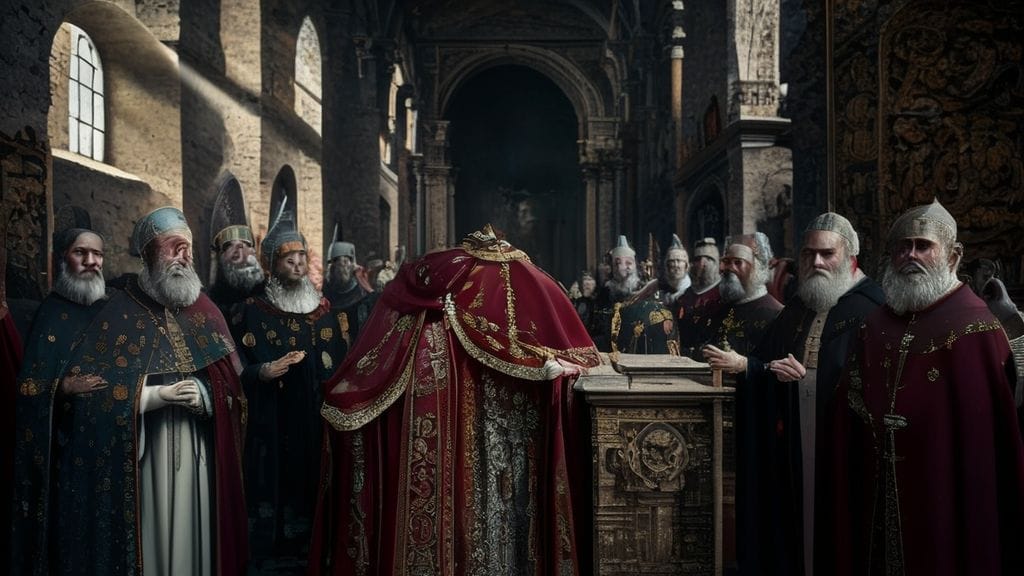
Within the basilica, meanwhile, ceremonies unfolded that would have looked, to a casual observer, much like any papal coronation. The irony is almost unbearable. Incense rose toward the painted ceilings as chants echoed from marble to marble. The new pope was invested with the pallium, seated on the cathedra, and presented to the faithful as the successor of Peter, the servant of the servants of God. Outside, armored men still stood guard, their hands on the hilts of swords not yet fully wiped clean.
The blending of sacral ritual and recent bloodshed struck some clerics with a kind of spiritual nausea. How could one reconcile the peace of Christ with the chain of violence that had just delivered Sergius to the throne? And yet, for many in Rome, there was also a grim relief. The crisis of dual pontiffs — Leo V languishing in captivity, Christopher claiming the papacy, the specter of further division — seemed resolved. In a city weary of instability, even a papacy born of arms might seem preferable to endless uncertainty.
Still, the stain could not be ignored. Later reformers would look back on this coronation as a dark milestone, emblematic of the so‑called “saeculum obscurum,” the dark age of the papacy. Some would single out the election of Pope Sergius III as one of the lowest points in that story, when brute force most nakedly dictated who sat on the throne of Peter. A contemporary bishop, quoted centuries later, lamented that “the holy see was no longer sought by holiness, but by steel and gold” — an indictment that fits this moment with chilling accuracy.
A Pope Under Guard: The New Regime of Sergius III
Once enthroned, Sergius faced a double task: to govern the Church and to survive. His reliance on Theophylact and the Roman nobility did not end with his elevation; it had only just begun. The new pope’s security depended on the same armed presence that had brought him to power. The Lateran, ostensibly a house of prayer and administration, functioned also as a garrison. Guards loyal to Theophylact controlled entrances, patrolled courtyards, and kept watch over the chambers where the pope slept.
Sergius’s early acts as pontiff must be read against this backdrop of dependence. He confirmed certain positions and benefices for Theophylact and his allies, ensuring their continued support. He reached out to secular rulers in Italy and beyond, seeking to re‑stitch a fabric of alliance that might shore up his legitimacy. Diplomatic letters from this period, though sparse, show a man acutely aware that his papacy would be judged not only by Rome’s factions, but by bishops and kings across Christendom.
At the same time, Sergius tried to assert a measure of doctrinal and disciplinary authority. He presided over synods, issued rulings on episcopal disputes, and attempted to present himself as a stabilizing force after years of turmoil. To do this credibly, however, he had to confront the poisonous legacy of Formosus and the Cadaver Synod — an issue that had not faded with time, but continued to haunt the Church’s conscience.
Rewriting the Past: Formosus, Legitimacy, and the Politics of Memory
Among Sergius’s most consequential decisions was his stance toward the memory of Formosus. According to a number of sources, Sergius aligned himself firmly with the anti‑Formosan tradition. He is said to have approved or even repeated the condemnation of Formosus, thereby invalidating his ordinations and appointments. If this is entirely accurate, it would mean that Sergius was willing to plunge the Church back into the legal morass that the Cadaver Synod had created, all in order to delegitimize certain bishops and secure his own faction’s dominance.
The historical record here is complex and debated. Some scholars, drawing on documents and later corrections, argue that Sergius’s role in renewing Formosus’s condemnation has been exaggerated by later enemies. Others insist that the pattern — a pope using the past as a weapon to shape the present — is too consistent to ignore. In either case, the broader truth remains: under Sergius, the Church once again weaponized memory.
Rewriting the past was not only a matter of ritual and decree; it was also a matter of storytelling. Chronographers in Rome, some attached to noble households, crafted narratives that painted certain popes as heroes and others as villains. Formosus, for Sergius’s camp, could be recast as a traitor and usurper, his supporters as rebels against the proper Roman order. In this contest of memory, the election of Pope Sergius III itself became a kind of retroactive justification. If Sergius now reigned securely, if order seemed restored, then surely God had favored his cause and condemned his foes. It was a powerful, and dangerous, circular logic.
One medieval source, later quoted by the historian Liutprand of Cremona, describes with bitter sarcasm the way Roman elites treated the papal office in these years, as if they were “changing not pastors but masks” on the same stage. The charge is theatrical, but the underlying point is painfully real: the persona of the pope, his official memory, could be reshaped by his successors to fit the needs of the current regime.
Rome’s Iron Women: Marozia, Theodora, and the So‑Called Pornocracy
Any account of Sergius’s papacy must grapple with the figure of Marozia, the teenage daughter of Theophylact and Theodora, and with the tales that cluster around her name. Later writers, especially those sympathetic to the Gregorian reform movement centuries afterward, would depict Marozia as the seductress who ensnared Sergius and bore him a son, the future Pope John XI. They painted a lurid picture of a so‑called “pornocracy” in which Rome’s noblewomen ruled the Church through their lovers and bastards.
Modern historians, reading these accounts against the grain, caution that many such stories are colored by misogyny and political propaganda. There is little contemporary evidence proving that John XI was indeed Sergius’s illegitimate son, though the possibility cannot be entirely ruled out. What is certain, however, is that Theophylact’s household — including Theodora and Marozia — wielded enormous influence. Marozia would later play a direct role in the deposition of still other popes and in the installation of her preferred candidates.
For Sergius, this environment meant that the lines of power around him were not purely male, nor purely clerical. Decisions about alliances, appointments, and even the treatment of rival factions were discussed not only in the Lateran, but also in the fortified mansions of the Theophylact clan, where Theodora and Marozia had a say. The image of these women as puppeteers pulling the strings of a helpless pope is almost certainly exaggerated, but the opposite image — of a pope ruling alone, free from their influence — is equally implausible.
This entanglement between family, gender, and ecclesiastical authority contributed to the scandalous aura that still surrounds the election of Pope Sergius III in historical memory. For later generations, the idea that the papacy could be shaped by the loves and hatreds of a single noble household, in which women played a conspicuous part, became a symbol of everything that had gone wrong in the so‑called saeculum obscurum. It is a reminder that power never moves along one simple axis, and that the human heart, with all its desires and loyalties, leaves its mark on even the most sacred institutions.
Europe Reacts: Kings, Bishops, and the Waning Awe of the Papacy
Outside Rome, the news of yet another violent papal turnover traveled slowly along the old imperial roads and through networks of monasteries and courts. Bishops in distant sees, already puzzled by the rapid succession of popes in recent decades, now received word that Christopher had fallen and Sergius reigned. For many, the main practical question was simple: whose name should be listed in the liturgy, whose authority recognized in disputes?
The deeper question — what did this turbulence say about the spiritual reliability of the Roman Church? — took longer to surface, but it did not go away. Frankish and German nobles, who had once trembled at the thought of papal excommunication, now watched as popes were imprisoned, deposed, and even posthumously condemned by their successors. The awe surrounding the papal office began to crack. If a pope could be made by the sword of a local count, then surely secular princes might also aspire to control such appointments in their own lands.
At the same time, many European rulers were too entangled in their own civil wars to intervene decisively in Roman affairs. The absence of a strong, unified empire — that long shadow of the Carolingians — meant that the election of Pope Sergius III, as troubling as it was, did not immediately produce a concerted international response. Instead, it contributed to a slow erosion of trust, a sense that Rome was a distant and disorderly place whose decrees were as likely to be reversed as upheld.
Monastic chroniclers, writing in quieter corners of Christendom, sometimes commented on the Roman chaos with a mixture of sorrow and resignation. One such writer noted that “in our time, the apostolic see is afflicted by storms.” Another observed that “we obey the Roman pontiff as far as we can discern justice.” These guarded phrases hint at a new attitude: respect for the papal office, yes, but also a willingness to question, to hesitate, to hold back full obedience when Rome seemed driven by faction rather than faith.
Ordinary Lives Under Extraordinary Corruption
Amid these sweeping political and ecclesiastical dramas, ordinary Romans continued their lives in the shadow of the basilicas and fortresses. The election of Pope Sergius III may have been a headline event in the chronicles, but for the baker on the Tiber bank or the widow near the Forum, its meaning was more immediate and concrete. Would the new pope’s supporters impose new taxes? Would fighting break out in the streets again? Would pilgrims return in greater numbers, bringing trade and alms, or would they stay away in fear of violence?
We know from archaeological evidence that the Rome of this era was sparsely populated, with many ancient monuments reused as quarries or shelters. The city’s economy was fragile. Markets depended heavily on the flow of pilgrims and on the stability of rural estates that supplied grain, oil, and wine. Every papal crisis threatened that delicate balance. A siege or skirmish near the gates could interrupt food shipments; a dispute with a powerful abbey might cut off charitable support to the poor.
In such a context, the installation of a new pope — even one elected under the shadow of swords — might bring a sense of fragile hope. If Sergius could, at least for a time, impose order, perhaps the roads would be safer, and the markets more predictable. Yet there was always a cost. The families who had backed the losing side might find their sons barred from office, their properties threatened, their shrines neglected. The city’s lowest classes often paid in blood for quarrels that began in noble halls.
For the faithful who still believed devoutly in the sanctity of the papal office, this dissonance was particularly painful. They knelt in churches where the name of Sergius was now intoned in the canon of the Mass, asking God to bless “our pope Sergius,” even as they knew that his rise had been stained by human ambition and cruelty. Their prayers, perhaps, carried an undertone of plea: that God might work through flawed instruments, that grace might yet shine in a city so often darkened by greed.
The Long Echo: From Sergius III to the Reformers of the Eleventh Century
The career of Sergius III did not single‑handedly create the age of reform that would blossom two centuries later, but it formed a crucial part of the background against which reformers defined themselves. When figures like Pope Gregory VII and his allies in the eleventh century thundered against lay investiture and the domination of the Church by secular powers, they looked back on episodes like the election of Pope Sergius III as a negative example, a kind of cautionary mirror of what had gone wrong.
In their polemics, these reformers sometimes exaggerated the depravity of the tenth‑century papacy, painting a picture of almost unrelieved corruption and worldliness. Sergius was grouped with other “dark age” popes as evidence that noble clans, and even women in those clans, had once “owned” the papacy. The truth, as always, was more complicated. Yet the memory of his violent accession and his entanglement with the Theophylacts provided convenient material for arguments in favor of stricter rules on papal elections and clerical independence.
It is no coincidence that by the mid‑eleventh century, new procedures like the creation of the College of Cardinals as the primary electors of the pope took shape. These reforms aimed, among other things, to prevent the kind of armed political takeover that had characterized Sergius’s rise. The hope was that by limiting the direct role of local Roman nobles and foreign princes, the Church could ensure that future conclaves would be more truly spiritual and canonical, less subject to the whims of swords and gold.
In this sense, the election of Pope Sergius III had a paradoxical legacy. In the short term, it deepened the disorder of the Roman Church and further entangled the papacy in aristocratic intrigues. In the long term, it became part of the dark background against which a new, more centralized, and more regulated papacy would be imagined. History, as so often, used failure as a teacher.
Myth, Legend, and the Historian’s Problem
The story of Sergius III, and especially of his election, comes to us through a glass darkened by politics, piety, and polemic. Many of our written sources were composed decades or even centuries after his death, by authors who had their own agendas. Some were reformers eager to paint the earlier papacy in lurid colors; others were chroniclers attached to particular noble houses; still others wrote from far away, relying on rumor and hearsay. Sorting fact from legend, therefore, is one of the historian’s hardest tasks in this period.
Take, for instance, the claim that Sergius fathered a child, the future Pope John XI, with Marozia. The earliest explicit testimony for this appears in later narratives that are themselves embroiled in disputes about the legitimacy of various popes. Modern scholars have spilled much ink over the question, weighing prosopographical clues against the biases of the sources. Some accept the story as probable, others reject it as hostile invention. Either way, it has shaped the popular image of Sergius as a pope whose private life mirrored the public chaos of his election.
Similarly, the precise details of the armed takeover in January 904 — where exactly the fighting occurred, how many died, what role different noble factions played — remain sketchy. Archaeology can tell us about the fortifications and urban landscape of Rome, but it cannot reconstruct each clash of steel. The surviving texts offer more impressions than detailed reportage. Hence historians must compare, contrast, and, at times, admit uncertainty.
Yet even with these gaps, certain elements stand firm enough to serve as anchors. There was a violent change of regime. Sergius, once exiled, returned with the backing of Theophylact. Christopher was deposed and confined. A formal election and coronation followed the seizure of power. In the wake of this, Sergius aligned himself with the anti‑Formosan line and deepened the involvement of Roman aristocratic families in papal governance. Around these points, interpretation swirls, but the core narrative of the election of Pope Sergius III remains recognizable.
This is perhaps the final irony: the very scandal and confusion that make this era so difficult to reconstruct also ensured that it would not be forgotten. Chroniclers who might have ignored a quiet, uneventful pontificate could not resist writing about cadaver synods, armed coups, and whispered scandals. In preserving their outrage and fascination, they have allowed us, centuries later, to glimpse — if imperfectly — the tumultuous world in which Sergius rose to power.
Conclusion
On that winter day in 904, when soldiers ringed the Lateran and Sergius III was raised to the papal throne, Rome reached one of the nadirs of its long history. The papacy, designed as a beacon of unity for Western Christendom, had become the prize in a brutal contest between armed factions and aristocratic houses. The election of Pope Sergius III was at once a legal ritual and a coup d’état, an event that blended sacred acclamation with the coercive power of steel. It signaled to Europe that the holy see could be captured and held by local strongmen, its occupant chosen not purely for sanctity but for usefulness.
Yet behind the sensational elements — the exile, the violence, the shadowy role of Theophylact and Marozia — lies a more human and tragic story. Sergius himself was both actor and prisoner, shaping events even as he was shaped by the brutal logic of his age. The clergy who anointed him, the people who heard his name in the Mass, the poor who lived under his rule, all inhabited a world in which the divine and the corrupt were inseparably interwoven. They had to find faith amid ruins.
In the long view of history, this dark chapter became a kind of negative template for later reform. Precisely because the election of Pope Sergius III and similar episodes revealed how far the papacy could fall into the grip of local power, a future generation resolved to build stronger safeguards, to insist that popes be chosen by procedures that minimized outside interference and maximized spiritual discernment. Whether they fully succeeded is another question, but their efforts show how even scandal can become a spur to renewal.
Today, looking back across more than a millennium, we can neither dismiss Sergius as a mere villain nor romanticize him as a misunderstood reformer. Instead, we see in him — and in his election — a stark reminder of how fragile institutions are when power is unchecked, and how even the most sacred offices are vulnerable to the ambitions of the age. The Rome of 904 may be gone, its crumbling walls repaired and its fortresses transformed or destroyed, but the questions it raises about authority, legitimacy, and memory remain painfully relevant.
FAQs
- Who was Pope Sergius III before his election in 904?
Pope Sergius III was a Roman aristocrat and cleric who became bishop of Caere before emerging as a papal candidate in the late ninth century. He was initially involved in earlier papal disputes surrounding Pope Formosus, lost an earlier bid for the papacy, and was subsequently exiled when his faction fell from favor. During his years in the shadows, he maintained connections with powerful Italian nobles, which later proved crucial to his return. - Why is the election of Pope Sergius III considered controversial?
It is controversial because Sergius’s rise to the papacy in January 904 was accompanied, and arguably enabled, by armed intervention from Count Theophylact and his forces. Christopher, who then held the papal office, was deposed and imprisoned, and only after this show of force did the formal election and coronation occur. Many contemporaries and later historians have therefore described the process as a coup disguised in canonical robes rather than a free ecclesiastical election. - What was the Cadaver Synod, and how does it relate to Sergius III?
The Cadaver Synod was a grotesque church council held in 897, in which the corpse of Pope Formosus was exhumed, put on trial, condemned, and desecrated. This event deepened the split between pro‑ and anti‑Formosan factions in Rome. Sergius III aligned himself with the anti‑Formosan camp and, according to several sources, later confirmed or renewed Formosus’s condemnation, thereby prolonging the legal and spiritual crisis that the Cadaver Synod had sparked. - What role did Theophylact and his family play in Sergius III’s papacy?
Theophylact, a powerful Roman noble and regional count, was the key secular patron behind Sergius’s ascent. His armed followers controlled crucial strongpoints in and around Rome, making it possible to depose Christopher and install Sergius. Theophylact’s wife, Theodora, and daughter, Marozia, also wielded significant influence, helping to shape appointments and alliances. Under Sergius, the papacy became more tightly bound to this aristocratic household, reinforcing the image of a “family papacy.” - Did Pope Sergius III really father a future pope with Marozia?
The widely repeated claim that Sergius III fathered Pope John XI with Marozia rests on later and partisan sources, many of which aimed to discredit the Roman nobility and the “pornocracy” of the era. Some historians consider the story plausible, while others see it as an invention colored by misogyny and political hostility. There is no decisive contemporary evidence, so the question remains open, serving as an example of how legend, morality tales, and history intertwine. - How did the election of Pope Sergius III affect the wider Church in Europe?
In the short term, the election signaled to European bishops and rulers that Rome remained unstable and deeply politicized. It weakened the aura of the papacy as a purely spiritual authority above factional disputes, encouraging some secular lords to view papal appointments as manipulable prizes. In the longer term, episodes like this contributed to the sense, especially among later reformers, that new safeguards were needed to protect papal elections from armed interference and aristocratic domination. - What is meant by the term “pornocracy,” and how is it linked to Sergius III?
“Pornocracy” is a polemical term coined by much later writers to describe the tenth‑century period when powerful Roman noblewomen, especially Theodora and Marozia, supposedly dominated papal affairs through sexual and familial relationships. Sergius III is often placed at the beginning of this era because of his close dependence on the Theophylact household and the disputed story of his relationship with Marozia. Modern scholarship treats the term with caution, recognizing both the real influence of these women and the prejudices of the sources that demonized them. - Was the election of Pope Sergius III considered valid under canon law?
Contemporaries did not reach a clear consensus. While the formal requirements — an acclamation by Roman clergy and people, a ritual enthronement — were ultimately fulfilled, the process was clearly shaped by prior military coercion and the violent removal of a rival pontiff. Some later canonists quietly accepted Sergius in the official papal lists, while reform‑minded writers cited his election as an example of what should never happen again. The ambiguity itself underlines the fragility of canon law in times of political crisis. - How did later church reforms respond to episodes like Sergius III’s election?
Later reforms, especially in the eleventh century, sought to insulate the papacy from local Roman nobles and from lay rulers generally. Measures such as entrusting papal elections primarily to the College of Cardinals and insisting on the freedom of ecclesiastical appointments can be seen as reactions, in part, to the violent and factionalized elections of the tenth century. By institutionalizing clearer procedures, reformers hoped to prevent another election of Pope Sergius III‑type scenario, where the sword dictated the outcome. - What can the election of Pope Sergius III teach us today?
It teaches that no institution, however sacred its mission, is immune to the distortions of unchecked power and factional ambition. The events of 904 show how easily spiritual offices can be captured when political structures are weak and when memory and law are used as weapons rather than guides. At the same time, the later reform movements that reacted against this dark period remind us that scandals, if faced honestly, can inspire efforts to build more just, transparent, and resilient systems.
External Resource
Internal Link
Other Resources
- Encyclopaedia Britannica – general search for the exact subject
- Google Scholar – academic search for the exact subject
- Internet Archive – digital library search for the exact subject

