Table of Contents
- The Passing of a Literary Titan: September 29, 1902
- Paris at the Dawn of the 20th Century: A City in Turmoil and Triumph
- Emile Zola: The Man Behind the Name
- The Dreyfus Affair: Zola’s Defining Battle for Justice
- How Zola’s Death Shook France and Reverberated Globally
- A Quiet Afternoon in Paris: The Circumstances of Zola’s Final Breath
- Controversies Surrounding the Death: Was It Accident or Assassination?
- The Immediate Public Reaction: Mourning a National Hero
- Zola’s Funeral: A Symbolic Moment for the Republic
- The Legacy of a Warrior Writer: From Naturalism to Social Justice
- Zola’s Influence on Literature and Political Thought After 1902
- The French Third Republic and the Cult of the Intellectual
- How Zola’s Death Reinforced the Role of Artists in Society
- Rediscovering Zola in the Modern Era: Memory and Commemoration
- The Global Impact: Zola’s Death and the International Human Rights Movement
- Museums, Monuments, and Memorials: Paris Remembering Zola
- The Mystery Remains: Scholars Debate the Final Night
- From Pen to Eternity: Zola’s Enduring Words and Their Power
- Conclusion: The Death That Transformed a Nation
- FAQs: Unraveling the Life and Death of Emile Zola
- External Resource: Wikipedia Link to Emile Zola
- Internal Link: Visit History Sphere
1. The Passing of a Literary Titan: September 29, 1902
It was a clouded autumn day in Paris, the kind that presses grey and heavy on the soul, as if the heavens themselves mourned the loss about to unfold beneath them. On September 29, 1902, Émile Zola, one of the most influential writers and social activists of his era, closed his eyes forever in a modest apartment on Rue de Bruxelles. There was no fanfare, no grand farewell in that small, book-lined room, only the muffled desperation of a wife searching for air and the slow, suffocating silence that crept over a city unaware—at least for the moment—of the void that would soon engulf France and much of the literate world.
Zola’s death was not simply the end of a prolific pen or the passing of a man. It was the close of an epoch—marked by relentless battles in the name of truth and justice, by a voice that had dared to confront society’s darkest secrets. It was, in many ways, the death of an idealism that had shaken the very foundations of the Third Republic. But in the shadows of that quiet Parisian apartment, as life slipped away, a storm was already gathering—one that would amplify Zola’s voice beyond his final breath.
2. Paris at the Dawn of the 20th Century: A City in Turmoil and Triumph
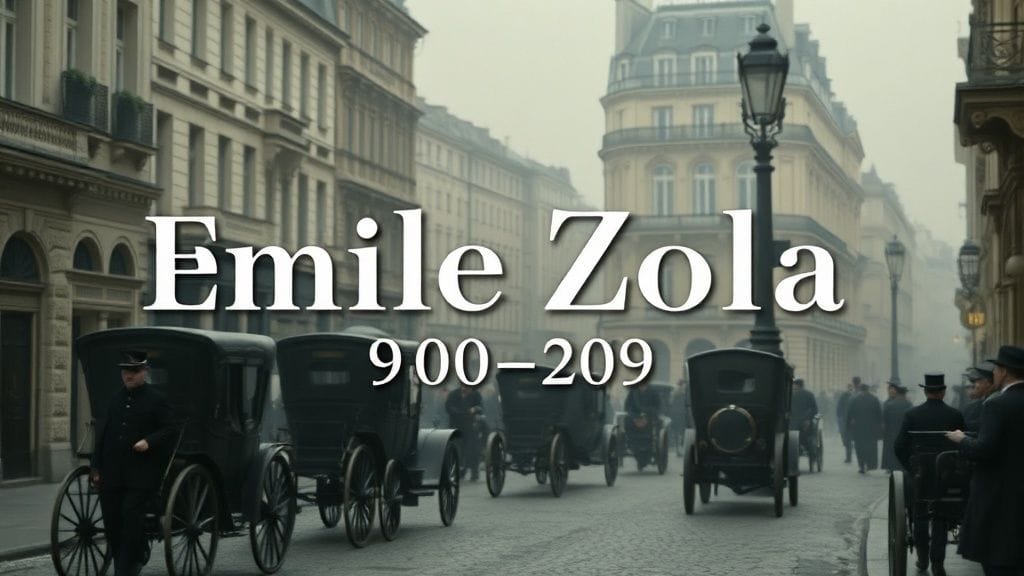
Paris in 1902 was a paradox of elegance and unrest. The Belle Époque dazzled with its culture, innovation, and relative peace after the devastation of the Franco-Prussian War. The Eiffel Tower soared proudly into the skyline, an emblem of modernity. Cafés hummed with ideas, and the streets pulsed with intellectual fervor.
Yet beneath this shimmering surface, France grappled with fierce ideological conflicts. The scars of the Dreyfus Affair, a national scandal that had polarized the country for nearly a decade, were still raw. Anti-Semitism, social inequality, and political corruption simmered dangerously close to eruption.
In this tense atmosphere, Émile Zola had become more than a writer — he was a symbol of resistance, a beacon for those who believed literature must carry a moral duty. By the time autumn 1902 approached, Parisian society stood at a crossroads, and Zola’s death would come to epitomize this fragile moment of transition.
3. Émile Zola: The Man Behind the Name
Émile Zola was not born a titan but had risen through sheer talent and tenacity. Born in 1840 to a modest Italian father and French mother, Zola’s early life was marked by struggles that would shape his relentless dedication to the working class and the truth.
From his early writings, he embraced Naturalism, a literary movement striving to expose the laws of nature governing human behavior. His masterpieces — from Germinal, describing miners’ harsh realities, to Nana, unveiling the seamy underbelly of Parisian life — revealed a France that many sought to keep hidden.
More than a novelist, Zola was a man who believed words could wield change. His commitment to exposing social injustice and defending human dignity made him a polarizing figure, loved by some and loathed by others.
4. The Dreyfus Affair: Zola’s Defining Battle for Justice
Nothing defined Zola more than the Dreyfus Affair. In 1898, when Captain Alfred Dreyfus, a Jewish officer in the French army, was wrongfully accused of treason, the scandal tore France apart.
Zola’s “J’accuse…!”—a fierce open letter published in L’Aurore—was a thunderclap in a subdued world. In it, he accused the military and government of manufacturing evidence and anti-Semitic abuse, risking his freedom for a cause many feared.
His intervention resulted in a libel trial, imprisonment, and social ostracism, but also eventually the exoneration of Dreyfus. Zola’s courage in this battle forever linked him with the fight for justice and truth, but it left him exposed to enemies who never forgave his defiance.
5. How Zola’s Death Shook France and Reverberated Globally
When Zola died suddenly in 1902, suspicion and grief swept through France. His death at forty-two seemed too abrupt, too enigmatic for a man still at the height of his powers.
For many, it was more than the loss of a beloved writer—it symbolized the precarious edge on which the Republic balanced. Across Europe and America, intellectuals and activists mourned the passing of someone who dared to wield literature as a weapon in the struggle against oppression.
6. A Quiet Afternoon in Paris: The Circumstances of Zola’s Final Breath
On that fateful afternoon, Zola was alone in his home on Rue de Bruxelles, working on his latest novel. His wife, Alexandrine, was elsewhere. Suddenly, he collapsed, overcome by a violent headache and a suffocating sensation.
Medical reports later spoke of carbon monoxide poisoning caused by a blocked chimney, but the facts were murky. Some witnesses claimed to hear nothing amiss; others suspected foul play by those still angry over his activism.
His death was quick yet shrouded in mystery—an end as dramatic and haunting as any of his novels.
7. Controversies Surrounding the Death: Was It Accident or Assassination?
Almost immediately, conspiracy theories swirled. Had Zola been the target of a deadly plot by his many political enemies? Given the venomous backlash he received after exposing military corruption and anti-Semitism, many believed his death was no accident.
Historians and investigators have debated this question for over a century. Some point to the blocked flue; others cite suspicious behavior around the property. Though no definitive proof emerged, the intrigue surrounding his death only added to his legend.
8. The Immediate Public Reaction: Mourning a National Hero
News of Zola’s unexpected death ignited an outpouring of grief throughout Paris and beyond.
Crowds gathered outside his home, and editorial tributes flooded newspapers. Artists, writers, and politicians recognized not just a literary giant, but a courageous defender of truth in times of peril.
Zola’s death felt like a personal loss for all who believed in the power of conscience and the promise of a just society.
9. Zola’s Funeral: A Symbolic Moment for the Republic
Held on September 30, 1902, Zola’s funeral became a grand affair, reflecting the deep respect he had garnered. Thousands lined the streets of Paris to pay homage.
A public procession brought the coffin to Montmartre Cemetery, where graveside eulogies celebrated his unwavering commitment to social justice and intellectual freedom.
In the days following, the Republic itself appeared to embrace Zola as a martyr for liberty—a status cemented by his reburial in the Panthéon years later.
10. The Legacy of a Warrior Writer: From Naturalism to Social Justice
Zola’s death did not diminish his impact. On the contrary, it crystallized his legacy as the quintessential literary warrior who sought not just beauty in art, but justice in society.
His novels remain seminal works in the canon of Naturalism, while his public activism paved the way for the role of writer as social critic and cultural conscience.
11. Zola’s Influence on Literature and Political Thought After 1902
Zola’s style and moral conviction inspired a generation of writers, thinkers, and politicians. The link between social responsibility and literature found new advocates in his wake.
Figures such as Jean-Paul Sartre and Albert Camus would later echo Zola’s belief that literature has a duty to confront injustice.
Politically, Zola’s fight helped strengthen movements against anti-Semitism, authoritarianism, and censorship.
12. The French Third Republic and the Cult of the Intellectual
By 1902, the Third Republic was evolving into a society where intellectuals held unprecedented influence. Zola represented this trend: a man who shaped public opinion, national identity, and political discourse through his pen.
His death intensified the reverence for the intellectual as protector of democratic values—a notion that would define French culture throughout the century.
13. How Zola’s Death Reinforced the Role of Artists in Society
Zola’s dramatic death illuminated the risks borne by those who dare to speak truth to power. It bolstered the belief that artists and writers have a critical voice in society—sometimes at great personal cost.
His life and death became a clarion call for those who followed, inspiring an enduring tradition of socially committed art.
14. Rediscovering Zola in the Modern Era: Memory and Commemoration
Today, Zola’s memory is carefully preserved in France and around the globe. His novels are studied in literature classes; his role in the Dreyfus Affair is hailed as a turning point for justice and human rights.
Commemorative events, literary prizes, and exhibitions continue to celebrate his achievements and the principles he championed.
15. The Global Impact: Zola’s Death and the International Human Rights Movement
Beyond France’s borders, Zola’s death and legacy influenced emerging human rights discourses in Europe and the Americas.
His fearlessness in exposing injustice inspired advocates worldwide, linking literature and activism in powerful new ways.
16. Museums, Monuments, and Memorials: Paris Remembering Zola
Paris hosts numerous sites honoring Zola—from plaques on his residences to dedicated corners in literary museums.
The Panthéon, where his remains rest among France’s greatest, remains a potent symbol of his enduring place in national history.
17. The Mystery Remains: Scholars Debate the Final Night
Despite decades of research, the exact circumstances of Zola’s death remain debated. Was it truly an accident caused by a blocked chimney? Or was a darker hand involved?
This uncertainty fuels fascination, keeping Zola’s story alive as a mix of fact, myth, and the overpowering force of history.
18. From Pen to Eternity: Zola’s Enduring Words and Their Power
Emile Zola’s words still echo across time—fiery, compassionate, unyielding. His commitment to truth, courage in the face of adversity, and unflinching focus on the human condition continue to inspire writers, activists, and citizens alike.
His death was not an end but a powerful beginning, a claimer of the eternal role of art in freedom.
Conclusion
Émile Zola’s death on that chilly September day in 1902 was a moment pregnant with gravity for France and for the world. The man who had lived a life battling injustice, wielding his pen as a sword, exited the stage under circumstances as enigmatic as his life was courageous. Paris wept, a nation paused, and the intellectual world braced itself.
But this ending was no true finale. Zola’s death amplified the roar he had begun decades earlier—demanding truth, justice, and conscience in the face of tyranny and prejudice. His legacy remains a testament to the power of courage and conviction, illustrating how one individual’s voice can ignite the flame of change and illuminate history’s darkest corners.
In the end, Zola did not simply die; he transcended, becoming immortal not only in literature but in the heartbeats of every generation that seeks to challenge injustice with words and deeds alike.
FAQs
Q1: What caused Émile Zola’s death?
A1: Officially, Zola died of carbon monoxide poisoning due to a blocked chimney in his apartment, but some historians speculate foul play because of his many political enemies.
Q2: Why was Zola an important figure in French history?
A2: Zola was both a seminal novelist and an impassioned defender of justice, most famously through his role in the Dreyfus Affair, which challenged anti-Semitism and corruption in the military.
Q3: What was the Dreyfus Affair, and how was Zola involved?
A3: The Dreyfus Affair was a political scandal involving the wrongful conviction of a Jewish army officer for treason. Zola publicly defended Dreyfus with his open letter “J’accuse,” risking imprisonment.
Q4: How did Zola’s death affect French society at the time?
A4: His death provoked national mourning and reinforced his status as a symbol of intellectual courage, becoming a rallying point for social justice and free speech advocates.
Q5: Was Zola reburied in the Panthéon?
A5: Yes, in 1908, several years after his death, Zola’s remains were moved to the Panthéon in Paris, the resting place of France’s greatest citizens.
Q6: How is Zola remembered today?
A6: He is remembered through his literary works, public commemorations, and as a foundational figure in the fight for human rights and the role of intellectuals in society.
Q7: Did Zola influence modern literature?
A7: Absolutely. His naturalist approach and social activism inspired later writers and thinkers who believed literature must engage with real societal issues.
Q8: What controversies surround the circumstances of his death?
A8: Some suggest Zola was assassinated by enemies opposed to his activism, though hard evidence remains inconclusive, leaving his death enveloped in enduring mystery.