Table of Contents
- Introduction
- Childhood and Early Life in Erlangen
- Family and Intellectual Environment
- Early Education and Gender Barriers
- Academic Studies and Doctorate
- Struggles to Find Teaching Positions
- Contributions to Abstract Algebra
- Noether’s Theorem and Physics
- Work in Göttingen with Hilbert and Klein
- Resistance and Support in Academia
- Influence on Einstein and Theoretical Physics
- Emigration to the United States
- Bryn Mawr Years and Teaching Style
- Personality and Human Side of Emmy Noether
- Challenges as a Woman in Mathematics
- Later Life and Death in Pennsylvania
- Legacy in Mathematics and Physics
- Honors and Recognition Posthumously
- Cultural Representations and Anecdotes
- External Resource
- Internal Link
Introduction
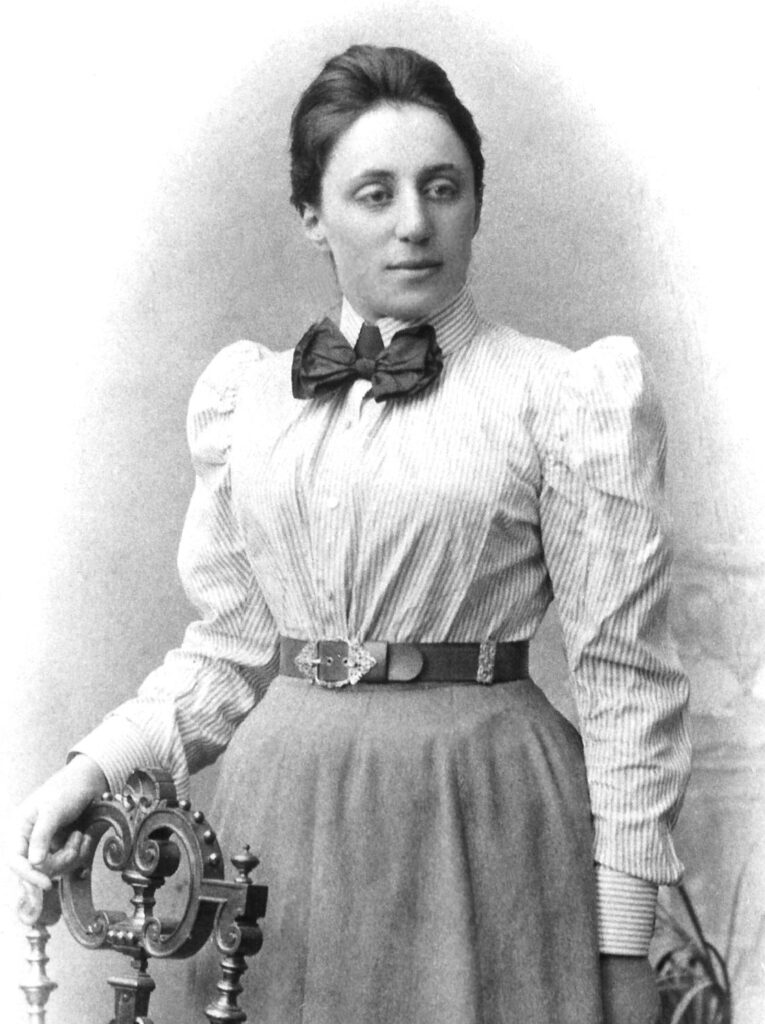
Emmy Noether biography is often described as the tale of one of the most important yet underappreciated mathematicians of all time. Born in Erlangen, Germany, on March 23, 1882, she changed the very foundations of mathematics and theoretical physics. Her groundbreaking Noether’s theorem, linking symmetries in physics to conservation laws, is considered one of the cornerstones of modern science. Albert Einstein himself praised her genius, calling her a “creative mathematical genius.” Isn’t it fascinating that someone once denied the right to teach because of her gender ended up transforming our understanding of the universe?
Childhood and Early Life in Erlangen
Emmy was born into a Jewish family. Her father, Max Noether, was a professor of mathematics at the University of Erlangen, which meant Emmy grew up in an intellectual household. Despite this, societal expectations for women in 19th-century Germany were restrictive. While boys were encouraged to pursue studies, girls were expected to focus on domestic roles. Emmy, however, had other plans.
Family and Intellectual Environment
The Noether household was filled with academic discussions. Max, despite his own physical disabilities, encouraged his daughter’s curiosity. Young Emmy showed an early aptitude for languages and logic, though few could predict that she would one day outshine many of her male contemporaries in mathematics.
Early Education and Gender Barriers
At first, Emmy followed the typical path expected for young women: she trained to become a language teacher. But her passion for mathematics grew too strong to ignore. At the University of Erlangen, women were not officially allowed to enroll, so she attended classes as a guest student. Imagine the determination it took to sit in classrooms where she wasn’t formally recognized, absorbing knowledge simply because she loved it.
Academic Studies and Doctorate
In 1907, Emmy completed her doctoral thesis on algebraic invariants under the supervision of Paul Gordan, a prominent mathematician. While the thesis itself was conventional, her true originality blossomed later. What mattered most was that she had broken through the barrier of being a woman in mathematics, securing a doctorate at a time when very few universities even allowed women to study.
Struggles to Find Teaching Positions
After her doctorate, Emmy faced a harsh reality: universities did not want to hire women professors. For years, she taught unpaid at Erlangen and later Göttingen, often listed as an assistant to male colleagues. Think of the irony: one of the greatest mathematical minds of the century was forced to lecture under another man’s name.
Contributions to Abstract Algebra
Emmy’s deepest contributions came in abstract algebra. She developed concepts that underlie modern group theory, ring theory, and ideals. Her approach emphasized structure and generalization, moving mathematics away from specific cases toward universal principles. This shift paved the way for countless developments in 20th-century mathematics.
Noether’s Theorem and Physics
Perhaps her most famous contribution is Noether’s theorem, published in 1918. The theorem states that every continuous symmetry in nature corresponds to a conservation law. For example, the symmetry of time leads to the conservation of energy, and spatial symmetry leads to conservation of momentum. This profound insight linked mathematics and physics in a way that still shapes quantum mechanics, relativity, and particle physics today.
Work in Göttingen with Hilbert and Klein
At Göttingen, the world’s leading mathematical center, Emmy collaborated with giants such as David Hilbert and Felix Klein. Hilbert fought fiercely to allow her to lecture, once arguing: “After all, this is a university, not a bathhouse!” His defense highlights the prejudice of the time, but also the respect she commanded from leading scholars.
Resistance and Support in Academia
Despite Hilbert’s support, many opposed Emmy’s presence simply because she was a woman. Yet her lectures, often delivered unofficially under Hilbert’s name, drew devoted students who became known as “Noether’s boys.” Her influence extended well beyond her official position.
Influence on Einstein and Theoretical Physics
Albert Einstein admired Noether greatly. In fact, when her theorem was published, Einstein wrote a letter praising her insight, acknowledging that her work clarified aspects of his own general relativity. That a woman mathematician could shape the thoughts of Einstein himself shows the depth of her genius.
Emigration to the United States
The rise of the Nazi regime in Germany in the 1930s forced Emmy, as a Jewish intellectual, to emigrate. She accepted a position at Bryn Mawr College in Pennsylvania, where she continued teaching and inspiring young women in mathematics. Her arrival in America provided both a safe haven and a new opportunity to nurture female talent in science.
Bryn Mawr Years and Teaching Style
At Bryn Mawr, Emmy’s warmth and clarity made her a beloved teacher. She treated her students as collaborators rather than passive listeners, encouraging them to think independently. Her humility and lack of pretension left a lasting impression—one student described her as “like a mother of modern algebra.”
Personality and Human Side of Emmy Noether
Emmy was known for her modesty, often dressing plainly and focusing entirely on ideas rather than appearances. Friends remembered her as cheerful, generous, and utterly absorbed in mathematics. She cared little for fame or recognition, preferring the joy of discovery and the success of her students.
Challenges as a Woman in Mathematics
Throughout her career, Emmy faced obstacles simply because she was a woman: lack of pay, lack of positions, prejudice from colleagues. Yet she never stopped working, never stopped pushing mathematics forward. Her life remains a testament to persistence in the face of injustice.
Later Life and Death in Pennsylvania
Tragically, Emmy’s life was cut short. She died in 1935, at the age of 53, following complications from surgery. Her death was mourned by mathematicians worldwide. Einstein himself wrote an obituary, calling her “the most significant creative mathematical genius thus far produced since the higher education of women began.”
Legacy in Mathematics and Physics
Today, Emmy Noether is celebrated as a giant of mathematics. Her name graces theorems, lectures, awards, and schools. Noether’s theorem continues to underpin modern physics, while her contributions to algebra define entire branches of mathematics.
Honors and Recognition Posthumously
During her lifetime, she received far less recognition than she deserved, but posthumously, Emmy has been honored with awards, memorial lectures, and institutions bearing her name. The Noether Lecture, given annually by distinguished women mathematicians, keeps her memory alive.
Cultural Representations and Anecdotes
Anecdotes about Emmy often highlight her absent-minded brilliance. She could become so engrossed in solving a problem that she forgot the time, her surroundings, or even meals. But these quirks only add to the legend of a woman whose passion for mathematics never dimmed.