Table of Contents
- From Constantinople to Syracuse: A Turning Point in the Empire’s Fate
- An Empire Under Siege: The World Constans II Inherited
- The Young Emperor in a Dying Golden Age
- Why Sicily? Strategic Dreams at the Center of the Mediterranean
- Whispers in the Palace: Planning the Great Relocation
- The Journey West: An Emperor Leaves His Eternal City
- First Impressions of Syracuse: A New Imperial Stage
- Rebuilding Power: Fortresses, Fleets, and Fiscal Reforms
- The Church Reacts: Patriarchs, Popes, and Theological Storms
- Life Under a Traveling Court: Soldiers, Traders, and Common Folk
- Rome and Ravenna: Allies, Pawns, or Hostages of Policy?
- The Shadow of the Caliphate: War, Diplomacy, and Lost Provinces
- Conspiracies in the Harbor City: Local Elites Push Back
- The Murder in the Bathhouse: The Violent End of Constans II
- After Syracuse: The Empire’s Lurch Back to the Bosporus
- Memory, Blame, and the Long Echo of Constans’s Decision
- Conclusion
- FAQs
- External Resource
- Internal Link
Article Summary: This article explores the dramatic and controversial episode of emperor constans ii relocation of the imperial capital from Constantinople to Syracuse in 662, tracing how one man’s strategic gamble reshaped the Byzantine world. It sets the stage with an empire besieged by enemies and torn by theological conflict, then follows Constans II westward across the Mediterranean to his new Sicilian seat. The narrative examines the motives behind the move—military, political, and personal—and the shock it caused among courtiers, bishops, and ordinary citizens alike. It looks closely at daily life in Syracuse under a suddenly imperial sky, where local elites and newly arrived bureaucrats struggled to coexist. The piece also delves into the relations with Rome, Ravenna, and the rising Islamic Caliphate, showing how emperor constans ii relocation failed to halt the empire’s territorial losses. In a cinematic recounting of the emperor’s assassination in a bathhouse, the article captures the intimate violence that ended his experiment. Finally, it evaluates how emperor constans ii relocation has been remembered by chroniclers and modern historians—as folly, foresight, or tragic inevitability—and considers its lasting imprint on Mediterranean history. Throughout, emperor constans ii relocation serves as the central thread, binding together strategy, faith, ambition, and the fragility of imperial power.
From Constantinople to Syracuse: A Turning Point in the Empire’s Fate
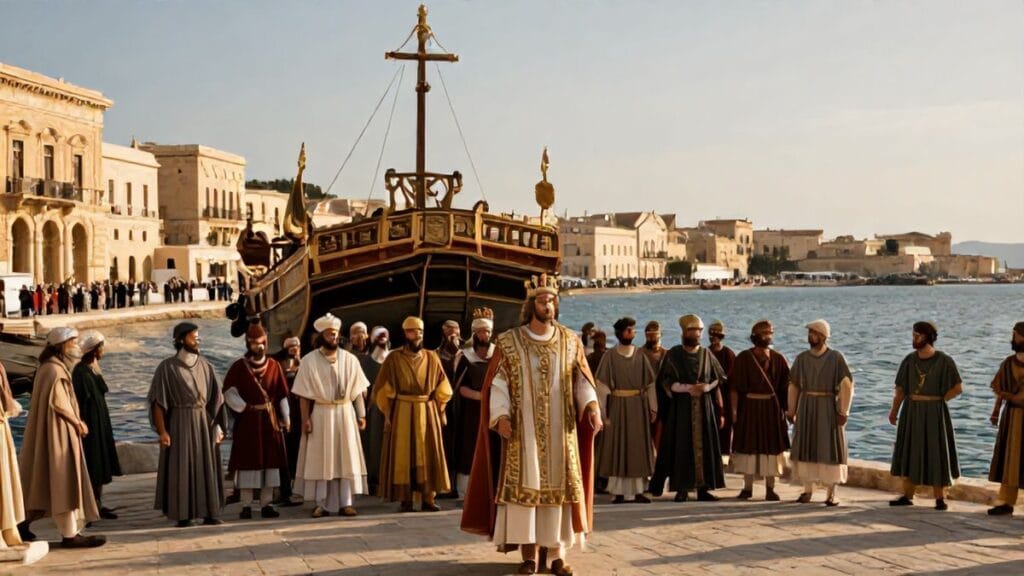
The story begins with a ship leaving the Bosporus, its hull heavy with imperial baggage: golden icons wrapped in cloth, rolls of parchment containing laws and land registers, chests of coin stamped with a young emperor’s stern profile. Above the decks, under the shifting light of a late-summer sky in 662, stands Constans II, Basileus of the Romans, watching the domes and walls of Constantinople grow smaller on the horizon. For a thousand years of Roman history, power had meant Rome or Constantinople; on this day, Constans chose something else. That moment—emperor constans ii relocation of his court and effective capital to Syracuse in Sicily—felt to many contemporaries like sacrilege, to others like madness, and to a very few, a desperate stroke of genius.
But this was only the beginning. Behind the imperial ship, the city he left behind simmered with rumors: that Constans had abandoned his people, that he had fled from the Arabs, that he meant to strip the capital of its treasures and leave it to ruin. Before him stretched the long reach of the Mediterranean, still bearing the faint echoes of Roman supremacy but now increasingly ruled by new powers. Syracuse, once a jewel in the crown of ancient Greek Sicily and later a crucial stronghold in Rome’s war against Carthage, was to become, at least for a time, the beating heart of a battered empire. The emperor’s decision to uproot his residence from Constantinople did not simply move administrators and archives; it shifted expectations, alliances, and fears across three continents.
It’s astonishing, isn’t it? An emperor leaving his ceremonial center, the city of Justinian and the vast dome of Hagia Sophia, to live on an island closer to Rome than to the Bosporus. To the court chroniclers, this act demanded explanation. To the soldiers fighting on the exposed frontiers, it demanded results. To the ordinary inhabitants of Sicily and southern Italy, it meant that imperial concerns—taxes, troops, and theology—would suddenly weigh on them more heavily than ever. The emperor constans ii relocation was therefore not a mere shuffle of palaces but a profound reorientation of where power seemed to lie in the shrinking Roman world.
This article follows that choice from conception to catastrophe. We will move backward and forward in time, from the war-stricken provinces of the East to the cramped streets of Syracuse, from the glittering halls of Constantinople to a small, steam-filled bathhouse where the emperor’s story ended in a spray of blood. Along the way we will see how this relocation was rooted in fear and hope in equal measure: fear of the expanding Islamic Caliphate, of internal rebellions, of doctrinal schisms; hope for tighter control of the western provinces, for new naval strategies, for relief from the suffocating politics of the capital. The emperor constans ii relocation, seen in retrospect, was no isolated whim; it was the act of a ruler cornered by history, convinced that to stay still was to die.
An Empire Under Siege: The World Constans II Inherited
To understand why any emperor would contemplate leaving Constantinople, we must first step into the world that greeted Constans II when he ascended the throne. The Byzantines themselves might still have called their realm the “Roman Empire,” but by the early seventh century its map had been savagely redrawn. The great conqueror of the previous generation, Emperor Heraclius, had battled the Sassanian Persians in a war of annihilation that left cities gutted, treasuries drained, and armies exhausted. Though Heraclius emerged triumphant and restored much of the lost territory, the victory was pyrrhic: the empire was wounded to the bone.
Into this fragile landscape burst a new force: Arab armies united under the banner of Islam. Within a decade, imperial defenses that had withstood centuries of pressure began to unravel. Syria, cradle of ancient Christian communities and a vital economic heartland, was lost by 636 after the devastating defeat at Yarmouk. Palestine followed, then Egypt—grain basket of the empire and hinge between the Mediterranean and the Red Sea. By the time Constans II was old enough to understand the world around him, the empire’s frontiers had surged backward; what had once been Roman lakes were now contested waters, with Arab fleets testing their strength against the vaunted Byzantine navy.
Internally, the picture was no calmer. Theological disputes that had riven Christian communities for generations—questions over the nature of Christ, the will or wills of the incarnate God—were not dry abstractions. They fueled revolts, hardened regional identities, and gave rival claimants to power a ready ideological tool. As the historian J. B. Bury once remarked, “In the East, theology was politics,” and by the time Constans inherited the throne, theology had become a battlefield as dangerous as any frontier. The empire’s leaders knew this all too well and tried, repeatedly, to impose solutions that would heal divisions between Chalcedonian and non-Chalcedonian communities. Instead, they often provoked new schisms.
There was also the question of legitimacy. Constans II, born Herakleios, was the grandson of Heraclius, but his path to power was marked by palace intrigue and the elimination of rivals. As a child-emperor crowned in 641, he had to balance regents, ambitious generals, and the memory of his grandfather’s heroic—but ruinous—campaigns. The weight of expectation hung heavily on his shoulders: somehow, this boy was to restore imperial fortunes against enemies who believed history itself now favored them.
By the 650s, when Constans had taken personal control of government, the empire was still formidable but unmistakably diminished. The Anatolian heartland and the Balkan provinces held, yet the loss of the wealthy eastern territories had permanently altered the empire’s fiscal base. The state survived by squeezing more from fewer taxpayers, reorganizing military districts, and relying heavily on the loyalty and effectiveness of regional commanders. That loyalty was never guaranteed. Rebellions in distant provinces, especially in the Exarchates of Ravenna and Africa, loomed as constant threats.
From this perspective, emperor constans ii relocation to Syracuse emerges as one possible answer to a dire strategic riddle. How could a ruler whose eastern provinces had fallen to a new world religion, whose religious policies angered Rome and Constantinople alike, whose generals commanded armies he might not fully trust, hope to hold together what remained? One solution was to re-center the empire—at least symbolically—away from the vulnerable Bosporus and toward the middle sea that had once tied its provinces together: the Mediterranean. That sea, though contested, still carried echoes of Roman unity. Sicily lay at its crossroads.
The Young Emperor in a Dying Golden Age
Constans II did not grow up in an era of steady decline so much as in one of dizzying reversals. As a child, he would have heard stories of his grandfather Heraclius’s triumphant entry into Jerusalem in 630, bearing what was believed to be the True Cross, reclaimed from the Persians. The crowds, the hymns, the sense of rebirth after catastrophe—these would have lingered in family memory like half-faded frescoes on palace walls. Yet by the time Constans came of age, that same Jerusalem lay in Arab hands, and the Cross itself was a relic of a world that had vanished almost overnight.
The boy-emperor’s early years were overshadowed by rapid successions and court purges. Empress Martina, Heraclius’s second wife, sought to secure the throne for her own son, Heraclonas, creating rival claims that erupted after Heraclius’s death. Constans, the son of Heraclius’s earlier marriage, became the focus of those who opposed Martina’s influence. The resulting coup, led by soldiers and churchmen claiming to restore legitimate rule, pushed the young Constans onto the throne. Martina and Heraclonas were mutilated—tongues and noses cut, an old Roman method of disqualification—and exiled. Constans learned almost immediately that emperorship was not a mystical dignity but a dangerous game in which defeat meant annihilation.
Growing into his role, Constans developed a reputation for severity and suspicion. He was not the charismatic, larger-than-life figure that his grandfather had been. Chroniclers portray him as harsh, even dour, a man whose default response to perceived threats was elimination. Yet beneath this severity lay a tortured calculus: he governed at a time when mercy could easily be interpreted as weakness and weakness as an invitation to revolt. The empire needed a steel spine, he believed, and if that steel appeared cold or cruel, so be it.
At the same time, Constans was no mere brute. He issued laws, restructured provinces, and tried to repair the tattered fiscal system. He understood the navy’s centrality and, unlike some of his predecessors, took a personal interest in maritime affairs. His decision later in life to base himself in Syracuse was not a sudden infatuation with the West; it grew out of years spent trying to find leverage in an unstable world. The emperor watched as the Caliphate’s fleets raided Cyprus, Rhodes, and even threatened Constantinople itself. He saw the Balkans plagued by Slavic incursions and internal revolts. It must have seemed that danger came from every direction, while safety lay nowhere.
These experiences shaped the man who, in his thirties, would attempt the unthinkable by leaving Constantinople. For Constans, the capital was not a sacred, immovable center of Roman destiny; it was a place where enemies clustered, where factions schemed, where his own life hung by a thread. In his mind, emperor constans ii relocation to a new operational base might be a chance to regain personal and strategic freedom. If Constantinople had become a gilded cage, Syracuse promised at least the illusion of open sea beyond the bars.
Why Sicily? Strategic Dreams at the Center of the Mediterranean
Why choose Syracuse, of all places, for an imperial residence? To a modern reader, the decision may seem eccentric, even reckless. But to a seventh-century strategist surveying the map of the Mediterranean, Sicily’s advantages leapt out. The island sat astride key sea lanes linking the eastern and western basins. From Syracuse, an emperor could look north toward the Italian peninsula and the Exarchate of Ravenna, south toward Africa and the grain-rich lands of the old Vandal kingdom, and west toward the still-Roman enclaves in Spain and the rising kingdoms of the Franks and Lombards.
Sicily had long been a coveted prize. Greeks, Carthaginians, Romans, and Goths had all fought over it, drawn by its fertile plains and superb harbors. Syracuse itself had once been among the greatest cities of the Greek world, rivaling Athens in wealth and power. By the seventh century, its glory had dimmed, but its position had not. A secure, fortified Syracuse could act as a naval hub controlling the Tyrrhenian and Ionian seas. It offered a relatively safe distance from the main thrusts of Arab expansion, which were then concentrated in the eastern Mediterranean and North Africa, while remaining close enough to intervene in Italy and the central sea.
There was also a fiscal logic to choosing Sicily. With the loss of Egypt, the empire had seen its most important grain supply fall into enemy hands. Sicily and parts of North Africa became crucial alternative sources of food for Constantinople and the remaining eastern provinces. By placing himself in Syracuse, Constans could oversee the extraction and distribution of Sicilian grain, perhaps even diverting more for military purposes in Italy and the Balkans. Controlling the island directly might allow him to tighten imperial grip over tax collection, curbing corruption among local officials.
Beyond strategy and finance lay politics. The West—especially Italy and the papacy—had been drifting away from Constantinople, resenting the doctrinal edicts issued by emperors seeking theological compromise. The monothelite formula, intended to bridge the gap between Chalcedonian and non-Chalcedonian Christians by positing a single will in Christ, had angered Rome, which saw it as doctrinally suspect. Popes found themselves pulled between loyalty to the emperor and fidelity to their own understanding of orthodoxy. By relocating closer to Rome, Constans may have hoped to reassert imperial authority, to remind Italian elites and bishops that the emperor was not a distant, abstract figure but a near and present sovereign.
In this sense, emperor constans ii relocation to Syracuse was an attempt to re-center not merely geography, but loyalty. The move could project the image of a ruler who was not passively waiting behind the Theodosian Walls but actively confronting the empire’s problems, especially in the West. As the naval historian John Pryor and others have noted, the Byzantine state’s survival often depended on its ability to adapt—shifting bases, reorganizing logistics, reinventing itself under pressure. Constans’s decision, while radical, fit this tradition of improvisation under fire.
Yet behind the grand strategy lay personal calculation. Sicily was far from the factions of Constantinople, from the Senate, the Hippodrome demes, and the volatile crowds who had toppled emperors before him. In Syracuse, Constans could surround himself with loyal officers, foreign mercenaries, and administrators whose fortunes rose or fell with his own. The island offered distance: from rivals, from memories, from the suffocating expectations of ruling from the New Rome. It promised, at least in theory, a fresh start.
Whispers in the Palace: Planning the Great Relocation
There is no surviving decree in which Constans calmly announces, “I shall now move my capital to Syracuse.” Instead, the decision emerges in fragments from later chronicles and from the pattern of his movements. But one can imagine the conversations in the dim chambers of the Great Palace: guarded whispers between trusted generals, maps spread over tables lit by oil lamps, ships and routes traced by fingers thick with signet rings.
Officials responsible for provisioning the court would have been set to calculations. How many ships, how much grain, how many men? An imperial relocation was not a simple voyage; it was the transplantation of a mobile government. The emperor traveled with a retinue of bureaucrats, scribes, bodyguards, servants, and clergy. He needed warships for protection, transports for equipment and archives, and a reliable escort of experienced sailors. By the early 660s, imperial shipyards along the Aegean and Anatolian coasts were put to work preparing for what must have seemed an extraordinary mission.
Not everyone in the palace would have approved. The decision to leave Constantinople struck at the heart of long-held assumptions about Roman power. Senators, many of whom had estates in Thrace and Asia Minor, feared a diminution of their influence. The bureaucracy, whose routines depended on the fixed rhythms of life along the Bosporus, balked at the thought of re-establishing itself in a city they considered provincial. Churchmen in the capital, anxious to maintain their prestige near the Patriarchate and Hagia Sophia, worried about what distance from the emperor might mean for their own authority.
But opposition in Byzantium was rarely voiced openly. Constans, with his reputation for ruthlessness, would not have tolerated open defiance. Instead, resistance took the form of murmurs in corridors, sullen compliance, and the quiet nurturing of alternative alliances. Some believed that the emperor was fleeing the Arabs; others suspected that he simply no longer trusted the capital’s population. Either way, his critics waited, hoping that the experiment would fail and that circumstances would call him—or someone else—back to Constantinople.
The final preparations were probably cloaked in ambiguity. Official proclamations may have framed the move as a “campaign” or an extended “tour of inspection” in the West. The full implications—that the emperor intended to base himself in Syracuse for years—would become clear only gradually. Yet among those closest to him, the watchword was likely urgency. Constans had survived a major naval defeat at the Battle of the Masts in 655, when the Arab fleet severely mauled the Byzantine navy. He could not afford further catastrophic losses. The empire needed a new approach, and he was determined to shape it from a place of his own choosing.
The Journey West: An Emperor Leaves His Eternal City
Imagine the dawn in Constantinople on the day of departure. The air smells of salt and tar along the Golden Horn. Crowds gather on the quays to watch the imperial convoy assemble: dromons with their double banks of oars, sails furled; supply ships loaded with amphorae, tents, and chests; smaller craft bustling between them like beetles. Imperial standards flutter in the breeze, gilded eagles and the Christogram catching the light. Priests chant blessings, incense smoke mingling with sea mist.
At the center of this floating city stands the emperor’s flagship, its stern adorned with the imperial insignia. As Constans boards, accompanied by his bodyguard, some in the crowd bow and cross themselves; others stare in silence, wondering if they will ever see their ruler again. The ceremony is official, but beneath the formulaic prayers there is a note of uncertainty, even dread. No emperor before has undertaken such a journey with the clear intention of governing from afar. His grandfather had campaigned for years but always returned. Constans, people whispered, is not coming back.
The fleet threads its way through the Dardanelles, past the shores of Asia Minor where so many imperial armies had marched. The sea voyage itself is both practical and symbolic. At each major port of call—perhaps in Greece, in southern Italy, in maritime bases along the route—the emperor can review local garrisons, inspect fortifications, and make his presence felt. Yet as his ships push further west, the mental map of the empire shifts. Constantinople shrinks behind him, and the western Mediterranean, with its own complicated tangle of powers, grows nearer.
This was not a triumphant progress in the old Roman sense. The empire was no longer in a position to overawe all who saw its sails. Arab raiders and Lombard warbands loomed as constant dangers. Storms could scatter fleets; sickness could ravage crews. Nonetheless, Constans’s journey carried echoes of older imperial traditions: the idea that the ruler was not bound to a single city but was, in his person, the embodiment of the state wherever he went. For the moment, the sea itself became his avenue of power.
One can imagine the conversations on deck in the evenings, when the sun sank into the western horizon and lamps were lit. Advisors debated the scale of reforms that might be possible from a Sicilian base. Generals outlined plans to strengthen control over southern Italy, to keep the Lombards at bay, to coordinate naval patrols against Arab corsairs. Courtiers speculated about the reaction in Rome: Would the pope welcome the emperor’s presence nearby as a chance for closer influence, or resent it as an intrusion of temporal power?
As the ships approached Sicily, the coastline rose from the sea—dark, volcanic mountains, patches of cultivated land, the white speckle of villages. Syracuse’s harbor opened before them, its breakwaters and quays bristling with local craft. The city that had once faced down Carthaginian fleets now prepared to greet a Roman emperor arriving not as conqueror, but as a kind of refugee from the storms of the East.
First Impressions of Syracuse: A New Imperial Stage
When Emperor Constans stepped ashore at Syracuse, he entered a city that bore the weight of centuries. Ancient temples, some converted into churches, stood alongside later Roman structures and more recent Byzantine additions. The streets, narrower and more irregular than the great avenues of Constantinople, bustled with merchants selling grain, olives, and fish; artisans working metal and cloth; sailors shouting in Greek, Latin, and local dialects. The smell of the city was different too—salt and citrus, smoke from hearths burning olive wood, the faint tang of nearby marshes.
For the Sicilians, the emperor’s arrival was a shock and an opportunity. Syracuse had long housed a significant garrison and served as the seat of the island’s governor, but it had never hosted the full weight of imperial ceremony. Now, in quick succession, came courtiers in silks, eunuchs managing schedules and audiences, fiscal officials bearing ledgers bound in leather, bishops and monks representing different strands of the church’s ongoing disputes. The local elites—landowners, clergy, merchants—scrambled to adjust, to find their place in the new hierarchy that had descended upon them.
Constans chose existing administrative buildings and fortified residences as the nucleus of his new court. Some structures were hastily expanded; others were adapted for functions they had never been meant to fulfill. Storage rooms became archive vaults; large halls became audience chambers where Sicilian petitioners now brushed shoulders with officers from distant themes in Anatolia. The city’s defenses were reinforced, walls patched and towers strengthened. Ships in the harbor were requisitioned or refitted for naval use, turning Syracuse into a buzzing hive of imperial logistics.
Yet behind the practical adjustments lay a deeper question: Could this old Greek city, with its complex history and strong local identity, truly become the center of a still-Roman empire? Unlike Constantinople, which had been built and mythologized as a New Rome from its very foundation, Syracuse carried memories of independence and of rival empires. Its people were proud, well aware that their island had once set its own course in Mediterranean politics. Some welcomed the emperor’s presence as protection against Lombards and Arabs. Others feared heavier taxation, stricter military demands, and the inevitable frictions of accommodating a foreign court.
The emperor constans ii relocation thus brought Syracuse into a different orbit. Suddenly, decisions made in its council chambers could ripple as far as the Balkans or the Aegean. The harbor saw an influx of ships from the eastern Mediterranean. Foreign envoys, who once traveled to the distant Bosporus, now disembarked here, walking the same streets as local fishermen and bakers. The weight of history shifted slightly on its axis, and for a few brief years, the Mediterranean’s old crossroads became once more a place where the future of empires was decided.
Rebuilding Power: Fortresses, Fleets, and Fiscal Reforms
Constans II was not content to sit idly in his Sicilian refuge. From Syracuse, he launched a series of reforms and initiatives aimed at shoring up imperial authority and, if possible, recovering lost ground. The first priority was military. The naval defeat at the Battle of the Masts had demonstrated how vulnerable the empire had become at sea. In Sicily, the emperor invested heavily in rebuilding the fleet, repairing ships, and commissioning new ones. The island’s timber, shipyards, and skilled craftsmen were put to work around the clock.
Syracuse’s harbor became a theatre of ceaseless activity. New dromons were fitted with reinforced hulls and improved rams. Crews were drilled in coordinated rowing and boarding tactics. Admirals came and went, summoned to the imperial presence to explain their readiness, their supply lines, their seasonal plans for patrolling key waters. The emperor himself, it is said, took an active interest in these discussions, asking detailed questions about oar arrangements and sail patterns, determined not to repeat past mistakes.
On land, fortifications across Sicily and southern Italy were inspected and, where possible, strengthened. Constans understood that Arab raids, already plaguing the coasts of the Mediterranean, could one day target Sicily itself. The island’s defense thus became a matter of imperial survival. Garrisons were repositioned, watchtowers repaired, and field armies rotated through the region to maintain discipline and readiness. The presence of the emperor lent urgency to these efforts: failure was now visible, perhaps fatally so, to the highest authority.
All this required money, and here too the emperor acted. From Syracuse, he oversaw a tightening of the fiscal system in the western provinces under his control. Taxation became more rigorous, exemptions were revisited, and imperial agents were dispatched to investigate corruption. In Calabria, in Apulia, in the hinterland of Sicily, landowners found themselves called to account. The old Roman balance between local autonomy and imperial oversight tilted decisively toward the latter, at least in theory.
Yet such measures came at a cost. Harsh tax collection bred resentment, particularly when it seemed to benefit distant campaigns rather than local needs. Military requisitions of supplies and animals strained rural communities already living close to the margin. Administrators arriving from Constantinople, fluent in the arcane language of imperial bureaucracy but foreign to Sicilian traditions, often clashed with local leaders. Emperor constans ii relocation, intended to reinforce imperial cohesion, thus generated frictions that would reverberate throughout his reign in Syracuse.
Still, for a moment, there was the faint sense that a new equilibrium might be found. The fleets in Syracuse’s harbor represented not only imperial might but imperial resilience—the refusal of a centuries-old state to accept the verdict of defeat. Chroniclers later inclined to view Constans’s move as folly may have underestimated the extent to which, in these years, the empire appeared to be fighting back, experimenting, recalibrating in the face of unprecedented threats.
The Church Reacts: Patriarchs, Popes, and Theological Storms
If strategy and finance formed one axis of Constans’s experiment, theology and ecclesiastical politics formed another. The emperor ruled over a Christian empire, and in the Byzantine mind, true sovereignty required not only military prowess but the patronage and defense of orthodoxy. From the very beginning of his reign, Constans had been entangled in the debates over monothelitism, the doctrine proposing a single will in Christ as a compromise between various Christological factions. His grandfather Heraclius had promoted it; Rome had condemned it.
By the 660s, the papacy and many Western bishops regarded imperial attempts to enforce doctrinal formulas from Constantinople with deep suspicion. Popes had been arrested, exiled, even mutilated for resisting what they saw as heretical intrusions. The arrival of the emperor in the West therefore created both fear and opportunity in Rome. Would Constans seek to intimidate the papacy more directly now that he was geographically closer? Or might his presence force a renegotiation of the relationship between imperial and papal authority?
The answer, as so often in Byzantine history, was mixed. Constans made clear that he expected loyalty from the pope and the Italian clergy, and he did not hesitate to exert pressure when he felt it necessary. His broader religious policy, however, remained marked by a kind of grim pragmatism rather than fanatical zeal. He wanted unity, above all, and doctrinal formulas were instruments toward that end. What he could not have foreseen was that his own relocation would feed Western narratives of imperial overreach: an emperor in Sicily, meddling in Italian affairs, appeared as a distant eastern autocrat encroaching upon Latin spiritual autonomy.
Meanwhile, in Constantinople, the Patriarch and the clergy had to adjust to life without the emperor physically present. This did not mean they were free; imperial authority still reached them through officials and military governors. But the symbolic balance shifted. The Patriarch’s voice, resonant beneath the dome of Hagia Sophia, now echoed in a capital where the emperor’s throne stood empty. Some churchmen feared that without the emperor’s constant presence, doctrinal enemies might gain ground. Others thought that the distance might allow the church in the capital to breathe, even to set its own course more confidently.
In one sense, emperor constans ii relocation exposed the fragile triangulation that held the Christian Mediterranean together: the emperor, the patriarch, and the pope. When one corner of this triangle moved, the whole structure shuddered. Theological debates over wills and natures in Christ, abstract as they may sound to us, were in fact the vocabulary through which deep questions of authority, identity, and loyalty were expressed. A ruler who physically repositioned himself risked reconfiguring those loyalties in unpredictable ways.
Later historians would argue over whether Constans’s policies worsened or mitigated the empire’s theological divisions. What is certain is that his years in Syracuse coincided with intensifying alienation between Constantinople and Rome, setting the stage for future confrontations. The seeds of later schisms, while not yet in full bloom, pushed fragile shoots through the cracks opened by his Sicilian experiment.
Life Under a Traveling Court: Soldiers, Traders, and Common Folk
For most people living in Syracuse and the surrounding countryside, the abstraction of imperial policy came down to tangible changes in daily life. Soldiers billeted in newly fortified outposts needed food, clothing, and equipment. Their pay brought coin into local markets, their presence brought trouble and protection in equal measure. Taverns filled with grizzled veterans swapping stories of campaigns in Anatolia or Egypt, their scarred faces bearing mute witness to the empire’s recent traumas.
Traders quickly adapted. The arrival of imperial agents created fresh demand for luxury goods—fine textiles, spices, high-quality wine—desired by courtiers accustomed to the refined tastes of Constantinople. Local artisans learned to mimic eastern styles; jewelers copied designs seen in the capital; icon painters incorporated techniques brought by artists accompanying the court. The port thrummed with new rhythms of commerce, as ships from the Aegean and the Levant unloaded wares that mingled with Sicilian produce on the city’s quays.
For common folk, the emperor’s presence was both distant and intimate. They might catch a glimpse of him only rarely, during processions or public ceremonies, when he appeared in armor or embroidered robes beneath an awning held by attendants. Yet they felt his policies directly in the form of taxes, requisitions, and the disruptions of a militarized society. Rumors about his character circulated in marketplaces and churchyards: some said he was stern but just, others that he was bloodthirsty and greedy. These judgments were shaped less by ideology than by experience—whether a tax collector had been lenient, whether soldiers had behaved in the village, whether one’s son had come back from the latest campaign.
The traveling court itself was a small world on the move. Eunuchs managed intricate hierarchies of access; scribes kept records and drafted documents; cooks prepared food for banquets that sought to match the ceremonial standards of Constantinople on a smaller scale. There were performers—singers, storytellers, perhaps acrobats—who entertained at feasts and festivals. There were also petitioners from every corner of the realm under Sicilian influence: Italian bishops seeking support against Lombard neighbors, Sicilian landowners contesting tax assessments, widows pleading for pensions owed to fallen soldiers.
In this swirl of human activity, emperor constans ii relocation took on a more human face. It was not just a strategic maneuver but a lived reality of crowded streets, bustling harbors, overworked scribes, anxious local officials, and families torn between hope and fear. For some, the emperor’s presence meant a chance to press their case directly, to seek redress or favor. For others, it meant an era of uncertainty, when the old distances that had offered a kind of insulation from imperial demands had suddenly collapsed.
Rome and Ravenna: Allies, Pawns, or Hostages of Policy?
No account of Constans’s years in the West can ignore his interactions with Rome and Ravenna, the twin pillars of imperial and ecclesiastical power in Italy. Ravenna, seat of the imperial Exarchate, represented the empire’s official face in the peninsula—a city of mosaics and marshes, guarded by bureaucrats and soldiers still loyal to Constantinople. Rome, by contrast, embodied a different kind of authority: spiritual, historical, increasingly independent in its posture toward eastern emperors.
In 663, Constans made a dramatic visit to Rome itself—the first time in over two centuries that a reigning eastern Roman emperor set foot in the old imperial city. The event ought to have been a glorious affirmation of unity, a reminder that despite all changes, the empire still spanned East and West in a single Roman identity. Instead, it became a scene of uneasy coexistence. Pope Vitalian received Constans with the honors due a Christian emperor, organizing processions and liturgies that showcased Rome’s ecclesiastical splendor. For a brief moment, ancient and newer Romes faced each other in wary ceremony.
Yet behind the celebrations, tensions simmered. Constans’s reputation for harshness preceded him, and his position on contentious doctrinal issues remained unclear to many Romans. Moreover, his fiscal needs were pressing. According to later sources, he stripped some Roman monuments of their bronze decorations, shipping them off—some say to Syracuse, others suggest to help finance military and naval projects. Whether or not every detail is accurate, the memory persisted in Roman tradition that the emperor had come as a plunderer as much as a protector.
Ravenna fared somewhat better, being more integrated into the empire’s administrative system and more accustomed to imperial demands. The Exarch there coordinated with Constans’s officials in Syracuse to maintain garrisons, collect taxes, and manage relations with the Lombard kingdoms to the north. Yet even in Ravenna, the emperor’s relocation was a reminder of both closeness and fragility. Closeness, because Sicily was now within relatively easy reach, and imperial attention could be focused quickly on Italian affairs. Fragility, because the whole arrangement rested on precarious sea lanes and on the continued loyalty of local elites whose patience had limits.
In this triangular relationship of Syracuse, Rome, and Ravenna, we see the empire’s western strategy stretched to its breaking point. To hold Italy, the emperor needed the cooperation of the pope and the Exarch, as well as the goodwill—or at least the neutrality—of local aristocracies and monastic communities that wielded significant influence. Emperor constans ii relocation aimed to reassert imperial presence, but it also magnified every misstep. Any instance of excessive taxation, any doctrinal heavy-handedness, any hint of disrespect toward Rome’s ancient prestige could drive wedges deeper into already strained relationships.
What might have been, in another time, a renewal of shared Roman identity became instead a contested episode, later recalled in the West mostly with bitterness. Constans’s visit to Rome, framed by his Sicilian residence, would echo down the centuries as a symbol of imperial intrusion rather than imperial guardianship.
The Shadow of the Caliphate: War, Diplomacy, and Lost Provinces
While Constans labored in Syracuse to fortify the West, the East continued to bleed. The Islamic Caliphate—first under the Rashidun caliphs and then under the Umayyads—consolidated its control over the former Roman provinces of Syria and Egypt and pressed further into North Africa. Arab fleets, emboldened by victories at sea, probed deeper into the Mediterranean, raiding islands and coastal settlements that had once felt safely under the shield of Byzantine naval power.
From his Sicilian vantage point, Constans saw both danger and opportunity in this shifting strategic landscape. On one hand, the loss of Egypt and the Levant seemed irretrievable in the near term; the empire lacked the manpower and resources for a full-scale reconquest. On the other hand, the Caliphate faced its own internal challenges and logistical constraints. The Mediterranean, though increasingly contested, was not yet an Arab lake. Well-managed fleets and fortified island bases could still check or delay further expansion.
Syracuse was thus conceived as part of a broader defensive and, where possible, offensive system. By coordinating naval patrols across the central Mediterranean and along the coasts of North Africa, Constans hoped to slow the Arab advance westward. Control of Sicily allowed him to project force into waters that would one day see the fall of Carthage and the eventual Muslim conquest of much of the western Mediterranean, but in his time still hung in the balance.
Diplomacy played a role too. The emperor’s agents negotiated truces and prisoner exchanges with Muslim commanders. Tribute payments, however humiliating, were sometimes the price of buying time. The empire’s survival strategy, honed over centuries, combined stubborn military resistance with pragmatic deals when necessary. The presence of the imperial court in Syracuse did not change this basic pattern, but it added a new geographic dimension: now, some of those negotiations and strategic calculations unfolded not in the shadow of Hagia Sophia, but under the Sicilian sun.
Yet the long-term outcome was unforgiving. North Africa would eventually fall, and with it another vital pillar of the old Roman system. Constans did not live to see that final collapse, but he certainly sensed the direction of the tide. Emperor constans ii relocation, in this context, was like a chess player moving his king toward the center of the board to coordinate a last, complex defense. It was not a move that guaranteed victory, but one that sought to avoid immediate checkmate. Whether this maneuver bought the empire precious time or merely scattered its already thin resources is a question that historians still debate.
What is undeniable is that, even with Syracuse as an imperial base, the empire could not be everywhere at once. Choices had to be made about which frontiers to fortify, which provinces to prioritize, which losses to accept. The Caliphate forced Constans and his successors into a brutal triage of empire, and Sicily—despite all his efforts—could not become a magic anchor holding back the tides on all shores.
Conspiracies in the Harbor City: Local Elites Push Back
No imperial move of such magnitude could proceed without breeding resistance at its new home. In Syracuse, where ancient traditions of autonomy and local power structures ran deep, the sudden influx of imperial authority rubbed raw against existing hierarchies. The island’s great landowners, accustomed to a degree of freedom in managing their estates and tenants, now faced closer scrutiny from fiscal officials. Church leaders saw new rivals in the bishops and clerics who came in the emperor’s wake, bearing patronage and influence from afar.
In this tense atmosphere, conspiracies began to ferment. Some plots were little more than grumblings among disgruntled minor officials; others drew in military officers, anxious about their future under an emperor whose trust they felt they could not earn. The empire’s long tradition of palace coups and provincial rebellions had not been left behind in Constantinople; it had merely been transplanted to a new soil.
Constans, aware of the dangers, responded as he always had: with surveillance and swift punishment. Informers were rewarded; suspected traitors were arrested, interrogated, and, when judged guilty, executed or mutilated. The harbor city’s streets occasionally echoed with the tramp of soldiers escorting prisoners to their fate. Public punishments served as grim reminders that the emperor’s majesty, though far from the Bosporus, remained sharp and unforgiving.
But repression carried its own risks. Fear could stifle open revolt, yet it could not generate genuine loyalty. Local elites learned to hide their resentments, to wait for opportunities, to cultivate contacts in Rome, Ravenna, or even among the empire’s enemies. Some may have quietly wondered whether the Arabs, though foreign in faith and language, might ultimately prove more predictable masters than a distant emperor whose policies seemed driven by desperation.
It is here, in the confined world of Syracuse’s alleyways and council chambers, that we glimpse the human cost of emperor constans ii relocation most vividly. What had been conceived as a grand strategic relocation turned out, at street level, to be a series of strained bargains between a suspicious emperor and wary subjects. Trust, never abundant in Byzantine politics, wore thin under the pressure of fear and compulsion. The city’s harbor, so vital to the empire’s survival, reflected this tension: ships bearing grain and soldiers moved briskly in and out, while quiet boats at night carried whispers, rumors, and perhaps coded messages to those who would see the emperor gone.
The Murder in the Bathhouse: The Violent End of Constans II
On a day in 668, in the steamy confines of a bathhouse in Syracuse, the drama of Constans’s Sicilian experiment reached its bloody climax. The story, preserved in later chronicles, has the terrible simplicity of a tragic play. The emperor, weary from years of struggle, sought relaxation in the baths, one of the few luxuries that even embattled rulers still allowed themselves. Surrounded by attendants, he disrobed, stepped into the warm, humid air, and settled into routine.
Among the bath attendants was a man named Andrew—an apparently unremarkable figure whose presence aroused no suspicion. Whether he was a hired assassin, a puppet of conspirators, or a man with his own personal grievances remains uncertain. In the enclosed space of the bath, with steam obscuring vision and the emperor relaxed and unarmed, Andrew found his moment. Taking up a heavy object—some sources say a bucket or perhaps a brass instrument—he struck Constans violently on the head.
The emperor collapsed, the shock and pain perhaps barely registering before unconsciousness claimed him. Blood mingled with water on the bathhouse floor. Panic erupted: attendants shouted, some fled, others tried to intervene too late. The Basileus of the Romans, grandson of Heraclius, ruler of a battered but enduring empire, lay dead in a small, tiled room far from the golden mosaics of Constantinople.
It is easy, in recounting this scene, to focus on the lurid elements—the traitorous servant, the vulnerability of a powerful man in a moment of private relaxation. But the meaning of the murder ran far deeper. Constans’s assassination was not an isolated crime; it was the culmination of years of discontent, fear, and opposition. Someone, somewhere, had decided that the emperor’s experiment in Syracuse had gone far enough, that his removal was worth the risk of chaos. Whether local elites, disaffected officers, or emissaries of distant rivals stood behind Andrew’s hand, the blow he struck reverberated across the empire.
The bathhouse murder also symbolized the limits of imperial control. Constans had tried to escape the intrigues of Constantinople, to build a new base of power in Sicily where his authority would be more direct and uncontested. In the end, the knife—or the club—reached him just the same. No amount of relocation could insulate a Byzantine emperor from the latent violence that always hovered at the edge of power. The very intimacy of the setting only underscored the vulnerability of autocracy: the ruler who commanded fleets and armies could still be undone by a single, well-timed blow from a lowly servant.
News of his death spread quickly through Syracuse, then across the seas to Constantinople and beyond. Some received it with genuine grief; others with relief, even quiet satisfaction. The experiment of emperor constans ii relocation had ended not with a triumphant consolidation of imperial power, but with the thud of a murderer’s weapon in a southern Italian bath.
After Syracuse: The Empire’s Lurch Back to the Bosporus
The death of Constans II triggered a rapid reconfiguration of power. His son, Constantine IV, was proclaimed emperor, and one of his earliest priorities was clear: restore the centrality of Constantinople. Whatever strategic or personal logic had underpinned his father’s years in Sicily, the new regime recognized that the symbolic and administrative heart of the empire had to be the city on the Bosporus.
The imperial court, now under new leadership, gradually reoriented itself eastward. Syracuse, once the stage for an audacious attempt to redefine the empire’s geography, slipped back toward the status of an important but provincial stronghold. Officials and soldiers who had tied their fortunes closely to Constans’s Sicilian project scrambled to pledge loyalty to the new regime. Some succeeded; others fell in the inevitable purges and reshuffling that accompany every dynastic shock.
For Constantinople, the emperor’s return—if not of his person, then of his office—was a moment of vindication. Many in the capital had never accepted the idea that imperial authority could flourish elsewhere. The city’s massive walls, its strategic position controlling the passage between the Black Sea and the Mediterranean, and its accumulated traditions of Roman civic and religious life made it, in their view, irreplaceable. The failure of the Sicilian experiment seemed to confirm their instincts. The empire might be forced to adapt, to shift resources and priorities, but its soul remained anchored in the shadow of Hagia Sophia.
Yet the legacy of emperor constans ii relocation did not evaporate overnight. The years in Syracuse had left deep imprints on the western provinces. Military units had been redeployed, fortifications upgraded, fiscal systems tightened. The very notion that the empire could, in extremis, be governed from a different center lingered as a haunting possibility in the political imagination. Later generations would occasionally wonder whether, under different circumstances, another emperor might try a similar maneuver.
Moreover, Constans’s assassination and the abandonment of Syracuse as an imperial residence sent a clear message to would-be reformers and strategists: the risks of radical geographic experiments were immense. Future emperors, even when they campaigned for long periods or shifted operational centers for specific wars, remained careful never to present such moves as permanent relocations of the capital. The Great Palace and the Hippodrome retained their central roles in imperial ceremony and legitimacy.
In this sense, the return to Constantinople was not merely a practical choice but a reaffirmation of a particular vision of empire—one in which the capital was more than an administrative hub, it was a sacred space binding past and present, East and West, earth and heaven. Constans’s time in Syracuse had challenged that vision; his death seemed to restore it, but at a cost that would not soon be forgotten.
Memory, Blame, and the Long Echo of Constans’s Decision
How, then, did history remember Constans II and his sojourn in Syracuse? The verdict has rarely been kind. Later Byzantine chroniclers, writing from the secure vantage point of Constantinople, often depicted emperor constans ii relocation as an act of folly or cowardice. They emphasized the abandonment of the capital, the discontent stirred in the West, the bloody end in a bathhouse far from the imperial city. In their narratives, the move became a cautionary tale about the dangers of straying from the ordained center of Roman power.
Western sources, particularly those influenced by papal perspectives, tended to highlight Constans’s heavy-handed behavior in Italy and Rome. Stories of his stripping bronze from Roman buildings, of his doctrinal pressure on the papacy, and of the burdens his policies imposed on local populations colored his image for centuries. To many Latin writers, he was the archetype of an eastern emperor who neither understood nor respected the peculiar dignity of the old imperial city and the independence of its bishop.
Modern historians have offered more nuanced assessments. Some, like George Ostrogorsky, have seen Constans as a harsh but energetic ruler whose options were severely limited by circumstances beyond his control. The empire he inherited was already reeling from external invasions and internal discord; any emperor in his position would have faced agonizing choices. From this viewpoint, the relocation to Syracuse appears as a bold, if ultimately unsuccessful, attempt to create a new strategic axis for a beleaguered state.
Others, however, argue that the move dissipated scarce resources and undermined the political cohesion of the empire at a critical moment. By distancing himself from Constantinople, Constans may have weakened central authority, emboldened rivals, and accelerated the alienation of Italy and the papacy. In this reading, emperor constans ii relocation stands as a symbol of misjudged priorities—an emperor so focused on tactical repositioning that he lost sight of the deeper, intangible forces that held his realm together.
Yet the truth, as often, lies somewhere between these polarities. Constans’s decision was neither sheer madness nor clear-sighted genius. It was an improvisation born of crisis, a gamble taken by a ruler who had seen too many defeats and betrayals to trust in the old formulas. His failure does not negate the logic of his motives; it merely reminds us that in history, even the most rational strategies can founder against the shoals of contingency and human resistance.
The long echo of his choice reaches into broader questions about empire and its centers. Can a state so deeply tied to a particular capital survive if that capital is abandoned, even temporarily? How much of power resides in buildings and geography, and how much in the minds of subjects who accept—or refuse—to transfer their loyalties? The episode of Syracuse, fleeting as it was, forces us to confront these questions. It shows us an emperor who tried to drag the center of the Roman world across the sea and discovered, in the end, that some centers cannot be moved by decree alone.
Conclusion
The relocation of Constans II to Syracuse in 662 was one of those rare moments when the map of empire briefly tried to reconfigure itself in real time. Driven by fear of the Caliphate, by frustration with the politics of Constantinople, by strategic visions of a Mediterranean-centered defense, the emperor uprooted his court and sailed westward, hoping to forge a new axis of power. For a few intense years, Syracuse became the nerve center of a battered but unbroken Roman world: fleets were rebuilt, fortresses strengthened, taxes reformed, alliances renegotiated.
Yet behind the appearance of energetic governance lurked the costs and contradictions of this experiment. Local elites in Sicily chafed under tighter control; Rome and Ravenna viewed the emperor’s proximity with suspicion; Constantinople muttered at his absence. The church’s fragile balance between East and West was strained by his doctrinal policies and his presence in Italy. Above all, the relocation could not halt the long-term advance of the Islamic Caliphate or reverse the loss of the empire’s richest eastern provinces.
The violent end of Constans in a Syracuse bathhouse dramatized the ultimate vulnerability of his Sicilian project. Emperor constans ii relocation, once conceived as a path to renewed strength, concluded in an act of intimate betrayal that underscored how little security geography alone could provide. His successors, chastened by the risks, pulled the center of gravity back to Constantinople, reaffirming the city’s role as the indispensable core of Byzantine identity and rule.
And yet, the shadow of Constans’s gamble lingers in our understanding of the empire. His story reminds us that states are not static, that even the most entrenched capitals can, in moments of desperation, be questioned and tested. It invites us to see the Byzantine Empire not as a monolithic relic but as a living, adaptive organism, capable of bold experiments—and prone to tragic miscalculations. In the end, Syracuse’s brief moment as imperial capital stands as both a testament to Roman resilience and a warning about the limits of human agency in the face of grinding historical change.
FAQs
- Why did Constans II decide to relocate to Syracuse?
Constans II moved to Syracuse primarily for strategic and political reasons. He hoped to create a new operational center in the central Mediterranean, closer to Italy and North Africa, at a time when the eastern provinces were under immense pressure from the Islamic Caliphate. The move also distanced him from the volatile factions of Constantinople and allowed him tighter control over western provinces, especially Sicily and southern Italy. - Did Syracuse officially replace Constantinople as the capital of the Byzantine Empire?
Legally and symbolically, Constantinople remained the empire’s capital, but in practical terms, Syracuse functioned as the main seat of imperial power while Constans II resided there. The emperor, his court, and a significant portion of the central administration operated out of Syracuse, effectively making it an imperial capital in all but formal title during those years. - How did the papacy react to Constans II’s presence in the West?
The papacy’s reaction was cautious and ambivalent. On one hand, popes recognized Constans as the legitimate Christian emperor and welcomed him ceremonially when he visited Rome in 663. On the other, they resented his doctrinal pressure and his apparent plundering of Roman monuments. His proximity increased imperial influence in Italy but also deepened tensions that would later contribute to the estrangement between Rome and Constantinople. - Did the relocation to Syracuse help the empire resist the Islamic Caliphate?
The move allowed for some improvements in naval organization and western defenses, and it helped coordinate responses in the central Mediterranean. However, it did not fundamentally alter the strategic balance. The empire continued to lose ground in the East, and North Africa would eventually fall to the Arabs. Most historians agree that while the relocation may have bought limited time and flexibility, it failed to reverse the empire’s overall strategic decline. - How was Constans II killed, and what impact did his death have?
Constans II was assassinated in 668 while bathing in Syracuse, struck on the head by a bath attendant named Andrew. The killing was likely linked to wider conspiracies among discontented elites and officers. His death ended the Sicilian experiment abruptly and paved the way for his son Constantine IV to restore the centrality of Constantinople. It also reinforced a lasting suspicion among later emperors about abandoning the traditional capital. - What lasting effects did Constans II’s relocation have on Sicily?
Constans’s years in Syracuse left tangible marks on Sicily’s fortifications, military infrastructure, and fiscal organization. The island’s strategic importance was underscored, and it became even more firmly integrated into the imperial defensive system. At the same time, heavier taxation and military demands fostered local resentments that would resurface in later centuries as Arab forces advanced and local loyalties shifted. - How do modern historians evaluate Constans II’s decision today?
Modern scholars are divided. Some see the relocation as a bold, if desperate, attempt to adapt to new realities, emphasizing the severe constraints under which Constans operated. Others regard it as a miscalculation that drained resources, weakened central authority, and aggravated tensions with both Constantinople and the West. Most agree, however, that the decision reveals a ruler grappling creatively—if not always successfully—with a world in convulsive change.
External Resource
Internal Link
Other Resources
- Encyclopaedia Britannica – general search for the exact subject
- Google Scholar – academic search for the exact subject
- Internet Archive – digital library search for the exact subject

