Table of Contents
- The Final Moments of an Era: Emperor Meiji’s Death in Tokyo
- The Man Behind the Throne: A Portrait of Emperor Meiji
- The Meiji Restoration: Birth of Modern Japan
- From Shogunate to Emperor: The Radical Transformation of Japanese Society
- The Slow Unraveling of Feudal Japan
- Industrialization and Imperial Ambitions: Japan’s Leap into the Modern Age
- Political and Social Reform under Meiji’s Reign
- The Emperor’s Health Declines: The Last Years of Meiji
- Tokyo in 1912: The Capital Poised Between Past and Future
- The Sudden News: Death of the Emperor on July 30, 1912
- National Mourning: Public Reaction Across Japan
- The Imperial Funeral and State Ceremonies
- The End of the Meiji Era: Transition to the Taishō Period
- Meiji’s Legacy: The Making of Modern Japan
- International Impact: How Meiji’s Death Resonated Globally
- Cultural Shifts: Meiji’s Influence on Art, Literature, and Identity
- Meiji’s Successors: Crown Prince Yoshihito and the New Path Ahead
- Reflections from the World: Foreign Observers and Diplomats
- The Emperor’s Tomb and Memorials: Sites of Memory
- Lessons from the Meiji Era: Modernization, Leadership, and Change
The Final Moments of an Era: Emperor Meiji’s Death in Tokyo
On the humid summer day of July 30, 1912, Tokyo awoke to news that would send ripples through an empire and beyond. Emperor Meiji, the sovereign who had shepherded Japan from isolated feudalism into the vigorous confidences of modernity, had passed away. The very air seemed thick with a mingling of sorrow and awe, as if the city itself, bustling with new trains, factories, and electric lights, paused momentarily in quiet tribute.
Inside the imperial palace, familiar with centuries of ritual and solemnity, the passing of the Emperor marked not merely the death of a man but the closing chapter of an era. His reign, stretching over 44 pivotal years, had witnessed the metamorphosis of a nation—its institutions, culture, and place in the world fundamentally altered. The streets, the markets, the university halls, and even the farthest villages felt the impact of Meiji’s vision. Yet, as with all monumental changes, the passing of the architect raised profound questions: What now for Japan? How would the people—long bound by tradition, now electrified by change—grapple with this transition? The death of Emperor Meiji was the end of a saga, but also the dawn of uncertainty and hope.
The Man Behind the Throne: A Portrait of Emperor Meiji
Born Mutsuhito in 1852, the young prince would one day become known simply as “Meiji,” meaning “enlightened rule.” He inherited the Chrysanthemum throne during a time of unprecedented upheaval. Frail in health and modest in stature, Meiji was not a fiery revolutionary nor a charismatic demagogue. Instead, his strength lay in his symbolic role—the living embodiment of a nation’s hopes and its centuries-old, mystical identity.
Though often overshadowed by powerful leaders and advisors, Emperor Meiji’s presence provided a steady anchor. His personality was marked by a deep seriousness about duty, tempered by a willingness to embrace change. Recorded letters and diaries reveal a ruler attuned to the winds of history, often reflecting personally on the balance between preserving tradition and pushing forward. “A nation must bend before it breaks,” he reportedly said in his youth, showing a rare pragmatism for his royal station.
The Meiji Restoration: Birth of Modern Japan
To understand the significance of Emperor Meiji’s death, one must first grasp the revolutionary event bearing his name. The Meiji Restoration of 1868 was neither a simple coup nor a mere change of dynasty—it was an epochal transformation of Japanese political, social, and economic life. It signaled the collapse of the Tokugawa shogunate’s rigid feudal regime and the restoration of imperial power, mixing ancient authority with radical modernization.
This restoration was driven by a confluence of pressures: internal unrest among samurai, peasant uprisings, and the urgent realization that Japan could no longer close itself off from the Western world’s expanding imperial influence. Commodore Perry’s arrival in 1853, with his black ships, had thrown open the gates—whether Japan liked it or not—to trade, technology, and ideas. The new era demanded swift adaptation or risk total domination.
From Shogunate to Emperor: The Radical Transformation of Japanese Society
The shift from military rule by the shogun to restored imperial power was more symbolic than immediate. In reality, a complex network of elites, samurai clans, and new bureaucrats wrestled for control, navigating the fragile balance between tradition and progress. The emperor, once a cloistered religious figurehead, would now become a symbol of unity and modernization, deliberately invoked to stimulate national pride.
The abolition of class privileges decimated the samurai’s centuries-old dominance. Feudal domains dissolved into prefectures, governed by appointed officials rather than hereditary lords. The Land Tax Reform standardized revenue collection, rekindling fiscal efficiency. In every town and village, echoes of change resonated—from new schools teaching Western sciences to an army trained along Prussian lines.
The Slow Unraveling of Feudal Japan
This transformation was not without pain. Samurai faced unemployment and an identity crisis, peasants wrestled with new taxes, and conservative elements lamented the erosion of “Japanese spirit.” Yet, the narrative was not just top-down reform; grassroots movements, intellectual debates, and the rise of newspapers created a national conversation about Japan’s destiny.
One of the more poignant images from these years involved young samurai who, once defenders of the old order, found themselves protesting the very changes they helped inaugurate. Tensions periodically exploded into violence—such as the Satsuma Rebellion of 1877—testing the mettle of the new government and the resolve of the emperor as a symbol.
Industrialization and Imperial Ambitions: Japan’s Leap into the Modern Age
Perhaps the most dramatic aspect of Meiji’s reign was the industrial revolution. From textile mills in Osaka to ironworks in Yawata, Japan surged into manufacturing with an impatience not often seen in human history. Railways spread like veins; telegraphs connected islands; Western scientific methods transformed agriculture.
But modernization did not stop at infrastructure. Meiji Japan dared dream bigger geopolitically—it eyed the Korean Peninsula and Chinese coastlines with ambitions that would soon erupt into conflict. The First Sino-Japanese War (1894–1895) and the Russo-Japanese War (1904–1905) signaled Japan’s arrival as an imperial power, stunning Western observers and unsettling regional balance.
Political and Social Reform under Meiji’s Reign
This was an era of embryonic democracy and political experimentation. In 1889, the Meiji Constitution created a parliamentary system, albeit one carefully controlled by the oligarchy. Political parties emerged, elections became staged watersheds, and the idea of citizenship slowly took root.
On social fronts, compulsory elementary education was introduced, literacy skyrocketed, and health campaigns sought to extend life expectancy. The emperor became a figure worshipped not only for divine descent but also as a source of national unity amid rapid change.
The Emperor’s Health Declines: The Last Years of Meiji
Despite outward vigor, by the first decades of the 20th century, Emperor Meiji’s health steadily declined. Accounts suggest he suffered from various ailments, including tuberculosis and heart disease. His once commanding presence was increasingly fragile, and concerns rippled through the court and nation.
While official proclamations project calm, behind closed doors advisers debated succession, political stability, and how the looming shift might unsettle Japan’s delicate social fabric. The death of the emperor hence was anticipated but also feared for the unpredictable ripple effects.
Tokyo in 1912: The Capital Poised Between Past and Future
In 1912, Tokyo was a city caught between eras. Horse-drawn rickshaws still shared streets with electric trams; ancient temples stood near Western-style buildings; silk merchants whispered tradition while factory whistles heralded relentless change.
The urban population swelled, newspapers multiplied, and cafés became centers of lively debate. Tokyo’s transformation encapsulated Japan itself—a society simultaneously modern and reverent, restless yet deeply rooted.
The Sudden News: Death of the Emperor on July 30, 1912
When the news was officially announced that Emperor Meiji had died at 2:34 a.m. on July 30, it sparked both shock and solemn reflection. Telegrams zoomed to all corners of Japan and foreign embassies. Government officials quickly convened; the imperial household entered a period of strict mourning.
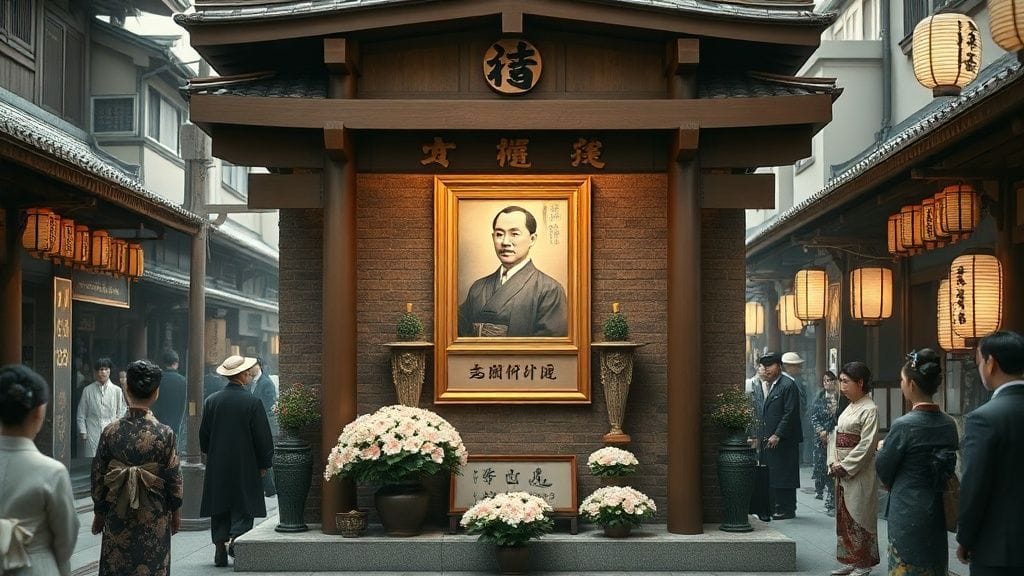
Although many understood the inevitability of Meiji’s passing, the emotional toll was profound. Streets emptied as citizens reflected quietly or gathered to offer prayers. A nation paused to honor the life that had traversed such turbulent, triumphant decades.
National Mourning: Public Reaction Across Japan
Mourning rituals unfolded on a grand scale. Flags flew at half-mast, newspapers printed special editions, and schools suspended classes. For many, this was a deeply personal moment despite the emperor’s lofty stature—even among those who had never seen him, the symbolic connection wielded tremendous emotional force.
Temples and shrines held memorial services; local communities organized collective remembrances. Yet, the mood was complex—grief mixed with anxiety over the future of an empire that had changed so much under Meiji’s guidance.
The Imperial Funeral and State Ceremonies
The imperial funeral, steeped in centuries of Shinto and Buddhist rites, began with solemn processions. From the imperial palace to the Kyūshū Mausoleum, every step was laden with meaning. Nobles, military officials, foreign dignitaries participated in ceremonies that combined ancient customs with the protocols of a modern nation-state.
Spectators lined the streets, and newspapers described the scene as “a moving testament to the Japanese spirit—respectful, orderly, and imbued with a quiet dignity.” The event reaffirmed the continuity of the imperial line even amid momentous change.
The End of the Meiji Era: Transition to the Taishō Period
Emperor Meiji was succeeded by his son, Crown Prince Yoshihito, who assumed the throne as Emperor Taishō. This marked the beginning of a new era, promising a gentler leadership style but also fraught with its own challenges—including political instability and social tensions intensified by rapid modernization.
Yet the handover was smoother than many anticipated, thanks to elaborate preparations and the legitimizing presence of the imperial institution. The nation looked forward with cautious optimism but remained deeply aware of its transformative past.
Meiji’s Legacy: The Making of Modern Japan
Meiji’s death compelled Japan and the world to reckon with his vast legacy. The restoration he personified had ended centuries of isolation and catapulted Japan onto the global stage. A once agrarian society had transformed into an industrial powerhouse capable of competing—militarily, economically, culturally—with Western great powers.
Cities, infrastructure, law, education—all bore his imprint. While not all changes were universally welcomed, the Meiji era became synonymous with progress and national pride.
International Impact: How Meiji’s Death Resonated Globally
Outside Japan, the news stirred diplomatic circles and the public alike. Western observers who had witnessed Japan’s startling ascent understood that an old order had truly passed. Newspapers from London to Washington printed stories praising Meiji as a “visionary architect” of a new East.
For many colonial powers, Japan now represented both a model and a challenge—proof that non-Western modernization was possible and could rival Western supremacy.
Cultural Shifts: Meiji’s Influence on Art, Literature, and Identity
Meiji’s reign ushered in a cultural renaissance through fusion—embracing Western styles while nurturing a reawakened Japanese identity. Artists experimented with new mediums; authors addressed themes of nationalism and modernity; theater and cinema found new audiences.
The emperor himself became a motif in literature and visual arts, symbolizing the tension between ancient values and modern aspirations. His death prompted renewed introspection about what it meant to be Japanese in a changing world.
Meiji’s Successors: Crown Prince Yoshihito and the New Path Ahead
Emperor Taishō faced the daunting task of carrying forward Meiji’s vision under changing circumstances. With a more constitutional approach to governance and prevalent political pluralism, his reign reflected Japan’s evolving political culture.
Though health issues limited Taishō’s direct influence, the period set the stage for further modernization and international engagement, influenced always by the towering legacy of his father.
Reflections from the World: Foreign Observers and Diplomats
Foreign diplomats in Tokyo described the emperor’s death as “a defining moment.” Reports captured admiration for Meiji’s quiet determination to uplift Japan and the bittersweet nature of the transition. Some contemporaries saw the changing leadership as an opportunity, others with apprehension—especially in imperial rivalries brewing across Asia.
These international perspectives offer a richer understanding of Meiji as a global figure, not just a national one.
The Emperor’s Tomb and Memorials: Sites of Memory
Today, Emperor Meiji’s mausoleum in Tokyo, within the Meiji Shrine, stands as a tranquil sanctuary amid a sprawling metropolis. It draws millions annually, a testament to the enduring connection between Japan’s modern identity and its imperial tradition.
Monuments, museums, and educational programs continue to explore his life, inviting reflection on the tensions, achievements, and contradictions of his era.
Lessons from the Meiji Era: Modernization, Leadership, and Change
The death of Emperor Meiji invites us to consider the complex interplay of leadership, tradition, and innovation. His reign teaches that true transformation demands vision but also patience, sacrifice, and the courage to embrace uncertainty.
In an age still grappling with rapid change and identity, Meiji’s story resonates—reminding us that history is never linear, but a mosaic of human hopes, failures, and relentless striving.
Conclusion
The death of Emperor Meiji on that quiet Tokyo morning in July 1912 was far more than an end; it was a profound inflection point in the grand saga of Japan and, indeed, the modern world. As a figure, Meiji embodied the paradox of continuity and change, of ancient imperial mystique entwined with the gritty realities of modernization. His passing closed a chapter defined by seismic shifts in politics, economy, society, and culture—transformations that positioned Japan as a formidable global actor.
Yet, beyond the broad strokes of history lies the intimate and universal story of a nation, its people, and its leaders confronting the paradoxes of progress: how to honor the past while carving a path forward, how to meld identity with innovation. The portraits painted by his life and death remain a vital reminder of the human dimensions of history, fraught with emotion, complexity, and enduring hope.
Emperor Meiji’s legacy endures not only in monuments or textbooks but in the spirit of Japan itself—a nation forever poised between reflection and renewal.
FAQs
1. What were the primary causes leading to Emperor Meiji’s rise to power?
The decline of the Tokugawa shogunate, internal unrest, and external pressures from Western powers, especially Commodore Perry’s arrival, catalyzed the restoration of imperial rule under Meiji, aiming to modernize and unify Japan.
2. How did Emperor Meiji influence Japan’s modernization?
While much change was driven by ministers and advisors, Meiji’s symbolic endorsement was crucial. His reign oversaw industrialization, military reform, education expansion, and political restructuring that propelled Japan into the modern age.
3. What were the immediate political consequences of Meiji’s death?
His death ushered in the Taishō era, marked by a more constitutional approach to governance and growing political pluralism. Although the imperial institution remained central, power dynamics gradually shifted towards elected officials.
4. How did the Japanese public react to the Emperor’s death?
The nation entered a period of deep mourning, characterized by solemn public observances, suspension of activities, and widespread reflection. The death was felt both as a personal loss and a historic moment.
5. What international significance did Meiji’s death hold?
Foreign governments and observers noted it as the passing of a visionary leader who had remade Japan, signaling shifts in global power. Japan’s emergence as an imperial power was thus framed against changing leadership.
6. In what ways did Meiji’s death affect cultural life in Japan?
It prompted renewed artistic and literary interest in themes of identity, modernity, and nationalism. The emperor became a symbol around which cultural expressions of change and continuity coalesced.
7. Who succeeded Emperor Meiji, and what challenges did they face?
His son, Emperor Taishō, succeeded him. Taishō’s reign faced health challenges, political shifts, and social tensions, requiring delicate balancing between tradition and modernization.
8. Where can one visit to learn more about Emperor Meiji today?
The Meiji Shrine in Tokyo, his mausoleum, museums, and historical sites provide rich resources for understanding his life and legacy.