Table of Contents
- Rome Awaits a Victor: The Stage Set for Probus
- The Empire in Crisis: Before the Rise of Probus
- From Soldier to Sovereign: The Making of Emperor Probus
- Threats on the Danube: Goths, Vandals, and the Fraying Frontier
- Forged in Campaigns: Probus Takes Command of a Shaken Empire
- Battles on the Edge of the World: Crushing the Goths
- Against the Northern Storm: Confronting the Vandals
- Peace at a Price: Settlements, Treaties, and Resettled Barbarians
- The Long Road Home: Probus Marches Toward Rome
- The Day of Glory: Emperor Probus Triumph Enters the City
- Spectacle and Symbolism: Rituals of a Roman Triumph
- Crowds, Captives, and Curiosity: How Romans Saw the Goths and Vandals
- Politics Behind the Laurels: Senate, Army, and the Fragile Peace
- Probus the Reformer: Fortifications, Vineyards, and Veterans
- Echoes in the Provinces: Provincial Lives After the Triumph
- Thunder on the Horizon: Mutiny, Unrest, and the Shadow of Doom
- The Fall of a Victor: Death of Probus and the Return of Chaos
- Memory of a Brief Rescuer: Probus in Ancient and Modern Eyes
- What the Triumph Meant: Rome’s Identity in a Changing World
- Conclusion
- FAQs
- External Resource
- Internal Link
Article Summary: In the autumn of 281 CE, Rome staged a spectacle to celebrate emperor probus triumph over the Goths and Vandals, a moment that shimmered with hope in an age of crisis. This article traces how a hardened Illyrian soldier rose through bloody frontier campaigns to become emperor, and how his victories briefly stabilized a fractured empire. It follows the dangerous clashes along the Danube, the negotiations that resettled defeated peoples, and the long march back to Rome that culminated in the glittering triumphal procession. Yet behind the garlands and acclamations of emperor probus triumph lay deeper tensions—between Senate and army, city and frontiers, Romans and “barbarians.” We explore the reforms Probus pursued, from fortifying borders to planting vineyards, and how these measures shaped everyday life across the provinces. The narrative then turns to the mutinies and resentments that would doom him, showing how his career illustrates the volatility of Rome’s third-century politics. Finally, we consider how ancient historians remembered emperor probus triumph and why his brief, bright reign still matters when we think about imperial power, identity, and survival in a world on the brink of transformation.
Rome Awaits a Victor: The Stage Set for Probus
In the year 281, the city of Rome prepared itself for a sight it had not seen in years with such conviction: the full, dazzling return of a victorious emperor at the head of his legions. Banners were hoisted along the Via Flaminia, garlands hung from balconies, and statues of the gods—Jupiter, Mars, and Victoria—were carefully polished to catch the pale autumn light. Rumors preceded the army’s approach like distant thunder: the Goths checked, the Vandals punished, the Danube frontier breathing again after years of fear. At the center of these stories, invoked with a mixture of awe and relief, stood one name—Marcus Aurelius Probus. The emperor probus triumph was not merely a military parade; it was a desperate people’s attempt to believe once more in the old promise that Rome, whatever its wounds, remained eternal.
The streets filled early. Artisans closed their shops, senators donned ceremonial togas with broad purple stripes, and freedmen jostled for vantage points near the Forum. Children, who had grown up hearing that emperors could be murdered almost as soon as they were proclaimed, tugged at their mothers’ tunics and asked whether this emperor would last longer. In the anxious stillness before the horns sounded, the city’s history seemed to hang in the air: decades of invasions, plagues, usurpations, and near-collapse. The triumph, as ever, was about more than one man’s glory. It was a ritual attempt to stitch together the torn fabric of time, to show that the empire that had once subdued Hannibal, Mithridates, and countless kings could still humble the northern tribes that haunted the Roman imagination.
Yet behind the decorations and rehearsed chants lurked unease. Many in the crowd had already seen several emperors come and go, each promising to restore security and prosperity. They had memorized the script of victory and collapse. As the distant sound of marching feet began to echo through the city gates, Romans wondered if this celebration marked a genuine turning point or just another brilliant spark in a long, dark night. The emperor probus triumph would dazzle them, yes—but it would also reveal, in all its pageantry, the fragility of the world they were trying to hold together.
The Empire in Crisis: Before the Rise of Probus
To understand the meaning of that triumphal day in 281, we have to step back into the turbulence that preceded it. Historians now call the third century the “Crisis of the Roman Empire”—a phrase that almost feels too mild. Between 235 and 284, the empire saw more than twenty legitimate emperors and countless usurpers. Few died peacefully. Many fell by the swords of their own soldiers; others were captured by enemies or simply disappeared in the chaos of campaigning.
Along the frontiers, the enemies Rome had once looked down upon as scattered tribal confederations began to appear as organized, terrifying forces. To the north and east, new coalitions of Germanic and steppe peoples emerged: Goths moving down from the Baltic zones, Vandals from the lands beyond the Rhine, Sarmatians roaming the plains. They probed Rome’s borders, sacked cities, and occasionally penetrated deep into the imperial heartlands. In 251, the emperor Decius himself perished in battle against the Goths in the Balkan swamps—a moment that seemed to tear away the last illusions of invincibility.
The year 260 witnessed perhaps the most shocking humiliation: Emperor Valerian captured alive by the Sassanid Persian king Shapur I and paraded as a symbol of Rome’s weakness. In the west, Gallic generals broke away to form a short-lived independent “Gallic Empire.” In the east, Palmyra under Queen Zenobia nearly carved a dominion from Rome’s tired hands. Plague ravaged cities and armies, while inflation hollowed out the value of coinage. The empire did not so much crumble as shudder and shift, its foundations cracking under the strain of emergencies it could barely contain.
In this world of permanent crisis, soldiers began to matter more than senators. Emperors rose not because of noble birth but because they were declared imperator by legions stationed in some dusty frontier fort. It is within this harsh military theater that Probus emerged: an officer forged in continuous war, whose legitimacy came less from Rome’s ancient institutions than from the steel loyalty of the men who had bled beside him. When the emperor probus triumph finally wound through the streets of Rome, it was the visible result of this new order—an empire ruled from the front lines, sustained by men who knew the landscape of battlefields better than that of the Senate House.
From Soldier to Sovereign: The Making of Emperor Probus
Marcus Aurelius Probus was not born into the soft luxury of a Roman aristocratic palace. He first saw the light in Sirmium, in the province of Pannonia (modern-day Sremska Mitrovica in Serbia), a frontier town where the empire’s might and vulnerability were both on display. To grow up there was to live with the ever-present rumor of raids across the Danube, with the sight of soldiers drilling under the watchful eyes of experienced centurions, and with the understanding that Rome’s safety depended on men who could endure cold nights on ramparts and sudden attacks at twilight.
Probus joined the army young, as was common among talented provincials whose families aspired to rise through merit. His abilities quickly set him apart. Sources, though sparse and sometimes embellished, agree that he proved fearless in combat and disciplined in command. Under the emperor Valerian and his son Gallienus, Probus campaigned widely. He honed his skills fighting not only Goths and other northern tribes but also usurpers and rebels who took advantage of Rome’s momentary weakness to seize power for themselves.
By the time Aurelian—another tough soldier from the Balkan provinces—came to power in 270, Probus had become one of the empire’s most reliable generals. Aurelian embarked on what might be called the first great attempt at restoring imperial stability: he crushed the Palmyrene and Gallic breakaway regimes and famously built the massive Aurelian Walls around Rome. In these campaigns, Probus distinguished himself repeatedly. Ancient historian Zosimus later remarked on his “extraordinary energy and skill in arms,” a telling compliment in an age when only such qualities could keep an emperor on his throne.
When Aurelian was murdered in 275, the empire again faced a vacuum. Tacitus briefly took the purple, followed by Florian, but their reigns were short and uncertain. In this maelstrom, the army’s gaze turned more and more toward Probus, the seasoned commander who had become the personification of resilience. In 276, stationed in the east, he was proclaimed emperor by his troops. His opponent, Florian, could not withstand the tide of military opinion and soon perished. The Senate in Rome, as was now almost routine, ratified faits accomplis rather than initiating them. Thus a frontier general from Sirmium became ruler of the Roman world.
This background mattered profoundly to the later spectacle of the emperor probus triumph. When Probus eventually entered Rome in 281, he did so not as a descendant of ancient patrician families but as a child of the crisis, a soldier’s emperor whose authority rested squarely on his proven capacity to win battles and secure borders. The people watching him that day saw, whether they realized it or not, the embodiment of an empire remade by necessity: harder, more militarized, yet still clinging to the ceremonies that connected it to its republican and early imperial past.
Threats on the Danube: Goths, Vandals, and the Fraying Frontier
The stage for Probus’s most celebrated victories lay along the restless Danube frontier. For centuries, this great river had served as one of the key boundaries of the Roman world, a shimmering line separating imperial provinces from the complex patchwork of tribes beyond. By the third century, that patchwork had begun to shift into something more formidable. Chief among the northern peoples that preoccupied Roman strategists were the Goths and the Vandals, both Germanic groups whose migrations and confederations gave them a scale and mobility that unnerved their southern neighbors.
The Goths, originally associated with regions north of the Black Sea, had already etched their name into Roman nightmares. They had crossed the Danube more than once, sacked cities like Philippopolis, and even challenged emperors directly in battle. They moved not as small raiding parties but often as sizable warbands, combining heavy infantry with swift cavalry. The Vandals, meanwhile, had long dwelt in the regions along the Elbe and Oder but were also moving southward under pressure from other tribes and the lure of Rome’s wealth. Their raids along the Rhine and upper Danube disrupted trade routes and devastated vulnerable settlements.
Rome’s defenses along these rivers were extensive yet overstretched. Forts, watchtowers, and fortified bridges dotted the frontier. Legionary camps had grown into towns, anchoring a militarized border society where soldiers might marry local women and veterans retire to nearby farms. But such defenses required constant maintenance, adequate manpower, and a stable central government—things the empire frequently lacked during the mid-third century. As civil wars drained resources and pulled troops away from the frontiers, gaps opened in the shield that protected the interior provinces.
By the time Probus gained the purple, these gaps had already been exploited repeatedly. Raids had pushed deep into Pannonia, Moesia, and Thrace. Farmers had abandoned fields; villages had been burned. Refugees swelled the populations of fortified cities. Against this grim backdrop, Probus could not afford half-measures. If his reign was to mean anything more than another name on a long list of doomed emperors, he needed decisive victories—and he needed them fast. The emperor probus triumph that would later weave through Rome’s streets would be built, quite literally, out of the blood spilled and dangers confronted along this volatile borderland.
Forged in Campaigns: Probus Takes Command of a Shaken Empire
When Probus assumed power, he inherited not just an imperial title but a series of unfinished wars. His predecessors had made efforts to stabilize the frontiers, but their short, troubled reigns meant that successes were often fleeting. Probus understood this brutally well. Rather than linger in Rome seeking senatorial approval or ceremonial legitimacy, he did what a third-century emperor almost had to do: he went straight to the army and the crisis zones.
His first years as emperor were a whirlwind of constant movement. He operated like a field commander rather than a distant ruler, appearing where the danger was greatest. He fought in Gaul, along the Rhine, beating back Franks and other Germanic raiders. He secured the loyalty of legions that had grown accustomed to proclaiming their own emperors. Then his gaze turned toward the Balkans and the Danube, where Gothic and Vandal pressures mingled with unrest among local populations and displaced peoples seeking land and safety within the empire.
The sources suggest that Probus combined relentless campaigning with strategic clemency. He understood that some barbarian groups could be crushed, but others might be more usefully tamed and incorporated. Prisoners of war could be turned into colonists or auxiliaries; defeated tribes could be resettled as buffer communities in underpopulated regions. Still, such long-term measures depended on first establishing clear military dominance. Until the legions had reasserted their strength, every negotiation risked being read as weakness.
Contemporary panegyrics—speeches of praise delivered in honor of emperors—paint Probus as tireless, almost superhuman in endurance. While their flattery must be handled with care, they preserve a sense of the atmosphere: horses collapsing under the strain of forced marches, armored men wading through rivers in the autumn chill, scouts slipping between forests and marshes to locate enemy encampments. It was here, in these harsh campaigns, that the narrative line leading to the emperor probus triumph in 281 was drawn. Each skirmish, ambush, and negotiated surrender added another thread to the tapestry of victory he would later unfurl in Rome.
Battles on the Edge of the World: Crushing the Goths
The confrontation with the Goths was both military and psychological. Roman soldiers carried the memory of Decius’s death and of Gothic incursions that had torched once-secure cities. To defeat them decisively would send a message not only to other barbarian groups but also to anxious provincials who wondered whether imperial promises of protection still meant anything.
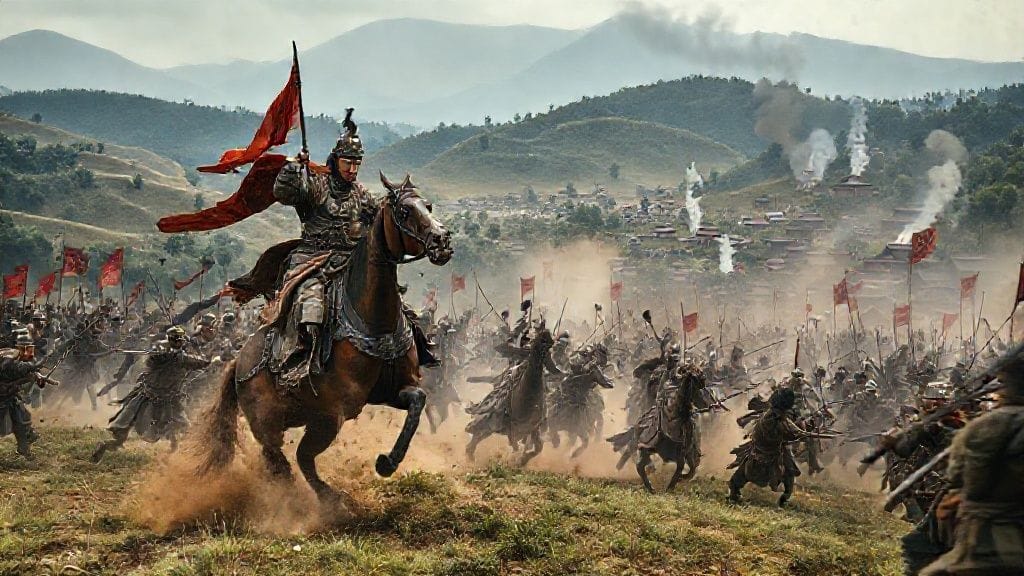
Details of Probus’s campaigns are fragmented, yet a coherent outline emerges from later chroniclers and inscriptions. Probus met Gothic forces in the regions of Moesia and Thrace, where wooded hills and river valleys created both opportunities and dangers. Gothic warbands, often mounted and highly mobile, excelled at surprise attacks and rapid withdrawals. Probus countered by restoring discipline to his legions and making aggressive use of cavalry. He pressed the Goths hard, denying them time to regroup or withdraw in good order.
In one campaign, Roman forces reportedly encircled a large Gothic contingent near a fortified city, cutting off their access to supplies. The siege that followed was grim. Night raids, burning projectiles, and sudden sorties characterized the struggle. The Romans, better supplied and more accustomed to siege warfare, gradually tightened the noose. Some Gothic leaders, recognizing the inevitability of defeat, sent envoys seeking terms. Probus, mindful of Rome’s battered prestige, insisted on clear submission: hostages, weapons, and an agreement to withdraw beyond the Danube.
Such victories came at a cost. Legionaries fell in battle or succumbed to disease. Local fields were trampled, villages looted by both sides. But slowly, the tide turned. The Goths, harried and exhausted, pulled back toward the river. Many were forced to accept resettlement arrangements on Roman terms. Others slipped away eastward, biding their time for future opportunities. For the moment, however, Probus could claim something rare in the third century: a sustained military success against one of Rome’s most dangerous foes.
When the day of the emperor probus triumph finally arrived in Rome, among the prisoners marched in chains were Gothic warriors captured in these campaigns. To the watching crowd, their tall frames, distinctive dress, and foreign hairstyles confirmed every story they had heard about ferocious northern enemies. Yet they also embodied something else: proof that, under capable leadership, Rome could still win on the very edges of its world.
Against the Northern Storm: Confronting the Vandals
If the Goths symbolized a recurring terror from the east of the Danube, the Vandals represented a more diffuse but equally troubling threat in the regions of the middle Danube and beyond. Compared to the Goths, Roman sources speak less frequently and less precisely about the Vandals in this period, but what they do say suggests persistent raiding, shifting alliances, and an ability to take advantage of Roman distractions elsewhere.
Under Probus, however, the Vandals encountered a different kind of imperial response. The emperor moved swiftly to bring his reorganized forces to bear against them, determined to prevent them from turning local raids into something more catastrophic. The campaigns against the Vandals likely involved a mixture of open-field battles and countryside sweeps, where Roman detachments combed through forests and river valleys to locate small warbands that evaded large-scale confrontation.
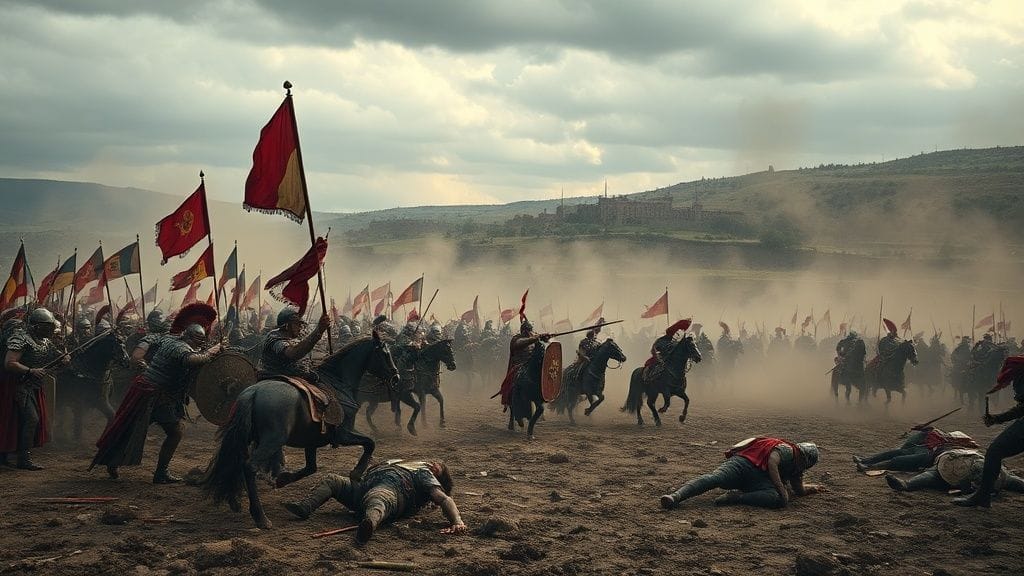
In at least one engagement, tradition has it that Probus’s troops trapped a substantial Vandal force near a river crossing. The Vandals, initially confident, found themselves hemmed in between the water and the advancing legions. Roman engineers, masters of field fortification, rapidly constructed ditches and palisades to block escape routes, turning the area into a killing ground. The resulting battle was savage. One can imagine the clash of shields, the thunder of hooves, the desperate shouts in mixed tongues as the Vandals attempted to break through Roman lines.
In the end, discipline and numbers prevailed. Many Vandals fell; others were captured. Some tribal leaders accepted terms that involved delivering hostages and serving as federate allies under Roman oversight. What mattered to Probus was not annihilation but subordination—ensuring that the Vandals could no longer raid Roman territory with impunity and that they understood the costs of defiance.
Thus, when the emperor probus triumph wound its way through Rome, the Vandals too were represented among the chained captives and displayed spoils. For a Roman audience, who had long associated the name “Vandal” with trouble in the murky northern forests, seeing these once-distant enemies humbled in the heart of the city carried immense symbolic weight. Ironically, centuries later, the Vandals would return to history’s center stage by sacking Rome itself in 455. But in 281, under Probus’s gaze, they appeared as a defeated people—a reassurance, however temporary, that the empire still held the upper hand.
Peace at a Price: Settlements, Treaties, and Resettled Barbarians
Victory in the third century rarely meant simple conquest and withdrawal. Rome could not afford to station unlimited troops forever along every exposed stretch of frontier, nor could it endlessly depopulate its own provinces to replenish the army. After defeating the Goths and Vandals, Probus faced a familiar yet thorny question: what to do with the defeated?
One answer was resettlement. Probus followed and expanded a practice increasingly used by third-century emperors: planting captured or allied barbarian groups within the empire as agricultural colonists or auxiliary troops. He is said to have resettled tens of thousands—ancient numbers are notoriously imprecise, but the scale was clearly significant—of defeated or displaced peoples in underpopulated provinces such as Thrace, Pannonia, and parts of Asia Minor. These men and women were given land on the condition that they would farm it and defend the surrounding territory.
This policy was both pragmatic and risky. On one hand, it turned former enemies into potential defenders and revitalized regions devastated by war and plague. On the other, it introduced large non-Roman communities into the imperial interior, accelerating processes of cultural mixing and raising concerns among traditionalists. To a Roman senator reading reports from the front, the sight of Gothic or Vandal villages inside provincial borders might have felt like a quiet erosion of what had once been a stark, comforting line between “Roman” and “barbarian.”
Probus also pursued diplomatic deals, formalizing peace with certain Gothic and Vandal leaders through treaties that regulated tribute, trade, and crossing rights along the rivers. These agreements often called for the provision of auxiliary troops to the Roman army—a useful infusion of manpower in an age when recruitment could be difficult. In return, Rome offered subsidies, trade opportunities, and the vague but significant prestige of being recognized as foederati, allied peoples under imperial patronage.
Such arrangements underpinned the calm that made the emperor probus triumph possible. When Probus rode into Rome at the head of his formations, he had behind him not just battlefield successes but also a network of new accommodations and controls. The peace he advertised was thus layered: swords sheathed, fields replanted, alliances fragile but functioning. It was a peace, however, that required constant vigilance, for the integration of barbarians into the Roman world would, over the following decades and centuries, transform the empire in ways no one lining the triumphal route in 281 could fully imagine.
The Long Road Home: Probus Marches Toward Rome
With the Danubian campaigns concluded and the northern threats temporarily pacified, Probus did something no emperor of his generation could take for granted: he turned his face toward Rome to claim his triumph. This journey was not a simple ride; it was a carefully choreographed demonstration of stability. As the imperial retinue moved through the provinces, cities prepared receptions, erected temporary arches, and sent delegations to greet the victor. Provincial elites, ever attuned to shifts in power, seized the moment to renew their loyalty and petition for favors.
For the soldiers marching in the long columns, the route home was a time of both pride and fatigue. They carried the marks of hard campaigning: scars, worn equipment, banners tattered at the edges. Yet they also bore visible tokens of success—captured standards, exotic weapons, carts laden with spoils. Prisoners, including Gothic and Vandal warriors and their families, trudged alongside under guard. To towns along the way, these captives appeared as living proof of Roman supremacy and as reminders of the dangers that lurked beyond the frontier.
Probus himself rode at the center of this moving theater, surrounded by guards and officers whose fortunes were tied to his own. Messages sped ahead to Rome, informing the Senate and people of his imminent arrival and his intentions to celebrate a full triumph. The Senate, perhaps with a mixture of pride and resignation, passed decrees in his honor, confirming titles and preparing official ceremonies. After decades in which Rome sometimes felt like little more than a ceremonial backdrop to an empire ruled from distant camps, the emperor probus triumph promised, at least briefly, to re-center imperial drama within the city’s ancient walls.
As the imperial column drew nearer, the stories multiplied: tales of last stands against the Goths, negotiations with humbled Vandal chiefs, speeches proclaiming that a new age of security had begun. Exaggerations blended with reality, but the emotional truth remained: after years of fear and fragmentation, many Romans were eager—perhaps desperately so—to believe that this emperor, hardened by frontier campaigns, might truly be the one to restore order.
The Day of Glory: Emperor Probus Triumph Enters the City
At last, the day arrived. The morning sky over Rome in 281 was, we may imagine, a clear blue washed by the cool air of early autumn. Crowds pressed along the route from the city gate to the Forum, bodies a living wall of expectation. Trumpeters and heralds moved ahead, warning those in side streets that the procession was coming. At its heart was the emperor probus triumph, a spectacle crafted to condense years of war and policy into a few hours of theater.
The order of a triumphal procession followed an ancient, revered pattern. First came the magistrates and senators, in white togas edged with purple, representing the continuity of Rome’s civic institutions. Then the spoils: carts piled high with captured arms and armor, shields painted with Gothic and Vandal motifs, bundles of spears, glittering bits of jewelry ripped from the necks and wrists of defeated chiefs. Boards with painted scenes—almost like living storyboards—depicted key battles and sieges so that even those who could not read might grasp the emperor’s achievements.
Next marched the captives. Tall, fair-haired Gothic warriors, some still glaring despite their chains; Vandal fighters, women and children in tow, their faces marked by exhaustion and anger; tribal leaders in distinctive cloaks and ornaments, now stripped of their freedom. The crowd gaped and jeered. Some pelted the captives with insults or refuse; others simply stared, perhaps with a more complex, uneasy curiosity. The presence of these foreigners in the heart of Rome dramatized the victory more vividly than any inscription could.
Above and behind them, riding in a chariot drawn by horses, stood Probus himself. He wore the traditional triumphal attire: toga picta, richly embroidered, and the laurel wreath of victory on his brow. For these few hours, Roman ritual treated him almost as a god. The people shouted, “Io Triumphe! Ave Probus! Restitutor orbis!”—“Restorer of the world!” He raised his hand in acknowledgment, a figure at once individual and symbolic, his scarred soldier’s face framed by the finery of office. The emperor probus triumph thus fused man and myth: behind the wreath and purple sat the frontier general from Sirmium, yet the city saw, or wanted to see, the living embodiment of Roman destiny.
The procession wound through the Forum, past temples whose foundations had seen centuries of similar spectacles, and finally approached the Capitoline Hill, where sacrifice would be offered to Jupiter Optimus Maximus. When Probus dismounted to ascend the steps and lay his laurels before the god, he enacted the same ritual performed by Scipio, Caesar, and countless other victors. In that moment, time seemed to fold: the crisis-torn third century reached back to clasp hands with the confident Republic and early Principate. It is astonishing, isn’t it, how ritual can make such different worlds feel like one continuous story?
Spectacle and Symbolism: Rituals of a Roman Triumph
The triumph was not a mere parade; it was a language of power, dense with symbolism. Every component of the emperor probus triumph communicated a message—to the people, the army, the Senate, and to the gods themselves. The route, passing key public monuments, reminded spectators of Rome’s accumulated glory. The order of march placed the emperor at the high point of a rising crescendo, culminating in the sacrifice that sanctified his victories.
Even the costume mattered. By donning the toga picta and the red-painted face sometimes associated with Jupiter, Probus momentarily stepped into a semi-divine role. Roman religion did not formally declare him a god (that would come, if at all, after death through deification), but the implication was clear: he enjoyed a special favor of the gods, particularly Jupiter, whose own victories he was thought to echo. The laurel wreath symbolized not just a specific set of campaigns but the broader idea of Roman victory and renewal.
Music, too, played its part. Trumpets blared; flutes and drums kept the steady rhythm of marching feet. The chants of the crowd, though seemingly spontaneous, often repeated formulas crafted by official heralds and priestly colleges. Inscriptions that would later commemorate the triumph used stock phrases like “for having restored peace to the provinces” and “for having avenged Roman blood.” The triumph thus rewrote the messy, brutal reality of frontier warfare into a coherent narrative of justified struggle and righteous success.
Yet there were also more ambiguous notes. Traditionally, a slave would stand in the chariot behind the triumphant general and whisper, “Remember you are mortal,” a quiet antidote to hubris. Whether this detail was still scrupulously followed in the third century is debated, but the principle lingered: even as he basked in adulation, Probus was reminded, perhaps by advisers or by his own hard-earned realism, that fortune was fickle. The same soldiers cheering him today could, under different circumstances, turn against him tomorrow.
For Rome’s citizens, the emperor probus triumph was a rare moment when vast geopolitical forces became visible and tangible. They could see the foreign peoples they had long heard about, gaze on the spoils that would replenish state treasuries, and feel, through the rhythm of drums and the shimmer of metal, that they were part of a larger story of survival. It was a catharsis—but also a performance that masked the complex, unresolved tensions underlying the empire’s brief resurgence.
Crowds, Captives, and Curiosity: How Romans Saw the Goths and Vandals
As the captives shuffled past, the crowd’s reactions revealed much about Roman attitudes toward the peoples beyond their borders. On one level, the Goths and Vandals were simply “barbarians,” a catch-all term that Roman writers used to signal linguistic confusion, unfamiliar customs, and what they regarded as a lower level of civilization. Their clothing—trousers rather than tunics, heavy cloaks, distinctive jewelry—marked them at a glance as outsiders. Children in the crowd pointed and whispered, perhaps half-afraid, half-fascinated.
On another level, these captives were objects of both contempt and grudging respect. The very fact that they were being paraded indicated that they had once posed a serious threat. Stories circulated of their ferocity in battle, their willingness to fight to the death rather than submit. Roman spectators might call them savages, yet the enormity of the emperor probus triumph depended on the perceived stature of the defeated enemy. A triumph over a trivial foe was no triumph at all.
Some Romans watching that day may have wondered about the human stories behind those chained faces. A Vandal mother clutching her child, a Gothic youth glaring in impotent fury—what villages had they left behind? What promises had they been given by their leaders when they followed them into war? For a fleeting moment, the boundaries between “Roman” and “barbarian” might have blurred, as shared human experiences of loss and dislocation came into view. But then the music swelled, the crowd roared, and the narrative of Roman supremacy reasserted itself.
Ancient authors such as the later historian Ammianus Marcellinus, though writing decades after Probus, give a sense of the complexity of Roman views toward Germanic peoples: fear, disdain, curiosity, and sometimes admiration for their courage. The triumph crystallized these mixed emotions. It visibly confirmed Rome’s ability to dominate, yet it also reminded observers that these northern peoples were not going away. They remained, in Roman eyes, eternal neighbors—dangerous, unpredictable, and fated to appear again and again on the empire’s borders.
Politics Behind the Laurels: Senate, Army, and the Fragile Peace
While the public face of the emperor probus triumph was unity and celebration, the political realities behind it were more nuanced. Probus’s power base lay overwhelmingly in the army, particularly in the frontier legions that had proclaimed him and followed him into campaigns. The Senate, though still accorded formal respect, had little real say in imperial succession. Its role in the triumph—passing honorific decrees, providing a dignified escort—masked its reduced political weight.
Some senators likely resented this state of affairs. They might appreciate Probus as a stabilizing force yet bristle at the way military acclamation had replaced senatorial deliberation in choosing emperors. At the same time, they had little choice but to embrace him, at least outwardly. A stable emperor, however he came to power, protected their estates and preserved the social order from the chaos of constant usurpation.
Within the army, too, opinion was not monolithic. Frontline troops who had fought beside Probus could take genuine pride in the triumph as a validation of their sacrifices. Yet there were also officers and soldiers who, for reasons of ambition or grievance, remained potential focal points for future rebellions. The memory of how quickly emperors could be overthrown lingered in every camp. A triumph might temporarily elevate an emperor, but it could not magically erase the underlying realities of power politics in a militarized empire.
Probus sought to navigate these tensions by projecting an image of shared achievement. In speeches associated with his reign, he emphasized the collective nature of victory: the bravery of soldiers, the loyalty of officers, the support of the Senate, the prayers of the Roman people. He styled himself not merely as a conqueror but as a restorer, someone who returned the world to its proper order. Nevertheless, the chronic instability of the third century hovered over his laurels. The same rituals that connected him to Rome’s most glorious past also highlighted, through contrast, how precarious his own position remained.
Probus the Reformer: Fortifications, Vineyards, and Veterans
Victory alone could not secure the empire’s future; Probus understood that he needed to reshape the conditions that had allowed crisis to flourish in the first place. In the years surrounding his triumph, he embarked on a series of reforms and public works that sought to harden the empire’s shell while nourishing its inner life.
One major focus was fortification. Along the Rhine and Danube, Probus repaired and expanded existing structures, building watchtowers, reinforcing walls, and restoring roads to ensure rapid troop movements. In some areas, he established new defensive lines slightly behind the existing frontier, creating depth in defense. These measures were not glamorous, but they were essential. A stronger, more coherent frontier infrastructure would make it harder for Goths, Vandals, and other groups to penetrate deep into imperial territory before being intercepted.
Probus also became famous—almost uniquely among emperors—for promoting agriculture, especially viticulture, on a large scale. Later sources recount that he encouraged, even compelled, soldiers to plant vineyards in Gaul, Pannonia, and other provinces during periods when they were not actively campaigning. On one level, this policy reflected the simple necessity of using the army as a labor force to restore devastated lands. On another, it symbolized a deeper vision: transforming regions scarred by war into productive, flourishing landscapes.
Some modern scholars have questioned the scale or details of these accounts, but the image endures: legionaries in armor digging furrows, planting vines, reshaping the soil they had so often marched over in grim silence. The emperor probus triumph in Rome, with its emphasis on conquered enemies and captured weapons, told one half of the story. The quieter half lay in these fields and hills where Probus tried to plant the seeds—literally and metaphorically—of a renewed prosperity.
Veterans also figured prominently in his plans. Settled on land in frontier provinces or Italy, they served as both farmers and a kind of latent militia, ready to defend their communities if trouble flared. In this, Probus followed an old Roman tradition that stretched back to the Republic: rewarding soldiers with land and using their presence to stabilize sensitive regions. But in the third century, with frontiers more porous and enemies more organized, the stakes of such policies were especially high.
In all these endeavors, Probus sought to turn the short-term glow of the emperor probus triumph into something more durable: a structure of defense and production that might outlast his own precarious lifespan. It was an ambitious project, and like all such efforts in this era, it ran headlong into the limits imposed by constant military demands and the fickle loyalty of the troops.
Echoes in the Provinces: Provincial Lives After the Triumph
While Rome reveled in garlands and pageantry, life in the provinces bore the more subtle imprint of Probus’s victories and reforms. In the Balkans and along the Danube, the immediate impact was relief. Villages that had lived under the recurring threat of raids could, for a time, sleep more soundly. Farmers returned to abandoned fields, rebuilding houses and workshops. Markets revived as traders cautiously resumed their routes, bringing wine, salt, and manufactured goods to communities that had been on the brink of abandonment.
The resettlement of defeated Goths and Vandals added new layers to provincial societies. In Thrace, for instance, Roman landowners might suddenly find themselves neighboring villages of recently transplanted barbarians. Communication required interpreters; legal disputes generated new kinds of cases for provincial governors. Over time, these communities could become partially Romanized, adopting Latin or Greek, participating in local economies, and even sending their young men into the Roman army. But in the short term, their presence was a reminder of how the empire’s boundaries had become more porous, its sense of identity more complex.
In Gaul, the vineyards attributed to Probus’s policies symbolized a different aspect of change. Towns that had previously known the army only as a passing host might now see soldiers working the soil, helping to plant the very vines that would, in later centuries, make certain regions of France famous. Even if the stories exaggerate Probus’s personal involvement, they capture a truth: the third-century empire increasingly relied on creative blends of military and economic policy to hold its vast territories together.
For provincial elites—city councilors, landowners, local priests—the triumph celebrated in distant Rome was both an inspiration and a calculation. To align themselves with Probus meant potential benefits: tax remissions, honorary titles, perhaps imperial favor in the settlement of local disputes. Yet they also knew how quickly emperors could fall. In private, over wine poured from newly productive vineyards, they might speculate on how long this stability would last and whether they should also keep channels open to ambitious generals commanding legions nearer to home.
Thus, in towns from Sirmium to Colonia Agrippina, the echo of the emperor probus triumph sounded not as a single note but as a complex chord, blending hope, skepticism, and the day-to-day pragmatism that had become a survival skill throughout the empire.
Thunder on the Horizon: Mutiny, Unrest, and the Shadow of Doom
For all his successes, Probus could not escape the structural dangers that haunted every third-century emperor. Armies that made emperors could also unmake them. The very qualities that endeared him to some—his strict discipline, his demand that soldiers work on civilian projects during peacetime, his refusal to indulge the army’s every desire—bred resentment among others.
Reports from later sources, such as the often unreliable but evocative Historia Augusta, tell of grumbling in the ranks. Soldiers complained that under Probus they were treated more like laborers than conquerors, forced to dig canals, build walls, and plant vineyards instead of enjoying the spoils of war. Whether these stories are entirely accurate or partly shaped by later moralizing, they capture a genuine tension: the clash between an emperor’s need to rebuild the empire and the army’s expectation of reward and status.
As campaigns continued—against internal usurpers, against lingering threats on various frontiers—the strain on men and resources mounted. Some officers, resentful of Probus’s firm hand or eager for advancement, may have whispered in darkened tents that a different emperor would be more generous, more pliant. The memory of how quickly Aurelian had fallen, undone by his own troops, lingered as a grim precedent.
The emperor probus triumph, with its carefully staged affirmation of unity between ruler, army, and people, could not obliterate these undercurrents. In fact, by crowning Probus’s achievements so spectacularly, it may have heightened the stakes. After such public glory, any sign of weakness or unpopularity would be all the more glaring. The same laurel wreath that gleamed in the Roman sun cast a long, dark shadow across future years.
The Fall of a Victor: Death of Probus and the Return of Chaos
In 282, scarcely a year after his triumph in Rome, Probus met the fate he had surely contemplated but could never fully prepare for. While engaged in yet another phase of military activity—likely in the Balkans or near Sirmium, though sources differ—he was killed by his own soldiers. The exact circumstances remain murky, obscured by the usual haze that shrouds the violent ends of third-century emperors. Some accounts speak of a spontaneous mutiny sparked by his demands for labor; others hint at a more organized plot by officers who had already settled on his successor.
What is clear is that the same army that had carried him to the purple and cheered him in triumph turned against him with lethal efficiency. Perhaps there were shouts, accusations, an attempt by loyal officers to intervene. Perhaps Probus, the veteran soldier, tried to reason with the men whose loyalty he had trusted. In the end, however, words gave way to weapons. An emperor who had spent a lifetime mastering the art of war and government fell to the blades of those he had led.
His death unleashed the familiar cycle. Carus, a senior officer of Illyrian origin, was acclaimed emperor by the troops. The Senate ratified the decision, as it always did. Probus’s reforms, though not erased overnight, lost their driving force. The precarious balance he had maintained between frontier defense, provincial recovery, and imperial authority began to tilt once more toward fragmentation and opportunism.
In retrospect, the emperor probus triumph of 281 took on a bittersweet aura. It had been a peak, perhaps the peak, of his career and of the empire’s short-lived stabilization in the post-Aurelian era. But like so many triumphs in the age of crisis, it failed to guarantee a secure future. Its laurel wreath became, in memory, a crown of thorns: a poignant reminder of what might have been had Probus lived longer, or had the structures of power around him been less violently unstable.
Memory of a Brief Rescuer: Probus in Ancient and Modern Eyes
After his death, Probus did not vanish from Roman memory, but neither did he receive the elaborate cult of personality awarded to more fortunate emperors. Later historians, from Zosimus to the anonymous authors of the Historia Augusta, remembered him as an energetic, capable soldier-emperor who worked tirelessly to restore order. One later writer praised him as “a man of such industry and bravery that he seemed born for the salvation of the empire,” a sentiment that captures the retrospective sense that his reign was a missed opportunity.
Yet ancient sources are sparse and often contradictory. Some laud his clemency; others emphasize his severity with troops. The triumph of 281 is mentioned as a highlight, but the surviving accounts focus less on colorful description than on its political and religious significance. For archaeological confirmation, historians rely on coins struck under his reign, many of which bear legends like RESTITVTOR ORBIS (“Restorer of the World”) and imagery of Victory crowning the emperor—visual echoes of the emperor probus triumph that once threaded through Rome.
Modern scholarship, drawing on these scattered threads, tends to view Probus as part of a line of “soldier-reformers” that included Claudius II Gothicus, Aurelian, and Diocletian. Within this narrative, he occupies the role of an able, innovative ruler whose actions bought the empire precious time. As historian Pat Southern has argued in her study of the late Roman army, emperors like Probus demonstrated that military professionalism and administrative pragmatism could still hold the empire together, at least temporarily, even in a world of mounting pressures.
The emperor probus triumph, in this light, becomes more than a picturesque episode. It stands as a culminating symbol of an entire strategy: confront threats head-on, integrate the defeated where possible, harden the frontiers, revitalize the provinces. That this strategy ultimately could not halt the long-term transformations of the Roman world does not diminish its achievements. If anything, it casts Probus as a kind of tragic hero of late antiquity—a man who did almost everything an emperor in his position could reasonably do, and who still fell victim to forces larger than himself.
What the Triumph Meant: Rome’s Identity in a Changing World
What, then, did it mean for Rome to celebrate the emperor probus triumph in 281? On the surface, the answer seems straightforward: it meant that a dangerous set of enemies had been defeated and that the empire, for the moment, was safe. But beneath that surface lay deeper questions about who the Romans thought they were and what kind of world they believed they inhabited.
In the Republic and early Principate, a triumph reinforced the sense that Rome stood at the center of a world it dominated both militarily and culturally. By the late third century, however, this certitude had been shaken. The empire had faced near-disintegration, rival emperors, lost territories, and devastating incursions. The peoples paraded as captives—Goths, Vandals, and others—were no longer distant curiosities. They were neighbors, sometimes foederate allies, occasionally fellow-soldiers in the imperial army.
In this context, the triumph’s message was both conservative and adaptive. Conservative, because it insisted on the continuity of Rome’s traditions: the same gods, the same rituals, the same official language of victory. Adaptive, because it tacitly accepted a new reality in which maintaining dominance required negotiation, integration, and compromise as well as conquest. The same Goths who today marched in chains might tomorrow farm Roman fields or fight in Roman ranks.
The triumph also demonstrated the growing centrality of military power in defining Roman identity. The hero of the day was not a senatorial aristocrat but a provincial soldier-emperor, risen through the ranks by merit and opportunity. His story told Romans that their survival now depended less on ancient lineage and more on the hard virtues of the camp: discipline, courage, logistical skill. It suggested that the empire’s future, if it had one, would be written by men like Probus—products of the frontiers, familiar with the languages and tactics of Rome’s enemies, pragmatic in both war and peace.
Finally, the emperor probus triumph cast a long shadow in historical imagination. It offered a snapshot of an empire at once resilient and fragile, capable of impressive recoveries yet haunted by the knowledge that each victory might be only a reprieve. When we look back on that day, with its gilded chariots and captive kings, we see not just a celebration but a crossroads—a moment when the Roman world briefly believed that it could still be what it had always been, even as the deeper currents of change flowed on beneath the surface.
Conclusion
The triumph of Emperor Probus in Rome in 281 was both culmination and prelude: the culmination of grueling campaigns against Goths and Vandals that had threatened the very fabric of the Danube frontier, and the prelude to further upheavals that would soon engulf the empire. In that luminous, orchestrated procession—gleaming armor, painted trophies, captive chieftains, the laurel-crowned emperor passing beneath the gaze of Jupiter—Rome attempted to tell itself a comforting story: that the old patterns still held, that victory still flowed reliably from Roman arms and Roman gods.
Yet beneath the surface of the emperor probus triumph lay the hard truths of the third-century crisis. Probus was a soldier-emperor whose authority rested on legions exhausted by constant war, an innovator who pushed for fortifications, agricultural renewal, and the integration of defeated peoples, but who could not entirely reconcile his army to the burdens of rebuilding as well as fighting. His policies purchased security and even prosperity in some regions, but they also exposed the deep interdependence between Rome and the very “barbarians” it sought to dominate.
His assassination a year after the triumph underscores the volatility of the age. Glory in Rome did not guarantee safety in the provinces; the same hands that raised an emperor up could cut him down. Still, the legacy of Probus endured in more than coins and panegyrics. He left strengthened frontiers, resettled communities that would shape the cultural landscape of late antiquity, and a powerful, if fleeting, example of what energetic leadership could achieve amid systemic crisis.
Looking back, the emperor probus triumph stands as a poignant emblem of the late Roman world: magnificent, theatrical, full of ancient ritual power, yet shadowed by the knowledge that the empire was changing in ways no single man, however capable, could fully control. It reminds us that history’s great ceremonies are often held on the edge of an unseen precipice, and that the laurel wreath, for all its radiance, is always woven around a mortal brow.
FAQs
- Who was Emperor Probus?
Emperor Probus (Marcus Aurelius Probus) was a Roman soldier-emperor who ruled from 276 to 282 CE. Born in the frontier city of Sirmium, he rose through the army by merit and became known for his energetic campaigns to secure the empire’s borders, especially along the Rhine and Danube. His reign is often seen as one of the most capable attempts at stabilization during the third-century crisis. - Why was the triumph of 281 so important?
The triumph of 281 celebrated Probus’s victories over the Goths and Vandals, key threats along the Danube frontier. It symbolized a rare moment of confidence in an age marked by civil war, invasions, and economic turmoil. By staging a full imperial triumph in Rome, Probus signaled that the empire remained powerful and that its traditions of victory and divine favor still held meaning. - Who were the Goths and Vandals in Probus’s time?
The Goths and Vandals were Germanic peoples living beyond the Roman frontiers in central and eastern Europe. By the third century, both had formed powerful confederations capable of large-scale raids into Roman provinces. They attacked cities, disrupted trade, and challenged Roman armies, making them among the most feared northern enemies of the period. - How did Probus deal with defeated barbarian peoples?
Probus combined military force with pragmatic integration. After defeating groups like the Goths and Vandals, he often resettled them within the empire as agricultural colonists or recruited them as auxiliary troops. These arrangements restored devastated lands and bolstered the army, but they also blurred the traditional line between “Roman” and “barbarian,” contributing to the empire’s evolving social landscape. - What reforms did Probus implement beyond his military campaigns?
Probus focused on strengthening frontier defenses, repairing and expanding fortifications, and improving roads. He also promoted agriculture, especially viticulture, reputedly having soldiers plant vineyards in several provinces. Additionally, he settled veterans on land in frontier regions, reinforcing both local economies and defense. These measures aimed to turn short-term victories into lasting stability. - How and why did Emperor Probus die?
Probus was killed in 282 CE by his own soldiers, likely near Sirmium, during or after a period of military operations. Ancient sources suggest that discontent in the army over his strict discipline and demands for labor contributed to the mutiny. His death followed a pattern common in the third century, where emperors rose and fell at the mercy of their troops. - What is the historical legacy of Probus’s reign?
Probus is remembered as one of the more capable and energetic emperors of the crisis period. His campaigns and reforms strengthened the empire’s defenses and temporarily restored a degree of order and prosperity, especially in troubled frontier regions. Modern historians often see him as a precursor to the more durable reorganization under Diocletian, and his triumph in 281 stands as a vivid symbol of what late Roman leadership could still achieve, even amid profound instability.
External Resource
Internal Link
Other Resources
- Encyclopaedia Britannica – general search for the exact subject
- Google Scholar – academic search for the exact subject
- Internet Archive – digital library search for the exact subject