Table of Contents
- A Northern Emperor in the South: Setting the Stage for a Pilgrimage
- From Steppe to Court: The Rise of the Northern Wei and Emperor Xiaowen
- Qufu and the Sleeping Sage: Confucius’s Tomb Before 494
- Crossing the Cultural Frontier: Planning the Journey to Qufu
- The Procession Begins: Imperial Banners on Ancient Roads
- The City of the Sage: First Sight of Qufu
- Emperor Xiaowen Visits Confucius Tomb: The Ritual Unfolds
- Tears in the Cypress Shade: Private Moments at the Grave
- Edicts beneath the Ancient Trees: Political Declarations at the Tomb
- From Tuoba to Han: Sinicization and the Remaking of Identity
- Scholars, Scribes, and Skeptics: How the Elites Saw the Pilgrimage
- Echoes in the Villages: Common People and the Emperor of the North
- Historians and Memory: Recording the Visit in Official Chronicles
- Confucianism as Statecraft: Ritual, Morality, and Imperial Authority
- A Turning Point in the Long Civil War of Ideas
- After Qufu: Reforms, Resistance, and the Fate of Northern Wei
- Across the Centuries: How Later Dynasties Read the 494 Pilgrimage
- Modern Perspectives: Nation, Ethnicity, and the Story of a Visit
- Conclusion
- FAQs
- External Resource
- Internal Link
Article Summary: In the year 494, during an age of fractured kingdoms and contested identities, emperor xiaowen visits confucius tomb in Qufu, staging one of the most symbolically charged journeys in early medieval China. This article follows that journey step by step, placing it within the turbulent history of the Northern Wei dynasty and the broader struggle between nomadic heritage and classical Chinese culture. It explores why a ruler of steppe ancestry chose to bow before the grave of an ancient sage, and how ritual became a language of power, legitimacy, and transformation. Through vivid narrative, we step into the city of Qufu, listen to the murmurs of officials and villagers, and watch as incense smoke curls over centuries of history. The article also considers how this pilgrimage shaped later reforms, influenced Confucian statecraft, and was remembered—or mythologized—by historians. Along the way, it examines the political uses of tradition, the emotional resonance of ancestral rites, and the delicate balance between sincerity and performance. By returning again to the moment when emperor xiaowen visits confucius tomb, it reveals how a single act of reverence could help remake a dynasty and reconfigure the cultural map of North China.
A Northern Emperor in the South: Setting the Stage for a Pilgrimage
The year was 494, on most calendars an unremarkable entry in a long age of division, war, and tenuous peace. Yet along the dusty roads that led toward the modest city of Qufu in Shandong, something unprecedented was taking shape. Far to the north, in the formidable capital of the Northern Wei, orders had been drafted, seals impressed, and messengers dispatched to prepare a journey that would ripple through centuries of Chinese history. An emperor born into a dynasty of steppe horsemen would travel to the resting place of the most revered sage of China’s classical past. In a world where borders were as fragile as paper screens, this was more than a visit; it was a declaration.
When emperor xiaowen visits confucius tomb, the act does not emerge from nowhere. It is the culmination of pressures that had been building for decades: the need to legitimize rule over millions of Han Chinese subjects, the ambition to transform a once-nomadic royal clan into the stewards of a classical civilization, and the competing claims of Buddhism, Daoism, and Confucianism upon the hearts and minds of the elite. His journey to Qufu came at a time when the Northern Wei dynasty, founded by the Tuoba, a Xianbei people, controlled a vast swath of northern China but lacked deep roots in the Chinese cultural imagination. Their martial prowess was unquestioned; their right to preside over the traditions of the sages was not.
From the dusty archives of the Wei Shu (Book of Wei) and the Bei Shi (History of the Northern Dynasties), historians have pieced together a portrait of a young emperor determined to re-forge his lineage. Early medieval North China was not just a battlefield of armies, but a battlefield of identities, scripts, and rituals. To the south, the Liu Song and then the Southern Qi courts claimed to be the true heirs of Han and Jin civilizations. To the north, the Northern Wei were slowly, sometimes painfully, renouncing the customs of their ancestors—short jackets, braids, and mounted archery as the highest art—in favor of robes, formal caps, and the rectitude preached by ancient texts.
Within this context, the decision to leave the capital and move southward toward Qufu had an almost theatrical quality. Yet behind the theater lay desperation and calculation in equal measure. If the emperor could be seen not as a foreign conqueror but as a devout guardian of the tradition of Confucius, then perhaps the great landowning families, the scholars who copied and taught the classics, and the common people who still told stories of the ancient sage might offer him a loyalty deeper than fear. With each step toward Qufu, the past and the present seemed to draw closer, poised to meet beneath the shade of old cypresses over an unassuming mound of earth that marked Confucius’s grave.
From Steppe to Court: The Rise of the Northern Wei and Emperor Xiaowen
To understand why emperor xiaowen visits confucius tomb in 494, one must first trace the unlikely path that brought his ancestors from the grasslands to the palaces of northern China. The Northern Wei dynasty had been founded more than a century earlier, in 386, by Tuoba Gui, who took the reign title Daowu. The Tuoba were one of many Xianbei groups whose lives revolved around horses, herds, and the austere freedoms of the steppe. Their political culture prized kinship bonds, warrior valor, and a mobile court that could move as quickly as the nomad encampments from which it sprang.
Over the decades, the Northern Wei expanded relentlessly, swallowing up rival states and pushing their authority into the agricultural heartlands of the Yellow River basin. With conquest came wealth, but also culture shock. The Tuoba ruling clan now presided over fortified cities, irrigated fields, and millions of sedentary subjects whose lives were knitted together by ancestral temples, literacy, and the Confucian classics. The Tuoba needed the cooperation of Chinese gentry families to collect taxes, administer justice, and provide a veneer of civilized order to their rule.
By the time Yuan Hong—later known to history as Emperor Xiaowen—was born in 467, the dynasty faced a pivotal choice. Would it remain a conqueror’s regime, projecting strength from the saddle and keeping its distance from the scribes and ritualists? Or would it attempt the far more difficult task of transforming itself into a Chinese-style dynasty, wielding power through institutions crafted centuries before on the model of Han and Jin government? The young prince’s education suggested the answer. He was steeped in Chinese literature, instructed in the rites and teachings of Confucius and Mencius, and surrounded by advisors who believed that the only path to long-term stability lay in embracing the Confucian order.
Ascended to the throne in 471, Xiaowen inherited not only armies and lands but a fractious elite and a divided identity. His early reign saw intense debates over language, clothing, and names. Could Tuoba chieftains be transformed into Confucian gentlemen? Could the nomadic past be folded safely into a new, Sinicized present? In a now-famous series of reforms, Xiaowen moved the capital from the northern stronghold of Pingcheng (modern Datong) to the more southerly Luoyang, the ancient heart of Han civilization. He ordered the adoption of Chinese-style surnames, renaming the Tuoba clan as Yuan, and encouraged the abandonment of the Xianbei tongue in favor of spoken and written Chinese.
These policies won him the admiration of some and the hatred of others. Conservative nobles muttered that the emperor was betraying the ways of their ancestors. Chinese literati, long sidelined at the northern court, watched warily to see whether this turn toward the classics was genuine devotion or mere opportunistic mimicry. It is against this backdrop of tension and transformation that emperor xiaowen visits confucius tomb: a gesture that sought to bind the reforms not only to Luoyang’s palaces but to the very origin point of Confucian civilization.
Qufu and the Sleeping Sage: Confucius’s Tomb Before 494
Long before imperial banners fluttered before its gates, Qufu was a quiet city nestled among low hills and fields. It had grown around the old home of the Kong family, the lineage of Kong Qiu—better known by his Latinized name, Confucius. By 494, nearly a millennium had passed since the sage’s death in the fifth century BCE, yet his presence lingered like a steady, unwavering echo. Generations of descendants maintained his ancestral temple and the tomb complex, while pilgrims—official and humble alike—came to bow in the shadows of ancient cypress and pine.
Descriptions from later dynasties, though colored by time, help us imagine what Emperor Xiaowen would have seen. The tomb itself was modest, a raised earthen mound rather than a towering monument, built in a style that matched the classical preference for simplicity in death. Nearby stood shrines where ritual offerings could be made, and halls where tablets of Confucius and key disciples were installed for seasonal ceremonies. The landscape was defined not by marble and jade but by weathered stone steles, worn stairways, and pathways trodden by the feet of countless scholars seeking inspiration or solace.
Qufu was not merely a religious site; it was a node in a living network of learning. Local academies and families cultivated the study of the classics. Stories circulated of Confucius teaching beneath trees, traveling across the states of the old Zhou world, and returning here to be laid to rest among his kin. For the people of the region, the tomb was a source of quiet pride, an anchor that tied their everyday lives—of sowing and harvest, marriage and funerals—to the sweeping language of the Analects and the rituals of the Liji (Book of Rites).
Yet Qufu in the late fifth century CE did not exist in a vacuum. The political map of China was fractured. To reach the city, travelers from the north would traverse a landscape pockmarked by old battle sites, shifting borders, and competing loyalties. Southern dynasties, claiming to be the rightful heirs of Han, looked upon places like Qufu as part of their own spiritual sphere, even when they lay beyond their direct control. For a northern ruler to step onto this hallowed ground was not merely a personal act of piety; it was a challenge and a claim, an assertion that the moral legacy of the sage belonged to him as much as to any southern rival.
It is astonishing, isn’t it, that the resting place of a man who had never ruled a state or commanded an army would become a court for emperors, generals, and diplomats? By 494, Confucius had become more than a teacher; he was a touchstone of legitimacy. When emperor xiaowen visits confucius tomb, he enters a space where power is measured not in swords or taxes, but in the ability to align one’s rule with the timeless virtues of ren (benevolence), yi (righteousness), and li (ritual propriety).
Crossing the Cultural Frontier: Planning the Journey to Qufu
Before the first hoofbeat rang on the road to Qufu, the visit was carefully crafted in the shadowed offices and audience halls of the Northern Wei court. The question was not only whether emperor xiaowen visits confucius tomb, but how he would be seen to visit it. Protocols had to be drawn up: what robes should he wear—those of a Son of Heaven in full regalia, or the subdued attire of a mourning disciple bowing before a master? Which classics should be cited in the accompanying proclamations: the Book of Documents, the Analects, or the Spring and Autumn Annals?
Advisors debated routes, security, and symbolism. The journey from the new capital region toward Shandong would take the emperor through counties inhabited largely by Han Chinese farmers, many of whom had known only distant, often harsh, northern regimes. An imperial progress of this sort required careful choreography. Supplies had to be arranged, relay stations prepared, and local officials notified in elaborate terms so that their reception ceremonies would conform to the expectations of Luoyang’s court. Behind each ritual detail lay urgent political intent: to display the emperor’s magnificence without alienating the people whose labor sustained his rule.
Within the palace, dissent flickered. Some Xianbei nobles muttered that bowing to the tomb of a long-dead Chinese teacher demeaned the warrior prestige of their race. Others feared that the journey exposed the emperor to danger: assassination, ambush, or even embarrassing omens such as storms, eclipses, or illness. Yet Xiaowen insisted. If the dynasty was to complete its transformation, he could not remain cloistered. He needed to be seen moving south, crossing the invisible frontier where steppe traditions thinned and the gravitational pull of China’s classical heartland strengthened.
Scholars selected texts to be recited along the way and at the tomb itself. One courtier suggested framing the visit through lines from the Analects, where Confucius speaks of the gentleman’s duty to serve his age while honoring ancient models. Another advocated invoking the Classic of Filial Piety, comparing the emperor’s reverence for Confucius to a son’s devotion to his father. Even the drafting of sacrificial documents—the formal written statements presented during the ceremony—became a contest over how boldly the Northern Wei would claim continuity with the Zhou and Han past.
This was only the beginning of a process that would culminate in gestures visible to all, from the highest official to the barefoot child watching the procession pass. From the very first orders signed with the imperial seal, the pilgrimage was built as a bridge: between north and south, steppe and sown land, conqueror and sage. At its center stood a man not yet thirty years old, determined to step into history not as a Tuoba chieftain but as a Confucian ruler.
The Procession Begins: Imperial Banners on Ancient Roads
When at last the day came for the emperor to leave the capital region, the city awoke to the clatter of wheels and the rhythmic stamping of horses. Witnesses would later remember the sight: long lines of carriages, cavalry units in lacquered armor, officials in silk robes bearing writing tablets, and attendants carrying ritual implements wrapped in protective cloth. Incense braziers burned at the palace gates as Emperor Xiaowen stepped into his carriage, the air thick with a mixture of anticipation and unease.
Along the route, towns and villages were alerted days in advance. Locals swept streets, repaired gates, and hoisted whatever banners they owned to welcome the imperial party. For many, this was the first time they had seen the ruler whose titles they had heard in tax proclamations and legal edicts. Now, as emperor xiaowen visits confucius tomb, he passes through their fields in person, his presence turning rutted roads into temporary avenues of empire.
The journey itself was a form of moving theater. At prearranged stops, officials would present grain, livestock, and wine as offerings of loyalty. The emperor, in turn, might hold brief audiences, hearing petitions or delivering short addresses filled with Confucian maxims. He spoke of benevolent government, of lightening burdens, of rewarding diligence in agriculture and scholarship. Whether all of these speeches occurred exactly as described by later chroniclers is impossible to know, yet the record insists on this pattern: at each step southward, Xiaowen performed not the role of a distant conqueror but that of a ruler molded by the teachings of the sages.
Nights on the road were less grand but no less significant. In temporary pavilions and commandeered halls, the emperor and his closest advisors discussed rumors from court, reports from the frontiers, and the broader meaning of their mission. One can imagine Xiaowen, by lamplight, rereading passages from the Analects in which Confucius spoke of rectifying names and upholding ritual as the backbone of order. Did the emperor see himself as a disciple at the feet of a long-dead master, or as a co-creator of a new tradition in which foreign blood could wear the mantle of Chinese civilization?
As the party moved closer to Shandong, the landscape began to change. Hills rose and fell more gently, rivers meandered through expanding plains, and the dialects heard at way-stations bore the musical traces of the old states of Lu and Qi, lands that had once been Confucius’s world. For officials steeped in geography and history, every mile south felt like a reentry into the classical map: these were the lands of the Spring and Autumn Annals, dotted with sites associated with stories taught for centuries in schools and households. The emotional weight of the journey grew heavier; soon, the emperor would stand where Confucius’s own descendants had stood for generations.
The City of the Sage: First Sight of Qufu
Qufu did not dazzle like Luoyang or intimidate like Pingcheng. Its walls were lower, its markets humbler, and its population smaller. Yet as the imperial procession approached, the city must have felt larger than life. According to traditional practice, local magistrates and the Kong lineage elders awaited the emperor outside the eastern gate, robes arranged carefully, faces rehearsed into expressions of solemn gratitude and awe.
Drums sounded as imperial banners came into view—yellow, the color of Heaven’s own mandate. The air filled with dust and drumbeats, with the hushed murmurs of those craning for a glimpse. Children were hoisted onto shoulders, market stalls hastily covered, windows thrown open. For the Kong family, whose prestige rested on tending the memory of their ancestor, the arrival of a northern emperor was an event both thrilling and fraught. Here was a ruler whose ancestors had never bowed before the Zhou ritual order now seeking to inscribe himself into its very heart.
Protocol dictated each movement. The magistrate knelt, presenting a memorial of welcome. The Kong patriarch, as head of Confucius’s direct descendants, offered a short speech framed in the formulaic language of the classics, praising the emperor’s virtue in honoring the sage. Xiaowen responded with words that, if not recorded verbatim, survive in paraphrased form in later histories: he spoke of the empire’s need for moral guidance, of his desire to place learning and virtue above brute strength, and of his recognition that the teachings of Confucius transcended dynastic boundaries.
Yet behind the formalities, emotions ran deeper. Many in Qufu had grown up with stories that painted the northern regimes as crude warlords, indifferent to the rites and texts that defined civilized life. To see their city honored by the bodily presence of the emperor from the north shook those assumptions. At the same time, some likely wondered whether this display of reverence would translate into better governance, lower taxes, or more peaceful borders—or whether it was merely a splendid passing pageant, destined to fade as soon as the banners disappeared over the horizon.
As evening fell, the emperor lodged in quarters hastily refurbished for the occasion. Outside, the city buzzed with tales. “They say emperor xiaowen visits confucius tomb at dawn,” someone would whisper in a cramped tavern, passing cups of cloudy wine. “They say he has read all the classics,” another would respond, half impressed, half skeptical. Within those murmured conversations, the meanings of the pilgrimage multiplied, shifting like shadows cast by torchlight on old stone.
Emperor Xiaowen Visits Confucius Tomb: The Ritual Unfolds
The morning of the central ceremony began before sunrise. A thin mist clung to the ground as attendants moved through the dimness, lighting lanterns and arranging ritual vessels. The air in the tomb complex was cool and earthy, the silence punctuated only by occasional bird calls from the branches of long-lived trees whose roots had drunk centuries of rain. This was the stage upon which the visit—later condensed into the terse phrase “emperor xiaowen visits confucius tomb”—would unfold as a carefully choreographed act of statecraft and devotion.
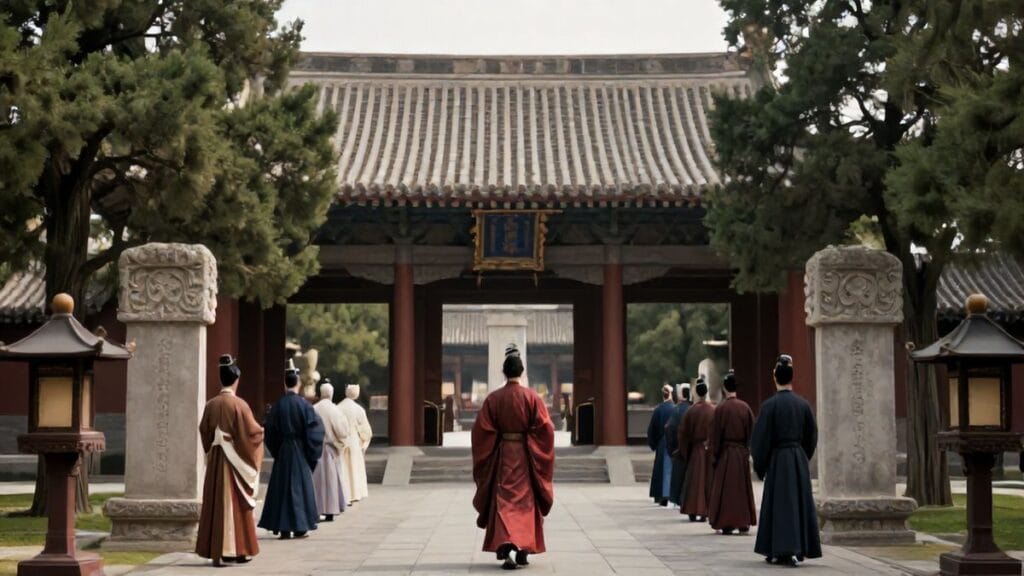
As the sky lightened, the emperor approached on foot, having dismounted at a respectful distance. He wore robes of restrained elegance, less ornate than those of a full court ceremony, in deference to the tomb’s sanctity. Flanked by high-ranking officials, ritual specialists, and members of the Kong family, he walked slowly along the stone path leading to the mound that marked Confucius’s grave. Incense smoke drifted upward from censers, curling in pale threads as if carrying silent words toward Heaven.
Upon reaching the appointed spot, the officials signaled for the ceremony to begin. A sacrificial ox, already slaughtered according to strict ritual guidelines, had been prepared as the main offering, accompanied by ritual wine and carefully arranged trays of grains and fruits. A designated reader stepped forward and, unrolling a silk scroll, recited the imperial sacrificial text. In it, Xiaowen addressed Confucius directly, acknowledging him as “Master of Ten Thousand Ages” and affirming that the Northern Wei state sought guidance from his teachings. One later chronicle paraphrased the key line: “Though the dynasties have changed, your Way endures; today an unworthy ruler from afar bows his head to seek your virtue.”
Then came the moment that witnesses would recall with particular vividness: the emperor bowing. According to Confucian ritual, he performed full prostrations—three deep bows, forehead touching the ground, in a gesture of submission not to a living man but to an ideal of governance and moral rectitude. For an emperor, the “Son of Heaven,” whose own subjects seldom saw him lower his gaze, the symbolism was immense. As emperor xiaowen visits confucius tomb and bends before the grave, the message is unmistakable: his rule is not above the Way; it is subject to it.
Musicians, positioned discreetly to one side, played stately melodies associated with ancient court rites, their notes austere and measured. The combination of sound, scent, and solemn movement created an atmosphere that one might call cinematic, if not for the fact that no camera stood to capture it—only human memory and the later pens of historians. When the bows were complete, Xiaowen stepped forward to offer libations of wine, pouring them slowly into the earth as a gesture of sharing sustenance with the departed sage.
In that moment, beneath the aged cypresses, multiple layers of time converged. The Zhou-era teacher who had once wandered through fractious states seeking a ruler who would heed his counsel now became, in a sense, the host to a foreign-born emperor seeking the very legitimacy that the sage’s teachings conferred. This scene, later summarized dryly in official histories, carried a quiet drama: conquest kneeling before culture, the sword bowing to the brush.
Tears in the Cypress Shade: Private Moments at the Grave
Formal chronicles rarely dwell on private emotions. Yet scattered hints suggest that the ceremony was not purely theatrical. Some accounts note that as emperor xiaowen visits confucius tomb and completes the prescribed bows, “his eyes grew moist” and his voice trembled slightly during the reading of certain lines. Whether this detail is literal truth or a historian’s embellishment meant to show the emperor’s sincerity, it reveals how later ages imagined the inner core of that morning: a moment when political calculation and genuine reverence intertwined.
After the main rite, the crowd of high officials and attendants withdrew to a respectful distance, leaving the emperor with only a small circle: a few trusted counselors, the chief ritual officer, and the Kong patriarch. In this more intimate space, Xiaowen is said to have asked the descendant of Confucius about the state of learning in Qufu—were the classics still widely studied? Did families still pass down the rites as prescribed? The old man, his beard white and hands trembling, reportedly replied that though times were hard and states had risen and fallen, the Way of the Master still lived in the hearts of many.
One anecdote, preserved in a later commentary, adds a poignant detail. Walking a short distance from the tomb, Xiaowen paused beneath a large cypress and remarked, “These trees have stood since the Han at least. They have seen more dynasties than we can count.” Turning to his advisors, he posed a question that no one could answer with certainty: “Will the Way that we claim to follow outlast even these trees?” That line, whether apocryphal or not, captures the tension of the era—a ruler undertaking sweeping reforms in the hope of aligning his transient dynasty with something that might endure.
Another version of the story suggests that the emperor, in a quieter aside, confessed his own sense of inadequacy before the sage. He reportedly said, “I have not yet been able to govern without harshness, nor to bring peace to all under Heaven; how can I stand before the Master without shame?” The remark echoes passages in the Analects, where Confucius himself expresses regret at failing to bring his vision fully into being. If Xiaowen indeed said these words, they were meant to weave his own struggle into that older pattern of striving without certainty of success.
These intimate scenes—half historical, half literary—help us imagine the human figure behind the imperial titles. The man who knelt before the tomb was not just an emblem of Sinicization or an instrument of policy; he was also a young ruler grappling with the loneliness of power and the weight of expectations from both his steppe ancestors and his newly embraced Confucian heritage. In the cool shade of Qufu’s trees, he confronted not only the memory of Confucius but the yet-unwritten verdict of history on his own reign.
Edicts beneath the Ancient Trees: Political Declarations at the Tomb
No major imperial ritual was complete without words turned into law. After the offerings and bows, after the more intimate exchanges, Emperor Xiaowen convened a formal gathering beneath pavilions set up near the tomb complex. There, in front of assembled officials, local gentry, and representatives of the Kong family, he issued edicts that tethered the symbolic power of the visit to concrete policies.
One such edict reaffirmed the status of Confucian learning as the cornerstone of official recruitment. While the Northern Wei had long employed Chinese-educated clerks and administrators, the emperor now proclaimed more forcefully that mastery of the classics would be a principal path into government service. The text, as summarized in later chronicles, declared: “Let it be known that the study of the Way, as transmitted by Confucius, shall be honored above mere cleverness in law or stratagem. Officials must be cultivated in virtue, not only skilled in calculation.” In this way, when emperor xiaowen visits confucius tomb, he also visits the very curriculum from which his hoped-for officials would emerge.
Another edict addressed ritual practice more broadly. Xiaowen called for the repair and standardization of ancestral temples and local schools throughout the territories under Northern Wei control. He argued that disorder in rites led to disorder in hearts and that only by restoring proper forms—seasonal sacrifices, mourning periods, codes of dress and conduct—could the state achieve genuine stability. For those listening that day, these declarations transformed the visit from an isolated act of piety into the visible tip of a much larger campaign to reorder northern society along classical lines.
Perhaps most crucially, the emperor used the occasion to redefine the identity of his own house. Referring explicitly to his adoption of a Chinese surname and the move of the capital to Luoyang, he proclaimed that the Northern Wei now stood not as outsiders ruling a conquered land, but as rightful heirs to the mantle of unified Chinese civilization. In one striking passage preserved by the Bei Shi, he reportedly said, “The Way of the Sage knows no boundary of region or race. In honoring Confucius, we show that Heaven’s mandate rests upon virtue, not on birth alone.” The words were bold, even risky; they invited subjects to judge the dynasty’s legitimacy according to Confucian standards, rather than merely by fear of its armies.
These edicts, carved into tablets and copied for distribution, ensured that the resonance of the Qufu visit would echo far beyond the city walls. They allowed distant readers—county clerks in dusty offices, teachers in small village schools, ambitious youths dreaming of office—to imagine the scene where they had been proclaimed, lending an aura of sacred authority to reforms that might otherwise have seemed abrupt or alien. Politics and piety, in this way, became inseparable.
From Tuoba to Han: Sinicization and the Remaking of Identity
The phrase “Sinicization” can sound clinical, as if it were a simple, one-way process of cultural assimilation. The reality was far more complex, and the visit to Qufu sits near its center. When emperor xiaowen visits confucius tomb, he is not merely performing a Chinese ritual; he is publicly renegotiating what it means to be ruler, subject, and even “Chinese” in an age when many of the most powerful figures in northern politics came from non-Han backgrounds.
Under Xiaowen’s guidance, reforms accelerated. The adoption of Chinese-style surnames extended beyond the imperial house to other Xianbei elites, who were encouraged—or pressured—to take on the outward markers of Han identity. Court dress codes changed, favoring long, flowing robes instead of the shorter garments suited to horseback riding. The Xianbei language, once common in the palace, gradually retreated before the spread of Chinese. Marriages between Xianbei nobles and Chinese gentry families became policy, not exception, binding the two groups together through blood and shared property.
These changes did not erase the past. Steppe traditions persisted in private, in military camps, and in regions farther from the capital. But the public face of power shifted decisively. In this process, the symbolic capital gained when emperor xiaowen visits confucius tomb was invaluable. It provided a narrative: the dynasty was not betraying its roots but ascending to a higher order of civilization, one already validated by the revered sage of Qufu. To question the reforms, then, was to risk being cast as an opponent of the Confucian Way itself.
Yet this transformation carried its own tensions. Some Xianbei nobles felt dispossessed not only of political influence but of dignity. Their ancestral songs and battle rituals, once honored, now seemed increasingly out of place in a court where scholars debated the proper interpretation of the Great Learning. Meanwhile, some Chinese elites suspected that the emperor’s embrace of Confucianism was pragmatic rather than heartfelt. Were these reforms deep moral commitments or just a new costume for power?
For commoners in the countryside, identity was perhaps less about abstract categories than about tangible experiences: who collected taxes, how disputes were judged, whether granaries opened in years of famine. Still, even here the imperial tilt toward Confucian norms left its mark. Schools received new support, ancestral rites were more strictly regulated, and the language of government edicts became saturated with references to virtue, filial piety, and proper conduct—echoes of that morning in Qufu when the emperor had bowed before the grave of the Master.
Scholars, Scribes, and Skeptics: How the Elites Saw the Pilgrimage
Among the greatest beneficiaries of Xiaowen’s reforms were the literati: scholars and scribes who had devoted their lives to mastering the classics, often in the face of political marginalization. For them, watching emperor xiaowen visits confucius tomb was akin to seeing the world tilt toward their ideals. Many wrote poems and essays celebrating the visit, though few survive in full. One surviving note from a Luoyang scholar, preserved in a later anthology, exults: “The northern dragon bows to the southern sage; the brush now guides the sword.”
Yet support was not unanimous. In the privacy of their studies, some scholars harbored doubts. They had seen rulers in past decades mouth Confucian platitudes while indulging in cruelty, corruption, and capricious wars. Would this emperor be any different? A skeptical commentator—quoted centuries later by Song dynasty historian Sima Guang in his Zizhi Tongjian—remarked, “To bow before the tomb is easy; to govern the people with justice is not. Let us see which he pursues more tirelessly.” Such remarks remind us that the Confucian tradition always contained within it a capacity for self-critique, judging even emperors against its standards.
For the scribes tasked with writing official histories, the visit was a gift and a burden. It provided a dramatic moment through which to tell the story of the Northern Wei’s cultural transformation. At the same time, they had to decide how much agency to attribute to the emperor’s personal piety versus broader social forces. Some accounts, likely influenced by the need to praise the dynasty, portray Xiaowen almost as a latter-day sage in his own right, intuitively drawn to Qufu by spiritual affinity. Others, more sober, emphasize the pragmatic necessity of winning over Chinese elites and stabilizing a diverse empire.
Within learned circles, debates also raged about the proper balance between Confucianism and Buddhism, which had flourished under previous Northern Wei rulers. Could an emperor patronize Buddhist monasteries while also presenting himself as a devoted disciple of Confucius? Some argued for harmony, citing the need for “three teachings” (Confucianism, Buddhism, Daoism) to coexist. Others worried that favor shown to one might undermine the authority of the others. In this contested landscape, the image of emperor xiaowen visits confucius tomb became a powerful symbol for those who wanted Confucianism to hold pride of place in the hierarchy of doctrines.
Echoes in the Villages: Common People and the Emperor of the North
Official histories seldom record what peasants thought, yet we can attempt a cautious reconstruction. For villagers along the route and in Qufu itself, the pilgrimage was first of all a spectacle: an eruption of imperial grandeur into the rhythms of agricultural life. They watched, they gossiped, they tried to make sense of why a man who ruled distant provinces would trouble himself to kneel before an old mound of earth.
Some may have felt genuine pride, especially those in Qufu, whose city name now appeared in edicts and reports. To say, “I live where the emperor came to honor the Master” would have carried a certain weight in local boastfulness. Others likely viewed the visit with cautious hope: perhaps a ruler devoted to a sage who preached benevolence and duty would be more inclined to lower taxes, protect the poor, or punish corrupt officials. Stories of Confucius protecting the weak and rebuking unjust power circulated in oral form, and it is reasonable to imagine villagers connecting those stories to this new, ritual-obsessed emperor from the north.
But there might also have been cynicism. Empires had come and gone, each claiming moral superiority. Did this one truly differ? A farmer who had lost sons to conscription or grain to harsh levies might watch the procession pass and mutter that reverence for the dead did little to ease the burdens of the living. Rituals, no matter how elaborate, could not cancel debts or fill empty granaries. In this sense, the visit to Qufu became a kind of mirror, reflecting back the hopes and doubts of all who saw it.
Over time, however, as edicts inspired by the visit filtered down—support for local schools, enforcement of certain moral regulations, occasional displays of clemency framed in Confucian terms—the memory of “the year the emperor came” intertwined with practical administrative changes. Long after the banners had vanished over the horizon, people could still point to the old cypresses and say that beneath their shade, a northern ruler had acknowledged the authority of a sage whose teachings spoke, in their own way, to the dignity of even the lowliest person.
Historians and Memory: Recording the Visit in Official Chronicles
When we say today that emperor xiaowen visits confucius tomb, we are already speaking through the words of others—court historians, compilers of dynastic histories, later scholars who reinterpreted earlier sources. The visit’s survival in our records owes much to the tradition of official historiography that had taken firm root in China centuries earlier. Each dynasty, in theory, entrusted historians with the task of recording its rise, heyday, and fall, often with a frankness that could be dangerous in the present but invaluable to the future.
The Wei Shu, compiled in the sixth century, provides one of the earliest narrative frameworks. There, the visit is mentioned in the context of Xiaowen’s broader reforms: his relocation of the capital, his name changes, his emphasis on Confucian learning. The tone is laudatory, stressing the emperor’s wisdom in honoring the sage and aligning his court with classical norms. The text is careful to frame the pilgrimage not as an isolated act of curiosity, but as a key step in a divinely guided historical process leading the Northern Wei from rough beginnings to refined governance.
Later historians, such as those responsible for the Bei Shi and the grand synoptic history Zizhi Tongjian, added layers of interpretation. Some highlighted the irony that a dynasty rooted in the steppe would become, in some respects, more Confucian than many of its Han predecessors. Others used the visit as a moral lens through which to judge Xiaowen’s successors. Did they live up to his proclaimed ideals, or did they squander the legitimacy he had so carefully cultivated at places like Qufu?
Historiography is never neutral. By choosing to highlight the visit, to attribute to it certain motives and consequences, historians helped fix its meaning in collective memory. The fact that emperor xiaowen visits confucius tomb appears repeatedly in later works suggests that it was seen as emblematic—not just of a single ruler’s piety, but of an entire age’s fraught negotiation between conquest and culture. Like a stone dropped into a pond, the event sent ripples outward, each historian capturing the expanding circles in different ways.
Modern scholars, drawing on archaeology, comparative studies, and critical readings of the texts, have added their own voices. Some emphasize that the visit should be read primarily as political theater, a performance staged for both domestic and foreign audiences. Others argue that the boundaries between “sincere” and “strategic” were themselves different in early medieval China, where rulers could genuinely believe in the power of ritual while also harnessing it for pragmatic ends. In this dialogue across centuries, the Qufu pilgrimage remains a focal point—a case study in how history is not only made, but remembered and remade.
Confucianism as Statecraft: Ritual, Morality, and Imperial Authority
At the heart of the story lies a fundamental question: what did it mean for a state to be “Confucian”? When emperor xiaowen visits confucius tomb and prostrates himself before the sage’s grave, he embraces a vision of rulership in which moral character, proper ritual, and the cultivation of virtue are not optional adornments but essential foundations of power. In theory, at least, the Confucian ruler governs less through fear than through example, inspiring subjects to internalize norms rather than merely obey commands.
Practically, this translated into several key policies. Education became a critical concern of the state. Schools—both at the central and local levels—were expected to teach the classics, instilling not only literacy but a shared vocabulary of ethical concepts. Laws and punishments, while remaining harsh by modern standards, were increasingly framed as instruments for restoring moral order rather than simply asserting dominance. Rituals, from the emperor’s grand sacrifices to village-level ancestral ceremonies, were codified and supervised, understood as essential in maintaining the invisible bonds that held family and state together.
Confucian statecraft also placed heavy emphasis on hierarchy: father over son, ruler over minister, elder over younger. However, these hierarchies were supposed to be tempered by reciprocal obligations. A ruler owed his people benevolent governance; a father owed his children care and guidance. In this framework, when Xiaowen bowed before Confucius’s tomb, he was in effect acknowledging that even the greatest hierarch—“the Son of Heaven”—stood within a higher moral order. The gesture modeled humility, a quality extolled in the classics but not always evident in imperial politics.
The Qufu visit thus became more than a symbolic capstone to ongoing reforms; it was a demonstration of how ritual action could embody and reinforce a particular theory of governance. By visibly submitting himself to the memory of a teacher, the emperor underscored the notion that rulers must be students of the Way, continually refining their understanding and practice of virtue. Such an image could be profoundly persuasive, especially among officials whose careers and identities were anchored in classical learning.
Of course, ideals and realities seldom aligned perfectly. Corruption persisted, officials abused power, and regional conflicts continued. Yet the Confucian vocabulary of criticism allowed remonstrating ministers and later historians to call rulers to account. They could ask, explicitly or implicitly: does the conduct of the court today honor the spirit of that morning when emperor xiaowen visits confucius tomb, or does it betray it?
A Turning Point in the Long Civil War of Ideas
Fifth-century China was not only fragmented politically; it was also a crucible of competing worldviews. Buddhism, introduced centuries earlier, had blossomed in the north under imperial patronage. Monasteries owned land, sheltered refugees, and offered a transcendent vision of salvation beyond the confines of the earthly state. Daoism, in various institutional and popular forms, continued to inspire both mystics and rebels. Confucianism, once the unchallenged orthodoxy of the Han, had to reassert itself in this crowded marketplace of ideas.
Within this context, the act by which emperor xiaowen visits confucius tomb can be read as a battle flag raised in a long civil war of ideas. It did not signal hostility to Buddhism or Daoism outright—Northern Wei rulers continued to support Buddhist institutions in particular—but it firmly positioned the state’s public ideology in Confucian terms. When the emperor needed to speak of legitimacy, hierarchy, and the nature of good government, he reached for Confucian concepts and Confucian exemplars.
Citations from the period capture this shift. One edict, likely issued in the wake of the visit, states: “The teachings of the Buddha address the suffering of the soul; the Way of the Sage orders the affairs of the world. Though both are worthy, the latter must guide the state.” This pragmatic distinction allowed Xiaowen to honor multiple traditions while implicitly elevating Confucianism in matters of governance.
Over the following decades, this orientation influenced debates on everything from land policy to military recruitment. Should monasteries’ landholdings be limited to ensure sufficient agricultural labor for the state? Confucian-minded officials argued yes, often winning support by invoking the need to uphold the well-being of families and the fiscal health of the realm. Should military appointments be based more on hereditary status or on proven ability and learning? Again, Confucian meritocratic ideals played a role, though practice lagged behind rhetoric.
In retrospect, historians often mark Xiaowen’s reign—and particularly his Confucian gestures such as the Qufu visit—as a crucial pivot. The Northern Wei, though eventually divided and supplanted, helped ensure that when China was next unified under later dynasties, it would be within a shared Confucian framework that extended across both north and south, conquering lineages and “native” elites alike.
After Qufu: Reforms, Resistance, and the Fate of Northern Wei
The visit to Confucius’s tomb did not mark an end point but a midpoint in Xiaowen’s ambitious program. In the years that followed, he continued to push reforms that sought to embed Confucian norms in law and everyday practice. The equal-field system, which aimed to allocate land more fairly and stabilize tax bases, gained momentum. Efforts to regulate aristocratic privileges and curb the independent power of great families intensified, justified by appeals to the classical ideal of a balanced, orderly society.
Yet resistance grew as well. Among Xianbei and other non-Han aristocrats, resentment simmered at policies that seemed to devalue their cultural heritage and curtail their autonomy. Some felt that in trading the bow and saddle for the brush and scroll, the dynasty risked losing the very martial virtues that had won its empire in the first place. Murmurs of dissent occasionally flared into plots and rebellions. Even within the Chinese elite, there were disagreements about the pace and direction of change, with some complaining that reforms were too disruptive or that Confucian rhetoric masked the concentration of power in the emperor’s hands.
In 499, only a few years after his journey to Qufu, Emperor Xiaowen died at the age of thirty-two. His early death left many of his projects unfinished and opened the door for factional struggles. Subsequent rulers and regents alternately advanced and reversed aspects of his agenda. The Northern Wei itself would split in 534 into Eastern Wei and Western Wei, precursors to later short-lived regimes that dominated the northern political scene before the Sui and Tang reunifications.
Despite this institutional instability, the cultural direction Xiaowen had set proved remarkably durable. The notion that northern regimes could and should present themselves as Confucian states, grounded in the teachings of Confucius and manifesting them through ritual and law, persisted. Even as dynastic names changed, temples to Confucius continued to receive imperial attention, and the visit of 494 lingered in memory as an early, decisive moment when a non-Han dynasty claimed the sage as its own.
Thus, the fate of Northern Wei as a political entity diverged from the fate of its cultural legacy. The dynasty crumbled, but the image of emperor xiaowen visits confucius tomb remained, a kind of moral capital bequeathed to later states that sought to integrate diverse populations under a shared Confucian banner.
Across the Centuries: How Later Dynasties Read the 494 Pilgrimage
Centuries after Xiaowen’s bones had turned to dust, later emperors continued to visit—or at least send offerings to—Confucius’s tomb in Qufu. The Tang, Song, Ming, and Qing dynasties each developed their own rituals and architectural expansions of the temple and tomb complex. Yet when their scholars looked back at early medieval precedents, the Northern Wei pilgrimage stood out, both because of its relative novelty at the time and because of the ethnic and cultural background of the ruler who undertook it.
Song dynasty scholars, intensely concerned with moral self-cultivation and the role of the state in upholding the Way, found in Xiaowen a mixed model. On the one hand, they admired his determination to submit to Confucian norms, sometimes casting him as a warning to their own rulers who might be tempted by luxury or neglect of ritual. On the other hand, they drew attention to the eventual collapse of his dynasty as evidence that ritual and ideology alone could not compensate for structural weaknesses. Sima Guang, in his sprawling chronicle Zizhi Tongjian, cites the Qufu visit while also noting the political failures that followed, implicit in his message that virtuous gestures must be matched by sustained, wise governance.
The Ming and Qing, both dynasties with their own complex relationships to ethnicity and cultural identity—the former led by Han Chinese who expelled the Mongol Yuan, the latter founded by the Manchu—saw particular resonance in the story. For Qing scholars in particular, the Northern Wei experience offered a kind of historical mirror. Here too was a “conquest dynasty” of non-Han origin, grappling with the challenge of ruling a predominantly Han populace through Confucian structures. Qing commentaries sometimes invoked Xiaowen’s pilgrimage to underscore the importance of imperial humility before the sage and to reassure doubters that foreign origins did not preclude genuine commitment to the Way.
Architectural changes at Qufu itself reflected the accumulating weight of these traditions. What had been a relatively simple complex in Xiaowen’s time expanded over centuries into a grand ensemble of temples, pavilions, stele forests, and ceremonial gates. Inscriptions from later emperors occasionally alluded to earlier visits, weaving a chain of imperial piety across time. In this long genealogy of homage, emperor xiaowen visits confucius tomb appears as an early link, perhaps modest in scale compared to later, more elaborate ceremonies, but foundational in its bold assertion that the sage’s authority could encompass all who willingly bowed before it.
Modern Perspectives: Nation, Ethnicity, and the Story of a Visit
In the modern era, the story of Emperor Xiaowen’s 494 journey to Qufu has taken on new layers of meaning. Historians working in the late nineteenth and twentieth centuries, often under the influence of nationalism and new theories of ethnicity, revisited the Northern Wei with fresh questions. Was Xiaowen’s embrace of Confucianism a form of cultural self-colonization, or a strategic, creative adaptation? Did his policies help integrate diverse peoples into a shared civilization, or did they suppress valuable forms of cultural difference?
Some scholars, particularly in the early decades of the twentieth century, emphasized a narrative of “Sinification” as a triumphant story of civilization overcoming barbarism, casting emperor xiaowen visits confucius tomb as a key moment when northern “foreigners” fully accepted Chinese norms. This perspective mirrored, consciously or unconsciously, the nation-building agendas of modern states that sought to unify disparate groups under a single cultural banner.
More recent research has been more critical and nuanced. It stresses that the Tuoba and other steppe peoples were not blank slates onto which “Chinese culture” was simply imprinted. Instead, they actively engaged with, reshaped, and contributed to the evolving tradition we now call “Chinese.” In this light, Xiaowen’s pilgrimage becomes an example of cross-cultural negotiation rather than one-sided assimilation. His bow before Confucius is not a surrender of identity, but a redefinition of identity on terms that borrow from multiple sources.
Contemporary visitors to Qufu encounter a site layered with these interpretations. Tourist guides mention ancient emperors and philosophers, sometimes highlighting Xiaowen’s visit as an early precedent for state-sponsored veneration of Confucius. Exhibits might note how the Northern Wei, despite their “non-Han” origins, played a crucial role in preserving and institutionalizing the Confucian tradition. Academic conferences, held in nearby cities or on university campuses, debate the legacy of such acts of homage in the construction of a pan-Chinese cultural heritage.
In a world still grappling with questions of multiculturalism, assimilation, and the politics of memory, the story of how emperor xiaowen visits confucius tomb continues to resonate. It poses enduring questions: Can power genuinely humble itself before moral ideals? Can cultural traditions accommodate new participants without losing their core? And who has the right to claim the legacy of a sage whose teachings have, over millennia, been invoked by rulers and rebels, conservatives and reformers alike?
Conclusion
On a misty morning in 494, beneath trees whose roots reached back into forgotten dynasties, a young emperor from the north bent his knees and touched his forehead to the earth before the grave of Confucius. In that gesture—emperor xiaowen visits confucius tomb—centuries of history converged: the rise of steppe powers, the endurance of classical texts, the anxieties of divided realms, and the human yearning to align transient power with lasting meaning. His pilgrimage was at once a personal act of devotion, a carefully staged piece of political theater, and a decisive move in the ongoing negotiation of what it meant to rule, and to belong, in early medieval China.
The journey to Qufu did not solve all problems. The Northern Wei would fracture, reforms would be contested, and the land would continue to know war and suffering. Yet the symbolic capital generated by that visit outlived the dynasty itself. It helped cement Confucianism’s role as the public ideology of the state, convinced many that even rulers of foreign origin could be legitimate heirs to the sage’s teachings, and provided later generations with a powerful story about the humility—or at least the necessary appearance of humility—of those who wield power.
Through the lenses of official chronicles, later commentaries, and modern scholarship, we see the Qufu pilgrimage as a turning point in the long history of interaction between conquest states and classical culture. It reminds us that identity is not fixed but crafted, that rituals can both mask and reveal sincerity, and that places like Confucius’s tomb are not merely relics but active stages on which new meanings are continually performed. Standing today in the quiet of that cemetery, one can almost hear the echoes of that imperial procession and sense how thin the line can be between reverence and strategy—and how, sometimes, the two become indistinguishable.
FAQs
- Did Emperor Xiaowen really visit Confucius’s tomb in Qufu in 494?
The consensus among historians, based on early sources like the Wei Shu and Bei Shi, is that Emperor Xiaowen did travel to Qufu around 494 and conducted formal rites at Confucius’s tomb. While specific details of the ceremony may have been embellished or stylized in later retellings, the visit itself is widely accepted as a historical event. - Why was this visit so important for the Northern Wei dynasty?
The visit helped legitimize a dynasty of steppe origin in the eyes of its largely Han Chinese subjects. By publicly honoring Confucius, Emperor Xiaowen signaled a deep commitment to Confucian values and presented himself as a guardian of classical Chinese civilization, which in turn strengthened his position among scholars and local elites. - Was Emperor Xiaowen sincerely devoted to Confucianism, or was it just politics?
Most scholars argue that his actions were motivated by both conviction and calculation. Xiaowen was personally educated in the Confucian classics and seems to have believed in their importance, but he also understood that adopting Confucian norms was politically advantageous for stabilizing his rule and integrating diverse populations under Northern Wei control. - How did the visit affect Confucianism’s status compared to Buddhism and Daoism?
The pilgrimage reinforced Confucianism’s primacy in matters of state ideology and governance, even as Buddhism and Daoism continued to flourish. After the visit, policies and public rhetoric more consistently framed the state’s mission in Confucian terms, while Buddhism in particular was often positioned as a religion focused on personal salvation rather than political order. - Did later emperors also visit Confucius’s tomb?
Yes. From the Tang dynasty onward, many emperors either personally visited Qufu or sent elaborate offerings and emissaries to conduct rites on their behalf. Over time, the temple and tomb complex expanded into a major ceremonial center, and imperial homage to Confucius became a recurring feature of Chinese political culture. - What does the visit tell us about ethnicity and identity in early medieval China?
It shows that ethnic origins did not rigidly determine cultural affiliation. A dynasty founded by non-Han steppe peoples could, through conscious policy and symbolic acts like the Qufu pilgrimage, adopt and reshape “Chinese” traditions. Emperor Xiaowen’s visit illustrates how identity was negotiated through ritual, language, law, and marriage, rather than fixed by ancestry alone. - Is Confucius’s tomb in Qufu still an important site today?
Yes. Confucius’s tomb, along with the adjacent temple and family cemetery, remains a major cultural and tourist site in modern Qufu. It is recognized as part of a UNESCO World Heritage ensemble, and it continues to host ceremonies, scholarly gatherings, and visitors interested in the life and legacy of the sage and the many historical figures, such as Emperor Xiaowen, who honored him there.
External Resource
Internal Link
Other Resources
- Encyclopaedia Britannica – general search for the exact subject
- Google Scholar – academic search for the exact subject
- Internet Archive – digital library search for the exact subject

