Table of Contents
- A Frozen Nightmare Unfolds: The Erzincan Earthquake of December 27, 1939
- The City Before the Fall: Erzincan’s Vibrant Heartbeat
- Turkey in the 1930s: Between Tradition and Modernity
- The Tectonic Giants Beneath Anatolia: Understanding the Seismic Context
- December 27, 1939, Early Hours: A Terrifying Roar Shakes Erzincan
- Collapse and Catastrophe: The Immediate Aftermath
- Heroism Amid Ruins: Stories of Survival and Loss
- The Scale of Devastation: Counting the Dead and Displaced
- National Response: Turkey’s Mobilization in Crisis
- International Aid and Global Solidarity
- Scientific Breakthroughs: Lessons Learned from the Disaster
- The Reconstruction of Erzincan: A City Reborn from Rubble
- Political Repercussions: Seismology and State Policy in Turkey
- Personal Memories and Collective Mourning
- The Erzincan Earthquake in Cultural Memory: Literature, Art, and Film
- Earthquake Preparedness in Turkey: From 1939 to Today
- Regional Impact: How Erzincan’s Disaster Shaped Eastern Anatolia
- The Human Cost: Beyond the Numbers
- Comparing the Erzincan Earthquake to Other Historic Quakes
- Geological Legacy: Anatolia’s Seismic Past and Future
- Surviving Erzincan: Oral Histories and Survivor Testimonies
- Media Coverage: Reporting a Natural Disaster in 1939
- Long-Term Economic Consequences for Erzincan and Turkey
- Remembering Erzincan: Memorials and Commemorations
- Conclusion: The Enduring Lessons of Disaster and Resilience
1. A Frozen Nightmare Unfolds: The Erzincan Earthquake of December 27, 1939
It was a bitter cold winter night in Erzincan, a city cradled in Eastern Anatolia, when the earth suddenly groaned—a deep, ominous rumble that shattered the quiet. At precisely 1:57 a.m. on December 27, 1939, the ground convulsed with a force unseen in modern Turkish history. In less than a minute, the city that thrived with bustling markets, echoing prayers from mosques, and the laughter of children, was reduced to smoldering ruins and frozen cries. Death did not discriminate; stone homes, wooden verandas, and crowded dormitories crumbled alike, swallowing thousands in an instant. Where life once pulsed, now lay silence—a silence that would haunt Erzincan for generations.
This shockwave of destruction was one of the deadliest earthquakes of the 20th century. But beyond the staggering death toll and invisibly altered geography, the Erzincan quake reshaped a nation’s understanding of its place beneath the surface of the Earth. To appreciate this tragedy is to peer deeply into the fabric of human vulnerability—the fragile intersection of nature’s fury and the human spirit’s resistance.
2. The City Before the Fall: Erzincan’s Vibrant Heartbeat
Erzincan in the late 1930s was not just a waystation on the Silk Road; it was a vibrant hub of cultural intermingling and economic activity. Situated along the fertile valleys of the Euphrates’ upper reaches, Erzincan boasted a mixed population—Turks, Kurds, Armenians, and others—all woven together by centuries of trade and community.
Its streets were lined with cafés buzzing with political debate, bazaars thrumming with the sale of wool, copper, and handwoven fabrics, while mosques’ domes reflected both tradition and the optimism of early Republican Turkey. The city was embracing modernization: schools multiplied, roads improved, and electrical lines crept into neighborhoods. And yet, beneath this tapestry of progress, the ancient ground held secrets, restless and dangerous.
3. Turkey in the 1930s: Between Tradition and Modernity
Under the stern yet visionary stewardship of Mustafa Kemal Atatürk, Turkey in the 1930s was a nation re-forging itself. The ashes of the Ottoman Empire gave way to a turbulent experiment in secularism, nationalism, and modernization. Erzincan, tucked away in the east, was a microcosm of these tensions—a conservative populace bridging the gap between rural traditions and urban reforms.
The government was investing in infrastructure and education, seeking to centralize power and knowledge. Yet seismic awareness was minimal, and building codes, where they existed, were not designed for catastrophic earthquakes. The intersection of rapid change and geological peril set the stage for unparalleled tragedy.
4. The Tectonic Giants Beneath Anatolia: Understanding the Seismic Context
The geology beneath Erzincan tells a story of unrelenting pressure and friction. Turkey sits on the convergence of the Eurasian, Arabian, and African tectonic plates. The North Anatolian Fault, a major strike-slip fault system stretching over 1,500 kilometers, slices across the country like an invisible faultline of threat and energy.
This fault had a series of deadly ruptures near Erzincan before, but no one quite anticipated the magnitude or timing of the forthcoming earthquake. On that fateful winter night, accumulated strain released not in a distant creak, but a roaring cataclysm—a magnitude of 7.8 on the Richter scale, one of the most powerful recorded.
5. December 27, 1939, Early Hours: A Terrifying Roar Shakes Erzincan
The first tremors startled some awake, but it was the main shock at 1:57 a.m. that sealed the city’s fate. Eyewitnesses remember a sound like thunder rolling beneath their feet, walls trembling like paper, and the gut-wrenching sense that the earth itself was tearing apart. Entire neighborhoods collapsed in seconds, the sharp winter air filled with dust and cries. Buildings pitched at odd angles before toppling into heaps of stone and timber.
The earthquake lasted scarcely a minute but left behind an eternity of grief. Railway lines snapped, telephone poles fell, and the vital road to the provincial capital became impassable. And in the chaos, darkness—since the power grid failed almost immediately—shrouded survivors as they stumbled through the wreckage.
6. Collapse and Catastrophe: The Immediate Aftermath
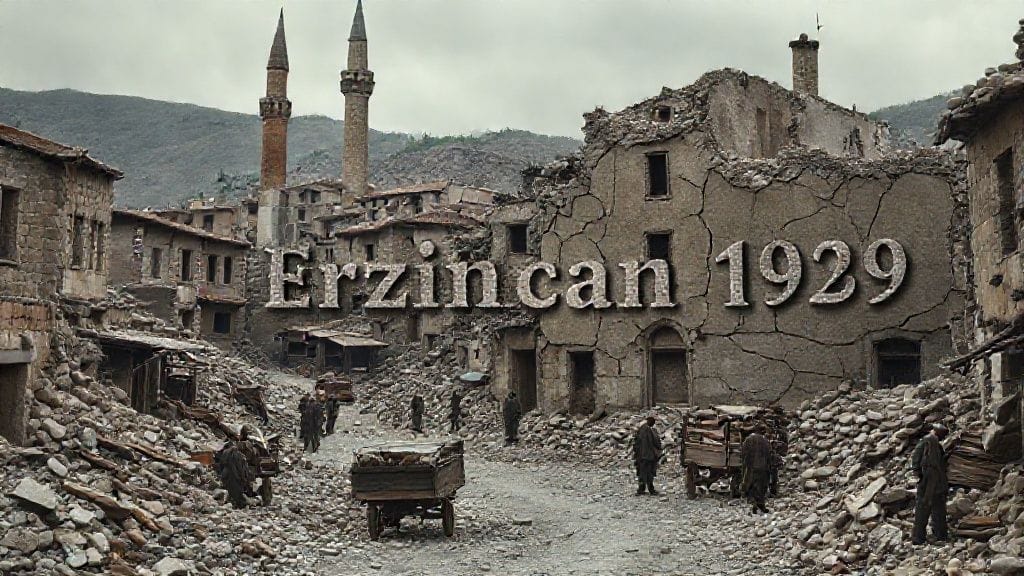
As daylight broke over Erzincan on December 27, the grim scale of destruction became apparent. Approximately 90 percent of the city had crumbled or was severely damaged. Entire families lay buried under homes, schools, and hospitals. Fires ignited by broken stoves and candles spread, jumping across debris-strewn streets. The streets were choked with confusion—injured civilians staggered amid the ruins, desperate for help that was slow to come.
Hospitals were overwhelmed or had collapsed entirely; doctors and nurses worked in the open air, improvising care on snowy streets. The bitter cold magnified the hardship—those who escaped injury battled freezing temperatures and lack of shelter overnight.
7. Heroism Amid Ruins: Stories of Survival and Loss
In the midst of despair, human courage surged. Ordinary citizens became rescuers without orders—they dug through frozen rubble with bare hands, formed human chains to pull infants from crumbled walls, and formed ad-hoc shelters for the homeless.
One story is seared into local lore: a schoolteacher who, upon sensing the quake’s near arrival, woke her students and led dozens to safety moments before their dormitory collapsed. Her quick thinking saved many lives. But not all stories ended with survival; entire families vanished overnight, and survivors carried scars seen and unseen forever.
8. The Scale of Devastation: Counting the Dead and Displaced
Initial reports cited a death toll ranging from 30,000 to 33,000, but exact numbers remain elusive due to mass destruction and the challenges in record-keeping. Over 100,000 people were left homeless in Erzincan alone, with many perishing in the days following due to exposure, starvation, or untreated injuries.
The scale placed the Erzincan earthquake among the deadliest in the modern era, a grim statistic that foregrounded the precariousness of human settlements on volatile ground.
9. National Response: Turkey’s Mobilization in Crisis
The Turkish government swiftly declared a state of emergency. Military units were dispatched for rescue and aid distribution, and temporary camps were established in the countryside. Prime Minister Refik Saydam coordinated relief efforts, calling for national solidarity.
Despite bitter winter conditions and transportation difficulties, relief supplies—clothing, blankets, food—were shipped via rail and truck. Yet, logistical problems and the sheer scale of damage tested Turkey’s young republic resilience. The scale of destruction was unexpected and demanded unprecedented mobilization.
10. International Aid and Global Solidarity
News of the catastrophe rippled worldwide. Countries including the Soviet Union, Germany, and the United States expressed condolences and sent aid. Medical teams, medicines, and tents arrived from abroad, an early example of international humanitarian cooperation under the shadow of looming global war.
Notably, the Soviet Union, sharing a border with eastern Turkey, sent doctors and equipment rapidly, transcending tense political relations. This solidarity illustrated a universal sense of shared vulnerability when nature’s wrath strikes.
11. Scientific Breakthroughs: Lessons Learned from the Disaster
The Erzincan earthquake became a turning point for Turkish and international seismology. Scientists flocked to the epicenter to study the fault rupture, ground displacement, and aftershock patterns. Data collected helped to understand the North Anatolian Fault’s behavior, fueling advancements in earthquake prediction models.
The catastrophe illuminated the urgent need for earthquake-resistant construction practices, seismic monitoring stations, and public education — innovations which Turkey would begin implementing in subsequent decades.
12. The Reconstruction of Erzincan: A City Reborn from Rubble
Rebuilding Erzincan was a monumental task. The government launched comprehensive planning efforts, relocating critical infrastructure away from the most vulnerable zones. New building codes mandated stronger materials and designs better suited to seismic resistance.
Slowly, resilience manifested in brick and mortar—and in the spirit of the citizens, steadfast in reclaiming their homes and lives. By the early 1950s, Erzincan was rising again, a living testament to human endurance amid calamity.
13. Political Repercussions: Seismology and State Policy in Turkey
The catastrophe accelerated the Turkish government’s commitment to integrating scientific expertise into public policy. Earthquake research institutions were funded, and urban planning began factoring seismic risk systematically.
It also influenced wider political discourse: the fragility revealed by the disaster highlighted the importance of state capacity, modernization, and investment in infrastructure for national security. The earthquake was not just a natural event but a political inflection point.
14. Personal Memories and Collective Mourning
The Erzincan earthquake remains deeply etched in the memory of its survivors and descendants. For families who lost loved ones, the disaster defined an emotional landscape of grief and endurance. Folk songs, poems, and oral histories have preserved the personal layers behind the statistics.
Every year, memorial ceremonies rekindle the collective mourning—a reminder of fragility but also of the enduring will to rebuild and remember.
15. The Erzincan Earthquake in Cultural Memory: Literature, Art, and Film
The tragedy inspired poets and authors, whose works explore the earthquake’s emotional aftermath with haunting clarity. Visual artists depicted the shattered cityscape and the human toll, often blending motifs of loss and hope.
Though overshadowed by later Turkish historical events, the Erzincan earthquake’s cultural imprint persists as a potent symbol of vulnerability and resilience in the face of uncontrollable forces.
16. Earthquake Preparedness in Turkey: From 1939 to Today
The disaster sparked a slow but critical transformation in Turkey’s approach to seismic hazards. Building codes became more rigorous; emergency management systems were developed; and public awareness campaigns began emphasizing preparedness.
Today, Turkey grapples with ongoing seismic threats, honoring past lessons to safeguard future generations. The Erzincan quake stands as a brutal teacher, shaping national priorities in disaster risk reduction.
17. Regional Impact: How Erzincan’s Disaster Shaped Eastern Anatolia
Beyond Erzincan’s borders, the earthquake caused ripple effects across Eastern Anatolia. Neighboring towns suffered damage and displacement; regional economies were disrupted; and social bonds stretched under strain.
The event exposed disparities between urban and rural readiness, prompting targeted development and integration efforts. In this way, the earthquake's impact catalyzed uneven but crucial regional evolution.
18. The Human Cost: Beyond the Numbers
Though statistics provide scope, the true cost lies in personal loss—thousands of lives interrupted, families scattered, childhoods uprooted. Survivors coped with physical injuries and psychological trauma in a society with limited mental health support.
Generations born after 1939 grew up under the shadow of this trauma, their identity intertwined with stories of survival and loss. The earthquake was a profound human wound as much as a natural calamity.
19. Comparing the Erzincan Earthquake to Other Historic Quakes
When placed alongside the 1906 San Francisco quake or the 1935 Quetta earthquake, Erzincan ranks as one of the deadliest and most powerful quakes of the early 20th century. Yet, its lessons were unique—springing from Turkey’s complex geology and developmental context.
Comparisons highlight universal patterns of human response, resilience, and the persistent challenge of living atop volatile earth.
20. Geological Legacy: Anatolia’s Seismic Past and Future
The Erzincan earthquake was part of a seismic chain reaction along the North Anatolian Fault. Subsequent quakes in the 1940s continued shifting pressures, reminding geologists that this restless fault remains a constant risk.
Today’s monitoring technologies pay homage to these early studies, and Anatolia remains a hotspot of cautious vigilance.
21. Surviving Erzincan: Oral Histories and Survivor Testimonies
Stories collected from survivors reveal moments of quiet heroism, bewildering luck, and wrenching loss. These narratives add humanity to the geological data, framing the disaster with empathy.
Their recollections form a vital archive, ensuring the disaster’s lessons endure beyond textbooks.
22. Media Coverage: Reporting a Natural Disaster in 1939
News of the earthquake spread cautiously via radio and newspaper, with correspondents describing the devastation in somber terms. The event challenged media capabilities in conveying catastrophe amid limited infrastructure and wartime geopolitical tensions.
Still, coverage spurred public empathy and mobilized aid, demonstrating the growing power of mass communication.
23. Long-Term Economic Consequences for Erzincan and Turkey
The destruction crippled Erzincan’s economy for years. Agricultural cycles were disrupted, commercial networks broken, and investments diverted into rebuilding rather than growth.
At a macro level, the government had to balance recovery with modernization ambitions. Despite setbacks, the disaster ultimately pushed Turkey’s infrastructural policies toward increased resilience.
24. Remembering Erzincan: Memorials and Commemorations
Monuments and plaques in Erzincan honor victims and heroes alike. Annual remembrance ceremonies foster community healing and educate new generations.
These rituals underscore the collective responsibility to remember, rebuild, and respect nature’s power.
25. Conclusion: The Enduring Lessons of Disaster and Resilience
The Erzincan earthquake of 1939 reverberates far beyond the ruins it left behind. It is a story of brutal loss and inspiring courage, of a landscape reshaped by forces no human hand can control. Yet, it is also a testament to the indomitable will to recover, rebuild, and prepare for the future.
This seismic chapter echoes a universal truth: nature challenges, but humanity endures—transforming tragedy into knowledge, grief into resolve. Erzincan’s legacy reminds us that from the deepest cracks in the earth, resilience and hope can—and must—arise.
Conclusion
The night of December 27, 1939, remains etched in the collective memory of Turkey and the world as a piercing testament to nature’s power—and humanity’s fragile response. The Erzincan earthquake is not just a historical event; it’s a human saga of loss, endurance, and renewal.
Today, as Turkey continues to confront seismic risks, the lessons born from that frozen night shape policies, inspire compassion, and fuel scientific progress. Erzincan stands not only as a city rebuilt with stronger bricks but as a symbol of hope—proof that from devastation, rebirth is possible.
Understanding this tragedy in its fullness allows us to honor those lost, support those who survived, and prepare more wisely for the earth’s future tremors.
FAQs
Q1: What caused the Erzincan earthquake of 1939?
A1: It was caused by a rupture along the North Anatolian Fault, a major strike-slip fault where tectonic plates meet and slide past each other, accumulating stress that was released violently that night.
Q2: How many people died in the Erzincan earthquake?
A2: Estimates range from 30,000 to over 33,000 people killed, making it one of the deadliest earthquakes in Turkey’s history.
Q3: How did the Turkish government respond to the disaster?
A3: The government declared a state of emergency, mobilized military and medical teams for rescue and aid, coordinated national relief efforts, and later implemented seismic regulations and reconstruction plans.
Q4: Did international communities assist Turkey after the earthquake?
A4: Yes, countries such as the Soviet Union, Germany, and the United States sent medical teams, supplies, and financial aid, exemplifying early global humanitarian cooperation.
Q5: How did the earthquake impact scientific understanding?
A5: It provided critical data on fault mechanics and seismic risk, improving earthquake prediction models and stimulating the development of seismic monitoring in Turkey and elsewhere.
Q6: What is the legacy of the Erzincan earthquake today?
A6: Beyond memorials, it fostered stronger building codes, emergency preparedness, and public awareness in Turkey, shaping national resilience policies against earthquakes.
Q7: How is the memory of the 1939 Erzincan earthquake preserved?
A7: Through annual commemorations, monuments, survivor testimonies, literature, and artistic works, anchoring the event in cultural and historical memory.
Q8: What lessons can modern cities learn from the Erzincan earthquake?
A8: The importance of earthquake-resistant infrastructure, emergency planning, timely rescue operations, and public education to minimize human and economic losses in seismic zones.