Table of Contents
- London Awakes to a Queen’s Final Dawn
- From Lady-in-Waiting to Queen: Anne’s Meteoric Rise
- A Kingdom Turned Upside Down: The Break with Rome
- Whispers, Enemies, and the Gathering Storm at Court
- Arrest in the Gardens: The Trap Closes on Anne Boleyn
- Imprisoned in the Tower: Hope, Prayer, and Despair
- A Trial Staged for a Verdict Already Written
- Condemned Queen: Between Mercy Promised and Death Assured
- Men Sent Before Her: The Executions that Prepared the Scaffold
- The Morning of 19 May 1536: London Holds Its Breath
- On the Scaffold: Words, Silence, and the Sword from Calais
- The Blow That Changed a Kingdom: Immediate Aftermath of the Execution
- Henry VIII Rejoices, Europe Reacts: Diplomats and Chroniclers Speak
- Elizabeth Without a Mother: The Human Cost of a Political Death
- Faith, Reform, and Fear: Religious Consequences of Anne’s Fall
- From Traitor to Martyr: How Memory Rewrote Anne Boleyn
- Tower Hill and the Tower of London: Landscape of a Queen’s Death
- The Execution of Anne Boleyn in Literature, Drama, and Film
- What the Execution Reveals About Tudor Power and Fragility
- Conclusion
- FAQs
- External Resource
- Internal Link
Article Summary: On a May morning in 1536, the execution of Anne Boleyn unfolded in London as both a personal tragedy and a public spectacle of royal power. This article traces her extraordinary journey from ambitious court lady to Queen of England, then to condemned prisoner whose fate reshaped a kingdom. Through detailed narrative and analysis, it explores how politics, religion, and intimate relationships converged to make the execution of Anne Boleyn appear necessary to Henry VIII and his ministers. The story moves from the splendor of her coronation to the shadows of the Tower, where she awaited death with a mix of piety and desperate hope. It examines the trials of the men accused alongside her, the chilling choreography of the scaffold, and the shockwaves that followed across Europe. The execution of Anne Boleyn also left deep scars on her daughter Elizabeth, on the evolving English Reformation, and on the popular imagination. Over centuries, witnesses, historians, and artists have revisited that morning at the Tower, turning a single sword stroke into an enduring symbol of both tyranny and resilience. By the end, the execution of Anne Boleyn stands revealed not only as the end of one woman’s life, but as a moment that forever altered the trajectory of English history.
London Awakes to a Queen’s Final Dawn
Before the bells rang fully over London on 19 May 1536, a small world inside the walls of the Tower stirred to life. It was a Friday, cool and bright, the kind of spring morning that might have promised new beginnings. Yet for Anne Boleyn there would be no more dawns. In just a few hours, the execution of Anne Boleyn would transform her from living queen to a severed figure on a wooden scaffold, her fate sealed by the will of her husband, Henry VIII. Word had crept through the city during the night: the queen was to die today. Boats on the Thames slowed beside the grim silhouette of the Tower, their passengers peering up at the fortress that was part palace, part prison, and now, once again, a place of death.
Inside, her ladies whispered, prayed, and wept. Guards shifted their weight uneasily, for it was no ordinary prisoner they were to escort. A queen of England, a woman whom the king had once loved so fiercely that he had broken with the Pope to marry her, was about to be publicly destroyed. The execution of Anne Boleyn had been delayed once already, the queen kept in a torturing state of expectation. She had prepared herself for death, then been told to wait another day. To some observers, it seemed as if the regime was not only determined to kill her, but to test the limits of her endurance and faith first. In her chamber in the Queen’s Lodgings, she dressed with care, selecting a dark gown and a mantle, arranging her famously elegant neck for the last time, fully aware that in a few hours a French swordsman would strike at that slender line that had so often been praised at court.
Beyond the walls, Londoners argued and speculated. Some believed the charges: adultery, incest, treason, a web of corruption at the very heart of the court. Others, especially those who had watched Henry’s first marriage to Katherine of Aragon collapse under what they saw as Anne’s enchantment, thought this a fitting justice. Yet many others sensed the raw power of it all, the terrible truth that in this kingdom, no crown could save even a queen when her husband wished her gone. As the sun climbed higher, carpenters checked the planks of the scaffold built within the Tower precincts, officials rehearsed the order of the ceremony, and a swordsman from Calais — brought secretly to ensure a swift, clean strike — flexed his hands, preparing to deliver the single blow that would end a controversy, a marriage, and a life.
From Lady-in-Waiting to Queen: Anne’s Meteoric Rise
To understand how the execution of Anne Boleyn became necessary, in the eyes of her enemies, one must step back to the glittering yet perilous world of Henry VIII’s early reign. Anne did not arrive in that world as a queen, or even as a particularly notable noblewoman. She was born around 1501, the daughter of Thomas Boleyn, an ambitious diplomat, and Elizabeth Howard, a member of one of England’s great families. Sent to the courts of Burgundy and France in her youth, Anne absorbed not only languages and courtly manners, but the polished, flirtatious, intellectually charged culture of the French Renaissance. She learned how to charm without surrendering, how to command attention in a room filled with power.
By the time she returned to England and took her place as a lady-in-waiting, first to Mary Tudor and later to Katherine of Aragon, Anne carried with her a continental sophistication that stood out. Dark-eyed, quick-witted, and sharp-tongued, she did not conform to the era’s ideal of pale, demure, and silent womanhood. Henry VIII, already married for nearly two decades to Katherine, had mistresses and a well-established pattern of infidelity. Yet when his gaze fell on Anne, something different happened. She did not become his mistress. She declined. She flirted, yes, but retreated just enough to remain out of reach, forcing the king — not a man used to hearing “no” — to pursue her more seriously.
Over the years that followed, their relationship moved from seduction to obsession. Henry, desperate for a male heir and convinced that his marriage to Katherine was cursed because she had once been wed to his brother, began to see in Anne not just a lover but a solution. If he could free himself from Katherine and marry Anne, perhaps God would finally bless him with a son. Anne, for her part, seems to have believed wholeheartedly in this destiny. She accepted Henry’s courtship on the condition of marriage, not merely the role of royal mistress. The stakes rose with every letter, every secret promise. A private love affair evolved into a national crisis.
In 1532, after years of legal wrangling and diplomatic deadlock, Henry made Anne Marchioness of Pembroke and introduced her to the political stage, a public sign that she was more than a fleeting passion. The following year, he finally broke with Rome, defied the Pope, and married Anne in secret. By June 1533 she was crowned queen in a splendid ceremony, gliding through London like a symbol of a new age. Yet embedded in that triumph was a fatal flaw: her rise had been so dramatic, so tied to upheaval, that many of Henry’s subjects never accepted her as rightful queen. The same speed that markered her ascent would later mark her fall.
A Kingdom Turned Upside Down: The Break with Rome
The execution of Anne Boleyn was not simply the end of a marriage; it was the dark echo of a much larger transformation that Anne herself had helped to embody. Henry’s “Great Matter” — his desire to annul his first marriage and wed Anne — tore England out of centuries of obedience to the Papacy. By 1534, through a series of calculated parliamentary acts, Henry had declared himself Supreme Head of the Church of England. The Act of Supremacy, the Act of Succession, and a string of treason laws made denial of his new authority not just sinful, but criminal.
Anne encouraged this transformation. Though not the secret architect of the Reformation in England — a role sometimes romantically assigned to her — she was certainly a patron of reformist clergy and was known to own, read, and recommend texts that questioned traditional church practices. She supported the translation of the Bible into English and is said to have given Henry a copy of William Tyndale’s work. Foreign ambassadors reported with alarm that the new queen spoke openly in favor of evangelical preachers and against monasteries bloated with wealth.
This religious stance earned her passionate allies among reformers, but also implacable enemies. Conservative nobles and churchmen, loyal to Rome or simply fearful of rapid change, viewed Anne as the very embodiment of upheaval. The king’s break with the Pope had already unsettled the kingdom; monasteries faced dissolution; familiar rites and devotions seemed under threat. When plague, bad harvests, or local unrest occurred, many whispered that God was punishing England for Henry’s union with Anne and his abandonment of his first, long-suffering queen, Katherine of Aragon.
Thus Anne’s position as queen sat at the intersection of faith, politics, and personal passion. Her future children would inherit not only the crown but the new Church of England. Her body became the vessel in which a new royal and religious order would be carried forward — or fail. When she gave birth to a daughter, Elizabeth, rather than the desperately hoped-for son, disappointment rippled through the court. Subsequent pregnancies ended in miscarriage, raising questions not only about her ability to bear a male heir but, in the fevered moral imagination of the time, about divine favor or condemnation. Every failure of her womb fed into the narrative that the union itself was cursed.
In this climate, her enemies needed only to wait and watch. If Henry’s passion cooled, if political winds shifted, if international pressure mounted, Anne’s religious and political significance might turn from shield to sword. The same queen who had once embodied the dawn of a reformed England could, in an instant, be recast as the source of its reported misfortunes. It is within this atmosphere of rising tension, where private marriage and public faith were hopelessly intertwined, that the fatal machinery leading to the execution of Anne Boleyn began to creak into motion.
Whispers, Enemies, and the Gathering Storm at Court
Court life under Henry VIII was a maze of glitter and menace, and Anne Boleyn navigated it with boldness that bordered on recklessness. She had enemies from almost the moment she appeared as the king’s favored companion. The supporters of Katherine of Aragon saw in her an interloper and a seductress. Traditionalists in religion branded her an upstart heretic. Even some of the king’s closest courtiers, displaced or offended by her influence, watched for chances to undermine her.
Anne’s own temperament did not help. She could be sharp, sarcastic, and quick to anger. Stories circulated of her quarrels with Henry, of sarcastic remarks and scenes in which she reminded him that she had sacrificed much to become his wife. This mutual intensity, so intoxicating in the early years of their courtship, turned to volatility once she was queen. Henry, who prided himself on his majesty and authority, chafed at being rebuked or cajoled by his wife in front of others. Their love had remade the kingdom, but it increasingly looked less like a romance and more like a contest of wills.
Enter Thomas Cromwell, the king’s chief minister, a man whose intelligence and ruthlessness were renowned. Cromwell had worked closely with Anne to advance the break with Rome and the dissolution of the monasteries, but by 1535–1536 their interests had diverged. Anne reportedly opposed some of his policies, especially when it came to where the wealth stripped from the monasteries should go. She favored patronage and charity; he preferred channeling much of it toward the Crown’s coffers and strategic allies. Their disagreements were more than personal; they were about the future shape of power in England.
At the same time, Henry’s eye had begun to wander. Jane Seymour, a quiet, seemingly modest lady of the court from a respectable but not dazzlingly powerful family, drew his attention. Unlike Anne, Jane held back, presenting herself as chaste and obedient. To Henry, tired of arguments and unmet expectations for a son, she seemed a balm. For Cromwell and others, she represented an opportunity — a new queen who might be more pliant, less divisive, and untainted by years of controversy.
Whispers multiplied. According to Eustace Chapuys, the imperial ambassador and relentless critic of Anne, many at court celebrated quietly when signs of Anne’s waning influence appeared. Each miscarriage, each tense public exchange with the king, each perceived slight or political failure added weight to the idea that Anne’s star was dimming. The idea that she could simply be set aside was complicated: having defied Pope and emperor to wed her, Henry could not easily admit that this second marriage, too, was a failure. Divorce or annulment would undermine his claims that his union with Anne had been the true, God-ordained marriage all along. A more drastic solution would be cleaner. Thus the storm gathered, invisible yet irresistible, around a queen who did not yet realize that her every gesture was now being read as potential evidence against her.
Arrest in the Gardens: The Trap Closes on Anne Boleyn
The spring of 1536 unfolded with a deceptive normality. There were jousts, banquets, and the usual choreography of court ritual. Yet beneath the silk and music, plans were being laid. In April, Cromwell reportedly withdrew from Anne’s circle, working quietly with those who wished to see her fall. Charges were needed — charges so grave that they would erase doubts, silence protest, and justify what was, in truth, the political elimination of a queen.
The accusations that emerged in late April and early May were explosive. Anne, it was said, had committed adultery with multiple men, including her own brother, George Boleyn, Lord Rochford. She was accused not only of betraying the king’s bed, but of conspiring to kill him, of plotting treason at the heart of the monarchy. The alleged lovers — musicians, courtiers, gentlemen of the king’s privy chamber — were arrested in sudden, dramatic sweeps. Mark Smeaton, the court musician of humble birth who had enjoyed unusual access to the queen’s inner spaces, was the first to be taken and, crucially, the first to confess under pressure. His confession, probably extracted by intimidation if not torture outright, would be used as a linchpin for the entire case.
On 2 May 1536, Anne was summoned from her rooms at Greenwich and brought before a council of lords. She faced them with composure, denying the charges, stunned that rumors had turned into formal accusation. That same day, she was conducted by barge along the Thames to the Tower of London. It was a haunting echo of her journey three years earlier, when she had traveled to the Tower in ceremonial splendor before her coronation. Then, the fortress had been a stage for celebration; now it was a cage. As she passed under Traitors’ Gate, Anne was no longer queen in triumph, but a suspected traitor under guard.
Inside the Tower, she was shown to the Queen’s Lodgings, the same elegant suites that had once hosted her before her coronation. This bitter symmetry was not lost on her. According to some accounts, she laughed hysterically, then wept. Over the coming days, she endured repeated interrogations. Her ladies — carefully selected, many of them none too friendly to her — were instructed to report every word she spoke, every emotional outburst, every recollection. Innocent chatter could be twisted into suspicious commentary. The trap had closed; all that remained was to stage the performance of justice that would make possible the execution of Anne Boleyn in a form that the public could accept.
Imprisoned in the Tower: Hope, Prayer, and Despair
The days Anne spent in the Tower between her arrest and execution were a strange mixture of isolation and exposure. Shut away from the glittering world where she had once reigned, she was now more heavily scrutinized than ever. Guards and officials moved in and out; her own ladies reported on her moods and words. Yet beyond the walls, the great, noisy organism of London life went on: merchants calling at the wharves, bells tolling, children playing in the streets, unaware or only dimly conscious that their kingdom’s queen sat pacing in a chamber not far away.
Anne’s mental state vacillated. Some reports, preserved in the writings of ambassadors and chroniclers, suggest moments of wild laughter, abrupt shifts from defiance to resignation. She is said to have declared her innocence passionately yet also to have imagined, almost obsessively, how she might still be spared. Might Henry show mercy? Might she be banished to a nunnery, or sent into exile abroad? The hope was fragile, but it was hope nonetheless.
The spiritual dimension of her imprisonment was intense. Anne was, by all accounts, sincerely pious. She prayed frequently, read scripture, and prepared herself for death as a good Christian was supposed to do: by examining her conscience, confessing her sins, and seeking forgiveness. Yet the injustice of her situation cannot have been far from her thoughts. Charged with multiple adulteries and with incest, crimes that she vehemently denied, she was forced to contemplate not only death but the destruction of her reputation, the possibility that her name would endure in history as that of a corrupt and treacherous queen.
News filtered in: the arrests of the men accused alongside her, the rumors of Jane Seymour’s quiet residence at a nearby house, safely protected from public view. Each new piece of information must have cut deeply. If Jane had been elevated to such a position of confidentiality, Anne would have known that the king’s heart had moved on. In the logic of Tudor power, a queen without her husband’s love was already half-dethroned. Her prayers, then, grew not only more fervent but more focused on the next world rather than any salvation in this one.
At times she spoke to those around her with chilling clarity. One account has her musing that her little neck would be quickly severed, pinching it in a gesture of grim humor. Beneath such bravado lay the reality that she was one woman caught in the gears of a massive political machine. In those days of captivity, as the structure of the trial was being assembled elsewhere, Anne’s existence collapsed to a few rooms, a handful of watchers, and the uncertain ticking of time toward a moment she could not fully imagine but knew she would soon face.
A Trial Staged for a Verdict Already Written
The machinery of Tudor justice, when turned against a noble, moved with both ceremony and foregone conclusion. The men accused of adultery with the queen — including Henry Norris, Francis Weston, William Brereton, and Mark Smeaton — were tried first. Convicted quickly, they cleared the path for the main spectacle: the trials of George Boleyn, Lord Rochford, and Anne herself. The charges against them went beyond personal betrayal. They were accused of conspiring together to harm the king’s life and lineage, of mocking him in private, of undermining the very stability of the realm.
On 15 May 1536, Anne was brought from her lodgings in the Tower to the great hall within its walls to face a court of peers. Above her presided Henry’s uncle, the Duke of Norfolk, as High Steward. The room was filled with lords who owed their positions to the king’s favor, men unlikely to risk his displeasure. Yet the formalities were all observed: the reading of charges, the presentation of supposed evidence, the opportunity for the accused to respond.
Contemporary sources differ on the exact content of her defense. Some report that she answered each accusation firmly, with dignity, insisting on her innocence. Others hint at moments of emotional strain. However she spoke, it is clear that the outcome was never truly in doubt. The dates given in the charges were often demonstrably impossible — on some of the alleged occasions of adultery, the king was not even in the same palace as Anne. Yet these inconsistencies were brushed aside. The trial was less an investigation of truth than an enactment of the king’s decision.
George Boleyn, tried separately but on the same day, faced the added horror of the incest charge. He, too, defended himself with eloquence, but eloquence counted for little. When the jury of peers returned their verdicts — guilty, guilty — the stage was set. Anne, kneeling to hear her sentence, listened as the Duke of Norfolk, his voice reportedly trembling, declared that she was to be burned or beheaded at the king’s pleasure. It was a brutal phrasing, leaving her manner of death to the whim of the man who had once called her his “most dear and entirely beloved wife.”
From that moment, the execution of Anne Boleyn became a scheduled inevitability. Even if some in the hall doubted her guilt, none moved to save her. The laws of treason had been expanded precisely to encompass such moments, making it dangerous to question royal justice. Thus, beneath the vaulted roof of a fortress that had stood through wars and dynastic struggles, a queen was condemned, and the crowd of nobles, courtiers, and officials witnessed a victory not of truth, but of power unrestrained.
Condemned Queen: Between Mercy Promised and Death Assured
After the verdict, Anne was led back to her rooms in the Tower, now not merely a prisoner awaiting trial, but a condemned woman counting down an unknown number of days. The thought of the stake — the horrific prospect of being burned alive — must have haunted her. It was a traditional punishment for women convicted of treason, one that sought not only to kill but to obliterate physically. Yet shortly thereafter, word came that Henry had intervened: she would be beheaded instead. It was, grimly, an act framed as mercy.
Further “kindness” was arranged. Rather than allow the usual English axeman to perform the deed, Henry ordered a specialist swordsman from Calais. This executioner, trained in the swift French style of decapitation by sword, was reputed to be able to dispatch a victim with a single, near-instant stroke. Anne herself reportedly remarked that she had “a little neck,” and while the comment is often recounted as a morbid joke, it masked the intense focus she was placing on the details of her death — the last domain where she could exert even a sliver of control.
Officially, her execution was scheduled for 18 May, then abruptly postponed to the following day. The delay tortured her. She had prepared spiritually, made her peace as best she could, and then had that fragile resolution unsettled. Some accounts describe her spending the extra time in prayer, in conversation with her confessor, and in poignant farewells to the few companions allowed to remain with her. The ladies who dressed and served her were forced participants in this slow-motion tragedy, tasked with comforting a woman doomed by the very court they all had once served in happier days.
Outside, preparations advanced. The scaffold was constructed not on the open space of Tower Hill, where commoners could crowd in large numbers, but within the Tower precincts, near the site now known as Tower Green. This more controlled environment allowed the Crown to shape the audience, selecting witnesses whose reactions would be politically manageable. The execution of Anne Boleyn would thus be public enough to send a clear message, yet contained enough to minimize disruptions or displays of sympathy.
Anne, meanwhile, composed herself with a serenity that astonished some observers. The fear and fury of earlier days gave way, according to several sources, to a striking calm. She spoke often of her faith, of her belief that God knew her innocence on the charges that mattered most to her reputation. That did not mean she saw herself as sinless; like all devout Christians of her time, she knew herself to be flawed. But she rejected the image that had been constructed of her as a many-times adulteress and would carry that rejection with her to the scaffold.
Men Sent Before Her: The Executions that Prepared the Scaffold
The execution of Anne Boleyn did not occur in isolation. Before the sword was lifted against the queen, the men whose supposed sins had helped condemn her were themselves put to death. On 17 May 1536, two days before Anne’s own end, five men were led from the Tower to Tower Hill. There, before crowds of Londoners, they were beheaded by axe in the traditional English manner. Henry Norris, Francis Weston, William Brereton, Mark Smeaton, and George Boleyn — each had been convicted of adultery with the queen and of treason against their sovereign.
Their deaths served several purposes. Practically, they removed potential sources of scandalous gossip: if any of them had attempted to recant or reveal the coercion behind their confessions, the entire edifice of the case might have wobbled. Symbolically, killing the men first painted Anne as the central spider in a web of corruption already purged by blood. George Boleyn’s execution was particularly shocking. As Anne’s brother and a prominent courtier, his fall underscored that no family tie, no rank, could protect those who fell out of favor in Henry’s England.
Contemporary accounts describe George’s final speech as eloquent and remarkably restrained. He is said to have acknowledged his sins in general terms without confessing to the specific crimes charged — a delicate balancing act between Christian humility and the preservation of his own and his sister’s honor. Mark Smeaton, the only one to have confessed under interrogation, reportedly maintained that confession to the end. Whether he did so out of fear, resignation, or because he had come to see no alternative is impossible to know. The other men, insisting on their innocence regarding the central accusations, nonetheless submitted to the axe with a decorum expected of gentlemen of their standing.
For Anne, news of their deaths must have been devastating. With her brother’s execution, the Boleyn family’s political power was shattered. Her supposed lovers’ bloodshed turned the narrative of her “crimes” into a fait accompli stamped on the bodies of others. When, later that same day, Archbishop Thomas Cranmer declared Henry and Anne’s marriage null and void, the case against her reached its chilling conclusion: she would die, not even as a lawful wife put to death for betraying her marriage, but as a woman retroactively stripped of that status. Soon, even the word “queen” would be denied her in official documents. The carefully orchestrated sequence — first the men, then the annulment, then the execution of Anne Boleyn — ensured that by 19 May, resistance, legal or emotional, would have little ground left to stand on.
The Morning of 19 May 1536: London Holds Its Breath
Dawn on 19 May 1536 broke clear and bright over London. Inside the Tower, Anne rose early. She had slept, she reportedly said, more peacefully than on many previous nights. The decision, the date, the hour — all were now fixed. The uncertainty that had gnawed at her was over. She dressed with care in a grey or black gown over a crimson petticoat, colors that to later generations would seem almost symbolic: sober mourning over hidden blood. Over her shoulders she placed a mantle; on her head, a gable hood, which she would remove before kneeling to the sword.
Outside her chamber, the selected witnesses gathered. Among them were Sir William Kingston, the Lieutenant of the Tower, several nobles, courtiers, and officials. Ordinary citizens were excluded from the immediate circle, but they crowded as close as permitted, filling the Tower’s approaches and watching for any glimpse of the condemned queen. It was as though the entire city leaned in toward that small, elevated wooden stage erected for the purpose of ending one life and reshaping many others.
The atmosphere was electric, tense, and strangely quiet. Executions were not rare in Tudor England; they were part of the public rhythm of justice. Yet the execution of Anne Boleyn was unprecedented. Never before had a crowned queen of England been put to death by a formal sentence of the law. The fact that this was Henry’s second wife, the woman for whom he had turned his kingdom’s religion upside down, only charged the air further. People whispered prayers, made the sign of the cross, or muttered curses depending on their loyalties and beliefs.
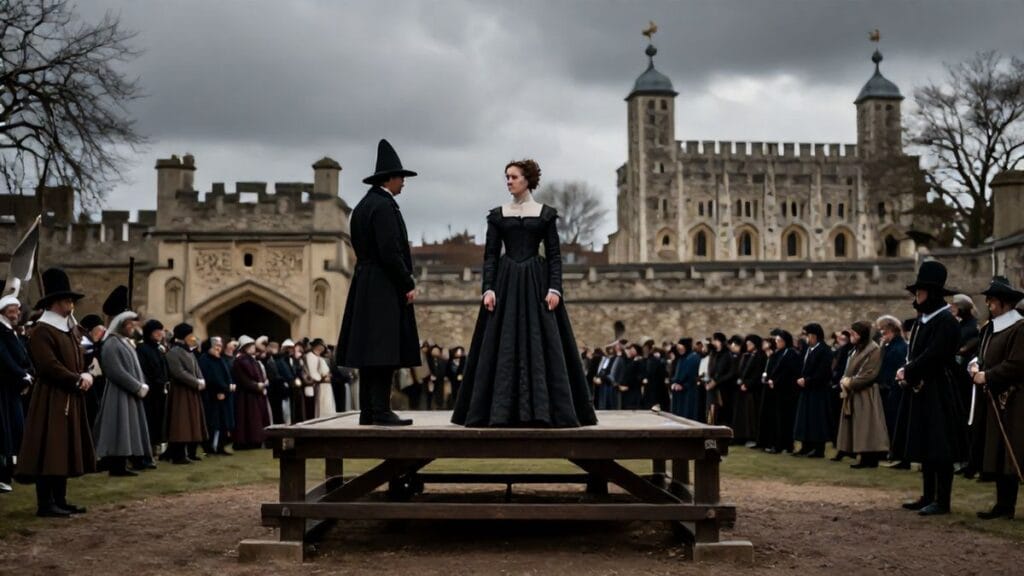
Shortly before 9 a.m., Anne’s guards escorted her out. She stepped onto the scaffold with a poise that many would later recall with awe. The swordsman from Calais stood at the ready, his weapon concealed at first so as not to unnerve her further. She would not kneel to an axe; she would stand, then kneel upright, without a block, in the French style. As she looked out at the assembled company, she saw faces that had once smiled at her in feasts and masques now set in solemn lines. It was a scene both intimate and momentous, a tiny stage on which the fate of a woman and the image of a monarchy would be simultaneously displayed.
On the Scaffold: Words, Silence, and the Sword from Calais
The scaffold, that stark geometry of wood and straw, became in those final minutes a theater for Anne’s last performance — not in pretense, but in the truest sense of presenting herself before an audience and posterity. She had been carefully coached in what she could and could not say. Any hint that she questioned the king’s justice, any protest of innocence too fierce, might rattle the carefully constructed illusion of lawful procedure. Tudor protocol required those about to die for treason to affirm their loyalty, confess their sins broadly, and commend themselves to God, without overtly challenging the Crown.
Anne complied, and yet within her compliance there was a subtle assertion of dignity. According to the chronicler Edward Hall, she began by acknowledging the law under which she was condemned, stating that she was willing to die and accusing no one of her misfortune. She spoke of the king with remarkable restraint, praising him as a “gentle prince” and asking those present to pray for him. It has puzzled generations that, at the very moment of her destruction, she chose such words. But in doing so, she protected herself in the one way still available to her: by dying as a loyal subject rather than a defiant rebel, she safeguarded her soul in the framework of the time and perhaps, she may have hoped, the future fortunes of her daughter Elizabeth.
She admitted herself a sinner in general, as every Christian must, but did not confess to the specific crimes laid against her. Her speech, brief and measured, ended with a simple request for prayer and a declaration of faith. Then, guided by the attendants, she removed her outer garments and her hood. A linen cap was placed over her hair. She knelt upright on the straw, her hands either clasped in prayer or extended in a gesture of quiet readiness, depending on the account one reads. Some said she repeated the name of Jesus softly, over and over.
The swordsman approached from behind, as was customary, to spare her the terror of seeing the weapon raised. In one vivid anecdote passed down by later writers, he called to an assistant to fetch his sword, prompting Anne to turn her head slightly in that direction; in that split second of distraction, he seized his moment, drawing the sword he had already concealed and swinging it in a single, clean arc. Whether this particular detail is accurate or embellished, all sources agree that the stroke was swift and effective. The blade flashed. Her head parted from her body, falling softly onto the scaffold, her dark hair contrasting starkly with the pale straw.
Witnesses reported a hush that followed — a strange stillness as the reality of what had just occurred registered. The execution of Anne Boleyn, for which so many legal and theological arguments had been spun, had come down in the end to this primal, physical moment: steel, flesh, silence. The queen who had once commanded Henry’s heart and the direction of a kingdom now lay motionless, her body soon to be hastily interred in an unmarked grave within the Tower chapel of St Peter ad Vincula.
The Blow That Changed a Kingdom: Immediate Aftermath of the Execution
Almost as soon as Anne’s head hit the straw, practicalities took over. Her body and head were placed in a rough arrow chest, the only container readily at hand, and carried to the nearby chapel. There, in a simple, unceremonious burial, the woman who had worn the crown of England was laid beneath the floor, without the elaborate rites that would normally attend a queen’s funeral. Her grave was not marked in any way that the public would easily recognize. In death, as in the propaganda surrounding her downfall, her status was intentionally blurred.
The Tower officials and onlookers drifted away, some with shaken hearts, others with a cold sense of duty fulfilled. Within the fortress, the residue of the morning clung to the air — the scent of fresh-cut wood, the faint metallic tang lingering in the mind more than in the nose. Outside, the news moved quickly through the city. Bells tolled in some quarters, either in mourning or simply in acknowledgment of the event. In taverns and marketplaces, people argued: had justice been done, or had a once-beloved queen been sacrificed to the king’s whims?
Henry VIII, notably, was not present at the execution. He had removed himself from the Tower, physically distancing his body from the act his will had nonetheless made inevitable. The same day, or very shortly thereafter, he rode out to visit Jane Seymour, the woman intended to replace Anne as his wife and queen. To many contemporaries, this speed was shocking. Chapuys, writing to Emperor Charles V, noted with a mix of horror and dark amusement how swiftly Henry moved from one marriage to the next, remarking that the king had “supped with the one and dined with the other,” or words to that effect in his reports.
Within days, the court’s machinery turned toward celebration and new beginnings. The memory of Anne was to be erased, or at least buried under the narrative of her supposed sins. Her badges were removed, her arms taken down. The falcon emblem she had used as queen ceased to adorn the palaces. Jane Seymour would be crowned in due course, presented as a fresh start, a model of virtue and obedience after the turbulent reign of her predecessor. The execution of Anne Boleyn, officially, had cleared away a dangerous influence and restored moral order to the royal household.
Yet under the surface, unease lingered. Nobles and commoners alike could not entirely ignore the chilling precedent: if a queen could be investigated, tried, and beheaded under such contestable claims, what protection did any subject truly have against the royal will? The sword that had ended Anne’s life also delivered a message carved into the consciousness of the nation: loyalty alone might not suffice if you stood in the path of the king’s desires.
Henry VIII Rejoices, Europe Reacts: Diplomats and Chroniclers Speak
The reaction to the execution of Anne Boleyn varied dramatically between those who moved within Henry’s orbit and observers beyond England’s shores. In Henry’s own court, outward conformity was the rule. Courtiers adjusted quickly, aligning themselves with Jane Seymour and projecting an air of relief, as if a malign influence had been lifted. Official proclamations framed Anne’s fall as a triumph of justice over corruption. Henry himself, according to several accounts, showed little public sign of grief. Instead, he appeared buoyant, as though unburdened. Within eleven days he would marry Jane, cementing the impression that Anne’s removal had been, for him, less a tragedy than a solution.
Across the Channel, however, foreign ambassadors wrote with unease and fascination. Eustace Chapuys, the imperial envoy whose letters have become one of historians’ richest sources on these events, depicted Anne as a scheming, ambitious woman but nonetheless raised implicit questions about the fairness of her trial. In one report, he relayed how swiftly Henry transferred his affections and intentions, a swiftness that alarmed even monarchs used to the hard calculations of dynastic marriage. The King of France, Francis I, and the Emperor Charles V weighed how these events might change the balance of power, the prospects for alliances, and the possibility of exploiting English instability.
Chroniclers within England also responded in varied tones. Some, like the moralizing historian Raphael Holinshed decades later, would echo the official line that Anne’s fate was a cautionary tale about pride and sexual misconduct. Others left room for doubt. The speed of the proceedings, the dubious nature of some evidence, and the odd mixture of supposed mercy and extreme violence all suggested a political execution more than a judicial one. Even among those who disliked Anne personally or opposed her religious sympathies, there was a sense that something excessive, even monstrous, had occurred.
In the longer term, the execution also complicated Henry’s own image abroad. While some rulers admired his iron control, others wondered if such volatility made him an unreliable ally. If he could so publicly destroy the wife for whom he had once risked excommunication, what might he not do to a favored minister, a diplomat, or even a treaty partner if circumstances or passions shifted? The spectacle of a queen’s beheading thus reverberated far beyond London, unsettling the diplomatic chessboard as agents reported, in hurried, almost breathless correspondences, that England’s king had once more redefined the limits of royal power.
Elizabeth Without a Mother: The Human Cost of a Political Death
Amid the grand narratives of religion and power, it is easy to overlook the small, fragile figure most deeply marked by the execution of Anne Boleyn: her daughter, Elizabeth. Not yet three years old at the time of her mother’s death, Elizabeth was far too young to understand what had happened. Yet the consequences of that sword stroke would shape the entire course of her life. Before May 1536, Elizabeth had been recognized as heiress presumptive to the throne, her legitimacy protected by the king’s declaration that his marriage to Anne was lawful and blessed. After Anne’s fall and the annulment, Elizabeth was suddenly declared illegitimate. Like her half-sister Mary before her, she was stripped of her rank as princess and demoted to the status of “Lady.”
Removed from the center of court life, placed in various households, Elizabeth grew up in an environment where her mother’s name was dangerous to speak too freely. She would have learned about Anne in fragments: a remark from a nurse, a whisper from a sympathetic lady, a document glimpsed and then taken away. As she matured into a fiercely intelligent young woman, she must have pieced together the story of how a queen — her mother — had been accused, condemned, and beheaded. The knowledge that both her parents’ marriages had ended in public disgrace or catastrophe — her father’s first union repudiated, her mother’s punished with death — cannot have failed to influence her ideas about love, marriage, and power.
When Elizabeth eventually became queen in 1558, she carried all this history like a shadow. Her famous decision never to marry, styling herself the “Virgin Queen,” can be read in many ways: as political strategy, as personal inclination, as religious imagery. Yet it is difficult not to see in it also the imprint of Anne’s fate. To bind herself to a husband would, for Elizabeth, mean potentially subjecting herself to the kind of domination and danger that had destroyed her mother. Remaining single allowed her to be both woman and sovereign, avoiding the trap that had cost Anne her life.
On a more intimate level, Elizabeth’s sporadic gestures toward rehabilitating her mother’s memory — wearing jewelry that may have belonged to Anne, appointing relatives of the Boleyn family to positions of favor, allowing subtle references to Anne’s lineage in court pageants — suggest a daughter quietly reclaiming what had been stolen. Though she never publicly denounced her father’s actions, and never initiated a full legal reversal of the charges, Elizabeth’s reign itself became, in some measure, a vindication of Anne. The child for whom Anne had struggled, prayed, and ultimately died grew up to be one of England’s greatest monarchs. In that sense, the execution of Anne Boleyn, meant to erase her, instead ensured that her bloodline would define an era.
Faith, Reform, and Fear: Religious Consequences of Anne’s Fall
Religiously, the execution of Anne Boleyn did not reverse England’s break with Rome, but it did complicate its spiritual trajectory. For reform-minded Englishmen and women, Anne had been a symbol of hope: a queen who supported vernacular scripture, who favored evangelical preachers, who represented a future in which the old ecclesiastical order would be replaced with something purer and more scriptural. Her removal left many of them anxious. Would Jane Seymour share Anne’s sympathies? Would Henry, freed from his turbulent second wife, retrench toward more conservative religious positions?
In the immediate years following Anne’s death, Henry’s religious policy remained a shifting hybrid. With Cromwell still in favor for a time, the dissolution of the monasteries continued, and reformist ideas continued to circulate. Yet the lesson many drew from the queen’s fate was not one of triumph for the gospel but of the unpredictability of royal favor. If Anne, with all her influence and evangelical allies, could be cast down, so too could any preacher or pamphleteer who fell afoul of the king’s changing moods. The climate of fear that followed her execution thus dampened some of the earlier enthusiasm for rapid religious change.
Among traditional Catholics, reactions were mixed. Some rejoiced that the woman they blamed for Henry’s break with Rome had been punished. Others, more politically astute, saw that the break itself remained intact, now resting less on Anne’s personal allure and more on Henry’s own pride and desire for sovereignty. The Pope did not regain authority over the English Church; the monasteries continued to be dismantled. Anne’s blood had not washed away the new order; it had merely shown how little sentimentality would restrain the monarch in defending and reshaping it.
Spiritually, some English observers interpreted Anne’s fall as a moral warning about the dangers of courtly ambition and sexual temptation, especially for women. Sermons and moral tales used her as an example of how God visited judgment on those who disordered the natural and social hierarchies. Yet as time passed and more people quietly doubted the fairness of her trial, such narratives had to contend with an uncomfortable possibility: that the king himself might have been the greater sinner, sacrificing an innocent to his desire for a new marriage and a male heir. Thus Anne’s death became a kind of spiritual Rorschach test, onto which different Englishmen projected their anxieties, hopes, and fears about the nature of sin, authority, and divine justice.
From Traitor to Martyr: How Memory Rewrote Anne Boleyn
History did not leave Anne Boleyn in the unmarked grave where her body had been hastily placed. Over the centuries, the memory of her life and death shifted dramatically, reshaped by changing political, religious, and cultural currents. In the immediate decades after her execution, official narratives portrayed her as a woman of questionable morals, whose alleged adultery had threatened the stability of the realm. Chronicles like Hall’s and Holinshed’s presented her fall as broadly justified, even if the details were murky.
Yet alternative memories persisted. Among some reformers, Anne was remembered with quiet reverence as a patroness of godly men and of English scripture. In the Elizabethan era, when her daughter sat on the throne, more sympathetic depictions began to emerge, albeit cautiously. Writers hinted that Anne had been badly used or falsely accused. The fact that Elizabeth’s successful reign had brought England relative stability and Protestant identity cast Anne’s earlier support for reform in a more favorable light. The mother’s supposed crimes could now be reinterpreted, if not publicly exonerated, as the tragic prelude to a noble result.
In the seventeenth and eighteenth centuries, as interest in the Tudors grew and as concepts of despotism and individual rights evolved, Anne increasingly appeared as a victim of tyranny. Historians, memoirists, and playwrights recast her less as a temptress, more as a courageous woman destroyed by a capricious king. Early modern historians like Gilbert Burnet questioned the validity of the evidence against her. Over time, the image of Anne as tragic heroine began to solidify, especially in Protestant narratives that contrasted her supposed innocence with Henry’s brutality.
The nineteenth century, with its romantic sensibilities, sealed her status as a tragic figure of passion and betrayal. Novels, paintings, and popular histories lingered on her dramatic rise and catastrophic fall. The execution of Anne Boleyn became a staple of historical imagination, rendered in lush detail on canvases and in melodramatic prose. Victorian writers, fascinated by the psychology of marriage and the limits placed on women, found in Anne’s story a potent exploration of love, ambition, and patriarchal power.
By the twentieth and twenty-first centuries, Anne had become one of the most studied women in English history. Academic historians like Eric Ives and Alison Weir sifted through the surviving documentation, challenging myths and proposing nuanced portraits that balanced her political acumen, personal flaws, and the deadly context in which she moved. Feminist scholars saw in her an early modern woman navigating — and ultimately destroyed by — a male-dominated system. Popular culture, through novels, television dramas, and films, further elevated her myth, sometimes accurizing, sometimes sensationalizing, but always returning to that scaffold in the Tower as a focal point.
Thus, the woman whom official Tudor propaganda tried to cast into disgrace has, in many ways, triumphed in memory. The execution of Anne Boleyn, once presented as an act of righteous punishment, is now widely viewed as a miscarriage of justice, a political killing masquerading as lawful retribution. In this reversal lies one of history’s quiet ironies: the regime that cut off her head could not, in the long run, keep her from becoming a symbol of resilience against arbitrary power.
Tower Hill and the Tower of London: Landscape of a Queen’s Death
The geography of Anne Boleyn’s final days is as significant as their chronology. The Tower of London, whose massive stone walls loom over the Thames, was more than a prison. It was a royal residence, an armory, a symbol of conquest dating back to William the Conqueror, and the stage of countless dramas of power. When Anne entered it in triumph for her coronation in 1533, she would have seen the same thick walls, the same looming White Tower, the same inner yards where, three years later, her scaffold would be raised.
The choice to execute her within the Tower precincts, rather than on the more exposed Tower Hill, was deliberate. Tower Hill, just beyond the fortress walls, had long been the standard site for the executions of high-ranking traitors: it allowed for large crowds and maximum public display. For Anne, the Crown chose a more controlled environment, enclosing the moment within the fortress itself. Here, on what is now called Tower Green, a small scaffold was constructed. Only selected witnesses could gather around. This did not negate the spectacle — word would spread quickly — but it allowed the government to avoid unruly crowds, heckling, or outbursts of sympathy that might have complicated the narrative.
Today, visitors to the Tower of London often seek out the spot associated with Anne’s execution, pausing before the modest memorial that marks the place where she and other notable figures, such as Catherine Howard and Lady Jane Grey, met their deaths. The chapel of St Peter ad Vincula, where Anne’s remains were interred, stands a short walk away. In the nineteenth century, during renovations, bodies were exhumed and examined; some were believed to be those of Anne and other famous victims, though exact identifications remain contested. Nonetheless, the chapel has become, in the public imagination, Anne’s final resting place, a quiet, candlelit space contrasting starkly with the bloody function it once served.
The physical proximity of these sites — the royal apartments where Anne once lodged in state, the chambers where she was imprisoned, the courtyard where the scaffold was raised, and the chapel where she was buried — compresses her story into a few hundred steps. Standing there, one can trace in minutes a journey that took her years to make: from celebrated consort to isolated prisoner to executed traitor. It is astonishing, isn’t it, how tightly the human drama can be bound to a small parcel of land? The Tower’s stones have seen the cycles of rise and fall repeat so often that Anne’s story becomes both unique and part of a larger pattern. Yet because she was a queen, and because her death was bound up with such seismic changes, her presence still seems to haunt those ancient walls with particular intensity.
The Execution of Anne Boleyn in Literature, Drama, and Film
From the moment news of the execution of Anne Boleyn spread, storytellers began to shape it into narrative. Early ballads and poems circulated, some vilifying her, others hinting at sympathy. As centuries passed, playwrights and novelists seized on her story as a perfect fusion of romance, intrigue, and tragedy. In the eighteenth century, stage dramas presented Anne as a virtuous woman ensnared by jealous rivals and a fickle king, bolstering a growing critique of despotism. The scaffold scene became a climactic moment, rich with opportunities for speeches of noble resignation and for cathartic tears.
The nineteenth century elevated this theatrical tradition. Painters like Edouard Cibot and others depicted Anne’s last moments in lush, dramatic canvases: the pale, composed queen in elegant dress, the looming executioner, the subdued yet captivated audience. Novelists embroidered the historical record with imagined dialogues and inner monologues. Writers such as Agnes Strickland, in her “Lives of the Queens of England,” blended history with a storytelling impulse, emphasizing Anne’s virtues and downplaying or disputing the evidence of her alleged crimes. These works helped recast her as a martyr of love and injustice in the popular mind.
In the twentieth century, with the rise of cinema and television, Anne’s death reached new audiences through the camera’s lens. Films like “Anne of the Thousand Days” (1969) and television series such as “The Six Wives of Henry VIII,” “The Tudors,” and adaptations of Hilary Mantel’s “Wolf Hall” each offered their own interpretation of Anne’s personality and her end. Some portray her as fiery and proud, others as more vulnerable and reflective. The execution scene, invariably, is shot with heightened emotion: the drumbeats, the hush of the crowd, the careful removal of jewelry and headgear, the final words, and the swift, shocking stroke of the sword.
These dramatizations, while sometimes departing from strict historical accuracy, have played a powerful role in cementing the idea of Anne as a sympathetic, even heroic figure. They invite viewers to stand on that scaffold with her, to feel the injustice, the fear, and the calm acceptance. At their best, they also hint at the broader political and religious stakes, showing that this was not merely a jealous husband killing an unfaithful wife, but a king eliminating a queen whose continued presence threatened to complicate his dynastic plans.
Of course, popular culture also risks simplifying a complex woman into stock roles: temptress, victim, feminist pioneer before her time. Careful historians caution against reading modern values too neatly into a sixteenth-century context. Yet even the debates sparked by these portrayals keep Anne’s story alive in public consciousness. Each new retelling is another attempt to make sense of that day in May 1536, to understand how a love that once seemed to define an era could end in such brutal finality.
What the Execution Reveals About Tudor Power and Fragility
At its core, the execution of Anne Boleyn exposes a paradox at the heart of Tudor monarchy: immense power coupled with acute fragility. Henry VIII could reorder his kingdom’s church, command the building of fleets, and dispatch armies abroad. He could summon parliaments to enshrine his will in law and could silence opposition with the threat of the scaffold. Yet his obsession with producing a male heir — a single human life that no amount of statute-making could guarantee — left him vulnerable, anxious, and prone to extreme measures.
Anne’s rise and fall trace the contours of this paradox. Her ability to captivate Henry and influence policy demonstrated the permeability of power structures at court: a relatively minor noblewoman could become queen and champion religious change. But that same permeability meant she was dispensable when her usefulness waned. Once Henry’s desire turned elsewhere and her failure to bear a surviving son became undeniable, Anne was not merely an emotional burden; she was a political liability. The same system that had allowed her to rise offered no protections when the king judged that her removal would better serve his interests.
Legally, the episodes surrounding her downfall illustrate the dangerous expansion of treason law in the Tudor era. By making words and even unexpressed intentions potentially treasonous, the Crown equipped itself with tools to criminalize almost any form of disfavor. The charges against Anne — impossible dates, coerced confessions, piling up of multiple alleged lovers — reflect a process seeking not truth but rationale. That so many powerful men cooperated, from judges to peers of the realm, also shows how deeply the culture of obedience ran. Few were willing to stand between the king and his chosen course, even at the cost of judicial integrity.
And yet, the very need to stage a trial, to collect confessions, to choreograph the execution with pretenses of mercy and solemnity, suggests that Henry and his advisors recognized limits. Raw assassination in the shadows would not suffice. They needed the appearance of justice, however flawed. The monarchy, for all its power, still depended on public narratives of legitimacy. In that sense, the scaffold became not just an instrument of fear but a platform on which royal authority and its moral claims were dramatically enacted.
Looking back from a modern vantage point, the execution of Anne Boleyn can be seen as both horrifying and instructive. It warns of the dangers when law bends entirely to the will of a single ruler, and it shows how personal obsessions can shape the destinies of nations. It also highlights the precarious position of women in systems that grant them influence through marriage yet deny them secure agency. Anne’s story, in all its complexity, remains a powerful lens through which to view the bright splendor and dark undercurrents of the early modern state.
Conclusion
On that May morning in 1536, the execution of Anne Boleyn seemed, to the men who ordered it, a decisive solution: a clean end to a troubled marriage, a removal of a divisive figure, a clearing of the path for a new queen and, they hoped, a male heir. In the short term, it worked. Anne disappeared from the stage, Jane Seymour took her place, and Henry VIII continued his reign. Yet the echo of the sword stroke refused to fade. It reverberated through political life, religious identity, family memory, and cultural imagination for centuries.
Anne’s journey from ambitious court lady to queen, from reformist patron to condemned traitor, encapsulates the turbulence of Tudor England. Her death exposes the extra-legal force hidden beneath legal forms, the brutality that lurked behind the polished rituals of monarchy. It also illuminates the resilience of human dignity: the way she carried herself at the scaffold, the composure she showed in her final speech, and the enduring achievements of her daughter Elizabeth all challenge the attempt to reduce her to the caricature her enemies desired.
Over time, historians and artists have revisited her life and death, questioning old sources, uncovering new details, and reinterpreting motives. While debates continue about her character and her role in the Reformation, few now accept that her trial was anything but deeply compromised. The execution of Anne Boleyn thus stands in the historical record as a cautionary tale about power unmoored from justice, about the perils of fusing personal passion with political and religious upheaval.
And yet, beyond caution and horror, there is also a strange, quiet legacy of hope. In the girl she left behind, in the religious transformations she helped to advance, and in the enduring fascination her story inspires, Anne Boleyn refuses to be only a victim. Her life and death continue to invite reflection on how individuals, even when crushed by the machinery of their age, can shape the world they leave behind in ways their executioners could never fully control.
FAQs
- Was Anne Boleyn legally still queen at the time of her execution?
Technically, no. Just days before her execution, Archbishop Thomas Cranmer pronounced Henry VIII’s marriage to Anne null and void, which meant that in legal terms she was no longer considered his wife or queen. However, in practice and in the perception of many contemporaries, she died as the queen who had fallen from grace, since everyone knew she had been publicly crowned and had reigned in that role. - Why was a French swordsman used instead of an English executioner with an axe?
Henry VIII ordered a specialist swordsman from Calais because execution by sword was often quicker and cleaner than by axe, which sometimes required multiple blows. This was portrayed as an act of royal mercy toward Anne, ensuring a swift death. It also distanced her execution stylistically from more routine English beheadings, marking it as an exceptional event. - Did Anne Boleyn really commit adultery and incest as charged?
Most modern historians believe the charges were fabricated or at least grossly exaggerated to justify removing her. The dates and circumstances in the indictments contain clear impossibilities, and the rapid, coordinated trials suggest a political purpose rather than a genuine search for truth. While Anne may have had enemies and engaged in flirtations typical of courtly culture, there is no credible evidence that she committed the crimes for which she was executed. - Where is Anne Boleyn buried?
Anne Boleyn was buried in the Chapel of St Peter ad Vincula within the Tower of London, close to the site of her execution. Her body and head were placed in a simple chest and interred without elaborate ceremony. Later renovations uncovered remains thought to be hers, and today a memorial slab in the chapel’s floor commemorates her among other notable victims of Tudor justice. - How did Anne’s execution affect her daughter Elizabeth’s later reign?
Elizabeth grew up marked by the knowledge that her mother had been executed for treason and that she herself had been declared illegitimate afterward. As queen, she never formally overturned Anne’s conviction, but she subtly rehabilitated her memory and elevated Boleyn relatives. Many scholars see Elizabeth’s decision not to marry as influenced by the disastrous fates of both her mother and stepmothers, and by a deep awareness of the dangers queens faced in marriage to powerful men. - Did the execution of Anne Boleyn change England’s religious direction?
Her death did not reverse the English Reformation or restore papal authority, but it removed a prominent supporter of reform from the king’s inner circle. In the short term, this made some evangelicals anxious and reinforced a climate of fear around religious expression. In the longer term, however, the structures she had helped legitimize — the royal supremacy and the break with Rome — persisted and were later consolidated under her daughter Elizabeth. - Why wasn’t Anne simply divorced or sent to a convent instead of executed?
Henry had already defied Rome to secure his marriage to Anne, declaring his previous union invalid. To admit now that his second marriage was also flawed could undermine the legal and moral arguments that had justified the break with Rome. Execution offered a more final and politically convenient solution, allowing him to portray himself as a betrayed husband and to remove not only Anne but also several courtiers considered dangerous or inconvenient. - Was the public allowed to witness Anne Boleyn’s execution?
The execution took place within the Tower of London, on what is now known as Tower Green, rather than on Tower Hill, where larger crowds could gather. Attendance was limited to a selected group of nobles, officials, and some members of the public allowed inside the precincts. This controlled setting minimized the risk of disorder or public displays of sympathy while still ensuring that news and impressions of the event would spread quickly. - How quickly did Henry VIII remarry after Anne’s death?
Henry married Jane Seymour just eleven days after Anne’s execution. Their betrothal had effectively been in place before Anne’s death, and preparations for the new marriage moved with remarkable speed. This rapid transition reinforced contemporary suspicions that Anne’s removal had been planned in tandem with the king’s pursuit of Jane as her replacement. - How do historians today view the trial and execution of Anne Boleyn?
Most historians regard the trial as deeply flawed and politically motivated, with coerced or unreliable testimony and charges tailored to secure a predetermined verdict. While interpretations of Anne’s character differ — some emphasize her ambition and sharp temper, others her courage and piety — there is broad agreement that her execution was a miscarriage of justice orchestrated to serve Henry VIII’s dynastic and personal aims.
External Resource
Internal Link
Other Resources
- Encyclopaedia Britannica – general search for the exact subject
- Google Scholar – academic search for the exact subject
- Internet Archive – digital library search for the exact subject